MCP(モデル・コンテキスト・プロトコル)仕様のリリース候補版が公開、7月28日に正式発表へ
MCP(Model Context Protocol)の 2026 年仕様リリース候補が公開され、ステートレス化や拡張機能の導入により、大規模なプロダクション環境でのスケーラビリティと運用効率が決定的に向上する。
キーポイント
プロトコルのステートレス化によるスケーリング強化
セッション管理や共有ストアが不要になり、通常の HTTP インフラ上のラウンドロビンロードバランサーで直接トラフィックを処理できるようになる。
新機能としての拡張仕様(MCP Apps と Tasks)
サーバーレンダリングされた UI を提供する「MCP Apps」と、長時間実行されるタスクを管理する「Tasks」が正式な拡張として採用される。
OAuth/OpenID Connect に準拠した認証基盤
既存の標準的な OAuth や OpenID Connect のデプロイメントと整合性が高まり、セキュリティと権限管理が強化される。
破壊的変更を含む公式な非推奨ポリシー
プロトコルの進化に伴い既存の構築物が壊れないよう、正式な非推奨(deprecation)ポリシーが策定され、2026 年 7 月 28 日に最終仕様としてリリースされる。
影響分析・編集コメントを表示
影響分析
この発表は、MCP が実験的なプロトコルから、大規模なエンタープライズ環境で運用可能な堅牢な標準へと進化することを示しています。特にステートレス化によるスケーラビリティの向上と、既存の認証基盤との統合は、AI エージェントが複雑な業務システムに安全かつ効率的に接続されるための決定的な転換点となります。
編集コメント
MCP のこのアップデートは、単なる機能追加ではなく、アーキテクチャの根本的な刷新であり、AI エージェントの実用化におけるインフラ制約を解消する画期的な一歩です。開発者は、2026 年 7 月の最終リリースに向けた移行計画を早急に策定する必要があります。
The release candidate for MCP 2026-07-28 is now available. It is the largest
revision of the protocol since launch and delivers on the
- a stateless core that scales on ordinary HTTP infrastructure
- extensions including server-rendered UIs through MCP Apps and long-running work through the Tasks extension
- authorization that aligns more closely with OAuth and OpenID Connect deployments
- a formal deprecation policy so the protocol can evolve without breaking what you’ve
built,
and many other changes.
The practical effect on a production deployment is immediate. A remote MCP
server that previously needed sticky sessions, a shared session store, and
deep packet inspection at the gateway can now run behind a plain round-robin
load balancer, route traffic on an Mcp-Method header, and let clients cache
tools/list responses for as long as the server’s ttlMs permits.
The release candidate is available today and the final specification ships on
July 28, 2026. This release contains breaking changes; see
Release Timeline and Validation for the
details.
A Stateless Protocol
The headline change is that MCP is now stateless at the protocol layer. Six
Specification Enhancement Proposals
(SEPs) work together to get there, completing the plan we laid out in
The Future of MCP Transports in
December.
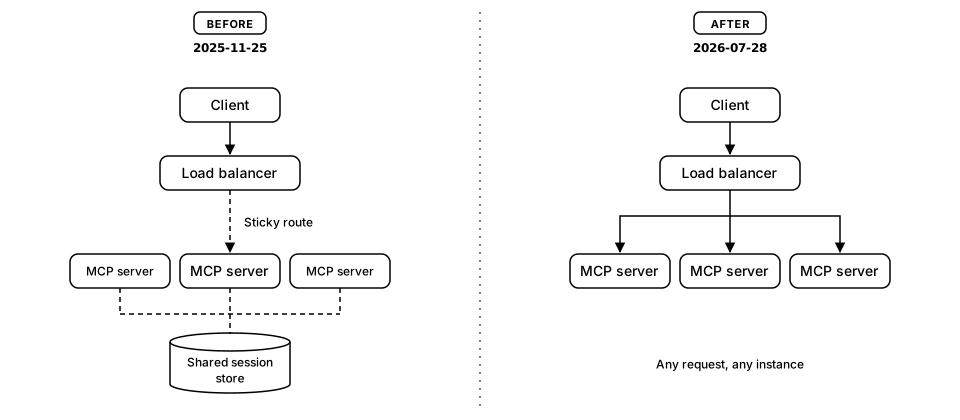
Before and after
In 2025-11-25, calling a tool over
Streamable HTTP means establishing a session first:
POST /mcp HTTP/1.1
Content-Type: application/json

{"jsonrpc":"2.0","id":1,"method":"initialize",
 "params":{"protocolVersion":"2025-11-25","capabilities":{},
           "clientInfo":{"name":"my-app","version":"1.0"}}}
The server responds with an Mcp-Session-Id that every subsequent request must
carry, pinning the client to whichever instance issued it:
POST /mcp HTTP/1.1
Mcp-Session-Id: 1868a90c-3a3f-4f5b
Content-Type: application/json

{"jsonrpc":"2.0","id":2,"method":"tools/call",
 "params":{"name":"search","arguments":{"q":"otters"}}}
In 2026-07-28, the same call is a single self-contained request that any
server instance can handle:
POST /mcp HTTP/1.1
MCP-Protocol-Version: 2026-07-28
Mcp-Method: tools/call
Mcp-Name: search
Content-Type: application/json

{"jsonrpc":"2.0","id":1,"method":"tools/call",
 "params":{"name":"search","arguments":{"q":"otters"},
           "_meta":{"io.modelcontextprotocol/clientInfo":{"name":"my-app","version":"1.0"}}}}
The handshake and session are gone
The initialize/initialized handshake is removed
(SEP-2575).
The protocol version, client info, and client capabilities that used to be
exchanged once at connection time now travel in _meta on every request, and a
new server/discover method lets clients fetch server capabilities when they
need them up front.
The Mcp-Session-Id header and the protocol-level session that came with it are
also removed
(SEP-2567).
With both gone, any MCP request can land on any server instance, and the sticky
routing and shared session stores that horizontal deployments needed before are
no longer required at the protocol layer.
Stateless protocol, stateful applications
Removing the protocol-level session does not mean your application has to be
stateless. Servers that need to carry state across calls can do what HTTP APIs
have always done: mint an explicit handle (a basket_id, a browser_id) from
a tool and have the model pass it back as an ordinary argument on later calls.
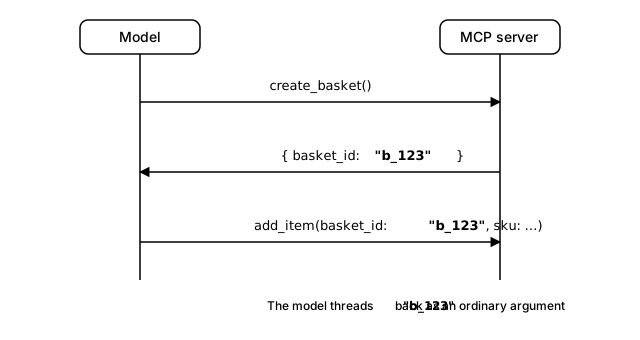
In practice, we’ve found this pattern (the model threading an identifier from
one tool call to the next) to be more than just a workable substitute for
session state. It’s often a more powerful one. The model can compose handles
across tools, reason about them, and hand them off between steps in ways that
externally managed session state, hidden in transport metadata, never really
allowed.
The protocol no longer manages that state for you, but it doesn’t prevent you
from managing it yourself. The explicit-handle pattern simply makes the state
visible to the model rather than hidden away.
Server-to-client requests, restructured
A stateless protocol still needs a way for servers to ask the client for
something mid-call, such as an elicitation prompt. Two SEPs rebuild that flow so
it works without a persistent connection.
Server-initiated requests may now only be issued while the server is actively
processing a client request
(SEP-2260).
Earlier spec versions recommended this; it’s now required. A user is never
prompted out of nowhere, and every elicitation traces back to something they (or
their agent) started.
Multi Round-Trip Requests
(SEP-2322)
change how those prompts are delivered. Instead of holding a Server-Sent Events
(SSE) stream open, the server returns an InputRequiredResult:
{
  "resultType": "inputRequired",
  "inputRequests": {
    "confirm": {
      "type": "elicitation",
      "message": "Delete 3 files?",
      "schema": { "type": "boolean" }
    }
  },
  "requestState": "eyJzdGVwIjoxLCJmaWxlcyI6WyJhIiwiYiIsImMiXX0="
}
The client gathers the answers and re-issues the original call with
inputResponses and the echoed requestState. Any server instance can pick
that retry up because everything it needs is in the payload.
Routable, cacheable, traceable
Three smaller changes make the resulting traffic easier to operate.
The Streamable HTTP transport now requires Mcp-Method and Mcp-Name headers
(SEP-2243)
so load balancers, gateways, and rate-limiters can route on the operation
without inspecting the body. Servers reject requests where the headers and body
disagree.
List and resource read results now carry ttlMs and cacheScope
(SEP-2549),
modeled on HTTP Cache-Control. Clients know exactly how long a tools/list
response is fresh and whether it’s safe to share across users, and a long-lived
SSE stream is no longer the only way to learn that a list changed.
W3C Trace Context propagation in _meta is now documented
(SEP-414),
locking down the traceparent, tracestate, and baggage key names so
distributed traces correlate across SDKs and gateways. Several SDKs and tools
were already doing this; with the key names fixed in the spec, a trace that
starts in a host application can follow a tool call through the client SDK, the
MCP server, and whatever the server calls downstream, and show up as a single
span tree in an OpenTelemetry-compatible backend.
Extensions Become First-Class
Extensions existed in the 2025-11-25 release but had no formal process behind
them.
adds that: extensions are identified by reverse-DNS IDs, negotiated through an extensions
map on client and server capabilities, live in their own ext-* repositories
with delegated maintainers, and version independently of the specification. A new
Extensions Track in the SEP process gives them a path from experimental to
official.
This release includes two official extensions.
MCP Apps: server-rendered user interfaces
(SEP-1865)
lets servers ship interactive HTML interfaces that hosts render in a sandboxed
iframe. Tools declare their UI templates ahead of time so hosts can prefetch,
cache, and security-review them before anything runs. The rendered UI talks back
to the host over the same JSON-RPC base protocol used everywhere else in MCP, so
every UI-initiated action goes through the same audit and consent path as a
direct tool call.
Tasks graduates to an extension
Tasks shipped as an experimental core feature in
Production use surfaced enough redesign that the right home for it is an
extension rather than the specification.
The Tasks extension
reshapes the lifecycle around the stateless model: a server can answer
tools/call with a task handle, and the client drives it with tasks/get,
tasks/update, and tasks/cancel. Task creation is server-directed: the client
advertises the extension and the server decides when a call should run as a
task. tasks/list is removed because it can’t be scoped safely without
sessions.
Anyone who shipped against the 2025-11-25 experimental Tasks API will need to
migrate to the new lifecycle.
Authorization Hardening
Six SEPs harden the
to align more closely with how OAuth 2.0 and OpenID Connect are deployed in
practice.
Clients must now validate the iss parameter on authorization responses per
(SEP-2468).
This is a low-cost mitigation for a class of mix-up attack that is more
prevalent in MCP’s single-client, many-server deployment pattern. In a future
version, clients will be expected to reject responses that omit iss, so
authorization servers should begin supplying it now if they don’t already.
Clients now declare their OpenID Connect application_type during Dynamic
Client Registration
(SEP-837),
avoiding the common case where an authorization server defaults a desktop or CLI
client to "web" and rejects its localhost redirect URI. Clients bind
registered credentials to the issuing authorization server’s issuer and
re-register when a resource migrates between authorization servers
(SEP-2352).
The spec also documents how to request refresh tokens from OpenID Connect-style
authorization servers
(SEP-2207),
and clarifies scope accumulation during step-up
(SEP-2350)
and the .well-known discovery suffix
(SEP-2351).
Roots, Sampling, and Logging Are Deprecated
Three core features are deprecated under the new
(SEP-2577):
FeatureReplacement
RootsTool parameters, resource URIs, or server configuration
SamplingDirect integration with LLM provider APIs
Loggingstderr for stdio transports; OpenTelemetry for structured observability
These are annotation-only deprecations. The methods, types, and capability flags
continue to work in this release and in every specification version published
within a year of it, and removing any of them will require a separate SEP under
the lifecycle policy.
Full JSON Schema 2020-12 for Tools
Tool inputSchema and outputSchema are lifted to full
(SEP-2106).
Input schemas keep the type: "object" root constraint but now allow
composition (oneOf, anyOf, allOf), conditionals, and references ($ref,
$defs). Output schemas are unrestricted, and structuredContent can now be
any JSON value rather than only an object. Implementations must not
auto-dereference external $ref URIs and should bound schema depth and
validation time.
Separately, the error code for a missing resource changes from the MCP-custom
-32002 to the JSON-RPC standard -32602 Invalid Params
(SEP-2164).
If your client matches on the literal -32002 value, update it.
How the Protocol Evolves From Here
This release contains breaking changes. We don’t intend for that to be the norm.
Three governance SEPs in this release are designed so that future revisions can
evolve the protocol without breaking core capabilities. The
gives every feature an *Active*, *Deprecated*, and *Removed* lifecycle with at least
twelve months between deprecation and the earliest possible removal. The
Extensions framework means new capabilities
can ship as opt-in extensions and stabilize there before, if ever, moving into
the specification. And a Standards Track SEP can no longer reach Final status
until a matching scenario lands in the conformance suite
(SEP-2484),
which is the same suite the new SDK tier system
scores official SDKs against.
The stateless rework in this release is the kind of foundational change that
needed a clean break. With it landed, and with deprecation windows and
extensions as the standard tools going forward, our expectation is that
implementers targeting 2026-07-28 will be able to adopt future revisions without
rewriting their transport or lifecycle code.
Release Timeline and Validation
The release candidate is locked as of May 21, 2026. The final specification
will be published on July 28, 2026. The ten-week window is for SDK
maintainers and client implementers to validate the changes against real
workloads; under the SDK tier system,
Tier 1 SDKs are expected to ship support within this window.
The full release candidate is in the
draft specification, and
the changelog
will list every change against 2025-11-25.
If you find a problem, open an issue in the
For implementation questions, the relevant
channel in the
is the fastest path to an answer.
Looking Ahead
This release gives MCP the foundation we expect it to grow on for a long time: a
protocol that runs statelessly on commodity HTTP infrastructure, an extensions
framework where capabilities like Tasks and MCP Apps can ship on their own
timeline, and a lifecycle policy that lets implementers build on 2026-07-28
knowing what they ship will keep working.
Thank you to everyone who shaped these proposals through the Working Groups and
a great deal of patient review. We’re looking forward to making this final with
the community on July 28.
関連記事
Amazon Bedrock AgentCore Runtime を用いた AWS API MCP サーバーと Amazon Quick の統合
AWS は、インフラの複雑化に対応するため、SRE や DevOps エンジニアが業務を効率化できるよう、Amazon Bedrock AgentCore Runtime を活用して AWS API MCP サーバーと Amazon Quick を統合する機能を発表した。
より賢くなったGoogle AI Edge Gallery:MCP統合、通知機能、セッション継続性の追加
GoogleはAndroid向けAIエッジギャラリーアプリにオープンソースのモデルコンテキストプロトコル(MCP)の実験的サポートを追加し、Gemma 4が外部データソースと連携して複雑なタスクを調整可能にした。これにより、より能動的で継続的なユーザー体験が可能になった。
Amazon Bedrock AgentCore Runtime でカスタム MCP プロキシサーバーをサーバーレス実行可能に
Amazon が提供する Bedrock AgentCore Runtime を利用し、Model Context Protocol(MCP)経由で AI エージェントがツールと連携する際の入力検証やガバナンスを実現するカスタムプロキシサーバーをサーバーレス環境で構築・運用できる機能を公開した。