[AINews] FrontierCode:コードの質を評価するベンチマーク「Slop」への対抗
Cognition が発表した新ベンチマーク FrontierCode は、単なるテスト通過ではなく「マージ可能なコード」の品質を評価するものであり、現在のコーディング AI ベンチが過大評価されている可能性を示唆している。
キーポイント
コード品質評価基準の転換
FrontierCode は従来の SWE-Bench のような「テスト通過」中心の評価から、回帰安全性、クリーンネス、スコープ、保守性など「マージ可能か」という実質的な品質に焦点を当てた。
ベンチマークの難易度と現実
最難関タスクでは最高性能モデルである Opus 4.8 でさえ約 13% のスコアしか得られず、コーディング AI が以前考えられていたほど「解決済み」ではないことを浮き彫りにした。
偽陽性(False Positives)の是正
METR の調査で指摘された「マージされない PR を生成する」というベンチマークの欠陥を、FrontierCode はメタプロンプトやループを含む抽象度の高い課題を通じて直接測定・解決しようとしている。
2025 年の技術的転換点
2025 年 12 月頃の急激な進歩が、アジェンティックエンジニアリングや「バイブコーディング」を可能にし、目的やループレベルでの抽象化へと移行させた背景を示している。
FrontierCode ベンチマークの厳格性
単なるユニットテスト合格ではなく、実際のマージ可能性に焦点を当てた新ベンチ「FrontierCode」により、最良モデルでも難易度が高いタスクで約 13% のスコアしか出せず、コーディングが以前考えられていたほど解決されていないことが示された。
エージェント制御におけるループの限界と人間の関与
明確な目標と検証基準を持つ反復構造が推奨される一方で、容易に検証できない領域では依然として人間によるチェックポイントが不可欠であり、「ループ」という概念への盲目的な信頼は警戒されている。
エージェント環境のインフラ整備と運用指針
隔離され検査可能な長期実行環境の需要が高まる中、スレッドの長さや文脈管理などハッシュの実装方法がモデル性能に大きく影響を与えるため、測定可能な成果と制限された自律性が重要視されている。
重要な引用
FrontierCode raises the bar on coding evals: Cognition introduced FrontierCode, a new benchmark explicitly targeting whether code is actually mergeable, not merely unit-test passing.
The headline result is that the best model, Opus 4.8, scores only about 13% on the hardest subset—far below the 50%+ regime common on SWE-Bench-style evals
There needed to be a lot more work around the rubrics for code quality and maintainability
current agent performance is still strongly shaped by harness behavior and workflow choices, not just base-model quality
benchmarks are no longer static scoreboards; they are becoming feedback loops for product and RL improvement
evaluation is expanding beyond text/code into structured artifacts where correctness is physical and geometric
影響分析・編集コメントを表示
影響分析
このニュースは、AI エンジニアリングの現場において、単にテストをパスするコード生成ではなく、実際のプロダクション環境で使える高品質なコードを生み出すことの重要性が再認識されたことを示しています。ベンチマークの評価基準が厳格化されることで、業界全体が「実用性」を重視した開発へと舵を切り、過剰な期待(Hype)から脱却する契機となるでしょう。
編集コメント
「テスト通過」から「マージ可能」へという評価軸の転換は、AI コーディングツールの実用化において極めて重要なマイルストーンです。ベンチマークの数値が下がったように見えますが、これはむしろ業界が健全な方向へ成熟した証左と言えるでしょう。
AI エンジニアワールドフェアの AI リーダーシップおよびエンジニアリング+ワークショップの第 2 弾チケットは昨夜完売しました!残り 500 枚を現在販売中、在庫限りです。この記事をご覧いただいた最初の 20 名には 20% オフの特典があります。
私たちがその日のメインストーリーに個人的に関与することは稀ですが、Apple の WWDC で Gemini を搭載した Siri が発表されたことは候補の一つでした。しかし、私たちは以前にも騙されています。そこで今回は、私たちの「スロップ(低品質なコード)との戦い」の最新作である FrontierCode をご紹介します。
このチャートがどこかで見たことがあるように感じられるのは、FrontierCode が明確に FrontierMath に着想を得て命名されたからです。2 年前、FrontierMath は最難関モデル向けの極めて困難な問題に焦点を当てた最上位階層を設定していました。
FrontierCode の背景には、私たちが SWEBench-Verified に関する過去に行ってきた仕事があります。
SWEBench Pro への移行があったにもかかわらず、2025 年に何が起こったのかについての説明が不十分であることは明らかです。そのポッドキャストで OpenAI チームと議論した通り、コードの品質や保守性に関する評価基準については、さらに多くの取り組みが必要でした。まさにこれが、Cog 研究チームがこの FrontierCode の最初のリリースで構築した内容です。
一方、METR は「SWE-bench を通過する PR の多くはメインブランチにマージされない」という発見をしました。また、FrontierCode のレポートでは、偽陽性の軌道(厳密には「報酬ハック」ではありませんが、モデルそのものよりもベンチマークの信頼性という点で精神的に類似した問題)の問題を直接測定し、対処しました。
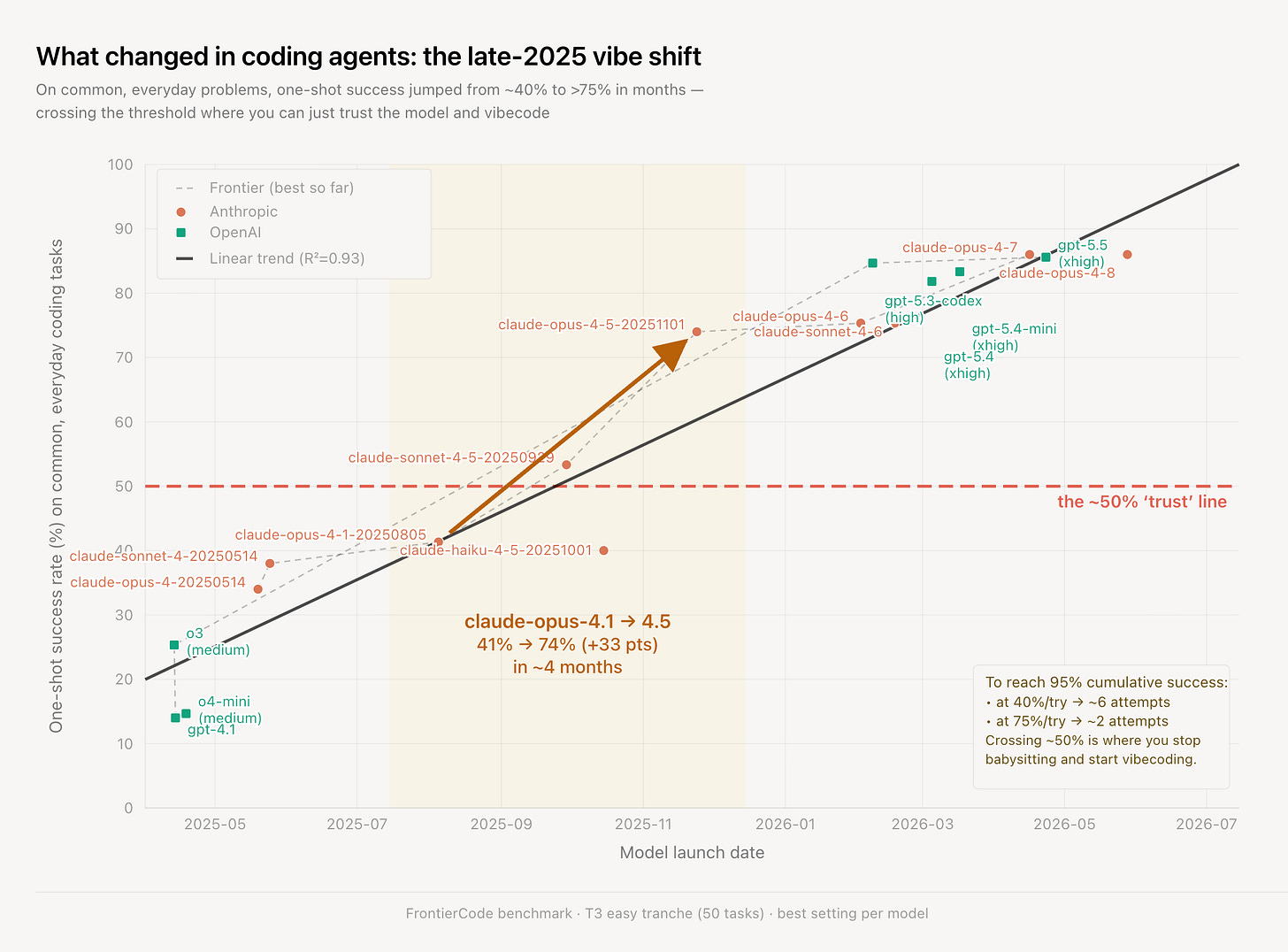
振り返ってみると、FrontierCode の第 3 レベルの問題は、2025 年 12 月にかけて劇的な加速が起き、アジェンティック・エンジニアリングやバイブコーディングが可能になり、抽象度の一段階高いレベルへと移行したことを示しています。それは今日私たちが議論している「目標(goals)」、「ループ」、「メタプロンプト」の領域です。
より詳しい文脈はこちら
2026 年 6 月 5 日〜6 月 8 日の AI ニュース。私たちは 12 のサブレッド、544 件の Twitter(X)投稿を確認し、Discord はさらに調査していません。AINews のウェブサイトでは過去のすべての号を検索できます。念のためにお伝えしますが、AINews は現在 Latent Space のセクションの一部となっています。メールの配信頻度を選択・解除することも可能です!
AI Twitter レビュー
コーディングエージェント、ループ、「テスト合格」から「マージ可能なソフトウェア」への転換
FrontierCode はコーディング評価の基準を引き上げます:Cognition が FrontierCode を導入しました。これは単にユニットテストを通過するだけでなく、コードが実際にマージ可能かどうかを明確に狙った新しいベンチマークです。タスクはオープンソースのメンテナと共に構築され、それぞれ 40 時間以上を要し、回帰安全性、クリーンさ、スコープ、テストの正確性、保守性などの次元で評価されました。注目すべき結果は、最良のモデルである Opus 4.8 でさえも、最も困難なサブセットでは約 13% のスコアしか出せないことです。これは SWE-Bench スタイルの評価で一般的に見られる 50% 以上の水準を大きく下回っており、コーディングが人気のあるベンチマークが示唆するほど「解決済み」ではないことを示しています(Cognition の発表、Scott Wu の要約、swyx の解説、theo のばらつきと再現性に関する質問、Cognition の回答)。
"ループ" が支配的なエージェント制御の比喩になりつつありますが、いくつかの注意点があります:今日の最も実践的なテーマは、コーディングエージェントにはワンショットのプロンプトではなく、明確な目標、検証基準、そして反復構造を与えるべきだという点です。人気の例としては、dzhng の「ループを使わず状態機械を設計する」、Claude Code の自動モード・ルーチン・検証に関する回顧、bcherny のスレッド、OpenAI Codex のアウトカムファーストなプロンプティングとデフォルトの承認機能に関するヒント、そして LangChain OSS の"評価基準(rubrics)"があります。しかし、いくつかの実践者は素朴なループへの過熱反応に反発しました:Omar Sar0 と Graham Neubig は、容易に検証可能な領域以外では人間のチェックポイントが依然として不可欠であると強調し、Hamel Husain はこの言葉を完全に無効化することについて冗談を言いました。
エージェントのエルゴノミクスは、検証とオーケストレーションの周りで改善されています:スタック全体にわたる製品の変更がこのシフトを反映しています。ClaudeDevs は、MCP コネクタ開発者向けの観測性ダッシュボードを追加しました。これには採用状況、レイテンシ、エラービューが含まれます。MagicPath は、外部エージェントワークフローとマルチプレイヤーキャンバス編集のための Builder プランを立ち上げました。LangSmith のサンドボックスや Modal のサンドボックススケーリングの事例は、同じインフラストラクチャのトレンドを示しています:エージェントには、隔離され、検査可能で、長時間実行可能な環境が必要です。
実用的な使用パターンが定着しつつあります:最も強力な運用者からのアドバイスは、測定可能な成果、制限された自律性、およびスレッドの衛生管理に収束しました。Angaisb_ は、Codex のスレッドが長すぎるとパフォーマンスが低下する可能性を警告しましたが、reach_vb は単一スレッドでのコンテキスト蓄積で成功を報告しています。この不一致自体が有用なシグナルです:現在のエージェントのパフォーマンスは、ベースモデルの品質だけでなく、ハネス(harness)の動作やワークフローの選択によって強く影響を受けています。
モデルリリース、ローカル推論、およびサービングスタックのアップグレード
Kimi は、より強力なコーディングエージェントとデスクトップエージェント製品を両方とも出荷しました:Moonshot は、オープンソースのコーディングエージェントである Kimi Code の主要アップデートをリリースしました。これには、1 行で CLI インストールが可能になる機能、ドラッグ&ドロップによる動画のコードコンテキスト化、ACP(Agent Communication Protocol)サポート、プラグイン、および IDE 統合が追加されました(発表)。また、最大 300 個のローカルサブエージェントを備えたデスクトップエージェント製品「Kimi Work」も立ち上げました。これは拡張機能によるブラウザ使用、財務に特化したツールアクセス、永続的なメモリ機能を特徴としています(製品発売、デスクトップ利用可能)。
Google は効率的なローカル展開に力を入れており、Gemma にはいくつかの注目すべきアップグレードが施されました。新しい QAT Gemma 4 チェックポイントは、パフォーマンスを維持しながらメモリ使用量を約 4 分の 1 に抑えることが報告されており(@_philschmid)、Gemma 4 E2B はモバイル向け量子化フォーマットを使用することで約 1GB の容量に収まります。一方、Gemma 4 MTP は llama.cpp にマージされ、QAT チェックポイントと組み合わせることでより高速なデコーディングが可能になりました(Gemma チーム)。llama.cpp ではまた動画入力サポートも追加され、ローカルでのマルチモーダル利用事例が拡大しました。
オープンソース/オープンウェイトの競争は依然として激化しています。Artificial Analysis によると、MiniMax-M3 はそのインテリジェンス指数で 55 を記録しており、ウェイトが公開されれば最も優れたオープンウェイトモデルとなるでしょう。M3 はネイティブなマルチモーダル性と 100 万トークンのコンテキストウィンドウを追加し、GPQA/MMMU-Pro における数値は強力ですが、幻覚に敏感な評価では目立つほどの拒否反応を示しています。一方、norpadon は Apple ハードウェア最適化された量子化 Qwen3.5 チェックポイントを発表しました。
サービングインフラストラクチャはテキスト LLM から世界モデルやオムニモデルへと拡大しています:vLLM-Omni 0.22.0 では、NVIDIA Cosmos 3 世界モデルの day-0 サポート、ロボットサービング API、Qwen3-TTS や VoxCPM2 などの TTS モデル、高速な画像/動画サービング、そしてより広範な量子化・ハードウェア対応が追加されました(リリース)。これはテキストのみを扱う推論スタックではなく、一般化されたマルチモーダルサービングへのより広いトレンドを反映しています。
ベンチマーク、評価手法、および実世界におけるエージェント測定
エージェント評価は、合成タスクから実世界のテレメトリへと移行しています。Arena は Agent Arena を立ち上げました。これは 100 万件以上の実世界セッションに基づくリーダーボードであり、投票ではなく因果推論(causal tracing)を用いて、オーケストレーターやハネスの介入効果を 5 つのシグナルで推定します。そのシグナルとは、確認された成功、称賛と苦情、操作可能性、Bash リカバリ、およびツールの幻覚です(概要、手法スレッド)。この方法論が完全に成立するかは今後の課題ですが、実際の使用履歴を用いて展開されたエージェントをベンチマークする試みとしては、これまでで最も明確なものの一つと言えます。
専門的なベンチマークは新たな出力ドメインへと次々と拡大しています。Hugging Face と Mecado は CADGenBench をリリースしました。これは図面や STEP 形式の修正から、エンジニアリンググレードの 3D CAD パーツを生成・編集するためのベンチマークであり、幾何学形状、トポロジー、インターフェース互換性、および CAD の妥当性をカバーする指標を備えています(発表スレッド、Thom Wolf によるサマリー)。これは意味のある転換点です。評価がテキストやコードから、正しさが物理的・幾何学的な構造化アーティファクトへと拡大しているのです。
繰り返される主張:優れたベンチマークはトレーニングパイプラインとなる。Ofir Press は、最高のベンチマークはスケーラブルであり、実世界で収集されたデータソースに根ざしており、測定のためだけでなくデータ生成にも有用であると論じました。この考え方は FrontierCode と Agent Arena の両方に暗黙的に表れています。ベンチマークはもはや静的なスコアボードではなく、製品改善や強化学習(RL)のためのフィードバックループへと進化しつつあるのです。
Google、Apple、そして消費者向け AI プラットフォームの競争
Google は AI のパッケージ化、検索、開発者向けのインターフェースを拡大しました。Google は、エージェント型チャット機能、推論能力の強化、Ultra サブスクリプションユーザー向けの出力フォーマットの増加など、より高機能な NotebookLM を発表しました(ローンチ)。また、Google AI Plus の料金を月額 7.99 ドルから 4.99 ドルに引き下げるとともに、ストレージ容量を倍の 400GB に増量しました(価格改定)。プラットフォーム面では、マルチモーダル検索や AI モードにおけるデフォルトとして Gemini 3.5 Flash を採用するなど、検索機能の大規模なアップグレードが強調されました。
Apple の WWDC における AI の物語は、最先端技術でのリーダーシップではなく、統合に焦点を当てていました。WWDC に関する議論の中心は、画面認識機能、アプリ操作、個人文脈の理解、音声対話の改善を備えた再構築された Siri AI と、EU 地域での利用可能性やハードウェアによる制限への懸念でした(kimmonismus ライブスレッド、地域限定注記)。技術的に注目すべき点として、awnihannun が指摘した内容があります。Apple のオンデバイスモデルは、20B パラメータのクエリルーティングアーキテクチャであり、各クエリごとに NAND からエキスパートを RAM へ一度読み込むという、デバイス制約に最適化された非標準的な設計である reportedly です。
研究動向:継続学習、エージェントトレーニング、および最適化に関する議論
Anthropic は、科学分野における AI の核心的な障壁をインフラの不整合として捉えています。同社の新しい科学ブログでは、AI がコーディング分野で生物学よりも急速に進展した理由は、生物学的データベースやツールがエージェント利用のために設計されていなかったからだと指摘しています。ボトルネックは純粋な知能そのものではなく、エージェントと互換性のある科学的インフラにあります(Anthropic ブログスレッド)。これは、ハブ/環境の標準化を求める広範な要請ともよく合致しています。
オープンソースの強化学習(RL)および環境プロトコルが調整の拠点となりつつあります。OpenEnv は、Hugging Face、Meta-PyTorch、Reflection、Unsloth、Modal、Prime Intellect、NVIDIA などを傘下に含むコンソーシアムに移管されました。その主張は、フロンティア研究所が緊密に結合されたハブとモデルを共同訓練する一方で、オープンなエコシステムにはモデル、ハブ、環境、トレーナーの間に共有プロトコル層が必要であるという点です。
エージェントのための継続的学習(Continual Learning)が、実用的なシステム問題として再び浮上しています。Hivemind は、Claude Code、Codex、Cursor、Hermes などのエージェントからのトレースを再利用可能なスキルに変換するシステムを発表し、様々な設定で測定可能な向上を達成したと主張しています。関連して、Nando de Freitas は、トークン列のみではなく相互作用の結果から学習するという研究プログラムを長文のスレッドで概説しました。
最適化に関する議論は異例に活発でした:複数のスレッドで、Muon が Shampoo と本質的に異なるのかについて議論が行われ、Arohan は Shampoo より優れたオプティマイザーを示唆し、Keller Jordan は公開のベンチマークで Shampoo と Spectral Descent を評価しました。このドラマの背後にある実質的な点は、最適化レベルでの改善が単なるベンチマークのノイズではなく、真のフロンティアを切り開くレバーとして再び注目されているという点です。
トップツイート(エンゲージメント順)
UK デバイススキャンに関するシグナル:最もエンゲージメントが高く技術的に関連性の高い投稿は、Signal が UK の要求するデバイス内スキャンおよび年齢確認に紐づくコンテンツ検査に反対する声明でした。これは AI よりもプライバシー・セキュリティポリシーの側面が強いですが、クライアントサイド推論やプラットフォームへの信頼という点で直接的に関連しています。
OpenAI の企業方向性と流動性:Sam Altman が OpenAI の現在の計画を共有し、直後に OpenAI は非公開で S-1 を提出したと発表しました。AI エンジニアにとっての重要な示唆は戦略的なものであり、OpenAI と Anthropic の両社が、現在キャパシティと製品の幅を広げつつも IPO の選択肢を温存しているように見える点です。
NotebookLM と FrontierCode が当日の純粋な製品・評価関連の最大の発表でした:NotebookLM のアップグレード、Kimi Code、Kimi Work、そして FrontierCode が技術的な議論を支配し、特に FrontierCode は「優れたコーディングパフォーマンス」とは何を意味すべきかという議論そのものを再構築しました。
AI Reddit まとめ
/r/LocalLlama + /r/localLLM まとめ
続きを読む
原文を表示
Second batch of AI Leadership and Engineering+Workshops tickets for AI Engineer World’s Fair sold out last night! Last 500 tickets on sale now - get while stocks last! 20% off for the first 20 readers who see this.
It is rare that we are personally involved in the title story of the day, and Apple’s WWDC announcing Gemini-powered Siri was a possible candidate, but we’ve been fooled before. So instead, we’ve got FrontierCode, the latest in our War on Slop!
If that chart looks familiar, it’s because FrontierCode was explicitly inspired and named for FrontierMath - focusing its hardest tier on extremely hard problems for frontier models 2 years ago:
The context of FrontierCode revolves around past work we have done around SWEBench-Verified.
It is clear that even with the switch to SWEBench Pro, there has been insufficient articulation around WTF Happened in 2025. As discussed with the OpenAI team in that podcast, there needed to be a lot more work around the rubrics for code quality and maintainability, and that is exactly what the Cog research team ended up building in this first release of FrontierCode.
Separately, METR found that Many SWE-bench-Passing PRs Would Not Be Merged into Main and the problem of false positive trajectories (not quite “reward hacks”, but spiritually similar in terms of the unreliability of the benchmark rather than the model) was directly measured and addressed in the FrontierCode report.
With hindsight, FrontierCode’s third tier of problems shows the huge accceleration going into Dec 2025 that suddenly made agentic engineering and vibe coding possible to go up one level of abstraction, to the /goals and loops and metaprompts we are discussing today.
more context here
AI News for 6/5/2026-6/8/2026. We checked 12 subreddits, 544 Twitters and no further Discords. AINews’ website lets you search all past issues. As a reminder, AINews is now a section of Latent Space. You can opt in/out of email frequencies!
AI Twitter Recap
Coding Agents, Loops, and the Shift from “Passing Tests” to Mergeable Software
FrontierCode raises the bar on coding evals: Cognition introduced FrontierCode, a new benchmark explicitly targeting whether code is actually mergeable, not merely unit-test passing. Tasks were built with open-source maintainers, with each taking 40+ hours and evaluated on dimensions like regression safety, cleanliness, scope, test correctness, and maintainability. The headline result is that the best model, Opus 4.8, scores only about 13% on the hardest subset—far below the 50%+ regime common on SWE-Bench-style evals, suggesting coding is much less “solved” than popular benchmarks imply (Cognition announcement, Scott Wu’s summary, swyx breakdown, theo’s questions on variance/reproducibility, Cognition response).
“Loops” are becoming the dominant agent-control metaphor—but with caveats: The day’s loudest practical theme was that coding agents should be given clear goals, verification criteria, and iteration structure rather than one-shot prompts. Popular examples include dzhng’s “don’t use loops, design state machines”, Claude Code’s retrospective on auto mode, routines, and verification, bcherny’s thread, OpenAI Codex tips on outcome-first prompting and Approve-for-me defaults, plus LangChain OSS “rubrics”. But several practitioners pushed back on naïve loop hype: Omar Sar0 and Graham Neubig emphasized that human checkpoints remain essential outside easily verifiable domains, while Hamel Husain joked about muting the word entirely.
Agent ergonomics are improving around verification and orchestration: Product changes across the stack reflect this shift. ClaudeDevs added observability dashboards for MCP connector developers, including adoption, latency, and error views. MagicPath launched a Builder plan for external-agent workflows and multiplayer canvas editing. LangSmith Sandboxes and Modal’s sandbox scaling story point toward the same infrastructure trend: agents need isolated, inspectable, long-running environments.
Practical usage patterns are settling: The strongest operator advice converged on measurable outcomes, bounded autonomy, and thread hygiene. Angaisb_ warned against overlong Codex threads degrading performance, while reach_vb reported success with single-thread context accumulation. That mismatch itself is useful signal: current agent performance is still strongly shaped by harness behavior and workflow choices, not just base-model quality.
Model Releases, Local Inference, and Serving Stack Upgrades
Kimi shipped both a stronger coding agent and a desktop agent product: Moonshot released a major update to Kimi Code, its open-source coding agent, adding one-line CLI install, drag-and-drop video as coding context, ACP support, plugins, and IDE integration (announcement). It also launched Kimi Work, a desktop agent product with up to 300 local sub-agents, browser-use via extension, finance-focused tool access, and persistent memory (product launch, desktop availability).
Google pushed hard on efficient local deployment: Gemma got several notable upgrades. New QAT Gemma 4 checkpoints reportedly preserve performance while using ~4x less memory, with Gemma 4 E2B fitting in about 1GB using a mobile quantization format (@_philschmid). Separately, Gemma 4 MTP was merged into llama.cpp, enabling faster decoding when paired with QAT checkpoints (Gemma team). llama.cpp also added video input support, expanding local multimodal use cases.
Open-source/open-weight competition remains intense: Artificial Analysis reported MiniMax-M3 at 55 on its Intelligence Index, which would make it the leading open-weights model once weights are released. M3 adds native multimodality and a 1M token context window, with strong GPQA/MMMU-Pro numbers but notable abstention on hallucination-sensitive evals. Meanwhile norpadon announced Apple-hardware-optimized quantized Qwen3.5 checkpoints.
Serving infrastructure is broadening from text LLMs to world models and omni models: vLLM-Omni 0.22.0 added day-0 support for NVIDIA Cosmos 3 world models, robot serving APIs, TTS models such as Qwen3-TTS and VoxCPM2, faster image/video serving, and broader quantization/hardware coverage (release). This reflects a broader trend toward generalized multimodal serving rather than text-only inference stacks.
Benchmarks, Evaluation Methodology, and Real-World Agent Measurement
Agent evaluation is moving from synthetic tasks to in-the-wild telemetry: Arena launched Agent Arena, a leaderboard based on over 1M real-world sessions, using causal tracing rather than voting to estimate treatment effects of orchestrators/harnesses across five signals: confirmed success, praise vs complaint, steerability, bash recovery, and tool hallucination (overview, methodology thread). Whether the methodology fully holds up remains to be seen, but it’s one of the clearest attempts yet to benchmark deployed agents using actual usage traces.
Specialized benchmarks keep proliferating into new output domains: Hugging Face and Mecado released CADGenBench, a benchmark for generating and editing engineering-grade 3D CAD parts from drawings or STEP modifications, with metrics covering geometry, topology, interface compatibility, and CAD validity (launch thread, Thom Wolf summary). This is a meaningful shift: evaluation is expanding beyond text/code into structured artifacts where correctness is physical and geometric.
A recurring thesis: good benchmarks become training pipelines: Ofir Press argued that the best benchmarks are scalable and rooted in real-world crawled data sources, making them useful not just for measurement but also for data generation. That view shows up implicitly in both FrontierCode and Agent Arena: benchmarks are no longer static scoreboards; they are becoming feedback loops for product and RL improvement.
Google, Apple, and the Consumer AI Platform Race
Google expanded AI packaging, Search, and developer surfaces: Google announced a more capable NotebookLM with agentic chat, stronger reasoning, and more output formats for Ultra subscribers (launch). It also cut Google AI Plus pricing from $7.99 to $4.99/month while doubling storage to 400GB (pricing update). On the platform side, Google highlighted a major Search upgrade, including multimodal search and Gemini 3.5 Flash as the new default in AI Mode.
Apple’s WWDC AI story centered on integration, not frontier leadership: Commentary around WWDC focused on a rebuilt Siri AI with on-screen awareness, app actions, personal context, and better voice interaction, alongside concerns about EU availability and hardware gating (kimmonismus live thread, regional limitation note). A technically notable detail came from awnihannun: Apple’s on-device model is reportedly a 20B-parameter query-routed architecture that loads experts from NAND into RAM once per query, a nonstandard design optimized for device constraints.
Research Directions: Continual Learning, Agent Training, and Optimization Debates
Anthropic framed one core blocker for AI in science as infrastructure mismatch: Its new science blog argues AI has advanced faster in coding than biology because biological databases and tooling were not designed for agent use; the bottleneck is less raw intelligence than agent-compatible scientific infrastructure (Anthropic blog thread). This pairs well with broader calls for harness/environment standardization.
Open-source RL and environment protocols are becoming coordination points: OpenEnv was transferred to a consortium including Hugging Face, Meta-PyTorch, Reflection, Unsloth, Modal, Prime Intellect, NVIDIA, and others. The pitch is that frontier labs co-train models with tightly coupled harnesses, while open ecosystems need a shared protocol layer between model, harness, environment, and trainer.
Continual learning for agents is re-emerging as a practical systems problem: Hivemind announced a system that turns traces from agents like Claude Code, Codex, Cursor, and Hermes into reusable skills, claiming measurable gains across setups. Relatedly, Nando de Freitas posted a long thread outlining a research program around learning from interaction consequences rather than token sequences alone.
Optimization discourse was unusually active: Several threads debated whether Muon is materially distinct from Shampoo, with Arohan hinting at a better-than-Shampoo optimizer and Keller Jordan benchmarking Shampoo and Spectral Descent publicly. The substantive point beneath the drama: there is renewed appetite for optimizer-level gains as a real frontier lever, not just benchmark noise.
Top Tweets (by engagement)
Signal on UK device scanning: The highest-engagement technically relevant post was Signal’s statement opposing UK demands for on-device scanning and age-verification-linked content inspection. This is more privacy/security policy than AI, but directly relevant to client-side inference and platform trust.
OpenAI corporate direction and liquidity: Sam Altman shared OpenAI’s current plan, and shortly after OpenAI announced it had confidentially filed an S-1. For AI engineers, the key implication is strategic: both OpenAI and Anthropic now appear to be preserving IPO optionality while ramping capacity and product breadth.
NotebookLM and FrontierCode were the day’s biggest pure-product/eval launches: NotebookLM’s upgrade, Kimi Code, Kimi Work, and FrontierCode dominated the technical conversation, with FrontierCode in particular reshaping the discourse around what “good coding performance” should mean.
AI Reddit Recap
/r/LocalLlama + /r/localLLM Recap
Read more
関連記事
今日のまとめ
AI日報で今日の重要ニュースをまとめ読み