Cline SDK 発表、エージェントランタイムを再構築
Cline は、IDE に密着したアーキテクチャの限界を克服するため、ランタイムと製品層を分離した「Cline SDK」を公開し、エージェントの実行環境を拡張可能で堅牢な基盤へと再構築した。
キーポイント
SDK 化によるアーキテクチャの転換
従来の VSCode 拡張機能内包型から、ランタイムを独立したプラグ可能な SDK (@cline/sdk) として抽象化し、IDE や CLI 間で共有・再利用可能にする設計へ変更された。
堅牢なエージェント実行環境の実現
UI の再起動に関係なく継続して動作する「長期間実行」や、異なるインターフェース間でのセッション移動が可能となり、ランタイムは状態を保持し再利用可能なサービスとして機能する。
ベンチマークにおける高性能の実証
Claude Opus 4.7 や GPT-5.3-Codex などの最新モデルを用いたターミナルベンチマーク(Terminal Benchmark)で、競合製品や他社エージェントを上回るスコアを記録し、ハッチの改善効果が数値化された。
オープンソースによるエコシステムの拡大
Cline 自体の開発チームだけでなく、外部チームもこの SDK を基盤に独自のエージェントやツールを構築できるよう、SDK が npm で公開されオープンソース化された。
モジュラーなアーキテクチャと拡張性
Cline SDK は単一責任を持つレイヤー構造を持ち、開発者は必要な機能(例:LLM プロバイダー層やサーバーレスループ)のみを選択してインストールできる。
プラグインによるカスタマイズとエコシステム
チームはフォークすることなくドメイン固有の振る舞いを追加でき、ローカルモジュールからパッケージ化された機能まで段階的に拡張可能なプラグインシステムが提供される。
多様なモデルとプロバイダーへの対応
Anthropic や OpenAI だけでなく、AWS Bedrock や vLLM など多数の LLM プロバイダーをサポートし、設定変更のみで簡単に切り替えが可能である。
重要な引用
The architecture that got us there was not the modular and extensible framework we would choose for what comes next.
We abstracted our core agent harness into a plugable agent sdk (@cline/sdk).
Long-running work no longer dies with a UI restart; Sessions can move across surfaces.
Cline is no longer the only place this runtime can live; it is one product built on top of the same SDK we are opening up.
Switching providers should be as easy as a config change.
No need to implement orchestration yourself.
影響分析・編集コメントを表示
影響分析
この発表は、AI エージェント開発における「IDE 依存」という従来のボトルネックを解消し、マルチプラットフォームかつ堅牢なエージェントランタイムの標準化への大きな一歩となる。特に、SDK をオープンソース化することで、Cline の技術が業界全体で再利用可能なインフラとして定着する可能性が高まり、開発者コミュニティにおけるエージェントの実装基準そのものが書き換えられる影響を持つ。
編集コメント
「エージェント」という概念が単なるマーケティング用語から、実用的なインフラへと成熟する過程を象徴する出来事です。IDE に縛られないランタイムの分離は、将来的に AI エージェントがあらゆる環境でシームレスに動作するための重要な基盤技術と言えます。

「エージェント」が流行語になる以前、Cline は本格的なコーディング支援エージェントの先駆けでした。VS Code 拡張機能として始まった Cline は、多くの開発者に AI コーディングの世界へ足を踏み入れる機会を提供しました。確かに優れた VS Code 拡張機能でしたが、技術が進化する中で私たちは痛烈な教訓を学んでいます。あの頃のアーキテクチャは、次世代のために選んだようなモジュール性や拡張性を備えたフレームワークではなかったのです。
これは、早期に参入した代償でした。
多くの初期のエージェント製品と同じく、私たちも製品の表面部分から始めました。まず拡張機能があり、ターミナル統合や PC 操作支援、サブエージェント、マルチエージェントチーム、カスタムツールなど、新たなユースケースが生まれるたびに、その中でエージェントのループが発展していきました。プロダクトは着実に能力を高めましたが、その一方でランタイムは IDE から切り離しにくくなり、最終的にはシステムの維持や拡張、埋め込み、再利用が困難になってしまいました。
そこで Cline の次のフェーズでは、パッチを追加するのではなく、基盤そのものを再構築しました。コアとなるエージェントの枠組みを抽象化し、プラグイン可能な SDK(@cline/sdk)として切り出したのです。この SDK は VS Code、JetBrains、CLI 全体で Cline を支えています。また、私たちはこの SDK をオープンソース化し、他のチームもこれを基に開発できるようにしました。自分たち自身もその恩恵を受けることになります。
npm i -g @cline/sdk
この再設計の中心にあるのは、ランタイムを単なる特定製品の機能詳細ではなく、共有サービスとして扱うように改善されたエージェント・ハネスとアーキテクチャです。この転換により、Cline がサポートできるエージェントの種類も広がりました。長時間実行されるタスクは UI の再起動で終了不再り、セッションは異なる画面間でも移動可能になります。低レベルのエージェントループはステートレスで再利用可能なままに保ちつつ、その周囲のランタイムは耐久性を持ち、移植可能となり、特定の製品に依存しないものへと進化しました。
ベストインクラスのエージェント・ハネス
Cline 2.0 では、ハネスの改善に注力しました。プロンプトの再構築、ループの簡素化、コンテキスト管理の強化、フィードバックループとエラーハンドリングの向上、そしてモデルに対してツールを定義し提示する方法の見直しを行いました。これらの成果は、アプリ固有のものではなくランタイムに実装されているため、Cline のすべての画面で享受できます。
ターミナルベンチマークスコア
フロンティアモデル
| モデル | Cline CLI | Codex CLI | Droid | Claude Code |
|---|---|---|---|---|
| claude-opus-4.7 | 74.2% | N/A | N/A | 69.4% |
| claude-opus-4.6 | 71.9% | N/A | 69.9% | 65.4% |
| gpt-5.3-codex | 73.0% | 75.1% | 77.3% | N/A |
| gemini-3.1-pro-preview | 57.3% | N/A | N/A | N/A |
| gemini-3-flash-preview | 49.4% | N/A | N/A | N/A |
注:Cline CLI のスコアは pass@1 です。N/A は、tbench.ai(Terminal-Bench 2.0)においてそのエージェントとモデルの組み合わせで公開された実行結果がないことを示します。
オープンウェイトモデル
| モデル (オープンウェイト) | Cline | OpenCode | Pi-Code |
|---|---|---|---|
| kimi-k2.6 | 55.1% | 37.1% | 45.5% |
| deepseek-v4-pro | 53.9% | 51.7% | 52.9% |
| glm-5.1 | 49.4% | 52.8% | 51.7% |
| minimax-m2.7 | 42.9% | 39.3% | 46.0% |
OpenCode や Pi-Code は、オープンウェイトモデルに関するベンチマーク数値を公開していません。今回掲載した結果は、Cline チームが 2026 年 5 月 8 日時点の最新 Cline、OpenCode CLI、PI-Code を用いて実施したもので、pass@1 スコアに基づいています。
また、内部テストでは、新しい CLI が従来のものよりも高速にタスクを完了し、トークンコストも抑えられることが確認できました。
誰でも拡張可能な安定したアーキテクチャ
エンジン部分を拡張機能から切り離すことで、Cline の役割は大きく変化しました。このランタイムが Cline 内にしか存在しないわけではありません。私たちは、同じ SDK を基盤として構築された製品の一つとして Cline を位置づけています。すでに CLI は新しい SDK アーキテクチャへ移行済みです。IDE 拡張機能についても現在移行を進めています。
Cline 2.0 は、各レイヤーが単一の責任を持ち、下位のレイヤーにのみ依存する階層型 TypeScript スタックです。
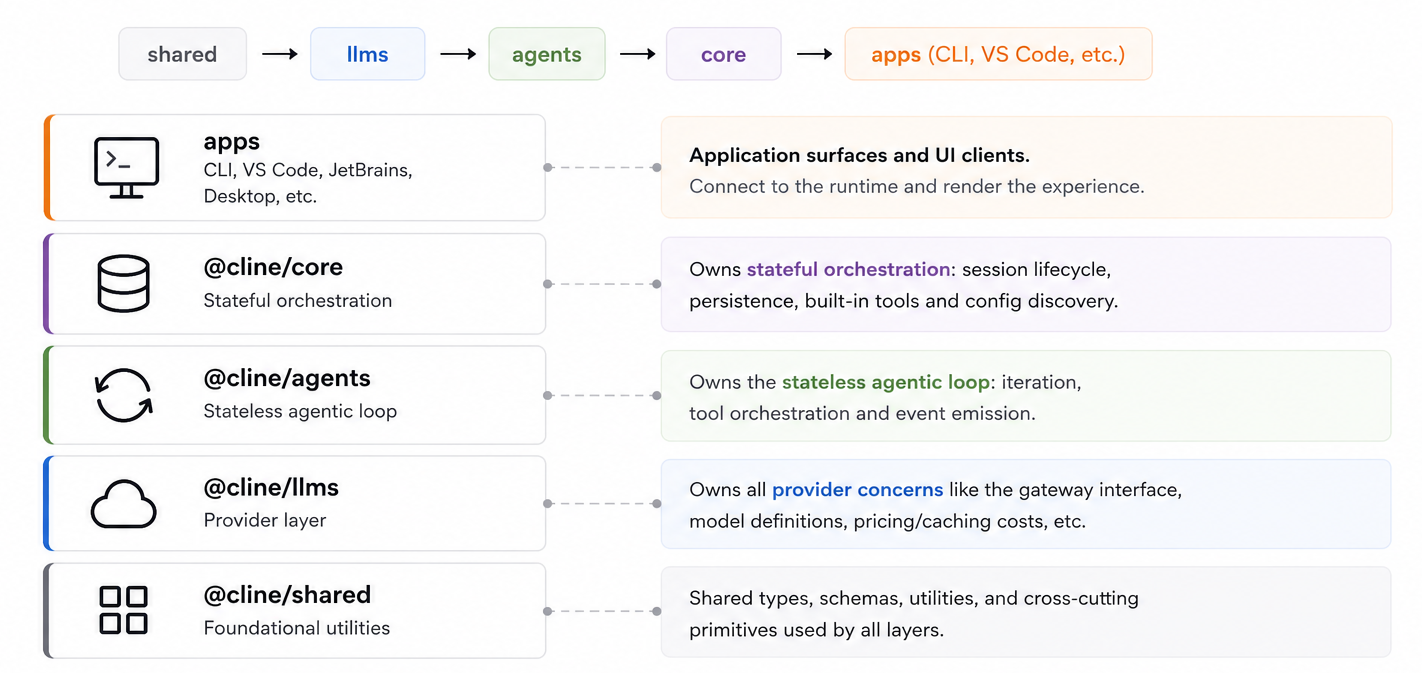
フルスタックが必要であれば @cline/sdk をインストールしてください。一方、LLM プロキシ用のプロバイダー層やサーバーレスランタイム向けのステートレスループなど、より小さな機能範囲で済ませたい場合は個別のパッケージを利用できます。このスタックは、最初は最小構成から始め、必要に応じて状態管理機能を追加できる設計になっています。
標準搭載の豊富な機能セット
ランタイムレイヤーにおけるプラグイン
プラグインを使えば、チームはランタイムをフォークすることなく、ドメイン固有の機能を追加できます。プラグインではツールの登録やライフサイクルイベントの監視、ルールやコマンドの追加、そしてエージェントが認識する情報の範囲を制御することが可能です。
プラグインは設定されたパスやワークスペース内の場所から読み込むことができます。最初はローカルの .ts または .js モジュールとして始め、後で cline.plugins マニフェストを持つパッケージディレクトリへと進化させることも可能です。これにより、チームはローカルでプロトタイプを作成し、機能を安定化させた後に再利用可能な能力をパッケージ化できます。
動作するプラグインの例は examples/plugins/ ディレクトリにあります。
プラグイン以外にも、Cline SDK ではカスタムツールや MCP、スキルなど、開発者がエージェントを簡単にカスタマイズできる他の拡張ポイントも提供しています。
任意のプロバイダーとモデルを選べる
オープンソースを核とする当社の製品では、モデルやプロバイダーを超えた「オープン・チョイス(選択肢の自由)」を実現し、開発者やユーザーに柔軟なエージェント利用を提供したいと考えています。Cline のプロバイダー層は、Anthropic、OpenAI、Google、AWS Bedrock、Mistral、LiteLLM をサポートしています。また、vLLM、Together、Fireworks などの OpenAI 互換エンドポイントにも対応しており、プロバイダーの切り替えは設定ファイルの変更だけで行えます。
プロバイダーのロジックは @cline/llms に実装されており、モデルカタログやプロバイダーの設定、ハンドラーの動作をエージェントのループから分離しています。
新しいカスタムプロバイダーを追加するには、ApiHandler を実装し、llms.registerHandler("my-provider", handler) で登録するだけです。
個別のオーケストレーション層を必要としないエージェントチーム
1 つのエージェントでは対応しきれないほど規模が大きく、あるいは曖昧さの残るタスクも存在します。Cline SDK にはネイティブでエージェントチームやサブエージェントの機能が組み込まれており、セッション内で専門家に委任したり、進捗を追跡したり、引き継ぎメモを交換したりすることが可能です。これらはすべて同じコアランタイム上で完結するため、自分でオーケストレーションを実装する必要はありません。
サブエージェントは独自のモデル、ツール、プロンプトで動作します。バンドルされたプラグインには、サブエージェントの起動やメッセージ送信、ステータス確認、引き継ぎメモの保存といった機能を提供するツールが含まれており、ゼロからオーケストレーションを構築することなく、マルチエージェントワークフローの実験が可能です。
また、当然ながら期待される機能もすべて用意されています。スケジュールされた CRON ジョブ、チェックポイント機能、Web 検索、MCP コネクタなど、必要な機能はすべて標準で提供されます。
新しい SDK を基盤に Cline を再構築
現在、700 万人以上の開発者が利用しているすべての Cline アプリケーションを、この改良された SDK ハンネスへ移行する作業を進めています。CLI とカンバン機能はすでに最新 SDK をベースに実装済みで、VS Code や JetBrains の拡張機能についても移行作業中です。
どこからでも使える Cline CLI
CLI のアップグレードに伴い、Telegram、WhatsApp、Slack など他のプラットフォームとも簡単に接続できる実験的なコネクタチャネルを導入しました。これにより、エージェントをあらゆる場所で利用可能にしています。
Cline CLI インタラクティブウィザードによるセットアップ:
cline connect
はじめに
@cline/sdk をインストールし、サンプルを試して、どこが壊れるか教えてください。Cline で開発する方々からのフィードバックを通じて、私たちはまだ学び続けています。
コードベースを読み込んでから回答するサポートボットを構築したり、依存関係を監査して PR を作成し、レビュアーを割り当てる夜間エージェントを作ったり、1 行のバグ報告からテスト済みの修正へと変換するマルチエージェントワークフローを実装したりできます。まだ作っていない IDE 統合や社内ツール、コネクタの開発も可能です。このランタイムはオープンソースです。なぜなら、利用ケースは私たちが提供する製品に限定されるべきではないからです。
SDK のインストール
npm install @cline/sdk
新しい CLI を確認
npm i -g @cline
または、エージェントに Cline SDK スキルを追加
npx skills add cline/sdk-skill
詳細なリソースは以下をご覧ください:
Cline SDK 上で構築されたアプリの例:sdk/apps/examples/
プラグインとフック、cron の例(SDK):sdk/examples
ドキュメント:docs.cline.bot/sdk
Discord:discord.gg/cline
インスピレーションについて
オリジナルの Cline は、Sonnet 3.5 と組み合わせてエージェントによるツール呼び出しを利用した初期プロジェクトの一つでした。当時としては画期的なアイデアであり、それが Cline に魔法のような体験をもたらしました。これは Claude Code や Codex が登場し、その後に続く一連のエージェントが台頭する前の話です。
私自身もこの道程で数え切れないほどの議論を交わしてきました。RAG と grep のどちらか、長いプロンプトと短いプロンプトの使い分け、どのツール呼び出しを公開するかやその方法など、コーディングエージェントそれぞれが独自の道を選んできた dozens の問いに直面しました。また、業界の進展を見守りつつ、他のオープンソースプロジェクトや最先端のコーディングエージェントからインスピレーションを得てきました。Cline 2.0 は、そうした学びとインスピレーション、失敗、そして成長を具現化したものです。
これまでの道のりで多くの皆様から学ばせていただいたことに、心より感謝申し上げます。
Cline チーム一同が、心を込めて作成しました。❤️
原文を表示
imageBefore “agents” became a buzzword, Cline was the first real agentic coding experience. Cline started with the VSCode extension and helped a generation of developers step into AI coding. It was a great VS Code extension, but as the technology evolves, it also taught us something uncomfortable: the architecture that got us there was not the modular and extensible framework we would choose for what comes next.
It was definitely the cost of being early.
We started where many early agent products did: inside the product surface itself. The extension came first, and the agent loop grew inside it as new use cases emerged: terminal integration, computer use, subagents, multi-agent teams, custom tools. The product kept getting more capable, but the runtime was becoming harder to separate from the IDE around it. Eventually, it made the system harder to maintain, extend, embed, and reuse.
So for the next phase of Cline, we rebuilt the foundation instead of adding another layer of patches. We abstracted our core agent harness into a plugable agent sdk (@cline/sdk). It powers Cline across VS Code, JetBrains, and the CLI; we are also open-sourcing the SDK so that any team can build on, including ourselves: npm i -g @cline/sdk
At the center of that redesign is the improved agent harness and architecture that treats the runtime as a shared service, not just an implementation detail of a single product. That shift changes the kinds of agents Cline can support: long-running work no longer dies with a UI restart; Sessions can move across surfaces; the low-level agent loop stays stateless and reusable, while the runtime around it becomes durable, portable, and product-agnostic.
Best-in-class agent harness
With Cline 2.0, we invested heavily into improving our harness. We rewrote the prompts, simplified the loop, tightened context management, improved feedback loops and error handling, and rethought how tools are defined and surfaced to the model. Those gains carry across every Cline surface because they live in the runtime, not the app.
Terminal Benchmark scores
Frontier models
Model
Cline CLI
Codex CLI
Droid
Claude Code
claude-opus-4.7
74.2%
N/A
N/A
69.4%
claude-opus-4.6
71.9%
N/A
69.9%
65.4%
gpt-5.3-codex
73.0%
75.1%
77.3%
N/A
gemini-3.1-pro-preview
57.3%
N/A
N/A
N/A
gemini-3-flash-preview
49.4%
N/A
N/A
N/A
Note: Cline CLI has pass@1 scores; N/A = no published run for that agent + model combination on tbench.ai (terminal-bench 2.0).
Open weights models
Model (open-weight)
Cline
OpenCode
Pi-Code
kimi-k2.6
55.1%
37.1%
45.5%
deepseek-v4-pro
53.9%
51.7%
52.9%
glm-5.1
49.4%
52.8%
51.7%
minimax-m2.7
42.9%
39.3%
46.0%
Source: Both OpenCode and Pi-Code don’t have publicly released benchmark numbers on open-weights models; These runs were performed by the Cline team with latest Cline,OpenCode CLI and PI-Code as of May 8, 2026 with pass@1 scores
We also see the new CLI complete the same tasks faster and at lower token cost than the old one in internal runs.
A stable architecture for anyone to build on
Pulling the engine out of the extension changes our role. Cline is no longer the only place this runtime can live; it is one product built on top of the same SDK we are opening up. We already migrated our CLI into the new SDK architecture. We are in the process of migrating our IDE extensions as well.
Cline 2.0 is a layered TypeScript stack. Each layer has a single responsibility and depends only on the layer beneath it.
imageInstall @cline/sdk when you want the full stack. Use the individual packages when you want a smaller surface, such as the provider layer for an LLM proxy or the stateless loop for a serverless runtime. The stack is designed so that you can start small and add the stateful runtime only when they need it.
A rich feature set out of the box
Plugins at the runtime layer
Plugins are how teams add domain-specific behavior without forking the runtime. A plugin can register tools, observe lifecycle events, add rules and commands, and shape what the agent sees.
Plugins can be loaded from configured paths or workspace locations. They can start as a local .ts or .js module and later become a package directory with a cline.plugins manifest, so teams can prototype locally and package reusable capabilities when they harden.
See working plugin examples under examples/plugins/.
Beyond plugins, Cline SDK also provides other extensible points like custom tools, MCPs, skills etc. to give developers easy mechanisms to customize their agents.
Open choice on any providers and models
Within our core of open-source, we also want to give developers and users the “open-choice” for agents across models and providers. Cline’s provider layer supports Anthropic, OpenAI, Google, AWS Bedrock, Mistral, LiteLLM, and OpenAI-compatible endpoints such as vLLM, Together, Fireworks, etc. Switching providers should be as easy as a config change.
Provider logic lives in @cline/llms, keeping model catalogs, provider settings, and handler behavior out of the agent loop.
To add a new custom provider, simply implement an ApiHandler and register it with llms.registerHandler("my-provider", handler).
Agent Teams without a separate orchestration layer
Some work is too large or too ambiguous for one single agent. The SDK includes agent teams and subagents natively, so a session can delegate to specialists, track progress, and exchange handoff notes, all inside the same core runtime. No need to implement orchestration yourself.
Subagents run with their own model, tools, and prompts The bundled plugin exposes tools for starting subagents, messaging them, reading status, and storing handoff notes, so teams can experiment with multi-agent workflows without building the orchestration from scratch.
Plus the things you'd expect
Scheduled CRON jobs, checkpointing, Web search, MCP connectors all handled natively out of the box.
Rebuilt Cline with the new SDK
We are in the process of migrating all Cline applications used by over 7m developers onto this improved SDK harness. Our CLI and kanban are already built upon the latest SDK; and we are in the process of migrating our VS Code and Jetbrains extensions.
Cline CLI available everywhere
With upgrading our CLI, we also introduced experimental connector channels to easily connect your agents with Telegram, WhatsApp, Slack and other platforms, to make your agent available everywhere.
Setup via Cline CLI interactive wizard: cline connect
Getting started
Install @cline/sdk, try the examples, and tell us what breaks. We are still learning from the people building with Cline.
Build the support bot that reads your codebase before answering. Build the nightly agent that audits dependencies, opens PRs, and assigns reviewers. Build the multi-agent workflow that turns a one-line bug report into a tested fix. Build the IDE integration, internal tool, or connector we have not built yet. The runtime is open because the use cases should not be limited to the surfaces we ship ourselves.
Install our SDK
npm install @cline/sdk
Check out our new CLI
npm i -g @cline
…or give your agent the Cline SDK skill
npx skills add cline/sdk-skill
Find more resources below:
More app examples built upon Cline SDK: sdk/apps/examples/
Plugin and hooks, cron examples on SDK: sdk/examples
Docs: docs.cline.bot/sdk
Discord: discord.gg/cline
A note on our inspirations
The original Cline was one of the first projects to use agentic tool calling with Sonnet 3.5, an idea novel for its time and what made Cline feel like magic. This was before Claude Code, Codex, and the wave of agents that followed.
We've had countless opinionated debates along the way ourselves: RAG vs. grep, long prompts vs. short ones, which tool calls to expose and how, and dozens of other questions where every coding agent has taken its own path. We’ve also seen how the industry has progressed and has drawn inspiration from other open source projects and frontier coding agents. Cline 2.0 is the manifestation of those learnings, inspirations, failures, and growth.
We're deeply grateful to everyone we've learned from along the way.
Made with ❤️ by the Cline team
関連記事
今日のまとめ
AI日報で今日の重要ニュースをまとめ読み