AI 初心者から実践者へ!無料コース 5 つ
KDnuggets は、AI の初学者を実践的なスキルを持つ人材へと成長させるための 5 つの無料オンライン講座を紹介している。
キーポイント
学習リソースの選定基準
記事は、初学者から実践家へ移行するための 5 つの厳選された無料コースを提示しており、カリキュラムの実践性を重視している。
スキルギャップの解消
理論的な知識だけでなく、実際のプロジェクトやツールを用いた学習を通じて、市場で求められる実践的スキルを習得する道筋を示している。
無料教育の重要性
高品質な AI 教育リソースが無料で入手可能であることは、参入障壁を下げる重要な要素として強調されている。
重要な引用
5 Free Courses to Go From AI Beginner to Practitioner
AI の初学者を実践的なスキルを持つ人材へと成長させるための無料オンライン講座
影響分析・編集コメントを表示
影響分析
この記事は、AI 分野への参入障壁を下げる無料学習リソースの存在を広く知らせることで、人材育成の加速に寄与する。特に初学者に対し、どこから手を付ければよいかという指針を提供することで、業界全体の人材供給拡大に間接的に貢献する。
編集コメント
AI 分野の急速な成長に伴い、初学者が実践的なスキルを身につけるための質の高い無料リソースは極めて貴重です。本記事で紹介される講座は、理論と実装のバランスが取れており、キャリア転換を目指す方にとって有益な第一歩となるでしょう。
イントロダクション
人工知能(AI)を学ぶための参入障壁はかつてないほど低くなっていますが、その反面、情報の質と量のバランスは最悪の状況にあります。週末だけで全てをマスターできると謳う数千もの「AI ブートキャンプ」が高額な受講料を要求する中、どれを選べばよいか迷ってしまうのは当然です。
しかし真実はシンプルです。2026 年において最も優れた AI 教育は、すべて無料で提供されています。実際に最先端のモデルやフレームワークを開発している組織が、その教育資料をオープンソースとして公開しているのです。
Python の基礎的な理解があり、AI プラクティショナー(実務家)への転身を望むのであれば、高額な学位取得にこだわる必要はありません。必要なものは、適切なカリキュラムだけです。
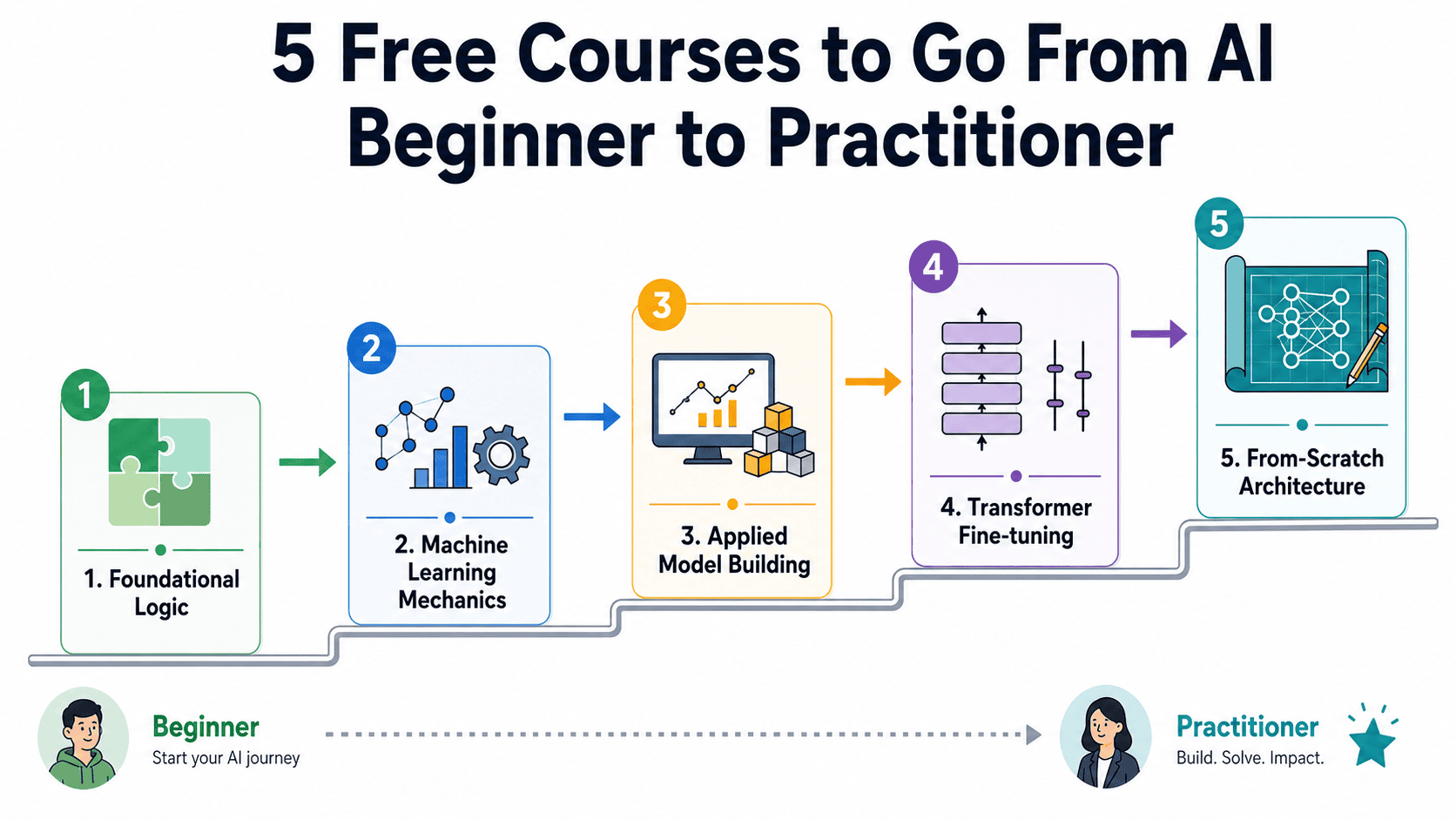
本記事では、基本的な AI アルゴリズムから始まり、ゼロから現代の大規模言語モデル(LLM)を構築するに至るまでの、順序立てられた 5 つのコースによるロードマップをご紹介します。これらはすべて無料であり、実用性が高く、業界全体で採用担当者に高く評価されていることが検証されています。
本格的な AI 教育において最初に行うべきことは、ライブラリのインストールや API の呼び出しではありません。重要なのは、AI システムがどのように問題を推論するかという「心のモデル」を構築することです。
このセクションにある 2 つのコース(リストの 1 番目と 2 番目)は、その基盤を築くものです。古典的な AI のロジックから、機械学習の中核となる数学へと段階的に進みます。独学で実践する人が最も犯しがちで、かつ技術面接でも頻繁に露呈するのが、この基礎層を飛ばしてしまうミスです。
理論が整った後は、いよいよ「ものづくり」に移ります。このセクションの 2 つのコース(リストの 3 番目と 4 番目)では、多くの学習者が最も大きな飛躍を実感します。なぜなら、単に知識を頭に入れるのではなく、実際に動くモデルを完成させてリリースするよう求められるからです。
この層を終える頃には、自分で選んだデータセット上でモデルの訓練、評価、デプロイまでを一通り行えるようになるはずです。
最後の層では、実践者がエンジニアへと成長します。フレームワークの上に構築するのは一つのスキルですが、そのフレームワークが裏側で何をしているかを理解することは、全く異なる次元の話です。
最終的なコースは、あらゆる抽象化を取り払い、第一原理からアーキテクチャを再構築するよう迫ります。このロードマップの中で最も易しい内容ではありませんが、最も本質が見える教材と言えるでしょう。
膨大なニューラルネットワークをインポートする前に、まずは人工知能の核心となるロジックを理解する必要があります。ハーバード大学の CS50 AI コース は、従来のソフトウェアエンジニアリングと機械学習をつなぐ堅牢な架け橋として機能し、AI システムが実際にどのように思考し、意思決定を行っているかに焦点を当てています。
この CS50 AI コースが特に重要な理由は以下の通りです。
- 深層学習ブーム以前から存在するグラフ探索アルゴリズム、確率論、敵対的検索といった核心概念に重点を置いています。
- タクシーゲーム(三目並べ)の AI を構築したり、論理パズルを解いたりするなど、古典的な AI 問題を Python で実際にコードを書いて解決することを求められます。
- モデルがなぜ機能するのかを理解できるため、単に API を呼び出すだけでなく、現代の機械学習を支える理論的基盤を提供します。
この CS50 の「Python とともに学ぶ人工知能入門」は、edX またはハーバード大学の OpenCourseWare プラットフォームを通じて無料で受講できます。
# 2. Google の機械学習クイックコース
基本的な AI ロジックを理解したら、次はマシンが実際にデータからどのように学習するかを学ぶ時です。Google の機械学習クイックコース は、現代の機械学習における核心となる数学とメカニズムを理解するための最速かつ最も効率的な手段です。これは Google が社内のエンジニアチームに対して実施しているのと同じカリキュラムです。
Google のクイックコースから得られる主な学びは以下の通りです。
必ず JSON 形式で返してください。translation フィールドのみ。他のフィールドは一切追加しないこと — 余計なフィールドを書こうとして本文がトークン上限で打ち切られる事故を防ぐため:
{"translation": "リライト全文"}
- 勾配降下法、損失関数、正則化といった機械学習の核心概念について、視覚的でインタラクティブなレッスンを提供します。
- TensorFlow や Keras への移行を支援し、業界標準ライブラリを用いた基本的なモデル構築方法を教えます。
- データサイエンティストが時間を最も多く費やす特徴量エンジニアリングやデータ準備に重点的に取り組んでいます。
Google の開発者ポータルから「Google Machine Learning Crash Course」に直接アクセスできます。インタラクティブなモジュールや Colab ノートブックを利用するには、登録は不要です。
# 3. fast.ai の実践的深層学習コース(Codlers向け)
多くのコースではまず数学を学び、数週間後にモデル構築に取り掛かるものです。しかし、ジェレミー・ハワードが率いる fast.ai はこのアプローチを完全に逆転させています。このコースはトップダウン型で知られており、最初のレッスンですでに最先端の深層学習モデルを実際に訓練し、その仕組みについて残りの時間で解説していく構成になっています。
なぜ fast.ai が実践家にとって究極のコースと言えるのか:
- コーダー向け設計:Python の知識があれば、すぐにコンピュータビジョン、自然言語処理(NLP)、表形式データ向けのモデル構築を開始できます。
- 実務で使えるスキルを習得可能:独自データのスクレイピング、クラウド GPU 上でのモデル訓練、Web へのデプロイなど、本番環境で即戦力となる技術を教えます。
- PyTorch ベースの fastai ライブラリを採用:世界レベルのニューラルネットワークを訓練する際に必要なボイラープレートコードを大幅に削減しています。
fast.ai のウェブサイトでは、すべての講義と Jupyter ノートブックが無料で公開されています。実践的なディープラーニングを学びたいなら、ぜひ「Practical Deep Learning for Coders」に挑戦してください。
# 4. Hugging Face NLP コース
現代の生成 AI を扱うには、トランスフォーマー(Transformer)の仕組みを理解することが不可欠です。Hugging Face はオープンソース AI の中心的なハブであり、同社が提供する公式 NLP コースは、そのエコシステムを効果的に活用するための決定版ガイドと言えます。このコースでは、NLP の基礎的な理解から始め、現在 AI アプリケーションを支えるモデルのファインチューニングまで、着実にステップアップできます。
Hugging Face のコースで得られる主な内容は以下の通りです:
- トランスフォーマーアーキテクチャの詳細解説。自己注意機構(self-attention)や、モデルがテキストをどのように処理・表現するかについて深く学びます。
- transformers ライブラリと datasets ライブラリの活用方法を実践的に学べるチュートリアル。事前学習済みモデルを取得し、特定のユースケースに合わせて適応させる手順を習得できます。
- ファインチューニングのテクニックに関する実践的な経験。オープンソースモデルを入手し、独自のプライベートデータで効率的に訓練する方法を身につけられます。
完全無料でインタラクティブな Hugging Face NLP コースは、サブスクリプション不要で同社のプラットフォーム上で直接利用可能です。
# 5. Andrej Karpathy の「Neural Networks: Zero to Hero」
まとめ
AI エンジニアになるために、数千ドルを費やす必要はありません。この 5 つのコースは順序立てて学ぶことを想定しており、それぞれの層が前の層の上に直接積み重なって構成されています。
CS50 は論理的な基礎を与え、Google のクイックスタート講座は数学的な仕組みを、fast.ai は実際に構築してリリースする経験を、Hugging Face はオープンソースのエコシステムを、そして Karpathy の講義はそのすべてを支える裏側の仕組みを教えてくれます。
この一連の学習をパートタイムで進める場合、およそ 3 か月から 5 か月かかりますが、得られる理解の深さは確固たるものです。同様の成果を得るための有料プログラムは高額なことが多く、ここで紹介されている無料のリソースほど網羅的なものはめったにありません。
まずは CS50 から始め、自分のペースで進めてください。基礎を急いで通さないことが重要です。土台がしっかりしていれば、その後のロードマップもずっと理解しやすくなります。
学習を楽しんでください!
ヴィノド・チュガニ氏は、AI とデータサイエンスの教育者であり、新興 AI 技術と実務家のための実践的な応用をつなぐ役割を果たしています。彼の専門分野は、エージェント型 AI(Agentic AI)、機械学習の活用、自動化ワークフローです。技術メンターや講師として活動する中で、ヴィノド氏はデータプロフェッショナルのスキル向上やキャリア転換を支援してきました。定量金融で培った分析力を、実践的な指導スタイルに活かしています。彼のコンテンツは、即座に業務に応用できる具体的な戦略とフレームワークに焦点を当てています。
原文を表示
**
# Introduction
The barrier to entry for learning artificial intelligence has never been lower, but the signal-to-noise ratio has never been worse. With thousands of "AI bootcamps" promising to teach you everything in a weekend for a steep fee, it's easy to get overwhelmed. The truth is, the best AI education in 2026 is entirely free. The organizations actually building the frontier models and frameworks have open-sourced their educational materials.
If you already have a basic understanding of Python and want to transition into an AI practitioner, you don't need an expensive degree. You just need the right curriculum.
In this article, we'll walk through a sequential, five-course roadmap that takes you from basic AI algorithms all the way to building modern large language models (LLMs) from scratch. These courses are verified to be free, highly practical, and respected by hiring managers across the industry.
The first step in any serious AI education isn't installing a library or calling an API. It's building a mental model for how AI systems reason about problems. The two courses in this section (the first and second in our list) establish that foundation, moving from classical AI logic to the core mathematics of machine learning. Skipping this layer is the most common mistake self-taught practitioners make, and it consistently shows up in technical interviews.
Once the theory is in place, the goal shifts to building things. The two courses in this section (courses number 3 and 4) are where most learners experience their biggest leap forward, because they force you to ship working models rather than just read about them. By the end of this layer, you should be able to train, evaluate, and deploy a model on a dataset of your own choosing.
The final layer is where practitioners become engineers. Building on top of frameworks is one skill; understanding what those frameworks are doing underneath is a different level entirely. Our final course strips away every abstraction and forces you to reconstruct the architecture from first principles. It's not the easiest material in this roadmap, but it's the most clarifying.
# 1. Harvard's CS50: Introduction to AI with Python
Before you start importing massive neural networks, you need to understand the core logic of artificial intelligence. Harvard's CS50 AI course** provides a well-constructed bridge between standard software engineering and machine learning, focusing heavily on how AI systems actually think and make decisions.
Here's what makes the CS50 AI course essential:
- Focuses on the core concepts that pre-date the deep learning boom, such as graph search algorithms, probability, and adversarial search.
- Requires you to write actual Python code to solve classic AI problems, like building an AI to play tic-tac-toe or solve logic puzzles.
- Lays the theoretical groundwork for modern machine learning, ensuring you understand why a model works, not just how to call it via an API.
You can audit CS50's Introduction to AI with Python for free on edX or directly through Harvard's OpenCourseWare platform.
# 2. Google's Machine Learning Crash Course
**
Once you understand basic AI logic, it's time to learn how machines actually learn from data. Google's Machine Learning Crash Course** is the fastest, most efficient way to understand the core mathematics and mechanics of modern machine learning. It's the exact same course Google uses to upskill its internal engineering teams.
Key takeaways from Google's crash course:
- Provides highly visual, interactive lessons on core machine learning concepts like gradient descent, loss functions, and regularization.
- Transitions you into TensorFlow and Keras, teaching you how to build basic models using industry-standard libraries.
- Focuses heavily on feature engineering and data preparation, which is where practicing data scientists spend the majority of their time.
Access the Google Machine Learning Crash Course directly on their developer portal. No sign-up is required to access the interactive modules and Colab notebooks.
# 3. fast.ai's Practical Deep Learning for Coders
**
Most courses teach you the math first and let you build a model weeks later. Jeremy Howard's fast.ai flips this entirely. This course is well known for its top-down approach, having you train a state-of-the-art deep learning model in the very first lesson, then spending the rest of the course explaining how it works.
Why fast.ai is the ultimate practitioner's course:
- Designed for coders: if you know Python, you can immediately start building computer vision, natural language processing (NLP), and tabular data models.
- Teaches practical, production-ready skills, including how to scrape your own datasets, train models on cloud GPUs, and deploy them to the web.
- Uses the PyTorch-based fastai library, significantly reducing the boilerplate code required to train world-class neural networks.
Dive into Practical Deep Learning for Coders on the fast.ai website, where all lectures and Jupyter notebooks are completely free.
# 4. The Hugging Face NLP Course
If you want to work with modern generative AI, you need to understand Transformers. Hugging Face** is the central hub for open-source AI, and their official NLP course is the definitive guide to using their ecosystem. It takes you from a working understanding of NLP directly into fine-tuning the models powering today's AI applications.
What you'll get from the Hugging Face course:
- A deep dive into the Transformer architecture, explaining self-attention mechanisms and how models process and represent text.
- Hands-on tutorials on using the transformers and datasets libraries to pull pre-trained models and adapt them to your specific use case.
- Practical experience with fine-tuning techniques, enabling you to take an open-source model and train it on your own private data efficiently.
The completely free and interactive Hugging Face NLP Course is available directly on their platform, with no subscription required.
# 5. ndrej Karpathy's Neural Networks: Zero to Hero
**
To truly move from beginner to high-level practitioner, you need to strip away the frameworks and build the architecture yourself. Andrej Karpathy**, former Director of AI at Tesla and founding member of OpenAI, created this series to teach you how to build a neural network and eventually a Generative Pre-trained Transformer (GPT) level LLM completely from scratch.
Why this series stands apart:
- You'll write the backpropagation algorithm from scratch, ensuring you permanently understand the calculus that makes deep learning possible.
- It builds up to creating a scaled-down version of the GPT architecture, writing every single line of code live on screen with detailed explanations at each step.
- It bridges the gap between high-level library usage and the low-level optimizations required for serious AI engineering, making you a far more effective debugger and researcher.
Dedicate a few weekends to the Neural Networks: Zero to Hero playlist on YouTube. It's arguably the most valuable free AI content available today.
# Wrapping Up
**
You don't need to spend thousands of dollars to become a proficient AI engineer. This five-course sequence is designed to be followed in order, with each layer building directly on the one before it. CS50 gives you the logical foundation. Google's crash course gives you the mathematical mechanics. fast.ai gets you building and shipping. Hugging Face puts the open-source ecosystem in your hands. Karpathy shows you what's happening underneath all of it.
The full sequence takes roughly three to five months for someone studying part-time, but the depth of understanding it produces is solid. Most paid programs charge a significant amount for a similar outcome, and few of them are more thorough than what's linked here for free.
Start with CS50, work through it at your own pace, and don't rush the foundations. The rest of the roadmap will make a lot more sense when you do.
Happy learning!
Vinod Chugani** is an AI and data science educator who bridges the gap between emerging AI technologies and practical application for working professionals. His focus areas include agentic AI, machine learning applications, and automation workflows. Through his work as a technical mentor and instructor, Vinod has supported data professionals through skill development and career transitions. He brings analytical expertise from quantitative finance to his hands-on teaching approach. His content emphasizes actionable strategies and frameworks that professionals can apply immediately.
関連記事
今日のまとめ
AI日報で今日の重要ニュースをまとめ読み