2026 年のデータエンジニアリング向け Python ライブラリトップ 10
KDnuggets は、データエンジニアリングの主要な時間消費領域に焦点を当てた 2026 年版の Python ライブラリトップ 10 を紹介し、特に Prefect のようなモダンなオーケストレーションツールの実用性を強調している。
キーポイント
データエンジニアリングの課題と分類
データパイプラインはより高速で信頼性が高く、維持が容易であることが求められており、記事はこれを解決するためのツールをオーケストレーション、インgestion、品質管理、ストレージの 4 つの領域に分類している。
Prefect のモダンなオーケストレーション
Prefect は、複雑なインフラ設定なしで Python 関数をデコレーターとして使用してパイプラインを定義・監視できる現代的なライブラリであり、自動リトライやキャッシュ機能を標準搭載している。
学習リソースの提供
各推奨ライブラリについて、読者がすぐに実践に移れるよう具体的な学習リソースへのリンクが提示されており、ツールの選定から実装までのスピードを重視している。
Prefect の特徴
Python 関数をデコレータでパイプラインコンポーネントに変換し、UI を介してリアルタイムに監視・障害診断が可能。
SQLMesh の機能
モデルの完全なリンケージとセマンティクスを理解し、変更後に再構築が必要なモデルのみを特定する。
dltによるスキーマ自動管理とインクリメンタル処理
dlt はデータソースの変化に応じてスキーマを自動的に生成・進化させ、重複排除やマージ戦略を含む増分ロード機能を備えています。
Bytewax のネイティブ Python によるストリーム処理
Rust で構築された Bytewax は、純粋な Python で状態管理付きのデータフローを定義でき、ウィンドウ処理や障害回復機能を標準で提供します。
重要な引用
"Data engineering has never been more demanding. Pipelines are expected to be faster, more reliable, and easier to maintain — all while the volume and variety of data keeps growing."
"Prefect is a modern workflow orchestration library that makes it easy to define, schedule, and observe data pipelines in pure Python, without heavy infrastructure setup."
Prefect is a modern workflow orchestration library that makes it easy to define, schedule, and observe data pipelines in pure Python, without heavy infrastructure setup.
SQLMesh is an open-source data transformation framework that extends the ideas behind dbt with semantic understanding of your models and true CI/CD for SQL pipelines.
Building connectors and ingestion scripts from scratch is repetitive work.
Bytewax Quickstart in the official docs builds a complete streaming pipeline in under fifty lines of Python.
影響分析・編集コメントを表示
影響分析
この記事は、データエンジニアリングの現場におけるツールの選定基準を「機能の多さ」から「業務フローへの適合性」という観点へシフトさせる示唆を与えています。特に、インフラ依存度の低いモダンなオーケストレーションツールの台頭は、開発者の生産性向上とパイプラインの敏捷化に直結する重要なトレンドを示しており、エンジニアリングスタックの刷新を検討する組織にとって有益な指針となります。
編集コメント
2026 年の展望を掲げつつ、現時点で即戦力となる具体的なライブラリ(特に Prefect)の選定基準を明確に示した実用的な記事です。
 image**
# イントロダクション
データエンジニアリングはかつてないほど要求が高まっています。パイプラインはより高速で、より信頼性が高く、メンテナンスが容易であることが求められていますが、その一方でデータの量と多様性は増え続けています。多くのデータエンジニアにはお気に入りのスタックがありますが、Pythonエコシステムは従来の定番ツールを超えて大きく拡大しており、この仕事に最も有用なツールの一部はまだ注目を集めていません。
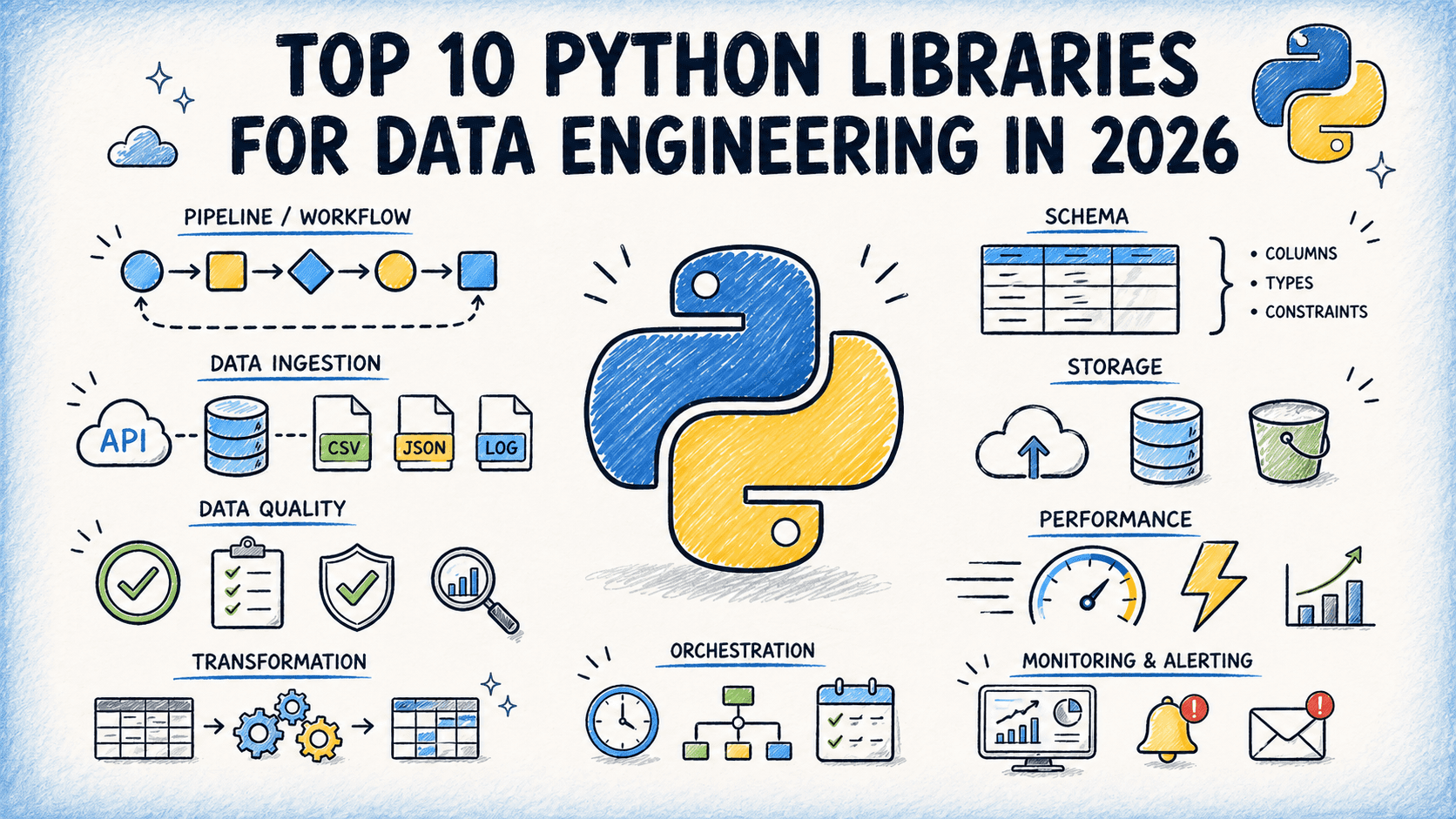
この記事では、データエンジニアリングの作業で時間を最も多く消費する 4 つの領域を中心に整理された Python ライブラリを紹介していきます:
- 信頼性の高い観測可能なデータフローを構築するためのパイプラインオーケストレーションとワークフロー管理
- 多様なソースに効率的に接続するためのデータ取り込みとフォーマット処理
- パイプラインの整合性を保つためのデータ品質とスキーマ管理
- データを高速で移動し、賢く保存するためのストレージ、シリアライゼーション、およびパフォーマンス
各ライブラリには学習リソースも案内しますので、読んだらすぐに構築に移れるようにします。現在のスタックの使いにくい部分を置き換えたい場合や、他にどんなツールがあるか単に好奇心を持っている場合でも、これらのいくつかがお気に入りのツールの一つになることを願っています。
# パイプラインオーケストレーションとワークフロー管理
// 1. Prefect を用いたスケジューリングとパイプラインの監視
オーケストレーターが邪魔をするとき、データパイプラインのスケジューリングと監視は苦痛を伴います。Prefect** は、重厚なインフラセットアップなしで、純粋な Python でデータパイプラインを定義・スケジュール・観測することを容易にするモダンなワークフローオーケストレーションライブラリです。
Prefect が有用である理由となる機能のリストは以下の通りです:
- 通常の Python 関数をデコレータで装飾するだけで、最小限のボイラープレートで観測可能かつ再試行可能なパイプラインコンポーネントに変換できます
- 別データベースやクラスターのセットアップを必要とせず、実行状況の監視、ログの検査、障害のリアルタイム診断を行うためのクリーンな UI を提供します
- カスタムロジックを書く前に生産環境のほとんどをカバーするよう、自動再試行、キャッシュ、並列処理制限、パラメータ化を標準でサポートしています
Prefect Foundations | Learn Prefect では、Prefect を用いてワークフローのオーケストレーションを開始するために必要なすべてが網羅されています。
// 2. SQLMesh を用いた環境間での安全な SQL 変換管理
SQL 変換の管理、テスト、および環境間への安全な変更デプロイは、データエンジニアリングにおいて最も厄介な部分の一つです。SQLMesh は、モデルに対する意味的理解と SQL パイプラインのための真の CI/CD を提供することで dbt の背後にあるアイデアを拡張したオープンソースのデータ変換フレームワークです。
SQLMesh が提供する機能は以下の通りです:
- 変換 DAG の完全な系譜と意味論を理解し、変更後にどのモデルを再構築する必要があるかを正確に判断して、すべてを再実行する必要をなくします
- モデル用の仮想環境をサポートしているため、生産データのサブセット上で変更を検証でき、テーブル全体のコピーや稼働中のパイプラインの停止を回避できます
- DuckDB、Spark、BigQuery、Snowflake、Trino など複数の実行エンジンで動作します
SQLMesh クイックスタートガイド では、ゼロからマルチ環境変換プロジェクトを設定する方法を順を追って解説しています。
# データ取り込みとフォーマット処理
// 3. dlt を用いたコネクタ不要なデータ取り込みの構築
コネクタや取り込みスクリプトを一から作成するのは反復作業になりがちです。dlt (data load tool) は、非常に少ないコードで任意のソースから任意の宛先へデータ取り込みパイプラインを構築できるオープンソースの Python ライブラリです。
dlt を検討する価値がある主な機能:
- データからスキーマを自動生成し、アップストリームのソースが変更された場合にも自動的に進化します
- インクリメンタル読み込み、重複排除、マージ戦略を処理します
- Python コード数行でプラグインできる、検証済みのソースと宛先のライブラリが徐々に充実しています
公式ドキュメントの dlt 入門 では、最初の取り込みパイプラインの構築方法を順を追って解説しています。
// 4. Bytewax を用いたリアルタイムストリームの処理
Python でリアルタイムデータ処理パイプラインを構築する場合、通常は重厚な Flink または Spark Streaming のセットアップを行うか、低レベルの Kafka コンシューマーループを書くことになります。Bytewax は Rust 上に構築された Python ストリーム処理フレームワークであり、クリーンでネイティブな Python API を備えたデータフロープログラミングモデルをストリーミングパイプラインに持ち込みます。
Bytewax が有用である理由となる機能:
- 関数型データフロー API を使用して、純粋な Python で状態保持型のストリーム処理ロジックを定義する
- ウィンドウ処理、状態保持演算子、障害からの回復機能を標準でサポートしており、最も一般的なリアルタイム集計およびエンリッチメントパターンを網羅している
- Kafka および Redpanda を入出力コネクタとして統合しており、Python ネイティブのストリーム処理を望むチームにとって Flink の実用的な軽量代替手段となっている
公式ドキュメントにある Bytewax Quickstart では、50 行未満の Python コードで完全なストリーミングパイプラインを構築できます。
// 5. PySpark を用いた分散型大規模バッチ処理のスケーリング
データセットが単一のマシンで扱える範囲を超えた場合、分散実行エンジンが必要となります。PySpark は、クラスター間での大規模なバッチおよびストリーミングデータ処理の業界標準フレームワークである Apache Spark の Python API です。
大規模スケールにおいて PySpark が不可欠となる機能:
- クラスター全体に計算を自動的に分散する
- パーティション間で遅延実行を行いながら pandas の慣習に似た DataFrame API を提供し、コードよりもクエリ記述を好むチーム向けに SQL インターフェースも用意している
- HDFS、S3、Delta Lake、Hive、Kafka といった広範な Hadoop およびクラウドエコシステムと統合されており、既存のデータインフラを持つ組織にとって自然な選択肢となる
公式ドキュメントにある PySpark Getting Started Tutorial は、分散プログラミングモデルを理解するための最も明確な入り口である。
# データ品質とスキーマ管理
// 6. Great Expectations を用いたパイプラインの検証とデータドキュメントの生成
本番環境に漏れ込んでしまうデータ品質の問題はデバッグが難しく、修正コストも高い。Great Expectations は、パイプライン全体でデータ品質ルールを定義・文書化・検証するための Python ライブラリである。
Great Expectations が提供する主な機能:
expect_column_values_to_not_be_nullのように人間が読みやすい「期待値(エクスペクテーション)」を記述でき、これらはデータセットのテストとドキュメントの両方の役割を果たす- 期待値スイートからデータドキュメントを自動生成し、コードを読むことなくステークホルダーにデータ品質の可視性を提供する
- Airflow、Prefect、Spark、SQL ベースのデータウェアハウスと統合可能で、パイプラインのあらゆる段階に検証チェックポイントを埋め込むことができる
Quickstart | Great Expectations と Create Expectations は、公式ドキュメントにおいて最初の期待値スイートを実行するための有用なリソースです。
// 7. Pandera を用いた関数レベルでのスキーマ強制
パイプライン内で問題が波及する前にスキーマ違反を検出することは、下流で破損したデータをデバッグするよりもはるかに安価です。Pandera は、統計的なデータ検証ライブラリであり、pandas および Polars の DataFrames に対して型ヒントとスキーマ強制機能をもたらします。
Pandera が有用である理由となる機能:
- 各列に対する期待されるデータ型、値の範囲、null 許容性、および統計的性質を指定するスキーマを定義し、ランタイムで DataFrames をそれらに対して検証できます
- Python の型注釈と統合されているため、
check_typesデコレータを使用して関数の引数および戻り値のチェックとしてスキーマを強制でき、変換ロジックのすぐそばに検証を配置することが可能です - pandas や Polars だけでなく Spark や Dask とも連携するため、同じパイプライン内で異なる実行エンジン間でも同一のスキーマ定義を再利用できます
Arjan Codes による How to Use Pandas With Pandera to Validate Your Data in Python は、スキーマ定義と検証パターンを明確に解説しています。
# ストレージ、シリアライゼーション、およびパフォーマンス
// 8. DuckDB を用いたインプロセス分析クエリの実行
データウェアハウスを起動せずに大規模ファイルに対して分析クエリを実行するのは、遅く、かつ扱いにくいものです。DuckDB は、Python 内部から直接 Parquet、CSV、JSON ファイルに対して高速な OLAP クエリ(Online Analytical Processing:オンライントランザクション処理)を実行するインプロセス型分析データベースです。
DuckDB が役立つ機能は以下の通りです:
- データを別のシステムに読み込むことなく、ローカルファイルやリモートオブジェクトストレージに対して直接 SQL を実行するため、軽量な ETL(Extract, Transform, Load:抽出・変換・ロード)や探索的データ分析に最適です。
- pandas や Arrow とネイティブに統合されているため、クエリ結果が即座に DataFrames に格納され、メモリがコピーされるのではなく共有されます。
Python プロセス内に埋め込まれて実行され、サーバー設定が不要であるにもかかわらず、pandas がメモリ上で扱える規模を遥かに超えるデータセットにもスケーラブルです。
DuckDB Tutorial for Beginners: Installation to First Query や A Guide to Data Analysis in Python with DuckDB は、DuckDB が現代のデータスタックにどのように組み込まれるかを示す優れた実践的な入門資料です。
// 9. Polars を用いた高パフォーマンスな DataFrames の変換
pandas は便利ですが、スケールするにつれてすぐに限界に達します。Polars は Rust で書かれた DataFrame ライブラリであり、ほとんどの変換ワークロードにおいて pandas よりも高速に動作し、クリーンな API と真のマルチスレッディング(並列処理)を提供します。
Polars が際立つ機能は以下の通りです:
- デフォルトですべての利用可能な CPU コアに対して並列実行を行い、追加の設定は不要
- LazyFrame を介した遅延評価をサポートし、Polars はデータベースエンジン内のクエリプランナーと同様に、実行前に全体のクエリ計画を最適化できる
- ストリーミング実行により RAM よりも大きなデータセットを処理可能で、Spark に頼らず中規模 ETL のための実用的な pandas 代替手段となる
Python Polars: A Lightning-Fast DataFrame Library および Pandas vs. Polars: A Complete Comparison of Syntax, Speed, and Memory では、API の使用方法とパフォーマンス特性について解説されています。
// 10. Ibis を用いたバックエンド非依存のデータ変換
バックエンド固有の SQL を記述したり、異なる環境間で pandas と PySpark を切り替えたりすることは、移植性が低く壊れやすいコードを生み出します。Ibis は、BigQuery、Snowflake、DuckDB、Spark、Postgres など 20 以上のバックエンドに対して同じ式コードを SQL にコンパイルする Python データフレームライブラリです。
Ibis が有用である理由:
- バックエンドに関わらず、データ変換のために単一の統一された Python API を提供します。SQL 方言の扱いに悩む必要はありません
- レーゼ評価(lazy evaluation)を採用しているため、式はバックエンドエンジンでコンパイル・実行され、データを Python に取り込むことなく大規模な変換を効率的に行えます
- 必要な場合はバックエンド固有の SQL に切り替えることができるため、抽象化の制限によって作業が止まることはありません
公式チュートリアルの 10 minutes to Ibis が、すぐに始められる最速の方法です。
# まとめ
**
これらの Python ライブラリは、データエンジニアリングの現場で直面する現実的な課題に対応しています。要約すると、ワークフローのオーケストレーション、多様なソースからのデータ取り込み、データ品質の強制、高速な分析クエリの実行、そして環境間での安全な変換管理に役立つライブラリを紹介しました。
LIBRARY
PRIMARY USE CASE
BEST FOR
Prefect
ワークフローオーケストレーション
スケジューリング、リトライ、パイプライン実行の監視
SQLMesh
SQL 変換管理
SQL モデルのための安全なデプロイと環境分離
dlt
データ取り込み
最小限のコードでソースから宛先までのパイプライン構築
Bytewax
ストリーム処理
Python で Kafka/Redpanda 上で動作するリアルタイム・ステートフルパイプライン
PySpark
分散バッチ処理
クラスター間でのペタバイト規模の ETL と変換
Great Expectations
パイプラインデータ検証
データ品質ルールの記述、ドキュメント化、レポート作成
Pandera
スキーマ強制
変換コード内でデータフレームスキーマを検証する
DuckDB
インプロセス OLAP クエリ
ウェアハウスなしでローカルファイルやオブジェクトストレージ上で SQL を実行
Polars
高速なデータフレーム変換
中規模 ETL 向けのマルチスレッド、アウト・オブ・コア(out-of-core)の pandas 代替ライブラリ
Ibis
バックエンド非依存の変換
15 以上の SQL バックエンドで動作する単一のデータフレーム API を記述
楽しいデータエンジニアリングを!
Bala Priya C はインド出身の開発者かつ技術ライターです。数学、プログラミング、データサイエンス、コンテンツ作成が交差する領域での作業を好みます。彼女の興味分野および専門知識には DevOps、データサイエンス、自然言語処理(NLP)が含まれます。読書、執筆、コーディング、そしてコーヒーを楽しむのが好きです。現在、チュートリアル、ハウツーガイド、意見記事などを執筆することで、開発者コミュニティに知識を共有し学習を進めています。また、魅力的なリソース概要やコーディングチュートリアルも作成しています。
原文を表示
**
# Introduction
Data engineering has never been more demanding. Pipelines are expected to be faster, more reliable, and easier to maintain — all while the volume and variety of data keeps growing. Most data engineers have their go-to stack, but the Python ecosystem has expanded well beyond the usual suspects, and some of the most useful tools for the job are still flying under the radar.
In this article, we'll walk through Python libraries organized around four areas that eat up the most time in data engineering work:
- Pipeline orchestration and workflow management for building reliable, observable data flows
- Data ingestion and format handling for connecting to diverse sources efficiently
- Data quality and schema management for keeping your pipelines honest
- Storage, serialization, and performance for moving data fast and storing it smart
We'll also point you to a learning resource for each library so you can go from reading to building as quickly as possible. If you're looking to replace a clunky part of your current stack or just curious what else is out there, hopefully a few of these earn a spot in your toolkit.
# Pipeline Orchestration and Workflow Management
// 1. Scheduling and Monitoring Pipelines with Prefect
Scheduling and monitoring data pipelines is painful when your orchestrator gets in the way. Prefect** is a modern workflow orchestration library that makes it easy to define, schedule, and observe data pipelines in pure Python, without heavy infrastructure setup.
Here's a list of features that make Prefect useful:
- Lets you decorate ordinary Python functions to turn them into observable, retryable pipeline components with minimal boilerplate
- Provides a clean UI for monitoring runs, inspecting logs, and diagnosing failures in real time, without requiring a separate database or cluster to get started
- Supports automatic retries, caching, concurrency limits, and parameterization out of the box, covering most production needs before you ever write custom logic
Prefect Foundations | Learn Prefect covers all you need to start orchestrating workflows with Prefect.
// 2. Managing Safe SQL Transformations Across Environments with SQLMesh
Managing SQL transformations, testing them, and deploying changes safely across environments is one of the messiest parts of data engineering. SQLMesh is an open-source data transformation framework that extends the ideas behind dbt with semantic understanding of your models and true CI/CD for SQL pipelines.
Here's what SQLMesh offers:
- Understands the full lineage and semantics of your transformation DAG, enabling it to determine exactly which models need to be rebuilt after a change rather than rerunning everything
- Supports virtual environments for models, so you can test changes on a subset of production data without copying entire tables or breaking running pipelines
- Runs on multiple execution engines including DuckDB, Spark, BigQuery, Snowflake, and Trino
SQLMesh Quickstart Guide walks you through setting up a multi-environment transformation project from scratch.
# Data Ingestion and Format Handling
// 3. Building Connector-Free Data Ingestion with dlt
Building connectors and ingestion scripts from scratch is repetitive work. dlt (data load tool) is an open-source Python library that lets you build data ingestion pipelines from any source to any destination with very little code.
Key features that make dlt worth exploring:
- Auto-generates schemas from your data and evolves them automatically as upstream sources change
- Handles incremental loading, deduplication, and merge strategies
- Ships with a growing library of verified sources and destinations that plug in with a few lines of Python
Introduction to dlt in the official docs walks you through building your first ingestion pipeline.
// 4. Processing Real-Time Streams with Bytewax
Building real-time data processing pipelines in Python typically means either heavyweight Flink or Spark Streaming setups or writing low-level Kafka consumer loops. Bytewax is a Python stream processing framework built on Rust that brings a dataflow programming model to streaming pipelines with a clean, native Python API.
Features that make Bytewax useful:
- Defines stateful stream processing logic in pure Python using a functional dataflow API
- Supports windowing, stateful operators, and recovery from failures out of the box, covering the most common real-time aggregation and enrichment patterns
- Integrates with Kafka and Redpanda as input/output connectors, making it a practical lightweight alternative to Flink for teams that want Python-native stream processing
Bytewax Quickstart in the official docs builds a complete streaming pipeline in under fifty lines of Python.
// 5. Scaling Distributed Large-Scale Batch Processing with PySpark
When datasets grow beyond what a single machine can handle, you need a distributed execution engine. PySpark is the Python API for Apache Spark, the industry-standard framework for large-scale batch and streaming data processing across clusters.
Features that make PySpark essential at scale:
- Distributes computation across a cluster automatically
- Provides a DataFrame API that mirrors pandas idioms while executing lazily across partitions, and a SQL interface for teams that prefer writing queries over code
- Integrates with the broader Hadoop and cloud ecosystem — HDFS, S3, Delta Lake, Hive, Kafka — making it a natural fit for organizations with existing data infrastructure
PySpark Getting Started Tutorial in the official docs is the clearest entry point for understanding the distributed programming model.
# Data Quality and Schema Management
// 6. Validating Pipelines and Generating Data Docs with Great Expectations
Data quality issues that slip into production are hard to debug and expensive to fix. Great Expectations is a Python library for defining, documenting, and validating data quality rules across your pipelines.
Here's what Great Expectations offers:
- Lets you write human-readable "expectations" like expect_column_values_to_not_be_null that double as both tests and documentation for your datasets
- Generates data docs from your expectations suite, giving stakeholders visibility into data quality without needing to read code
- Integrates with Airflow, Prefect, Spark, and SQL-based data warehouses, so you can embed validation checkpoints at any stage of a pipeline
Quickstart | Great Expectations and Create Expectations in the official docs are both useful to get your first expectations suite running.
// 7. Enforcing Schemas at the Function Level with Pandera
Catching schema violations before they propagate through a pipeline is much cheaper than debugging corrupt data downstream. Pandera is a statistical data validation library that brings type-hinting and schema enforcement to pandas and Polars DataFrames.
Features that make Pandera useful:
- Lets you define schemas that specify expected data types, value ranges, nullability, and statistical properties for each column, then validates DataFrames against them at runtime
- Integrates with Python type annotations, so schemas can be enforced as function argument and return type checks using check_types decorators — keeping validation right next to your transformation logic
- Works with Spark and Dask in addition to pandas and Polars, meaning you can reuse the same schema definitions across different execution engines in the same pipeline
How to Use Pandas With Pandera to Validate Your Data in Python by Arjan Codes covers schema definitions and validation patterns clearly.
# Storage, Serialization, and Performance
// 8. Running In-Process Analytical Queries with DuckDB
Running analytical queries on large files without spinning up a data warehouse is slow and awkward. DuckDB is an in-process analytical database that runs fast OLAP queries directly on Parquet, CSV, and JSON files from within Python.
Features that make DuckDB helpful:
- Executes SQL directly against local files and remote object storage without loading data into a separate system, making it ideal for lightweight ETL and exploration
- Integrates natively with pandas and Arrow, so query results drop into DataFrames instantly and memory is shared rather than copied
- Runs embedded inside your Python process with zero server setup, yet scales to datasets far beyond what pandas can handle in memory
DuckDB Tutorial for Beginners: Installation to First Query and A Guide to Data Analysis in Python with DuckDB are good practical introductions to how DuckDB fits into modern data stacks.
// 9. Transforming DataFrames at High Performance with Polars
Pandas is convenient but hits its limits quickly at scale. Polars is a DataFrame library written in Rust that outperforms pandas on most transformation workloads, with a clean API and true multi-threading.
Here are some features that make Polars stand out:
- Executes operations in parallel across all available CPU cores by default, with no extra configuration
- Supports lazy evaluation via LazyFrame, allowing Polars to optimize entire query plans before executing, similar to how a query planner works in a database engine
- Handles datasets larger than RAM through streaming execution, making it a practical pandas replacement for mid-scale ETL without reaching for Spark
Python Polars: A Lightning-Fast DataFrame Library and Pandas vs. Polars: A Complete Comparison of Syntax, Speed, and Memory cover using the API and performance characteristics.
// 10. Writing Backend-Agnostic Data Transformations with Ibis
Writing backend-specific SQL or switching between pandas and PySpark for different environments creates fragile, hard-to-port code. Ibis is a Python dataframe library that compiles the same expression code to SQL for 20+ backends, including BigQuery, Snowflake, DuckDB, Spark, and Postgres.
What makes Ibis useful:
- Provides a single, consistent Python API for transforming data regardless of backend — no SQL dialect juggling required
- Uses lazy evaluation, meaning expressions are compiled and executed on the backend engine rather than pulling data into Python, keeping large-scale transformations efficient
- Lets you drop into backend-specific SQL when needed, so you're never blocked by abstraction limits
10 minutes to Ibis in the official tutorials is the quickest way to get started.
# Summary
**
These Python libraries address real challenges you'll face in data engineering work. To summarize, we covered useful libraries for orchestrating workflows, ingesting data from diverse sources, enforcing data quality, running fast analytical queries, and managing transformations safely across environments.
LIBRARY
PRIMARY USE CASE
BEST FOR
Prefect
Workflow orchestration
Scheduling, retries, and monitoring pipeline runs
SQLMesh
SQL transformation management
Safe deploys and environment isolation for SQL models
dlt
Data ingestion
Building source-to-destination pipelines with minimal code
Bytewax
Stream processing
Real-time, stateful pipelines on Kafka/Redpanda in Python
PySpark
Distributed batch processing
Petabyte-scale ETL and transformations across clusters
Great Expectations
Pipeline data validation
Writing, documenting, and reporting on data quality rules
Pandera
Schema enforcement
Validating DataFrame schemas inline with transformation code
DuckDB
In-process OLAP queries
Running SQL on local files and object storage without a warehouse
Polars
Fast DataFrame transforms
Multi-threaded, out-of-core pandas replacement for mid-scale ETL
Ibis
Backend-agnostic transforms
Writing one DataFrame API that runs on 15+ SQL backends
Happy data engineering!
Bala Priya C** is a developer and technical writer from India. She likes working at the intersection of math, programming, data science, and content creation. Her areas of interest and expertise include DevOps, data science, and natural language processing. She enjoys reading, writing, coding, and coffee! Currently, she's working on learning and sharing her knowledge with the developer community by authoring tutorials, how-to guides, opinion pieces, and more. Bala also creates engaging resource overviews and coding tutorials.
関連記事
今日のまとめ
AI日報で今日の重要ニュースをまとめ読み