データ過多から実行可能な洞察へ:Verizon Connect がエージェント型 AI を 10 万人規模にスケーリングした方法
Verizon Connect は、100 万人以上の車両から毎日生成される膨大なデータを処理し、静的なダッシュボードに代わって自律型 AI(Agentic AI)を導入することで、運用上の異常やリスクを事前に検知するスケーラブルなインフラを構築した。
キーポイント
自律型 AI の導入と課題解決
従来のルールベースシステムでは対応しきれなかった予測不能な Fleet 運用の課題に対し、パターンを自ら調査・質問する Agentic AI を採用して手動分析からの脱却を図った。
大規模データ処理アーキテクチャ
120 万以上のアクティブ車両から毎日 5 億個のデータポイントを抽出し、8 万種類の指標を処理するスケーラブルな分析レイヤーとオーケストレーション基盤を構築した。
実用的な成果とスケーリング
このアーキテクチャにより、10 万人のユーザーに毎日明確で実行可能なインサイトを提供し、コスト効率を保ちながら運用効率を劇的に向上させた。
重要な引用
Fleet managers today face an overwhelming challenge: transforming data overload into actionable insights.
Rather than building another static dashboard or rule-based automation system, which only catches predefined patterns, Verizon Connect chose agentic AI to replace that manual guesswork with a centralized intelligence solution.
Agentic AI dynamically investigates new patterns, asks follow-up questions, and adapts its analysis based on what it discovers.
影響分析・編集コメントを表示
影響分析
この記事は、単なるデータ可視化から、AI が自律的に調査・推論を行う「Agentic AI」への移行が、大規模な産業運用において現実的な解決策となり得ることを示す重要な事例です。特に、AWS 環境における具体的なアーキテクチャ設計と、10 万人規模のユーザーベースでの実装成功は、他の企業におけるデータドリブンな意思決定プロセスの転換点となるでしょう。
編集コメント
「AI を使って分析する」のではなく、「AI が自ら疑問を持ち、調査して結論を導く」という Agentic AI の概念が、実務レベルでどう機能するかを示した非常に示唆に富む記事です。
*Verizon Connect チームに心から感謝いたします。このプロジェクトのために非常に熱心に尽力してくださった方々:Matteo Simoncini, Luca Bravi, Alberto Rossettini, Martin Villarruel, Ceyhun Unlu, Adriel Zuquini, Andrea Benericetti。
今日のフリートマネージャーが直面しているのは、データ過多を行動可能なインサイトに変換するという圧倒的な課題です。数千台の車両を管理し、それぞれが毎日数百ものデータポイントを生成する状況において、手動分析で重要なパターンを特定することはほぼ不可能です。Verizon Connect は、Reveal プラットフォームを通じて世界中の企業にフリート管理ソリューションを提供するグローバルなプロバイダーですが、この課題を大規模なスケールで実際に直面しました。
80,000 のユニークなデータ指標にわたって毎日 5 億以上のデータポイントを生成する 120 万件を超えるアクティブな車両サブスクリプションを抱える中、フリートマネージャーはこのデータの洪水に溺れ、断片化された紙のログや反応的なスプレッドシートの中で異常値を探すことを余儀なくされていました。その膨大な量は、コストのかかる問題になる前に、新たな安全上の課題、メンテナンスの必要性、あるいは運用上の非効率性を特定することを不可能にしていました。
単なる静的なダッシュボードや事前に定義されたパターンしか検出できないルールベースの自動化システムを構築するのではなく、Verizon Connect は手探りの作業を中央集権型のインテリジェンスソリューションに置き換えるために、エージェント型 AI(Agentic AI)を選択しました。エージェント型 AI は新しいパターンを動的に調査し、追加の質問を行い、発見した内容に基づいて分析を適応させるため、予測不可能なフリート運用の性質に適しています。
本稿では、Verizon Connect が膨大なフリートデータを 10 万人のユーザー向けに明確で実行可能なインサイトに変換するためにどのようにエージェント型 AI ソリューションを構築・拡張したかをご紹介します。データからインサイトへの転換を推進する際の指針となるアーキテクチャ上の意思決定、実装における課題、そして測定可能な結果について詳しく解説します。
スケーラブルなアーキテクチャの構築
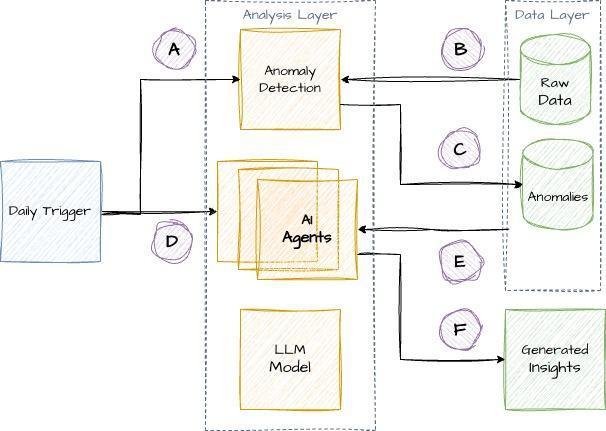
本ソリューションは、コスト効率を維持しながら大規模なデータを処理します。以下の図は主要コンポーネントを示しています。このセクションの後半では、各コンポーネントについて順を追って解説し、「全体アーキテクチャ」セクションでそれらを統合して説明します。
* image*
図 1 – 高レベルなソリューションアーキテクチャ
コンポーネントの概要と論理的フローは以下の通りです。
- オーケストレーション開始 – 日次トリガーが分析レイヤー内の異常検出モジュールを起動し、ワークフローを開始します。
- データ取り込み – モジュールは生データストアから構造化情報を取得します。ここで計算上の重負荷処理が行われます。
- ターゲット出力 – 大規模言語モデル(LLM)に「干し草の山の中から針を見つける」よう求めるのではなく、このモジュールは特定の異常を特定し、専用の異常テーブルへ記録します。数値分析を専門コードに任せることで、生表データに対する LLM が直面するスケーラビリティと精度の問題を回避しています。
- AI エージェント起動 – 異常が準備されると、マネージャーが AI エージェントを起動します。パフォーマンス向上のため、複数のエージェントを並列実行し、それぞれが異なる顧客やデータセグメントに焦点を当てることができます。
- 推論と文脈 – AI エージェントは最終分析をオーケストレーションします。何(what)については異常データを照会し、なぜ(why)については生データに参照し戻り、LLM を用いてこれらの入力を一貫した物語として統合します。
- インサイト提供 – 最終的な推論は生成されたインサイトとして保存され、その後 Reveal アプリケーションを介してエンドユーザーへ提供されます。
ソリューションのコンポーネント
アノマリー検出
AI エンジニアリングにおける一般的な落とし穴は、大規模な生テーブルデータに対して数値分析を LLM に実行させることです。AWS Prescriptive Guidance が指摘するように、LLM はスケーラブルな環境において複雑な表構造や数値抽出に苦戦することがあります。これに対処するため、AWS Step Functions と AWS Lambda を使用してサーバーレスの統計モデルを構築しました(図 4 参照)。このモデルは、構造化データに対するアノマリー検出という計算集約的な処理を担当します。これにより、「何が」アノマリーであるかを特定し、AI エージェントが「なぜ」発生したのか、そして「どのように対処すべきか」に集中できるようにしています。
AI エージェント
私たちは、サーバーレスの AWS Lambda 環境で動作する、AI エージェントの構築と実行のためのオープンソース SDK である Strands Agents を選択しました。このデプロイパターンは、需要に応じて水平方向にスケーリングします。AI エージェントは動的な推論ループを通じて動作し、固定された手順セットに従うのではなく、必要な調査経路を自律的に決定します。以下の記述からわかるように、AI エージェントはステートレスであり、インサイト生成に必要なコンテキストは分析時に新たに取得されます。
AI エージェントは特定のツールを使用して以下を行います:
- Amazon Simple Storage Service (Amazon S3) から事前計算された異常値を取得します。
- 生データについては Amazon Aurora から、歴史的洞察については Amazon DynamoDB から追加の文脈を照会します。
- 最終的な洞察を Amazon S3 に書き戻します。
- タスクリクエストの状態を Amazon DynamoDB で追跡します。
2段階のアジェンシーアーキテクチャ
洞察生成は、LLM の推論能力をそれぞれ異なる方法で活用する 2 段階のアプローチに従います:
ステージ 1: サマリー生成(異常値の集約と優先順位付け)この最初のステージでは、エージェントは fleet 全体で検出された一連の生異常値を受け取ります。各異常値を個別に処理するのではなく、LLM は自律的にそれらを統合して一貫性のある洞察候補へとまとめ上げる方法を決定します。異常値のグループ化には以下のような方法があります:
- 共通の根本原因(複数の車両が同じ行動パターンを示す場合など)
- 時間的相関(特定の日に集中した事象)
- カテゴリ的類似性(関連する安全性や効率性の指標)
グループ化ロジックと選択基準は、すべて大規模言語モデル(LLM)の裁量に委ねられています。システムは異常をどのように組み合わせるかについて固定されたルールを課しません。集約後、エージェントは深刻度、再発頻度、 fleet 全体への影響、実行可能性などの要因に基づき、各候補となるインサイトに関連性スコアを付与します。このように評価された候補の中から、エージェントは詳細な生成に進むために最も関連性の高い上位 4 つのインサイトを選択します。このアプローチにより、優先順位付けは静的なビジネスルールに依存するのではなく、各ユーザーの fleet の特定の文脈に適応し、新たなパターンを見逃すリスクを回避します。
第2段階: 詳細生成(エージェント型ツールベースの調査)
この第2段階こそ、システムのエージェント型性質が極めて重要となる部分です。各サマリーインサイトに対して、データ取得ツールへのアクセス権限を持つ別々のエージェントインスタンスが起動されます。エージェントは自律的に、どのツールを呼び出すか、その順序と回数を決定し、十分な証拠を集めてデータに裏打ちされたインサイトを生成するまで反復処理を行います。
ここでエージェント実行の仕組みを説明したので、なぜこのユースケースにおいてエージェント型アプローチが不可欠なのかを検証していきましょう。フリート管理には無数の変数と予測不能なシナリオが存在し、事前に定められたロジックではなく動的な調査が必要となります。これにより、2 つの根本的な限界が生じます:
- 有限なパターンカバレッジ:コードは明示的にプログラムされたパターンしか検出できません。エッジケース、新たな相関関係、あるいは予期せぬデータ分布は見逃されてしまいます。
- 硬直した調査フロー:スクリプトは分析の最中にデータが何を示唆しようとも、事前に定められた手順に従うのみです。
これに対し、AI エージェントは開発段階で想定されなかったエッジケースを含むあらゆる性質のパターンを発見できます。データが予期せぬ相関関係(例えば、急ブレーキイベントが一日の特定の時間帯パターンと関連している場合や、ある特定の日付を境に車両の挙動が変化するといった事例)を示唆する場合、エージェントは即座に調査戦略を転換し、これらの新たな仮説を検証するために追加のツール呼び出しを実行します。この柔軟性は特にフリート管理において極めて価値が高く、以下のような状況に対応できます。
- ドライバーの行動が予測不能に変化すること
- 外部要因(天候、交通状況、道路状態)が明白ではない相関関係を生み出すこと
- フリートの構成と利用パターンが時間とともに変化すること
- 過去のデータには存在しなかった新たな異常タイプの出現
フローオーケストレーションの例
- 初期調査:エージェントは、 fleet(車両群)全体において急ブレーキイベントが 30% 増加したという要約インサイトを特定します。
- ベースラインの確立:この急増が真の異常値なのか、それとも典型的な季節的な傾向に過ぎないのかを確認するため、自律的に過去 30 日間の fleet-wide(車両群全体)の平均データを取得することを決定します。
- パターン認識:急増が特定の日付に集中していることを確認すると、エージェントは焦点を日次 breakdown(内訳)へとシフトさせます。そして、これらの安全イベントのほとんどが同じ 2 日に発生したことを発見します。
- ターゲットドリルダウン:その日付に基づき、エージェントは車両 1015、1142、および 1032 がイベントのほぼ 70% を引き起こした責任者であることを特定します。
- 比較分析:その後、ドライバーのプロファイルが根本的に変化したかどうかを確認するため、車両 1015 の過去のパフォーマンスと現在の行動を比較する最終的なターゲットリクエストを実行します。
- 統合:これらの点を「結びつける」ことのみで完了し、エージェントはループを終了して、関与している特定のドライバーと日付を強調した、データに裏打ちされた最終インサイトを生成します。
ラージ言語モデル
価格性能比を最適化するため、まず高機能な Claude 4.5 Sonnet を使用してロジックとインサイトの品質を検証しました。検証完了後、本番環境のユースケースにはよりコスト効率の高い Claude 4.5 Haiku に移行しました。さらに価格性能比の最適化を進めた結果、Amazon Nova 2 Lite という超高速なマルチモーダルモデルを採用することになりました。このモデルは、Claude 4.5 Haiku と比較して入力トークンコストを 70% 削減しながらも、同等のインサイト品質を提供します。この大幅なコスト削減は極めて重要です。なぜなら、本ワークロードは主に入力トークン(テレマティクスデータ、異常検知情報、文脈情報)によって支配されているからです。Nova 2 Lite の高い効率性により、Verizon Connect はその全ユーザーベースに対して、AI インサイトをより費用対効果の高い形で提供できるようになりました。品質の維持は、自動化されたテストスイートとゴールドスタンダードのデータセットを通じて担保され、本番リリース時には実戦で検証済みのソリューションが保証されています。LLM(大規模言語モデル)は、包括的な生成 AI 機能、セキュリティ、プライバシー、責任ある AI の機能を備えた完全管理型サービスである Amazon Bedrock でスケールしてホストされています。
毎日のトリガー管理と並行処理
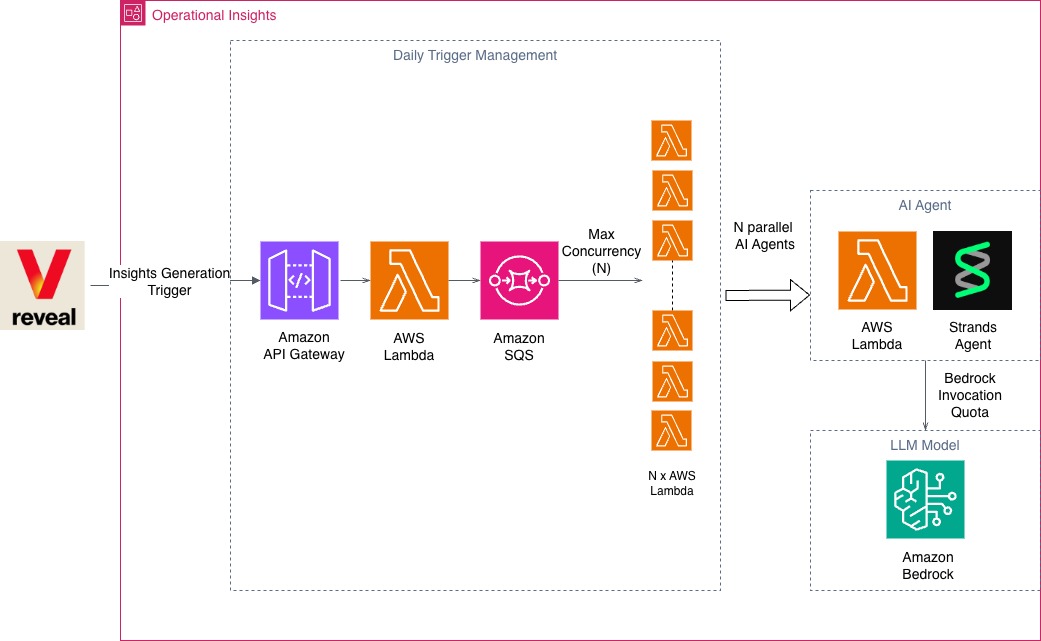
10 万人のユーザーに対して、それぞれのビジネス日開始時に即座に利用可能なインサイトを提供するために、Amazon Simple Queue Service (Amazon SQS) を使用して実行を管理しています。SQS から Lambda へのトリガーにおける最大並行度を制御することで、以下が可能になります:
- API 需要の急増を平滑化する
- Amazon Bedrock のクォータ(1 分あたりのトークン数 (TPM) および 1 分あたりのリクエスト数 (RPM))内に収める
- リソースの過剰割当てを行わずに、確実な配信を実現する
具体例として、全米規模の顧客に対してインサイトを配信するシナリオを考えてみましょう。インサイトの目標配信時間は米国東部時間 (ET) の午前 8:00 で、これは前日太平洋標準時 (PT) の午夜までに生成されたデータに基づいています。3 時間の時差を考慮すると、エンドツーエンドのプロセスは 5 時間のウィンドウ内で完了させる必要があります。異常検出に 1 時間を割り当てると、AI エージェントと大規模言語モデル (LLM) がインサイトを生成するための残りの時間は 4 時間となります。1 分あたり 1,500 リクエスト(調整可能)の速度で処理する場合、インサイト生成フェーズには約 1.25 時間が必要となり、これは運用要件を十分に満たす範囲内です。
* image*
図 2 – SQS から Lambda への最大並行処理の詳細
生成されたインサイト
エージェントが生成したインサイトは、Reveal アプリケーションで即座に利用可能な状態です。ログインすると、新しいインサイトはライブマップ上にある専用パネルに表示されます。これは Reveal で最も頻繁にアクセスされるページであり、すべてのユーザーが直ちに関連するインサイトを確認できるようになっています。各インサイトはクリック可能になっており、クリックすると詳細ページへ遷移して完全な分析内容が表示されます。
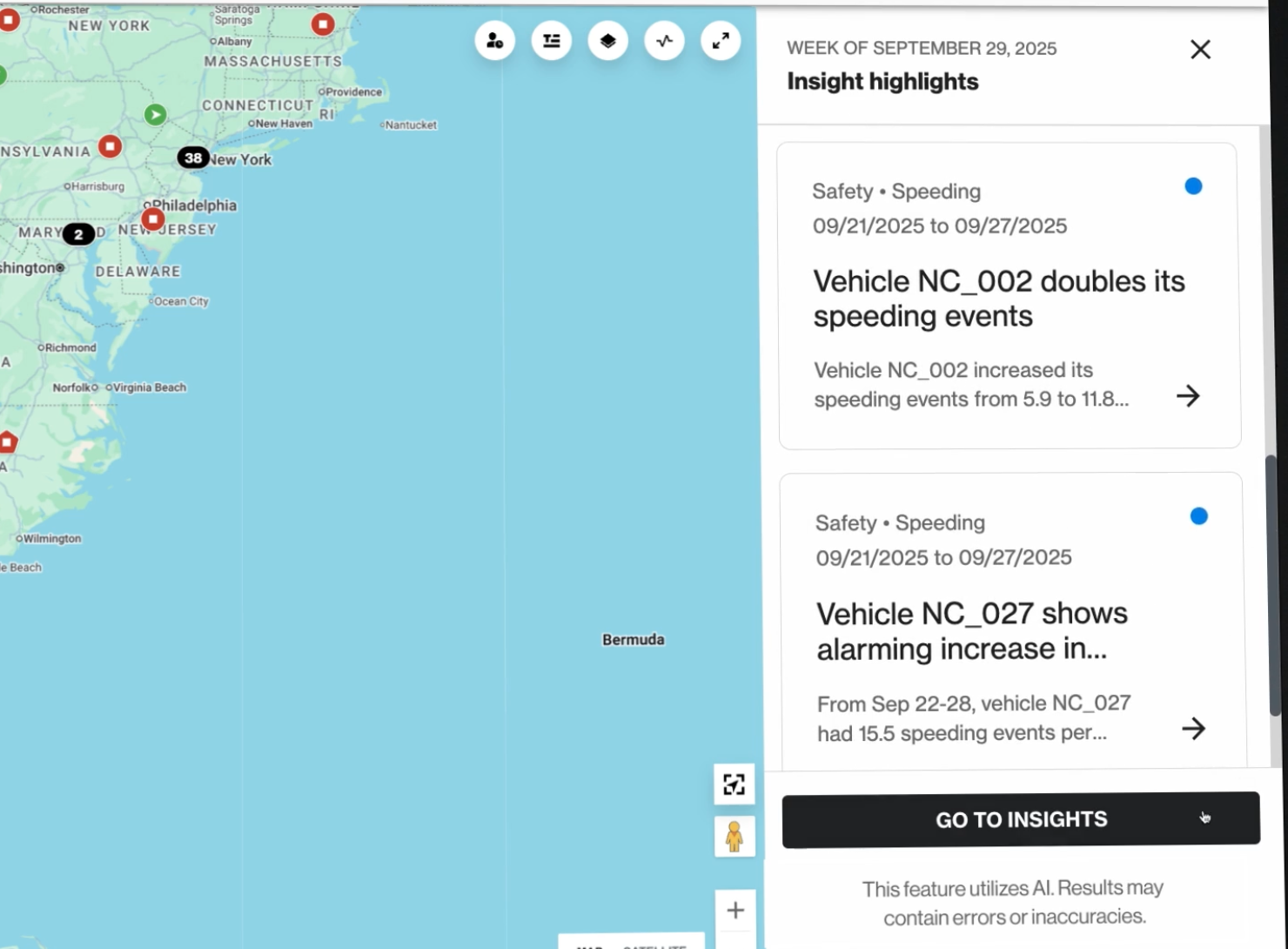
図3 – Reveal の最も訪問されたページには、Operational Insights の結果へのリンクが含まれています。
全体アーキテクチャ
全体アーキテクチャは、以下の4つのコンポーネントを統合しています:異常検知(Anomaly detection)、リクエストの並列化、インサイト生成エンジン、および Reveal アプリケーションが消費するために生成されたインサイトの保存です。
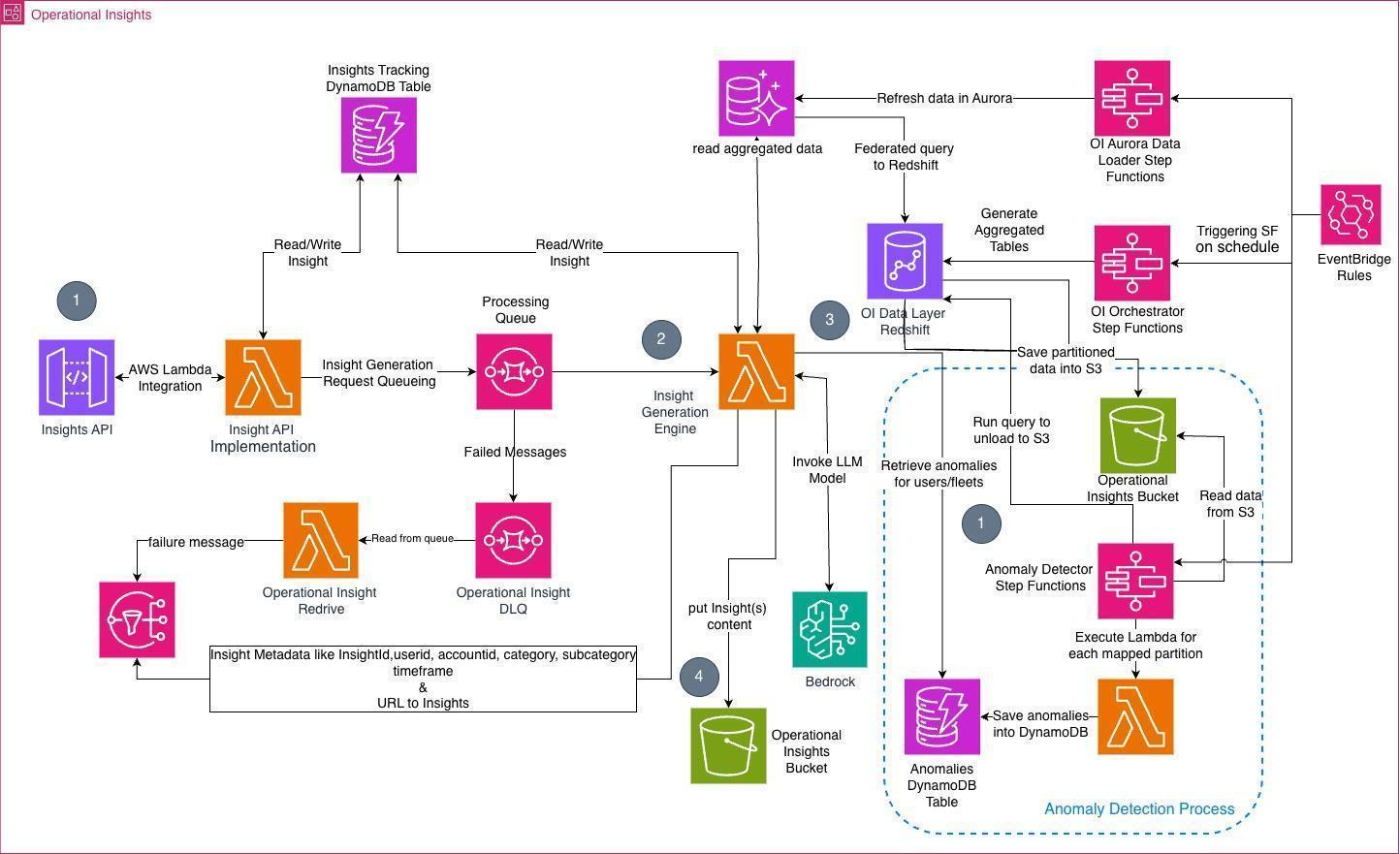
図4 – 全体アーキテクチャ
これらのコンポーネントがどのように連携して動作するかを理解するために、以下のワークフローを考慮してください。インサイト要求がトリガーされ、インサイトを計算する必要がある顧客IDのリストが含まれます。統計モデルは異常検知を実行し、その結果を Amazon S3 に保存します。
- 前述のように N の並列リクエストがトリガーされます。
- N のエージェントがデータを分析し、インサイトを作成して Amazon S3 に保存します。このフェーズでは、エージェントは選択されたモデルにアクセスするために Amazon Bedrock API を呼び出します。
- Reveal アプリケーションは、Amazon S3 に保存されたインサイトにアクセスできます。
結果:実行可能な知見
Operational Insights 機能は、2025年11月に Verizon Connect のユーザー向けに展開され、以下のような明確で自然言語によるナラティブをフリートマネージャーに提供しています:
- セーフティパターン検出:「今週のあなたの車両群では、急ブレーキの使用率が 100% 増加しました。興味深いことに、これは急加速の減少と同時期に発生しており、運転手の疲労または交通渋滞の増加を示唆しています。」
- 運用効率:「車両 #90000 はエンジン稼働時間の 50% をアイドリング状態で過ごしており、これは車両群の平均を大幅に上回っています。これは不要な燃料コストを生み出しています。」
- 車両群のパフォーマンス:「走行距離は前日比で 59% 減少していますが、速度超過イベントは 54% 増加しています。これは、車両がより短い距離を高速で移動していることを示唆しており、ルート最適化の検討が必要です。」
結論と今後の展望
本記事では、Verizon Connect が AWS 上でスケーラブルな Agentic AI ソリューションを構築し、10 万人以上のユーザーに対して生 IoT テレマティクスデータを行動可能な車両群インサイトに変換する方法を紹介しました。このアーキテクチャは、Amazon Bedrock、Strands Agents、AWS Step Functions、Amazon SQS、および多層データレイヤーを組み合わせており、大規模かつ信頼性が高くコスト効率の高いインサイトの提供を実現しています。
AI 環境の進化に伴い、今後は AWS Lambda ベースのエージェントデプロイメントから Amazon Bedrock AgentCore Runtime への移行を計画しており、AWS Lambda の実行をさらに合理化するとともに、Model Context Protocol (MCP) を活用してツールの統合を高速化していく予定です。
エージェント型 AI ソリューションを効果的に実装するには、まず小規模パイロットから始め、基本的なユースケースの妥当性とコスト効率を検証します。初期の価値が証明された後、自動化ワークフローとデータ駆動型のパーソナライゼーションを組み込むことでシステムを拡張します。最終段階では、組織全体にわたる高度なオーケストレーションとリアルタイム処理をサポートするフルエンタープライズ展開へと移行します。
今日から構築を始めましょう:
- 基盤から始める: 管理型 AI サービスには Amazon Bedrock を、サーバーレスエージェントのホスティングには AWS Lambda を使用
- オーケストレーションを追加: ワークフロー管理には AWS Step Functions を、スケーラブルなキューイングには Amazon SQS を活用
- データの保存と取得: オブジェクトストレージには Amazon S3 を、構造化データには Amazon Aurora を、高速検索には Amazon DynamoDB を利用
- エージェントフレームワークの探索: オープンソースエージェント開発には Strands Agents のドキュメントを参照
著者について

ルカ・ヴィニャーリ
ルカ・ヴィニャーリ は、AWS の Telco IBU(Telecommunications Industry Business Unit:通信業界事業部門)でソリューションアーキテクトを務めています。25 年にわたる専門経験を持つルカは、ML(機械学習)、AI(人工知能)、Gen-AI(生成 AI)、IoT(モノのインターネット)、量子コンピューティングなど、顧客の生活を革新し簡素化できる技術に情熱を注いでいます。貪欲な学習者であり、AWS サービスの知識を広めることを喜びとするルカは、家族と旅行をする時間を愛し、健康的なサイクリング活動を楽しんでいます。

ヤリ・マルケッティ
ヤリ・マルケッティ は、データウェアハウスソリューションアーキテクトとしての深い基礎を備えた AI エンタープライズアーキテクトです。彼は堅牢なデータ構造とスケーラブルでインテリジェントなエンタープライズ AI エコシステムとの間のギャップを埋めることに特化しています。アーキテクチャ設計に没頭していない時、ヤリはサッカーのピッチにいるか、世界中を旅しているか、あるいは究極のチームビルディングエクササイズである子供たちと遊ぶことを楽しんでいます。
原文を表示
*A special thanks goes to the Verizon Connect team who’s been working very hard on the project: Matteo Simoncini, Luca Bravi, Alberto Rossettini, Martin Villarruel, Ceyhun Unlu, Adriel Zuquini, Andrea Benericetti.*
Fleet managers today face an overwhelming challenge: transforming data overload into actionable insights. When you’re managing thousands of vehicles, each generating hundreds of daily data points, identifying critical patterns becomes nearly impossible through manual analysis. Verizon Connect, a global fleet management solutions provider serving businesses worldwide through its Reveal platform, encountered this exact challenge at scale.
With over 1.2 million active vehicle subscriptions generating over 500 million data points daily across 80,000 unique data indicators, fleet managers were drowning in this data and forced to hunt for anomalies across fragmented paper logs and reactive spreadsheets. The sheer volume made it impossible to identify emerging safety issues, maintenance needs, or operational inefficiencies before they became costly problems.Rather than building another static dashboard or rule-based automation system, which only catches predefined patterns, Verizon Connect chose agentic AI to replace that manual guesswork with a centralized intelligence solution. Agentic AI dynamically investigates new patterns, asks follow-up questions, and adapts its analysis based on what it discovers, making it well suited for the unpredictable nature of fleet operations.
In this post, we show you how Verizon Connect built and scaled an agentic AI solution to transform overwhelming fleet data into clear, actionable insights for 100,000 users daily. We walk you through the architectural decisions, implementation challenges, and measurable results that can guide your own data-to-insights transformation.
Building scalable architecture
The solution handles data at scale while maintaining cost-efficiency. The following figure describes the core components. Later in this section, we walk through and discuss the various components of the solution and tie them together in the ‘Overall architecture’ section.
*
*
Figure 1 – High-level solution architecture
The high-level description of the components and the logical flow is as follows.
- Orchestration begins – The daily trigger initiates the workflow by activating the anomaly detection module within the analysis layer.
- Data ingestion – The module pulls structured information from the raw data store. This is where the computationally heavy lifting happens.
- Targeted outputs – Rather than asking a large language model (LLM) to “find needles in a haystack,” this module identifies specific anomalies and writes them to a dedicated anomalies table. By offloading numerical analysis to specialized code, we avoid the scale and accuracy issues LLMs face with raw tabular data.
- AI agent activation – After the anomalies are ready, the manager triggers the AI agents. To improve performance, multiple agents can run in parallel, each focusing on a different customer or data segment.
- Reasoning & context – The AI agent orchestrates the final analysis. It queries the anomalies for the what and refers back to the raw data for the why, using the LLM to synthesize these inputs into a coherent narrative.
- Insight delivery – The final reasoning is stored as generated insights, which are then served to the end-user via the Reveal application.
Components of the solution
Anomaly detection
A common pitfall in AI engineering is asking an LLM to perform numerical analysis on large-scale raw tabular data. As AWS Prescriptive Guidance notes, LLMs can struggle with complex table structures and numerical extraction at scale. To address this, we built a serverless statistical model using AWS Step Functions and AWS Lambda (See Figure 4). This model performs the computationally intensive work of anomaly detection on structured data. It identifies *what* the anomaly is, so the AI agent can focus on *why* it occurred and *how to address it*.
AI agent
We selected Strands Agents, an open source SDK for building and executing AI agents, running in a serverless AWS Lambda environment. This deployment pattern scales horizontally based on your demand. The AI agent operates through a dynamic reasoning loop, autonomously determining the necessary investigation path rather than following a fixed set of steps. From the following description you can notice that the AI agent is stateless, the context required for the insights generation is retrieved fresh at analysis time.
The AI agent uses specific tools to:
- Retrieve pre-calculated anomalies from Amazon Simple Storage Service (Amazon S3).
- Query additional context from Amazon Aurora for raw data and Amazon DynamoDB for historical insights.
- Write final insights back to Amazon S3.
- Track task request status in Amazon DynamoDB.
Two-stage agentic architecture
The insight generation follows a two-stage approach, each using the LLM’s reasoning capabilities differently:
Stage 1: Summary generation (anomaly aggregation & prioritization)In this first stage, the agent receives a set of raw anomalies detected across the fleet. Rather than processing each anomaly individually, the LLM autonomously decides how to aggregate them into coherent insight candidates. It can group anomalies by:
- Common root causes (such as multiple vehicles showing the same behavior pattern)
- Temporal correlation (events concentrated on specific dates)
- Categorical similarity (related safety or efficiency metrics)
Both the grouping logic and the selection criteria are entirely at the LLM’s discretion. The system doesn’t impose fixed rules on how anomalies should be combined. After aggregation, the agent assigns a relevance score to each candidate’s insight based on factors such as severity, recurrence, fleet-wide impact, and actionability. From these scored candidates, the agent selects the top four most relevant insights to proceed to detailed generation. With this approach prioritization adapts to the specific context of each user’s fleet, rather than relying on static business rules that might miss emerging patterns.
Stage 2: Detailed generation (agentic tool-based Investigation)The second stage is where the agentic nature of the system becomes critical. For each summary insight, a separate agent instance is spawned with access to data retrieval tools. The agent autonomously decides which tools to call, in what sequence, and how many times—iterating until it has gathered sufficient evidence to produce a data-backed insight. Now that the agent execution is explained, let’s examine why an agentic approach is essential for this use case. Fleet management involves countless variables and unpredictable scenarios that require dynamic investigation rather than predetermined logic, that creates two fundamental limitations:
- Finite pattern coverage: Code can only detect patterns that were explicitly programmed. Edge cases, novel correlations, or unexpected data distributions go unnoticed.
- Rigid investigation flows: A script follows predetermined steps regardless of what the data reveals mid-analysis.
In contrast, the AI agent can discover patterns of any nature, including edge cases that weren’t anticipated during development. If the data suggests an unexpected correlation (such as harsh braking events correlating with specific time-of-day patterns, or a vehicle’s behavior changing after a particular date), the agent can pivot its investigation strategy in real time, making additional tool calls to explore these emergent hypotheses. This flexibility is particularly valuable in fleet management, where:
- Driver behavior varies unpredictably
- External factors (weather, traffic, road conditions) create non-obvious correlations
- Fleet composition and usage patterns evolve over time
- New anomaly types might emerge that weren’t present in historical data
Example of flow orchestration
- Initial discovery: The agent identifies a summary insight reporting a 30 percent increase in harsh braking events across the entire fleet.
- Establishing a baseline: It autonomously decides to pull the fleet-wide historical average for the last 30 days to confirm if this spike is a true anomaly or just a typical seasonal trend.
- Pattern recognition: Upon seeing that the spike is concentrated on specific dates, the agent shifts its focus to a daily breakdown. It discovers that most of these safety events occurred on the same two days.
- Targeted drill-down: Based on those dates, the agent identifies that vehicles 1015, 1142, and 1032 were responsible for nearly 70 percent of the events.
- Comparative analysis: It then makes a final, targeted request to compare the historical performance of Vehicle 1015 against its current behavior to see if the driver’s profile has fundamentally changed.
- Synthesis: only after “connecting these dots” does the agent terminate the loop and generate a final, data-backed insight that highlights the specific drivers and dates involved.
Large language model
To optimize price-performance, we first used the high-tier Claude 4.5 Sonnet to validate logic and insight quality. Post-validation, we transitioned to the more cost-efficient Claude 4.5 Haiku for our production use case. Further price-performance optimization led us to Amazon Nova 2 Lite, a lightning-fast multimodal model, which delivers comparable insight quality while reducing input token costs by 70 percent compared to Claude 4.5 Haiku. This substantial saving is critical since the workload is dominated by input tokens (telematics data, anomalies, context). The efficiency of Nova 2 Lite enables Verizon Connect to deliver AI insights more cost-effectively to its entire user base. Quality was maintained via an automated testing suite and a gold-standard dataset, ensuring a battle-tested solution upon full release. LLMs are hosted at scale in Amazon Bedrock, a fully managed service with comprehensive generative AI capability, security, privacy and responsible AI features.
Daily trigger management and concurrency
To provide insights ready at the start of their business day to the 100,000 users, we use Amazon Simple Queue Service (Amazon SQS) to manage execution. By controlling the maximum concurrency of the SQS-to-Lambda trigger, we can:
- Smooth out spikes in API demand
- Stay within Amazon Bedrock quotas: Tokens Per Minute (TPM) and Requests Per Minute (RPM)
- Provide reliable delivery without over-provisioning resources
To illustrate, consider a scenario delivering insights for customers across the entire United States. The target delivery of insights is 8:00 AM ET, based on data generated up to Midnight PT the previous day. Given the three-hour time zone difference, the end-to-end process must be completed within a five-hour window. Allocating one hour for anomaly detection leaves a four-hour window for the AI Agent and LLM to generate insights. At a rate of 1,500 RPM (adjustable), the insight generation phase will take approximately 1.25 hours, well within our operational requirements.
*
*
Figure 2 – Maximum Concurrency SQS-to-Lambda details
Generated insights
The insights the agent generates are ready for the Reveal application to consume. Upon login, new insights appear in a dedicated panel on the live map, Reveal’s most visited page, so that every user sees relevant insights immediately. Each insight is clickable, leading to a detailed page with the full analysis.
Figure 3 – Reveal’s most visited page includes links to Operational Insights results.
Overall architecture
The overall architecture puts together these four components: Anomaly detection, parallelization of requests, insights generation engine, and storage of generated insights for consumption by Reveal application.
Figure 4 – Overall architecture
To understand how these components work together, consider the following workflow: An insights request is triggered, including the list of customer IDs for which insights must be calculated. The statistical model performs anomaly detection and stores results in Amazon S3.
- N parallel requests are triggered as described earlier.
- N agents analyze data, create insights, and save them to Amazon S3. In this phase, agents invoke Amazon Bedrock APIs to reach the selected model.
- The Reveal application can access the insights stored in Amazon S3.
The result: actionable intelligence
The Operational Insights feature was rolled out to Verizon Connects users in November 2025,and has served fleet managers with clear, natural language narratives like the following:
- Safety pattern detection: “Your fleet saw a 100% increase in harsh braking this week. Interestingly, this coincides with a reduction in harsh acceleration, suggesting driver fatigue or increased congestion.”
- Operational efficiency: “Vehicle #90000 is idling for 50% of its engine-on time, significantly above your fleet average. This represents unnecessary fuel cost.”
- Fleet performance: “Daily mileage is down 59%, but speeding events are up 54%. This suggests vehicles are traveling shorter distances at higher speeds—consider route optimization.”
Conclusion and looking ahead
In this post, we showed how Verizon Connect built a scalable Agentic AI solution on AWS that transforms raw IoT telematics data into actionable fleet insights for over 100,000 users. The architecture combines Amazon Bedrock, Strands Agents, AWS Step Functions, Amazon SQS, and a multi-tier data layer to deliver reliable, cost-efficient insights at scale.
As the AI landscape evolves, we plan to migrate from AWS Lambda based agent deployment to Amazon Bedrock AgentCore Runtime to further streamline our AWS Lambda execution and use Model Context Protocol (MCP) for faster tool integration.
To implement an agentic AI solution effectively, begin with a small-scale pilot to validate a basic use case and establish cost-efficiency. After the initial value is proven, expand the system by integrating automated workflows and data-driven personalization. The final stage involves transitioning to a full enterprise deployment that supports advanced orchestration and real-time processing across the entire organization.Start building today:
- Start with the foundations: Amazon Bedrock for managed AI services and AWS Lambda for serverless agent hosting
- Add orchestration: AWS Step Functions for workflow management and Amazon SQS for scalable queueing
- Store and retrieve data: Amazon S3 for object storage, Amazon Aurora for structured data, and Amazon DynamoDB for fast lookups
- Explore agent frameworks: Strands Agents documentation for open source agent development
About the authors
Luca Vignali
Luca Vignali is Solutions Architect in the Telco IBU at AWS. With 25 years of professional experience, Luca is passionate about technologies that can innovate and simplify customers’ life, including ML, AI, Gen-AI, IoT and Quantum Compute. Avid learner and eager to spread AWS service knowledge, Luca loves spending time travelling with family and enjoys healthy biking activity.
Yari Marchetti
Yari Marchetti is an AI Enterprise Architect with a deep foundation as a Data Warehouse Solution Architect. He specializes in bridging the gap between robust data structures and scalable, intelligent enterprise AI ecosystems. When he isn’t architecting Yari is likely on the soccer pitch, traveling the world, or enjoying the ultimate team-building exercise: playing with his kids.
関連記事
今日のまとめ
AI日報で今日の重要ニュースをまとめ読み