AI の能力向上に伴い、私たちが働くべきことは何になるか?
プリンストン大学の研究者が、AI の急激な能力向上に対する不安に対し、「AI は通常の技術として進化し、完全な自動化ではなく人間との協働(co-superintelligence)へ移行する」という3 つの主要論点を提示した。
キーポイント
AI を「通常の技術」として捉える枠組み
再帰的自己改善などの特異点が発生しない限り、AI の影響は既存の技術進化の延長線上にあると捉えるべきであり、この視点が有用であると主張。
労働市場への即時的打撃の否定
実験室で特定のマイルストーンを達成したとしても、それが直ちに全雇用を奪うような劇的な転換点にはならないと分析している。
未来の職と人間-AI 協働のビジョン
将来の仕事は根本的に変容し、多くの適応が必要となるが、最終的には人間と AI が互いの能力を補完する「共超知能(co-superintelligence)」へと進化すると予測。
AI の未来像による戦略の分岐
AI が人間の仕事を「代替」するものだと考えるなら即座に資産を築くべきだが、「能力増幅」ツールだと信じるなら、判断力や審美眼など AI と補完し合うスキルを今こそ構築すべきである。
社会への影響と政治的反動の回避
AI 業界が単に仕事を奪われることを受け入れる姿勢を示すことは、将来的には現在の倍以上の強い政治的バックスラッシュを招く恐れがあり、明確な境界線の設定が必要である。
「通常技術」としての AI の位置づけ
AI は単なる道具ではなく産業革命規模の変革をもたらす技術だが、「通常技術(Normal Technology)」という枠組みで捉えることで、その本質的な役割と人間との共存を再定義する。
AI 影響の因果モデル
著者は AI の経済・社会への影響を理解するための枠組みを提示しており、これは再帰的自己改善のような未来の不連続性が起きる限り有効であると主張しています。
重要な引用
I made three arguments. First, the AI as Normal Technology framework is a correct and useful as a way to think about AI's impacts...
...there is no milestone that companies might achieve in the lab that will suddenly put us all out of work.
...ended with a vision of human/AI "co-superintelligence".
If you believe, as I do, that this is a technology that will greatly amplify our potential, then now is the best time to build skills — especially the skills that are going to be complementary to what AI is doing and is going to be able to do
AI as Normal Technology is the intellectual framework for my talk today. When we say AI is normal, we don't mean that it's just like a hammer or a toothbrush, some kind of mundane technology.
This is not a slogan. It's a framework — sort of a causal model how AI capabilities impact the economy and society.
影響分析・編集コメントを表示
影響分析
この記事は、現在の AI 業界が抱える「雇用喪失への過度な不安」に対して、冷静で構造的な分析を提供し、社会の適応戦略を再定義する重要な役割を果たす。特に、技術的特異点(AGI)への恐怖に流されず、現実的な技術進化の文脈で議論を進める姿勢は、政策立案者や企業経営層にとって指針となるものである。
編集コメント
技術的特異点を巡る議論において、感情的な恐怖ではなく「通常の技術」としての進化プロセスに焦点を当てた視点は非常に貴重です。特に、即時的な失業危機への懐疑的な見方は、現在の過熱した市場環境における冷静な判断材料となります。
先週、ソウルで開催された国際機械学習会議(ICML)で、「今後私たちが取り組むべきことは何か?」というタイトル基調講演を行う機会を得ました。AI の能力が向上する中で、私たちはどのように適応すべきかという広範な不安についてお話ししました。
講演の反響に大変感激し、スライドを公開することにしました。ここでは軽微な編集を加えた原稿を注釈付きで掲載しています。また、このページ上でも閲覧可能ですが、オンライン版にはアニメーションやクリック可能なリンクが含まれており、全体的により優れた体験を提供しています。
私は主に3つの主張を行いました。第一に、「AI を通常の技術として捉える」という枠組みは、再帰的自己改善のような将来の断絶が生じるまでの間、AI の影響を考える上で正しいかつ有用なアプローチであるという点です。第二に、再帰的自己改善を真剣に受け止めるべきですが、企業が実験室で達成する特定のマイルストーンが、突如として全員を職から追いやるような事態を引き起こすことはないという点です。そして第三に、将来の職業は根本的に変化し、多くの適応が必要になるという点です。
その具体的な姿について私の考えを共有し、「人間とAI の共存的超知能(co-superintelligence)」というビジョンで講演を締めくくりました。
現在、AI の分野は大きな興奮に満ちていますが、同時に AI コミュニティ内には深い不安も広がっています。私はその不安に正面から向き合い、どう対処すべきかを考えたいと思います。
AI が今後、私たちが今日行っている業務の多くを担えるようになる未来に向けて、私たちはどのように備えていくべきでしょうか?
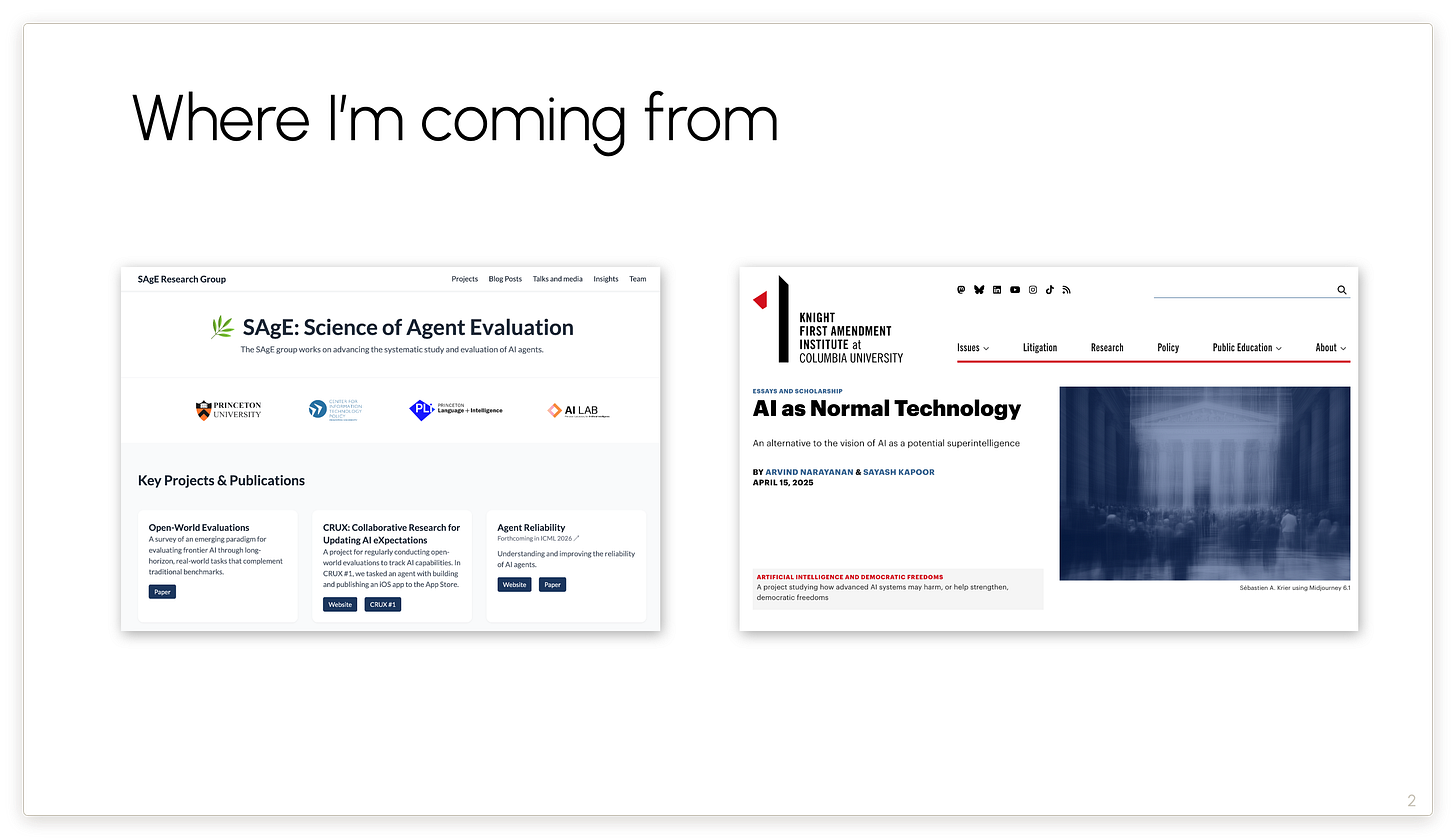
私はプリンストン大学で、AI エージェントの評価に関する科学の発展に取り組むチームを率いています。私たちの取り組みは、「ベンチマークでの能力が向上している」といった一般的な主張に留まりません。こうした主張は、一般の人々によって誤解されがちです。「エージェントがすぐにすべての仕事を奪う」というような過剰な解釈がなされてしまうのです。
もしかすると、そのような未来が訪れるかもしれません。しかし、私たちの研究では、実社会での導入において能力以外の重要な要素是什么かを理解し、その知見を評価プロセスに組み込むことに注力しています。
私がよりよく知られている仕事は、Sayash Kapoor 氏と共著した「AI を通常の技術として捉える」というエッセイです。これは、AI の中期的な未来をどう考えるか、そしてそれに対応し、さらに社会や経済のニーズに合わせて AI をどう適応させていくべきかを考察する枠組みを提供するものです。
これまで私たちは、弁護士やジャーナリストがどのように適応すべきかについて論じるエッセイを書いてきました。しかし皮肉なことに、この「いかに適応するか」という問いは、私たち自身に最も早く突きつけられています。ソフトウェアエンジニアリングであれ、AI 研究そのものであれ、これらの分野における AI の能力は確かに急速に進化しています。
私たちが今どう対応するかが、コミュニティの外でも大きな意味を持ちます。世界が注目しているのです。もし将来の多くの仕事が AI に任せられると安易に受け入れ、明確な境界線を示さなければ、現在見られている以上の強い政治的反発を招くことになるでしょう。つまり、この問いは私たちだけの問題ではなく、全世界に関わる課題なのです。
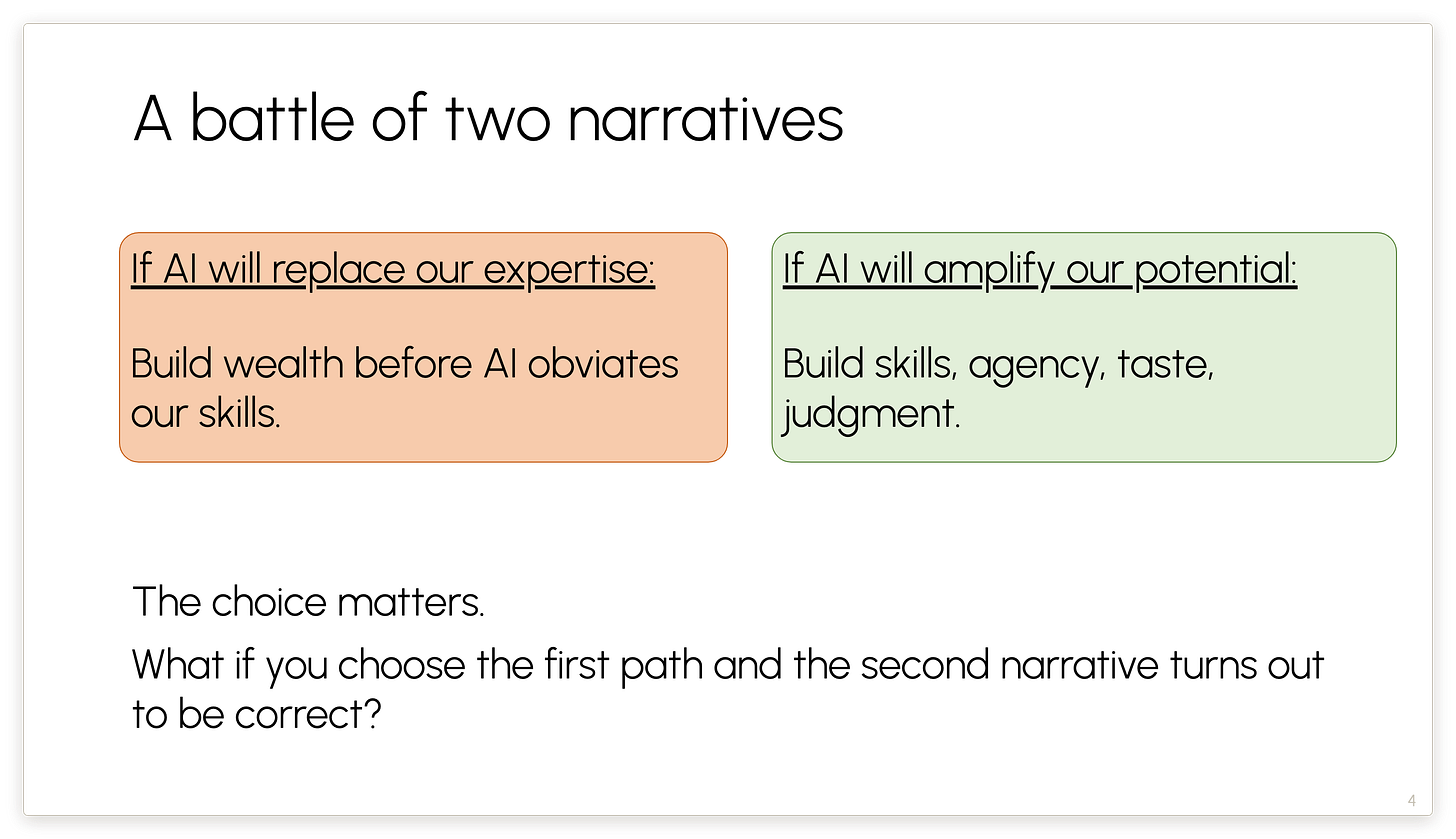
AI の歴史を振り返れば、常に二つの対立する物語が存在してきました。かつては学術的・哲学的な議論の域を出ませんでしたが、今やそれは極めて実践的な課題となっています。私たちはそれぞれがどちらの陣営に属するか、あるいはこのスペクトラム上のどこにいるかを自ら決断しなければなりません。なぜなら、どちらを信じるかで現実社会に与える影響は、あまりにも大きく異なるからです。
もし、この技術が数年のうちに今日私たちが行っているすべての仕事を代替してしまうものだと考えるなら、スキルが無意味になる前にできるだけ早く富を築くことが最善の対応かもしれません。シリコンバレーでは、多くの人がまさにその道を選んでいます。「恒久的な下層階級」というミームをご存知の方もいるでしょう。
一方、私のように、この技術が私たちの可能性を劇的に増幅するものだと信じるなら、今こそスキルを築く絶好のタイミングです。特に重要なのは、AI が現在および将来行うことと補完し合うスキルであり、またその周囲に「エージェント性」や「審美眼」「判断力」といった要素を構築することでもあります。
もし最初の道を選んだ結果、AI が実際には代替技術ではなく増幅技術であったことが判明したとしたら、私はこう主張します。今後数年の間に、私たちに超能力をもたらすスキルを築くための歴史上最高の機会を失ってしまったことになるでしょう。だからこそ、全員が同じ結論に至るわけではないとしても、私たちはこの問いについて考える必要があるのです。
今日の講演の知的枠組みとなるのは、「AI は通常の技術である」という考え方です。ここで「通常」と言うとき、単にハンマーや歯ブラシのような日常的な道具と同じだと意味しているわけではありません。
私たちがこの論文で強調しているのは、これは産業革命に匹敵する規模の変革をもたらす技術だということです。私たちは AI に懐疑的な立場をとっているのではありません。
これはスローガンではなく、AI の能力が経済や社会にどのような影響を与えるかを説明するための因果モデルのような枠組みです。この 1 万 5000 語に及ぶ論文は、現在書籍化されています。あえてそのことをお話しするのは、「normal(通常)」という言葉だけを聞くと、多くの人が勝手に意味を推測してしまい、誤解を生むケースが多いためです。
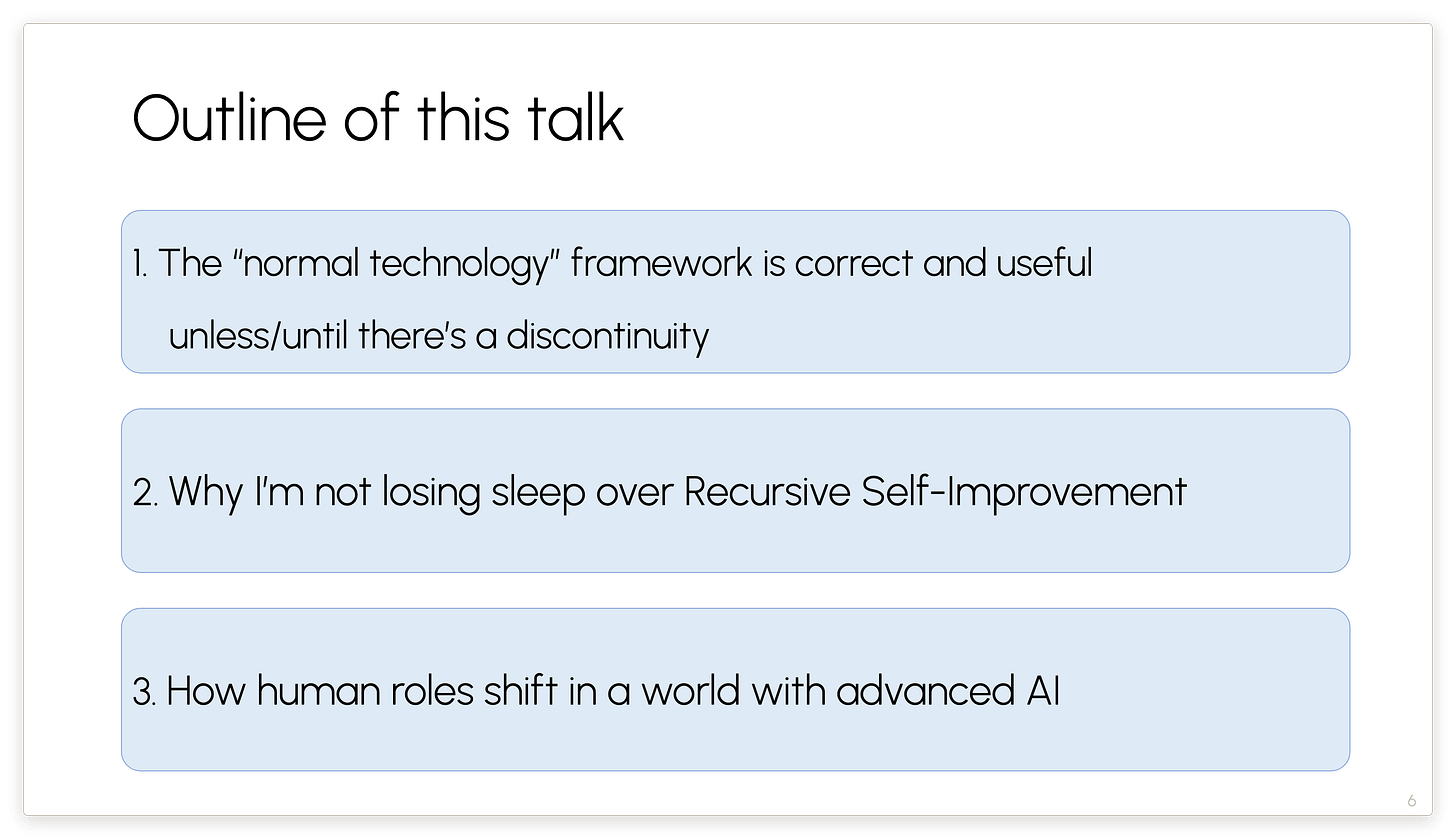
まず、再帰的自己改善(recursive self-improvement)などによって将来のインパクトが過去とは全く異なるものになるという「不連続点」が発生しない限り、この枠組みは AI の影響を考える上で正しく、有用であると主張します。
次に、再帰的自己改善を真剣に受け止めるべきであるにもかかわらず、なぜ私がそれほど不安を抱いていないのかについてお話しします。
最後に、未来の雇用形態が現在のそれと全く同じになるとは決して言いません。多くの適応が必要になることは間違いありません。そこで、役割がどのように変化し、私たちはその変化にどう最善を尽くして対応すべきかについて、私の考えをいくつか整理しておきます。
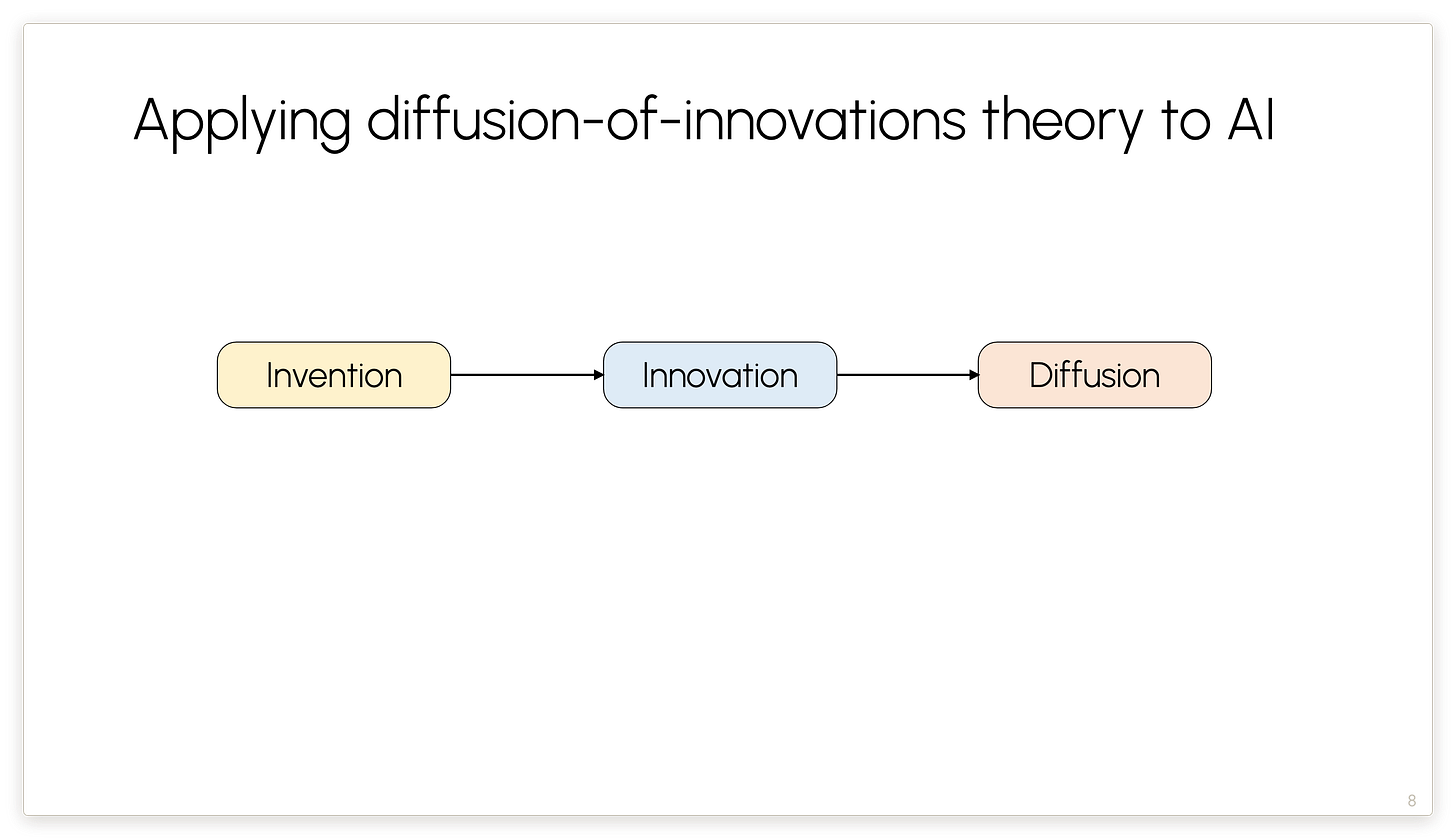
過去に登場した強力な技術、例えば電気などはすでに徹底的に研究されており、技術の進歩が経済にどのような影響を与えるかを理解するための確立された枠組みが存在します。
発明:電磁気学の原理や交流と直流の違いなど、基本原理を発見することです。
革新:人々は「電気」そのものを直接使うわけではありません。電気製品を使います。これらもまた発明されなければならず、これは後続の革新、すなわち枠組みにおける第二段階に該当します。
普及:これは人々が徐々に革新を受け入れ始める過程を指します。
私たちの論文では、この枠組みを AI に適用し、4 つの部分からなる詳細な枠組みへと発展させました。
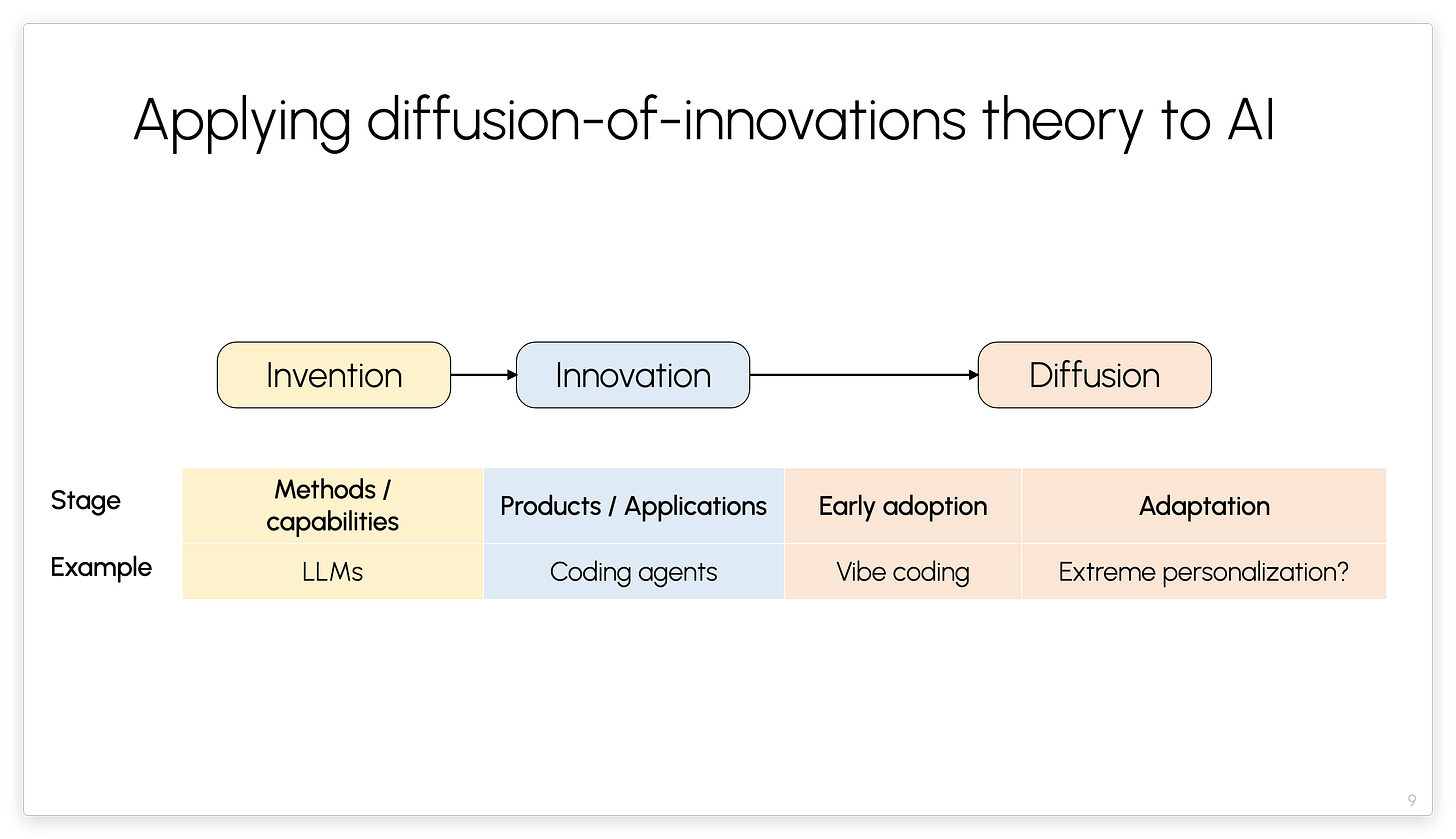
基本となる図景を、ソフトウェアエンジニアリングの例で説明しましょう。
まず「技術・機能」の段階です。モデルの性能は急速に向上しています。
次に「製品・応用」の段階です。私たちは LLM(大規模言語モデル)をそのまま直接使用しているわけではありません。私たちの業務においてこれほどまでに影響力を持つようになったのは、コード生成エージェントのおかげです。これらの製品は、モデルが持つ潜在的な能力を活用し、現場の労働者が実際に使いこなせる形に変換したものです。
そして「初期採用」の段階です。当初は多くの人が「雰囲気コーディング(vibe coding)」を試していましたが、現在ではそれが本番環境向けのソフトウェア開発において最良の方法ではないことが分かっています。そこで現在は、より洗練されたエージェント工学のアプローチへと移行しています。
最後に「適応(あるいは構造的変革)」の段階です。これは四つ目のフェーズであり、最も時間がかかるものです。今日の私の話の中心もこの点にあります。この段階には数十年を要すると私は主張します。コード生成エージェントという比較的新しい技術を採用しているソフトウェアエンジニアリング分野でさえ、実はまだ本格的な適応期は始まっていないのです。
適応フェーズがどのような姿になるかはまだ不明です。あくまで推測の域を出ませんが、あえて想像してみましょう。
もし将来、コーディングエージェントがバグやセキュリティ脆弱性に満ちない 1000 万行規模のコードベースを生成できるようになったとしたら、何十億人もの人が使う汎用的なソフトウェアを作成する意味は薄れてしまいます。むしろ、個々のユーザーやチームのニーズに合わせてカスタマイズされたソフトウェアの方が合理的になるはずです。私が「極端なパーソナライゼーション」と呼んでいるのはまさにこのことです。
これは単なる技術的な変化にとどまりません。業界構造そのものの変革でもあります。例えば、もはやソフトウェア企業が必要なのでしょうか?もしかすると、ソフトウェア開発は実際にそれを使う企業やチームの内部へと大規模にシフトするかもしれません。これもあくまで推測ですが、重要なのは、AI の真の可能性をソフトウェアエンジニアリングに限らずあらゆる分野で引き出すには、このような組織変革や人間の変容が不可欠だということです。しかし、こうした変化は非常にゆっくりと進み、数十年単位の時間を要します。これが本稿の核心的な洞察の一つです。
過去の技術を見ても、この種の変化は極めて緩やかであることがわかります。
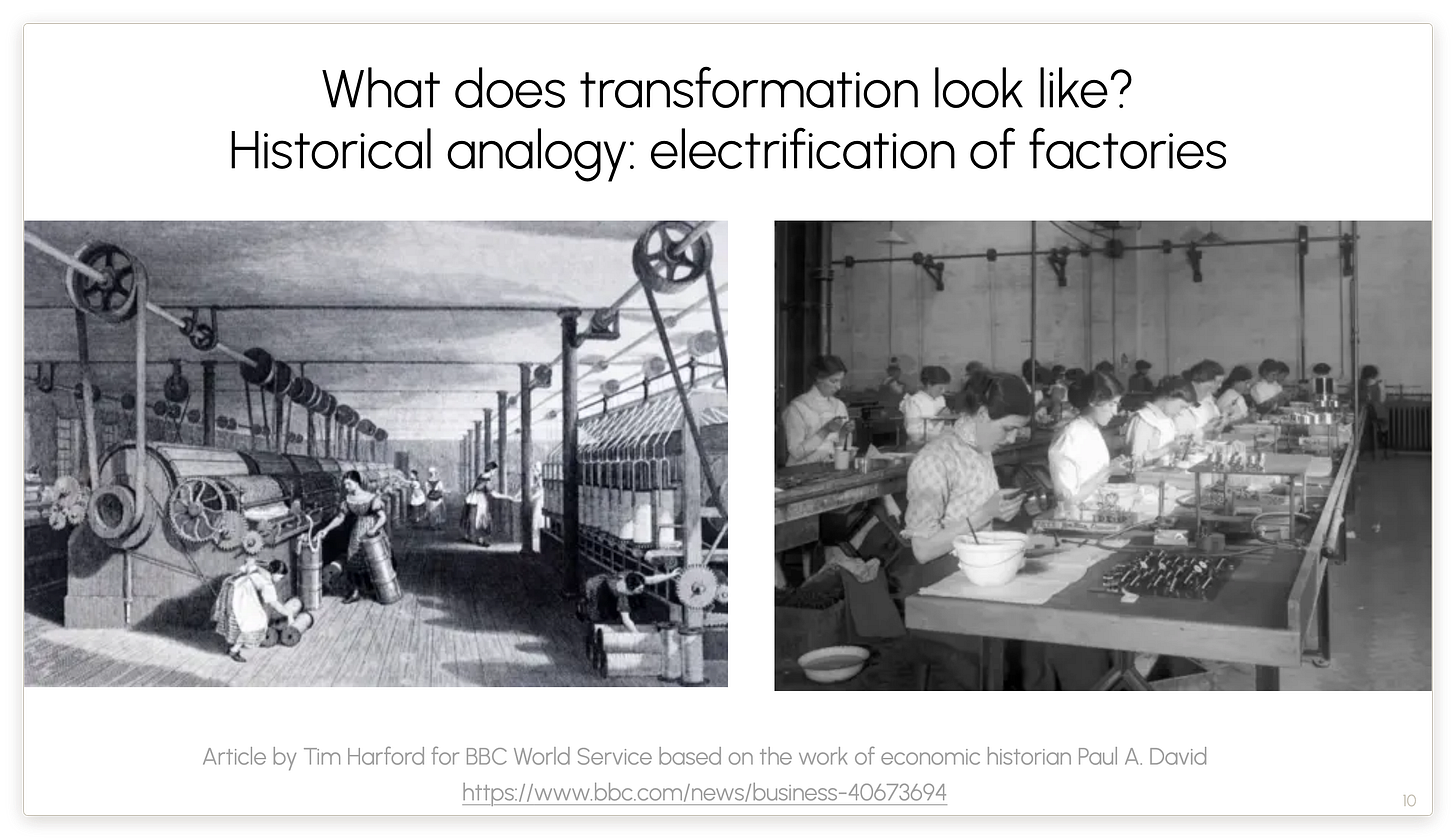
電気が登場する前、工場は左側の写真のような姿でした。巨大な蒸気機関が動力を生み出し、それを機械的な歯車やベルトで工場の隅々まで伝達していたのです。
そこで電気が登場すると、工場経営者は蒸気ボイラーを電動発電機に置き換えようとしました。これならはるかに効率的になると考えたからです。しかし、「そのまま差し替えるだけ」という発想は成功しませんでした。現在、AI エージェントの文脈でも同じような言葉が聞かれます。「人間労働者の代替品としてそのまま導入できる」という主張です。しかし、電気の時代においてこのアプローチは機能しませんでした。
実際に成功したのは、電気という技術が蒸気とは全く異なる性質を持つと認識した時でした。そしてその理解に至るまでに 40 年を要しました。電気が持つ「携帯性」こそが鍵です。必要な場所に動力を運ぶことができるため、工場全体のレイアウトをアセンブリラインの論理に合わせて再編成することが可能になりました。
これを実現するには、労働者の訓練方法や採用・解雇のプロセスを見直し、新たな労働法を整備するなど、組織的な適応が必要でした。つまり、工場で電気の恩恵を享受するためには、こうした組織レベルの変革が不可欠だったのです。
私たちが主張するのは、これは AI がもたらすプロセスの典型例だということです。数十年後には、仕事のあり方そのものが根本的に再編成されているでしょう。それが具体的にどのような姿になるかは誰にもわかりません。これが私たち全員が直面している課題です。
これは AI 企業だけが解決すべき問題ではありません。かつて電力会社が「工場をどう再編すべきか」を決める役割ではなかったのと同じように、AI 業界もその責任を負うべきではないのです。私たちの見解では、これは AI が経済に波及するまでの4つの段階の中で最も時間がかかるプロセスです。現在、このプロセスはまだ本格的には始まっていません。
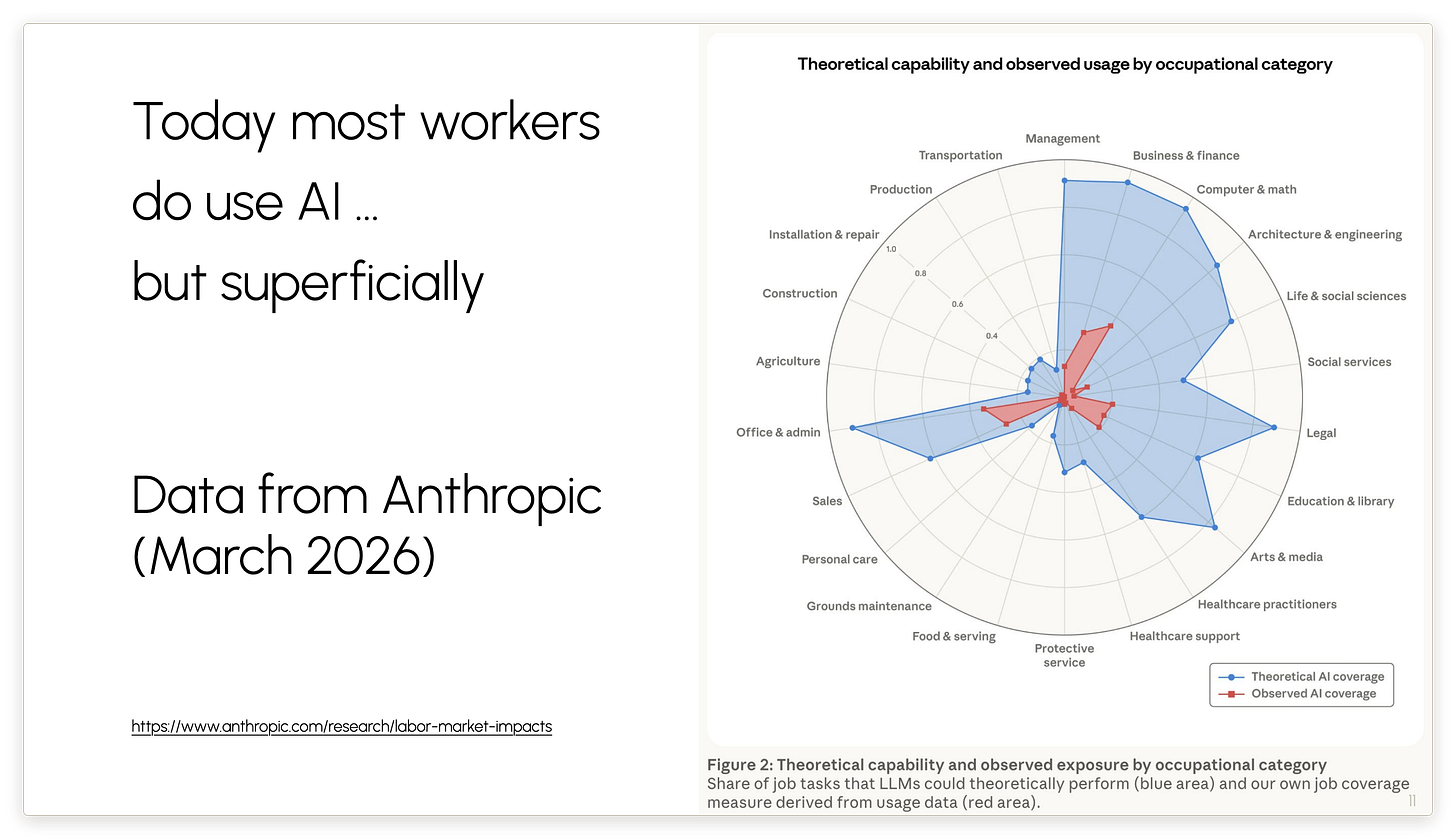
なぜ、各職業の人が AI を活用できる可能性と、実際に使われている範囲の間にはこれほど大きな隔たりがあるのでしょうか。その理由の一つとして、人々が技術の導入に時間がかかることが挙げられます。これは私たちの枠組みにおいても重要な要素です。
しかし、私たちは疑問を持ちました。AI の実装に携わり、あまり成功していない人たちが、AI 業界が知らない「AI の実践的な限界」について何かを知っているのではないか、と。能力と実際の活用との関係については、もう少し謙虚になるべきではないでしょうか。
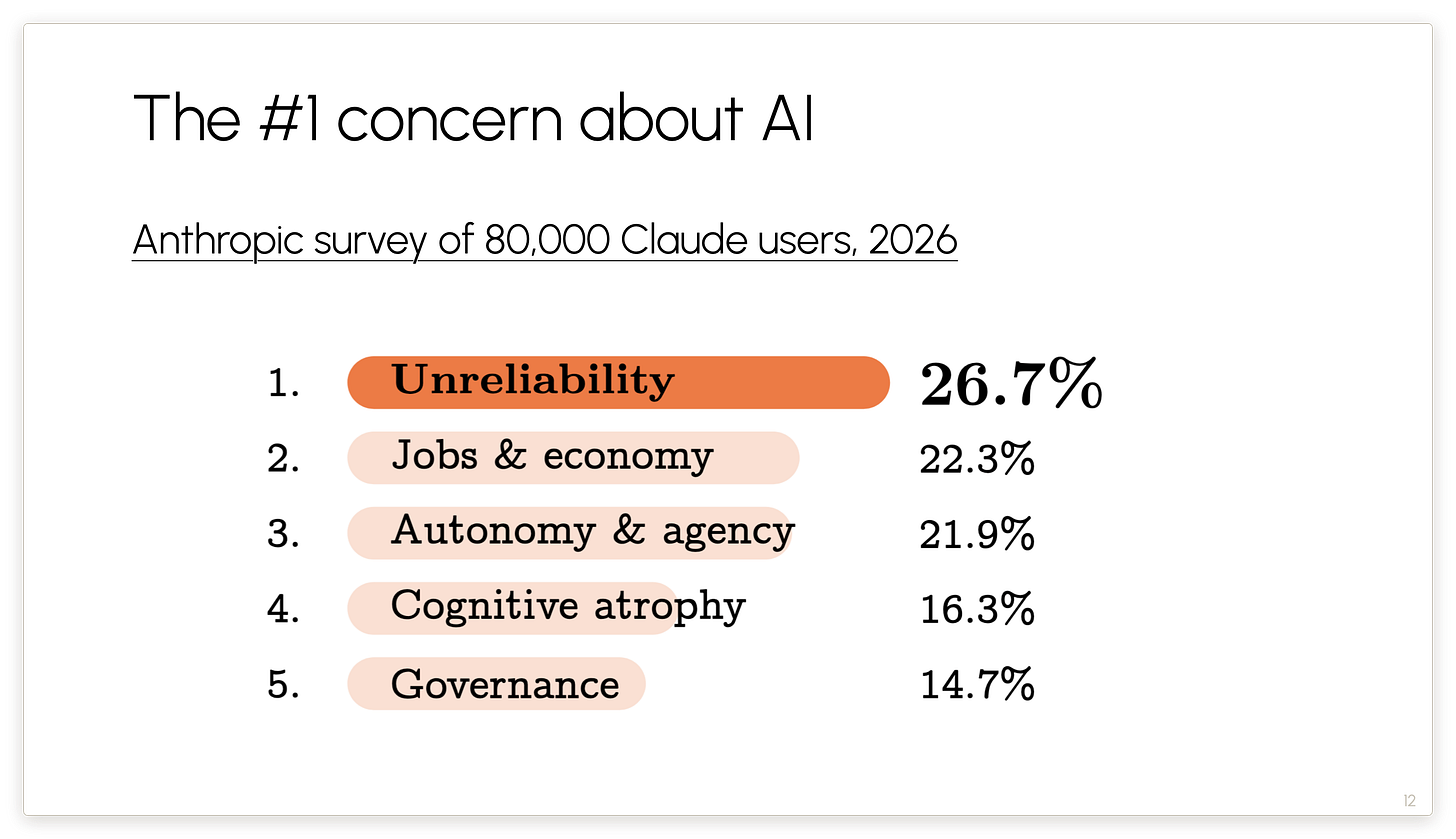
人々が最も懸念しているのは「信頼性」です。そこで私たちは、能力とは別に、この信頼性が AI エージェントの実用性を阻む障壁となっているかどうかを測定してみることにしました。
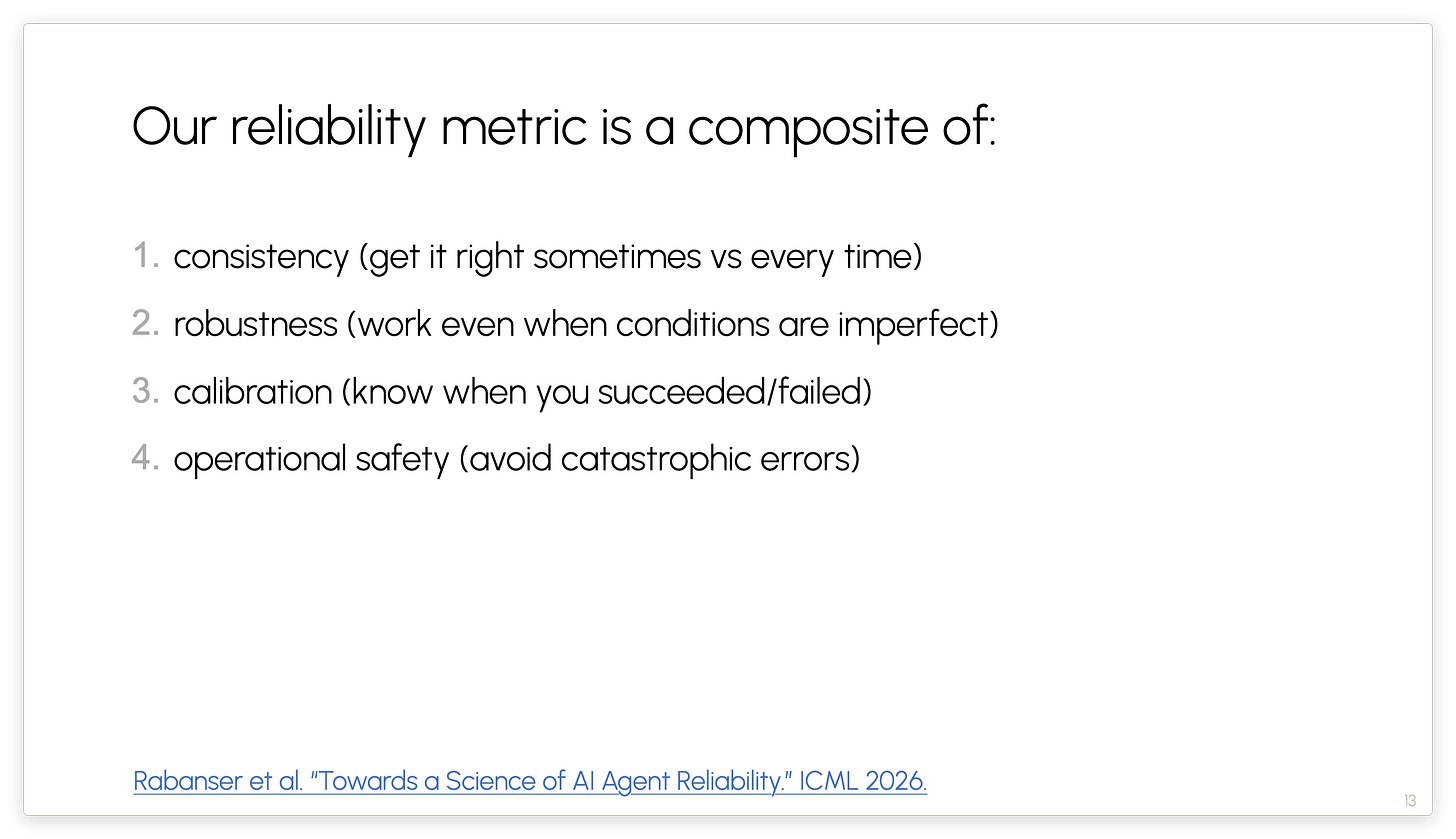
10〜12 の信頼性指標を調査し、4 つの次元に分類しました。
まず「一貫性」です。ある AI エージェントの精度が 70% と報告された場合、それは「タスクの 70% で正しく動作するが、残りの 30% では失敗する」という意味でしょうか?それとも、「どのタスクでも実行されるたびに 70% の確率で成功し、30% の確率で予測不能に失敗する」ことを意味しているのでしょうか。前者なら実運用には非常に適しています。特定のタスクのサブセットに対してのみデプロイすれば済むからです。しかし後者であれば、実運用の観点からはほぼ役に立ちません。驚くべきことに、私たちが調査したエージェントベンチマークのいずれも、この 2 つの違いを区別していません。どちらも単に「70% の精度」として表記されているだけです。
次に「頑健性」です。環境がわずかに変化した際にどうなるかを評価します。
「較正(キャリブレーション)」については、エージェント自身が過去のログを振り返り、「自分はタスクを正しく完了できたか」を判断できるかどうかを確認します。
そして「運用上の安全性」です。失敗した際、その状態から回復可能でしょうか?それとも、本番データベースの削除のように取り返しのつかない事態に陥るのでしょうか。
人間の仕事において、ある人が「有能だ」と評価されるのは、精度が高いという理由だけではありません。上記すべてが揃って初めて成立します。ところが現状では、エージェントの評価は精度のみで行われているのが実情です。
過去24ヶ月ほどに発表された、主要3社の最先端AIモデルを対象に、能力と信頼性を評価するための2つの補完的なベンチマークを用いて測定を行いました。
この期間中、精度や能力は劇的に向上しました(左図)。
しかし、信頼性(右図)の向上はわずか5〜10ポイント程度にとどまりました。
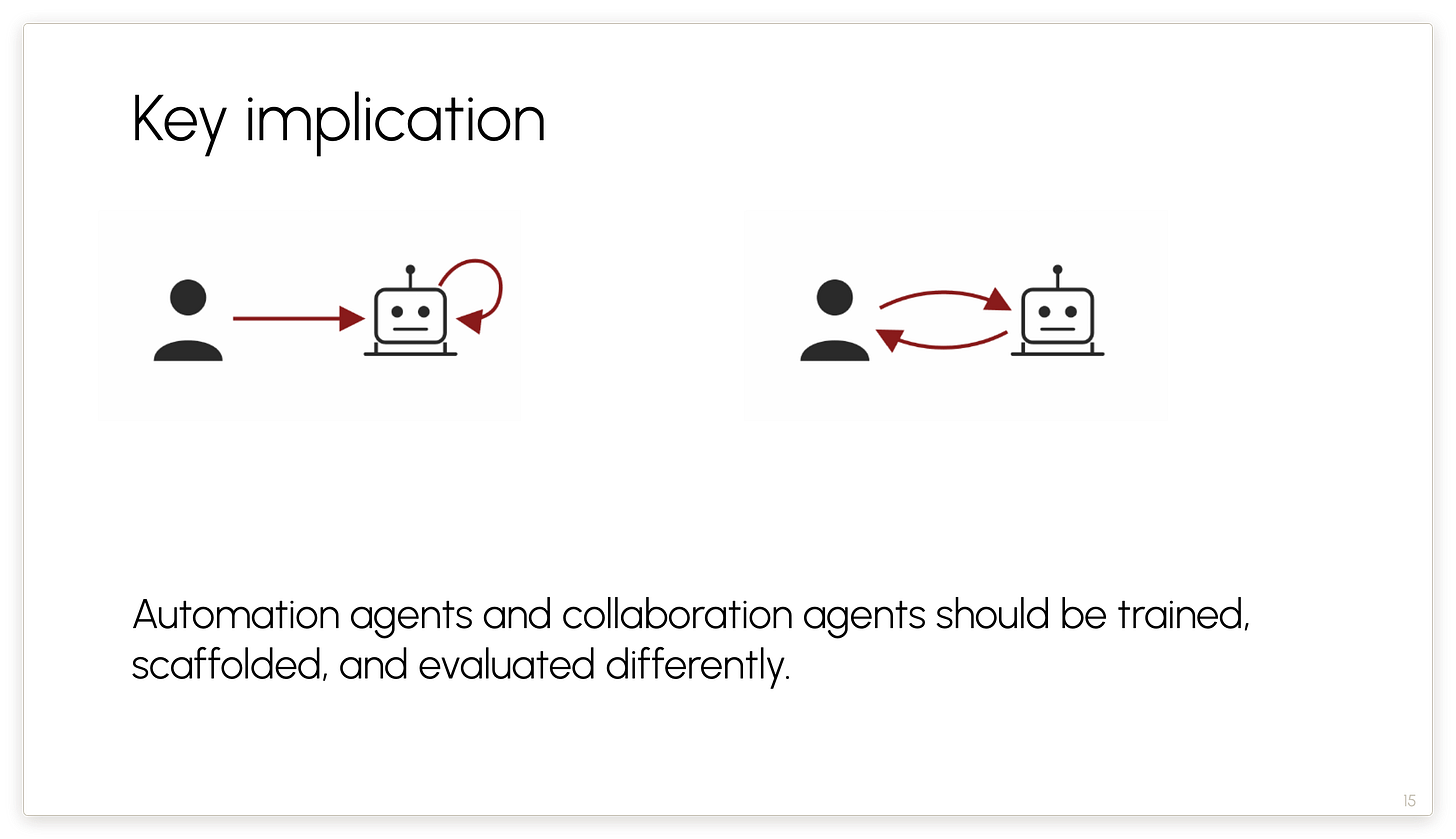
ここから導き出される示唆は多岐にわたりますが、特に重要な点を一つ挙げます。現在、業界では「自動化エージェント」と「協働型エージェント」を区別して扱っていません。ヘッドレスモードで実行すれば自動的に「自動化エージェント」とみなされてしまうのが現状です。しかし、これは誤った見方です。
自動化において極めて重要となる「信頼性」といった特性は、クリエイティブライティングの向上などを目的とした協働型エージェントにとっては、むしろ足かせになる可能性があります。そのような用途のエージェントには、毎回同じ動作をするロボットのような振る舞いは求められません。むしろ、創造性を発揮し、さまざまな可能性を探求し、予測不能な動きを見せることが望ましいのです。
したがって、モデルのスケフォールド(支援構造)やポストトレーニング(事後学習)は、それが協働型エージェントを駆動するためか、自動化エージェントのためなのかによって、明確に使い分けるべきです。
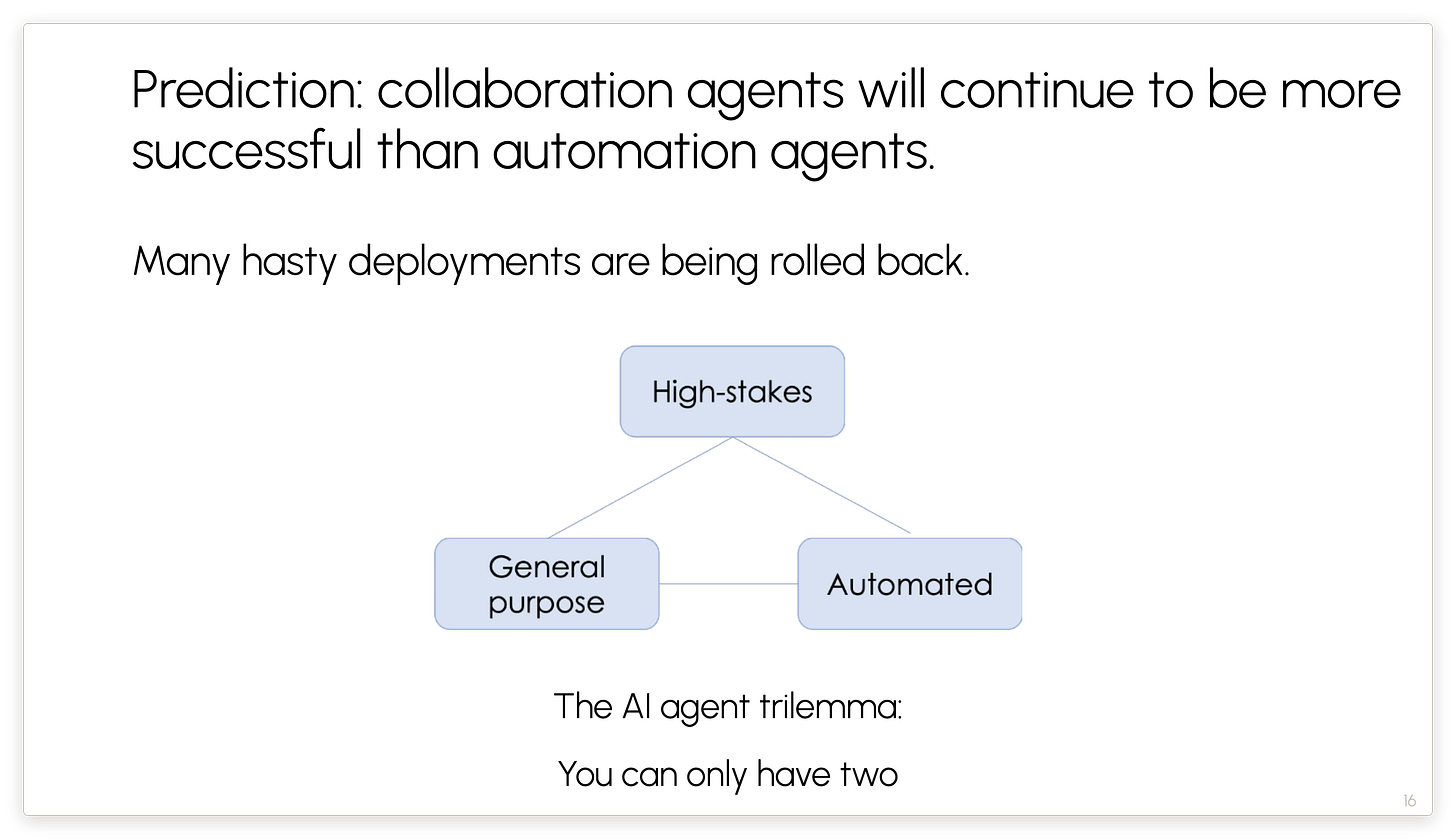
信頼性の向上と自動化の容易化は、今後さらに進んでいくと願っています。しかし現状では、協働型のエージェントの方が遥かに成功していると考えられます。多くの企業が、エージェントを用いた業務プロセスの自動化を急ピッチで進めましたが、その限界やコスト、さらには法的責任(例えば、生産データのエージェントによる削除など)に直面し始めています。
現時点において、エージェントが同時に満たすことのできる 3 つの特性のうち、2 つまでしか選べません。それは「汎用性」(特定のタスク向けに設計された従来のソフトウェアではなく、指示によって異なるタスクを実行できる言語モデルベースのエージェント)、「ハイリスクなシナリオでの展開」、そして「自動化」です。
この点も踏まえると、現時点では AI は労働者を置き換える技術というよりも、むしろ人間と協働する技術としての側面が強いと言えます。
例としてソフトウェアエンジニアリングを取り上げてみましょう。コーディングエージェントが特に急速に普及しているため、この分野は良い先行指標となります。
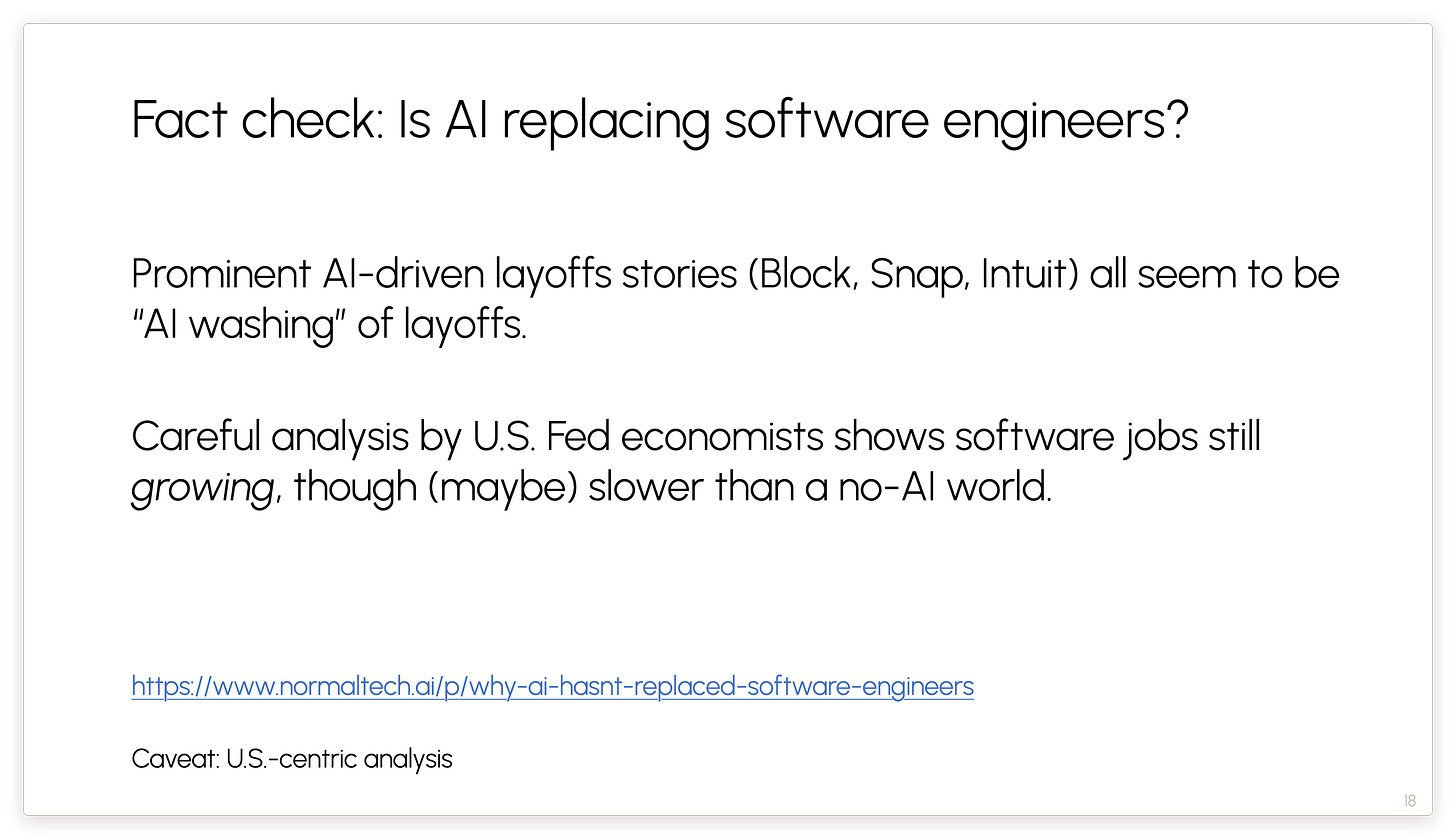
ソフトウェアエンジニアリングの完全な自動化は不可能だと考えているかもしれません。しかし、AI エージェントがエンジニアの生産性を 10 倍に高めたなら、必要なエンジニア数は 1/10 で済むはずです。これは明白な帰結ではないでしょうか。
しかし、その考えはデータによって完全に否定されています。私たちは別の記事でこの点について検証しましたが、調査したすべてのケースで企業は財務上の圧力に直面しており、実際には AI を理由の口実にして人員削減を正当化している方が都合がよかったのです。
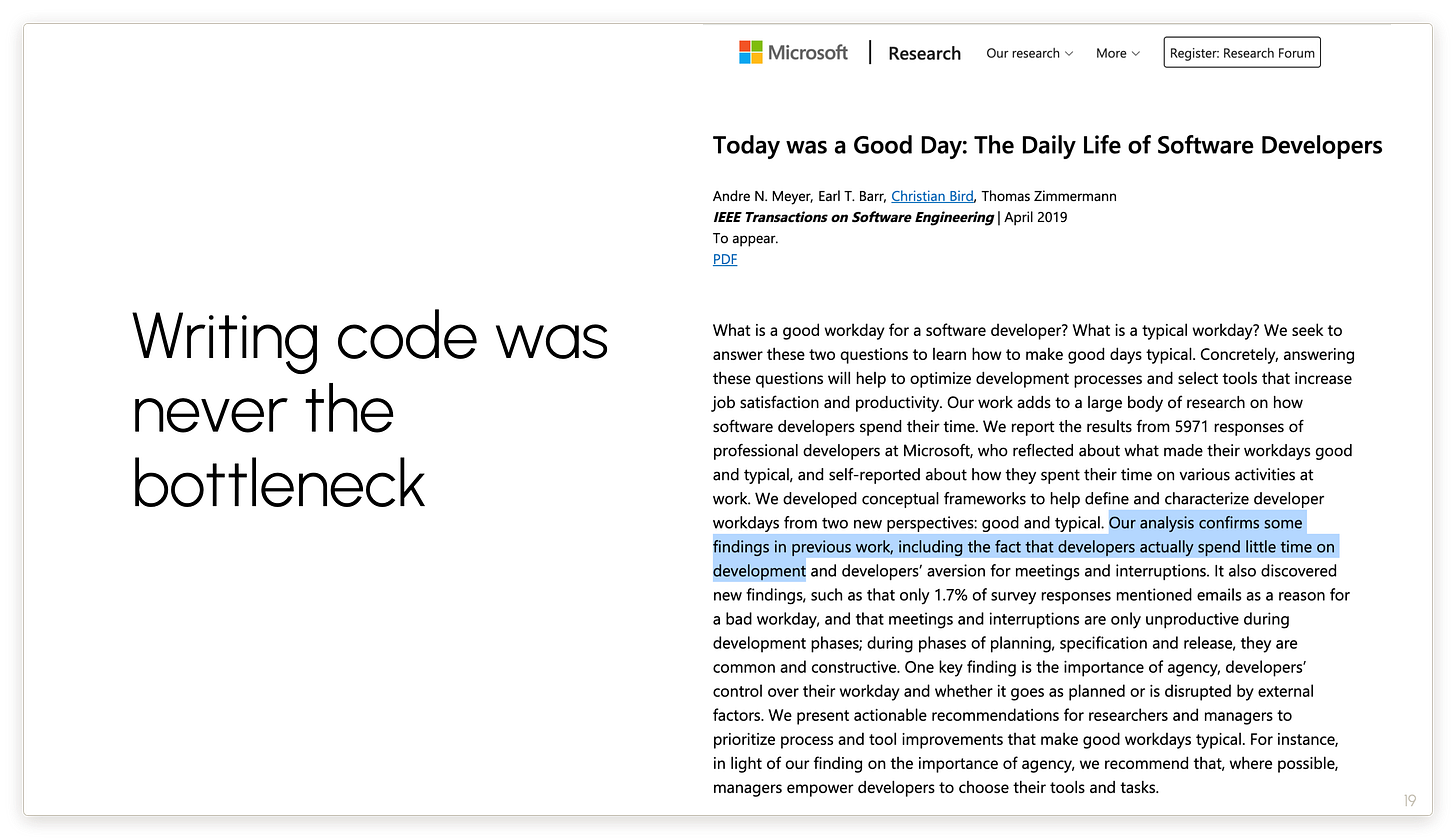
では、なぜこれまでに AI がソフトウェアエンジニアを置き換えていないのでしょうか。実は 2019 年の論文でも示されているように、コードを書くこと自体がボトルネックになっているわけではないことは、すでに周知の事実です。
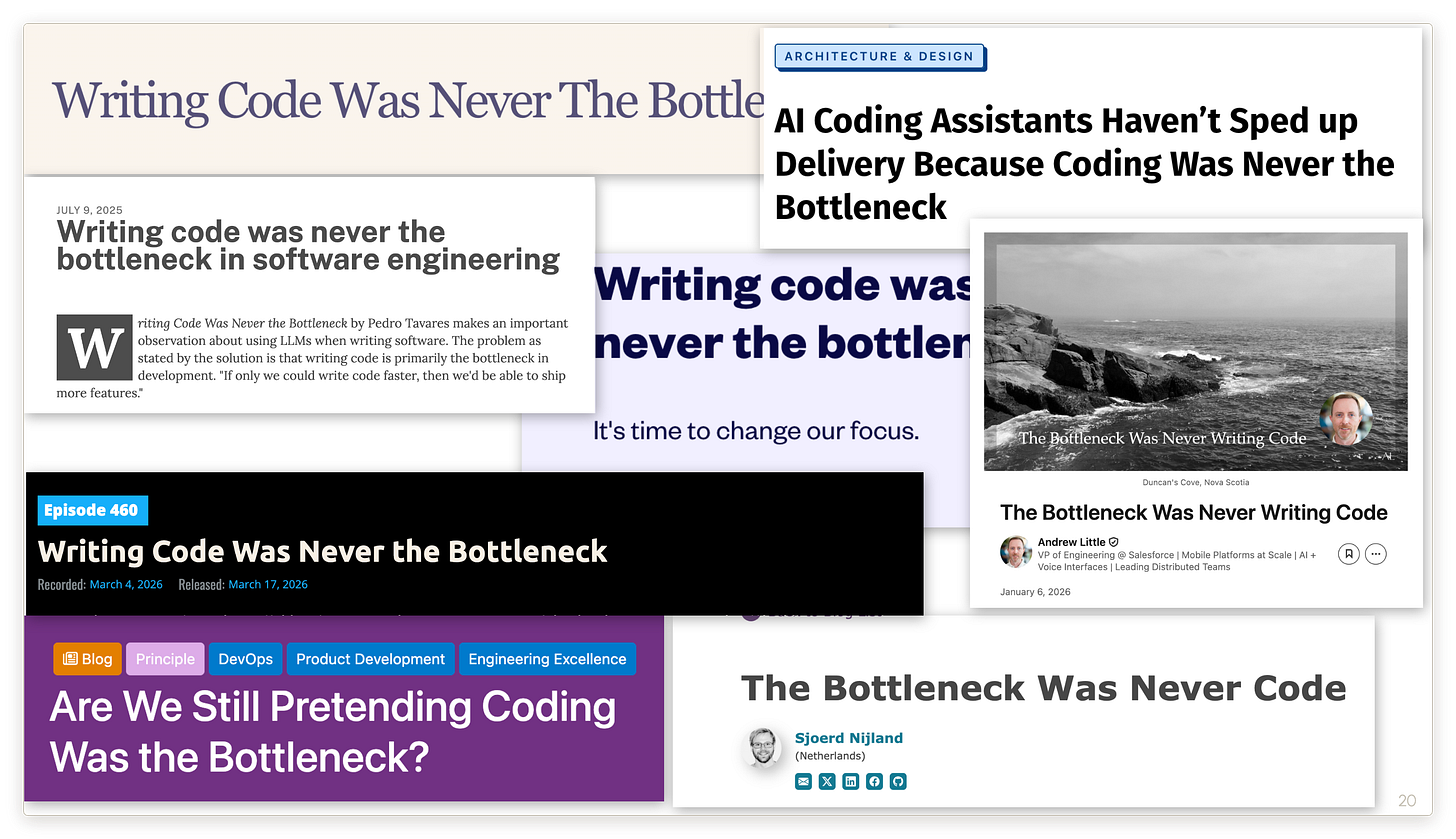
ここ一年、ソフトウェアエンジニアたちがコーディングエージェントの導入を進めつつも、結局は作業量が減っていないことに気づき始めています。その中で、「コードを書くこと自体がボトルネックではない」という事実を再発見するブログ記事が多数登場しました。
では、実際のボトルネックとは何なのでしょうか?
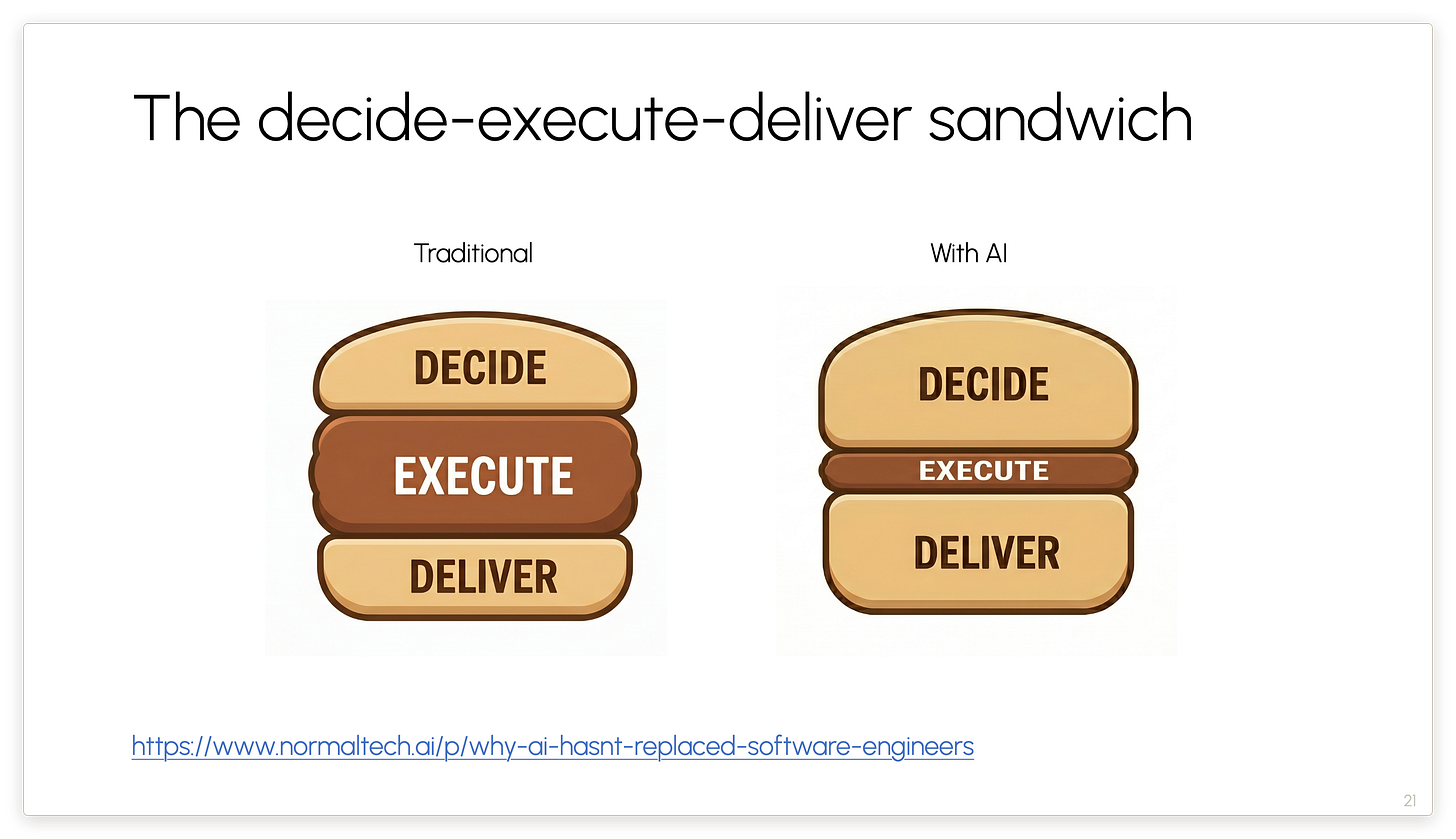
このフレームワークこそが、その問いに対する私たちの答えです。
「決定」レイヤー——顧客要件の理解、仕様の策定、計画立案など。ここにはまだ圧縮の余地が残されています。
原文を表示
I had the honor of giving a keynote at the International Conference on Machine Learning in Seoul last week titled “What will be left for us to work on?” I addressed the widespread anxiety about how we should adapt as AI capabilities increase. I was thrilled by the talk’s reception, so I have made my slides available here, annotated with a lightly edited transcript. You can also view them below right here on this page, but the online version has animations, clickable links, and a much nicer experience overall.
I made three arguments. First, the AI as Normal Technology framework is a correct and useful as a way to think about AI’s impacts, unless and until there is some future discontinuity such as through recursive self-improvement. Second, even though we should take recursive self-improvement seriously, there is no milestone that companies might achieve in the lab that will suddenly put us all out of work. Third and finally, jobs of the future will be radically different, and a lot of adaptation will be needed. I shared my thinking about what this might look like and ended with a vision of human/AI “co-superintelligence”.
Now is a time of great excitement in AI, but it’s also a time of great anxiety in the AI community. I want to address that anxiety head on. How do we prepare for a future where AI will become capable of doing more and more of the work that we do today?
I lead a team at Princeton University trying to advance the science of AI agent evaluation. We try to go beyond the usual claims of “Look, capability is going up on benchmarks!” Those claims tend to be misinterpreted by the broader public as implying that agents are soon about to take all our jobs.
Maybe that will happen. But in our work we try to understand the factors beyond capability that matter for real-world deployment, and bring that understanding into evaluations.
The work that I’m better known for is the essay I co-authored with Sayash Kapoor called AI as Normal Technology. It’s a way to think about the medium-term future of AI and how to adapt to it — and in turn how to adapt it to the needs of society and the economy.
So we’ve been going around writing these essays about how lawyers should adapt, or maybe how journalists should adapt. But perhaps ironically, the question of how to adapt has been hitting our community first. Whether it’s software engineering or AI research itself, AI capabilities in these areas are of course advancing very rapidly.
Our response to this moment matters beyond this community. The whole world is watching. If we simply roll over and accept that a lot of our work will be done by AI in the future, instead of setting clear boundaries, I think it will lead to an even stronger political backlash against AI than what we are seeing today. So I think this question is not just for us but for the whole world.
From the beginning of AI, historically there have been these two battling narratives. In the past, the distinction was academic and philosophical, but now it has become an acutely practical question. Each one of us has to decide which camp we’re in, or where on this spectrum we’re in, because the practical consequences of believing in one versus the other are very, very different.
If you think this is a technology which in a few years is going to be able to replace everything we do today, then perhaps the correct response is to build wealth as quickly as possible before our skills become irrelevant. And this is the path that many have chosen in Silicon Valley. You may have heard of the “permanent underclass” meme.
On the other hand, if you believe, as I do, that this is a technology that will greatly amplify our potential, then now is the best time to build skills — especially the skills that are going to be complementary to what AI is doing and is going to be able to do — as well as to build all the things around it, such as agency and taste and judgment.
If you choose the first path, and it turns out that AI actually ends up being an amplifying technology as opposed to a replacing technology, then I would argue that over the next few years you’ve perhaps lost the best time in history to build these skills that will give us superpowers. That’s why we all need to think about this question, even if we won’t all land in the same place.
AI as Normal Technology is the intellectual framework for my talk today. When we say AI is normal, we don’t mean that it’s just like a hammer or a toothbrush, some kind of mundane technology.
We acknowledge prominently in the essay that this is a transformative technology on the scale of the industrial revolution. We’re not AI skeptics.
This is not a slogan. It’s a framework — sort of a causal model how AI capabilities impact the economy and society. It’s a 15,000-word essay and we’re turning it into a book. And I mention that because people often hear the word normal and they assume they know what we mean, but that leads to misunderstandings.
First, I’ll argue that this framework is correct and useful as a way to think about AI’s impacts, unless and until there is some future discontinuity — such as through recursive self-improvement — that leads to future impacts looking very different from past impacts.
Second, I will talk about why, even though we should take recursive self-improvement seriously, I’m not particularly losing sleep over it.
Third and finally, I want to be clear that I’m not saying that jobs of the future will be just like jobs of the present. A lot of adaptation will be needed. So I want to give some preliminary thinking on how I think our roles are going to change and how we can best adapt to the changes.
Powerful technologies of the past, like electricity, have been thoroughly studied, and we have good frameworks to understand how technological progress leads to economic impacts.
Invention: discovering the principles of electromagnetism, AC versus DC, etc.
Innovation: People don’t use “electricity” directly. We use electrical appliances. Those had to be invented, so that is a kind of downstream innovation — that’s the second phase of the framework.
Diffusion: This refers to the gradual process by which people start adopting innovations.
In our essay we apply this framework to AI and flesh it out into a four-part framework.
Here’s the basic picture, illustrated with software engineering as an example.
Methods/capabilities: Models are rapidly improving.
Products/applications: We don’t use LLMs directly. The reason they’ve been so influential in all of our work is because of coding agents. These are products that take those latent capabilities and turn them into something useful and usable for workers.
Early adoption: At first people were mostly trying vibe coding, and now we know that that’s not really the best way to develop production software — so now we have more sophisticated ways of doing agentic engineering.
Adaptation: (or structural transformation) — the fourth and slowest phase. Much of my talk today is going to be about that. I claim that this stage takes decades. It has not really started yet, even in a field like software engineering, which is a relative early adopter of coding agents.
We don’t know what the adaptation phase will look like — we can only speculate. Permit me to speculate for a minute. If it’s going to be the case that coding agents are going to be able to create ten-million-line code bases in the future that are not full of bugs and security vulnerabilities, then it won’t make a lot of sense for us to create one piece of software that billions of people should use. It’ll make a lot more sense for software to be tailored to the needs of each individual or team. And that’s what I mean by extreme personalization.
It’s not merely a technological change — that’s also a change for the industry. For instance: do we even need software companies anymore? Maybe software development will massively shift in-house, into the companies and teams that are actually using the software. Again, this is speculation, but the point is that it is this kind of organizational change, human change — that’s very slow, that takes decades — that will allow us to take advantage of the full potential of AI, whether it’s in software engineering or in any other field. So that’s one of the central insights of the essay. When we look at past technologies, this kind of change tends to be very slow.
Before electricity, factories used to look like the picture on the left. A massive steam engine generated power and it was moved throughout the factory by mechanical gears and belts. So when electricity came along, factory owners tried to replace those steam boilers with electric generators. They thought it would be much more efficient. But this idea of a drop-in replacement did not work. We keep hearing that term in the context of AI agents today — that they will be drop-in replacements for human workers. That did not work in the case of electricity.
What actually worked, and what took 40 years to develop, is to recognize that electricity is a very different technology. It’s portable, so you can move the power to wherever you need it. That lets you reorganize the entire layout of the factory around the logic of the assembly line. And that required changing the way that workers are trained, hired, and fired, new labor laws, and so forth. So that’s the kind of organizational adaptation that it took in order to reap the benefits of electricity in factories.
Our claim is that this is the kind of process that we will go through for AI. A couple of decades from now, we will have fundamentally reorganized work. We don’t know what that’s going to look like, and that is the challenge in front of all of us. And that’s not just a job for the AI companies to do, much like it wasn’t the job of the electric utility to figure out how factories should be reorganized. In our view, this is the slowest of the four stages through which AI leads to economic impacts. Today, this process has not really gotten started.
Why is there a huge gap between what people in various occupations could be using AI for and what they’re actually using it for? One reason could be that people are slow to adopt technology, and that’s certainly part of our framework.
But we wondered if maybe the people who are deploying AI and are not having much success at it know something about the practical limitations of AI that the AI industry doesn’t. Let’s have a bit more humility about the relationship between capabilities and deployment.
Given that the #1 concern people cite is reliability, we wanted to try to measure whether reliability, distinct from capability, is a barrier to the practical usefulness of AI agents.
We looked at 10-12 reliability metrics and clustered them into four dimensions.
Consistency: Suppose we hear that an AI agent has a 70% accuracy. Does this mean it works on 70% of the tasks, but on the ones that it does, it does so every time? That’s great for deployment — you can deploy it on that subset of the tasks. Or does it mean that on any given task it might unpredictably fail with a 30% probability? That’s pretty useless from a deployment perspective. Perhaps shockingly, none of the agent benchmarks that we looked into make a distinction between these two. Both of these are represented as 70% accuracy.
Robustness: We looked at robustness: what happens when the environment changes a little bit?
Calibration: Can the agent look back at its transcript and tell if it performed the task correctly?
Operational safety: When it does fail, is it recoverable, or is it something like deleting the production database?
For a human worker, if we think of someone as being competent at a job, it’s all of these things, not just accuracy. But it turns out we were measuring agents only on accuracy.
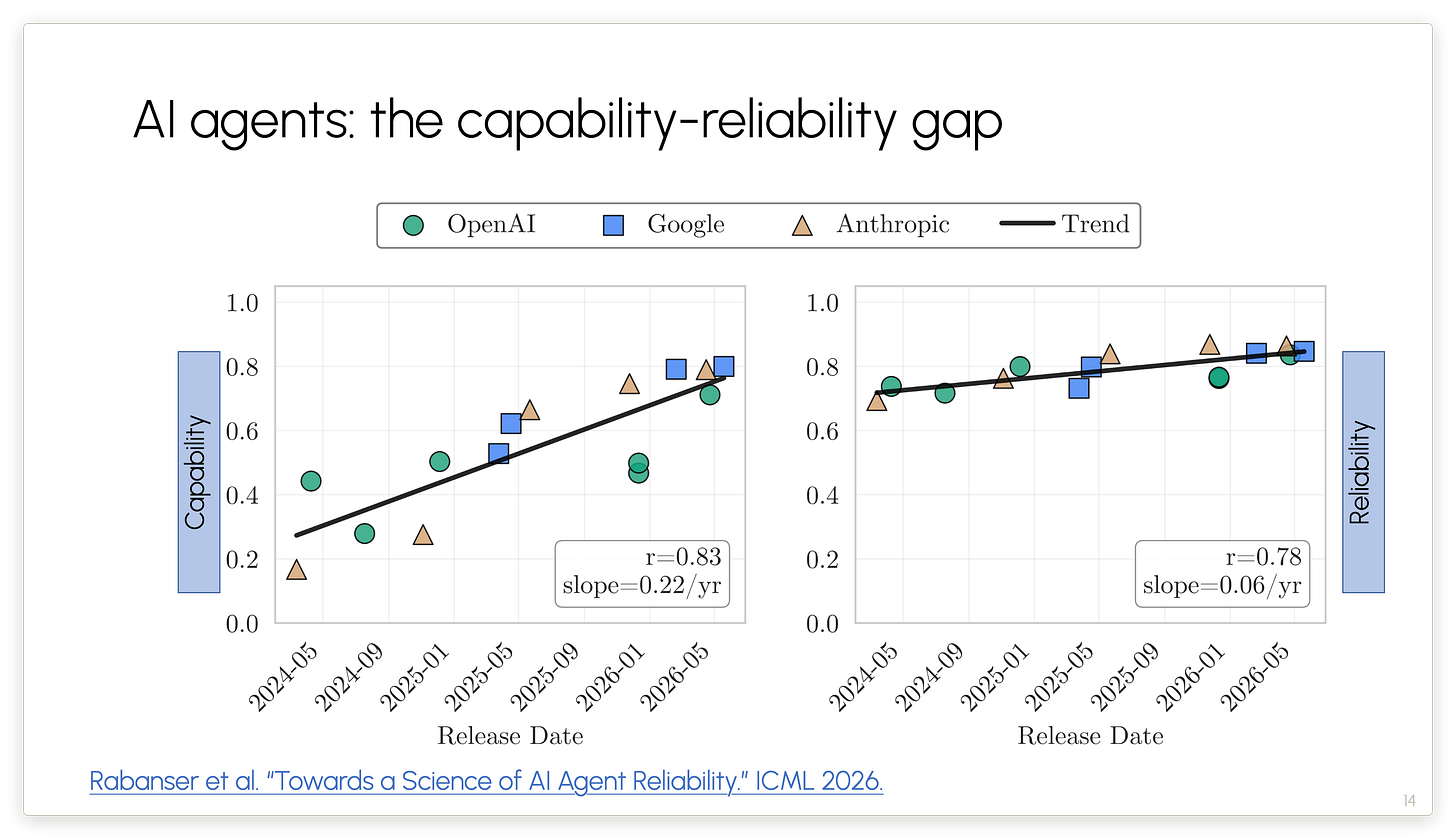
We measured capability and reliability using two complementary benchmarks, for models from these 3 frontier AI companies that were released over the last 24 months or so.
This is a period during which accuracy or capability shot up dramatically (left).
But reliability (right) only increased by five or ten percentage points.
There are a bunch of implications but let me highlight one. Right now the industry is not treating automation and collaboration agents differently. If you run an agent in headless mode, I guess that becomes an automation agent. That is not a good way to look at it, because properties like reliability that are very important for automation agents can actually be a hindrance for a collaboration agent that you might be using to improve your creative writing or something like that. For that kind of agent, you don’t want it to behave like a robot that does the same thing every time. You want it to be creative and explore different possibilities and be unpredictable.
Scaffolds and even the post-training of models should be different based on whether it is supposed to be driving a collaboration agent or an automation agent.
My hope is that reliability will continue to improve and automation will become easier over time. But for now I think collaboration agents will continue to be much more successful. Many companies that hastily rushed to automate business processes using agents are recognizing the limits and costs, and even legal liabilities — like when an agent deletes production data.
For the time being, you can have only two out of these three properties in agents: general-purpose (a language model based agent that can be instructed to do different tasks rather than purpose-built for a task like traditional software); deployed in high-stakes scenarios, and automated.
This is one of the reasons that I think that for now, AI remains much more of a collaboration technology than a technology that automates workers away.
Let’s take software engineering as a case study. It’s a good leading indicator because coding agents have been particularly rapidly adopted.
You might think: okay, we can’t completely automate away software engineering. But if agents make software engineers ten times more productive, then we need ten times fewer software engineers. Isn’t that an obvious consequence?
Well, that is completely contradicted by the data. We looked at this in a follow-up essay. In every case we looked at, the company was under financial pressure, and it turns out to be more convenient to blame AI for the layoffs instead.
Why is AI not replacing software engineers so far? We’ve known for a while — this is a paper from 2019 — that writing code is not really the bottleneck.
Over the last year, as software engineers started adopting coding agents and started to recognize that it doesn’t seem to be cutting down on the amount of their work, there have been many blog posts rediscovering the fact that writing code is not a bottleneck. Here is a small sample.
So what actually is the bottleneck?
This framework is our answer to the question.
The decide layer: understanding customer requirements, developing the specification, planning, etc. That is not getting compresse
関連記事
今日のまとめ
AI日報で今日の重要ニュースをまとめ読み