ホワイトハウスが個別に GPT-5.6 のアクセス権をその場しのぎで決定する方針へ
ホワイトハウスが GPT-5.6 のアクセスを個別かつ非公式に承認する方針を打ち出し、AI 規制の枠組みが不透明な政治的判断へと後退している。
キーポイント
個別審査によるリリース規制の実施
トランプ政権はセキュリティ懸念から、OpenAI の次期モデル GPT-5.6 を顧客ごとにホワイトハウスが個別に承認する方式を採用した。
不透明な政治的判断への懸念
予測不可能で非公式なアプローチは「最悪の政策」と批判されており、以前のような何もしない姿勢から一転した急進的な規制へと移行した。
Mythos 能力との類似性への言及
政府が介入した理由は、GPT-5.6 が「Mythos」と呼ばれる特定の強力な能力を備えている可能性にあるとされるが、その定義には混乱が生じている。
規制の急激な変化
ゼロから始まった AI 規制がわずか数日で CFIUS(外国投資委員会)レベルの API アクセス制限へと急速にエスカレートした状況にある。
開発の非対称性の拡大
新政策は外部への公開速度を遅らせるだけで、ラボ内部の開発速度には影響せず、一般利用可能なモデルと内部保有モデルの格差が広がる。
中国製モデルの制限リスク
西側諸国での段階的リリースにより中国製モデルとの技術格差が縮まるため、中国製モデルの禁止や NVIDIA などの半導体輸出規制の可能性が高まる。
ビジネスモデルへの脅威と政府介入
公開遅延は最終的にオープンソース代替品の台頭を招く恐れがあるため、米国政府がそれを防ぐために中国との協調または禁止措置を検討する可能性がある。
影響分析・編集コメントを表示
影響分析
この方針は、AI モデルの普及速度とセキュリティ確保のバランスが、技術的な判断から政治的な判断へとシフトしたことを示しています。企業にとっては、明確な基準がないままアクセス承認を待つ必要が生じ、開発ロードマップやビジネス計画に不確実性が生じるリスクが高まります。また、政府による個別審査が常態化すれば、AI 産業全体のイノベーション速度が阻害される恐れがあります。
編集コメント
政府による個別審査という前代未聞の手法は、AI ガバナンスにおける「透明性」と「予測可能性」を損なう重大な転換点です。業界全体が不確実な政治的判断に晒される中、明確な規制基準の早期策定が急務となっています。
We have a new standard policy for releasing frontier AI models. It is not good.
We are now, it seems, going to have the White House individually, in an opaque ad hoc manner, deciding who can access which frontier AI models when.
One hopes we will at least transition this into a predictable and formal set of procedures for determining what to do. But we spent years not laying the groundwork for doing that, and now here we are.
Essentially everyone should read the first half of this post, to understand what happened, and my speculations on what it means going forward for AI and America.
Only those who care and find it relevant to their interests should proceed to the second half, which addresses the blame game about how we got here, and claims that things would be better if people stopped speaking truth.
Table of Contents
Part 1: A Maximally Terrible Policy.
What Does This Mean For Fable?
Solve For The Equilibrium.
The Once And Future Fable.
Part 2: The Blame Game.
A Parable.
What About the Recent Executive Order?
The Problem Is Real.
Part 1: A Maximally Terrible Policy
Stephanie Palazzolo: New w/ @leomschwartz @amir:
The Trump admin has asked OpenAI to stagger the release of GPT-5.6 over security concerns.
On Thursday, CEO Sam Altman told staff that the government will be approving access to GPT-5.6 customer by customer, a highly unusual approach.
Jeffrey Ladish: Decent evidence that the Mythos ban wasn’t just the government targeting Anthropic
Samuel Hammond: We went from zero AI regulation to CFIUS-but-for-API-access in about a week.
I am happy that this suggests our policy is not primarily ‘try to murder or cripple Anthropic in particular,’ or at least that they will not be too hypocritical around that.
I am happy that our policy is not going to continue to be the previous policy of ‘do nothing, impose no restrictions, gather no information, build no capacity, see no evil, hear no evil, speak no evil, lest we not beat the only evil we can speak, which is China.’
Ad hoc opaque politicized decisions from the White House on who gets frontier intelligence, however, is Not The Way. It is maximally Not The Way.
Axios: The source said the government intervened because GPT-5.6 has “Mythos-like” capability, not because the administration is suddenly taking a heavier hand.
“This is what’s happening with models of that caliber,” the source said. The models are so powerful that the administration wants to be sure the companies have adequate safeguards in place, the source added.
What is ‘Mythos-like’ capability? I expect there to be a lot of confusion about the distinction between the thing Mythos is actually uniquely able to do, versus being able to replicate any individual finding. It is possible GPT-5.6 is ‘Mythos-like’ but my guess is it will be good but not be that Mythos-like.
Altman, in this case, is highly on point, but has no choice but to play ball:
Sam Altman: We’ve made clear to the U.S. government that this is not our preferred long term model, and will work with them and others in industry to achieve a more sustainable approach for future releases.
Thus, do not consider this new policy a victory.
Andrew Curran: For the people saying this is a pause, or a victory for safety, it is not. This does not slow development in any way, it only slows the rate at which the labs can 혳혦혭혦혢혴혦 models, not how fast they can train them. The gap between what is available to the public, and what the labs have internally, will steadily widen from this day forward. This actually makes no one happy. The old ‘AGI has been developed internally’ joke will absolutely come true now though, long before it is available to the public.
This also means Chinese models are almost certainly going to be restricted in some way - possibly even banned - in the West. Right now they’re roughly nine months behind. If every American frontier release is forced into a slow, staggered rollout from now on, they’ll start closing that gap immediately.
Over time, this destroys Western labs business models, because users will eventually have access to genuinely equivalent open-source alternatives - and in time, even better ones! The US government will not allow that to happen. The only way to prevent it is if China agrees to the same staggered release schedule (unlikely but I suppose it’s possible), keeping the gap roughly where it is today. Otherwise, the US will likely restrict or ban Chinese models. There’s probably a nine-month window, at most, probably a lot less, before one of those outcomes plays out.
It also means the probability that NVIDIA eventually gets restricted to within US borders just got way higher. It’s a lot harder for GPUs to wind up in China if they are a national resource. I wrote about this in my article.
How long will the delays be for releases? I agree that ‘roughly nine months ahead’ is correct. So if it takes two months to do releases, now we are seven months ahead. That still seems like enough. If it gets to be much more than that, it gets a lot scarier.
As Curran points out, this slows deployment. It does not slow internal development. OpenAI will be working on GPT-5.7 (or 6) on the same schedule as before. So this doesn’t cause cumulative damage to American AI.
I do not think this implies Chinese models are banned in America. It is a possibility for other reasons, but the point of the new policy is to keep dangerous things out of the wrong hands, especially Chinese or other foreign hands.
We might still ban Chinese models out of paranoia that they have backdoors or are otherwise biased or unsafe, now that we are in the model banning business. Or we might do it to protect American AI labs, although at that point we are rather cooked.
I don’t think America would restrict Chinese models from Americans purely because they were too good and thus dangerous in the wrong hands, once they were out there. But also I have a hard time predicting what the DC threat models will look like, because they often don’t match reality.
What about export controls on Nvidia? I don’t think we have a coherent theory here, and the government doesn’t yet understand that access to compute scales threats. But yeah, I do think long term this moves us towards tighter controls on chips.
What Does This Mean For Fable?
This had only a small negative impact on the odds of Fable returning, with time decay explaining most of the change in probabilities here since last time.
My worry is that treating GPT-5.6 this way makes it more likely that the White House is confused about what it means to have ‘Mythos-like capabilities’ and thus is likely to insist upon impossible interventions to ‘fix jailbreaks.’
Why such a small reaction? I think there is another market that is a big hint:
As in, by June 30 there is only a 14% chance the foreigner ban is rescinded (we need more dates here, please) but a 26% chance the Americans are back online. That implies a 12% chance of KYC implementation.
I thus interpret the bulk of the 50% chance we get Fable back in July as Anthropic being allowed to implement a relatively straightforward KYC process of some kind, rather than the restriction being lifted.
Solve For The Equilibrium
More generally, what happens now?
For now, all frontier model releases that exhibit whatever the White House considers ‘Mythos-level’ cyber capabilities, or other sufficiently threatening capabilities, will be subject to a similar approval process. The White House will decide, ad hoc, what gets released, and what does not, to who, on what schedule.
Over the next few months or hopefully weeks, we will probably get something more formalized, and we will better understand what the government is demanding. The requirements for releases may or may not be reasonable or achievable. I expect it to be relatively reasonable, but disaster is certainly possible.
Will the process be trying to be fair, or will it systematically favor some companies over others? The order on GPT-5.6 updates us towards the process being at least less unfair, but doubtless it will not be entirely fair. Anthropic is going to get more suspicion, and have a tougher time dealing with such things, than OpenAI. Up to a point, that is manageable, and even has its advantages. My instinct says that the gap will be meaningful, but manageable.
If what we get is a tiered release approval process, the biggest overall question will be, how long does it take? This does not much slow down development of American frontier AI. Instead, it slows down releases, which means everyone will be a fixed amount behind where they would otherwise be.
The first few weeks of the process are mostly ‘free’ in the sense that there are other things that require that time. A little extra time has its advantages, as many releases often feel rushed. After that, it gets perilous, and if the gap is often months that starts to dig into our competitive edge.
The other big question is, who will get the early access, and how will that be decided? Will it almost entirely be restricted to Americans? My assumption is yes, and this will be a big problem. How much this be politicized domestically, and not only Anthropic versus OpenAI (versus Google or SpaceX or Meta)? My guess is by default not that much, but that this will be used as leverage for other things, in an ad hoc manner.
It will be a while before any of this can be meaningfully codified into law. We need people to be working on that now, or else it takes even longer. Yes, events will move faster than Congress can, but we should not simply give up.
Another question is, what happens when open models start to cross the ‘Mythos-capable’ threshold? This is going to happen within a year or so. The hope is that we are ready before that happens, or ready enough that the fallout is not so bad.
If the US government wanted to ban open models, at least above some capability level, could they do so effectively? For the bulk of all tokens used, yes, rather straightforwardly, and if you ask ‘on what authority’ I am sorry but it is 2026, and they can totally get anyone with a footprint to stop.
If the question is ‘can they actually prevent a determined person with ordinary skill in the art from running DeepSeek or GLM or Kimi at home or from renting a Chinese server’ the answer is no, not without international cooperation.
If we are wise, we will use this as an opportunity to Pick Up The Phone. We have sent a costly signal that we see real issues with these models and are willing to make real sacrifices in the name of security. We should try to use that to get things in return, or at least lay the foundation for joint action.
Most of all, we are out of the ‘people don’t do things’ phase of the game, where basically all meaningful actions were outside the Federal overton window. That’s done. We should expect a lot more actions, many of them similarly ill-executed, at least at first, in ways that we did not anticipate.
And yes. It looks like this regime is here to stay, and things will only get crazier.
The Once And Future Fable
We also have a fun little update on the Fable negotiations.
First they complain when they can’t get you on the phone fast enough. Then they complain when they can’t get you off the phone fast enough.
Shikhar: “Dario Amodei hit a safety filter, and the conversation was automatically switched to Tom Brown”
Axios: The Trump Administration has been happier talking to Anthropic lately, according to people familiar with the matter: They don’t have to deal with CEO Dario Amodei anymore, because he’s been replaced in meetings about re-releasing the Claude Fable 5 AI model by his cofounder Tom Brown.
Tom Brown seems like an excellent choice for liason. He can absolutely handle this. Logically this puts a lie to ‘we need to only ever talk to Dario so he needs to be able to respond instantly at all times or else everything we do after that is your fault.’
Part 2: The Blame Game
You don’t have to keep reading past this point, if you don’t want to.
But here we are, and it seems necessary to have it here for the record.
Zvi Mowshowitz (Thursday): Our new AI policy is that the White House decides ad hoc, for whatever reasons it likes, who does and does not get access to frontier intelligence. This seems rather maximally terrible.
I did not see even a single person defend the new policy. Nor did I see any of the anti-regulation crowd respond with ‘thank you for saying this, let’s work together’ or any form of ‘thank you for changing your mind.’
Instead, we had a bunch of ‘who is to blame for this horrible new policy’ and a lot of ‘you warned us that this would happen, and this was directionally something you pointed out was needed, so this must be what you wanted and also your fault.’
Zvi Mowshowitz: Getting a highly unsurprising set of people RTing [the above] with versions of ‘if you people hadn’t warned of an underlying problem and called for laws to be passed and preparations to be made, which we ensured didn’t happen, we wouldn’t have this ad hoc thing, this is your fault.’
Teortaxes: That’s all retarded ofc. Dario’s commentary may have contributed on the margins, but anyone who’s so much as watched Terminator gets the idea of why the state would decide to seize military grade AI.
Matjaž Leonardis: I think the substantive point is more like “after months of trying to legitimise government taking control of AI the government now has taken control. Why are you opposing this?”
And certainly none of those people considered that they might actually be the ones most responsible for this mess.
Or that this might be a response, however inept, to a real underlying problem, rather than a response to a bunch of rhetoric.
Here’s the canonical example, in addition to Matt Parlmer and Martin Casado:
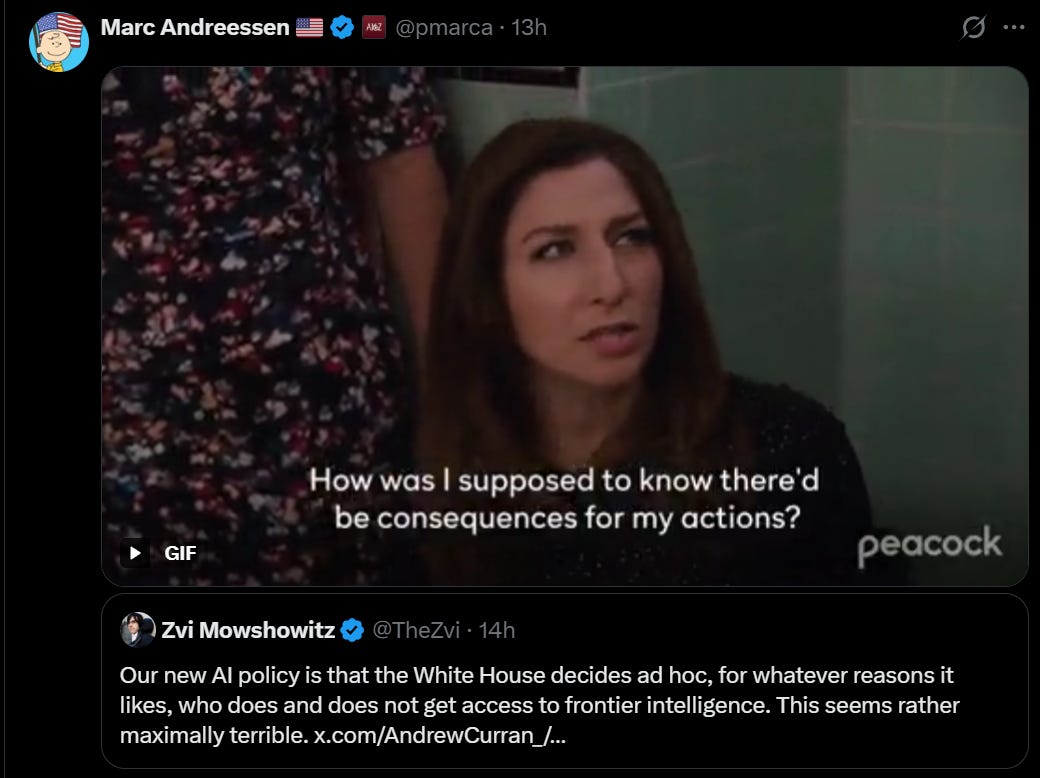
I dunno, I say back to the person most directly responsible for us not having any state capacity or transparency or understanding required to have a more reasonable and less crazy response to this situation, maybe you could introspect a little?
Marc also saw me come back and thus tried to taunt me a second time, saying that ‘you got what you wanted,’ but thought better of this and deleted the tweet.
Gary Marcus gets this story right, that the likes of Marc Andreessen and David Sacks spent the whole time until last month insisting that models would commoditize and no meaningful regulations or transparency were needed, and indeed no preparations should be made.
As a result, when the time came and the others at the White House freaked out over the new cyber capabilities, they took ad hoc actions based on misunderstandings, and we ended up in this giant mess.
A Parable
I mean, the events happened, but think of it as a parable.
In January 2020, some people started warning about a new virus: Covid-19.
These ‘doomers’ claimed that unless decisive action was taken now the virus would not be contained, that it would spread around the world, and that people would likely need to lock down to avoid infection. They urged preparing better for such steps now, both personally and as policy, and for us to do things like travel bans and screenings to try and stop the virus from fully spreading.
Others strongly opposed such talk.
In February 2020, it became obvious that this was going to happen. We did nothing.
In March 2020, it happened. When exponential growth went far enough, with almost no preparation, ad hoc rules were assigned as America locked down.
This was of course the fault of the people warning about the lockdowns. And they should be happy, right? Never mind that the execution was horrible. They got what they wanted. We could have avoided all this if not for all their talk of pandemics. Didn’t they know how governments work?
Then, later, a vaccine was invented and rolled out. People warned that this rollout would be logistically difficult and involve hard choices, and urged us to move quickly and prioritize saving lives.
The government instead largely prioritized preferred groups, and slowed the rollout considerably to ensure the right people got access first. This was all, of course, the fault of those who warned that this rollout would be difficult, and who proposed that we set rules for who got the vaccine first on the basis of age only. They should have known how government works.
There was also that time when I warned that we were at risk for termites and should take precautions, so it was totally my fault when termites were discovered and you then decided to then burn down my house. Problem solved, right? I got what I wanted.
I could generate like 20 more of these, several of which still involve Covid-19, but hopefully you get the point.
What About the Recent Executive Order?
SE Gyges makes the reasonable point that three weeks ago my opinion on the EO was different, calling this me ‘defending the EO power grab.’
SE Gyges: if you want me to take you seriously as an anti regulation person i want to know why you said we should be happy three weeks ago and why having said that wasn’t disqualifying.
Sure, that’s centrally fair.
First off, no, I am not saying I am general anti-frontier-AI-regulation-guy now.
I am saying I am anti this particular form of regulation, and its implementation.
(I do claim to be a general anti-regulation-of-most-things guy, in most areas of life, and I believe my and this blog’s track record on that are hard to argue with, and yes I would include many forms of non-frontier AI regulation.)
When it comes to government, ‘you will not get the version of this that you would like’ is always an excellent point, but also something in this vein was going to happen around this time no matter what, we confirmed that no later than a month ago, and the whole idea was always to try and do this better rather than worse.
So I think it is right to revisit this, I will quote the same passage SE quotes:
Zvi Mowshowitz: Anyone reading this the way adversaries tried to read previous proposals like SB 1047 would presumably be rightfully having a conniption fit, as this grants essentially unlimited leverage to the Executive branch. Yes, all of this is ‘voluntary,’ and sufficient abuse of the program could make companies not want to participate, but good luck dealing with the consequences if you tell the President no.
My view of the Executive Order’s Section 3 is that this implementation threatens to go in dangerous directions, and I’m sad about some implementation details opening the door to abuse, but if the The Offer Was Nothing as the alternative, yeah, you have to do it.
Thus I think we should be happy about this versus the alternatives, even though there are serious issues with details and implementation and there is a substantial chance we look back and regret this, perhaps quite a lot. We should try to turn this into an actual law as soon as possible.
I will extend it a bit, here is the rest of this passage:
Zvi Mowshowitz: We had our opportunity to do ‘this is hard to abuse’ forms of frontier model regulation, to do things the easy and better way, with things like the frontier parts of the Biden EO (it also contained some woke nonsense) and SB 1047, at a time when we carefully debated clauses to deal with worst-case scenario attempts at government abuse.
That window is closed now. We have to make policy within the Trump White House, and Dean Ball’s service term is over, so this is as good as we likely are going to get. We should still try and do better, but I am not so optimistic.
Yes, this could end up leading down a road of regulation that interferes and does damage, including for little or no safety gain, if the governmen
関連記事
今日のまとめ
AI日報で今日の重要ニュースをまとめ読み