React Native 向け高速・特化型モデル「Apex」の紹介
Callstack が React Native 開発に特化した専用 AI モデル「Apex」を発表し、汎用モデルの限界を超えたコスト効率と精度の実現を目指す動きを示した。
キーポイント
React Native 特化モデル「Apex」の発表
Callstack が React Native アプリ開発、アーキテクチャ分析、クロスプラットフォーム制約への対応に最適化された専用コーディングモデル Apex を公開した。
汎用モデルから特化モデルへ市場シフト
GitHub Copilot の従量課金移行など背景にあるように、大規模汎用モデルでの複雑なワークフローは高コストであり、特定領域に最適化した小規模モデルがコストパフォーマンスを改善している。
React Native 固有の課題への対応
サードパーティライブラリやネイティブモジュール、プラットフォーム制約など、汎用モデルが見落としがちな React Native 特有の文脈を理解し、より正確なデフォルト回答を提供する。
プライベートベータと今後の展開
社内エンジニアで既に稼働中であり、法的・運用的準備を整えつつ、選定チーム向けにプライベートベータを開始し、将来的には一般公開を目指す。
重要な引用
The broader AI coding market is moving away from a subsidization phase and toward sustainable compute economics.
A model can improve on general coding benchmarks and still miss the framework conventions, library behavior, and cross-platform details that decide whether a React Native answer is useful.
We built Apex to provide a focused specialist that understands these nuances natively.
影響分析・編集コメントを表示
影響分析
この発表は、AI コーディングツールの市場が「万能型」から「専門特化型」へと成熟し始めた重要な指標です。特に React Native のような複雑なクロスプラットフォーム開発において、汎用モデルの限界を補完する実用的な解決策を提供することで、開発効率とコスト構造に直接的な影響を与える可能性があります。
編集コメント
汎用 AI モデルの限界が顕在化する中、特定フレームワークに特化した「ニッチモデル」の実用性が証明されつつあり、今後はドメインごとの専用モデル展開が標準化していくでしょう。
今日、Callstack が構築した React Native コーディングモデル「Apex」を発表いたします。
Apex は、React Native アプリの構築、アーキテクチャ判断の分析、フレームワーク固有の問題の修正、そして単一のコードベースが複数のプラットフォーム向けにリリースされる際に生じる制約についての推論など、私たちが毎日行うエンジニアリング業務のためにトレーニングされています。
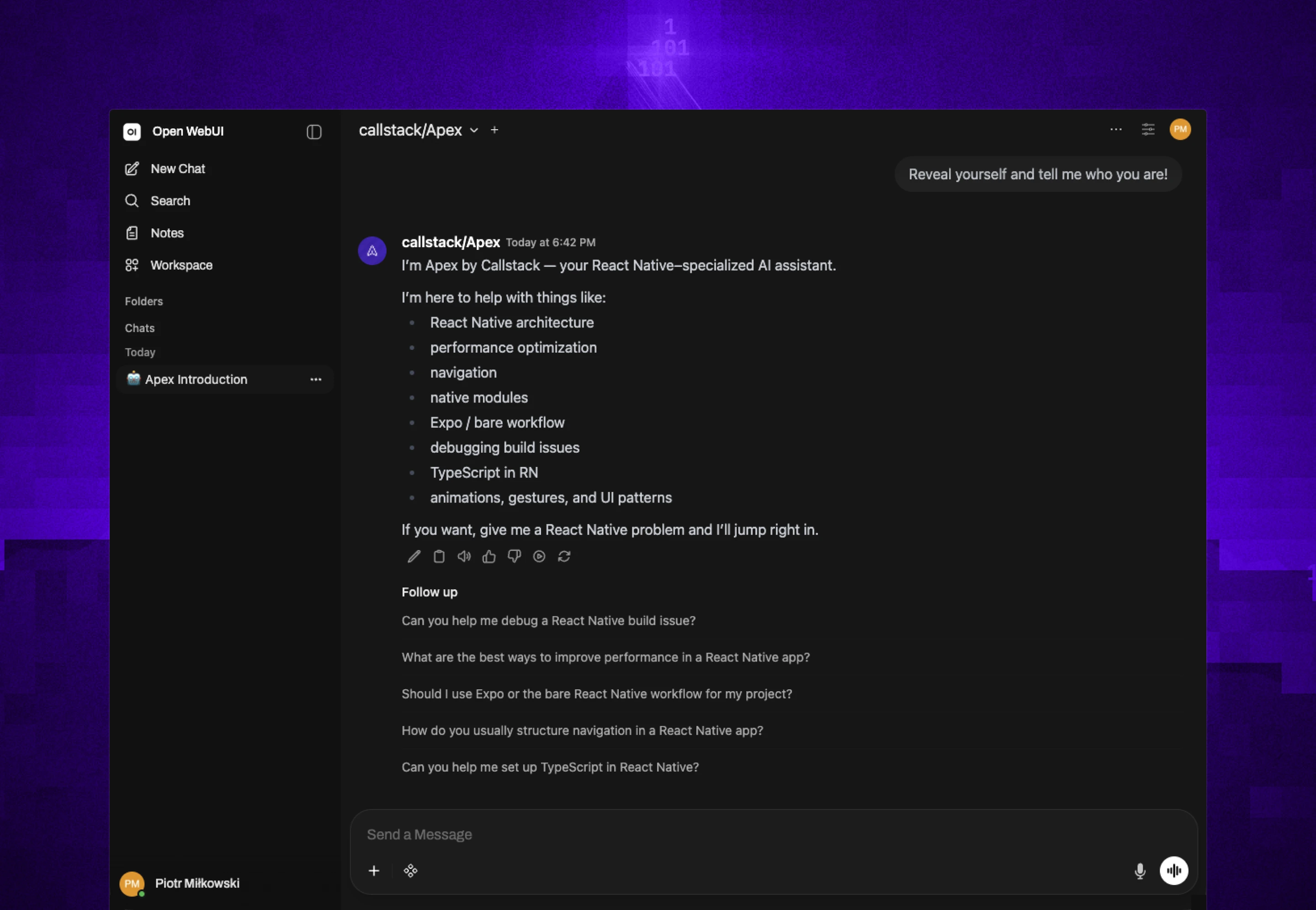
その実用的な価値はシンプルです。React Native 固有の回答、より高速な出力、そして推論コストの削減です。
すでに当社のエンジニアの間で内部運用を開始しており、現在、より広範な公共サービスとして提供するために必要な法的・運営上の手続きを完了するまで、特定のチーム向けにプライベートベータ版を公開しています。
専門化モデルへの転換
広範な AI コーディング市場は、補助金依存の段階から、持続可能な計算資源経済へと移行しています。GitHub が Copilot の利用量ベース課金へ移行したことは明確なシグナルです:大規模な汎用最先端モデル上で多段階の自律型ワークフローを実行することは、コストがかかります。
同時に、小さく高度に最適化されたモデルが、コスト対性能曲線を変革できることを証明し始めています。Cursor の Composer 2 や Windsurf の SWE-1 といった公的な実証事例は、汎用モデルをあらゆるワークフローに完璧に適応させるよりも、小さなモデルを特定の方向へ狭く最適化する方がはるかに容易であることを示しています。
私たちは、すべての孤立したタスクにカスタムモデルが必要だと考えてはいません。しかし、React Native 開発のような反復的で大量のエンジニアリング作業は、ドメイン固有のモデルから大きな恩恵を受けます。
なぜ Apex を構築したのか
React Native の開発は、サードパーティライブラリ、ネイティブモジュール、そして厳格なプラットフォーム制約など、複数の要素が同時に絡み合うものです。
一般的なコーディングモデルもこれらについてある程度の知識を持っており、急速に能力を向上させています。しかし、広範な進歩が必ずしもより優れた React Native の出力につながるとは限りません。モデルが一般的なコーディングベンチマークで改善しても、React Native の回答が有用かどうかを決定するフレームワークの慣習、ライブラリの動作、クロスプラットフォームの詳細を見逃す可能性があります。
React Native のワークフローやエージェント型エンジニアリングにおいては、より正しい答えに近いところから始められるモデルが必要です。ツール呼び出し、検索、スキル読み込み、プロンプトのスキャフォールディング(足場)をあまり必要とせずに、ライブラリ、API、パターンに関するより良いデフォルトを提供できることが求められます。
私たちは Apex を構築し、これらの微妙なニュアンスをネイティブに理解する焦点を絞ったスペシャリストを提供しました。
現在の Apex の得意分野
現状について現実的に捉えています。Apex はすべての最先端コーディングモデルの代替品ではありません。すでに有用であり、急速に進化している焦点を絞った React Native モデルです。
その能力を客観的に測定するために、私たちは Apex を React Native Evals に対して評価しています。
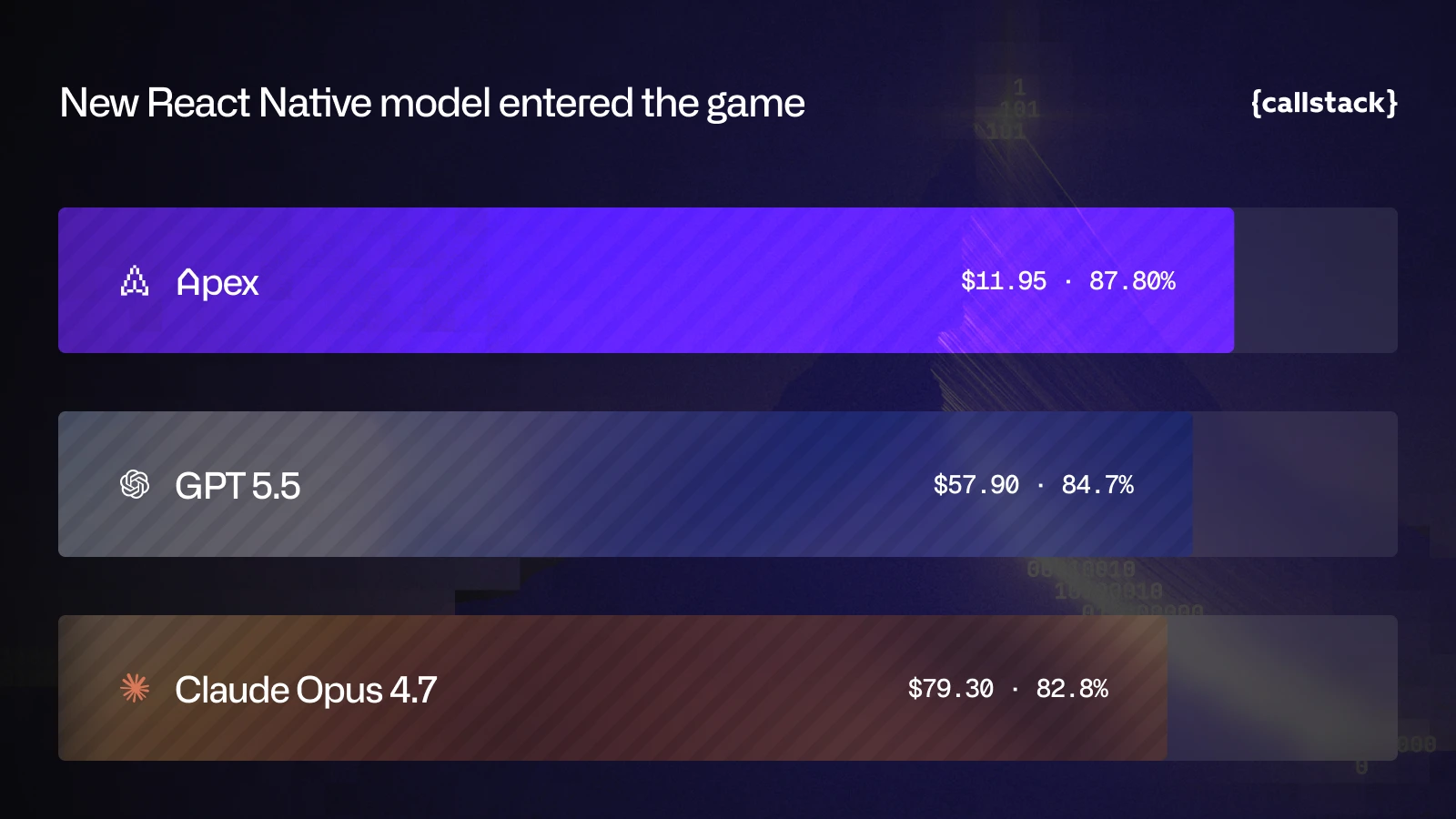
この特定のドメインにおいて、この最適化されたモデルは、より大規模で高価な汎用モデルと比較して、パフォーマンスとコストの比率を劇的に変化させます。
どのように訓練したか
Apex は Gemma 4 を基盤としており、React Native のコーディング作業に特化するように調整されています。
私たちは当初、Devstral や Qwen など他のベースモデルで概念実証実験を行いました。初期テストの結果、専門化を行う前にすでに React Native 作業に対して強みを持っていたため、Gemma 4 に移行しました。
その後、Apex を教師あり微調整(Supervised Fine-Tuning: SFT)とグループ相対ポリシー最適化(Group Relative Policy Optimization: GRPO)を用いて訓練しました。
訓練データは、最近の GitHub リポジトリや React Native エコシステムにおける作業から取得しています。ランダムで広範なウェブスクレイピングを行ったのではなく、エンジニアが日々の納品で頻繁に遭遇するライブラリやフレームワークを中心に慎重に選別したデータを使用しました。
最初の実験は 2 月 13 日に開始されました。3 月にはデータを収集し、複数のバリエーションを訓練しました。オープンソース開発者による内部テストは 4 月 2 日から開始され、それ以降、本番グレードのサービス提供のためのインフラストラクチャを整備する一方で、約 50 の異なるモデルバリエーションと設定を用意してきました。
動作環境と高速化の理由
速度は、モデルアーキテクチャ、私たちのサービング設定、そして狭いタスクへの焦点によって実現されています。
Gemma 4 が Apex に効率的な基盤を提供しています。負荷に応じて、専用クラスター上の 4 から 8 台の NVIDIA RTX PRO 6000 Blackwell Server Edition GPU を使用してホスト版を実行しており、本番環境でのテストでは、総生成出力は秒間 2,000〜4,000 トークン以上となっています。
モデル自体に React Native の知識が重み付けとして直接組み込まれているため、回答を生成する前に検索やツール呼び出し、汎用的なコンテキストの読み込み、または外部スキル実行への依存にかかる時間が短縮されます。開発者にとっての実践的なメリットは、プロンプト間の待機時間、リトライ、およびフォローアップタスクにおける待ち時間の削減です。
Apex は Vast.ai のセキュアクラウド上でホストされており、検証済みで信頼できるデータセンタープロバイダーを利用しています。このインフラストラクチャアプローチにより、レンタル GPU ハードウェアのコスト柔軟性と、本番環境での企業向けサービスに必要な厳格なセキュリティ体制を両立させています。
ここから先へ
Apex はより実世界での利用が可能ですが、まだ完全な公開サービスとして提供開始する段階ではありません。
外部にモデルを提供することに伴う法的、運営的、商業的な詳細について現在調整を進めています。準備が整うまでの間、選定されたチームとのプライベートベータ版を運用しており、体験の質を高め、より良いフィードバックを集め、実際の React Native 作業に対してモデルを継続的に改善するためです。
React Native の作業で Apex をテストしたい場合は、以下のリンクからプライベートベータへの申請を行ってください。
目次
あなたの React Native アプリで Apex を試す
Apex は、本格的なコーディングモデルを実際のエンジニアリングワークフローで検証したい、選抜された React Native チームに対して公開されています。
原文を表示
Today we are announcing Apex, a React Native coding model built by Callstack.
Apex is trained for the engineering work we do every day: building React Native apps, analyzing architecture decisions, fixing framework-specific issues, and reasoning about the constraints that appear when one codebase has to ship across platforms.
The practical value is simple: React Native-specific answers, faster output, and lower inference cost.
It is already running internally with our engineers. We are now opening a private beta for selected teams while we finish the legal and operational work needed to offer it as a broader public service.
The Shift Toward Specialized Models
The broader AI coding market is moving away from a subsidization phase and toward sustainable compute economics. GitHub’s move to usage-based billing for Copilot is a clear signal: running multi-step, agentic workflows on large, general-purpose frontier models is expensive.
At the same time, smaller, heavily optimized models are proving they can alter the cost-performance curve. Public proof points like Cursor's Composer 2 or Windsurf with SWE-1 demonstrate that it is far easier to optimize a smaller model narrowly in one direction than to make a general model perfect for every workflow.
We do not believe every isolated task needs a custom model. However, repeated, high-volume engineering work, like React Native development, benefits immensely from a domain-specific model.
Why We Built Apex
React Native development is composed of multiple moving parts at once: third-party libraries, native modules, and rigid platform constraints.
General coding models know some of this, and they are getting better quickly. But broad progress does not always translate into better React Native output. A model can improve on general coding benchmarks and still miss the framework conventions, library behavior, and cross-platform details that decide whether a React Native answer is useful.
For React Native workflows and agentic engineering, we want a model that starts closer to the right answer. We need better defaults around the libraries, APIs, and patterns without needing as much tool calling, search, skill loading, or prompt scaffolding.
We built Apex to provide a focused specialist that understands these nuances natively.
What Apex Is Good For Today
We are being realistic about where it stands. Apex is not a replacement for every frontier coding model. It is a focused React Native model that is already useful and improving quickly.
To measure its capabilities objectively, we evaluate Apex against React Native Evals.
Within its specific domain, this optimized model alters the performance-to-cost ratio significantly when compared to larger, more expensive general models.
How We Trained It
Apex is based on Gemma 4, then adapted specifically for React Native coding work.
We started with proof-of-concept experiments on other bases, including Devstral and Qwen. After early testing, we moved to Gemma 4 because the base model was already stronger for React Native work before specialization.
From there, we trained Apex using Supervised Fine-Tuning (SFT) and Group Relative Policy Optimization (GRPO).
The training data comes from recent GitHub repositories and React Native ecosystem work. We did not run a random, broad web scrape; instead, the data was carefully cherry-picked around the libraries and frameworks our engineers see in daily delivery.
Our first experiments started on February 13. In March, we gathered data and trained multiple variants. Internal testing with our open-source developers started on April 2. Since then, we prepared about 50 different model variants and configurations while building the infrastructure for production-grade serving.
Where It Runs and Why It Is Fast
Speed comes from the model architecture, our serving setup, and narrow task focus.
Gemma 4 gives Apex an efficient base. We run the hosted version on a dedicated cluster of 4 to 8 NVIDIA RTX PRO 6000 Blackwell Server Edition GPUs, depending on load. In production-serving tests, total generation output sits between 2,000 to 4,000+ tokens per second.
Because the model carries more React Native knowledge directly in its weights, it spends less time searching, calling tools, reading generic context, or relying on external skill execution before producing an answer. For developers, the practical benefit is less waiting between prompts, retries, and follow-up tasks.
We host Apex on Vast.ai Secure Cloud, using verified, trusted data-center providers. This infrastructure approach gives us the cost flexibility of rented GPU hardware combined with the strict security posture required for production enterprise serving.
Where We Go From Here
Apex is ready for more real-world use, but we are not opening it as a full public service yet.
We are still working through the legal, operational, and commercial details that come with offering a model externally. Until that is ready, we are running a private beta with selected teams so we can curate the experience, gather better feedback, and keep improving the model against real React Native work.
If you want to test Apex on React Native work, apply for the private beta below.
Table of contents
Try Apex on your React Native app
Apex is open to selected React Native teams that want to test a focused coding model against production engineering workflows.
関連記事
今日のまとめ
AI日報で今日の重要ニュースをまとめ読み