脳の働き方が異なる人にとって、AI は贅沢ではなくアクセシビリティである
AWS のエンジニアが自身の神経多様性(AuDHD)を克服するために AI を活用する実体験を通じて、AI が単なる生産性ツールではなく、認知機能の格差を埋める不可欠なアクセシビリティ手段であることを示した。
キーポイント
神経多様性と実行機能の葛藤
自閉症と ADHD が併存する AuDHD の脳は、構造を求める特性と新奇性を求める特性が常に対立し、従来の組織化システムを維持することが極めて困難であることを解説している。
AI を活用した代替システムの構築
単なるチャットボットの利用ではなく、Amazon Quick on your desktop などの AI エージェントを用いて、記憶やタスク切り替えといった認知機能の欠落を補完する具体的なシステムを構築した事例を紹介している。
アクセシビリティとしての AI の再定義
多くの生産性ツールが神経典型的な脳を前提としている中で、AI は神経多様性のプロフェッショナルにとって「贅沢」ではなく、業務を遂行するための必須のインフラ(アクセシビリティ)であると主張している。
従来のツールの限界と「ツール墓地」
Asana や Notion などの一般的なタスク管理ツールが、神経多様性を持つ人々の脳内メカニズムとの親和性の低さからすぐに廃棄されるという現実(ツール墓地)を指摘し、AI の役割の重要性を浮き彫りにしている。
重要な引用
When your brain works differently, AI isn't a luxury—it's accessibility
The 'tool graveyard' cycle isn't laziness. It's two competing neurotypes making it impossible to sustain any organizational system.
Most AI productivity tooling still assumes neurotypical brains.
影響分析・編集コメントを表示
影響分析
この記事は、AI の普及を「効率化」だけでなく「社会的包摂(インクルージョン)」と「アクセシビリティ」の観点から再定義する重要な示唆を与えています。特に、神経多様性を持つ人材が持つ創造性や分析能力を最大限に引き出すためには、従来の画一的なツールではなく、AI による個別最適化された支援システムが必要であることを明確にしています。企業にとっては、多様な人材を活用するための技術的基盤整備において AI の役割を見直す契機となるでしょう。
編集コメント
AI の進化を「人間を代替するもの」と捉えるのではなく、「人間の認知特性の多様性を補完・拡張するインフラ」として捉え直す視点を提供しています。特に、神経多様性を持つ人材が持つポテンシャルを引き出すための具体的な技術的アプローチとして非常に示唆に富んでいます。
AI をアクセシビリティツールとして:神経多様性のアーキテクトが脳との戦いをやめ、構築に転じたとき
この投稿では、神経多様性を持つプロフェッショナルにとって AI がどのようにアクセシビリティの手段となるかをお伝えします。私が活用しているのは、Amazon Quick on your desktop です。これはデスクトップおよび Web 上で動作する AI アシスタントで、日々の実行機能の欠落を補う役割を果たしています。また、AI があなたの業務をどのように支援できるかを見極めるための質問も紹介します。
ロンドン大学バーベック校の研究によると、英国の成人人口の約 15〜20%が神経多様性(ニューロダイバージェント)であると言われています。しかし、現在利用可能な AI の生産性ツールは依然として「神経典型性」を持つ脳を前提に設計されています。メールの仕分け、優先順位付け、フォローアップ管理といった業務は、神経多様性を持つプロフェッショナルにとって、技術的な作業そのものよりも遥かに大きな認知エネルギーを消費してしまいます。
私自身、自閉症と ADHD が併存する AuDHD です。私の脳はパターン認識や深い分析的思考、創造的な問題解決には非常に優れています。一方で、「昨日何があったか」の記憶、次に何をすべきかの判断、文脈を失わずにタスクを切り替えること、そして組織化されたシステムを維持することについては、極めて苦手です。
長年私は、それを補うために必死でした。周囲に合わせて自分を隠し(マスキング)、複雑な workaround を構築し続けてきました。しかし、毎晩帰宅すると、仕事で使い果たした実行機能のすべてが枯渇しており、最も大切な人々との時間を持つことさえままならない状態でした。
その後、私は AI を活用してシステム構築に取り組み始めました。単に「ChatGPT にメールを書いてもらう」ような使い方をしたのではなく、私の神経多様性によって生じる特定の認知上の課題を補うためのシステムを実際に作り上げることに注力しました。
その結果、以下のようなことが起きました。
実行機能の維持にかかるコスト
多くの人は、AuDHD(自閉症とADHDが併存する状態)についてこの重要な側面を理解していません。2 つの状態は常に互いに衝突し合っているのです。
私の自閉的な脳は、構造やルーティン、予測可能性を強く求めます。「完璧なシステム」を手に入れたいという欲求があります。一方、ADHD の脳はルーティンを拒否し、新奇性を渇望します。そして、初期のドーパミンによる高揚感が去ると、どんなシステムも維持できなくなります。
この 2 つは常に戦っています。
そのため、私はまず完璧なシステムを構築し(自閉的な側面が満足)、そのシステムを熱心に使い始めます(ADHD の側面が新奇性による快感に乗り)。しかし、すぐに作業負担が増えると、そのシステムを完全に放棄してしまいます(ADHD が勝利)。すると、結果として生じたカオスに対して本物の苦痛を感じます(自閉的な側面が叫びます)。このループが永遠に繰り返されるのです。
整理整頓には、神経典型の脳が費やすエネルギーの 10 倍もの認知リソースが必要になります。そのコストを払ってシステムを構築しても、私の神経特性という現実とぶつかった瞬間に、そのシステムは崩壊してしまいます。
「ツールの墓場」に陥るサイクルは、怠惰なせいではありません。2 つの異なる神経タイプが互いに競合し、いかなる組織化システムも維持できなくなっている状態なのです。
Asana、Notion、Todoist、紙の手帳、ホワイトボード。これらすべてを試しました。しかし、どれも死んでしまいました。
すべてを変えた洞察はただ一つ。「自分自身で維持できるシステムを構築する」ということです。
目に見えない足場の構築
ここ数ヶ月、私は AI を活用したワークフローシステムを構築してきました。このシステムは私の仕事と並行して稼働しており、毎朝起動します。セキュリティ上の制約により完全な自律動作ではありませんが、一度起動すれば思考プロセスの大部分を担います。観察、分類、実行、報告——これらすべてを処理し、私が行うべきことは単に起動ボタンを押すことだけです。
毎朝このシステムが行うこと:
メールの仕分け:起動はワンクリックで、思考は不要。 スキャンを開始すると、システムは洗練されたルールに基づいてすべてのメッセージを分類します。そして優先順位をつけたブリーフィングとして提示されます。直接の依頼や時間制限のあるメッセージを特定し、安全に無視できるノイズもフラグを立ててくれます。
AuDHD(注意欠如・多動症と自閉症スペクトラム)の脳にとって、受信トレイは地獄のようなものです。ADHD の側面では、50 件の未読メールが処理不能な要求の壁として映り、行動を麻痺させます。一方、自閉症の側面では、50 件のメールすべてを正しい順序で正確に処理しなければならないという重圧を感じます。適切な順序が判断できない場合、作業自体を開始できません。
私のシステムはこれを「今日あなたがやるべきことは 3 つ、他者に任せて待っているのが 2 つ、その他はすべて処理済み」という形に変換します。どちらの神経特性を持つ人にとっても、この説明なら受け入れ可能です。
タスクの状態管理と優先順位付けも同様に、日々の作業の下層に単一の統合レイヤーとして機能しています。
手動でタスクを移動させる必要はなく、フォローアップを忘れることもありません。システムが私のワーキングメモリでは処理しきれない役割を果たしてくれるのです。
AuDHD(注意欠如・多動症と自閉スペクトラム症の併存)を持つ人にとって、優先順位の付け方は両方の特性が絡み合って悪夢のような状況を生みがちです。ADHD の特性により、「すべてが同じくらい緊急だ」と感じたり「すべてが重要でない」と思ったりして、内部で優先順位を判断する信号が機能しません。一方、自閉症の特性により、低優先度のタスクでも完全に理解できないと行動に移せないため、3 時間近くも過剰な調査に時間を費やしてしまいます。その結果、本当に緊急な用件は後回しにされてしまいます。
そこで私は、システム内に明確なルールを設けました。「まずやるべきこと(Do First)」とは、「誰かが私を待っている状態」「今すぐ行動に移せる状態」「時間制限がある状態」の 3 つがすべて満たされている場合のみです。これらの条件のいずれかが欠けていれば、自動的に優先度を下げます。
この仕組みにより、次に何をすべきか迷って 20 分も動けなくなる「麻痺」を解消できました。答えは最初からシステムの中に用意されているのです。
私が実際に構築したもの
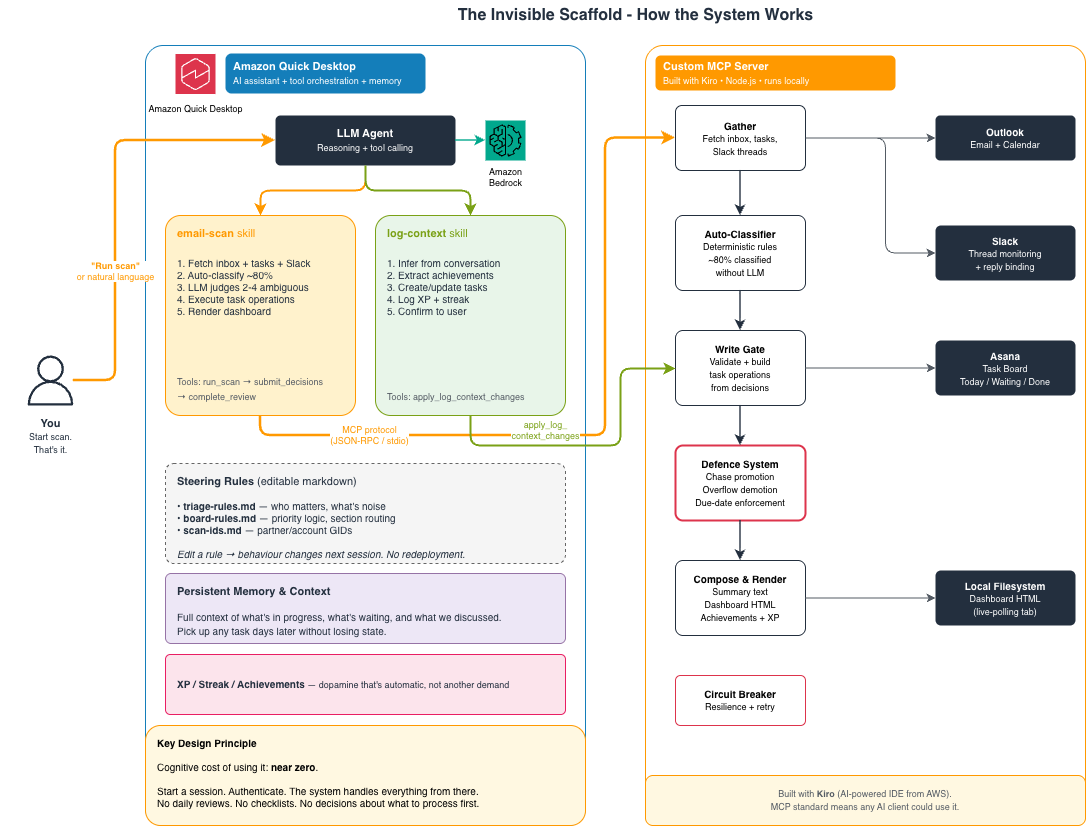
*図 1. メール仕分けのための AI ツール群の設計*
これは単に AI にプロンプトを入力して出力をコピーするだけの話ではありません。このシステムは、デスクトップアプリ「Quick」上で動作しており、恒久的な AI アシスタントとしての機能、会話履歴の保存、そしてツールを制御するオーケストレーション層を提供しています。基盤となる推論には Amazon Bedrock を接続しています。これにより、基盤モデルが改善されても、私のワークフローを変更することなく AI の推論能力を自動的に引き継ぐことができます。
このカスタムツールは、Model Context Protocol (MCP) サーバーです。AWS が提供する AI 搭載の統合開発環境(IDE)「Kiro」[https://kiro.dev/] を使って構築しました。
このサーバーは、Quick と Outlook の受信トレイやカレンダー、Asana のタスクボードを接続します。トリアージルールや優先順位付けのロジックは、設定可能な Markdown ファイルとして保存されています。コミュニケーションのパターンも同様にファイル化しています。AI はセッションごとにこれらのファイルを最新の状態で読み込みます。ルールを微調整すれば、システムの挙動が即座に反映されます。再デプロイの手間は一切不要です。
Quick のスキルフレームワークは、メールの書式設定、コンテキストの記録、一日のまとめ、タスク状態の管理など、繰り返し発生するワークフローのための再利用可能な自動化パターンを提供します。各スキルはトリガーされた際に確定的に動作するため、認知負荷をほぼゼロまで抑えることができます。
設計上の最も重要な原則は「利用にかかる認知コストがほぼゼロである」ことです。セッションを開始して認証するだけで、その後はシステムがすべてを処理してくれます。日々のメンテナンスや確認作業、チェックリストの完了、どのタスクから手をつけるかという判断は一切不要です。開始には数秒しかかかりません。実際に行われるのは、システムが引き受けた思考プロセスなのです。
神経多様性による違い
AI の生産性向上に関する記事の多くは、すでにオフィスワークに適した脳の持ち主によって書かれています。彼らは AI を使って「良い」状態から「素晴らしい」状態へ移行しようとしています。
しかし、多くの神経多様性を持つ人々にとって、AI は機能するかどうかを分ける決定的な要素になり得ます。
最初に変わったのは、時間感覚の欠如でした。私は時間が経過していることを実際に感じ取ることができません(これが ADHD の特徴です)。しかし、自閉症の影響で「何かが遅れている」ことに気づいた瞬間、遅れによる恥や社会的な不安が行動をさらに阻害してしまいます。私のシステムはすべてのタスクに対して経過時間を追跡し、古くなる前に通知を表示します。そのため、恥を感じる段階に至ることはありません。フォローアップは自動的に 1 週間以内に実行されるからです。
意思決定の麻痺と、コンテキスト切り替えに伴うコストも、このシステムが整えば解消されます。ADHD の場合、優先順位をつけることができません。自閉症の場合、文脈全体を理解するまでタスクを開始することができません。これらが組み合わさると、完全に行動不能な状態になります。しかし、朝にボードを見れば、すべてが整理されています。「まずやること」「次にやること」「時間があるときにやること」。決断する必要はありません。上から順に実行すればいいのです。同様に、ADHD のせいでタスクを切り替えた瞬間に文脈を失ってしまいますが、自閉症の影響で再参加する前に完全な文脈が必要になります。AI アシスタントとの会話は、これまでの議論内容、現在進行中の作業、待機中のタスクといった全コンテキストを含んでいます。一度タスクから離れても 3 日後に戻れば、システムは自閉症の脳が問題空間に再参入するために必要な情報を正確に提供してくれます。
次に問題となるのは、社会的な「マスキング(仮面)」にかかるコストです。自閉症のコミュニケーションは直接的です。私は自然に、プロフェッショナルなメールで求められるような角を削る表現をしません。しかし、あまりにも直接的すぎると失礼だと受け取られてしまうため、私は無理にマスキングをしてしまいます。その行為が私を疲れさせていました。
そこで、私はこのシステムに私の実際のコミュニケーションスタイルを学習させました。それは「本物の私」でありながら、ビジネスの文脈でも通用するように調整されたバージョンです。生成されるドラフトは、冷たい企業用 AI のようなものではなく、私らしい言葉で書かれます。その結果、「プロフェストional であるふりをする」という行為に費やすエネルギーを大幅に減らすことができました。
また、「ツール墓場」の問題も解消されました。これまで失敗したシステムとの決定的な違いは、導入コストが極めて低いことです。アプリを開き、認証し、スキャンを実行するだけで、残りの処理はすべて自動で行われます。
数値による効果
以下の数値はすべて私の個人的な体験に基づくものであり、製品のベンチマークや保証ではありません。
- 私がこれまで維持した中で最長の継続的なワークフロー期間。その長さは、以前のどのシステムよりも4倍に達しました。過去の組織化ツールはすべて10日以内に機能しなくなっていました。
- 完全なメールボックスのスキャンにかかる時間:6〜13分。以前はこの作業に手動でスクロールして判断するだけで45分以上を要していました(システム導入前の個人的な経験から推定)。
- 先月、フォローアップの取りこぼしはゼロでした。以前は、パートナーからのフィードバックやメールボックス内の追跡パターンの欠落に基づき、週に2〜3件は見逃していたと推測されます。
- 毎日終業時に明確な見通しが持てるようになりました。「何をしたか」「何が進展したか」「何を待っているか」が常に把握できます。これは以前には決してありませんでした。
私のような人にとって、これは何を意味するのか
誰よりも優れたエンジニアである必要はありません。
神経多様性(neurodivergent)を持ち、知識労働における組織化の要求に苦しんでいる場合、AI の役割は「神経典型的な意味での生産性向上」ではありません。重要なのは、見えない労力を可視化し、それを自動化して消去することです。
あなたの脳は、実際の作業自体には非常に優れているはずです。問題は、その周囲にあるものです。事務処理、フォローアップ、優先順位の付け方、記憶の負担などです。
まずはここから始めましょう。 自分にとってコストが最も高い認知タスク 3 つをマッピングしてください。それらの価値に対して不釣り合いにエネルギーを消耗するものを選びます。それぞれのタスクについて、「記憶」「判断」「開始」のいずれかが求められているか自問します。もしどれかに「はい」と答えられるなら、それは AI に任せる候補です。
次に、それを単一のアクションに還元できるかどうかを検討してください。「完全な自動化」(セキュリティや認証要件があるため現実的ではないことが多い)ではなく、思考プロセスをすべて AI に任せ、残るのは起動ボタンを押すだけにすることは可能でしょうか。これら 3 つの質問のうち一つでも「イエス」と答えられれば、それが最初の構築プロジェクトです。
マッピングの実践例は以下の通りです:
| 認知タスク | 記憶が必要? | 判断が必要? | 開始が必要? | 単一アクション候補? |
|---|---|---|---|---|
| メール仕分け | 誰が待っているか、何が古いか | 緊急性とノイズの選別 | インボックスを開いて処理を開始する | ✓「スキャン実行」ルールが残りを実行 |
フォローアップの追跡
- 何を、いつ、誰に約束したか
- 追撃すべき時と待つべき時の見極め
- 実際に追撃メッセージを送るタイミング
- ✓ 〇日間の無反応後に自動で優先度を上げる
優先順位の設定
- 進行中のタスク全体を把握する
- 今最も重要なことは何か
- 次のアクションへのコミットメント
- ✓ 毎朝、事前に計算されたボードを表示
これを実現するための問いかけ:
- 判断基準を正直に書き下せるか?
実際の動作原理を書き出すのです。理想の動き方ではなく、現実の仕組みです。「緊急性」は感情ではありません。私の場合、以下の 3 つが揃った時にのみ「緊急」と判断します。
- 外部から待たれている
- 今すぐ行動できる
- 48 時間以内に期限がある
これらどれかが当てはまらなければ、それは緊急事態ではありません。このルールは Markdown でわずか 6 行で記述できます。AI がそれを読み込み、疲労することなくすべてのメールに適用します。
- 思考と実行を分離できるか?
メールへの返信自体には 2 分かかりません。しかし、「どのメールに返信すべきか」を決めるのに 20 分もかかるのが現状です。これらは全く異なる問題です。私は後者の問題をすべて AI に任せることにしました。
- 開始コストをほぼゼロにできるか?
「使うことを忘れないように」と意識しなくてはいけないなら、私の AuDHD(注意欠如・多動症)がそのツールを殺してしまいます。基準はこうです。「抵抗感が湧く前に 5 秒以内に起動できるか?」もし Yes なら、そのツールは生き残ります。No なら、どんなに優れたツールでも「ツールの墓場」行きです。
ルール自体は単なる Markdown です。
プログラミング言語ではなく、平易な英語で記述します。例えば以下のようになります:
「まずやる」の定義
誰かが外部から待機しており、私が今すぐ行動でき、かつ時間制限がある場合のみ、「まずやる」と判断します。これらの条件のいずれかが満たされない場合は、自動的に優先度を下げます。
これが優先度のルール全体です。設定ファイルを編集するだけで、次のセッションから新しい動作が適用されます。再デプロイも不要ですし、学習コストもかかりません。一度自分の判断ロジックを書き留めておけば、それを一貫して永遠に使い続けることができます。
まずは「最も恥じらいを感じるタスク」から始めましょう。 私の場合、それはフォローアップの取りこぼしでした。何度も謝罪していたこと、基本的なプロフェッショナリズムを欠いていると感じさせていたことです。これが最初の構築対象です。ここが認知負荷(cognitive tax)が最も高く、かつ解決した際の relief が即座に得られる場所だからです。
恥じらいについて
この取り組みで最も難しかったのは、技術的な実装ではありませんでした。必要だと認めることの方がよほど困難だったのです。
「他のみんなはロボットアシスタントなしでこれをこなしている」と囁く声が聞こえるかもしれません。その声は間違いです。仮にそれが真実だとしても、関係ありません。視力を補うためにメガネが必要なら、それは着用すればよいのです。建物の入り口にスロープが必要なら、建物側にスロープを作るべきです。
もし AI が実行機能(executive function)の管理のために必要だと感じるなら、それはアクセシビリティ(accessibility)の問題です。それ以上でも以下でもありません。
ご自身のワークフローの可能性を探るには、Amazon Quick や デスクトップ版 Amazon Quick をご覧ください。
著者について

Andrew Johnston
アンダーソン・ジョンストンは、AWS で英国のパブリックセクター関連の取り組みを専門とするパートナーソリューションアーキテクトです。英国と米国で 30 年以上にわたり IT 業界に従事し、グローバルなシステムインテグレーターや中小企業、ソフトウェアベンダーとの協業を通じて培った深い知見を持っています。ビジネス上の課題と技術的な解決策をつなぎ合わせ、AWS パートナーが顧客のために革新的な成果を生み出すのを支援するのが得意です。パターンを見抜く鋭い眼力と、洗練されたソリューションを設計する能力は、パブリックセクターのデジタルトランスフォーメーションを推進する上で大きな強みとなっています。
原文を表示
*AI as accessibility: what happened when a neurodivergent solutions architect stopped fighting his brain and started building.*
In this post, I share how AI serves as an accessibility tool for neurodivergent professionals. The system is built on Amazon Quick on your desktop, an AI-powered desktop and web assistant that compensates for executive function gaps every day. I also share questions to help you identify where AI could support yours. Approximately 15–20 percent of the UK adult population is neurodivergent, according to research from Birkbeck, University of London. Most AI productivity tooling still assumes neurotypical brains. Email triage, prioritization, and follow-up management consume disproportionate cognitive energy for neurodivergent professionals compared to the technical work itself.
I have AuDHD (co-occurring autism and ADHD). My brain is excellent at pattern recognition, deep analytical thinking, and creative problem-solving. It’s terrible at remembering what happened yesterday, deciding what to do next, switching between tasks without losing context, and maintaining organizational systems.
For years, I compensated. I masked. I built elaborate workarounds. And every evening, I came home depleted, having spent all my executive function at work, with nothing left for the people who matter most.
Then I started building with AI. Not “asking ChatGPT to write email” but actually building systems that could compensate for the specific cognitive gaps my neurodivergence creates.
This is what happened.
What executive function actually costs
Most people don’t understand this about AuDHD: the two conditions are in constant conflict. My autistic brain craves structure, routine, and predictability. It *wants* the perfect system. My ADHD brain resists routine, craves novelty, and cannot sustain any system once the initial dopamine wears off. They’re permanently at war.
So I build the beautiful system (autism satisfied), use it enthusiastically for a week (ADHD riding the novelty hit), then abandon it completely when it becomes effortful (ADHD wins). Then I feel genuine distress at the resulting chaos (autism screaming). Repeat forever.
Organizing costs me 10 times the cognitive energy a neurotypical brain expends. Even when I pay that cost, the system I built won’t survive contact with my own neurology.
The “tool graveyard” cycle isn’t laziness. It’s two competing neurotypes making it impossible to sustain any organizational system.
Asana, Notion, Todoist, paper planners, whiteboards. I’ve tried them all. They all died.
The insight that changed everything: building a system that maintains itself.
Building the invisible scaffold
Over the past several months, I’ve built an AI-powered workflow system. It runs alongside my work. I start it each morning. Security controls mean it’s not fully autonomous. Once running, it handles the thinking. It observes, classifies, acts, and reports. My only job is to start it.
What it does every morning:
Email triage: One action to start, zero thinking required. After I start the scan, the system classifies every message against refined rules. It then presents me with a prioritized briefing. It identifies direct asks and time-sensitive messages. It also flags noise I can safely ignore.
For an AuDHD brain, inbox is death. The ADHD sees 50 unread email messages as a paralyzing wall of undifferentiated demand. The autism sees 50 email messages requiring correct processing in the right order. If I can’t determine the right order, I can’t start at all.
My system turns it into “3 things need you today, 2 are waiting on others, everything else is handled.” Both neurotypes can accept that.
Task state management and priority decisions work the same way, running as a single integrated layer beneath my daily work.
I don’t manually move a task, and I no longer forget to follow up. The system does what my working memory cannot.
Priority is where AuDHD creates a nightmare from both sides. The ADHD means everything feels equally urgent (or equally unimportant), with no internal ranking signal. The autism means that I will over-research a low-priority task for 3 hours because I need to understand it *completely* before I can act. Meanwhile, the actually urgent thing goes ignored.
I built explicit rules into my system. “Do First” means someone is actively waiting on me, I can act right now, and it’s time-bound. If any of those conditions aren’t true, it automatically demotes.
The system alleviates the 20-minute paralysis over what to do next. The answer’s already there.
What I actually built
*Figure 1. The design of the AI tooling for email triage*
This is more than prompting an AI and copying the output. The system runs on the Quick desktop application, which provides the persistent AI assistant, conversation memory, and tool orchestration layer. Quick connects to Amazon Bedrock for its underlying inference. This means the AI reasoning adapts as foundation models improve without requiring changes to my workflow.
The custom piece is a Model Context Protocol (MCP) server. I built it using Kiro, an AI-powered integrated development environment (IDE) from AWS. This server connects Quick to my Outlook inbox, calendar, and Asana task board. It encodes my triage rules and priority logic as configurable markdown files. Communication patterns are also stored this way. The AI reads these fresh each session. When I refine a rule, the system’s behavior changes immediately. No redeployment required.
The Quick skills framework provides reusable automation patterns for recurring workflows, including email formatting, context logging, end-of-day summaries, and task state management. Each skill runs deterministically when triggered, reducing the cognitive overhead to near zero.
The critical design principle: the cognitive cost of using it is near zero. I start a session, authenticate, and then the system handles everything from there. No daily reviews to maintain. No checklists to complete. No decisions about what to process first. The initiation takes seconds. It’s the *thinking* the system offloads.
The neurospicy difference
Most AI productivity content is written by people whose brains already work well for office work. They’re using AI to go from good to great.
For many neurodivergent people, AI can be the difference between functioning and not functioning.
The first thing that changed was time blindness. I genuinely can’t feel time passing (that’s the ADHD). But the autism means when I *do* realize something’s overdue, the shame and social anxiety about the lateness makes it even harder to act. My system tracks elapsed time on every task and surfaces things before they go stale. I never get to the shame stage because follow-ups happen automatically within a week.
Decision paralysis and context-switching tax both dissolve once the system is in place. The ADHD can’t rank importance. The autism can’t start a task without understanding the full context first. Together they produce complete inertia. But when I look at my board in the morning, everything’s already sorted: Do First. Do Next. If Time. I don’t need to decide. I start at the top. Similarly, ADHD causes me to drop context the moment I switch tasks, whereas autism means I need complete context before re-engaging. Every conversation with my AI assistant carries the full context of what we’ve discussed, what’s in progress, and what’s waiting. I can leave a task, come back 3 days later, and the system gives me exactly what my autistic brain needs to re-enter the problem space.
Then there’s the masking cost. Autistic communication is direct. I don’t naturally do the social softening that professional email requires. But I’ve learned that being *too* direct reads as rude, so I mask. That masking is exhausting. I’ve trained the system on my actual communication style, the version that’s authentically me but calibrated enough for professional contexts. Drafts come out sounding like me, not like corporate AI, and I spend less energy on the performance of professionalism.
The tool graveyard problem also dissolved. The key difference from every system that died before: the initiation cost is minimal. I open it, authenticate, run a scan, and everything else happens without me.
The numbers
All following figures are from my personal experience only. They aren’t product benchmarks or guarantees.
- Longest sustained workflow streak I’ve ever maintained, by a factor of four. Every previous organizational system died within 10 days.
- 6–13 minutes for a full inbox scan that previously took me over 45 minutes of manual scrolling and decision-making (estimated from personal experience before the system existed).
- Zero dropped follow-ups in the past month. Previously I lost an estimated 2–3 per week based on partner feedback and missed chase patterns in my inbox.
- Consistent end-of-day clarity. I know what I did, what moved, and what’s waiting. That never happened before.
What this means if you’re like me
You don’t need to be a better engineer than anyone else.
If you’re neurodivergent and struggling with the organizational demands of knowledge work, AI isn’t about making you more productive in the neurotypical sense. It’s about making the invisible labor visible and then automating it away.
Your brain is probably excellent at the actual work. The problem is everything around it: the admin, the follow-ups, the prioritization, the remembering.
Start here: Map your three most expensive cognitive tasks, the ones that drain you disproportionately to their value. For each one, ask whether it requires you to remember, decide, or initiate something. If the answer to any of those is yes, that task is a candidate for AI offloading. Then determine whether you can reduce it to a single action. Not “fully automatic” (that’s often unrealistic with security and authentication requirements). But could the *thinking* be offloaded so all that’s left is starting it? When even one passes that test, you’ve found your first build.
The mapping exercise looks like this:
Cognitive task
Remember?
Decide?
Initiate?
Single-action candidate?
Email triage
Who’s waiting on me, what’s stale
What’s urgent vs. noise
Open inbox and start processing
✓ “Run scan” – rules do the rest
Follow-up tracking
What I promised, when, to whom
When to chase vs. wait
Actually sending the chase
✓ Automatic promotion after N days silent
Priority setting
Full picture of everything in flight
What matters most right now
Committing to the next action
✓ Pre-computed board every morning
The questions that unlock it:
- Can I write down my decision rule honestly? Write down how it actually works, not how you wish it worked. Urgent isn’t a feeling. For me it means: Someone external is waiting, I can act right now, and there’s a deadline within 48 hours. If any of those conditions aren’t true, it’s not urgent. That’s six lines of markdown. The AI reads it and applies it to every email without fatigue.
- Can I separate the thinking from the doing? The act of replying to an email takes 2 minutes. The act of deciding which email to reply to takes 20 minutes of paralysis. Those are different problems. I offloaded the second one entirely.
- Can I make the initiation cost essentially zero? If it requires me to remember to use it, my AuDHD will kill it. The threshold is: Can I start it in under 5 seconds, before the resistance kicks in? If yes, it survives. If no, it joins the tool graveyard regardless of how good it is.
The rules themselves are only markdown. Plain English, no programming. Something like:
*“Do First” means someone external is actively waiting AND I can act right now AND it’s time-bound. If any of those conditions aren’t true, automatically demote.*
That’s the entire priority rule. Edit the file, and the behavior changes next session. No redeployment. No learning curve. Just your own decision logic, written down once, applied consistently forever.
Start with the one that causes the most shame. For me it was dropped follow-ups. The thing I kept apologizing for. The thing that made me feel like I was failing at basic professionalism. That’s your first build. It’s where the cognitive tax is highest and the relief is most immediate.
A note on shame
The hardest part of this journey wasn’t the technical build. It was admitting I needed it.
There’s a voice that says “everyone else manages this without a robot assistant.” That voice is wrong, and even if it weren’t, it doesn’t matter. If you need glasses to see, you wear glasses. If you need a ramp to access a building, the building should have a ramp.
If you need AI to manage your executive function, that’s accessibility. Full stop.
To explore the possibilities for your own workflow, see Amazon Quick and Amazon Quick on your desktop.
About the author
Andrew Johnston
Andrew is a partner solutions architect at AWS focused on UK Public Sector initiatives. With over 30 years in IT across the UK and US, he brings deep expertise from his work with global integrators, SMEs, and software companies. Andrew excels at connecting business needs with technical solutions, helping AWS partners deliver innovative outcomes for their customers. His unique ability to spot patterns and craft elegant solutions makes him an asset in driving public sector digital transformation.
関連記事
今日のまとめ
AI日報で今日の重要ニュースをまとめ読み