新 GPT-5.6 ファミリー:Luna、Terra、Sol の登場
OpenAI が新モデル「GPT-5.6」シリーズ(Luna, Terra, Sol)を一般公開し、エージェント性能で Claude Fable 5 を上回る一方、コーディング評価では SWE-Bench Pro の信頼性に疑問を呈した。
キーポイント
新モデル「GPT-5.6」シリーズの発表と価格設定
OpenAI が最小から大型までの 3 つのサイズ(Luna, Terra, Sol)を持つ GPT-5.6 シリーズを一般公開し、トークンあたりの価格体系も明示した。
エージェント性能における Claude Fable 5 の凌駕
長期的なプロフェッショナルワークフローを評価する「Agents' Last Exam」において、GPT-5.6 Sol が Claude Fable 5 を大幅に上回るスコアを記録し、コスト効率も極めて高いことを示した。
SWE-Bench Pro の信頼性への批判と反論
Anthropic の Fable 5 が SWE-Bench Pro で GPT-5.6 を上回った結果を受け、OpenAI は同ベンチマークの約 30% に不具合がある可能性を指摘し、結果の再検討を呼びかけた。
新 API 機能「Programmatic Tool Calling」
JavaScript を用いてツール呼び出しをオーケストレーションする新機能が追加され、MCP とターミナルセッションの統合や動的フィルタリングの可能性が示唆された。
影響分析・編集コメントを表示
影響分析
このニュースは、LLM の性能評価基準をめぐる OpenAI と Anthropic の対立を浮き彫りにしており、ベンチマーク結果の解釈に対する業界全体の警戒感を高める可能性がある。また、エージェント機能とプログラム実行能力の強化は、実務レベルでの AI 活用を加速させる重要な転換点となるだろう。
編集コメント
ベンチマーク結果の解釈を巡る企業間の対立は、開発者が評価指標を選ぶ際に注意を要する状況を示しています。一方で、エージェント機能の実用化に向けた API の進化は、現場での活用可能性を大きく広げる内容です。
OpenAI's latest flagship model hit general availability this morning, and comes in three sizes: Luna, Terra, and Sol (from smallest to largest).
The new models are priced per 1M input/output tokens as Luna $1/$6, Terra $2.50/$15, Sol $5/$30. For comparison, the Claude Opus series are $5/$25 and the Claude Fable 5 is $10/$50, but price-per-million tokens doesn't tell us much now that the number of reasoning tokens can differ so much between models for the same task.
OpenAI's biggest benchmark claim concerns long-running agentic performance, with one benchmark showing all three models outperforming Claude Fable 5:
We trained GPT-5.6 to get more useful work from every token. On Agents’ Last Exam, an evaluation of long-running professional workflows across 55 fields, GPT-5.6 Sol sets a new high of 53.6, eclipsing Claude Fable 5 (adaptive reasoning) by 13.1 points. Even at medium reasoning, it beats Fable 5 by 11.4 points at roughly one-quarter the estimated cost. That efficiency extends to smaller models, which are essential to making intelligence more abundant and affordable: GPT-5.6 Terra and GPT-5.6 Luna outperform Fable 5 at around one-sixteenth the cost.
Amusingly, one self-reported benchmark that Fable 5 crushed the GPT-5.6 family on was SWE-Bench Pro, where Fable 5 got 80% compared to GUT-5.6 Sol getting 64.6%. This may help explain why OpenAI chose to publish this article yesterday specifically calling out SWE-Bench Pro for problems they found while auditing that benchmark:
In light of these results, we estimate that ~30% of SWE-bench Pro tasks are broken, and advise that model developers carefully examine results
I've had some early access to GPT-5.6 Sol - it's definitely very competent, though so far it hasn't struck me as better than Fable at the kind of complex coding tasks I've been using with Anthropic's model.
As usual, the model guidance for using GPT-5.6 has the most interesting details. There are a bunch of new API features that I need to explore (and probably add support for in LLM), including:
- Programmatic Tool Calling allows the models to "compose and run JavaScript that orchestrates tool calls" - which sounds to me like it could help bridge the gap between MCPs and full terminal sessions that can compose CLI utilities in useful ways. Also reminiscent of the dynamic filtering mechanism Anthropic added to their web search tool, which allows code execution against web results as part of a single model turn.
- Multi-agent lets the model "spin up subagents for parallel, focused work" - the sub-agent pattern now baked into the core API.
- Prompt cache breakpoints brings the Claude model of prompt caching to OpenAI, letting you be explicit about where the cache breakpoints are rather than relying on the API to detect them automatically. Personally I much prefer automatic detection (still supported by OpenAI), but presumably there are optimization cost savings to be had here if you put the work in.
- You can now set detail: original on image requests to avoid resizing the image at all before it is processed.
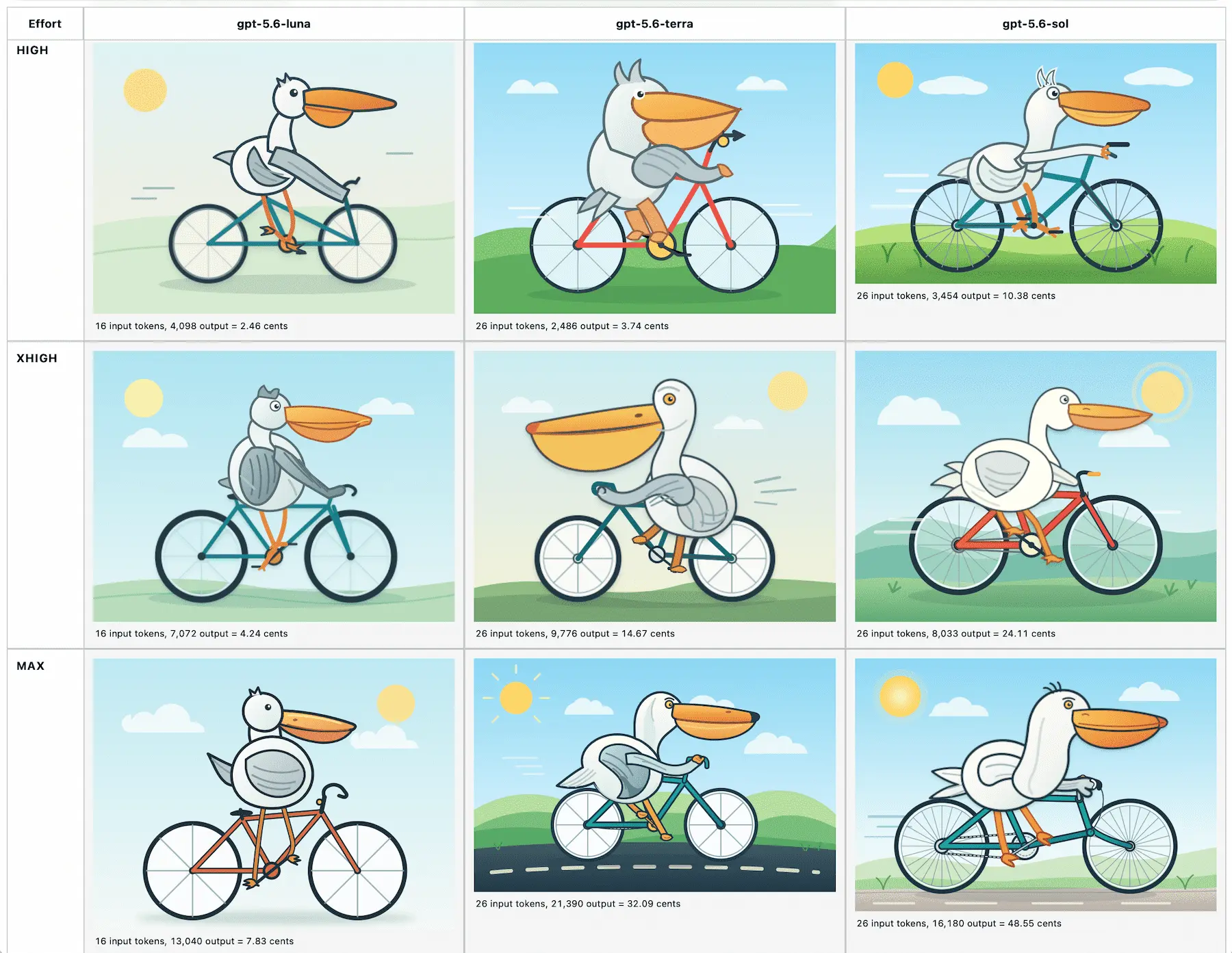
Here's a full page with 18 different pelicans - for reasoning efforts none, low, medium, high, xhigh, and max across the three different models. It also lists their token and calculated costs - the least expensive was gpt-5.6-luna at effort none for 0.71 cents, the most expensive was gpt-5.6-sol at max reasoning level for 48.55 cents.
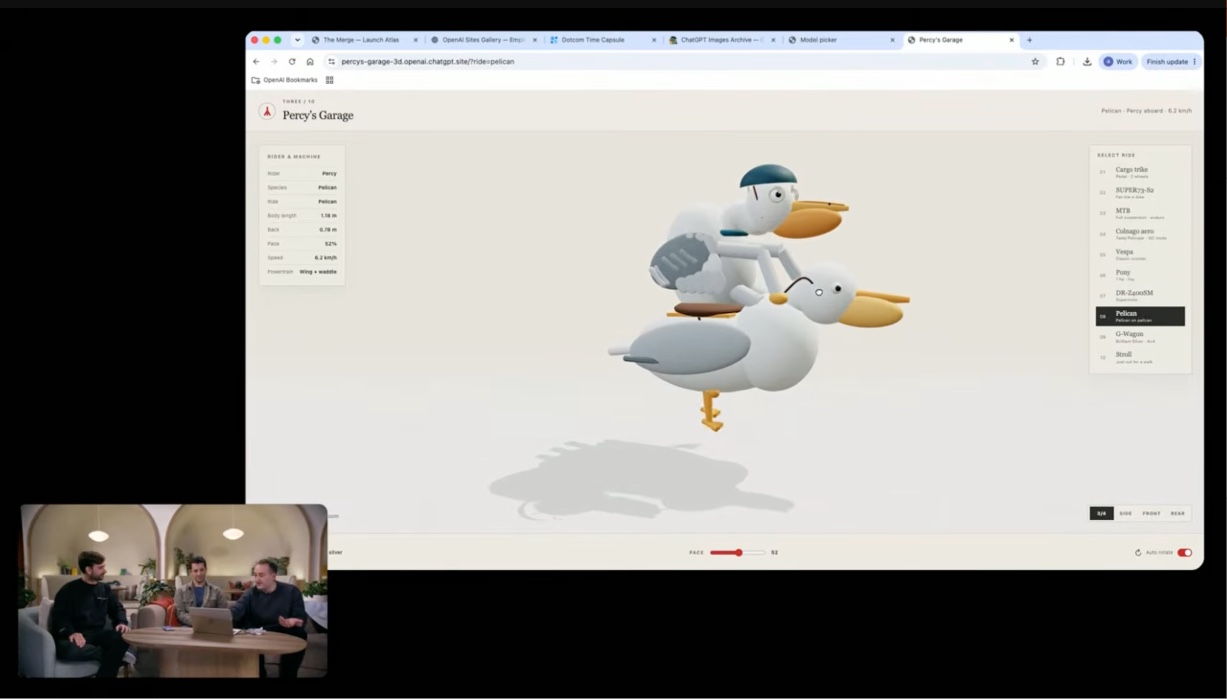
In further pelican news, if you jump to 17:50 in their livestream from this morning you'll see OpenAI's own demo of 3D pelicans riding a tricycle, a bicycle, a pony, and another pelican!
Tags: ai, openai, generative-ai, llms, llm-tool-use, llm-pricing, pelican-riding-a-bicycle, llm-release, gpt-5
関連記事
今日のまとめ
AI日報で今日の重要ニュースをまとめ読み