Amazon Bedrock AgentCore を用いた、組み込みのガードレールによる安全なエージェント決済の実現
Amazon は、AI エージェントがユーザーの資金を安全に運用するための「AgentCore payments」プレビューを開始し、Coinbase や Stripe と連携してランナウェイ支出や同意なしの取引といったリスクに対処するガードレールを提供した。
キーポイント
自律型エージェントの支払い課題とリスク
LLM の非決定性や長期間の自律動作により、誤ったプロンプトやコンパイルミスが「ランナウェイ支出」を引き起こす可能性があり、インフラ層でのガードレールが必要となる。
AWS AgentCore payments の機能と連携
Amazon Bedrock AgentCore が Coinbase Developer Platform や Stripe Privy と連携し、エンドユーザーに代わって支払いリソースへのアクセスを可能にする仕組みを提供する。
セキュリティ対策としてのガードレール
スコープ限定の「ペイメントセッション」を設定し、予算(budget)と有効期限(TTL)をインフラ層で強制することで、モデルの判断ミスによる資金流出を防ぐ。
エンドユーザーの同意と委任の確保
エージェントが行動する際のエンドユーザーの同意や権限委譲(デレゲーション)を明確に定義し、自己管理型ウォレット(Embedded Wallet)を活用して資金の所有権を保護する。
重要な引用
When the tools, MCP endpoints, or web resources an agent reaches are paid, the agent gets stuck without the ability to transact.
Putting real money behind an autonomous system raises a new set of risks. They come from agents acting autonomously over long sessions, model non-determinism, and a wider exposure surface between agent code and the end user's funds.
Spending limits must be defined and enforced outside the model, at the infrastructure layer.
影響分析・編集コメントを表示
影響分析
この発表は、AI エージェントが単なる情報処理から実際の経済活動(購買・決済)へ移行する際の最大の障壁であった「安全性と信頼性」の問題に対する具体的な解決策を示すものです。特に、大規模な自律システムにおける資金リスクをインフラレベルで制御可能にした点は、実社会でのエージェント活用を加速させる重要な転換点となります。
編集コメント
AI エージェントが現実世界で経済活動を行う際、最も懸念される「暴走」や「不正利用」への対策として、インフラ層での厳格なガードレールを実装した点は非常に重要です。AWS が大手決済プロバイダーと連携してこの機能を先行提供することは、エンタープライズ向け AI アプリケーションの実用化を後押しする大きな一歩と言えます。
エージェントは、エンドユーザーに代わってツールを選択したり、ウェブを閲覧したり、MCP サーバーを自律的に呼び出して目標を達成したりする行動をますます取っています。エージェントが到達するツール、MCP エンドポイント、または Web リソースが有料である場合、決済手段がないためエージェントは作業が行き詰まってしまいます。Coinbase および Stripe (Privy) との提携によりプレビューとして発表された Amazon Bedrock AgentCore payments により、エージェントはエンドユーザーに代わって有料リソースへのアクセス権を取得し、タスクを完了できるようになります。
自律的なシステムにお金を投入することは、新たなリスクのセットをもたらします。これらのリスクは、長期セッションにおけるエージェントの自律的な行動、モデルの非決定性、およびエージェントコードとエンドユーザーの資金間のより広い暴露面から生じます。本稿では、それらのリスクと、AgentCore payments が各リスクに対処するために組み合わせたガードレールについて解説します。
*AgentCore payments は、米国東部 (バージニア北部)、米国西部 (オレゴン)、欧州 (フランクフルト)、アジア太平洋 (シドニー) のプレビュー版として利用可能です。一般提供前に機能や API が変更される可能性があります。
本稿全体を通じて、以下の用語を使用します:
- エンドユーザー:資金を支出する人間であり、エージェントがその代わりに取引を行う対象者。
- 開発者:AI エージェントに支払い機能を統合する AWS の顧客。
- ウォレットプロバイダー:Coinbase Developer Platform (CDP) または Stripe Privy。
- 埋め込みウォレット:エンドユーザー所有の自己管理型ウォレットで、ウォレットプロバイダーがホストします。
- ペイメントセッション:単一のエージェント対話のためのスコープ付き支払いコンテキストであり、設定可能な予算と有効期限 (TTL: Time-To-Live) を持ちます。
- 開発者認証情報:ウォレットプロバイダーが開発者に発行する API キー、シークレット、および認証キーで、AgentCore payments がウォレットプロバイダーの API を呼び出す際に使用されます。
本稿では、エージェント向け支払いシステムを設計する際に顕在化する主要なリスクと、それらを AgentCore payments の機能を用いてどのように対処するかについて説明します。
課題:エージェント支払いにおける安全性リスク
エージェント向けの支払い機能を設計する上で、いくつかの主要なリスクが影響を及ぼします。
支出の暴走
エージェントは自律的かつ長時間稼働します。エンドユーザーに代わって意思決定を行い、セッション中に多くの意思決定を下すことがあり、キーボード操作を行う人間が常時いるわけではありません。明示的なガードレールがない場合、プロンプトミスや侵害を受けたエージェントによって、支出が制御不能になるリスクがあります。
大規模言語モデル(LLM)も非決定論的であるため、モデルが応答を支出の承認として誤解釈したり、予期しないリトライによって支払いを繰り返したりすることを保証することはできません。支出制限は、モデルの外側、すなわちインフラストラクチャ層で定義し、強制する必要があります。
エンドユーザーの同意と委任の欠如
エージェントは今や自律的に支払いを実行できますが、最終的な制御権はエンドユーザーが保持しなければなりません。エンドユーザーは、支出権限を委任するタイミング、ウォレットへの入金を行うタイミング、資金を引き出すタイミングを決定します。エージェントは包括的な付与ではなく、明示的かつスコープ限定された許可の下で動作し、エンドユーザーは必要に応じてその許可を取り消すことができます。
開発者キーおよびウォレットトークンの侵害
エンドユーザーに代わって取引を行うエージェントには、2 種類の機密情報が存在します。1 つ目は、AgentCore payments がウォレットプロバイダーの API を呼び出す際に使用する開発者認証情報(API キー、シークレット、認証キー)です。2 つ目は、エンドユーザーの埋め込まれたウォレットキー(これはウォレットプロバイダーが自己保管しています)です。これら両方はエージェントコードから遠ざけておく必要があります。これらの認証情報をエージェントコード内や環境変数に直接格納した場合、侵害されたエージェントによってそれらが漏洩してしまいます。エージェントはこれらの認証情報を直接取り扱うべきではなく、システムが個別の支払いのために発行する認証情報は、短期間で有効期限切れとなり、特定のセッションに紐付けるべきです。
エンドユーザーの決済手段の露出
エンドユーザーのカード番号、カード検証値(CVV)、その他の個人情報を含む決済詳細は、決してエージェントのコンテキストに含めてはいけません。クレジットカードを可視化できるエージェントは、できない場合に比べてはるかに大きな暴露面を持ち、Payment Card Industry (PCI) 基準の適用範囲もそれに伴って拡大します。エージェントが把握すべき情報は「ユーザー所有のウォレットからの支出許可」までとし、それ以上には及ばないべきです。
監査可能性の欠如
予期せぬ請求、決済拒否、セキュリティチームや財務チームから何があったのかという問い合わせが発生するなど、何か問題が生じた際には、エージェントが誰の名において、どの制限に対して、どの merchant に取引を行ったかについて、完全かつ信頼性の高い記録が存在していなければなりません。その記録は自動的に生成される必要があります。エージェントのコードに自己ログ出力を任せるだけでは不十分です。
AgentCore のサービスと制御機能を用いたリスク対策
AgentCore payments は、これらの課題に対処するため、Amazon Bedrock AgentCore の他の機能と統合されています。
以下の図は、AgentCore payments がすべての取引に対して適用するガードレールを要約したものです。
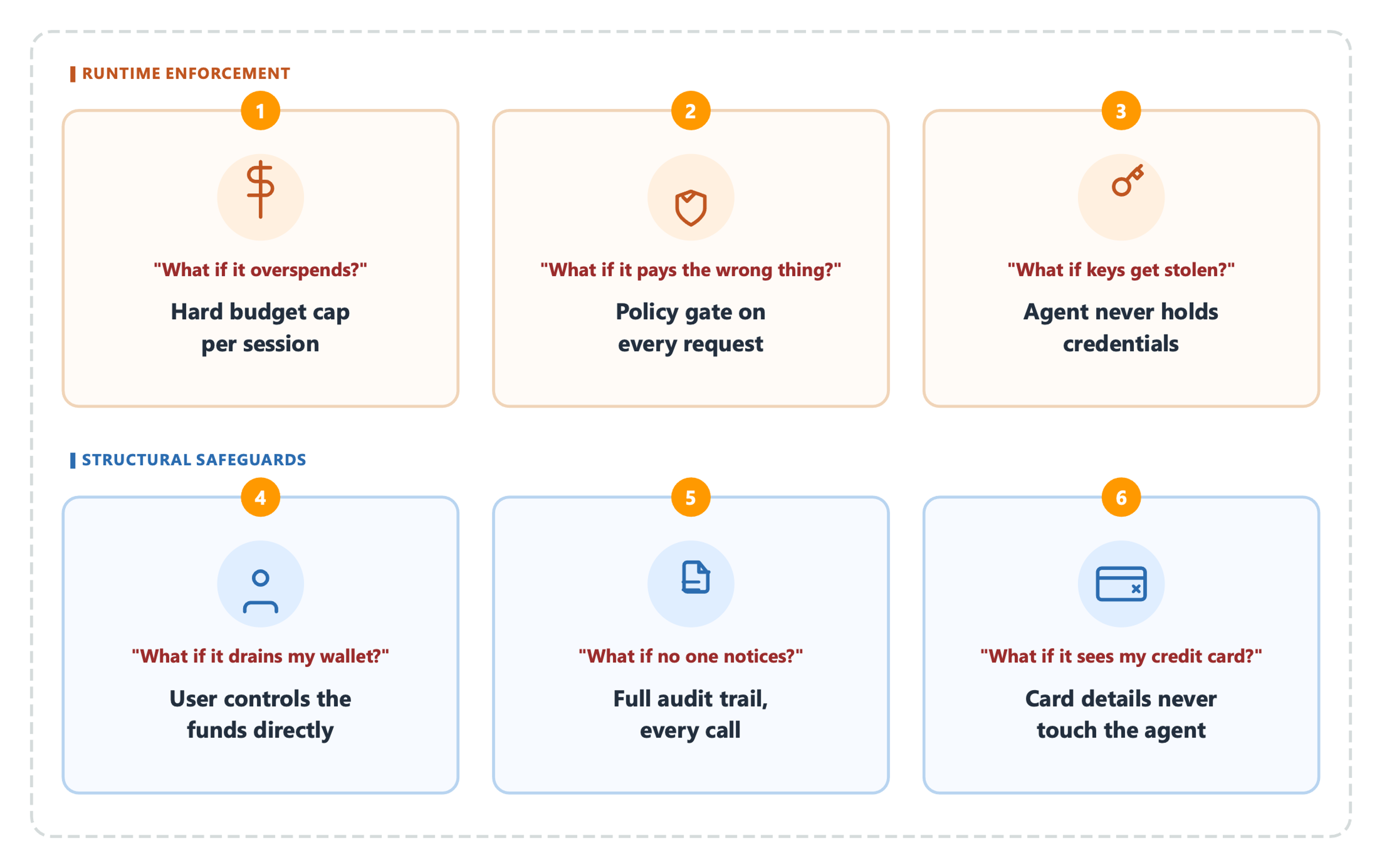 image*図 1 – 組み込みのガードレールがすべてのエージェント決済を保護します。各ガードレールは、エージェントコードの外側であるインフラストラクチャ層で強制されます。*
ツールアクセスの支払い制限とポリシー
すべての取引は、単一のエージェント対話のためのスコープ付き支払いコンテキストである支払い*セッション*内で実行されます。支払いセッションには、2 つの構成可能な上限があります:特定の通貨での最大支出額と有効期限です。署名を行う前に、AgentCore payments はリクエストをセッション予算に対してチェックします。セッションの上限を超えてしまうリクエストは、AgentCore payments によって拒否されます。サービスがすでに予算から差し引いた後に署名に失敗した場合、その差し引きはロールバックされるため、失敗した取引でも予算は消費されません。
このチェックは決定論的であり、インフラストラクチャ層で実行されます。上限はモデルの外側で強制されるため、プロンプトインジェクションによって上限を突破することはできません。開発者はワークロードに合わせた制限を設定し、AgentCore payments はすべての呼び出しに対してこれを強制します。エージェントが本番環境で信頼性を証明するにつれて予算を引き上げるために、最初はより小さな予算から始めることを推奨します。
ツールレベルの認証については、有料エンドポイントを Amazon Bedrock AgentCore Gateway を通じて公開することを推奨します。AgentCore Gateway を経由するすべての呼び出しは、Cedar ベースのエンジンである AgentCore の Policy によってインターセプトされ、エージェントのID、ツールの名前、パラメータを含むリクエストが評価され、許可されるかどうかが決まります。この2つの制御は異なる判断を担っています。Policy は「誰がどの有料ツールをどのようなパラメータで呼び出せるか」を決定し、AgentCore payments は「その呼び出しにいくらまで、どれだけの時間を使えるか」を決定します。これらを組み合わせることで、開発者はツールのアクセス権限と支出額という直交したレバーをそれぞれ独立して制御できるようになります。
- 予算とTTL(Time To Live)設定を含む支払いセッションの作成手順については、Amazon Bedrock AgentCore の開発者ガイドにある「Creating a payment session」をご覧ください。
- エージェントロールやユーザーグループに基づいてツールのアクセス範囲を定義するCedarポリシーの例については、開発者ガイドの「Policy in AgentCore」をご覧ください。
ユーザーによる制御、資金調達、委任
エンドユーザーはまずウォレットに資金を投入し、その後、エージェントが支出する権限を明示的に付与します。この順序は厳守されます。資金調達はオフバンド(別経路)のアクションです。エンドユーザーは、エージェントが API を介してアクセスできず、可視性も持たないウォレットプロバイダーのポータル内(Coinbase WalletHub または Stripe Privy フロントエンド)でこれを完了します。資金が着金した後でも、エンドユーザーがウォレットプロバイダーの権限プリミティブ(Coinbase Spend Permissions または Privy Delegated Actions)を通じて明示的にその権限を委任するまで、エージェントが取引を行う権限はありません。ウォレットへの資金投入とエージェントへの承認は、ウォレットプロバイダーのポータル内で行われるエンドユーザーによる2つの独立した決定です。
ウォレット自体は、Coinbase Developer Platform (CDP) の埋め込み型ウォレットであっても Stripe Privy の埋め込み型ウォレットであっても、エンドユーザーに帰属します。エンドユーザーが鍵を保持しています。AWS も開発者も保有していません。エンドユーザーは任意のタイミングで委任を取り消すことができます。また、ウォレットが彼らの所有物であるため、いつでも自分が制御するアドレスへ資金を引き出すことが可能です。
認証情報の保存のための AgentCore Identity および Secrets Manager
AgentCore Identity は4つのレイヤーにおいてセキュリティを処理します。以下セクションでそれぞれについて詳しく説明します。
1. IAM または SigV4 を用いたインバウンド認証
AgentCore payments へのインバウンドアクセスには、開発者が AWS Identity and Access Management (IAM) または SigV4 を設定します。このサービスに同梱されている 4 つのロールを持つ IAM パターンでは、コントロールプレーン(AgentCore payments の管理と設定を行う API)とデータプレーン(トランザクションを実行する API)が分離されています。
コントロールプレーンにおいては、*ControlPlaneRole* がサービスの管理を行い、*ManagementRole* が支払いマネージャーやセッションの設定を行います。*ManagementRole* には *ProcessPayment* に対する明示的な拒否権限が付与されているため、開発者が支払い設定に使用する認証情報でトランザクションを実行することはできません。
データプレーンにおいては、*ProcessPaymentRole* が支払いの実行を行い、サービス自体が実行時にセッションおよび認証情報の状態を取得するために *ResourceRetrievalRole* を引き受けます。単一のロールが予算の上限を設定し、かつその予算に対して支出を行うことは不可能です。
2. ウォレットプロバイダー呼び出し用の開発者認証情報
AgentCore payments がエンドユーザーに代わって Coinbase Developer Platform または Stripe Privy を呼び出す際、Coinbase Developer Platform API キーや Stripe Privy アプリ認証情報、および Privy 認証キーといった開発者認証情報を使用します。これらの情報は AgentCore Identity のトークンボルトに保存され、AWS Key Management Service (AWS KMS) によって保管時および転送時に暗号化されます。このボルトは AWS Secrets Manager とネイティブに統合されているため、開発者はセキュリティチームが既に使用しているツールを通じてキーのローテーションとアクセスポリシーを管理できます。エージェントコードはこれらの開発者認証情報を直接取り扱うことはありません。
3. エンドユーザーのウォレットアドレスはウォレットプロバイダーに保持される
前述の開発者認証情報とは別に、各エンドユーザーには独自の自己保管型ウォレットアドレスを持つ埋め込みウォレット(Coinbase Developer Platform ウォレットまたは Stripe Privy ウォレット)が用意されています。そのウォレットアドレスとそれを制御するキーはエンドユーザーおよびウォレットプロバイダーに保持され、AWS も開発者も一切保有しません。AgentCore payments では、キーではなくハンドルによってウォレットを参照します。
各支払いのためのジャストインタイムトークン
AgentCore payments が支払いを実行する必要がある場合、*GetResourcePaymentToken* API を介して Identity にスコープ付きトークンを要求します。このトークンはランタイムで発行され、支払いセッションにバインドされ、その 1 回の操作のみで使用されます。長期有効なオープンな支払いチャネルは存在しません。ランタイムは、セッションの TTL(Time To Live)または予算が尽きた後に追加の取引を拒否し、ウォレットプロバイダーを呼び出すために使用されるトークンも、操作が必要である間だけしか存在しません。
オフバンドでのトップアップにより、エージェントは機密データから遠ざかる
エンドユーザーがウォレットに資金を入金する際、クレジットカード、デビットカード、または銀行の詳細情報を、Coinbase WalletHub または Stripe Privy フロントエンドであるウォレットプロバイダーのホストオンランプ内に入力します。これらのインターフェースは、ウォレットプロバイダーによって運営され、PCI スコープに含まれています。エージェントにはこれらへの API 接続も UI アクセス権もありません。カード番号、有効期限、CVV(セキュリティコード)、または自動決済システム(ACH)の詳細情報は、エージェントのコードや、エージェントのプロンプトコンテキスト、開発者が運用する AWS サービスに一切触れることはありません。
この分離が重要なのは、爆発半径を制限するためです。プロンプトインジェクションや汚染されたツール応答、あるいはモデルの誤動作によって侵害されたエージェントであっても、そもそもアクセスできないシステムからカード番号を抽出することはできません。PCI の負担はウォレットプロバイダーに留まります。エージェントが操作するのは、エンドユーザーの埋め込みウォレットからのステーブルコインまたは法定通貨の支出に対するスコープ付きで取り消し可能な権限のみであり、その権限さえも前のセクションで説明したセッション制限によって制限されています。
コンプライアンスの観点から、この設計により開発者は独自のシステムを PCI スコープに含めることなく、エージェント型決済フローを提供できます。エージェントの表面積と開発者のコンプライアンス範囲は意図的に小さく保たれています。AWS は資金の流れには関与せず、資金はエンドユーザーの埋め込みウォレットからマーチャントへ、ウォレットプロバイダーのインフラストラクチャを介して移動します。
AgentCore Observability によるエンドツーエンドの洞察
AgentCore payments は AgentCore Observability と統合されており、開発者が決済ライフサイクルを可視化できるようにしています。このサービスは、データプレーン API の呼び出しごとに、vended ログを Amazon CloudWatch ロググループへ自動発行し、AWS X-Ray へ vended スパンを発行します。
ProcessPayment の各呼び出しは、成功した場合でも予算制限に達した場合でも、ウォレット層での失敗の場合でも、再現せずに問題を診断できる十分な詳細情報とともに記録されます。開発者はトランザクションの成功率を監視し、エージェント間での支出パターンを追跡し、エラーが発生した際に即座に把握することができます。
支払いトレースは、開発者がすでにエージェントの動作のために依存している可観測性インフラストラクチャと同じものを使用します。支払い活動は、ツールの呼び出し、モデル呼び出し、オーケストレーションステップとともに単一のタイムライン上に表示されます。運用チームは、エラーレートや支出速度に対して CloudWatch アラームを設定し、異常を早期に検出できます。
AgentCore の可観測性機能には、エージェント、セッション、および期間全体にわたるトランザクションの健全性を示す事前構築済みダッシュボードが含まれています。支払いテレメトリも CloudWatch および X-Ray に流れるため、開発者は独自のダッシュボードを構築することも可能です。単一の CloudWatch ダッシュボードでは、エージェント別の総支出額、理由別(予算枯渇、ポリシー拒否、資格期限切れ)の拒否率、支払いレイテンシのパーセンタイルなどを表示できます。これにより、財務、セキュリティ、コンプライアンスチームは、カスタムレポートインフラストラクチャを構築することなく必要な監査可能性を得ることができます。
結論
AgentCore ペイメントを使用すると:
- エージェントはエンドユーザーの資金や決済手段にアクセスできません。
- IAM と SigV4 はすべての着信呼び出しに対して認証を強制し、4 つのロールパターンによって制御プレーン(支払いの設定)とデータプレーン(支払いの実行)が分離されるため、単一のロールが予算の上限設定とそれに対する支出の両方を行うことはできません。
- セッションごとの支出制限と TTL は、エージェントコードの外側で決定論的にインフラストラクチャ層で強制されるため、プロンプト注入によってこれらを突破することはできません。
- エンドユーザーは埋め込みウォレットの管理権を保持し、自身の条件に基づいて支出を委任し、いつでも取り消しまたは引き出しを行うことができます。
- ウォレットの認証情報は AWS KMS で暗号化されたトークン vault に保存され、エージェントに渡されるのは必要なタイミングで発行される短期間でセッションスコープ限定のトークンのみです。
- AgentCore Observability はすべての取引を自動的に Amazon CloudWatch および AWS X-Ray にエミッションし、セキュリティチームと財務チームに完全な監査証跡を提供します。
- 資金はエンドユーザーの埋め込みウォレットとマーチャントの間で、AWS を介さず、ウォレットプロバイダのインフラストラクチャを通じて移動されます。
これらのガードレールが整うことで、エージェントによる決済は管理可能な機能となり、範囲が限定され、監査可能で、本番環境での運用も準備されたものとなります。
詳しくは、Amazon Bedrock AgentCore の製品ページ をご覧いただき、発表記事 をお読みください。エージェント型商取引のパターンに関する技術的な深掘りについては、技術的深掘り:AgentCore Payments とエージェント型商取引におけるイノベーション をご覧ください。
著者について
 image
image
Joshua Smith
Joshua は AWS で FinTech カスタマーを担当するシニアソリューションアーキテクトです。大規模分散システムの課題解決や、セキュリティ、信頼性、コスト効率、AI 機能を備えたソリューション(エージェント型商取引を含む)の構築を顧客に支援することに情熱を持っています。彼は初期スタートアップ、大企業、連邦機関において、セキュリティおよびシステムエンジニアリングのバックグラウンドを持っています。
 image
image
Guy Bachar
Guy は AWS のシニアソリューションアーキテクトであり、金融サービス企業と連携して、安全かつスケーラブルなクラウドソリューションの設計を担当しています。彼は AI を駆使したイノベーション、顧客体験の変革、そしてエンタープライズ規模の展開におけるアイデンティティおよびセキュリティアーキテクチャにおいて専門知識を有しています。
原文を表示
Agents increasingly take actions on behalf of their end users, whether that’s selecting tools, browsing the web, and calling MCP servers autonomously to achieve a goal. When the tools, MCP endpoints, or web resources an agent reaches are paid, the agent gets stuck without the ability to transact. Amazon Bedrock AgentCore payments, announced in preview in partnership with Coinbase and Stripe (Privy), gives agents the ability to access paid resources on the end user’s behalf to complete the task.
Putting real money behind an autonomous system raises a new set of risks. They come from agents acting autonomously over long sessions, model non-determinism, and a wider exposure surface between agent code and the end user’s funds. In this post, we walk through those risks and the guardrails that AgentCore payments combines to address each one.
*AgentCore payments is available in preview in US East (N. Virginia), US West (Oregon), Europe (Frankfurt), and Asia Pacific (Sydney). Features and APIs might change before general availability.*
Throughout this post, we use these terms:
- End user: the human whose money is being spent and on whose behalf the agent transacts.
- Developer: the AWS customer integrating payment capabilities into their AI agents.
- Wallet provider: Coinbase Developer Platform (CDP) or Stripe Privy.
- Embedded wallet: a self-custodial wallet, hosted by the wallet provider, that belongs to the end user.
- Payment session: a scoped payment context for a single agent interaction, with a configurable budget and time-to-live (TTL).
- Developer credentials: API keys, secrets, and authorization keys issued by the wallet provider to the developer, used by AgentCore payments to call the wallet provider’s APIs.
In this post, we address several key risks that surface when designing an agentic payment system, and how to address them with the capabilities of AgentCore payments.
The challenge: Safety risks in agentic payments
Several key risks shape how a payments capability for agents has to be designed.
Runaway spend
Agents are autonomous and long-running. They take decisions on behalf of their end users, often many decisions per session, and they keep running with no human at the keyboard. Without explicit guardrails, a mis-prompted or compromised agent can incur runaway spending.
Large language models (LLMs) are also non-deterministic, so you can’t guarantee that a model won’t misinterpret a response as authorization to spend, or repeat a payment because of an unexpected retry. Spending limits must be defined and enforced outside the model, at the infrastructure layer.
Lack of end user consent and delegation
The agent can now make payments autonomously, but the end user must retain ultimate control. The end user decides when to delegate spending authority, when to top up the wallet, and when to withdraw funds. The agent must operate with explicit, scoped permission, not a blanket grant, and the end user can revoke that permission when they choose.
Compromise of developer keys and wallet tokens
An agent transacting on behalf of an end user has two kinds of sensitive material. The first are developer credentials that AgentCore payments uses to call the wallet provider’s APIs (API keys, secrets, and authorization keys). The second are the end user’s embedded wallet keys (which the wallet provider holds in self-custody). Both must stay out of agent code. If those credentials are stored inline in agent code or environment variables, a compromised agent reveals them. The agent shouldn’t handle these credentials directly, and the credentials the system issues for individual payments should be short-lived and bound to a specific session.
Exposure of the end user’s payment instrument
The end user’s card number, card verification value (CVV), and other personal payment details should never enter the agent’s context. An agent that has visibility into a credit card is a much larger exposure surface than one that doesn’t, and the Payment Card Industry (PCI) standards scope grows accordingly. The agent’s view should stop at “a permission to spend from a user-owned wallet” and go no further.
Lack of auditability
When something goes wrong, such as an unexpected charge, a denied payment, or a security or finance team asking what happened, there must be a complete, reliable record of what the agent did, on whose behalf, against which limits, and to which merchant. That record must be produced automatically. Relying on agent code to log its own actions isn’t enough.
Using AgentCore services and controls to address these risks
AgentCore payments integrates with the rest of Amazon Bedrock AgentCore to address these challenges.
The following figure summarizes the guardrails that AgentCore payments enforces on every transaction.
*Figure 1 – Built-in guardrails protect every agent payment. Each is enforced at the infrastructure layer, outside agent code.*
Payment limits and policy for tool access
Every transaction runs inside a payment *session*, a scoped payment context for a single agent interaction. A payment session has two configurable caps: a maximum spend amount in a specified currency, and an expiry time. Before signing a payment, AgentCore payments checks the request against the session budget. AgentCore payments rejects requests that would push the session past its cap. If signing fails after the service has already deducted from the budget, it rolls the deduction back, so a failed transaction does not consume budget.
The check is deterministic and runs at the infrastructure layer. Prompt injection can’t lift the cap, because the cap is enforced outside the model. The developer configures the limits that match the workload, and AgentCore payments enforces them on every call. We recommend starting with a smaller budget and raising it as the agent proves itself in production.
For tool-level authorization, we recommend exposing paid endpoints through Amazon Bedrock AgentCore Gateway. Every call through AgentCore Gateway is intercepted by Policy in AgentCore, a Cedar-based engine that evaluates the request, including the agent’s identity, the tool name, and the parameters, and decides whether to allow it. The two controls cover different decisions. Policy decides who can call which paid tool and with what parameters. AgentCore payments decides how much that call can spend and for how long. Together, they give developers orthogonal levers for tool access and spend amount.
- For a walkthrough of creating a payment session with budget and TTL configuration, see Creating a payment session in the Amazon Bedrock AgentCore developer guide.
- For examples of Cedar policies that scope tool access by agent role and user group, see Policy in AgentCore in the developer guide.
User control, funding, and delegation
The end user funds the wallet first, then explicitly grants the agent permission to spend, in that order. Funding is an out-of-band action. The end user completes it inside the wallet provider’s portal (Coinbase WalletHub or the Stripe Privy frontend), in a flow the agent has no API into and no visibility into. Even after funds have landed, the agent has no permission to transact until the end user explicitly delegates that authority through the wallet provider’s permission primitive: Coinbase Spend Permissions or Privy Delegated Actions. Funding the wallet and authorizing the agent are two separate decisions, made by the end user, inside the wallet provider’s portal.
The wallets themselves belong to the end user, whether a Coinbase Developer Platform (CDP) embedded wallet or a Stripe Privy embedded wallet. The end user holds the keys. AWS doesn’t, and the developer doesn’t. The end user can revoke the delegation at their discretion. And because the wallet is theirs, they can withdraw funds back to an address they control whenever they want.
AgentCore Identity and Secrets Manager for credential storage
AgentCore Identity handles security at four layers. We walk through each in the following sections.
1. Inbound authentication with IAM or SigV4
For inbound access to AgentCore payments, developers configure AWS Identity and Access Management (IAM) or SigV4. The four-role IAM pattern that ships with the service separates the control plane (the APIs that administer and configure AgentCore payments) from the data plane (the APIs that execute transactions).
On the control plane, the *ControlPlaneRole* administers the service, and the *ManagementRole* configures payment managers and sessions. The *ManagementRole* carries an explicit Deny on *ProcessPayment*, so the credentials a developer uses to set up payments cannot also execute transactions.
On the data plane, the *ProcessPaymentRole* executes payments, and the service itself assumes the *ResourceRetrievalRole* to fetch session and credential state at runtime. No single role can both raise a budget and spend against it.
2. Developer credentials for calling wallet providers
When AgentCore payments calls Coinbase Developer Platform or Stripe Privy on behalf of an end user, it does so with developer credentials such as Coinbase Developer Platform API keys, Stripe Privy app credentials, and the Privy authorization key. AgentCore Identity stores these in its token vault, encrypted at rest and in transit with AWS Key Management Service (AWS KMS). The vault integrates natively with AWS Secrets Manager, so developers can manage rotation and access policy through tooling their security team already uses. Agent code does not handle these developer credentials directly.
3. End-user wallet addresses kept with the wallet provider
Separate from the developer credentials in the preceding section, each end user has an embedded wallet (a Coinbase Developer Platform wallet or a Stripe Privy wallet) with its own self-custodial wallet address. That wallet address and the keys that control it stay with the end user and the wallet provider, and neither AWS nor the developer ever holds them. AgentCore payments references the wallet by handle, not by key.
4. Just-in-time tokens for each payment
When AgentCore payments needs to execute a payment, it asks Identity for a scoped token through the *GetResourcePaymentToken* API. The token is runtime-issued, bound to the payment session, and used for that one operation only. There are no long-lived open payment channels. The runtime denies further transactions after the session’s TTL or budget runs out, and the token used to call a wallet provider only exists for as long as the operation needs it.
Out-of-band top-up keeps the agent away from sensitive data
When the end user funds their wallet, they enter their credit card, debit card, or bank details inside the wallet provider’s hosted onramp, either Coinbase WalletHub or the Stripe Privy frontend. These surfaces are operated and PCI-scoped by the wallet provider. The agent has no API into them and no UI access to them. Card numbers, expiry dates, CVVs, or Automated Clearing House (ACH) details do not touch agent code, the agent’s prompt context, or AWS services the developer operates.
That isolation matters because it bounds the blast radius. An agent that is compromised through prompt injection, a poisoned tool response, or a model misbehavior cannot extract a card number from a system it doesn’t have access to in the first place. The PCI burden stays with the wallet provider. The only thing the agent operates on is a scoped, revocable permission to spend stablecoin or fiat from the end user’s embedded wallet, and even that permission is bounded by the session limits in the previous section.
From a compliance perspective, this design lets developers ship agentic payment flows without bringing their own systems into PCI scope. The agent’s surface area, and the developer’s compliance scope, are deliberately small. AWS itself isn’t in the funds flow, as money moves between the end user’s embedded wallet and the merchant through the wallet provider’s infrastructure.
End-to-end insights with AgentCore Observability
AgentCore payments integrates with AgentCore Observability to give developers visibility into the payment lifecycle. The service automatically emits vended logs to your Amazon CloudWatch log group, and vended spans to AWS X-Ray for every data-plane API call.
Every ProcessPayment invocation, whether it succeeds, hits a budget limit, or fails at the wallet layer, is recorded with enough detail to diagnose the issue without reproducing it. Developers can monitor transaction success rates, track spending patterns across agents, and surface errors as they happen.
Payment traces use the same observability infrastructure that developers already rely on for agent behavior. Payment activity appears alongside tool invocations, model calls, and orchestration steps in a single timeline. Operations teams can set CloudWatch alarms on error rates or spend velocity to catch anomalies early.
AgentCore Observability includes prebuilt dashboards that show end-to-end transaction health across agents, sessions, and time periods. Because the payment telemetry also flows into CloudWatch and X-Ray, developers can build their own. A single CloudWatch dashboard can surface total spend by agent, rejection rates by reason (budget exhausted, policy denied, credential expired), and payment latency percentiles. This gives finance, security, and compliance teams the auditability they need without building custom reporting infrastructure.
Conclusion
With AgentCore payments:
- The agent doesn’t have access to the end user’s funds or payment instruments.
- IAM and SigV4 enforce authorization on every inbound call, while the four-role pattern separates the control plane (configuring payments) from the data plane (executing payments) so that no single role can both raise a budget and spend against it.
- Per-session spending limits and TTLs are enforced at the infrastructure layer—deterministically, outside agent code—so prompt injection can’t lift them.
- The end user retains custody of their embedded wallet, delegates spending on their own terms, and can revoke or withdraw at any time.
- Wallet credentials live in an AWS KMS-encrypted token vault and reach the agent only as short-lived, session-scoped tokens issued just in time.
- AgentCore Observability can emit every transaction to Amazon CloudWatch and AWS X-Ray automatically, giving security and finance teams a full audit trail.
- Money moves between the end user’s embedded wallet and the merchant through the wallet provider’s infrastructure, not AWS.
With these guardrails in place, agentic payments become a managed capability that is bounded, auditable, and production-ready.
To learn more, visit the Amazon Bedrock AgentCore product page and read the launch announcement. For a technical deep dive into agentic commerce patterns, see Technical deep dive: AgentCore Payments and innovation in agentic commerce.
About the authors
Joshua Smith
Joshua is a Senior Solutions Architect at AWS working with FinTech customers. He is passionate about solving high-scale distributed systems challenges and helping customers build secure, reliable, cost-effective, and AI-enabled solutions including agentic commerce. He has a background in security and systems engineering in early startups, large enterprises, and federal agencies.
Guy Bachar
Guy is a Senior Solutions Architect at AWS, partnering with financial services companies to design secure, scalable cloud solutions. He specializes in AI-driven innovation, customer experience transformation, and identity and security architecture for enterprise-scale deployments.
関連記事
今日のまとめ
AI日報で今日の重要ニュースをまとめ読み