Amazon Bedrock AgentCore を活用したビジネスインテリジェンス用 AI エージェントの構築
OPLOG は Amazon Bedrock AgentCore と Strands Agents SDK を活用し、複数システムに散在するデータを統合した AI エージェント基盤を構築することで、営業サイクルの短縮とデータ品質の劇的向上を実現した。
キーポイント
分散型データの統合と自動化
HubSpot, Microsoft Teams, Databricks など複数の孤立システムに存在するデータを AI エージェントが自律的に処理し、リアルタイムのビジネスインテリジェンスを提供する。
具体的な事業成果の実証
営業サイクルの 35% 短縮、CRM データ完全性の 91% 向上、手動調査時間の 98% 削減という明確な数値効果を確認した。
技術アーキテクチャの構築
Strands Agents SDK を用いて 3 つのエージェントを開発し、Amazon Bedrock AgentCore にデプロイして Claude Sonnet と RAG(知識ベース)を連携させた。
重要な引用
fragmented business data across systems resulted in delayed insights and manual reporting that consumed hours of productive time daily
35% reduction in sales cycles, 91% improvement in CRM data completeness, and 98% reduction in manual research time
insights arrived too late—weekly reports missed 60% of opportunities because deals had already progressed or stalled by the time analysis was complete
影響分析・編集コメントを表示
影響分析
この事例は、AI エージェントが単なる実験段階を超え、複雑な企業環境における実務的なビジネスインテリジェンスを担う実用レベルに達したことを示す重要な指標です。特に、複数のレガシーシステムや SaaS を横断してデータを統合・分析する能力は、多くの B2B 企業が抱える課題に対する具体的な解決策として注目されます。
編集コメント
AWS の新機能である AgentCore と、サードパーティの SDK(Strands)を組み合わせることで、従来の BI ツールでは不可能だったリアルタイムかつ自律的なデータ分析が実現された点に注目すべきです。これは、AI エージェントが「ツール」から「業務の一部」として定着する転換点となる事例と言えます。
OPLOG は、AI とロボット技術を活用した物流を担う企業であり、トルコ、イギリス、ドイツにおいて月間数百万点のアイテムを主要ブランドやグローバルマーケットプレイス向けに処理しています。複数のブランドが倉庫インフラ、労働者、自律型ロボットを共有する顧客非依存型の物流モデルを展開する OPLOG は、多くの B2B 組織が直面する共通の課題に直面していました。システム間で断片化されたビジネスデータにより、洞察が遅れ、生産的な時間を毎日数時間消費する手動レポート作成が発生していたのです。
この課題に対処するため、OPLOG は Amazon Bedrock AgentCore に展開された AI エージェント(AI agents)を活用して、本番環境対応型のビジネスインテリジェンス(BI: Business Intelligence)システムを構築しました。このソリューションはビジネス取引を自律的に処理し、販売パイプライン管理、データ品質の強制適用、見込み客調査においてリアルタイムなインテリジェンスを提供します。その結果、明確なビジネスインパクトが確認されました:販売サイクルが 35% 短縮され、CRM データの完全性が 91% 向上し、手動調査にかかる時間が 98% 削減されています。
本記事では、OPLOG が Strands Agents SDK を用いて 3 つの AI エージェントを開発し、Amazon Bedrock AgentCore にデプロイするとともに、Anthropic の Claude Sonnet と Amazon Bedrock Knowledge Bases(検索強化生成:RAG)を Amazon Bedrock と統合した方法をご紹介します。AI エージェントが BI 業務をどのように変革できるかを示すアーキテクチャ、実装アプローチ、およびビジネス成果について説明します。
OPLOG の事業とデータ上の課題
OPLOG の急速な成長により、従来の BI システムでは対応できない運用上の複雑さが生じました。同社のデータは複数の連携していないシステムに分散していました:Hubspot CRM には営業パイプライン情報が、コミュニケーションシステムには顧客との会話記録が、Microsoft Teams には文脈情報が、Databricks ウェアハウスには運用メトリクスがそれぞれ保存されていました。各システムは独立して稼働していたため、データサイロが発生し、包括的な BI が阻害されていました。
断片化によって生じた特定の運用上の課題。異なるシステムからのレポートへのアクセス、情報の統合、更新の準備といった作業です。この手動プロセスにより、洞察が提供されるのが遅れすぎました。分析が完了する頃には取引が既に進行中か停滞しているため、週次レポートでは機会の 60% を見逃していました。営業担当者が手動でのデータ入力要件に圧倒され、一貫性のない情報を入力したことで、CRM データの品質も低下しました。運用チームは問題発生から数時間後にしか検知できず、予防的な介入ではなく事後対応を余儀なくされました。
OPLOG は、断片化されたビジネスインテリジェンス(BI)に起因する重大な運用コストを定量化しました。これには、洞察の遅れによる機会の損失、生産時間を奪う手動レポート作成のオーバーヘッド、意思決定に影響を与える不整合なデータ品質、そして非効率な対応を強いる事後対応型の運用が含まれます。同社は、異なるシステム間でデータを自律的に処理し、リアルタイムのインテリジェンスを提供するとともに、データ品質を維持しつつ手動レポートの負担を排除し、予防的な意思決定を可能にするソリューションを必要としていました。
ソリューション概要
OPLOG は 3 つの AI エージェントを開発しました。それぞれが特定の BI ドメインに焦点を当てています。これらのエージェントは互いに通信することなく独立して動作し、各エージェントは特定のソースからデータを処理し、ターゲットを絞ったインテリジェンスを提供します:
- Deal Analyzer Agent – このエージェントは、ビジネス運営に同期したスケジュールに基づいて実行され、最近のアクティビティがある Hubspot の取引を分析します。OPLOG の販売手法に対して取引を検証し、不足しているフィールドを特定し、完了ステータスを Microsoft Teams に報告します。このエージェントは、自動化された毎日のレポートを通じて、営業パイプラインのデータ品質と手法への適合性を促進します。
- Sales Coach Agent – このエージェントは、取引ステージが変更された際に Hubspot の Webhook イベントに応答し、OPLOG のビジネスモデル(B2C のみ、B2B のみ、または B2B と B2B の両方)に基づいて必須フィールドを検証し、不足している情報に対して自動的にタスクを作成します。このエージェントはリアルタイムでデータ品質基準を強制し、不十分なデータのまま取引が進行するのを防ぐのに役立ちます。
- Lead Insight Agent – このエージェントは、新しいマーケティングリードが Hubspot に追加された際にトリガーされ、6 つのソーシャルメディア環境(Instagram, LinkedIn, Facebook, YouTube, Twitter, TikTok)にわたるリードのデジタルプレゼンスを分析します。OPLOG の資格認定手法を適用して、Ideal Customer Profile (ICP) への適合性を評価し、適合性の判定を含む包括的なプロファイルをまとめ、Microsoft Teams に調査レポートを提供します。これにより、手動の見込み顧客調査が最小限に抑えられ、営業のエネルギーが高ポテンシャルな機会に集中されます。
このアーキテクチャでは、エージェントのデプロイ環境として Amazon Bedrock AgentCore が使用されています。OPLOG は Strands Agents SDK を用いてエージェントを開発しており、これはエージェントの動作定義、カスタムツール、統合ポイントのためのフレームワークを提供します。各エージェントは、Amazon Bedrock と Anthropic の Claude Sonnet を推論に使用し、データの分析、ビジネスルールを通じた推論、洞察の生成を行います。Amazon Bedrock Knowledge Bases は RAG(Retrieval-Augmented Generation)を実装しており、Amazon Simple Storage Service (Amazon S3) に保存された販売プレイブック、製品カタログ、手法ドキュメントから関連するコンテキストをエージェントが取得できるようにします。
AWS Lambda 関数は外部システムとの統合を処理し、エージェントを Hubspot や Microsoft Teams、および外部データソースに接続します。Amazon EventBridge は Deal Analyzer エージェントの実行スケジュールを設定し、Hubspot の Webhook が Sales Coach エージェントと Lead Insight エージェントをリアルタイムでトリガーします。AgentCore Observability は Amazon CloudWatch を通じて、エージェントの呼び出し、パフォーマンス指標、およびコストを含む包括的な監視を提供します。OPLOG はエージェントの実行に対してのみ課金され、管理すべきインフラストラクチャは不要です。AgentCore Runtime は負荷に応じてゼロから数千のセッションまで自動的にスケールし、デプロイメントの更新もダウンタイムなしで行われます。
以下のセクションでは、OPLOG が各特定のビジネスインテリジェンス(BI)課題に対処するためにどのように各エージェントを実装したかを詳述します。Deal Analyzer エージェントはスケジュールされたパイプラインレポートを提供し、Sales Coach エージェントはリアルタイムのデータ品質を確保し、Lead Insight エージェントは見込み顧客のリサーチを自動化します。それぞれのエージェントが異なる目的を果たす一方で、Amazon Bedrock、Amazon Bedrock Knowledge Bases(知識ベース)、および Strands Agents SDK を基盤とした共通の技術的基盤を共有しており、これらはすべて Amazon Bedrock AgentCore にデプロイされています。
Deal Analyzer Agent: Daily pipeline quality reporting
OPLOG の営業マネージャーは、毎日数十件の商談をレビューし、情報が不足しているものを特定するという課題に直面していました。手動でのレビューには数時間かかり、商談が停滞するまで問題を見逃すこともよくありました。Deal Analyzer Agent は、定期的に自動分析を実行し、どの商談に注意が必要かを明確に示した包括的なレポートを Microsoft Teams に配信することで、この課題の解決を支援します。
以下の図は、エージェントのアーキテクチャを示しています:
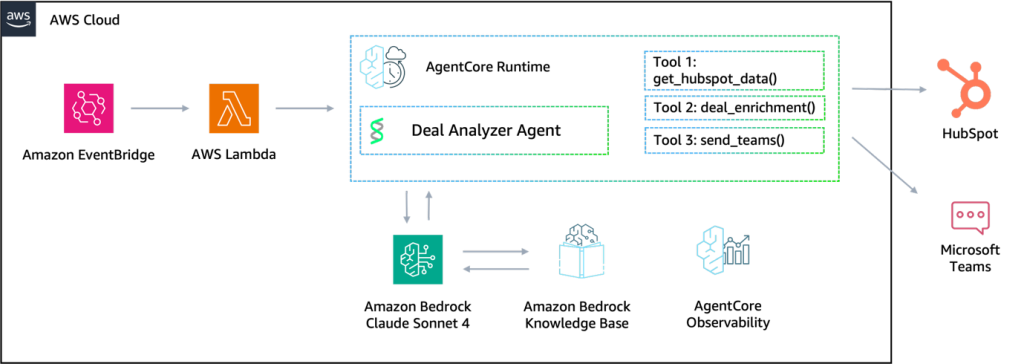
EventBridge は、ビジネスオペレーションに合わせたスケジュールで Lambda をトリガーします。Lambda は AgentCore Runtime(ランタイム)を呼び出し、エージェントを実行して最近のアクティビティがある Hubspot の商談を分析します。エージェントは、それらを OPLOG Way 手法に対して検証し、フォーマットされたレポートを Microsoft Teams に送信します。
OPLOG は Strands Agents SDK を使用して、3 つの専門化されたツールを持つエージェントを構築しました。hubspot_properties() ツールは、Lambda を介して Hubspot の API から商談データとメタデータを取得します。deal_enrichment() ツールは検証ロジックを実行し、ビジネスモデル固有のルールを用いて OPLOG Way 手法に対して商談を分析します。send_teams() ツールは結果を構造化されたレポートにフォーマットし、Webhook を使用して配信します。以下のコードをご覧ください:
from strands_agents import Agent, tool
class DealAnalyzerAgent(Agent):
@tool
def hubspot_properties(self, deal_id: str) -> dict:
"""Retrieve deal data and metadata from Hubspot"""
pass
@tool
def deal_enrichment(self, deal_data: dict) -> dict:
"""Analyze deal against OPLOG Way methodology"""
pass
@tool
def send_teams(self, report: dict) -> bool:
"""Format and deliver report to Microsoft Teams"""
pass
The validation logic handles OPLOG's customer-agnostic fulfillment model complexity. Different deals require different validation based on whether they're B2C only, B2B only, or B2B and B2C. For B2C deals, the agent validates B2C-specific fields plus the required fields. For B2B deals, it validates B2B-specific fields. For combined deals, it validates both fields. Conditional logic applies throughout—volume validation requires at least one inventory volume type for B2C deals, but requires both outbound and inventory volumes for B2B deals.
エージェントは、Amazon Bedrock と Anthropic の Claude Sonnet を使用してビジネスルールを解釈し、意図的なゼロ値と欠落したフィールドを区別します。これは単純な null チェックを超えた推論を必要とする微妙な判断です。Amazon Bedrock Knowledge Bases は、業界標準の埋め込みモデルおよびベクトルデータベースを使用して、OPLOG Way 手法を Amazon S3 に保存しています。取引を検証する際、エージェントは自然言語で知識ベースに問い合わせ、Anthropic の Claude が取得した文脈を適用して、各取引のステージとビジネスモデルに対する正しい検証ルールを決定します。
Microsoft Teams に配信されるレポートには、取引完了状況、欠落フィールドの詳細、優先順位付け、および実行可能な推奨事項が含まれています。営業マネージャーは、どの取引に注意が必要かという明確な視点から一日を始めます。この実装により、手動での毎日のレビュー時間が大幅に削減され、ステージの精度が 91% 向上しました。AgentCore Observability は、CloudWatch を通じて処理時間とレポート配信の成功を追跡します。
Sales Coach Agent: リアルタイム検証とタスク自動化
Sales Coach Agent は、Deal Analyzer エージェントとは異なるアプローチを採用しています。問題点を報告するのではなく、リアルタイムでデータ品質を強制します。営業担当者が取引をステージ間で移動させる際、エージェントは即座に必要なフィールドを検証し、欠落している情報に対するタスクを作成します。これにより、不十分なデータのまま取引が進行することが防がれ、パイプラインがクリーンに保たれます。
以下の図はエージェントのアーキテクチャを示しています: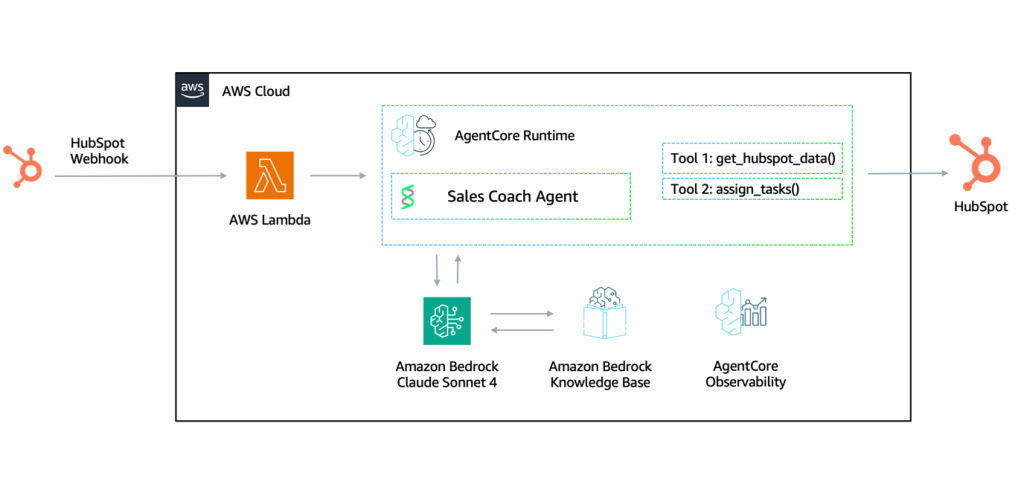 imageこのアーキテクチャでは、商談ステージが変更された瞬間にHubspotのWebhooks(ウェブフック)がLambdaをトリガーします。LambdaはAgentCore Runtime(ランタイム)を呼び出し、商談を検証し、必要に応じてタスクを作成します—すべて10秒以内で完了します。このWebhookベースのアプローチにより、営業担当者は商談を進めようとした際に即座にフィードバックを得ることができます。
このエージェントは、Strands Agents SDK(ストランズ・エージェンツSDK)を使用して構築された2つのツールを使用しています。analyze_deal_properties() ツールは、Hubspotから商談データを取得し、商談の運用モデルと新しいステージに基づいて必須フィールドを検証します。assign_task() ツールは、詳細な指示付きで優先度の高いタスクを作成し、それを商談にリンクして商談所有者に割り当てます。
以下のコードを参照してください:
from strands_agents import Agent, tool

class SalesCoachAgent(Agent):
    @tool
    def analyze_deal_properties(self, deal_id: str) -> dict:
        """運用モデルに基づいて必須フィールドを検証する"""
        pass

    @tool
    def assign_task(self, deal_id: str, task_description: str) -> bool:
        """検証タスクを作成し、商談所有者に割り当てる"""
        pass
検証ロジックは、Deal Analyzer エージェントのビジネスモデルルールを踏襲していますが、バッチ処理ではなく単一の取引に対してリアルタイムで動作します。このエージェントは、OPLOG Way 手法を格納した同じ Amazon Bedrock 知識ベースを使用し、特定のステージとビジネスモデルの組み合わせに必要なフィールドが何かを照会して判断します。Anthropic の Claude Sonnet はこれらのルールを解釈し、意図的にゼロ値となっている場合と、単に欠落しているフィールドとの重要な区別を行います。
タスクの説明は具体的かつ実行可能です。「不足しているフィールドを完了させる」といった汎用的なメッセージではなく、どのフィールドの完了が必要か、なぜ現在のステージで必要なのか、そしてどのように完了させるべきかのガイダンスを具体的に指定します。この明確さにより、販売担当者はドキュメントを参照したり管理者に問い合わせたりすることなく、迅速に問題を解決できます。
実装により取引の品質は 91% 向上し、フィールドの完了率は 96% を超えました。ステージ変更からタスク作成までの応答時間は平均 10 秒未満で、CloudWatch を通じて監視されるタスク作成成功率は 99.2% 以上、検証精度は 97% 以上となっています。
リードインサイトエージェント:自動化された見込み顧客調査
OPLOG の営業担当者は、これまで新しい見込み顧客ごとに多くの時間を費やして調査を行っていました。具体的には、LinkedIn を手動で検索したり、企業のウェブサイトを確認し、ソーシャルメディアでの存在感をレビューしたり、ビジネスモデルを理解しようと努めたりしていました。リードインサイトエージェントはこの一連のプロセス全体を自動化し、Hubspot に新しい連絡先が追加されてから 2〜5 分以内に包括的なプロファイルを提供できるよう支援します。
以下の図は、このエージェントのアーキテクチャを示しています:
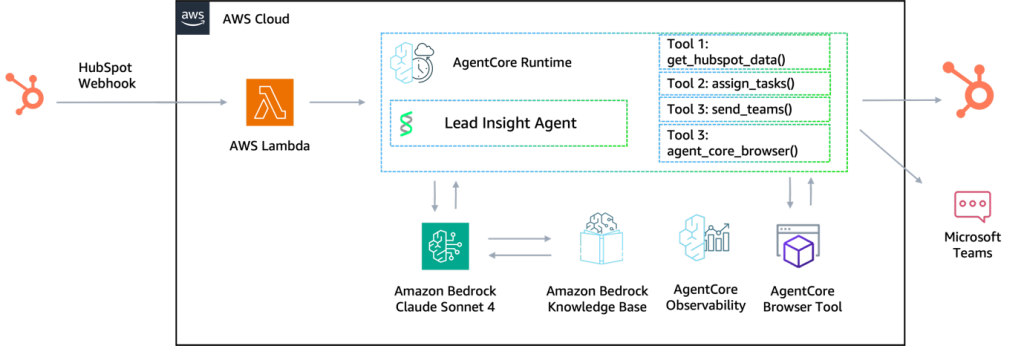
このアーキテクチャでは、Hubspot の Webhook(ウェブフック)を使用して、新しい連絡先が追加された際に Lambda をトリガーします。Lambda は AgentCore Runtime(ランタイム)を呼び出し、連絡先の詳細情報を渡します。その後、エージェントは Instagram、LinkedIn、Facebook、YouTube、Twitter、TikTok の 6 つのソーシャルメディア環境を並列に検索します。デジタルプレゼンスを分析した後、包括的なレポートを Microsoft Teams に配信します。
エージェントは、ソーシャルメディアでの発見に AgentCore Browser を使用します。AgentCore Browser はウェブナビゲーション、JavaScript のレンダリング、コンテンツの抽出を処理し、カスタムの Web スクレイピングインフラストラクチャ(*web scraping infrastructure*)の必要性を解消します。エージェントは検索クエリと URL パターン(例:LinkedIn 用の site:linkedin.com/in/ [name] [company])を提供し、AgentCore Browser は各環境から構造化されたコンテンツを返します。これは AWS によって管理され、ボット対策プロテクションに対応し、エージェントの呼び出しに応じて自動的にスケールします。
このエージェントがデータ収集機能に加えて価値ある理由は、その分析能力にあります。Amazon Bedrock と Anthropic の Claude Sonnet を組み合わせて抽出されたコンテンツを分析し、関連するプロフィールを特定し、デジタルプレゼンスを要約し、パーソナライズされたアプローチの推奨事項を生成します。エージェントは OPLOG の資格認定メソドロジー(*qualification methodology*)を適用して ICP 適合性を評価し、ビジネスモデル、業界、デジタルフットプリントに基づいてリードが OPLOG のターゲット顧客特性に合致するかどうかを判断します。
この ICP(理想顧客像)評価は、営業チームの働き方を変えます。リードを均等に扱うのではなく、高い可能性を持つ機会に優先順位をつけることが可能になります。レポートには、6 つの環境全体におけるソーシャルメディアの存在状況、 prospect が共有・議論している内容を示すコンテンツ分析、デジタルフットプリントから導き出されたビジネスモデルに関する洞察、推論付きの ICP 適合性の判定、そしてパーソナライズされたアウトリーチのための次のステップの推奨が含まれています。
実装により、見込み顧客調査にかかる時間が 98% 短縮され、手動調査よりも包括的なインテリジェンスが提供されました。エージェントはソーシャルメディア発見で 92% 以上、ウェブサイトへのアクセス性で 88% 以上の成功率を達成しています。営業チームは、接触前に適切な文脈を把握できるため、最初のアウトリーチでのエンゲージメント率が高まると報告しています。AgentCore Observability は CloudWatch を通じて分析時間、カバレッジ、Teams 配信の成功(99.5% 以上)を追跡します。
ビジネスへの影響と技術的成果
営業成績は大幅に改善しました。平均商談サイクルは 35% 短縮され、リード変換率は 28% 向上しました。CRM データの完全性は 102% に改善し(注:原文の数値をそのまま訳出)、日報作成にかかる時間は 92% 削減されました。営業担当者の生産性は 40% 向上しました。
運用効率の向上も同様に顕著でした。問題検知までの時間が 81% 短縮され、解決への応答時間は 83% 改善しました。プロセスコンプライアンスは 52% 向上し、意思決定のスピードは 70% 加速しました。
技術的なパフォーマンス指標は、本番環境レベルの信頼性を示しています。このシステムは、99.9% の稼働率を維持しながらニアリアルタイムのパフォーマンスを提供します。エージェント全体で毎日数千件のビジネスイベントを処理し、サーバーレスアーキテクチャによるコスト効率を実現しており、従来のシステムと比較してインフラコストが大幅に削減されています。
運用効率の改善により、AI エージェントシステムのインフラコストを大きく上回る測定可能なROI(投資対効果)が実現されました。
結論
OPLOG の導入事例は、Amazon Bedrock AgentCore にデプロイされた AI エージェントが BI(ビジネスインテリジェンス)運用をどのように変革できるかを示しています。このシステムは毎日数千件のビジネス取引を自律的に処理し、販売サイクルを35%短縮し、レポート作成時間を92%削減し、稼働率99.9%を実現します。従来のインフラと比較して大幅な削減となるサーバーレスアーキテクチャのコスト効果により、高度な AI 駆動型 BI が利用可能かつスケーラブルなものとなっています。
「AI が商業運用を根本から変えられると信じていました。Amazon Bedrock AgentCore を基盤として用いることで、私たちは単に販売サイクルを改善しているだけでなく、スケールする規模で履行企業がどのように競争するかを再定義しています」と、OPLOG の創設者兼CEOであるHalit Develioğlu氏は述べています。
このソリューションの成功は、いくつかのアーキテクチャ上の意思決定に起因しています:Amazon Bedrock AgentCore をエージェントデプロイメントに使用することでインフラ管理のオーバーヘッドを排除し、Amazon Bedrock Knowledge Bases(知識ベース)を用いた RAG(Retrieval-Augmented Generation: 検索拡張生成)の実装によりビジネスロジックとエージェントコードを分離して、再デプロイなしで更新を可能にし、推論には Anthropic の Claude Sonnet を採用することで複雑なビジネスルール解釈に必要な推論能力を提供し、EventBridge を統合してスケジュール処理やイベント駆動型トリガーを実現することで、自動化された実行とリアルタイムのエージェント実行の両方を可能にしています。
OPLOG は引き続き、追加のエージェント、画像およびドキュメントを処理するためのマルチモーダル機能、特定のビジネスコンテキストに合わせてエージェントの動作を最適化するためのカスタムファインチューニングによりシステムを拡張しています。同社のロードマップには、さらに多くの運用面および商業的な AI 機能が含まれています。
原文を表示
OPLOG, a technology-driven fulfillment company powered by AI and robotics, processes millions of items monthly across Türkiye, the United Kingdom, and Germany for major brands and global marketplaces. Operating a customer-agnostic fulfillment model where multiple brands share warehouse infrastructure, workers, and autonomous robots, OPLOG faced a challenge common to many B2B organizations: fragmented business data across systems resulted in delayed insights and manual reporting that consumed hours of productive time daily.
To address this challenge, OPLOG built a production-ready business intelligence (BI) system using AI agents deployed on Amazon Bedrock AgentCore. The solution processes business transactions autonomously, delivering real-time intelligence across sales pipeline management, data quality enforcement, and prospect research. The results demonstrate measurable business impact: 35% reduction in sales cycles, 91% improvement in CRM data completeness, and 98% reduction in manual research time.
In this post, we show you how OPLOG developed three AI agents using the Strands Agents SDK, deployed them to Amazon Bedrock AgentCore, and integrated Amazon Bedrock with Anthropic’s Claude Sonnet and Amazon Bedrock Knowledge Bases for Retrieval(RAG). We describe the architecture, implementation approach, and business outcomes that demonstrate how AI agents can transform BI operations.
OPLOG’s business and data challenges
OPLOG’s rapid growth created operational complexity that traditional BI systems couldn’t address. The company’s data existed across multiple disconnected systems: Hubspot CRM contained sales pipeline information, communication systems stored customer conversations, Microsoft Teams held communication context, and Databricks warehouses maintained operational metrics. Each system operated independently, creating data silos that prevented comprehensive BI.
The fragmentation created specific operational pain points. 2 accessing reports from different systems, synthesizing information, and preparing updates. This manual process meant insights arrived too late—weekly reports missed 60% of opportunities because deals had already progressed or stalled by the time analysis was complete. CRM data quality suffered as sales representatives, overwhelmed by manual data entry requirements, entered information inconsistently. Operations teams detected issues hours after they occurred, forcing reactive responses rather than proactive intervention.
OPLOG quantified significant operational costs from fragmented BI—including lost opportunities from delayed insights, manual reporting overhead consuming productive time, inconsistent data quality impacting decisions, and reactive operations forcing inefficient responses. The company needed a solution that could autonomously process data across the systems, deliver real-time intelligence, and remove manual reporting overhead while maintaining data quality and enabling proactive decision-making.
Solution overview
OPLOG developed three AI agents, each focused on a specific BI domain. The agents operate independently without communicating with each other; each processes data from specific sources and delivers targeted intelligence:
- Deal Analyzer Agent – This agent executes on a scheduled basis aligned with business operations, analyzing the Hubspot deals with recent activity. It validates deals against OPLOG’s sales methodology, identifies missing fields, and reports completion status to Microsoft Teams. The agent facilitates sales pipeline data quality and methodology conformance through automated daily reporting.
- Sales Coach Agent – This agent responds to Hubspot webhook events when deal stages change, validating required fields based on OPLOG’s business model (B2C only, B2B only, or B2B and B2C), and automatically creating tasks for missing information. The agent enforces data quality standards in real time, helping prevent deals from advancing with incomplete data.
- Lead Insight Agent – This agent triggers when new marketing leads are added to Hubspot, analyzing the lead’s digital presence across six social media environments (Instagram, LinkedIn, Facebook, YouTube, Twitter, TikTok). It applies OPLOG’s qualification methodology to assess Ideal Customer Profile (ICP) fit, compiles comprehensive profiles with fit determination, and delivers research reports to Microsoft Teams, minimizing manual prospect research while focusing sales energy on high-potential opportunities.
The architecture uses Amazon Bedrock AgentCore as the deployment environment for the agents. OPLOG developed agents using the Strands Agents SDK, which provides the framework for defining agent behavior, custom tools, and integration points. Each agent uses Amazon Bedrock with Anthropic’s Claude Sonnet for inference—analyzing data, reasoning through business rules, and generating insights. Amazon Bedrock Knowledge Bases implements RAG, allowing agents to retrieve relevant context from sales playbooks, product catalogs, and methodology documents stored in Amazon Simple Storage Service (Amazon S3).
AWS Lambda functions handle external system integrations, connecting agents to Hubspot, Microsoft Teams, and external data sources. Amazon EventBridge schedules agent executions for the Deal Analyzer Agent, and Hubspot webhooks trigger the Sales Coach and Lead Insight Agents in real time. AgentCore Observability provides comprehensive monitoring, tracking agent invocations, performance metrics, and costs through Amazon CloudWatch.OPLOG pays only for agent executions, with no infrastructure to manage. AgentCore Runtime scales automatically from zero to thousands of sessions based on workload, and deployment updates happen without downtime.
The following sections detail how OPLOG implemented each agent to address specific BI challenges. The Deal Analyzer Agent provides scheduled pipeline reporting, the Sales Coach Agent enforces real-time data quality, and the Lead Insight Agent automates prospect research. Although each agent serves a distinct purpose, they share a common technical foundation built on Amazon Bedrock, Amazon Bedrock Knowledge Bases, and the Strands Agents SDK, all deployed to Amazon Bedrock AgentCore.
Deal Analyzer Agent: Daily pipeline quality reporting
Sales managers at OPLOG faced a daily challenge: reviewing dozens of deals to identify which ones had missing information. Manual review took hours and often missed issues until deals stalled. The Deal Analyzer Agent helps solve this by running automated analysis on a scheduled basis, delivering comprehensive reports to Microsoft Teams that highlight exactly which deals need attention.
The following diagram illustrates the agent architecture:
EventBridge triggers Lambda on a schedule aligned with business operations. Lambda invokes AgentCore Runtime, which executes the agent to analyze the Hubspot deals with recent activity. The agent validates them against OPLOG Way methodology and sends formatted reports to Microsoft Teams.
OPLOG built the agent using the Strands Agents SDK with three specialized tools. The hubspot_properties() tool retrieves deal data and metadata from Hubspot’s API through Lambda. The deal_enrichment() tool performs the validation logic, analyzing deals against OPLOG Way methodology with business model-specific rules. The send_teams() tool formats results into structured reports and delivers them using webhooks. See the following code:
from strands_agents import Agent, tool
class DealAnalyzerAgent(Agent):
    @tool
    def hubspot_properties(self, deal_id: str) -> dict:
        """Retrieve deal data and metadata from Hubspot"""
        pass

    @tool
    def deal_enrichment(self, deal_data: dict) -> dict:
        """Analyze deal against OPLOG Way methodology"""
        pass

    @tool
    def send_teams(self, report: dict) -> bool:
        """Format and deliver report to Microsoft Teams"""
        pass
The validation logic handles OPLOG’s customer-agnostic fulfillment model complexity. Different deals require different validation based on whether they’re B2C only, B2B only, or B2B and B2C. For B2C deals, the agent validates B2C-specific fields plus the required fields. For B2B deals, it validates B2B-specific fields. For combined deals, it validates both fields. Conditional logic applies throughout—volume validation requires at least one inventory volume type for B2C deals, but requires both outbound and inventory volumes for B2B deals.
The agent uses Amazon Bedrock with Anthropic’s Claude Sonnet to interpret business rules and distinguish between intentionally zero values and missing fields—a nuanced decision that requires reasoning beyond simple null checks. Amazon Bedrock Knowledge Bases stores OPLOG Way methodology in Amazon S3 using industry-standard embedding models and vector databases. When validating deals, the agent queries the knowledge base with natural language, and Anthropic’s Claude applies the retrieved context to determine correct validation rules for each deal’s stage and business model.
Reports delivered to Microsoft Teams include deal completion status, missing field details, priority rankings, and actionable recommendations. Sales managers start their day with a clear view of which deals need attention. The implementation removed significant manual daily review time and improved stage accuracy by 91%. AgentCore Observability tracks processing time and report delivery success through CloudWatch.
Sales Coach Agent: Real-time validation and task automation
The Sales Coach Agent takes a different approach than the Deal Analyzer Agent—instead of reporting on issues, it enforces data quality in real time. When sales representatives move deals between stages, the agent immediately validates required fields and creates tasks for missing information. This helps prevent deals from advancing with incomplete data, making sure the pipeline stays clean.
The following diagram illustrates the agent architecture:
The architecture uses Hubspot webhooks to trigger Lambda the moment deal stages change. Lambda invokes AgentCore Runtime, which validates the deal and creates tasks if needed—all within 10 seconds. This webhook-based approach means sales representatives can get immediate feedback when they try to progress deals.The agent uses two tools built with the Strands Agents SDK. The analyze_deal_properties() tool retrieves deal data from Hubspot and validates required fields based on the deal’s operating model and new stage. The assign_task() tool creates high-priority tasks with detailed instructions, links them to the deal, and assigns them to the deal owner.
See the following code:
from strands_agents import Agent, tool
class SalesCoachAgent(Agent):
    @tool
    def analyze_deal_properties(self, deal_id: str) -> dict:
        """Validate required fields based on operating model"""
        pass

    @tool
    def assign_task(self, deal_id: str, task_description: str) -> bool:
        """Create and assign validation task to deal owner"""
        pass
The validation logic mirrors the Deal Analyzer Agent’s business model rules but operates on a single deal in real time rather than batch processing. The agent uses the same Amazon Bedrock knowledge base that stores OPLOG Way methodology, querying it to determine which fields are required for the specific stage and business model combination. Anthropic’s Claude Sonnet interprets these rules and makes the critical distinction between intentionally zero values and missing fields.
Task descriptions are specific and actionable. Instead of generic “complete missing fields” messages, tasks specify exactly which fields need completion, why they’re required for the current stage, and guidance on how to complete them. This clarity helps sales representatives resolve issues quickly without needing to consult documentation or ask managers.
The implementation improved deal quality by 91% and achieved over 96% field completion. Response time averages under 10 seconds from stage change to task creation, with over 99.2% task creation success and over 97% validation accuracy monitored through CloudWatch.
Lead Insight Agent: Automated prospect research
Sales representatives at OPLOG used to spend significant time researching each new prospect—manually searching LinkedIn, checking company websites, reviewing social media presence, and trying to understand the business model. The Lead Insight Agent automates this entire process, helping deliver comprehensive profiles within 2–5 minutes of a new contact being added to Hubspot.
The following diagram illustrates the agent architecture:
The architecture uses Hubspot webhooks to trigger Lambda when new contacts are added. Lambda invokes AgentCore Runtime with the contact details, and the agent searches six social media environments in parallel: Instagram, LinkedIn, Facebook, YouTube, Twitter, and TikTok. After analyzing the digital presence, it delivers a comprehensive report to Microsoft Teams.
The agent uses AgentCore Browser for social media discovery. AgentCore Browser handles web navigation, JavaScript rendering, and content extraction—alleviating the need for custom web scraping infrastructure. The agent provides search queries and URL patterns (for example, site:linkedin.com/in/ [name] [company] for LinkedIn), and AgentCore Browser returns structured content from each environment. It’s maintained by AWS, handles anti-bot protections, and scales automatically with agent invocations.
What makes this agent valuable in addition to its data collection capabilities is its analysis. Amazon Bedrock with Anthropic’s Claude Sonnet analyzes the extracted content to identify relevant profiles, summarize digital presence, and generate personalized approach recommendations. The agent applies OPLOG’s qualification methodology to assess ICP fit, determining whether the lead matches OPLOG’s target customer characteristics based on business model, industry, and digital footprint.
This ICP assessment changes how sales teams work. Instead of treating leads equally, they can prioritize high-potential opportunities. Reports include social media presence across the six environments, content analysis showing what the prospect shares and discusses, business model insights derived from their digital footprint, ICP fit determination with reasoning, and next-step recommendations for personalized outreach.
The implementation reduced prospect research time by 98%, while providing more comprehensive intelligence than manual research. The agent achieves over 92% social media discovery success and over 88% website accessibility. Sales teams report higher engagement rates on initial outreach because they have relevant context before making contact. AgentCore Observability tracks analysis time, coverage, and Teams delivery success (over 99.5%) through CloudWatch.
Business impact and technical outcomes
Sales performance improved significantly. Average deal cycles decreased by 35%. Lead conversion rates increased by 28%. CRM data completeness improved from 102%. Daily reporting time decreased by 92%. Sales representative productivity increased by 40%.
Operational efficiency gains were equally substantial. Issue detection time decreased by 81%. Resolution response time improved by 83%. Process compliance increased by 52%. Decision-making speed accelerated by 70%.
Technical performance metrics demonstrate production-grade reliability. The system delivers near real-time performance with 99.9% availability. The system processes thousands of daily business events across the agents. Cost-efficiency is achieved through serverless architecture that scales with usage, with infrastructure costs significantly lower than traditional systems.
The operational efficiency improvements delivered measurable ROI significantly exceeding the infrastructure costs of the AI agent system.
Conclusion
OPLOG’s implementation demonstrates how AI agents deployed on Amazon Bedrock AgentCore can transform BI operations. The system processes thousands of daily business transactions autonomously, delivering 35% faster sales cycles, 92% reporting time reduction, and 99.9% uptime. The cost-effectiveness of serverless architecture—representing significant reduction compared to traditional infrastructure—makes advanced AI-driven BI accessible and scalable.
“We believed AI could transform commercial operations entirely. With Amazon Bedrock AgentCore as our foundation, we’re not just improving sales cycles — we’re redefining how fulfillment companies compete at scale.” says Halit Develioğlu, Founder & CEO, OPLOG.
The solution’s success stems from several architectural decisions: using Amazon Bedrock AgentCore for agent deployment removes infrastructure management overhead; implementing RAG with Amazon Bedrock Knowledge Bases separates business logic from agent code, enabling updates without redeployment; using Anthropic’s Claude Sonnet for inference provides the reasoning capabilities necessary for complex business rule interpretation; and integrating EventBridge for scheduling and event-driven triggers enables both automated and real-time agent execution.
OPLOG continues to expand the system with additional agents, multi-modal capabilities for processing images and documents, and custom fine-tuning to optimize agent behavior for specific business contexts. The company’s roadmap includes additional operational and commercial AI capabilities c
関連記事
今日のまとめ
AI日報で今日の重要ニュースをまとめ読み