Madrigal が LangChain と LangGraph を活用し、製薬向けに柔軟かつスケーラブルなマルチエージェント研究・知能プラットフォームを構築した事例
Madrigal Pharmaceuticals は LangChain と LangGraph を活用し、データサイロを解消する柔軟かつスケーラブルなマルチエージェント研究プラットフォームを構築し、製薬業界における AI の実用的な導入事例を示した。
キーポイント
データサイロの打破と標準化
構造化システム、非構造化ドキュメント、外部ソースなど多様なデータ源を、エージェントから見える形で統一されたインターフェースに正規化し、シームレスな統合を実現した。
役割ベースのガバナンスと信頼性
ロールベースのアクセス制御とデータガバナランスガードレールを設け、すべての回答に明確な出典引用を付与することで、企業内での AI 利用への信頼を構築した。
汎用的なエージェントアーキテクチャ
特定のケーススタディから発展させ、検索、構造化基準による推論、大規模な要約、自律的動作が可能になる一般化されたマルチエージェントソリューションを確立した。
LangChain と LangGraph の活用
複雑なワークフローと並列ツール呼び出しを管理するために、LangChain と LangGraph を基盤技術として採用し、ドメインを超えたロジックの再記述なしでの運用を可能にした。
重要な引用
Most enterprise systems don't start as platforms. They start as a question.
We solved this by making the differences invisible to the agents.
Building trust in our multi-agentic platform frees Madrigal users to focus on our north star core value: keeping patients with MASH at the heart of everything we do.
影響分析・編集コメントを表示
影響分析
この事例は、製薬業界のような高リスク・高規制領域において、LLM やマルチエージェントシステムを実際の業務フローに統合する具体的な手法と成功体験を提供しています。特に「データサイロの解消」と「ガバナンスの確立」を両立させるアプローチは、他の産業でも模倣可能な重要な基準となり、AI の実用化における信頼構築のモデルケースとなるでしょう。
編集コメント
単なる技術紹介に留まらず、規制の厳しい業界でいかにして AI の信頼性を担保しつつ実装したかが詳細に記されており、企業導入を検討する担当者にとって極めて示唆に富む内容です。
*これは、Madrigal Pharmaceuticals のグローバル AI・データサイエンス責任者である Parth Patel と、同社の CIO である Ron Filippo によるゲスト投稿です。*
Madrigal Pharmaceuticals, Inc. では、当初からエンタープライズ向けマルチエージェントプラットフォームを構築しようとしたわけではありません。*多くのエンタープライズシステムは、最初からプラットフォームとして始まるものではありません。それらは一つの問いから始まります。*
私たちの場合も例外ではありませんでした。製薬会社にとっての重要な問いとは、*大規模に多様なデータセットからの情報を統合し、検索し、合成する方法はどうすればよいのか*というものでした。
そのためには、複数のソースから情報を引き出し、構造化された思考を適用し、信頼できる回答を生み出すワークフローを構築する必要がありました。
最初は単一のユースケースに見えるだけでした。しかしすぐに、多くの問題を同じように解決する方法を知っている、より一般的なエージェント型ソリューションを構築していることが明らかになりました。そのシステムは以下のようなことができます:
- 複数のソースにわたる検索
- 構造化された基準に基づく推論
- 大規模な出力の合成
- 自律的な運用
この考え方が、私たちのエンタープライズ向けマルチエージェントプラットフォームの基盤となりました。
私たちは、Madrigal の従業員が、適切なアクセス制御のもとで、企業内に散在する関連データを容易に検索・分析・統合し、かつすべての回答に明確な出典を示すことができるようにしたいと考えていました。このプラットフォームは、ロールベースの権限管理とデータガバナンスのガードレールを備えて設計されており、ユーザーがアクセスできる情報は許可されたもののみとなっています。多エージェント型プラットフォームへの信頼を構築することで、Madrigal の利用者は、私たちが取り組むすべての活動において MASH を患う患者を最優先するという、私たちの北極星となる中核価値に集中できるようになります。
データサイロの解消
製薬グレードの多エージェント型プラットフォームを構築するには、誤りの余地は許されません。適切なエージェントが正しいデータを正しく分析することを確実にする必要があります。しかし、どの企業でも同様ですが、情報は構造化されたシステム、非構造化ドキュメント、外部ソース、リアルタイム API など、至る所に散在しており、それぞれ有用ではあるものの互いに接続されていません。
多角的エージェントプラットフォームで利用可能な並列実行可能なツール呼び出しのスイートを通じて、断片化されたデータソースを統合しました。このプロセスにおいて、エンタープライズシステムにおける最大の制約の一つは、すべてのデータソースが異なる挙動を示すことです——異なるフォーマット、異なるアクセスパターン、そして異なる期待値です。私たちは、これらの違いをエージェントから隠蔽することで解決しました。データの発生源に関わらず、すべてが正規化され、同じ安全なデータウェアハウスに格納され、一貫したツールインターフェースを通じてアクセス可能になります。エージェントの視点から見れば、これらはすべて利用可能な情報に過ぎません。この抽象化こそが、システムがドメインを超えて動作し、毎回ロジックを書き換える必要がないようにする要因です。
LangChain と LangGraph は構築に適した場所でした
LangChain フレームワークと LangSmith プラットフォームを組み合わせることは、チームにとって単なるツールセット以上の意味を持ちます。それは私たちのプロセスを自動化するプラットフォーム哲学そのものです。
フルパイプラインの可視性、反復的な開発サイクル、そして監視機能により、エンタープライズグレードの生産システムが求める要件を犠牲にすることなく、オープンソースによるコミュニティ主導のイノベーションを実現できました。
LangChain フレームワークの開発者体験(Developer Experience)は、一般的なエージェントパターンや機能(ディープエージェント、ミドルウェア、スキルなど)と統合されており、这意味着私たちはエージェントフレームワーク自体を構築しているのではなく、その上にファーマインテリジェンスを構築しています。
これらすべては、ネイティブにデプロイメントとスケーラビリティと統合されており、LangSmith のデプロイメントにより、これらのエージェントは社内で即座に利用可能になります。これは小規模チームにとって一般的なボトルネックです。
*プラットフォーム哲学*とは、ドメイン固有の推論への焦点から、即時デプロイメント、モニタリング、トレーシングに至るまで、私たちが必要としたものをカバーするためにこれら要素がどのように統合されるかという考え方です。具体的には以下の通りです。
- スケールしたマルチエージェント調整を処理できるフレームワークが必要でした。
- LangSmith は、あらゆるアクション、意思決定、ステップの背後にある完全なトレーサブルなパイプラインの可視性を提供しました。
- LangChain フレームワークは、自信を持って反復的な開発を可能にし、小さな変更が具体的な結果をもたらしました。
- LangSmith は、デプロイメントと CI/CD ワークフローにおいて、企業で一般的に発生する問題のカテゴリー全体を排除し、プロトタイプから日常の企業利用までのギャップを数ヶ月ではなく数週間で埋めるのを支援しました。LangSmith の予期せぬ利点の一つは、明確に定義された API エンドポイントを通じたデプロイ済み UI 統合です。LangSmith Observability は、一般的なユースケースと摩擦ポイントを特定するリアルワールドの使用状況モニタリングを可能にしました。
LangChain チームは、プロセス全体を通じて真の思考パートナーとして機能し、高品質な開発者体験を保証しました。
From one system to many agents
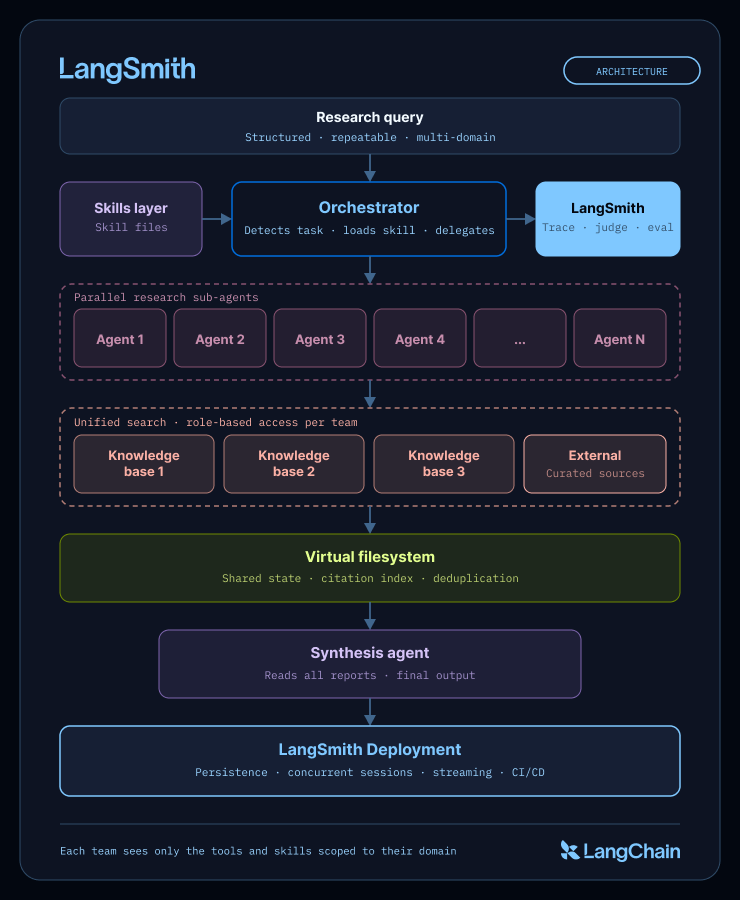
多様なデータを分析し、すべてを統合できる単一のシステムを構築しようとすると、複雑さによってすぐに破綻してしまいます。そこで私たちは異なるモデルを採用しました:複数のエージェントが協調して働き、それぞれが一つのことに特化して、包括的な主要目標に向かって取り組むというモデルです。一部のエージェントは検索を行い、他のエージェントは分析を行い、さらに別のエージェントは統合を行います。そしてそれらの上に位置するのが、多様なデータセットを正確に分析・統合する方法を決定するオーケストレーターです。
LangChain の DeepAgents エージェント用ハルネスを使用することで、オーケストレーションと並列実行の導入が容易になりました。このハルネスには、仮想ファイルシステム、コンテキスト管理、モジュール化されたスキル機能、チェックポイント機能などが標準で備わっています。これにより、私たちはエージェント調整の仕組みではなく、製薬業界を念頭に置いて設計されたエージェントの開発に注力することができます。
このハルネスは、システムが分割して征服することを可能にします。知能を一つの場所に押し込むのではなく、分散させてからそれを調整するのです。これは人間の脳が働く方法に似ています。
The Role of the Orchestrator
オーケストレーターは意図と実行が出会う場所です。タスクを受け取り、次に何を行うべきかを決定します:
- どの機能が必要か
- どのエージェントを実行すべきか
- 何が並列で行われ、いつすべてを統合するか。
すべてのドメインの詳細を知る必要はありません。問題を解決するための解決策をルーティングする方法を知っていれば十分です。この分離がシステムの柔軟性を保ちます。
研究手法や要件は企業内で多様であるため、オーケストレーターはそれらの差異を反映したモジュール型のワークフローセットを中心に構築されています。新しいユースケースが現れた際にも、システムはオーケストレーター自体の複雑さを増すのではなく、*スキル(skill)*という形式で新しいワークフローを追加することで拡張されます。
スキル:再利用性の鍵
ある一つのワークフローでシステムが動作することが確認された後、すぐに次の疑問が生じました。「他のこともできるのか?」
ロジックをハードコーディングするのではなく、Anthropic の *スキル(skill)*アプローチに基づいたモジュール型の機能を導入しました。各スキルは、特定の種類の課題にどのように取り組むかを定義します:何を探索すべきか、どのように推論を行うか、どのような出力が良質とみなされるかです。オーケストレーターは必要なタイミングで適切なスキルを読み込むだけです。つまり、新しいユースケースを追加する際にシステムを再構築する必要はなく、単に新たな思考様式を定義すればよいのです。
並列処理がゲームチェンジする理由
私たちが最初に気づいたことのひとつは、複雑な作業の多くを逐次的に行う必要はないということです。複数の角度から探索したり、複数のソースを検索したり、異なる次元を分析したりするタスクの場合、それを一つずつ順番に実行する必要はありません。
複数のエージェントが並列で実行され、それぞれが問題の異なる部分に焦点を当てています。システムが再び統合される頃には、完成された作業片が組み合わされます。オーケストレーションエージェントは研究質問を 3 つの部分に分け、3 つのサブエージェントに割り当てることで、各エージェントが自身の業務内で個別のデータセットの分析を並列化できます。これにより、精度と範囲が増加し、レイテンシが減少します。
LangSmith を用いた観測性と評価
複数のデータソース間で構築する際、最も難しい部分は検索そのものではなく、検索が機能しているかどうかを知ることにあります。回答が誤っている場合、それはデータがインデックスに含まれていないからでしょうか?それともクエリで取り出せなかったのでしょうか?あるいはエージェントが信頼すべきではないソースを信用してしまったのでしょうか?**
*トレーシング*(追跡)により、エージェントの行動を実質的に分析できるようになりました。LangSmith でシステムのトレースを初めて確認した際、以前の可視性がどれほど限定的であったかが明らかになりました。私たちは刺激に対する反応という行動しか観察できず、実際の認知プロセスは把握できませんでした。LangSmith でのトレーシングは、私たちのエージェント AI システムにおいて、基礎的な心理学から神経イメージングへと移行するようなものです;これにより、システムの脳内で実際に何が起こっているのかを視覚化できるようになりました。
LangSmith のエージェント評価フレームワークのトレースレベル評価から始めました。これは、完全なエージェント実行を対象としたもので、LLM をジャッジとして用いた評価器が採用されています。この評価器は、正確な経路ではなく結果をスコアリングする、実際のエンドユーザー向けビジネスフィードバックフォームを模倣するように設計されています。すべてのツール呼び出し、取得されたチャンク、そしてエージェントの決定は、セッション ID によって可視化されタグ付けされます。もしトレースがエージェントシステムの神経画像診断だとすれば、LangSmith は fMRI(機能的磁気共鳴画像法)のようなものであり、どの領域がいつ、どのような順序で活性化し、結果が妥当だったかを示してくれます。
最も大きな継続的な変化をもたらした点は、本番環境での障害が自動的に LangSmith のデータセットにフィードバックされることです。意味のあるエラーはすべて新しいテストケースとして扱われます。評価スイートは合成されたシナリオではなく、実際の失敗から成長していきます。
LangSmith を用いたデプロイ
エンタープライズ利用向けに構築する小規模チームには、現実的な緊張関係が存在します。信頼性とスケーラビリティが必要ですが、インフラを運用するための大規模なエンジニアリングチームは持ち合わせていないのです。
LangSmith Deploy がこの課題を解決しました。コアロジックを書き換えることなく、状態永続化、並行セッション、UI へのリアルタイムストリーミング機能を備えた管理サービスとしてグラフを展開しました。GitHub の CI/CD パイプラインが自動再デプロイをトリガーするため、スキル更新は手動ステップなしで提供可能です。この加速度的な進捗は歓迎すべき驚きでした。プロトタイプからエンタープライズ利用への移行には、予算化していた数ヶ月ではなく数週間しかかかりませんでした。
スケーラブルなドメイン専門家への対応
エージェント型スキルにより、マドリガルでは開発をドメイン専門家に開放できるようになりました。製薬業界の専門家は、どの証拠階層が重要か、どのデータベースを信頼すべきか、どのような出力が良質かを理解しています。このフィードバックループはこれまで構築してきたものよりもはるかに迅速です。ユーザーがシステムのロジックについて何か気づいた場合でも、深層エージェントのハネス(harness)のモジュール性により、あらゆる欠点を容易に解消できます。
現在、マドリガルの検索、分析、研究ニーズを可能な限り多くカバーできるよう、プラットフォームを急速にスケールさせています。LangChain や LangGraph の構築方法による相乗効果が、真の価値を発揮するポイントです。具体的には以下のような場面でその効果が見て取れます。
- 通常は数週間かかる新ユースケースの開発が数時間に短縮される
- 手動作業を必要としていたシステムが自律的に運用可能になる
- 新しいユースケースに新たなインフラストラクチャが必要なくなる
- (何より重要なのは)その後のデプロイが段階的に高速化される
これこそが、個別のソリューションに閉じこもっていないことの証です。あなたは、より速く、より良く構築できるシステムの上に築き上げているのです。
LangSmith の価値はプラットフォームを超えて
LangSmith が特に価値ある理由の一つは、その運営方法にあります。彼らは、オープンソースコミュニティからの最良の知見を LangChain フレームワークに取り込む稀有な能力を持ちながら、同時にエンタープライズチームの実情にも深く応答し続けています。
現場の開発者とプラットフォームを利用する企業顧客の間にあるこの継続的なフィードバックループこそが、AI 開発に求められるものです。LangChain はこれを真摯に受け止め、その姿勢は卓越したエンタープライズサポートや、プラットフォームへのフィードバックの募集、そして進化に伴いそのフィードバックが一貫してフレームワークおよびプラットフォームに反映される様子に表れています。
技術面を超えて、同等に重要なのは、彼らがどこへ向かっているかを明確に理解している点です。同社のチームは本質的に先見性があり、エージェント型 AI(agentic AI)がどの方向に進んでいるかを的確に把握しています。つまり、適切なツールを使用しているか、より良いものを見落としていないかと常に不安を抱えて振り返る必要がありません。この自信こそが、私たちが実際に重要視すべきことに集中する余地を与え、MASH 患者にとって意味のあるインパクトをもたらすデータ変換システムを構築することを可能にします。
エージェントの ROI(投資対効果)は、単一のユースケースを提供するだけでなく、そのパターンを再利用できる場合に真価を発揮します。LangSmith は、管理されたデプロイメント、トレーシング、評価機能を一つの場所で提供することで、Madrigal においてこれを現実のものにしています。これにより、新しいエージェントは常に確固たる基盤の上でスタートできます。これが私たちのチームが数ヶ月ではなく数週間でエンタープライズグレードのシステムを構築・ローンチし、MASH との戦いでより迅速に進むことを可能にする方法です。
—Parth Patel, Madrigal Pharmaceuticals 全球 AI 及びデータサイエンス担当責任者
*Madrigal では、技術的な目標として生産性を10倍に高め、患者の生活に影響を与え、MASH に対する闘いで主導権を握ることを目指しています。LangSmith は、事業全体で AI のスケール拡大を進める上で不可欠なパートナーであり、エージェントのライフサイクル全体(開発・評価から展開・継続的改善まで)にわたってエンドツーエンドの可視性を提供してくれます。この信頼性は、AI システムが置かれるハイリスク環境において妥協できない要件です。
—Ron Filippo, CIO, Madrigal Pharmaceuticals*
Madrigal Pharmaceuticals, Inc. について
Madrigal Pharmaceuticals, Inc.(ナスダック:MDGL)は、未解決の医療ニーズが高い肝疾患である代謝機能異常関連性脂肪性肝炎(MASH: metabolic dysfunction-associated steatohepatitis)に対して、新たな治療薬を提供することに注力しているバイオファーマシューティカル企業です。Madrigal の医薬品 Rezdiffra(resmetirom)は、1 日 1 回経口投与される肝臓指向型 THR-β アゴニストで、MASH の主要な根本原因を標的とするように設計されています。Rezdiffra は、中程度から進行した線維化(F2 から F3)を伴う MASH の治療に対して、FDA および欧州委員会の両方から承認された初の医薬品です。現在、代償性 MASH 肝硬変(F4c)に対する Rezdiffra の有効性を評価する第 3 相アウトカム試験が進行中です。詳細については、www.madrigalpharma.com をご覧ください。
原文を表示
*This is a guest post by Parth Patel, Global Head of AI and Data Science @ Madrigal Pharmaceuticals and Ron Filippo, CIO @ Madrigal Pharmaceuticals.*
At Madrigal Pharmaceuticals, Inc. we didn’t set out to build an enterprise multi-agentic platform. *Most enterprise systems don't start as platforms. They start as a question.*
Ours began with a key question for a pharmaceutical company: *how do we integrate, search, and synthesize information from diverse datasets at scale*.
To do that, we’d have to build a workflow that pulls information from multiple sources, applies structured thinking, and produces trusted answers.
At first, it looked like a single use case. But it quickly became clear that we were building a more general agentic solution that knows how to solve many problems the same way. A system that can:
- search across sources
- reason over structured criteria
- synthesize outputs at scale, and
- operate autonomously
That idea became the foundation of our enterprise multi-agentic platform.
We wanted Madrigal employees to be able to easily search, analyze, and synthesize relevant data spread across our enterprise within appropriate access controls, while ensuring every response was clearly cited. The platform is designed with role-based permissions and data governance guardrails so users only access information they are authorized to use. Building trust in our multi-agentic platform frees Madrigal users to focus on our north star core value: keeping patients with MASH at the heart of everything we do.
Breaking down data silos
Building a pharmaceutical-grade multi-agentic platform leaves no margin for error. We have to ensure the right data is analyzed correctly by the appropriate agent. However, like at any enterprise, information is scattered everywhere: structured systems, unstructured documents, external sources, real-time APIs... Each one useful but disconnected from the others.
We pieced together the disconnected data sources through a suite of parallelizable tool calls available to the multi-agentic platform. During this process, one of the biggest constraints in enterprise systems is that every data source behaves differently—different formats, different access patterns, and different expectations. We solved this by making the differences invisible to the agents. No matter where data comes from, it is normalized, stored in the same secure data warehouse, and made accessible through a consistent tool interface. From the agent's perspective, it's all just information it can use. That abstraction is what allows the system to operate across domains without rewriting logic each time.
LangChain and LangGraph were the right place to build
The LangChain framework combined with the LangSmith Platform is more than a toolset for our team; it represents a platform philosophy that automates our process.
The full pipeline visibility, iterative development cycle, and monitoring gave us the community-driven innovation of open source, without sacrificing what enterprise-grade production systems demand.
The *developer experience* of the LangChain framework is integrated with common agentic patterns and capabilities (like deep agents, middleware, and skills), which means we're not building the agent framework, we're building Pharma intelligence on top of it.
All of this is natively integrated with deployment and scale; LangSmith deployment makes these agents immediately accessible across the company, which is a common bottleneck for small teams.
When we say *platform philosophy*, it’s how these elements come together to cover what we needed—from focus on domain-specific reasoning, to instant deployment, monitoring, and tracing. In particular:
- We needed a framework that could handle multi-agent coordination at scale.
- LangSmith provided full traceable pipeline visibility behind every action, decision, and step.
- The LangChain framework enabled iterative development with confidence; small changes yielded tangible results.
- LangSmith removed a whole category of common enterprise problems with deployment and CI/CD workflows, helping bridge the gap between prototypes to daily enterprise use in weeks rather than months. An unexpected benefit of LangSmith was ready-to-deploy UI integrations through well-defined API endpoints. LangSmith Observability enabled real-world usage monitoring identifying common use cases and friction points.
The LangChain team served as a genuine thought partner throughout the process ensuring a high-quality developer experience.
From one system to many agents
Building a single system that can analyze diverse data and synthesize everything breaks quickly under complexity. Instead, we leaned into a different model: multiple agents working in concert, each doing one thing well, working towards an overarching major goal. Some agents search. Others analyze. Others synthesize. And sitting above them is an orchestrator deciding how the work to accurately analyze and synthesize diverse datasets gets done.
LangChain’s DeepAgents agentic harness allowed us to easily implement orchestration and parallel execution. The harness includes features such as a virtual filesystem, context management, modular skill capabilities, and checkpointing all out of the box. This lets us focus on building agents tailored with the Pharmaceutical industry in mind, not the mechanics of agent coordination.
The harness allows the system to divide and conquer. Instead of forcing intelligence into one place, you distribute it and then coordinate it... similar to how human brains work.
The Role of the Orchestrator
The orchestrator is where intent meets execution. It receives a task and decides what needs to happen next:
- which capabilities are required
- which agents should run
- what should happen in parallel and when to bring everything back together.
It doesn't need to know the details of every domain. It just needs to know how to route the solutions to address the problem. That separation keeps the system flexible.
Research methods and requirements vary across the enterprise, so the orchestrator is built around a modular set of workflows that reflect those differences. As new use cases emerge, the system grows by adding a new workflow in the form of a *skill*, not by increasing the complexity of the orchestrator itself.
Skills: the key to reusability
Once the system worked for one workflow, the next question came quickly: can it do something else?
Instead of hardcoding logic, we introduced modular capabilities based on Anthropic’s *skills *approach. Each skill defines how to approach a type of problem: what to look for, how to reason about it, what good output looks like. The orchestrator simply loads the right skill at the right time. That means adding a new use case doesn't require rebuilding the system. It just requires defining a new way of thinking.
Why parallelism changes the game
One of the first things we realized is that most complex work doesn't need to happen sequentially. If a task involves exploring multiple angles, querying multiple sources, or analyzing different dimensions, there's no reason to do that one step at a time.
Multiple agents run in parallel, each focusing on a different slice of the problem. By the time the system comes back together, it combines fully formed pieces of work. The orchestration agent can divide a research question into three parts to three sub-agents, who can then parallelize the analysis of individual datasets within their own work. This increases accuracy and scope while decreasing latency.
Observability and evals with LangSmith
The hardest part of building across multiple data sources isn't retrieval, it's knowing whether retrieval is working. When a response is wrong, is it because the data isn't in the index? the query didn't surface it? or the agent trusted a source it shouldn't have?
*Tracing* enabled real analysis of agentic behavior; the first time we saw traces for our system in Langsmith revealed how limited our visibility was before. We could only observe stimulus-response behavior, not the actual cognition. Tracing in LangSmith feels like going from basic psychology to neuroimaging for our agentic AI system; we were able to see what was actually happening inside the brain of our system.
We started with LangSmith's agent evaluation framework trace-level evals on full agent runs, using LLM-as-judge graders designed to mirror real end-user business feedback forms that score the outcome rather than the exact path. Every tool call, every retrieved chunk, every agent decision is visible and tagged by session ID. If tracing is neuroimaging for your agent system, LangSmith is the fMRI that shows you which regions activated, in what order, and whether the result made sense.
The part that's made the biggest ongoing difference: production failures feed back into our LangSmith datasets automatically. Every meaningful error becomes a new test case. The eval suite grows from real failures, not synthetic scenarios.
Deploying with LangSmith
A small team building for enterprise use has real tension: you need reliability and scalability, but you don't have a large engineering team to run infrastructure.
LangSmith Deploy resolved that. We deployed our graph as a managed service with state persistence, concurrent sessions, and real-time streaming to the UI without rewriting core logic. Our CI/CD pipeline in GitHub triggers automatic redeployment, so skill updates ship without manual steps. The acceleration was a welcome surprise. Going from prototype to enterprise use took weeks, not the months we'd budgeted.
Scaling across domain experts
Agentic skills allow us to open up the development to domain experts at Madrigal. Pharma experts know which evidence hierarchies matter, which databases to trust, and what good output looks like. That feedback loop is faster than anything we've built before; a user will notice something about the logic of the system, and the modularity of the deep agents’ harness allows us to easily address any shortcomings.
We are now working on rapidly scaling the platform to serve as many of Madrigal’s search, analysis, and research needs as possible. Because of how we built LangChain and LangGraph, the compounding effect is where the real value shows up. You see it
- when development for a new use case that would typically take weeks is reduced to hours
- when systems that required manual effort become self-sustaining
- when new use cases don't require new infrastructure
- (and most importantly) when subsequent deployments happen progressively faster.
That's when you know you're no longer isolating solutions. You're building on a system that enables you to build faster and better.
The value of LangSmith extends beyond the platform
What makes LangSmith particularly valuable is how they operate. They have a rare ability to absorb the best thinking from the open-source community into the LangChain framework, while also staying deeply responsive to the realities of enterprise teams.
That continuous feedback loop, between developers in the field and enterprise customers using the platform, is exactly what AI development demands. LangChain takes that seriously, and it shows in their stellar enterprise support, their solicitation of platform feedback, and how consistently that feedback surfaces in their framework and platform as they evolve.
Beyond the technology, there's something equally important: we are clear on where they are headed. Their team is genuinely forward-thinking, with a clear pulse on where agentic AI is heading. That means we're not constantly looking over our shoulders, wondering if we're using the right tools or missing something better. That confidence frees us to focus on what actually matters, building a system that transforms our data into meaningful impact for MASH patients.
The ROI of agents really shows up when you can reuse the pattern and not just ship a single use case. LangSmith helps make that real for Madrigal with managed deployment, tracing, and evals all in one place, so every new agent starts on solid ground. That’s how our teams can build and launch enterprise-grade systems in weeks, not months, helping us move faster in the fight against MASH.—Parth Patel, Global Head of AI and Data Science, Madrigal Pharmaceuticals
At Madrigal, our technology goal is to 10X our productivity so we can impact patients' lives and lead the fight against MASH. LangSmith has been a critical partner in that journey as we grow scale AI across our operations. It gives us end-to-end visibility across the agent lifecycle, from development and evaluation to deployment and continuous improvement. That trust is a non-negotiable for the high-stakes environment of our AI systems.—Ron Filippo, CIO, Madrigal Pharmaceuticals
About Madrigal Pharmaceuticals, Inc.
Madrigal Pharmaceuticals, Inc. (Nasdaq: MDGL) is a biopharmaceutical company focused on delivering novel therapeutics for metabolic dysfunction-associated steatohepatitis (MASH), a liver disease with high unmet medical need. Madrigal’s medication, Rezdiffra (resmetirom), is a once-daily, oral, liver-directed THR-β agonist designed to target key underlying causes of MASH. Rezdiffra was the first medication approved by both the FDA and European Commission for the treatment of MASH with moderate to advanced fibrosis (F2 to F3). An ongoing Phase 3 outcomes trial is evaluating Rezdiffra for the treatment of compensated MASH cirrhosis (F4c). For more information, visit www.madrigalpharma.com.
関連記事
今日のまとめ
AI日報で今日の重要ニュースをまとめ読み