Amazon Bedrock AgentCore を活用したビジネスサポート用 AI エージェントの構築
AWS GenAIIC と Works Human Intelligence は、Amazon Bedrock AgentCore を活用して HR システムの業務自動化 AI エージェントを開発し、コストを最大 97% 削減しながら運用効率を大幅に向上させた。
キーポイント
Bedrock AgentCore によるコスト劇的削減
既存の LangGraph や ECS/Fargate を用いた PoC から Bedrock AgentCore へ移行することで、インフラ管理コストを含め最大 97% の削減を実現した。
2 つの具体的な業務支援エージェント
通勤手当承認を自動化する「Commuting Allowance Agent」と、顧客に代わってブラウザ操作を行う「Browser Operation Agent」の 2 つが実装された。
統合型マルチエージェント環境の実現
AWS Fargate と Amazon Cognito を活用し、認証・認可機能を備えた高品質な統合マルチエージェント環境を構築した。
重要な引用
solutions that reduced costs by up to 97% while improving operational efficiency
WHI was already proceeding with a proof of concept (PoC) using LangGraph, Amazon Elastic Container Service (Amazon ECS), and AWS Fargate.
AI agents can significantly reduce workload and improve productivity.
影響分析・編集コメントを表示
影響分析
この記事は、生成 AI エージェントが単なる実験段階を超え、大規模な企業システム(特に HR 分野)において実際に運用され、劇的なコスト削減効果を発揮していることを示す重要な事例です。AWS のマネージドサービスである AgentCore が、複雑な認証や業務フローを内包するエンタープライズ環境での採用を加速させる可能性を示唆しています。
編集コメント
HR 業務という堅牢なセキュリティと複雑なルールが求められる領域で、Bedrock AgentCore が 97% のコスト削減を達成した点は非常に示唆に富んでいます。従来のカスタム構築からマネージドサービスへの移行が、いかに開発効率と運用コストの最適化に寄与するかを実証するケーススタディです。
ビジネスサポート用の AI エージェント開発は、多くの組織が一般的な人事業務の自動化を試みる際に直面する独自の課題を提示します。Works Human Intelligence (WHI) は、日本の大手企業および公益法人向けに統合人事システム「COMPANY」の開発、販売、サポートを行っています。
本記事では、AWS 生成 AI イノベーションセンター (GenAIIC) が Works Human Intelligence (WHI) と協力し、Amazon Bedrock AgentCore を用いて 2 つの AI エージェントを構築した事例について共有します。遭遇した課題と、運用効率を向上させながらコストを最大 97% 削減した解決策について議論します。
人事システムを利用する顧客は、組織変更や人事システムの改訂、従業員情報の更新など、数多くの状況に対応する必要があります。同様の課題に直面している組織にとって、AI エージェントは業務負荷を大幅に軽減し、生産性を向上させることができます。WHI が AI エージェントを用いた製品の構築に取り組んだ際、いくつかの課題が生じました。これらの問題を解決するため、GenAIIC の私たちは WHI チームと緊密に連携し、高品質な製品創出に向けた新たな視点とサポートを提供しました。
本プロジェクトの対象範囲は、運用部門の業務を支援する 2 つの AI エージェントです。「通勤手当エージェント」は、転居などのイベントに伴って発生する通勤手当申請の承認を処理します。もう一つの「ブラウザ操作エージェント COMPANY」は、顧客に代わってブラウザ操作を行います。これらの 2 つのエージェントにおける課題と解決策については、以下のセクションで詳述します。
通勤手当エージェント
このエージェントは、従業員の転居などのイベントに伴って発生するルーチン業務である通勤手当申請の承認を自動化します。
チャレンジ
通勤手当エージェントは、通勤手当申請の承認という日常的なタスクをサポートしています。WHI 社はすでに LangGraph、Amazon Elastic Container Service (Amazon ECS )、および AWS Fargate を用いて概念実証(PoC)を進めていましたが、開発中に Amazon Bedrock AgentCore がリリースされたため、チームは移行を検討し始めました。WHI 社は、私どもと協力して「COMPANY」と統合された AI エージェントを実現する AgentCore を活用したソリューションを構築したいと考えていました。また、現在開発中の AWS Fargate と Amazon Cognito を用いて認証および認可を実装し、統合型マルチエージェント環境へ移行することも望んでいました。
ソリューション概要
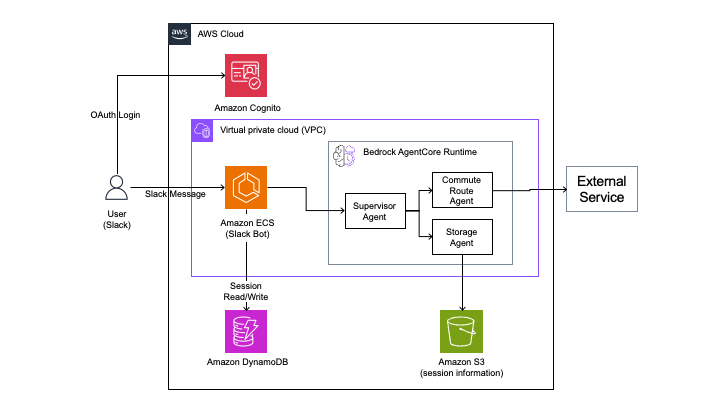
通勤手当エージェントは LangGraph と Amazon ECS を用いて開発されていましたが、チームはすべての処理が同じ Amazon ECS タスクとして実行されるモノリシックな構成について懸念を持っていました。そのため、サブエージェントを AgentCore Runtime 上で個別に起動するようアーキテクチャを変更するために協力しました。マルチテナンシーのサポートが必要であったため、WHI 社が柔軟に構築・管理できるようにするため、テナント管理には Amazon DynamoDB と Amazon Cognito を採用することになりました。
アーキテクチャ
Slack は Commuting Allowance Agent を呼び出すためのエントリーポイントとして機能するため、本システムは呼び出し時に認証を実行し、その後適切なサブエージェントがリクエストを処理するように設計されています。
結果とインパクト
プロジェクト中に AgentCore が一般提供 (GA) されたため、効果的に活用することができました。Commuting Allowance Agent は引き続き LangGraph を使用していますが、サブエージェントを別々のランタイムで実行するように修正を行いました。この変更により、将来的なサブエージェントの拡張が容易になります。また、将来はサブエージェントを束ねるスーパーバイザーエージェントを Strands Agents へ移行することも検討しています。さらに、WHI では従来、エージェントの状態を確認するために Langfuse をホストしており運用コストが発生していましたが、AgentCore Observability への切り替えによりこの負担が軽減されました。
ブラウザ操作エージェント
本エージェントはブラウザを使用して HR システムにアクセスし、コンテンツの確認、操作の実行、顧客に代わって証拠の収集を行います。
課題
2 つ目のエージェントも同様にブラウザを使用して「COMPANY」にアクセスし、コンテンツを確認し、操作を実行して証拠を取得します。構築には LangGraph と Playwright Model Context Protocol (MCP) が使用されていました。チームは以下のアプローチを通じて、ブラウザ操作に必要なトークンを 88% 削減することに成功しました:
- AI と Playwright MCP の間の会話履歴など、エージェントループ内の過去の不要な部分を削除しました。
- ブラウザ操作に関する不要な部分を、Playwright MCP の戻り値から除外しました。
- TOOL 部分にプロンプトキャッシングを採用しました。
しかし、これらは独自実装に依存していたため、Strands Agents への移行が困難であるなどの課題に直面しました。また、トークン数のさらなる削減方法についても検討していました。こうした背景のもと、GenAIIC は WHI と協力することになりました。
ソリューションの概要
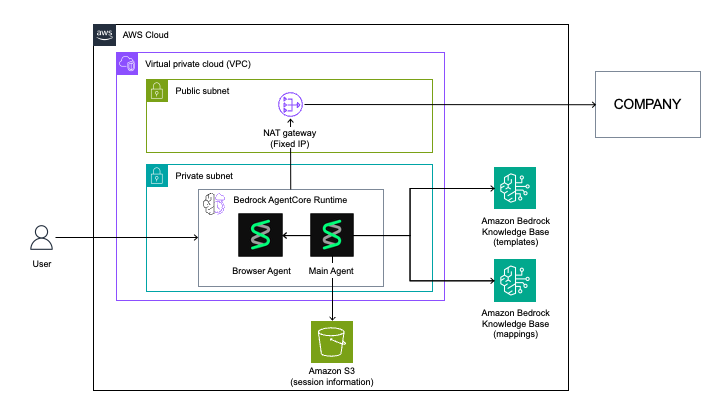
エージェントは Strands Agents を用いて構築しました。いくつかのブラウザ操作ツールをテストし、処理が成功することを確認した上で、使用されるトークン数の削減に注力しました。ワークフローはまず、ユーザーの指示に応じてナレッジベースから最適な操作テンプレートを検索することから始まります。次に、取得したテンプレートのプレースホルダーを、別のナレッジベースから得た情報で置換して操作マニュアルを作成します。その後、エージェントはこのマニュアルに基づいてブラウザを操作し、現在の情報を確認します。取得した情報(CSV など)をもとに変更提案を作成し、ユーザーに提示します。最後に、ユーザーの承認を得て、変更提案に基づいて再度ブラウザを操作し、変更を実行します。基本的なワークフローは定義されていますが、エージェントは独自の自律的判断により、ユーザー入力が不十分な場合や部分的なタスクのみが行われるケースにも柔軟に対応できます。
アーキテクチャ
エージェントからの「COMPANY」へのアクセスは IP アドレスによって制限されています。これに対処するため、AgentCore Runtime を仮想プライベートクラウド (VPC) 内に配置し、NAT ゲートウェイを使用して固定 IP アドレス経由でアクセスできるように構成しました。また、操作テンプレートや手順作成のための補助情報を格納するためのナレッジベースも構築しました。短期間の情報は Amazon Simple Storage Service (Amazon S3) バケットに保存しています。
結果と影響
ブラウザ操作エージェントは Strands Agents を用いて構築されました。browser-use、Playwright、fast playwright といったブラウザ操作ツールをテストしたところ、fast playwright が最も少ないトークン数で動作することが確認できました。さらに、Amazon Bedrock のプロンプトキャッシングの活用やシステムプロンプトの修正など、改善策への共同取り組みにより、プロセスあたりのコストを最大 97% 削減することに成功しました。主な改善施策は以下の通りです:
- ユーザーメッセージに対するプロンプトキャッシングの活用:Amazon Bedrock のプロンプトキャッシング機能を有効化($14.5 → $2.1)。
- エージェント動作の最適化:不要な操作を減らすためにサブエージェントのプロンプトを改善($2.1 → $1.0)。
- モデルの変更:Claude Sonnet 4.5 から Haiku 4.5 にモデルを変更($1.0 → $0.4)。
これらの改善により、コストを最適化しながら、より複雑なタスクの処理にも成功しました。具体的には、複数の変更を連続して実行するシナリオや、指示が曖昧な場合に人間に質問を行う必要があるシナリオなどが含まれます。
結論
私たちの協力により、AI エージェントの実行インフラを AgentCore Runtime へ移行することに成功し、AgentCore Observability を用いて運用状況を確認できるようになりました。WHI のメンバーは、AgentCore の採用によって開発が大幅に効率化され、ログ確認がマネージドサービスを通じて行えるようになったと述べています。さらに、ブラウザエージェントに Strands Agents を採用したことで、最小限の実装で柔軟な動作をするエージェントを実現できました。本記事では、AI エージェントの構築が日常業務をどのように支援できるかについて説明しました。私たちの共同作業により、WHI はビジネスロジックの開発に集中できる状態に至りました。AgentCore には実行基盤となる Runtime やその他の機能が含まれており、今後 WHI とともにさらなる活用を検討しています。また、AI エージェントの動作やコストは使用するモデルによって変化します。今回のプロジェクトを通じて、プロセスが期待通りに機能することを確認しました。今後はモデルの評価を継続し、コスト最適化を図っていく予定です。
Amazon Bedrock AgentCore がどのように AI エージェント開発を簡素化するかを体験するには、Getting Started Guide または Hands-on Lab をご覧ください。日常業務の自動化、マルチエージェントワークフローの構築、プロンプトキャッシングなどの機能を用いたモデルコストの最適化など、どのような目的であっても、AWS にはあなたをサポートするツールが用意されています。
著者について

Dayuan Jiang は、東京の AWS にてシニアディープラーニングアーキテクトとして勤務しており、Amazon Bedrock などの生成 AI テクノロジーの導入を顧客に支援し、クラウド上での運用効率の向上とイノベーションを推進しています。日本における生成 AI エンジニアとしての 3 年以上の実績を持ち、複数のクライアントプロジェクトを主導してきました。また、インフラストラクチャ・アズ・コードのための大規模言語モデル(LLM)の評価に関する研究にも貢献しています。AI を誰もが利用できるようにすることへの情熱から、フリータイムにはオープンソースツールの構築や、LLM やデータサイエンスに関する知見の共有を楽しんでいます。

Minsup Sim は、AWS 生成 AI イノベーションセンターに所属するディープラーニングアーキテクトで、日本における顧客向けにエンドツーエンドの生成 AI ソリューションを設計・提供することに専門化しています。データサイエンスのバックグラウンドを活かし、複雑なモデルの機能を、実際のビジネス課題を解決するための実用システムへと変換します。急速に進化する AI イノベーションと実践的な展開の交差点で力を発揮し、顧客が実験から本格的なスケールへ自信を持って移行できるよう支えています。

Angie Wang は、AWS 生成 AI イノベーションセンターでシニアジェネレーティブ AI ストラテジストを務めています。アジア太平洋地域の顧客と協力し、ジェネレーティブ AI の導入を加速させることに注力しています。コンピュータサイエンスとベンチャーキャピタル投資のバックグラウンドを持ち、ビジネス戦略と技術実行の架け橋となり、顧客が高インパクトを持つ生成 AI のユースケースを特定し、本番環境へ移行するのを支援します。アンジーは生涯学習者であり、変革的な AI 技術の最前線に立ち続けます。最新の進歩を実際の価値に変えることに情熱を持っています。

Toshio Katsurai は、AWS Japan の ISV/SaaS チームでシニアソリューションアーキテクトとして活躍しています。独立系ソフトウェアベンダーや SaaS 企業が、AWS 上で安全かつ適切にガバナンスされ、コスト最適化された環境を構築するのを支援しています。AWS Organizations、AWS Control Tower、AWS Config などのインフラストラクチャおよび管理・ガバナンスサービスに関する強力なバックグラウンドを持ち、AWS ブログやセッションを通じてベストプラクティスを定期的に共有しています。クラウドガバナンスに情熱を持ち、余暇には日本の AWS コミュニティの支援を楽しんでいます。
原文を表示
Developing AI agents for business support presents unique challenges that many organizations face when trying to automate routine HR tasks. Works Human Intelligence (WHI) develops, sells, and supports the integrated HR system “COMPANY” for major Japanese corporations and public interest corporations.
In this post, we share how the AWS Generative AI Innovation Center (GenAIIC) collaborated with Works Human Intelligence (WHI) to build two AI agents using Amazon Bedrock AgentCore. We discuss the challenges encountered and the solutions that reduced costs by up to 97% while improving operational efficiency.
Customers using HR systems must respond to numerous situations, such as organizational changes, revisions to HR systems, and updates to employee information. For organizations facing similar challenges with HR system operations, AI agents can significantly reduce workload and improve productivity. When WHI embarked on building products using AI agents, several challenges arose. To resolve these issues, we at GenAIIC worked closely with the WHI team to provide new perspectives and support in creating a high-quality product.The scope of this project covers two AI agents designed to support the work of operational departments. The Commuting Allowance Agent handles the approval of commuting allowance applications that arise during events like moving. The Browser Operation Agent “COMPANY” on behalf of the customer. We discuss the challenges and solutions for these two agents in the following sections.
Commuting allowance agent
This agent automates the approval of commuting allowance applications, which is a routine task that arises during events like employee relocations.
Challenge
The Commuting Allowance Agent supports the routine task of approving commuting allowance applications. WHI was already proceeding with a proof of concept (PoC) using LangGraph, Amazon Elastic Container Service (Amazon ECS), and AWS Fargate. However, because Amazon Bedrock AgentCore was released during development, the team began considering a migration. WHI wanted to work with us to build a solution with AgentCore that would realize an AI agent integrated with “COMPANY”. Additionally, they wanted to migrate to an integrated multi-agent environment and implement authentication and authorization using AWS Fargate and Amazon Cognito, which were currently under development.
Solution overview
The Commuting Allowance Agent was being developed using LangGraph and Amazon ECS, but the team had concerns about the monolithic configuration where everything ran as the same Amazon ECS task. Therefore, we worked together to change the architecture so that sub-agents are launched individually on the AgentCore Runtime. Because multi-tenancy support was required, we decided to manage tenants using Amazon DynamoDB and Amazon Cognito to maintain the flexibility for WHI to build and manage it.
Architecture
Slack serves as the entry point for calling the Commuting Allowance Agent, so the system is designed to perform authentication at the time of the call, and then the appropriate sub-agents process the request.
Results and impact
With AgentCore becoming generally available (GA) during the project, we were able to use it effectively. While the Commuting Allowance Agent continues to use LangGraph, we modified it so that sub-agents run on a separate Runtime. This change facilitates the future expansion of sub-agents. We are also considering changing the supervisor agent that bundles the sub-agents to Strands Agents in the future. Additionally, although WHI previously hosted Langfuse to check the status of agents, incurring operational costs, switching to AgentCore Observability has reduced this burden.
Browser operation agent
This agent uses a browser to access the HR system, check content, perform operations, and collect evidence on behalf of customers.
Challenge
The second agent uses a browser to access “COMPANY”, checks the content, performs operations, and acquires evidence. Construction was proceeding with LangGraph and Playwright Model Context Protocol (MCP). The team confirmed an 88% reduction in browser operation tokens through the following approaches:
- Removing past unnecessary parts from the agent loop (conversation history between AI and Playwright MCP).
- Removing unnecessary parts for browser operation from the return values of Playwright MCP.
- Using prompt caching for the TOOL part.
However, because it relied on a proprietary implementation, the team faced challenges such as difficulty in migrating to Strands Agents. They were also considering methods to further reduce tokens. It was in this context that GenAIIC began collaborating with WHI.
Solution overview
We built the agent using Strands Agents. After testing several browser operation tools and confirming successful processing, we focused on reducing the number of tokens used. The workflow begins by searching for the optimal operation template from the knowledge base according to user instructions. Next, it replaces placeholders in the acquired template with information obtained from another knowledge base to create an operation manual. The agent then operates the browser based on this manual to check the current information. Based on the information obtained (such as CSV), it creates a change proposal and presents it to the user. Finally, upon user approval, it operates the browser again based on the change proposal to execute the changes.Although a basic workflow is defined, the agent can flexibly handle cases where user input is insufficient or where only partial tasks are performed, based on its own autonomous judgment.
Architecture
Access to “COMPANY” from the agent is restricted by IP address. To address this, we placed the AgentCore Runtime within a virtual private cloud (VPC) and configured it to access through a fixed IP address using a NAT gateway. We also built a knowledge base to store operation templates and auxiliary information for creating operation procedures. We used an Amazon Simple Storage Service (Amazon S3) bucket to save short-term information.
Results and impact
The Browser Operation Agent was built using Strands Agents. We tested browser operation tools including browser-use, Playwright, and fast playwright, confirming that fast playwright consumed the fewest tokens. In addition, by collaborating on improvements such as using Amazon Bedrock prompt caching and modifying system prompts, we succeeded in reducing the cost per process by up to 97%.The main improvement measures were as follows:
- Using prompt caching for user messages: Enabled Amazon Bedrock’s prompt caching feature ($14.5 -> $2.1).
- Optimizing agent behavior: Improved sub-agent prompts to reduce unnecessary operations ($2.1 -> $1.0).
- Changing models: Changed the model from Claude Sonnet 4.5 to Haiku 4.5 ($1.0 -> $0.4).
Through these improvements, we optimized costs while successfully handling more complex tasks. These include scenarios that execute multiple changes in succession or scenarios where the agent asks the human questions when instructions are ambiguous.
Conclusion
Through our collaboration, we succeeded in moving the AI agent execution infrastructure to the AgentCore Runtime and can now check operational status using AgentCore Observability. WHI members have stated that using AgentCore has significantly streamlined development, as log checking is now performed through a managed service. Furthermore, adopting Strands Agents for the Browser Agent allowed us to realize a flexibly behaving agent with minimal implementation. In this post, we described how building AI agents can support routine tasks. Our work together has allowed WHI to reach a state where they can focus on developing business logic. AgentCore includes the Runtime, which serves as the execution foundation, and other features, so we are considering future utilization with WHI. Additionally, the behavior and cost of AI agents change with the model used. Through this project, we confirmed that the processes work as expected. We plan to continue evaluating models and optimizing costs.
To experience how Amazon Bedrock AgentCore simplifies AI agent development , visit our Getting Started Guide or the Hands-on Lab. Whether you are looking to automate routine tasks, build multi-agent workflows, or optimize model costs using features like prompt caching, AWS has the tools to support you.
About the authors
Dayuan Jiang is a Senior Deep Learning Architect at AWS in Tokyo, where he helps customers adopt generative AI technologies like Amazon Bedrock to improve operational efficiency and innovate on the cloud. With over 3 years of experience as a Generative AI engineer in Japan, he has led multiple client projects and contributed to research on evaluating LLMs for infrastructure-as-code. Passionate about making AI accessible, he enjoys building open-source tools and sharing insights on LLMs and data science in his free time.

Minsup Sim is a Deep Learning Architect at the AWS Generative AI Innovation Center, specializing in designing and delivering end-to-end generative AI solutions for customers in Japan. Drawing on his data science background, he translates complex model capabilities into production-ready systems that solve real business challenges. Minsup thrives at the intersection of rapid AI innovation and practical deployment, ensuring customers can move confidently from experimentation to scale.
Angie Wangis a Senior Generative AI Strategist at the AWS Generative AI Innovation Center, where she works with customers across the Asia-Pacific region to accelerate the adoption of generative AI. With a background in computer science and venture capital investment, she bridges business strategy and technical execution to help customers identify high-impact GenAI use cases and bring them to production. Angie is a lifelong learner who stays at the forefront of transformative AI technologies, and is passionate about turning the latest advances into real-world value.
Toshio Katsurai is a Senior Solutions Architect in the ISV/SaaS team at AWS Japan, helping Independent Software Vendors and SaaS companies build secure, well-governed, and cost-optimized environments on AWS. With a strong background in infrastructure and management & governance services such as AWS Organizations, AWS Control Tower, and AWS Config, he regularly shares best practices through AWS blogs and sessions. He is passionate about cloud governance and enjoys supporting the Japanese AWS community in his free time.
関連記事
今日のまとめ
AI日報で今日の重要ニュースをまとめ読み