Pineconeの専用読み取りノード:一般利用開始
ベクトルデータベースPineconeは、スケーラビリティとパフォーマンスを向上させる専用読み取りノードの一般提供を開始した。これにより、大規模な検索負荷に対応するインフラが強化された。
Source Article
元記事を日本語で読む
本文に関係しない購読案内、埋め込み通知、サイト内プロモーションは除いています。
ベクトルワークロードは万能ではありません。RAG システム、エージェント、プロトタイプ、スケジュールされたジョブなどの一部のアプリケーションでは、バースト性があり変動するトラフィックが発生します。負荷が急増し、アイドル状態になり、再び急増します。Pinecone のオンデマンドサービスはまさにこのために設計されています:クエリボリュームが予測不可能な場合に弾力性があり、使用量ベースでコスト効果が高いものです。
しかし、検索が収益に直結しており、かつスケールして一貫して実行されている場合、要件は変化します。クエリボリュームは高く持続し、レイテンシの SLO(サービスレベル目標)は厳しく、財務部門は予測可能な数値を必要とし、リクエストごとの課金モデルはもはや味方ではなくなります。コスト曲線が急峻化します。レート制限がスループットを制約します。そして問いは「検索は機能するか?」から「このスケールで安価かつ予測可能に実行できるか?」へと変化します。
本日、Pinecone Dedicated Read Nodes (DRN) が一般提供開始されたことを発表いたします。DRN インデックスは、予測可能なパフォーマンス、高いスループット、持続的な負荷下でのコスト効率の良いスケーリングを必要とするワークロード向けに設計されています。
TL;DR
持続的で高ボリュームのトラフィックを持つ検索、レコメンデーション、またはエージェントを実行する場合、DRN は以下を提供します:
- 高 QPS ワークロードにおいてリクエスト課金方式よりもはるかにコスト効果が高く、予測が容易な固定時間単価(per-node pricing)による、より低く予測可能なコスト
- メモリとローカル SSD を備えたウォームデータパスを持つ専用プロビジョニング済みリードノードにより、ベクトルを常にホット状態に保ち、コールドスタート時のレイテンシ劣化を排除した、予測可能な低レイテンシと高スループット
- QPS にはレプリカ、ストレージにはシャードを用いて生産トラフィックに合わせたスケーリングを実現し、スループットを制限するレートリミットなし
- インデックス再作成やダウンタイム、コード変更を必要とせず、オンデマンド(On-Demand)から単一の API 呼び出しで移行可能なパス
- 実際の生産ワークロードにおいて 77〜97% のコスト削減を実現。以下の例をご参照ください。
GA に伴い、DRN はより深い制御と観測性を可能にする 4 つの新たな生産環境機能が追加されました。詳細はこちらをご覧ください:チームにより多くの制御と観測性をもたらする DRN の新 GA 機能。
以下の Pinecone Assistant を使用して、ユースケースやスケーリング、コストモデル、移行方法などについて Pinecone Dedicated Read Nodes に関するご質問をお受けします。または、アシスタントをスキップしてブログ記事の続きをご覧ください。
収益に直結する検索がスケールしても一貫して実行される場合、経済性は変化する
ほとんどのチームはベクトル検索が「機能しない」ために失敗するわけではない。チームが直面するのは別の壁だ:検索は収益を駆動するエンドユーザー体験の一部であり、その検索の経済性とパフォーマンスは、他の重要なインフラストラクチャと同様に信頼性が高い必要がある。
実際には、ワークロードがスケールするにつれて、以下の 3 つのことが同時に起こりやすい。
- リクエストあたりのコストが持続的な QPS(1 秒間のクエリ数)で上昇する。オンデマンド(On-Demand)の使用量ベース課金は変動需要に対して効率的だ。しかし、ボリュームが一貫して高い場合、コストはすべてのクエリに応じてスケールし、特に大規模なデータセットをスキャンする場合に顕著になる。中程度のトラフィックでは費用対効果があったものが、持続的なスケールでは高価なものとなる。
- コストの予測が困難になる。課金がリクエスト単位であり、ボリュームがわずかに変動するだけでも、支出の見積もりには仮定が必要となる。財務部門は確定的な数字を求めている。しかし提供できるのは範囲だけだ。
- レート制限(rate limits)がスループットを制約する。マルチテナントのサーバーレスシステムでは、すべてのユーザーにサービス品質を保証するためにレート制限を使用している。これは優れたシステム設計だ。中断なく毎秒数千件のクエリが必要なワークロードにとって、これらの制限は制御できない天井となる。
持続的なスケールにおいて、これらのトレードオフは実際のビジネス上の結果を伴うことになり、特に検索が収益に直結する場合にはその影響が大きい:
- 高かつ安定した QPS におけるリクエスト駆動型コストカーブによる予測困難な支出
- トラフィックに合わせて柔軟に調整できないレート制限によるスループットの天井
- エンジニアが機能構築ではなく制限の回避に時間を割くことで生じる製品開発速度の低下
DRN は、パフォーマンスと経済性を計画・プロビジョニングする必要があるワークロード向けに設計されています。変動を許さない環境です。
DRN が適しているワークロードとは?
以下の条件を満たすワークロードには DRN を選択してください:
- 一定または高 QPS: ノードごとの時間課金はリクエスト単位の課金よりも優れており、多くの場合大幅に安価になります
- 大規模なベクトル数:数億から数十億のベクトルは、DRN の常時ホットデータパスにより恩恵を受けます。インデックスはメモリとローカル SSD に保持されるため、コールドスタートによるレイテンシの悪化はありません
- 厳格なレイテンシ SLO: 専有リソースにより、制御可能なパフォーマンスの下限が保証されます
- 予測可能な支出要件:固定時間課金により、予算計画が容易になります
On-Demand が適しているのは以下のケースです:
- バースト型または変動するワークロード:弾力的なスケーリングとリクエスト単位の課金がより効率的です
- 開発/テスト環境およびプロトタイプ:低コストでプロビジョニング不要
- 多数の小さな名前空間を持つワークロード:On-Demand の低レイテンシと容易なスケーリングがここで真価を発揮します
DRN はインデックスごとに設定されます。したがって、開発/テスト用ワークロードを On-Demand で実行し、本番用ワークロードを DRN で実行することが可能です。同じプラットフォーム、同じ API を使用します。Pinecone は、単一のプラットフォーム内でこれらのパフォーマンスプロファイルを混合できる唯一のソリューションです。
カスタマー事例:ZoomInfo がリアルタイム推薦をスケーリングし、コストを予測可能に保った方法
ZoomInfo は、営業およびマーケティングチームが関与すべき適切な人物や企業を特定するのを支援する、市場参入戦略用インテリジェンスソフトウェアを開発しています。同社の Applied AI チームは、3 億 9000 万件以上のコンタクト埋め込み(embeddings)に対して正確かつ低遅延のベクトル検索を行い、インタラクティブな UI の期待に応えるリアルタイムコンタクト推薦システムを構築しました。
Pinecone が同社の推薦システムの基盤となりました。トラフィックが増加するにつれ、Dedicated Read Nodes(専用読み取りノード)は、運用負荷の高いスケーリング、管理、チューニングを追加することなく、予測可能なパフォーマンスとコストで読み取り操作を分離・スケーリングするための明確な手段を提供しました。
「Pinecone のスラブアーキテクチャと Dedicated Read Nodes は、大規模なリアルタイム推薦を実行するために必要な速度、一貫性、隔離性を提供してくれました。インフラストラクチャの管理に時間を割くのではなく、推薦モデルと製品自体の改善に注力できるようになりました。その結果、顧客がコンタクトを調査・フィルタリング・評価する時間が数時間から数分に短縮され、ワンクリックで適切な人物にアプローチできる仕組みとなりました。」— ZoomInfo 技術担当バイスプレジデント兼 Applied AI 責任者 カルロス・ヌニェス
実際には、Dedicated Read Nodes(DRN)は、ZoomInfo に予測可能なパフォーマンスとコスト効率の高いスケーリングをもたらすと同時に、ワークフローの運用をシンプルに保ちました。これにより、エンジニアはインフラストラクチャ管理から解放され、モデルおよび製品の改善に集中することが可能になりました。
*ZoomInfo の事例研究を読む* ZoomInfo case study。
本番環境における DRN:実際のワークロードでのコストとパフォーマンス
DRN の経済性は、お客様のワークロードの形状に依存します。以下は、DRN が大きな差を生む場所を示す 3 つの本番環境でのワークロードです。
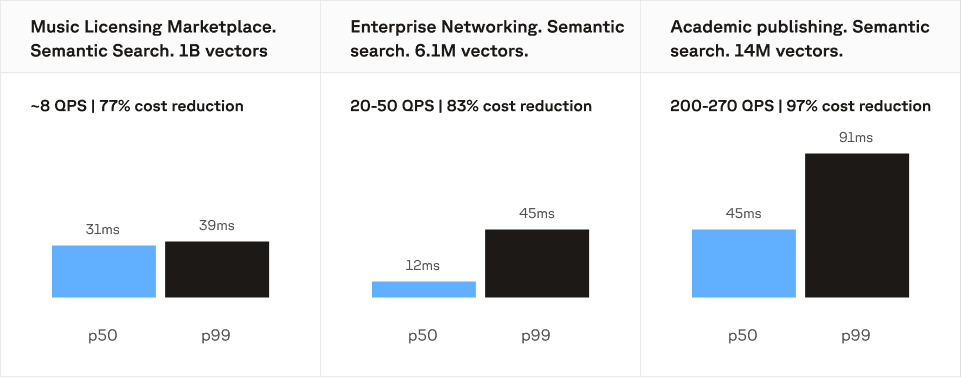
ビリオン規模のベクトル検索:コスト 77% 削減
主要な音楽ライセンス市場では、単一の名前空間内で 10 億個のベクトルからなるカタログに対してセマンティック検索を実行しています。クエリボリュームは約 8 QPS と低めですが、データセットが巨大であるため、リクエストごとの課金方式ではコストがすぐに膨らんでしまいます。なぜなら、すべてのクエリで巨大なインデックスをスキャンする必要があるからです。
DRN では、このワークロードは T1 ノード上で 14 シャードと 1 つの読み取りレプリカを使用して実行されます。レイテンシは厳しく、p50 で 31ms、p99 で 39ms です。このワークロードを DRN で実行すると、コストが77% 削減されます。
教訓:QPS が低くても、ベクトル数が膨大であれば、DRN では実質的なコスト削減が可能です。これは、コストがプロビジョニングされたインフラストラクチャに比例して変動するためであり、10 億個のベクトルを持つインデックスに対するクエリごとのスキャンに依存しないからです。
低レイテンシ検索:コスト 83% 削減
グローバルなエンタープライズネットワーク企業は、Pinecone を使用して、610 万個のベクトルからなるインデックス上で 20〜50 QPS の検索を実行しています。このワークロードはベクトル数は少ないもののレイテンシに敏感であり、一貫したクエリボリュームがあるため、データセットサイズに対してリクエストごとの課金方式が高額になります。
DRN において、このワークロードは T1 ノード上で 2 シャードと 2 つの読み取りレプリカで実行されます。p50 は 12ms、p99 は 45ms を達成します。このワークロードを DRN で実行するコストは83% 削減されます。
要点:DRN の専用リソースにより、制御可能なレイテンシの下限値が提供されます。SLO(サービスレベル目標)が厳しく、トラフィックが安定している場合、プロビジョニングされた容量は、リクエストごとに課金する方式よりも高速かつ安価です。
高 QPS 検索:コスト 97% 削減
主要な学術・科学出版プラットフォームでは、1400 万ベクトルのインデックスに対して、200〜270 QPS(秒間クエリ数)の持続的な検索トラフィックを処理しています。これは、リクエストごとの課金方式とプロビジョニング課金方式が最も大きく乖離するワークロードプロファイルです:中規模から大規模なデータセットで、かつクエリボリュームが高く一定であるケースです。
DRN において、このワークロードは T1 ノード上で 1 シャードと 4 つの読み取りレプリカで実行されます。p50 は 45ms、p99 は 91ms を達成します。このワークロードを DRN で実行するコストは97% 削減されます。
要点:持続的な高 QPS の場合、DRN の固定時間課金により劇的なコスト優位性が得られます。レプリカはスループットをほぼ線形にスケールするため、クエリボリュームに応じて容量を追加でき、各ステップでリクエストごとに課金される必要がありません。
DRN が一般提供開始
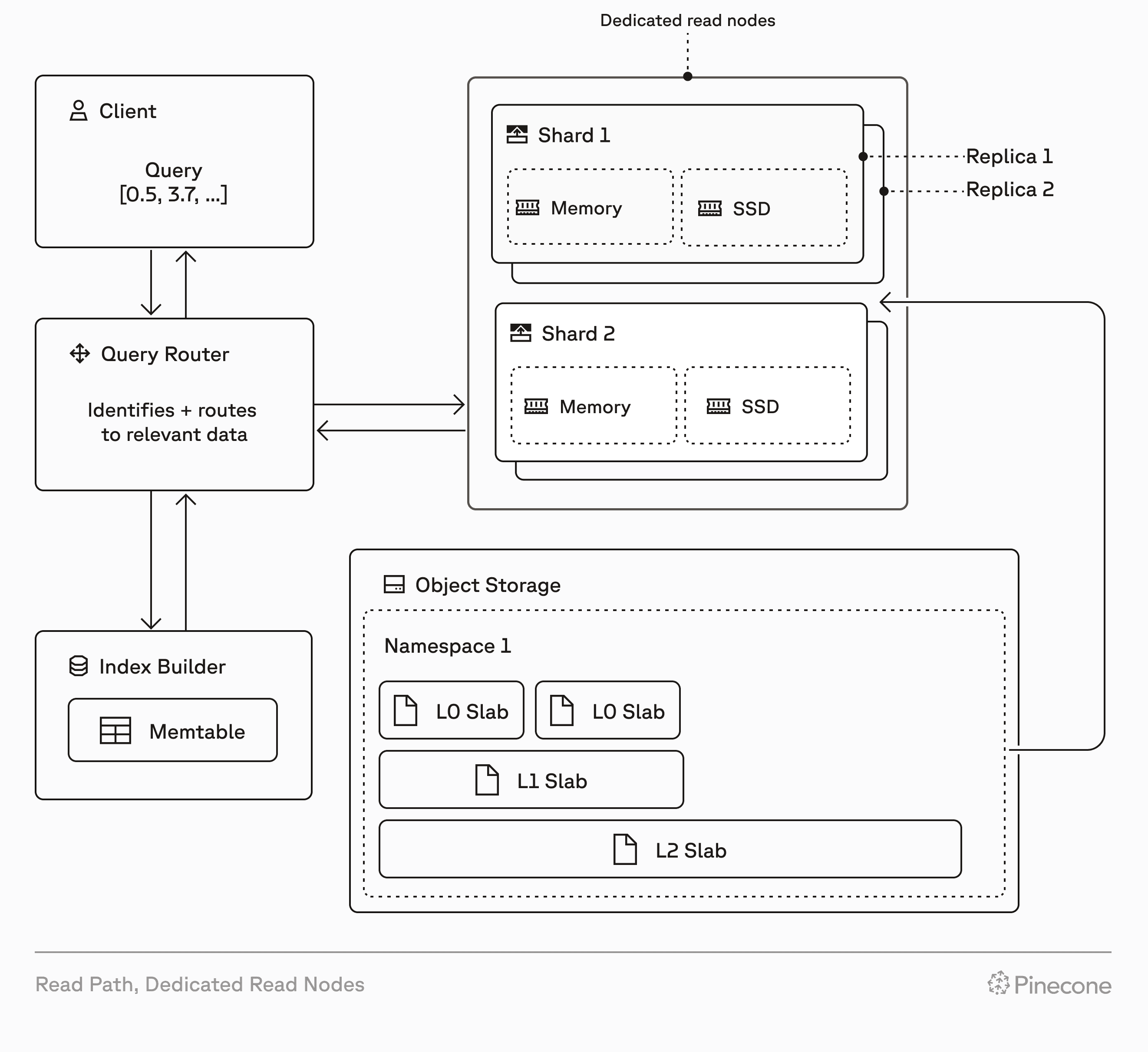
Dedicated Read Nodes(専用読み取りノード)は、インデックスに読み取り専用のサービング層を提供する一方で、それ以外の機能や構成は変更しません。
引き続き維持されるもの:
- 同じ Pinecone API と SDK
- 同じ書き込みパイプライン
- インデックスライフサイクルのための同じ運用モデル
追加されるのは:
- 各インデックスごとの専用、プロビジョニングされた読み取り容量
- ウォームデータパス(データは常にメモリとローカル SSD に保持される)
- 読み取りレート制限なし。専用リソースにより、スループットの上限を自分で制御可能
DRN のスケールは 2 つの次元で行われます:
- レプリカはスループットと可用性をスケールします。レプリカを追加することで QPS をほぼ線形に増加できます。
- シャードはストレージ容量をスケールします。シャードを追加することで、固定増分ごとにキャパシティを拡張できます。
DRN はインデックス単位で設定されるため、開発用・テスト用のインデックスはオンデマンドのままにしつつ、本番環境のインデックスには専用リソースを割り当てることができます。アーキテクチャも API も動作も同じですが、必要に応じてコストとパフォーマンスのプロファイルを使い分けることが可能です。
DRN を利用すれば、Pinecone のシンプルな開発者体験を維持しつつ、本番規模での読み取り性能とコストを予測可能にできます。
深い制御と可観測性のための 4 つの新しい GA 機能
DRN の中核的価値は変わりません:専用リソース、常にホットなデータ、固定コストでのスケーリングです。GA(一般提供)により、Day-2 オペレーションにおける制御性と可観測性を向上させる 4 つの機能が追加されました。具体的には、クエリごとのパフォーマンスとリコール率を構成可能にする機能、可観測性のためのメトリクスエクスポート機能、Web コンソール体験、そしてマルチネームスペースサポート(早期アクセス中)です。
DRN の新しい GA 機能の詳細はこちらをご覧ください:チームにより多くの制御と観測可能性をもたらす専用読み取りノードの 4 つの新 GA 機能 Four New GA Features for Dedicated Read Nodes That Give Teams More Control and Observability。
収益に直結する検索をスケールしても予測可能に
検索インフラの修正が最も高価になるのは、ユーザーがすでにそれを依存し始めてから後です。その頃には、コストの予期せぬ変動は現実的な影響を伴います:予算超過は厳しい議論を引き起こし、スループットの天井が製品発売を遅らせ、エンジニアは機能を実装する代わりに制限を回避するための作業に時間を費やすことになります。
現在一般提供(GA)された専用読み取りノード(Dedicated Read Nodes)は、持続的なスケールで収益に直結する検索を実行しているチームに対し、予測可能性への明確な道筋を提供します:常にホット状態のデータを持つ専用読み取り容量、読み取りレート制限のなし、インフラストラクチャではなくクエリ数に応じてスケーリングする固定時間単価です。
DRN インデックスを作成して開始するか、設定の詳細、スケーリングに関するガイダンス、API リファレンスについては DRN ドキュメント をお読みください。
原文を表示
Vector workloads aren't one-size-fits-all. Some applications, such as RAG systems, agents, prototypes, and scheduled jobs, have bursty, variable traffic. They spike, they idle, they spike again. Pinecone's On-Demand service is built for exactly this: elastic, usage-based, and cost-effective when query volume is unpredictable.
But when retrieval is both revenue-critical and consistently running at scale, the requirements change. Query volume is high and sustained, latency SLOs are tight, finance needs a number they can forecast, and per-request pricing stops being your friend. The cost curve steepens. Rate limits constrain throughput. And the question shifts from “does retrieval work?” to “can we run it affordably and predictably at this scale?”
Today, we're announcing Pinecone Dedicated Read Nodes (DRN) is generally available. DRN indexes are designed for workloads that need predictable performance, high throughput, and cost-efficient scaling under sustained load.
TL;DR
If you run search, recommendations, or agents with sustained, high-volume traffic, DRN gives you:
- Lower, more predictable cost with fixed hourly per-node pricing that is significantly more cost-effective than per-request pricing for high-QPS workloads and easier to forecast
- Predictable low-latency and high throughput through dedicated, provisioned read nodes with a warm data path (memory + local SSD) that keeps your vectors always hot, no cold start latency regressions
- Scaling that matches production traffic, via replicas for QPS and shards for storage, no rate limits constraining your throughput
- A single API call migration path from On-Demand with no reindexing, no downtime, and no code changes
- 77-97% cost reduction on real production workloads. See the examples below.
And with GA, DRN adds four new production capabilities for deeper control and observability. *Read more about DRN's new GA capabilities here: Four New GA Features for Dedicated Read Nodes That Give Teams More Control and Observability*.
*Use the Pincone Assistant below to ask questions about Pinecone Dedicated Read Nodes – from use cases and scaling to cost model and migration. Or skip the assistant and read the rest of the blog post.*
When revenue-critical retrieval consistently runs at scale, the economics change
Most teams don't fail because vector search “doesn't work.” Teams hit a different wall: retrieval is part of an end-user experience that drives revenue, and the economics and performance of that retrieval need to be as reliable as any other piece of critical infrastructure.
In practice, three things tend to happen at once as workloads scale:
- Per-request costs climb at sustained QPS. On-Demand's usage-based pricing is efficient for variable demand. But when volume is consistently high, costs scale with every query, especially when scanning large datasets. What was cost-effective at moderate traffic becomes expensive at sustained scale.
- Cost becomes hard to forecast. When pricing is per-request and volume fluctuates even modestly, forecasting spend requires assumptions. Finance wants a number. You can only offer a range.
- Rate limits constrain throughput. Multi-tenant serverless systems use rate limits to ensure quality of service across all users. That's good system design. For workloads that need thousands of queries per second without interruption, those limits become a ceiling you can't control.
At sustained scale, these tradeoffs carry real business consequences, especially when retrieval is revenue-critical:
- Hard-to-forecast spend from a request-driven cost curve at high, steady QPS
- Throughput ceilings from rate limits that can't flex with your traffic
- Slower product velocity when engineers work around limits instead of building features
DRN is built for workloads where retrieval performance and economics need to be planned and provisioned, not variable.
What workloads are a fit for DRN?
Choose DRN when your workload has:
- Consistent or high QPS: Hourly per-node pricing beats per-request pricing, often significantly
- Large vector counts: Hundreds of millions to billions of vectors benefit from DRN's always-hot data path, with indexes kept in memory and on local SSD, so there are no cold start latency regressions
- Tight latency SLOs: Dedicated resources give you a performance floor you control
- Predictable spend requirements: Fixed hourly pricing makes forecasting straightforward
On-Demand is the right fit for:
- Bursty or variable workloads: Elastic scaling and per-request pricing are more efficient
- Dev/test environments and prototypes: Lower cost, zero provisioning
- Workloads with many small namespaces: On-Demand's low latency and effortless scaling shine here
DRN is configured per-index. So you can run dev/test workloads on On-Demand and production workloads on DRN. Same platform, same APIs. Pinecone uniquely lets you mix these performance profiles within a single platform.
Customer story: how ZoomInfo scaled real-time recommendations (and kept costs predictable)
ZoomInfo builds go-to-market intelligence software that helps sales and marketing teams identify the right people and companies to engage. Their Applied AI team built a real-time contact recommendation system that required accurate, low-latency vector search over more than 390 million contact embeddings, with interactive UI expectations.
Pinecone became the foundation of their recommendation system. As traffic grew, Dedicated Read Nodes provided a straightforward way to isolate and scale reads with predictable performance and cost, without adding ops-heavy scaling, management, and tuning.
“Pinecone’s slab architecture and Dedicated Read Nodes gave us the speed, consistency, and isolation we needed to run real-time recommendations at scale. Instead of managing infrastructure, we spend our time improving our recommendation model and the product itself. That has reduced the time our customers spend researching, filtering, and evaluating contacts—from hours to minutes—by giving them the right people to reach out to with a single click.” — Carlos Nunez, Vice President of Engineering and Applied AI at ZoomInfo
In practice, DRN gave ZoomInfo predictable performance and cost-efficient scaling, while keeping the workflow simple to operate. So engineers could stay focused on model and product improvements rather than infrastructure management.
*Read the ZoomInfo case study.*
DRN in production: cost and performance across real workloads
The economics of DRN depend on the shape of your workload. Below are three production workloads that illustrate where DRN makes a big difference.
Billion-scale vector search: 77% cost reduction
A major music licensing marketplace runs semantic search over a catalog of 1 billion vectors in a single namespace. Query volume is low at ~8 QPS, but the dataset is large enough that per-request pricing adds up fast, because every query scans a massive index.
On DRN, this workload runs on T1 nodes with 14 shards and 1 read replica. Latency is tight: 31ms p50, 39ms p99. This workload costs 77% less to run on DRN.
The takeaway: even at low QPS, large vector counts drive meaningful savings on DRN because the cost scales with provisioned infrastructure, not per-query scans over a billion-vector index.
Low-latency search: 83% cost reduction
A global enterprise networking company uses Pinecone for search across a 6.1 million vector index at 20-50 QPS. The workload is small in vector count but latency-sensitive, and the consistent query volume makes per-request pricing expensive relative to the dataset size.
On DRN, this workload runs on T1 nodes with 2 shards and 2 read replicas. They achieve 12ms p50 and 45ms p99. This workload costs 83% less to run on DRN.
The takeaway: DRN's dedicated resources deliver a latency floor you control. When your SLOs are tight and traffic is steady, provisioned capacity is both faster and cheaper than paying per request.
High-QPS search: 97% cost reduction
A major academic and scientific publishing platform runs sustained search traffic at 200-270 QPS across a 14 million vector index. This is the workload profile where per-request pricing diverges most sharply from provisioned pricing: moderate-to-large dataset, high and consistent query volume.
On DRN, this workload runs on T1 nodes with 1 shard and 4 read replicas. They hit 45ms p50 and 91ms p99. This workload costs 97% less to run on DRN.
The takeaway: at sustained high QPS, DRN's fixed hourly pricing delivers a dramatic cost advantage. Replicas scale throughput near-linearly, so you add capacity in proportion to query volume rather than paying per request at every step.
DRN is now GA
Dedicated Read Nodes gives your index a dedicated serving layer for reads while keeping everything else the same.
You keep:
- The same Pinecone APIs and SDKs
- The same write pipeline
- The same operational model for your index lifecycle
You add:
- Dedicated, provisioned read capacity per index
- A warm data path, with data always kept in memory and on local SSD
- No read rate limits, dedicated resources mean you control your throughput ceiling
You scale DRN in two dimensions:
- Replicas scale throughput and availability. Add replicas to increase QPS near-linearly.
- Shards scale storage. Add shards to grow capacity in fixed increments.
And because DRN is configured per-index, your dev/test indexes can stay on On-Demand while production indexes get dedicated resources. Same architecture, same APIs, same behavior, different cost and performance profiles where you need them.
DRN lets you keep Pinecone's simple developer experience while making read performance and costs predictable at production scale.
Four new GA features for deeper control and observability
DRN's core value stays the same: dedicated resources, always-hot data, and fixed-cost scaling. GA adds four capabilities that improve control and observability for day-2 operations: configurable performance vs. recall per query, metrics exporting for observability, a web console experience, and multi-namespace support (in early access).
*Read more about DRN's new GA capabilities here: Four New GA Features for Dedicated Read Nodes That Give Teams More Control and Observability.*
Make revenue-critical retrieval predictable at scale
The most expensive time to fix retrieval infrastructure is after users already depend on it. By then, every cost surprise has a real consequence: budget overruns trigger hard conversations, throughput ceilings slow product launches, and engineers spend time working around limits instead of building features.
Dedicated Read Nodes, now generally available, gives teams running revenue-critical retrieval at sustained scale a clean path to predictability: dedicated read capacity with always-hot data, no read rate limits, and fixed hourly pricing that scales with your infrastructure, not your query count.
Create a DRN index to get started, or read the DRN documentation for configuration details, scaling guidance, and API reference.
関連記事
今日のまとめ
AIデイリーブリーフで今日の重要ニュースをまとめ読み