MagenticLite、MagenticBrain、Fara1.5:小型モデル向けに最適化されたエージェント体験
Microsoft Research は、小規模モデルでも高機能なエージェントを実現する MagenticLite アプリケーションと、その基盤となる MagenticBrain および Fara1.5 モデルを公開し、オンデバイスでの実行可能性を示した。
キーポイント
小規模モデルに特化したアジェンシー体験の提供
Microsoft Research は、MagenticLite を発表し、ブラウザとローカルファイルシステムを跨ぐ単一ワークフローで動作する実験的エージェントアプリケーションを提供した。
役割分担された専用モデルアーキテクチャ
推論・委任・ターミナル操作を担当する「MagenticBrain」と、ブラウザ操作に特化した「Fara1.5」の 2 つの専用モデルを組み合わせ、システム全体として最適化されている。
ツールオーケストレーションによるコスト削減
膨大な知識量ではなく、適切なツールの選定と実行(オーケストレーション)に焦点を当てることで、小規模モデルでも広範なタスクを低コストで処理可能であることを実証した。
オンデバイス実行とプライバシーの重視
ユーザーデータを端末内に保持し、ハードウェア上で直接動作可能なエージェントの実現を目指しており、クラウド依存からの脱却を示唆している。
Fara1.5 の性能向上と新機能
9B パラメータのフラッグシップモデルがウェブナビゲーションで前世代比約2倍の性能を達成し、フォーム入力や認証サイトへの対応を強化しました。
システム全体での設計最適化
データ生成からトレーニング、モデル設計、オーケストレーションに至るまで、各コンポーネントを個別ではなく協調して再設計することで小規模モデルでも信頼性の高いエージェント性能を実現しました。
ユーザー体験の改善と協働
エージェントの推論や行動の可視性を維持しつつ、ブラウザおよびチャットビューを更新して学習コストを下げ、必要な際にユーザーが直接介入しやすくする設計を採用しました。
重要な引用
MagenticLite is an agentic application that works across both the browser and local file system in a single workflow.
The project is built around a key research bet: that agentic capability depends on tool orchestration and action rather than knowledge alone.
Fara1.5 sets new state-of-the-art (SOTA) results among small computer-use models.
Fara1.5 sets new state-of-the-art (SOTA) results among small computer-use models and nearly doubles Fara-7B's performance on web navigation, with sharper handling of forms, credentialed sites, and long-running tasks.
Codesigning the app, models, and the harness enables capable and reliable agentic performance at this scale.
Fara1.5 outperforms all similarly sized models and nearly doubles the performance of Fara-7B.
影響分析・編集コメントを表示
影響分析
この発表は、大規模言語モデル(LLM)への依存度が高い現在の AI エージェント市場において、小規模・低コストモデルでも実用的なパフォーマンスを発揮できることを示す重要な転換点です。特に「ツールオーケストレーション」の重要性を再定義し、オンデバイスでの実行やプライバシー保護を重視する方向性を明確に打ち出すことで、企業や個人ユーザーがローカル環境で安全かつ効率的に AI エージェントを利用する未来像を具体化しています。
編集コメント
大規模モデルの競合が激化する中、あえて「小ささ」に賭け、ツール設計とオーケストレーションで性能を補うアプローチは、実用化におけるコストとプライバシー課題に対する有効な解となり得ます。

一言で言うと
MagenticLite は、ブラウザとローカルファイルシステムを単一のワークフロー内で横断して動作するエージェントアプリケーションです。次世代の Magentic-UI として構築され、再設計されたアプリと小規模モデル向けに最適化された実行基盤(harness)を組み合わせています。
MagenticBrain と Fara1.5 は、それぞれオーケストレーションおよびコンピュータ操作タスクのために設計された小規模モデルです。Fara1.5 は Fara の次世代版であり、実際のブラウザタスクにおいて測定可能な性能向上をもたらします。
これらのリリースは、小規模モデル、コード共設計ツール、最適化された実行基盤によって、エージェントの性能をどこまで引き上げられるかを探索するものです。
本日、Microsoft Research AI Frontiers は、小規模モデル向けに設計された実験的なエージェントアプリケーションである MagenticLite を発表しました(新しいタブで開く)。Magentic-UI の次世代版として、ブラウザとローカルファイルシステムを単一のワークフロー内で横断して動作します。
MagenticLite は、推論・委任・ターミナル操作用の MagenticBrain と、ブラウザベースのタスク向けのコンピュータ使用モデルファミリーである Fara1.5 という 2 つの専用モデルによって駆動されています。これら 3 つのコンポーネントは単一システムとして連携するように設計されており、その結果、効率的に動作し、データをユーザーの端末上に保持し、幅広いエージェントタスクをサポートするエージェントが実現されました。さらにこれは、ユーザーのハードウェア上で直接実行可能な能力を持つエージェントという、より広範な目標への道筋を示すものです。
このプロジェクトは、エージェント機能は知識だけでなく、ツールのオーケストレーションとアクションに依存するという重要な研究仮説に基づいて構築されています。この洞察により、コストを大幅に抑えながら、より小さなモデルを使用して幅広いエージェントタスクを実行することが可能になります。
MagenticLite は、トレーニングデータやモデル設計から、オーケストレーション、インタラクションデザイン、そして体験全体における人間の監督に至るまで、エンドツーエンドでどのようにエージェント AI に取り組んでいるかを反映したものです。
 image図 1. 一つの体験、三つのコンポーネント:MagenticLite、MagenticBrain、および Fara1.5。
今回のリリースに含まれるもの
MagenticLite (新しいタブで開く)
コミュニティからのフィードバックを反映して更新されたユーザーインターフェースを搭載し、小規模モデル向けに再構築されたエージェントハネス(agent harness)によって駆動される、実験的なエージェント体験である Magentic-UI の次世代版です。これは、単一のワークフロー内でユーザーのブラウザとローカルファイルシステム全体で動作します。
MagenticBrain (新しいタブで開く)
MagenticBrain は、プランナー、コーダー、そしてデレゲーター(委任者)を一つにまとめたものです。曖昧なリクエストを具体的な計画に変換し、各ステップに適したツールまたはサブエージェントを選択し、必要に応じてコードを記述し、タスク中に何かが破綻した場合でも回復処理を行います。
Fara1.5
私たちのコンピュータ使用モデルファミリーの次世代である Fara1.5 は、3 つのサイズで提供され、ほとんどのユースケースに対応するフラッグシップモデルとして 90 億パラメータモデルを備えています。Fara1.5 は、小規模なコンピュータ使用モデルの中で新たな最先端(SOTA)結果を達成し、ウェブナビゲーションにおける Fara-7B のパフォーマンスをほぼ倍増させ、フォーム、認証が必要なサイト、長時間実行されるタスクの処理をより鋭敏に行います。
各コンポーネントは単独でも有用ですが、それらが組み合わさることで最も効果を発揮します。アプリケーション、モデル、およびハルネス(評価・制御基盤)を協調設計することで、この規模において能力があり信頼性の高いエージェント性能を実現しています。
私たちの研究アプローチ:より少ないリソースでより多くのことを実現する
私たちは単純な問いから始めました:小規模モデルが本質的にエージェントタスクに優れるためには何が必要か?その答えはライフサイクル全体に及び、データ生成、トレーニング目標、モデル設計、そしてオーケストレーション(調整・制御)を個別ではなく一体的に見直す必要がありました。
フォームの入力、ブラウザを用いた調査の実施、ローカルでのファイル管理といった実世界のユースケースから要件を特定し、それらに基づいて評価用データセットを構築しました。標準的なベンチマークは状況の一部を捉えていますが、必ずしも実世界での有用性を直接測定するものではありません。シナリオベースの評価がこれらのベンチマークを補完し、モデルとハルネスの両方における反復改善のための重要な指標となりました(図 2 を参照)。
 image図 2. エージェントシステムを構築する反復プロセスには、成功基準の定義、パフォーマンスの評価、モデルまたはシステム設計(あるいはその両方)の改善が含まれます。その後、これを繰り返します。
ユーザーエクスペリエンスについては、Magentic-UI から重要な要素を維持しました。これには、エージェントの推論と行動の可視化、ユーザーが直接制御できる機能、重要なポイントでの明示的な承認が含まれます。最近のユーザー調査に基づき、ブラウザ表示とチャット表示を更新して MagenticLite を学習しやすく、協働しやすくしました。これは、ユーザーがエージェントの行動を理解しやすくなり、必要に応じて介入できるよう設計されたものです。この様子は図 3 に示されています。
 image図 3. MagenticLite のインターフェースには、エージェントの行動を理解しやすくし、必要に応じて介入できるように設計された、更新されたブラウザ表示とチャット表示が含まれています。
Spotlight: Event Series

Microsoft Research Forum
一般 AI の時代における研究についてのアイデアの継続的な交換に参加してください。最新のエピソードはオンデマンドで視聴できます。
オンデマンドで視聴
新しいタブで開く
システムコンポーネント
Fara1.5:その重量クラスを超えて性能を発揮するコンピュータ操作モデル
Fara1.5 は、私たちのコンピュータ操作モデルファミリーの次世代であり、3 つのサイズ(4B、9B、27B)で提供されています。多くのユースケースにはフラッグシップモデルである 9B モデルが推奨されます。Fara1.5 は小規模なコンピュータ操作モデルの中で新たな SOTA(State-of-the-Art:最先端)性能を達成し、ウェブナビゲーションにおける Fara-7B のパフォーマンスをほぼ倍増させ、フォームの処理、認証が必要なサイトへの対応、長時間実行されるタスクの扱いにおいてより優れた結果を示します。
昨年の 11 月、私たちはウェブブラウザ内でタスクを完了するために構築された小規模なエージェントモデル「Fara-7B」を発表しました。これは、ベスト・イン・クラスのパフォーマンスを実現する革新的な合成データ生成エンジンを用いてトレーニングされました。Fara1.5 はその賭けの次のステップであり、Qwen 3.5 を基盤とした 3 つのモデル(4B、9B、27B)からなるファミリーで、前回のリリースで見られたギャップを埋めるように設計されています。
新機能
最先端の結果。広く使用されるウェブドメインにわたる 300 のタスクを含む人気ベンチマーク「Online-Mind2Web」において、Fara1.5 はそのサイズクラスのモデルの中で新たな SOTA(State-of-the-Art:最先端)記録を樹立しました。Fara1.5 は同サイズのすべてのモデルを上回り、Fara-7B のパフォーマンスをほぼ倍増させました。より大規模な Fara1.5-27B バリアントは、同じベンチマークで 90% を超えるパフォーマンスを達成しています。
 image図 4. OnlineMind2Web ベンチマークにおいて、Fara‑1.5-9B は同サイズのモデル群の中で最先端の性能を達成し、先行するモデルを大幅に上回っています。
ユーザー体験の向上。ベンチマークでの改善に加え、Fara1.5 のユーザー体験も強化されました。フォームの入力や認証が必要なサイトへのログイン処理、予約の取得など、日常的なタスクにおいてより強力なパフォーマンスが確認できるはずです。これらの改善は、当社の FaraGen データ生成パイプラインの次の進化によって実現されています。ライブウェブサイトでのトレーニングに加え、ログインや取り消し不可能な操作などのシナリオをシミュレートするように設計された、極めて現実的な合成環境でもモデルを訓練しました。
長時間実行されるタスク向けに調整されたネイティブアクション空間。クリックやキーボード入力だけでなく、Fara1.5 には、数百ステップにわたって重要な情報をコンテキスト内に保持し、必要に応じてユーザーから許可や設定を問い合わせるための組み込みツールが備わっています。これにより、数分間に及ぶ実際の作業にまたがるタスクでも一貫性を保つことが可能になります。
重要ポイントの再調整。Fara-7B は、取引、ログインフロー、取り消し不可能な提出などの活動における重要ポイントを検出し、フラグを立てるよう訓練されていました。Fara1.5 では、実際の利用からの知見に基づき、重要ポイントに関する設計を洗練させました。その結果、必要な場合に安全トリガーが作動する一方で、フォーム入力など有用なタスクを妨げることがなくなりました。
 image図 5. Fara1.5 はクリティカルポイントを検出すると一時停止し、ユーザーの介入を要求します。この例では、メールアドレス認証を使用して LinkedIn アカウントにサインインしている最中です。
MagenticBrain: オーケストレーターモデル
MagenticBrain は、プランナー、コーダー、デレゲーターの機能を一つに備えた 14B パラメータ規模のオーケストレーションモデルです。Qwen 3 14B からファインチューニングされ、推論時に遭遇するのと同じツールスキーマと実行環境を備えた MagenticLite ハーネス内でエンドツーエンドに訓練されました。その結果、オーケストレーションの学習方法と実行時の動作との間にギャップが生じません。
多くのエージェントシステムにおいて、オーケストレーション(計画および調整)は最も推論集約的なコンポーネントであるため、チームは歴史的にこの役割に対して最も能力の高いモデルを依存してきました。私たちの仮説は、小規模モデルでも能力を犠牲にすることなくこの役割を担えるという点にあります。これを実現する二つの設計上の選択があります。
第一に、マルチステップのツール呼び出し軌道(モデルが適切なツールを選択し正しく呼び出す方法を学習するもの)と、コーディングおよびターミナル軌道(正解が場合によっては 5 行の Python コードであり、ツール呼び出しではないもの)を組み合わせることです。これには、訓練時と推論時に使用されるツールのフォーマット間の緊密な結合が伴います。
2 つ目は、コンピュータ使用エージェント(CUA)への委任です。オーケストレーターの職務の重要な部分は、自ら行動すべきでないタイミングを見極め、代わりにタスクを Fara1.5 に引き渡すことです。当社のデータパイプラインには、明示的な委任軌道が含まれています。これは、オーケストレーターがブラウザまたはユーザーインターフェース(UI)タスクを認識し、構造化された形で CUA モデルへ引き渡し、結果を待機してタスクを再開する一連のシーケンスです。その結果、14B のフットプリント内で柔軟に推論、コーディング、ツール呼び出し、そして委任を行うことができるオーケストレーターモデルが実現しました。私たちは、MagenticLite と併用するように設計された MagenticBrain を公開します。
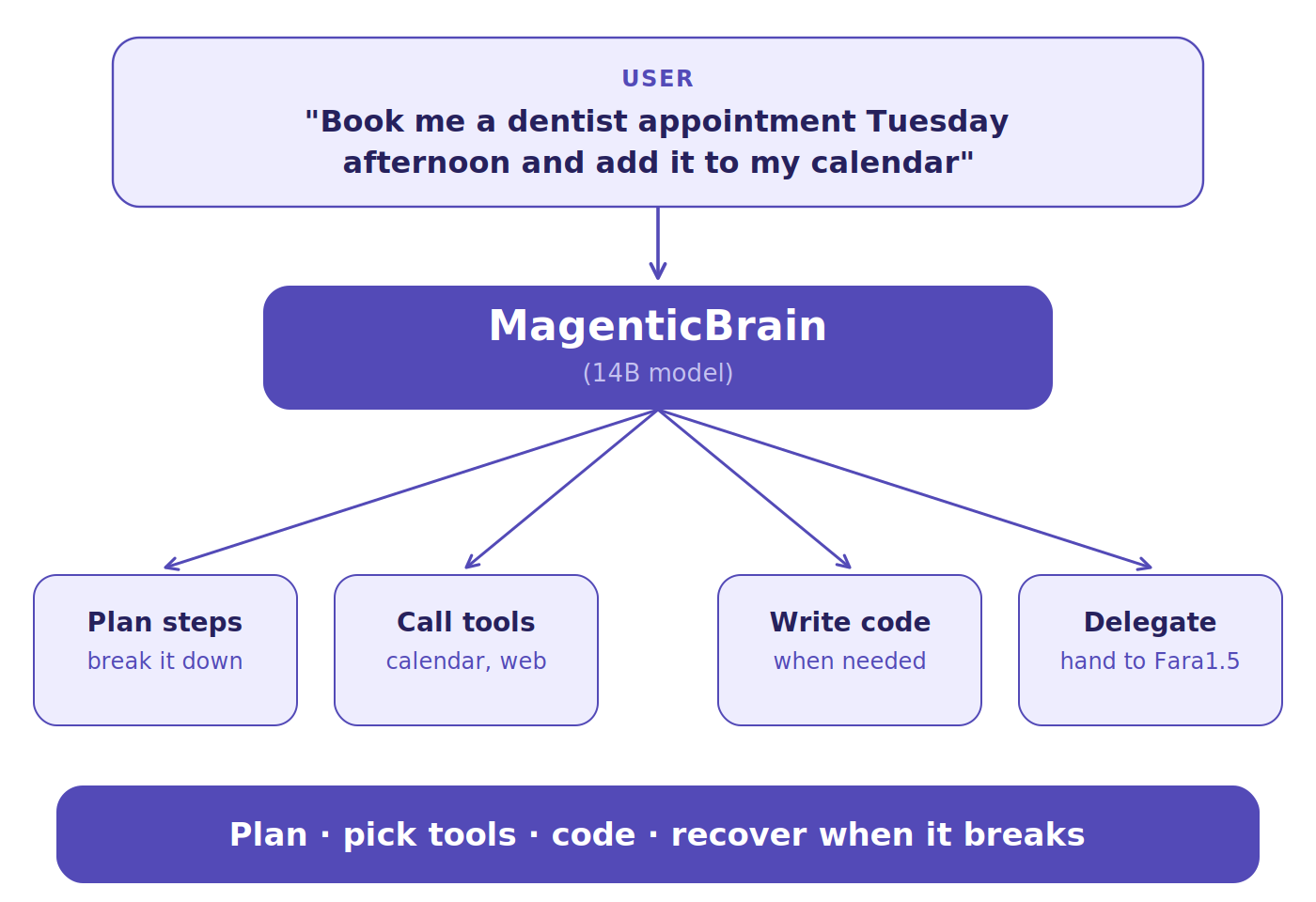 image図 6. MagenticBrain は、自然言語によるリクエストを小さなステップに分解し、適切なツールを選択し、必要に応じてコードを記述し、ブラウザ関連のタスクを Fara1.5 に委任できる小型のオーケストレーションモデルです。
Harness: 小型モデル向けに構築
Harness は、オーケストレーターとブラウザ使用モデルを単一のワークフローに統合します。最も重要な設計上の選択は以下の 3 つです。
段階的な計画立案。Harness は逐次的に計画を立てることで、システムを柔軟に保ち、長時間実行されるタスク全体を通じてよりスムーズな軌道修正と回復を可能にします。
アクティブなコンテキスト管理。小規模モデルは有効なコンテキストウィンドウが小さく、コンテキストが増大すると性能が急速に低下します。ハレス(harness)は各ステップで各モデルに提供される情報を積極的に選別し、プロンプトを焦点化し、必要な情報のみを表面化し、以前の対話を簡潔な要約に圧縮して残りをオフロードすることで、オーケストレーターと Fara1.5 が長期間のタスクにおいても効果的に機能し続けるようにします。
サブエージェントによる委任。すべてのタスクに対して単一の小規模モデルに依存するのではなく、オーケストレーターが主要なエージェントとして振る舞い、専門的な作業をサブエージェントに委任します。これにより、ブラウザ関連のタスクは Fara1.5 に引き継がれます。このパターンは、各モデルが問題のより狭く専門的な部分を処理できるようにすることで、小規模言語モデル(small language models)の強みを活かすものです。また、将来の拡張のための基盤も築きます:後続バージョンでは追加のサブエージェントを導入し、並列実行してより豊かで効率的なワークフローを実現できる可能性があります。
ハレスは、Magentic-UI 1.0 から継承された人間がループ内(human-in-the-loop)に存在するという保証を維持しています。ブラウザ操作およびコード操作における重要なポイントでは依然として明示的なユーザー承認を待機し、システム全体は Quicksand(新しいタブで開く)内で実行されます。Quicksand は QEMU ベースのサンドボックス用に作成されたオープンソースラッパーであり、ブラウザセッションとコードの実行をホストシステムから隔離します。
 image図 7. MagenticLite アーキテクチャの概要。本システムは、フロントエンド、ハネス(制御基盤)、モデル、サンドボックス化された実行環境にわたる階層型アーキテクチャを採用しています。
動作を確認する
MagenticLite は、ブラウザ上およびローカルファイルシステム全体にわたり、フォームの入力、予約の作成、ローカルファイルの整理、情報の検索と分析など、幅広いタスクを実行できます。
MagenticLite | 経費精算フォーム入力デモ
MagenticLite | レストランの検索・予約デモ
MagenticLite | レシピ材料の価格検索デモ
MagenticLite | ローカルファイル整理デモ
試して、一緒に構築しよう
MagenticLite、MagenticBrain、Fara1.5 は、継続的な探索と開発を支援するための研究用リリースです。より広いコミュニティからの実験、評価、フィードバックを促すために公開しています。
MagenticLite は Magentic-UI の更新版であり、GitHub で利用可能です(新しいタブで開く)。
MagenticBrain は Microsoft Foundry で利用可能です(新しいタブで開く)。
Fara1.5 モデルは Microsoft Foundry で利用可能です(新しいタブで開く)。
貢献者
エージェント型エクスペリエンス:Cheng Tan, Maya Murad, Weili Shi
エージェント型ハネス:Adam Fourney, Tyler Payne
Fara1.5: Alexey Taymanov, Andrew Zhao, Aravind Rajeswaran, Corby Rosset, Hussein Mozannar, Luiz Do Valle, Spencer Whitehead, Vibhav Vineet, Zach Nussbaum, Sahil Gupta, Yadong Lu
MagenticBrain: Ahmed Elgohary Ghoneim, Akshay Nambi, Amir Saeidi, Caio César Teodoro Mendes, Harkirat Behl, Karan Gupta, Pashmina Cameron, Pranav Vajreshwari, Shital Shah, Yash Lara, Yash Pandya
協力者: Abhishek Gowami, Amanda Swearngin, Michael Harrison, Sara Abdali, Sarthak Harne, Vidhisha Balachandran
プロジェクト責任者: Ahmed Awadallah, Rafah Hosn
スポンサー: Ahmed Awadallah, Ece Kamar, Rafah Hosn, Saleema Amershi, Shital Shah
新しいタブで開きます。投稿「MagenticLite、MagenticBrain、Fara1.5: 小型モデル向けに最適化されたエージェント型体験」は、Microsoft Research の記事として最初に掲載されました。
原文を表示
At a glance
MagenticLite is an agentic application that works across both the browser and local file system in a single workflow. Built as the next generation of Magentic-UI, it combines a redesigned app with a harness optimized for small models.
MagenticBrain and Fara1.5 are small models designed for orchestration and computer-use tasks, respectively. Fara1.5 is the next iteration of Fara and delivers measurable gains on real-world browser tasks.
Together, these releases explore how far agentic performance can be pushed with smaller models, codesigned tools, and an optimized execution harness.
Today, Microsoft Research AI Frontiers releases MagenticLite (opens in new tab), an experimental agentic application designed for small models. As the next generation of Magentic-UI, it works across the browser and local file system in a single workflow.
MagenticLite is powered by two purpose-built models: MagenticBrain, for reasoning, delegation, and terminal use, and Fara1.5, a computer-use model family for browser-based tasks. The three components were designed to work together as a single system. The result is an agent that runs efficiently, keeps data on the user’s machine, and supports a broad range of agentic tasks. It also points toward a broader goal: capable agents that can run directly on users’ hardware.
The project is built around a key research bet: that agentic capability depends on tool orchestration and action rather than knowledge alone. That insight makes it possible to use smaller models while still enabling a broad range of agentic tasks at a fraction of the cost.
MagenticLite also reflects how we approach agentic AI end-to-end—from training data and model design to orchestration, interaction design, and human oversight throughout the experience.
imageFigure 1. One experience, three components: MagenticLite, MagenticBrain, and Fara1.5.
Included in this release
MagenticLite (opens in new tab)
The next generation of Magentic-UI, our experimental agentic experience, is powered by an agent harness rebuilt for small models, with an updated user interface informed by community feedback. It works across users’ browsers and local file systems in a single workflow.
MagenticBrain (opens in new tab)
MagenticBrain is MagenticLite’s planner, coder, and delegator in one. It turns vague requests into concrete plans, selects the right tool or subagent for each step, writes code when needed, and recovers should something break mid-task.
Fara1.5
The next generation of our computer-use model family, Fara1.5 comes in three sizes, with a flagship 9-billion-parameter model for most use cases. Fara1.5 sets new state-of-the-art (SOTA) results among small computer-use models and nearly doubles Fara-7B’s performance on web navigation, with sharper handling of forms, credentialed sites, and long-running tasks.
Each component is useful on its own, but they work best together. Codesigning the app, models, and the harness enables capable and reliable agentic performance at this scale.
Our research approach: Doing more with less
We started with a simple question: what does it take to make a small model genuinely good at agentic tasks? The answer spanned the full lifecycle—data generation, training objectives, model design, and orchestration had to be redesigned together rather than in isolation.
We identified requirements from real-world use cases like filling out forms, conducting browser research, and managing files locally, and built an evaluation dataset around them. Standard benchmarks capture part of the picture, but they are not always a direct measure of real-world usefulness. Scenario-based evaluations complemented those benchmarks and became a key signal for iterative improvement across both the models and the harness, as shown in Figure 2.
imageFigure 2. An iterative process for building agentic systems involves defining success criteria, evaluating performance, and refining the models or system design (or both). Then repeat.
For the user experience, we retained key elements from Magentic-UI, including visibility into the agent’s reasoning and actions, the ability for users to take direct control, and explicit approval at critical points. Based on recent user studies, we also made MagenticLite easier to learn and collaborate with through updated browser and chat views, designed to make it easier for users to understand the agent’s actions and intervene when needed. This is illustrated in Figure 3.
imageFigure 3. MagenticLite’s interface includes updated browser and chat views designed to make it easier to understand agent actions and intervene when needed.
Spotlight: Event Series
image
Microsoft Research Forum
Join us for a continuous exchange of ideas about research in the era of general AI. Watch the latest episodes on demand.
Watch on-demand
Opens in a new tab
System components
Fara1.5: A computer-use model that outperforms its weight class
Fara1.5 is the next generation of our computer-use model family, which is available in three sizes, with a flagship 9B model recommended for most use cases. Fara1.5 achieves new SOTA performance among small computer-use models and nearly doubles Fara-7B’s performance on web navigation, with better handling of forms, credentialed sites, and long-running tasks.
Last November, we released Fara-7B, a small agentic model built for completing tasks in a web browser. It was trained using a novel synthetic data generation engine that enabled best-in-class performance. Fara1.5 is the next step in that bet: a family of three models (4B, 9B, 27B) based on Qwen 3.5, designed to close the gaps we saw in the prior release.
What’s new
State-of-the-art results. On the popular Online-Mind2Web benchmark, which contains 300 tasks across widely used web domains, Fara1.5 sets new SOTA results for models in its size class. Fara1.5 outperforms all similarly sized models and nearly doubles the performance of Fara-7B. The larger Fara1.5-27B variant achieves more than 90% performance on the same benchmark.
imageFigure 4. On the OnlineMind2Web benchmark, Fara‑1.5-9B achieves state-of-the-art performance among models in its size class and substantially outperforms prior models.
Improved user experience. In addition to improvements on benchmarks, we improved the user experience of Fara1.5. Users should observe stronger performance on everyday tasks like filling out forms, handling logins for credentialed sites, and booking appointments. These improvements are driven by the next evolution of our FaraGen data generation pipeline. Alongside training on live websites, we also trained the model on highly realistic synthetic environments designed to simulate scenarios like logins and irreversible actions.
A native action space tuned for long-running tasks. Beyond clicks and keyboard actions, Fara1.5 has built-in tools to store key information in its context across hundreds of steps and ask the user for permission or preferences when needed, helping it stay coherent on tasks that span many minutes of real work.
Recalibrated critical points. Fara-7B was trained to detect critical points for activities like transactions, login flows, or irreversible submissions and flag them. In Fara1.5, we refined our design around critical points based on our learnings from real use, so safety triggers still occur when they should but do not block useful tasks, such as form-filling.
imageFigure 5. Fara1.5 pauses and requests user intervention when it detects a critical point, in this case during a sign-in to a LinkedIn account using email credentials.
MagenticBrain: The orchestrator model
MagenticBrain is a 14B-parameter orchestration model—planner, coder, and delegator in one. Fine-tuned from Qwen 3 14B, MagenticBrain was trained end-to-end within the MagenticLite harness with the same tool schemas and execution environment it will encounter at inference time. As a result, there is no gap between how it learned to orchestrate and how it runs.
In many agentic systems, orchestration (planning and coordination) is the most reasoning-intensive component, so teams have historically relied on their most capable models for this role. Our bet is that small models can handle this role without sacrificing capability. Two design choices make that possible.
The first involves combining multistep tool-calling trajectories—where the model learns to pick the right tool and call it correctly—with coding and terminal trajectories—where the right answer is sometimes five lines of Python, not a tool call. This is paired with tight coupling between the tool format used during training and inference.
The second is computer-use agent (CUA) delegation. A key part of the orchestrator’s job is knowing when not to act itself and instead handing off a task to Fara1.5. Our data pipeline includes explicit delegation trajectories: sequences where the orchestrator recognizes a browser or user interface (UI) task, issues a structured handoff to the CUA model, waits for the result, and resumes the task. The result is an orchestrator model that reasons, codes, calls tools, and delegates fluidly within a single 14B footprint. We are releasing MagenticBrain which is designed for use with MagenticLite.
imageFigure 6. MagenticBrain is a small orchestration model that can break down a natural-language request into smaller steps, select the right tools, write code when needed, and delegate browser tasks to Fara1.5.
The Harness: Built for small models
The harness combines the orchestrator and browser-use models into a single workflow. Three design choices matter most:
Step-by-step planning. The harness plans incrementally, keeping the system flexible and enabling smoother course correction and recovery throughout long-running tasks.
Active context management. Small models have smaller effective context windows and degrade faster as context grows. The harness actively curates what each model receives at each step, keeping prompts focused, surfacing only the necessary information, condensing earlier interactions into concise summaries, and offloading the rest, so the orchestrator and Fara1.5 remain effective across long tasks.
Delegation through subagents. Rather than relying on a single small model for every task, the orchestrator acts as the main agent and delegates specialized work to subagents. This means handing off browser tasks to Fara1.5. This pattern plays to the strengths of small language models by allowing each model to handle a narrower, more specialized part of the problem. It also lays the foundation for future expansion: later versions could introduce additional subagents and run them in parallel for richer, more efficient workflows.
The harness preserves the human-in-the-loop guarantees from Magentic-UI 1.0. Critical points across both browser and code actions still pause for explicit user approval, and the entire system runs inside Quicksand (opens in new tab), an open-source wrapper created for a QEMU-based sandbox, which isolates browser sessions and code execution from the host system.
imageFigure 7. Overview of the MagenticLite architecture. The system uses a layered architecture spanning the front end, harness, models, and sandboxed execution environment.
See it in action
MagenticLite can perform a wide range of tasks across the browser and local file system, such as filling out forms, making appointments, organizing local files, and searching for and analyzing information.
MagenticLite | Fill expense forms demo
MagenticLite | Find and book a restaurant demo
MagenticLite | Find prices for recipe ingredients demo
MagenticLite | Organize local files demo
Try it, and build with us
MagenticLite, MagenticBrain, and Fara1.5 are research releases intended to support continued exploration and development. We are releasing them to encourage experimentation, evaluation, and feedback from the broader community.
MagenticLite is an updated release of Magentic-UI, it’s available on GitHub (opens in new tab).
MagenticBrain is available on Microsoft Foundry (opens in new tab).
Fara1.5 models are available on Microsoft Foundry (opens in new tab).
Contributors
Agentic experience: Cheng Tan, Maya Murad, Weili Shi
Agentic harness: Adam Fourney, Tyler Payne
Fara1.5: Alexey Taymanov, Andrew Zhao, Aravind Rajeswaran, Corby Rosset, Hussein Mozannar, Luiz Do Valle, Spencer Whitehead, Vibhav Vineet, Zach Nussbaum, Sahil Gupta, Yadong Lu
MagenticBrain: Ahmed Elgohary Ghoneim, Akshay Nambi, Amir Saeidi, Caio César Teodoro Mendes, Harkirat Behl, Karan Gupta, Pashmina Cameron, Pranav Vajreshwari, Shital Shah, Yash Lara, Yash Pandya
Collaborators: Abhishek Gowami, Amanda Swearngin, Michael Harrison, Sara Abdali, Sarthak Harne, Vidhisha Balachandran
Project leads: Ahmed Awadallah, Rafah Hosn
Sponsors: Ahmed Awadallah, Ece Kamar, Rafah Hosn, Saleema Amershi, Shital Shah
Opens in a new tabThe post MagenticLite, MagenticBrain, Fara1.5: An agentic experience optimized for small models appeared first on Microsoft Research.
関連記事
今日のまとめ
AI日報で今日の重要ニュースをまとめ読み