生成AIの旅をナビゲートする:AWSのPath-to-Valueフレームワーク
AWSは生成AIの実用化における課題を解決する「Path-to-Value(P2V)フレームワーク」を発表し、組織が概念実証から本番導入、持続的価値創出へと体系的に移行するためのメンタルモデルと実践ガイドを提供した。
キーポイント
生成AI実用化の根本的課題
概念実証(POC)段階では技術的実現可能性を示せても、本番導入や持続的価値創出に至る過程で、技術的・組織的・ガバナンス面の課題が顕在化し、多くの取り組みが停滞する。
Path-to-Value(P2V)フレームワークの目的
生成AIイニシアチブをアイデア段階から実験、大規模な本番導入へと体系的に移行させるためのメンタルモデルと実践ガイドを提供し、持続的なビジネス価値の創出を目指す。
実用化を阻む4つの主要障壁
価値(明確なROIや測定可能なビジネス成果の欠如)、リスク(法的責任、データプライバシー、セキュリティ脆弱性、評判への影響)、技術(既存システムとの統合、インフラ要件、データ品質、運用の複雑さ)、組織(スキルギャップ、文化の変化、意思決定プロセス)の4カテゴリーに課題が分類される。
重要な引用
The real challenge begins after those early wins. Although POCs frequently demonstrate technical feasibility, organizations often struggle to translate them into production-ready systems that deliver measurable business value.
The Generative AI Path-to-Value (P2V) framework was created to address this gap. It provides a mental model and practical guide to help organizations systematically move generative AI initiatives from ideation and experimentation to production at scale.
The core challenge with generative AI adoption is not innovation velocity. Initial pilots frequently show strong promise and generate enthusiasm across teams. However, when organizations attempt to operationalize these solutions, progress slows.
When organizations move generative AI from experimentation toward production and value creation, challenges consistently fall into four major categories.
影響分析・編集コメントを表示
影響分析
この記事は、生成AIの実用化における普遍的な課題を明確に定義し、AWSが提供する体系的アプローチ(P2Vフレームワーク)を提示している。業界全体が直面する「POC以降の壁」への解決策を示すことで、企業の生成AI導入を現実的なビジネス価値創出へと導く指針となり、実装段階におけるベストプラクティスの形成に影響を与える可能性が高い。
編集コメント
生成AIの「実用化の壁」を体系的に分析し、フレームワークとして具体化した点で実務家にとって価値が高い。AWSのプラットフォーム戦略の一環として、顧客の成功事例創出を支援する意図が読み取れる。
生成AIは、組織が生産性、顧客体験、運用能力にアプローチする方法を再構築しています。業界全体で、チームは新しい働き方を実現するために生成AIの実験を行っています。これらの取り組みの多くは、技術的な実現可能性を示す魅力的な概念実証(POC: Proof of Concept)を生み出します。しかし、本当の課題はこれらの初期の成功の後から始まります。POCが技術的な実現可能性を示すことは頻繁にありますが、組織はそれらを測定可能なビジネス価値をもたらす本番環境対応のシステムに変換することに苦戦することがよくあります。概念から本番環境へ、そして本番環境から持続的な価値創造への移行は、技術的、組織的、ガバナンスの各次元にわたる課題をもたらします。
生成AI Path-to-Value(P2V: 価値への道)フレームワークは、このギャップを解消するために作成されました。これは、生成AIのイニシアチブをアイデア出しや実験から大規模な本番環境への移行まで、組織が体系的に進められるよう支援するメンタルモデルかつ実践的なガイドを提供します。その目標は、持続可能なビジネス価値の創出です。
根本的な課題
生成AIの採用における核心的な課題は、イノベーションの速度ではありません。初期のパイロットプロジェクトはしばしば強い可能性を示し、チーム全体に熱意を生み出します。しかし、組織がこれらのソリューションを実務レベルで運用しようとする段階になると、進捗は鈍化します。データアクセスはセキュリティやプライバシーの要件によって制限されます。既存のエンタープライズシステムとの統合には予期せぬ複雑さが伴います。ガバナンス、コンプライアンス、承認プロセスが摩擦を生み出します。同時に、チームは生成AIの機能をビジネス成果に結びつける一貫した成功指標を定義することに苦戦しています。構造化されたアプローチがない場合、これらの課題は複合的に悪化します。多くのイニシアチブがプロトタイプ、本番環境での準備完了、そして価値実現の間で停滞してしまいます。組織が必要としているのは、これらの課題を意図的かつ包括的に解決するフレームワークです。適切なフレームワークは摩擦を軽減しつつ、価値実現までの時間を加速させます。
障壁の4つの主要カテゴリ
組織が生成AIを実験段階から本番環境および価値創造のフェーズへ移行する際、課題は一貫して4つの主要カテゴリに分類されます。
- 価値:多くの生成AIプロジェクトでは、明確に定義された投資利益率(ROI)や測定可能なビジネス成果が欠如しています。具体的な成功基準がない場合、継続的な投資を正当化したり、取り組みの優先順位付けをしたりすることが困難になります。
- リスク:法的責任、データプライバシー、セキュリティ脆弱性、評判への影響に関する懸念から抵抗が生じます。AIをめぐる規制環境が絶えず変化する中で、コンプライアンス要件に関する不確実性もさらに高まっています。
- テクノロジー:生成AIを生産環境へ移行させることは、モデル選定を超えた技術的課題をもたらします。既存システムとの統合、インフラ要件、データの品質問題、運用上の複雑さ(観測可能性、スケーラビリティ、レジリエンス)はしばしば過小評価されます。さらに、本番環境へのデプロイ前には評価と検証が重要な課題となります。デプロイチームは指標の確立、テストデータセットの構築、シナリオごとのパフォーマンス測定、品質維持のための継続的モニタリングの実装を行う必要があります。コスト最適化とリソース管理に関するFinOpsの考慮事項も、これらの技術的複雑さに拍車をかけます。
- 人材:変革への抵抗、チーム内のスキルギャップ、役割や責任に対する生成AIの影響に関する不確実性、適切な専門知識の確保や育成の難しさにより、採用が遅れています。
これらの障壁は孤立して現れることはめったにありません。他の課題を無視して一つだけを解決しようとすると、問題が解消されるのではなく、単に形が変わるだけです。

生成AIのバリューへの道筋フレームワーク
生成AI バリューへの道筋(Path-to-Value、以下P2V)フレームワークは、技術担当者だけでなく非技術担当者の両方にとっての共通のメンタルモデルおよびロードマップとして機能します。これは、初期のアイデア創出から本番環境での実装、そして持続的な価値の実現に至るまで、生成AIワークロードのライフサイクルに関するガイダンスを提供します。このフレームワークは、本番環境での運用を終着点と見なすのではなく、ビジネスへの影響という道筋における一つのマイルストーンとして位置づけることで、本番環境での運用を最終目標とする従来の考え方を転換します。その目的は、生成AIの取り組みが成功裏にスケールアップするのを妨げる最も一般的な障害を取り除くことを組織に支援することです。
フレームワークの構造
このフレームワークは、3つの主要なコンポーネントを通じて、実際の運用経験を実践的なガイダンスに変換します。
- 柱(Pillars):対応しなければならない主要な領域を表します。
- チェックポイント(Checkpoints):異なる段階における準備完了の状態を明確にします。
- ガイダンスおよび成果物(Guidance and artifacts):実行を支援する具体的なツールを提供します。
この構造により、組織は課題を理解する段階を超え、概念から価値への移行過程でそれらを一貫して解決することに焦点を当てることができます。
相互接続されたシステム、直線的なプロセスではない
P2V(Path-to-Value)フレームワークは、線形で段階的なプロセスとして適用することを意図したものではありません。生成AIの採用は、まっすぐな直線上を進むことはめったにありません。その代わりに、組織はこのフレームワークを柔軟かつ非同期に適用し、複数の柱(ピラー)を並行して扱うべきです。例えば、チームは技術的な能力を構築すると同時に、ガバナンスのガードレールを整備し、さまざまなユースケースに対するビジネスケースを開発することができます。この並行アプローチは、全体的なプロダクションへの到達と価値実現の道を大幅に加速させることができます。フレームワークの中心にあるのは、エンドツーエンドの生成AIジャーニーであり、組織を初期概念からプロダクション展開、そして最終的に測定可能な価値の実現へと導きます。P2Vジャーニーは、生成AI採用の全段階を通じて継続的な注意を要する相互接続された柱に依存しています。組織は、成熟度や制約に応じて複数の柱を並行して扱うことがよくあります。この柔軟で包括的なアプローチは、生成AI実装の重要な側面が適切に扱われることを保証するのに役立ちます。組織は自らの文脈に合わせてフレームワークを適応させることができます。ただし、PoC(Proof of Concept:概念実証)やMVP(Minimum Viable Product:最小実行可能製品)の段階に進む前に、基盤となる柱(ビジネスケース、データ戦略、セキュリティ、法的コンプライアンス)を優先すべきです。
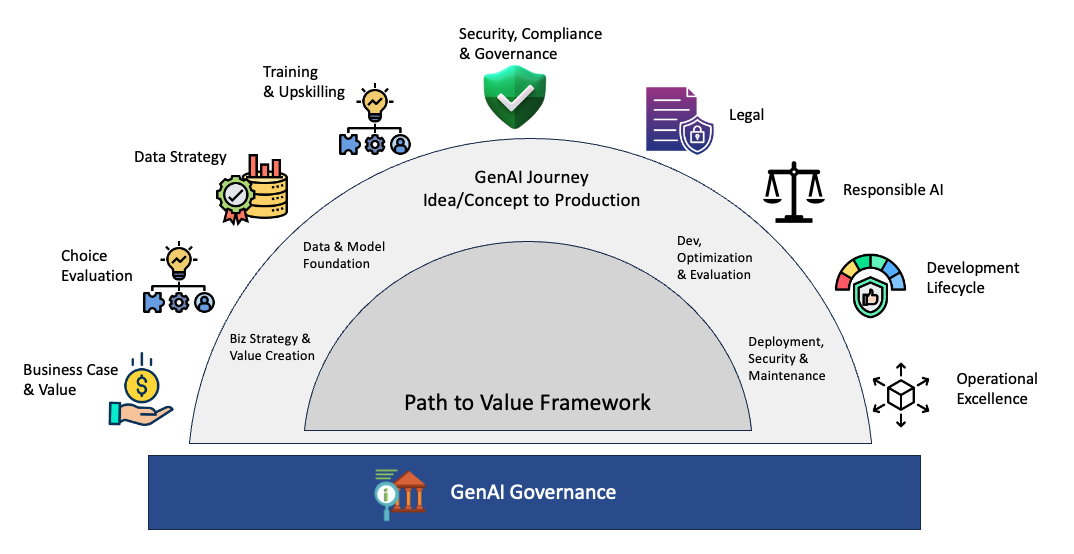
P2Vフレームワークの主要な柱
P2V(Path-to-Value:価値への道筋)フレームワークは、一連の基盤となる柱に旅を整理します。各柱は、生成AIイニシアチブを実験の段階から本番環境へ移行し、持続的なビジネス価値をもたらすために取り組む必要がある重要な次元を定義します。各柱は、その領域がなぜ重要なのかという意図と、チームが取り組むべき主要な焦点領域を概説することで、意図と実行を組み合わせています。一部の柱が短い評価だけで済む場合でも、組織は各柱を体系的に検討すべきです。それぞれの特定の視点を通じてレビューを行うことで、重要なギャップを見逃さないようにすることができます。今後の投稿では、各柱をより深く掘り下げて解説します。
ビジネスケースと価値創造
競争が激しい環境において、生成AIへの投資は明確なリターンを示さなければなりません。この柱は、ビジネス成果を定義し測定することに焦点を当てており、イニシアチブが概念実証(PoC)の段階を超えて、定量化可能な価値をもたらす本番ソリューションへと移行することを支援します。重点は、成功を測定可能にすること、そして投資が意味のある結果をもたらすことを確実に助けることにあります。
主要な焦点領域:
- ビジネスバリューテンプレート – 価値提案と期待される成果を文書化するための構造化されたテンプレートを作成する
- コスト意思決定マトリックス – 潜在的なリターンに対して実装コストを評価するためのフレームワークを整備する。プロンプトキャッシング、知識蒸留、コンテキスト管理、インテリジェントルーティングによるモデルティアリング、非緊急ワークロードに対するバッチ推論(低コストで利用可能)、および本番トラフィック向けのプロビジョンドスループットなど、コスト最適化技術を適用する。
- ビジネスKPIと影響の定量化 – ビジネスへの影響とパフォーマンスを測定するための指標を定義する
- 便益および成功ROI(投資対効果)指標 – 投資対効果を追跡し、実現した便益を検証する
- 測定可能なビジネス成果 – 時間経過に伴う具体的なビジネス結果を定義し、監視する
リソース
- モデル選択が重要な理由:柔軟なAIは革新の自由をもたらす
- 変革的なAIは明確なユースケースから始まる
- ジェネラティブAI ATLAS – ビジネスバリューとユースケース
- ジェネラティブAIを通じたビジネスバリューの提供:CxO向けユースケースと洞察
- コスト、レイテンシ、精度の最適化
- Amazon ElastiCacheをAmazon Bedrockとのセマンティックキャッシュとして使用し、AIのコストとレイテンシを削減する
- Amazon OpenSearch ServerlessおよびAmazon Bedrockを用いたリードスルーセマンティックキャッシュの構築
- Amazon Bedrockの有効なコスト最適化戦略
- 効果的なキャッシングによりLLM(大規模言語モデル)の応答コストとレイテンシを最適化する
データ戦略
高品質なデータは、成功するAIの基盤です。この柱では、ますます複雑化するモデルに依存するのではなく、エンタープライズ知識システムからの高品質なデータを統合することに重点を置きます。データの品質、ガバナンス(管理)、統合に焦点を当てることで、組織は技術的な複雑さを低く抑えつつ、より良い成果を得られることが多く、既存の情報資産を意味のある形で拡張する合成データ(synthetic data)で補完することも可能です。
主要な焦点領域:
- データの収集と準備 – 関連データの取得および前処理に関するガイドラインを確立する
- データの品質と整合性 – データの正確性と信頼性を支える基準を定義する
- データ基盤とガバナンス – データ資産の管理およびガバナンスに関するフレームワークを作成する
- ゴールデンデータセット – 学習および評価に使用されるベンチマーク用データセットの基準を定義する
- データパイプライン – 効率的なデータ処理ワークフローを構築する
- エンタープライズ知識の統合 – 生成AIシステムを組織の知識源に接続する
- 合成データの生成 – 適切に応じてトレーニングデータを補完するために技術を活用する
- データ中心型パイプライン – AIライフサイクル全体を通じてデータの品質を維持する
リソース
- 生成AIアプリケーションのためのデータセキュリティ、ライフサイクル、戦略
- あなたのデータ、あなたの生成AIの差別化要因
セキュリティ、コンプライアンス、ガバナンス
生成AIがビジネス運用にとって中核的な役割を果たすようになるにつれ、責任ある実装が不可欠となります。この柱は、生成AIを安全にスケールアップするために必要なガードレール(安全装置)を確立するものであり、組織がデプロイ後にセキュリティやコンプライアンスを追加するのではなく、初期段階からこれらを構築できるようにすることを目的としています。焦点は、進歩を可能にしながら、組織が進化する規制要件や企業内の要求事項をナビゲートするのを支援することにあります。
主要な焦点領域:
- アクセス制御 – システムおよびデータへのアクセス権限を管理するためのプロトコルを定義する
- ガードレール – 誤用や意図しない結果を防ぐために安全メカニズムを実装する
- 認可パターン – モデル、エンドポイント、データを保護するために一貫したパターンを適用する
- セキュリティのスケールアップ – POC(概念実証)レベルの制御を生産環境レベルのセキュリティプロトコルへアップグレードする
- 業界固有の考慮事項 – セクター固有の規制要因や基準に対処するのを支援する
- AI倫理評議会フレームワーク – 構造化された監督およびレビュー委員会を確立する
- セルフガバナンスフレームワーク – 責任あるAI開発のための内部ポリシーを定義する
- 自動化されたAIリスク管理 – セキュリティおよびコンプライアンスリスクを継続的に監視し、軽減する
リソース
- AWS Security Reference Architecture for AI
- Security for agentic AI on AWS
- The Agentic AI Security Scoping Matrix: A framework for securing autonomous AI systems
選択肢の評価
適切な生成AIアプローチを選択するには、技術仕様を比較するだけでなく、さらに深い検討が必要です。この柱は、テクノロジーの意思決定とビジネス目標を整合させ、実装戦略やリソース最適化に関する明確なガイダンスを提供することで、企業規模でのAI投資からのリターンを最大化します。
主要な焦点領域:
- モデルの概要と比較 – 一貫した基準を用いて、異なるモデルアーキテクチャを評価する
- デシジョンツリー – 技術選択の意思決定に対して構造化されたアプローチを適用する
- マイグレーション戦略 – 要件の変化に応じて、生成AIのアプローチ間の移行を計画する
- マルチモーダルアーキテクチャ – 複数のデータタイプを処理するシステムに関する検討事項を評価する
- ファインチューニング対RAGの意思決定マトリックス – 使用ケースのニーズに基づき、適切なカスタマイズアプローチを選択する
リソース
- 基本を超えて:生成AIのための包括的なファウンデーションモデル選択フレームワーク
AIへの信頼構築:責任ある基盤と実装
責任あるAI(Responsible AI)は、現在、企業採用における中核的な要件となっています。この柱は、規制コンプライアンスに対応しつつステークホルダーとの信頼を構築するガードレールを設定します。責任あるAIを早期に運用化する組織は、規律ある透明性の高い実践を通じて承認プロセスの加速と競争優位性の強化に貢献できます。
主要な焦点領域:
- モデルの検討事項 – モデルの調達と所有権に関する影響を評価する
- プライバシーパターン – データおよび推論ワークフロー全体にプライバシー保護技術を導入する
- 責任ある利用に関する検討事項 – 生成AIの使用事例における責任あるAIの影響を特定し、対応する
- バイアス軽減 – データおよびモデルにおけるアルゴリズムバイアスの検出と削減
- 透明性と解釈可能性 – AIによる意思決定の理解と説明を可能にする支援
- ガイドラインおよびポリシー – 責任あるAI利用の基準を定義する
- AIガバナンス評議会およびフレームワーク – ガバナンスおよび監督体制を提供する
- 自動化されたAIリスク管理 – 責任ある利用およびコンプライアンスリスクを継続的に監視する
リソース
- 責任あるAIを実践へと転換する
- AWS Well-Architected Generative AI Lensの発表
開発ライフサイクル
本番環境で生成AIを成功裏に提供するには、複雑さに埋もれることなく適切な技術的アプローチを選択することが必要です。このピラーは、評価、アーキテクチャ、実装に関する明確なガイダンスを提供し、システムがスケールする際にも技術的な意思決定がビジネス成果およびコスト効率と整合していることを保証します。重点は、高度な機能を採用しつつ、制御可能性、再現性、測定可能な影響を維持できるような規律ある開発プラクティスにあります。
主要な焦点領域:
- 評価指標とテスト – モデルの性能を測定し、動作を検証するための基準を定義する
評価プロセス – 構造化されたテストおよび検証アプローチを確立する
- オンライン評価とオフライン評価 – 本番前のテストと実際の使用に対して、異なる評価方法を適用する
- LLM 支援型評価 – LLM を評価者として活用し、大規模な応答品質を評価するなどの手法を用いる
- アプリケーション固有の指標 – タスク完了や回答精度など、ユースケースに適合する指標を定義する
- ヒューマン・イン・ザ・ループ: 精度、安全性、アライメントの向上を支援するため、AI のライフサイクル全体に人間の判断を組み込む。
- モデルアーキテクチャの選択 – 技術的な実装の選択肢を導くための意思決定フレームワークを適用する
タスクと出力のモダリティ – テキストのみ、マルチモーダルな応答など、対象となる出力に基づいてアーキテクチャを選択する
タスクタイプと事前トレーニングデータ – 以下のに基づいてアプローチを選択する
原文を表示
Generative AI is reshaping how organizations approach productivity, customer experiences, and operational capabilities. Across industries, teams are experimenting with generative AI to unlock new ways of working. Many of these efforts produce compelling proofs of concept (POC) that demonstrate technical feasibility. The real challenge begins after those early wins. Although POCs frequently demonstrate technical feasibility, organizations often struggle to translate them into production-ready systems that deliver measurable business value. The journey from concept to production, and from production to sustained value creation, introduces challenges across technical, organizational, and governance dimensions.
The Generative AI Path-to-Value (P2V) framework was created to address this gap. It provides a mental model and practical guide to help organizations systematically move generative AI initiatives from ideation and experimentation to production at scale. The goal is to create durable business value.
The fundamental challenge
The core challenge with generative AI adoption is not innovation velocity. Initial pilots frequently show strong promise and generate enthusiasm across teams. However, when organizations attempt to operationalize these solutions, progress slows. Data access becomes constrained by security and privacy requirements. Integration with existing enterprise systems introduces unexpected complexity. Governance, compliance, and approval processes add friction. At the same time, teams struggle to define consistent success metrics that connect generative AI capabilities to business outcomes. Without a structured approach, these challenges compound. Many initiatives stall between prototype, production readiness, and value realization. What organizations need is a framework that addresses these issues deliberately and holistically. The right framework reduces friction while accelerating time to value.
Four major categories of barriers
When organizations move generative AI from experimentation toward production and value creation, challenges consistently fall into four major categories.
- Value: Many generative AI initiatives lack clearly defined ROI or measurable business outcomes. Without concrete success criteria, it becomes difficult to justify continued investment or prioritize efforts.
- Risk: Concerns around legal exposure, data privacy, security vulnerabilities, and reputational impact create resistance. The evolving regulatory landscape for AI further increases uncertainty around compliance requirements.
- Technology: Productionizing generative AI introduces technical challenges beyond model selection. Integration with existing systems, infrastructure requirements, data quality issues, and operational complexity (observability, scalability, resilience) are often underestimated. Additionally, evaluation and validation remain critical challenges before production. Deployment teams must establish metrics, build test datasets, measure performance across scenarios, and implement continuous monitoring to maintain quality. FinOps considerations for cost optimization and resource management further compound these technical complexities.
- People: Adoption is slowed by resistance to change, skill gaps within teams, uncertainty around how generative AI affects roles and responsibilities, and challenges in finding or developing the right expertise.
These barriers rarely appear in isolation. Addressing one without the others often shifts the problem rather than solving it.
The Generative AI Path-to-Value framework
The Generative AI Path-to-Value (P2V) framework serves as a shared mental model and roadmap for both technical and non-technical stakeholders. It provides lifecycle guidance for generative AI workloads from early ideation, through production-ready implementation, to sustained value realization. Rather than treating production as the end goal, the framework positions production readiness as a milestone on the path to business impact. Its purpose is to help organizations remove the most common blockers that prevent generative AI initiatives from scaling successfully.
Framework structure
The framework translates real-world implementation experience into practical guidance through three core components:
- Pillars, which represent the key areas that must be addressed
- Checkpoints, which clarify what readiness looks like at different stages
- Guidance and artifacts, which provide concrete tools to support execution
This structure helps organizations move beyond understanding challenges and toward consistently resolving them as they progress from concept to value.
An interconnected system, not a linear process
The P2V framework is not intended to be applied as a linear, step-by-step process. Generative AI adoption rarely progresses in a straight line. Instead, organizations should apply the framework flexibly and asynchronously, with multiple pillars addressed in parallel. For example, teams can simultaneously build technical capabilities while establishing governance guardrails and developing business cases for different use cases. This parallel approach can significantly accelerate the overall path to production and value. At the center of the framework is the end-to-end generative AI journey, guiding organizations from initial concept through production deployment and ultimately to measurable value realization. The P2V journey relies on interconnected pillars that require continuous attention across all stages of generative AI adoption. Organizations often engage multiple pillars in parallel, depending on their maturity and constraints. This flexible, holistic approach helps make sure that the critical aspects of generative AI implementation are addressed. Organizations can adapt the framework to their context. However, they should prioritize foundational pillars (business case, data strategy, security, and legal compliance) before advancing to PoC or MVP stages.
Key pillars of the P2V framework
The P2V framework organizes the journey into a set of foundational pillars. Each pillar defines a critical dimension that must be addressed to move generative AI initiatives from experimentation to production and into sustained business value. Each pillar combines intent with execution by explaining why the area matters and outlining the key focus areas that teams must address. Organizations should work through each pillar systematically even if some require only a brief assessment, reviewing each through its specific lens helps make sure critical gaps aren’t overlooked. Future posts will explore each pillar in greater depth.
Business case and value creation
In a competitive landscape, generative AI investments must demonstrate clear returns. This pillar focuses on defining and measuring business outcomes so initiatives move beyond proofs of concept and into production solutions that deliver quantifiable value. The emphasis is on making success measurable and helping make sure that investments yield meaningful results.
Key focus areas:
- Business value template – Create a structured template to document the value proposition and expected outcomes
- Cost decision matrix – Establish a framework to evaluate implementation costs against potential returns. Apply cost optimization techniques including prompt caching, knowledge distillation, context management, model tiering via intelligent routing, batch inference for non-urgent workloads (available at reduced cost), and provisioned throughput for production traffic.
- Business KPIs and impact quantification – Define metrics to measure business impact and performance
- Benefits and success ROI metrics – Track return on investment and validate realized benefits
- Measurable business outcomes – Define and monitor concrete business results over time
Resources
- Why model choice matters: Flexible AI unlocks freedom to innovate
- Transformative AI starts with clear use cases
- Generative AI ATLAS – Business Value and use cases
- Delivering Business Value through Generative AI: Use Cases and Insights for CxOs
- Optimize for cost, latency, and accuracy
- Lower cost and latency for AI using Amazon ElastiCache as a semantic cache with Amazon Bedrock
- Build a read-through semantic cache with Amazon OpenSearch Serverless and Amazon Bedrock
- Effective cost optimization strategies for Amazon Bedrock
- Optimize LLM response costs and latency with effective caching
Data strategy
Quality data is the foundation of successful AI. This pillar emphasizes integrating high-quality data from enterprise knowledge systems, rather than relying on increasingly complex models. By focusing on data quality, governance, and integration, organizations can often achieve better outcomes with lower technical complexity, augmented by synthetic data where it meaningfully extends existing information assets.
Key focus areas:
- Data collection and preparation – Establish guidelines for gathering and preprocessing relevant data
- Data quality and integrity – Define standards to support data accuracy and reliability
- Data foundations and governance – Create frameworks for managing and governing data assets
- Golden datasets – Define criteria for benchmark datasets used for training and evaluation
- Data pipelines – Build efficient data processing workflows
- Enterprise knowledge integration – Connect generative AI systems to organizational knowledge sources
- Synthetic data generation – Apply techniques to augment training data where appropriate
- Data-centric pipelines – Maintain data quality throughout the AI lifecycle
Resources
- Data security, lifecycle, and strategy for generative AI applications
- Your data, your generative AI differentiator
Security, compliance, and governance
As generative AI becomes mission-critical to business operations, responsible implementation is essential. This pillar establishes the guardrails required to scale generative AI confidently, so that organizations can build security, compliance, and governance from the start rather than adding them after deployment. The focus is on enabling progress while helping organizations navigate evolving regulatory and enterprise requirements.
Key focus areas:
- Access control – Define protocols for managing system and data access permissions
- Guardrails – Implement safety mechanisms to help avoid misuse or unintended consequences
- Authorization patterns – Apply consistent patterns to secure models, endpoints, and data
- Security scaling – Upgrade POC-level controls to production-level security protocols
- Industry-specific considerations – Help address sector-specific regulatory factors and standards
- AI ethics council framework – Establish structured oversight and review committees
- Self-governance frameworks – Define internal policies for responsible AI development
- Automated AI risk management – Continuously monitor and mitigate security and compliance risks
Resources
- AWS Security Reference Architecture for AI
- Security for agentic AI on AWS
- The Agentic AI Security Scoping Matrix: A framework for securing autonomous AI systems
Choice evaluation
Selecting the right generative AI approach requires more than comparing technical specifications. This pillar aligns technology decisions with business objectives, providing clear guidance on implementation strategies and resource optimization to maximize return on AI investments at enterprise scale.
Key focus areas:
- Model overview and comparison – Evaluate different model architectures using consistent criteria
- Decision trees – Apply structured approaches to technology selection decisions
- Migration strategy – Plan transitions between generative AI approaches as requirements evolve
- Multimodal architecture – Assess considerations for systems that handle multiple data types
- Fine-tuning vs. RAG decision matrix – Select the appropriate customization approach based on use case needs
Resources
- Beyond the basics: A comprehensive foundation model selection framework for generative AI
Building trust in AI: Responsible foundations and implementations
Responsible AI is now a core requirement for enterprise adoption. This pillar establishes guardrails that address regulatory compliance while building trust with stakeholders. Organizations that operationalize responsible AI early can help accelerate approvals and strengthen their competitive position through disciplined, transparent practices.
Key focus areas:
- Model considerations – Evaluate implications of model sourcing and ownership
- Privacy patterns – Implement privacy-preserving techniques across data and inference workflows
- Responsible use considerations – Identify and address responsible AI implications of generative AI use cases
- Bias mitigation– Detect and reduce algorithmic bias in data and models
- Transparency and interpretability– Support the ability to understand and explain AI-driven decisions
- Guidelines and policies– Define standards for responsible AI usage
- AI governance council and framework – Provide governance and oversight structures
- Automated AI risk management– Continuously monitor responsible use and compliance risks
Resources
- Transform responsible AI from theory into practice
- Announcing the AWS Well-Architected Generative AI Lens
Development lifecycle
Delivering generative AI successfully in production requires selecting the right technical approach without getting lost in complexity. This pillar provides clear guidance for evaluation, architecture, and implementation so that technical decisions remain aligned with business outcomes and cost efficiency as systems scale. The emphasis is on disciplined development practices that allow teams to adopt advanced capabilities while maintaining control, repeatability, and measurable impact.
Key focus areas:
- Evaluation metrics and testing – Define standards for measuring model performance and validating behavior
Evaluation process – Establish structured testing and validation approaches
- Online and offline evaluation – Apply different evaluation methods for pre-production testing versus live usage
- LLM-assisted evaluation – Use techniques such as LLMs acting as evaluators to assess response quality at scale
- Application-specific metrics – Define metrics aligned to the use case, such as task completion or answer accuracy
- Human-in-the-loop: Integrate human judgment across the AI lifecycle to help improve accuracy, safety, and alignment.
- Model architecture selection – Apply decision frameworks to guide technical implementation choices
Task and output modality – Select architectures based on target outputs, such as text-only or multimodal responses
Task type and pre-training data – Choose approaches based on
関連記事
今日のまとめ
AI日報で今日の重要ニュースをまとめ読み