Kimi K3 アーキテクチャ:推論効率とマルチモーダル対応
TLDR AI は、Kimi K3 のアーキテクチャ分析を通じて、LatentMoE や Attention Residuals などの新技術が導入され、推論効率と性能が向上したことを示している。
AI深層分析を開く2026年7月29日 23:13
AI深層分析
キーポイント
大規模化された基本構造
Kimi K3 は昨年の Kimi Linear モデルを基にスケールアップされており、パラメータ数は 48B から 2.8T に拡大している。
効率化のための新コンポーネント
LatentMoE や Multi-head Latent Attention といった効率的なバージョンへの置き換えにより、推論効率の向上が図られている。
残差経路の改善技術
Attention Residuals の導入により層間を接続し、検証損失やダウンストリーム性能を向上させる一方で、トレーニングコストは約 4% 増加する。
位置埋め込み方式の変更
RoPE レイヤーが廃止され、NoPE(No Positional Embeddings)が全面採用されることで、アーキテクチャの簡素化が進んでいる。
RoPE層の完全排除とNoPEへの統一
Kimi K3 はすべての RoPE レイヤーを廃止し、ローカルアテンション層を含む全レイヤーで NoPE(位置埋め込みなし)を採用している。これは既存のアーキテクチャにおける混合アプローチとは異なり、フロンティアレベルのモデルとして初の事例である。
重要な引用
K3 is by far the biggest open-weight model right now
The idea here is to compress (down-project) large linear layers similar to multi-head latent attention.
Attention residuals connect the residuals across layers; the connection itself uses an attention score for an important/contribution weight.
this is the first frontier-level one as far as I know
編集コメントを表示
編集コメント
今回の分析は、Kimi K3 が単なる規模の拡大ではなく、推論効率と性能を両立させるための細部まで最適化されたアーキテクチャであることを浮き彫りにしている。特に RoPE から NoPE への移行や Attention Residuals の実装は、今後の大規模モデル設計における重要な指針となるだろう。
Source Article
元記事を日本語で読む
本文に関係しない購読案内、埋め込み通知、サイト内プロモーションは除いています。
昨日公開された大規模なオープンウェイトモデル「Kimi K3」のアーキテクチャ図と、その考察を紹介します。
- 確かに複雑そうに見えますが、これは昨年に発表した「Kimi Linear」モデルを大幅にスケールアップした実用版です。パラメータ数は480億から2.8兆へと拡大され、現在公開されているオープンウェイトモデルの中で最大規模となっています。
- Kimi Linear との違いは、新たに採用された「LatentMoE」です。図では既に要素が多くて見づらくなるため省略しましたが、これはNemotron 3 Ultra で採用されているものと同じアーキテクチャです(興味があれば私のLLMアーキテクチャギャラリーで確認できます)。この仕組みの狙いは、マルチヘッド・ラテンツィアテンションと同様に、大規模な線形層を圧縮(下位投影)することにあります。
- Kimi K3 の全体的な傾向は、Nemotron 3 や DeepSeek V4 などと同じく、推論効率の向上にあります。既存のコンポーネントをより効率的なバージョンに置き換える仕組みが多数採用されています。具体的には、MoE から LatentMoE へ、従来のアテンションからマルチヘッド・ラテンツィアテンションや Kimi Delta Attention へと進化しています。詳細については私のギャラリーで簡易チュートリアルや解説記事も公開しているので、ぜひご覧ください。
効率化のための調整ではない変更点として、アテンション残差(attention residuals)が挙げられます。DeepSeek V4 が mHC(多様体制約ハイパー接続)を用いて残差パスを改善したように、Kimi K3 も同様に残差パスの強化を図っていますが、アプローチは少し異なります。mHC は残差パスを「広く」する方向で機能しましたが、アテンション残差は層間の残差をつなぐ仕組みです。この接続には、重要な寄与度を示すアテンションスコアが重みとして用いられます。
報告書によると、この手法は検証損失の低下と下流タスクでの性能向上を一貫もたらしており、学習コストに約 4%、推論コストに約 2% の増加をもたらします。Kimi Linear でも採用されていた技術ですが、K3 ではさらに進化しています。
興味深いのは、Kimi K3 が RoPE(回転位置埋め込み)層をすべて排除し、NoPE(位置埋め込みなし)を全域で採用している点です。これも Kimi Linear から継承された特徴です。他のアーキテクチャでは近年、ローカルアテンション層(スライディングウィンドウなど)に RoPE を、グローバル層に NoPE を用いる傾向が見られていました。NoPE だけを全層で使うアーキテクチャもいくつか存在しましたが、Kimi K3 は私が知る限り、最先端レベルのモデルとして初めてこのアプローチを採用した例です。
また、Kimi K3 ではネイティブなマルチモーダル対応が実装されました。これは非常に大きな進歩です。
技術レポートには他にも興味深いトレーニングの知見が含まれていますが、アーキテクチャに関する主要なポイントはこのあたりです。全体的に素晴らしいリリースと言えるでしょう。
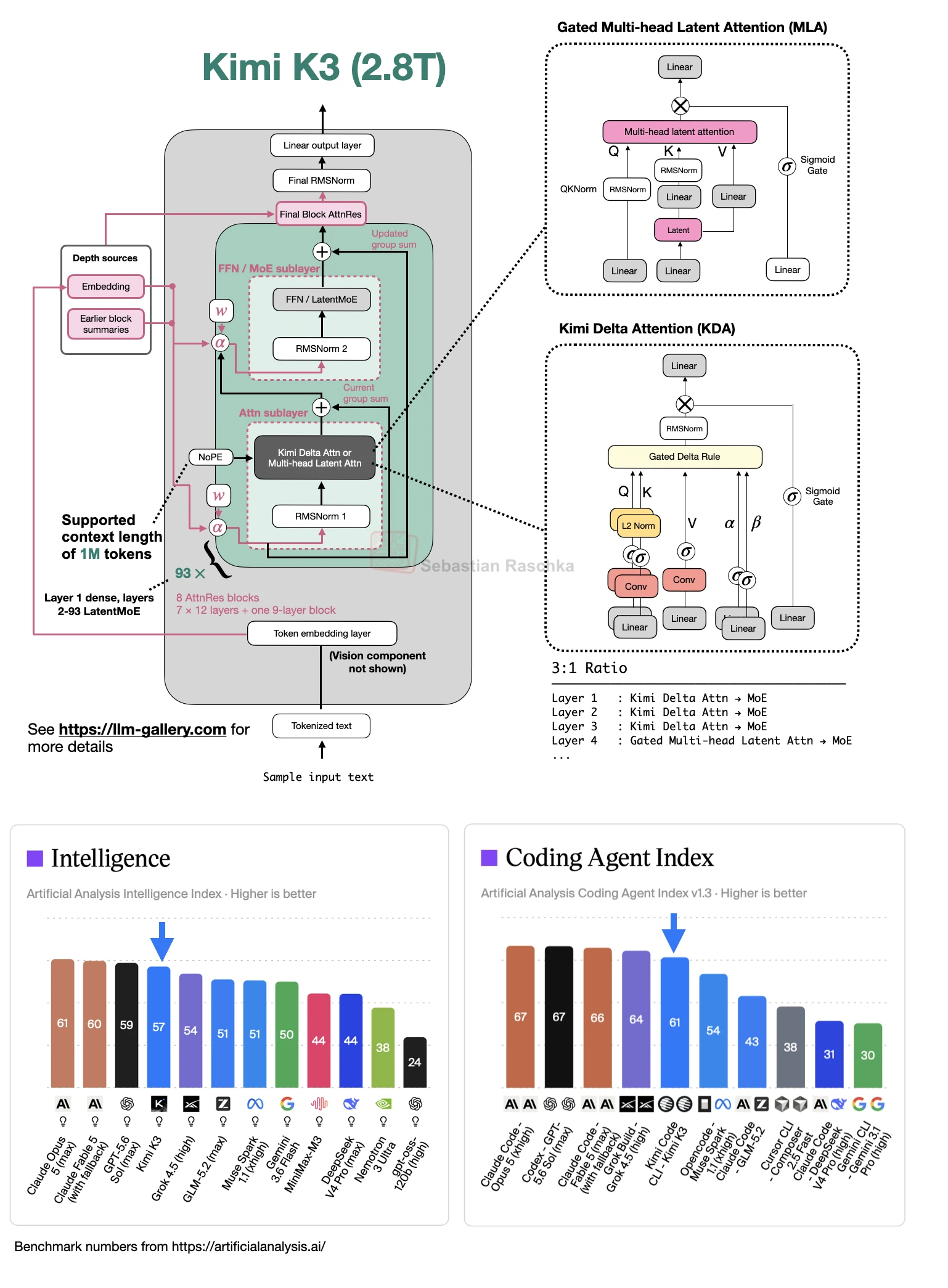
図 1. Kimi K3 のアーキテクチャとリリース時のベンチマーク比較。詳細はアーキテクチャギャラリーの K3 をご覧ください。
出典:私の Substack 記事 のウェブ版です。
次の記事もおすすめ
[今週の注目オープンウェイトモデル(数分でお読みいただけます)
Nanbeige 4.2、Laguna S 2.1、Motif-3-Beta、Solar Open 2、Antares 1B、BTL-3 の 6 つの新しいオープンウェイトモデルのアーキテクチャについてまとめた短い記事です。](https://sebastianraschka.com/blog/2026/notable-open-weight-models-this-week.html)
[『Scratch で推論モデルを作る』第 6.5 リスティングに関する訂正
書籍『Scratch で推論モデルを作る』(198 ページ)の第 6.5 リスティングにある乱数シードに関する短い訂正記事です。](https://sebastianraschka.com/blog/2026/reasoning-model-listing-6-5-correction.html)
[Inkling:いくつかの驚きを含む新しいオープンウェイト 975B MoE モデル
Thinking Machines Lab の 975B Inkling モデルについて、ベンチマーク結果やスパースな MoE デザイン、短距離コンボリューション、RMSNorm、位置バイアスなどの特徴をまとめた短い記事です。](https://sebastianraschka.com/blog/2026/inkling-architecture-benchmark-notes.html)
**
原文を表示
The Kimi K3 architecture figure for yesterday’s big open-weight model release, along with some observations and thoughts.
- Yes, it looks relatively complicated, but it’s essentially a scaled-up production version of their Kimi Linear model they released last year (scaled up from 48B -> 2.8T; K3 is by far the biggest open-weight model right now)
- The one new component compared to Kimi Linear is the LatentMoE. I omitted it in the figure below since it’s already very crowded, but that’s essentially the same LatentMoE as in Nemotron 3 Ultra (you can find it in my LLM Architecture Gallery if you are curious). The idea here is to compress (down-project) large linear layers similar to multi-head latent attention.
- Kimi K3’s overall trend (similar to Nemotron 3, DeepSeek V4, and others) is also towards better inference efficiency. That is, there are many components that replace existing components with efficiency-tweaked versions. I.e., MoE -> LatentMoE, regular attention -> multi-head latent attention and Kimi Delta Attention. (I also have short tutorials and write-ups in my gallery if you are curious about additional details).
- The one component change that is not an efficiency tweak is attention residuals. Like DeepSeek V4 improved the residual path with mHC (manifold-constrained Hyper-Connections), attention residuals are a way to improve the residual path, but it works a bit differently. I.e., mHC made the residual path wider. Attention residuals (also already part of Kimi Linear) connect the residuals across layers; the connection itself uses an attention score for an important/contribution weight. According to the report, it improves the validation loss and downstream performance (a bit) consistently and adds about 4% in training cost and 2% in inference cost.
- Interestingly, Kimi K3 got rid of all RoPE layers and uses NoPE (No Positional Embeddings) everywhere instead. (Again, this is inherited from Kimi Linear). In other architectures, the recent trend was towards RoPE in local attention layers (like sliding window attention) and NoPE in the global layers. There were a few architectures that only used NoPE everywhere, but this is the first frontier-level one as far as I know.
- Kimi K3 now also has native multimodal support, which is great!
There are several other interesting training tidbits in the technical report, but that’s it from the architecture front so far. A really great release overall.
Figure 1. Kimi K3 architecture and release-time benchmark comparisons. See [K3 in the architecture gallery for more details.](https://sebastianraschka.com/images/blog/2026/kimi-k3-architecture-notes/kimi-k3-architecture.webp)
Source: website version of my Substack note.
Read Next
[A Few Notable Open-Weight Models This Week
Short note on the architectures of six new open-weight models, including Nanbeige 4.2, Laguna S 2.1, Motif-3-Beta, Solar Open 2, Antares 1B, and BTL-3.](https://sebastianraschka.com/blog/2026/notable-open-weight-models-this-week.html)
[Correction for Listing 6.5 in Build a Reasoning Model From Scratch
Short correction note for the random seed in Listing 6.5 on page 198 of Build a Reasoning Model From Scratch.](https://sebastianraschka.com/blog/2026/reasoning-model-listing-6-5-correction.html)
[Inkling: A New Open-Weight 975B MoE with a Few Surprises
Short note on Thinking Machines Lab's 975B Inkling model, including benchmarks, sparse MoE design, short convolutions, RMSNorm, and position bias.](https://sebastianraschka.com/blog/2026/inkling-architecture-benchmark-notes.html)
AI算出
主要ニュースainew評価高い
記事は Kimi K3 の具体的な技術的変更点(Linear モデルからの拡張、ネイティブ・マルチモーダル対応など)を詳細に分析しており、新規性の高い一次情報に基づく主要なモデル発表として評価される。ただし、日本企業や日本語圏特有の情報が含まれていないため、日本の関連性は低めとなる。
6つの評価軸を見る
- AI関連度
- 100
- 情報源の信頼性
- 50
- 新規性
- 75
- 調べる価値
- 75
- 重複の少なさ
- 100
- 日本での有用性
- 25
関連記事
今日のまとめ
AIデイリーブリーフで今日の重要ニュースをまとめ読み