依然として重要視される7つの機械学習アルゴリズム
KDnuggets は、生成 AI や大規模言語モデルが注目される現代において、時系列予測や分類タスクなどに対して依然としてシンプルで効率的な機械学習アルゴリズムの重要性を再評価し、7 つの必須アルゴリズムと実装コードを紹介している。
AI深層分析を開く2026年7月30日 21:26
AI深層分析
キーポイント
AI 時代における基本アルゴリズムの価値
大規模言語モデルや生成 AI が普及する中で、特定の問題解決には単純な機械学習モデルの方が高速かつ低コストで機能する場合がある。
線形回帰とロジスティック回帰の解説
連続値予測のための線形回帰と、二値分類のためのロジスティック回帰が、その仕組みと Python による実装コードと共に紹介されている。
データサイエンティストに必須のスキルセット
コアとなる機械学習アルゴリズムとその適用タイミングを理解することは、現代のデータサイエンティストにとって不可欠な能力である。
XGBoostの効率化手法
tree_method="hist"設定により特徴値がビンにグループ化され、分割探索が効率的に行われる。
ランダムフォレストの仕組みと利点
複数の決定木の予測を結合することで単一の木より過学習を防ぎ、特徴量の重要度も算出可能である。
重要な引用
The simplest solution is often the best, especially when solving a specific machine learning problem.
In many cases, a simple machine learning model can solve the same problem faster, cheaper, and with much less complexity.
For data scientists, knowing the core machine learning algorithms and when to use them is still an essential skill.
XGBoost is flexible, reliable, and remains one of the strongest algorithms for many tabular machine learning problems.
編集コメントを表示
編集コメント
本記事は、最先端の生成 AI ブームの中で見落とされがちな古典的アルゴリズムの実践的な価値を再評価する有益な視点を提供している。技術選定においては常に「最も複雑な解決策」ではなく「最も適切な解決策」を選ぶ姿勢が求められることを示唆している。
Source Article
元記事を日本語で読む
本文に関係しない購読案内、埋め込み通知、サイト内プロモーションは除いています。
イントロダクション
最もシンプルな解決策こそが、最適なケースが多いものです。特に特定の機械学習問題を扱う際にはその傾向が強くなります。
時系列予測や画像分類、表形式データの予測といったタスクにおいて、大規模言語モデル(LLM)や生成 AI システムを多用する人々をよく見かけます。しかし多くの場合、単純な機械学習モデルの方が、より高速かつ低コストで、複雑さを大幅に抑えながら同じ問題を解決できます。
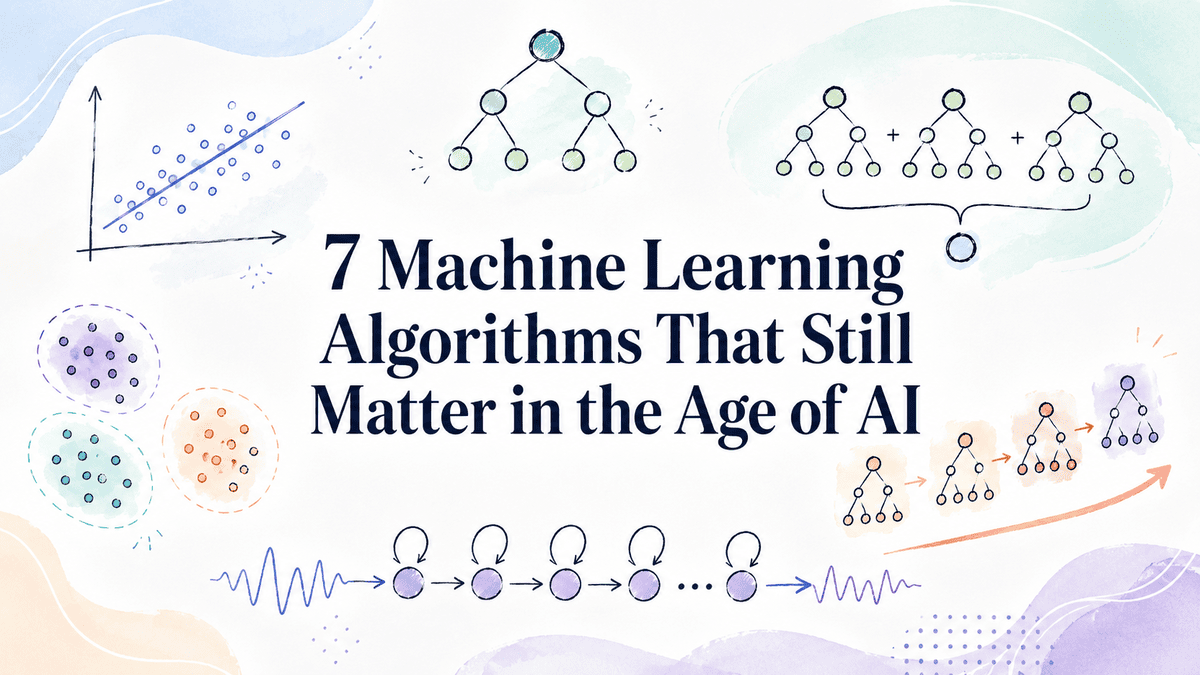
データサイエンティストにとって、中核となる機械学習アルゴリズムを理解し、いつそれらを活用すべきかを見極める能力は、依然として不可欠なスキルです。本ガイドでは、すべてのデータサイエンティストが知っておくべき 7 つのアルゴリズムを取り上げ、それぞれの仕組みを簡潔に解説するとともに、Python での実装方法も紹介します。
1. リニア回帰(Linear Regression)
リニア回帰は、連続する数値を予測するための最もシンプルで広く利用されている機械学習アルゴリズムの一つです。家賃や不動産価格の予測、月次収益の見積もり、エネルギー消費量の予測など、さまざまなタスクに活用できます。
このモデルは、入力特徴量と目的変数の間の関係を学習することで機能します。具体的には、訓練データにおける実際の値にできるだけ近い予測値を生成する直線関係を見つけ出そうとします。
トレーニング中、モデルは各特徴量が最終的な予測にどの程度寄与するかを学習していきます。一度学習が完了すれば、これらの関係性を基に新しいデータに対する予測を行うことができます。
from sklearn.linear_model import LinearRegression
model = LinearRegression()
model.fit(X_train, y_train)
y_pred = model.predict(X_test)
fit() メソッドは、トレーニングデータを用いて線形回帰モデルを学習させます。次に predict() メソッドが、学習済みの関係性を利用してテストデータの予測値を生成します。
線形回帰は高速で実装も簡単、解釈もしやすいという特徴があります。また、より高度な回帰アルゴリズムと比較するためのベースラインモデルとしても頻繁に利用されています。
# 2. ロジスティック回帰
ロジスティック回帰は、分類問題において最も広く使われているアルゴリズムの一つです。スパムかどうか、顧客の離脱か継続、不正取引か正常な取引など、二つの結果しかない問題を解決する際に一般的に用いられます。
このモデルは、ある観測値が特定のクラスに属する確率を推定することで動作します。各入力特徴量がその確率にどう影響するかを学習し、その結果に基づいてクラスを割り当てます。
名前に「回帰」とついていますが、ロジスティック回帰は分類アルゴリズムです。高速で比較的解釈が容易であり、多くの分類問題における強力なベースラインとなります。
from sklearn.linear_model import LogisticRegression
model = LogisticRegression()
model.fit(X_train, y_train)
y_pred = model.predict(X_test)
Scikit-learn** はデフォルトで正則化を適用しており、これによりモデルの複雑さを制御し、過学習を防ぐ効果があります。
# 3. LightGBM
LightGBM は、木ベースの機械学習を目的とした勾配ブースティングアルゴリズムです。特に構造化データや表形式のデータセットに対して高い効果を発揮します。
このモデルは決定木を順次構築していきます。新しい木は既存の木が犯した誤差の改善に焦点を当て、それらの予測結果を組み合わせて最終的な結果を導き出します。
LightGBM はヒストグラムベースの学習を採用しており、連続する特徴量値をビン(区間)にグループ化します。これによりメモリ使用量が削減され、特に大規模なデータセットにおいてトレーニングが効率化されます。
from lightgbm import LGBMClassifier

model = LGBMClassifier()
model.fit(X_train, y_train)

y_pred = model.predict(X_test)
この例では分類タスクのために LGBMClassifier を使用しています。LightGBM には回帰タスク用の LGBMRegressor も用意されています。
並列処理、分散学習、GPU 学習にも対応しているため、大規模な表形式データ向けの機械学習において人気の高い選択肢となっています。
# 4. ヒストグラム木を用いた XGBoost
XGBoost は、構造化データを扱うための別の人気のある勾配ブースティングアルゴリズムです。分類、回帰、ランキングの問題に対して広く利用されています。
LightGBM と同様に、XGBoost も決定木を順次構築します。新しい木は現在の予測における誤差の修正を試み、モデルを徐々に改善していきます。
巨大な単一の決定木に依存するのではなく、多くの小さな木を組み合わせてより強力な最終予測を生成します。
from xgboost import XGBClassifiermodel = XGBClassifier(tree_method="hist")
model.fit(X_train, y_train)
y_pred = model.predict(X_test)
tree_method="hist" の設定は、ヒストグラムベースのツリー構築を利用します。XGBoost が有用な分割点を探す前に特徴量の値をビンにグループ化するため、ツリーの構築がより効率的になります。
XGBoost は柔軟性があり信頼性も高く、多くの表形式データに対する機械学習問題において、依然として最強クラスのアルゴリズムの一つです。
# 5. ランダムフォレスト
**
ランダムフォレストは、複数の決定木を組み合わせるアンサンブル型の機械学習アルゴリズムです。
単一の木に頼るのではなく、トレーニングデータの異なるサンプルと利用可能な特徴量のサブセットを用いて多数の木を訓練し、その予測結果を統合します。
分類タスクでは各木が予測クラスに対して投票を行い、回帰タスクでは予測値の平均をとります。複数の木を組み合わせることで、単一の決定木よりも過学習を起こしにくくする効果が得られます。
from sklearn.ensemble import RandomForestClassifier
model = RandomForestClassifier(
n_estimators=100,
random_state=42
)
model.fit(X_train, y_train)
y_pred = model.predict(X_test)
n_estimators=100 の設定は、ランダムフォレストに 100 本の決定木を構築するよう指示します。
ランダムフォレストは使いやすく、多くの表形式データセットで良好な結果を出します。また、どの入力変数が予測に影響を与えているかを理解するために、特徴量の重要度スコアを提供することも可能です。
# 6. Long Short-Term Memory Networks
Long short-term memory networks、通称 LSTM は、時系列データを処理するために設計されたリカレントニューラルネットワークの一種です。
LSTM はシーケンスを一つずつ処理しながら、過去のステップで得た情報を保持します。内部メモリとゲート機構を用いて、どの情報を維持し、更新し、あるいは無視するかを判断します。
これにより、過去の観測値が後の予測に影響を与えることが可能になり、データの順序が重要な場合に LSTM は非常に有用です。具体的には、売上予測や交通量予測、センサーデータ解析など、時系列データを扱う問題に広く応用されています。
from tensorflow import keras
from tensorflow.keras import layers
model = keras.Sequential([
keras.Input(shape=(X_train.shape[1], X_train.shape[2])),
layers.LSTM(64),
layers.Dense(1)
])
model.compile(
optimizer="adam",
loss="mean_squared_error"
)
model.fit(X_train, y_train, epochs=20)
y_pred = model.predict(X_test)
LSTM(64) レイヤーには 64 個の LSTM ユニットが含まれており、シーケンスを処理します。一方、Dense(1) レイヤーは単一の数値予測を出力します。
LSTM の入力データは通常、「サンプル数 × 時間ステップ数 × 特徴量」の形式で構成されます。これらのモデルは複雑な時系列パターンを学習できますが、従来の機械学習アルゴリズムに比べて、より多くのデータと計算リソースを必要とする傾向があります。
# 7. K-Means クラスタリング
**
K-means は、類似した観測値をクラスタにグループ化する教師なし機械学習アルゴリズムです。分類とは異なり、ラベル付きの訓練データを必要としません。
このアルゴリズムは、セロイド(重心)と呼ばれる選ばれた数のクラスター中心点から始まります。各観測値は最も近いセロイドに割り当てられ、各グループ内の観測値に基づいてセロイドが再計算されます。
このプロセスは、クラスターの構成が大幅に変化しなくなるまで繰り返されます。
from sklearn.cluster import KMeans
model = KMeans(
n_clusters=3,
n_init=10,
random_state=42
)
clusters = model.fit_predict(X)
n_clusters=3 の設定は、K-means に 3 つのグループを作成するよう指示します。また、n_init=10 の設定では、複数のセロイド初期化パターンでアルゴリズムを実行し、その中で最も良い結果を採用します。
K-means は、ラベル付けされていないデータにおけるパターンの発見に有用です。例えば、顧客セグメントや似たような行動を持つグループの特定などが該当します。主な制限点は、アルゴリズム実行前にクラスターの数を事前に決定しなければならないことです。
# 結び
これらのアルゴリズムが人気を博したのには理由があり、現代の AI アプリケーションでも現在なお広く利用されています。私のプロジェクトにおいても、解決しようとしている問題に対してより適切な解決策をもたらすため、伝統的な機械学習手法に立ち返ることがよくあります。
これらのモデルは高速で実装も容易であり、通常、必要な CPU や RAM、インフラストラクチャの量が圧倒的に少なくて済みます。その過程で、シンプルさがしばしば最良の解決策であるという事実を、私たちはほとんど忘れてしまっているのかもしれません。
すべての問題に大規模言語モデルや生成AIが必要というわけではありません。単純な機械学習アルゴリズムで十分解決できる専門的なタスクは数多く存在します。巨大なモデルをファインチューニングしたり、複雑なAIシステムを構築する必要はありません。
重要なのは常に最新モデルを選ぶことではありません。その問題に最適なモデルを選定するスキルこそが求められます。
原文を表示
**
# Introduction
The simplest solution is often the best, especially when solving a specific machine learning problem.
I have seen many people use large language models (LLMs) and generative AI systems for tasks like time series forecasting, image classification, and tabular prediction. In many cases, a simple machine learning model can solve the same problem faster, cheaper, and with much less complexity.
For data scientists, knowing the core machine learning algorithms and when to use them is still an essential skill. In this guide, we will cover seven algorithms every data scientist should know, briefly explain how they work, and show how to use them in Python.
# 1. Linear Regression
Linear regression is one of the simplest and most widely used machine learning algorithms for predicting continuous numerical values. It can be used for tasks such as predicting house prices, estimating monthly revenue, or forecasting energy consumption.
The model works by learning the relationship between the input features and the target value. It tries to find a straight-line relationship that produces predictions as close as possible to the actual values in the training data.
During training, the model learns how much each feature contributes to the final prediction. Once trained, it can use these learned relationships to make predictions on new data.
from sklearn.linear_model import LinearRegression

model = LinearRegression()
model.fit(X_train, y_train)

y_pred = model.predict(X_test)
Here, fit() trains the linear regression model using the training data. The predict() method then uses the learned relationships to generate predictions for the test data.
Linear regression is fast, easy to implement, and simple to interpret. It is also commonly used as a baseline model to compare against more advanced regression algorithms.
# 2. Logistic Regression
Logistic regression is one of the most widely used algorithms for classification. It is commonly used for problems with two possible outcomes, such as spam or not spam, customer churn or retention, and fraudulent or legitimate transactions.
The model works by estimating the probability that an observation belongs to a particular class. It learns how each input feature affects that probability and uses the result to assign a class.
Despite its name, logistic regression is a classification algorithm. It is fast, relatively easy to interpret, and a strong baseline for many classification problems.
from sklearn.linear_model import LogisticRegression

model = LogisticRegression()
model.fit(X_train, y_train)

y_pred = model.predict(X_test)Scikit-learn** applies regularization by default, which helps control model complexity and reduce overfitting.
# 3. LightGBM
**
LightGBM** is a gradient boosting algorithm designed for tree-based machine learning. It is especially effective for structured or tabular datasets.
The model builds decision trees one after another. Each new tree focuses on improving the errors made by the existing trees, and their predictions are combined to produce the final result.
LightGBM uses histogram-based learning, which groups continuous feature values into bins. This can reduce memory usage and make training more efficient, particularly on larger datasets.
from lightgbm import LGBMClassifier

model = LGBMClassifier()
model.fit(X_train, y_train)

y_pred = model.predict(X_test)
This example uses the LGBMClassifier for classification. LightGBM also provides LGBMRegressor for regression tasks.
It also supports parallel, distributed, and GPU training, making it a popular choice for large-scale tabular machine learning.
# 4. XGBoost with Histogram Trees
**
XGBoost** is another popular gradient boosting algorithm for structured data. It is widely used for classification, regression, and ranking problems.
Like LightGBM, XGBoost builds decision trees sequentially. Each new tree tries to correct errors in the current predictions, gradually improving the model.
Instead of relying on one large decision tree, XGBoost combines many smaller trees to produce a stronger final prediction.
from xgboost import XGBClassifier

model = XGBClassifier(tree_method="hist")
model.fit(X_train, y_train)

y_pred = model.predict(X_test)
The tree_method="hist" setting uses histogram-based tree construction. Feature values are grouped into bins before XGBoost searches for useful splits, making tree building more efficient.
XGBoost is flexible, reliable, and remains one of the strongest algorithms for many tabular machine learning problems.
# 5. Random Forest
**
Random forest is an ensemble machine learning algorithm that combines multiple decision trees.
Instead of relying on a single tree, it trains many trees using different samples of the training data and subsets of the available features. Their predictions are then combined.
For classification, the trees vote on the predicted class. For regression, their predictions are averaged. Combining multiple trees usually makes the model less likely to overfit than a single decision tree.
from sklearn.ensemble import RandomForestClassifier

model = RandomForestClassifier(
    n_estimators=100,
    random_state=42
)

model.fit(X_train, y_train)

y_pred = model.predict(X_test)
The n_estimators=100 setting tells random forest to build 100 decision trees.
Random forest is easy to use, works well on many tabular datasets, and can also provide feature importance scores to help understand which inputs influence its predictions.
# 6. Long Short-Term Memory Networks
Long short-term memory networks, or LSTMs, are a type of recurrent neural network designed for sequential data.
An LSTM processes a sequence step by step while maintaining information from earlier steps. It uses internal memory and gates to decide what information to keep, update, or ignore.
This allows earlier observations to influence later predictions, making LSTMs useful when the order of the data matters. Examples include sales forecasting, traffic prediction, sensor readings, and other time series problems.
from tensorflow import keras
from tensorflow.keras import layers

model = keras.Sequential([
    keras.Input(shape=(X_train.shape[1], X_train.shape[2])),
    layers.LSTM(64),
    layers.Dense(1)
])

model.compile(
    optimizer="adam",
    loss="mean_squared_error"
)

model.fit(X_train, y_train, epochs=20)

y_pred = model.predict(X_test)
The LSTM(64) layer contains 64 LSTM units that process the sequence. The Dense(1) layer produces a single numerical prediction.
LSTM input data is usually arranged as samples × time steps × features**. These models can learn complex sequential patterns but often require more data and computation than traditional machine learning algorithms.
# 7. K-Means Clustering
**
K-means is an unsupervised machine learning algorithm that groups similar observations into clusters. Unlike classification, it does not require labeled training data.
The algorithm starts with a selected number of cluster centers called centroids. Each observation is assigned to its nearest centroid, and the centroids are recalculated based on the observations in each group.
This process repeats until the clusters stop changing significantly.
from sklearn.cluster import KMeans

model = KMeans(
    n_clusters=3,
    n_init=10,
    random_state=42
)

clusters = model.fit_predict(X)
The n_clusters=3 setting tells k-means to create three groups. The n_init=10 setting runs the algorithm with multiple centroid initializations and keeps the best result.
K-means is useful for discovering patterns in unlabeled data, such as customer segments or groups with similar behavior. Its main limitation is that the number of clusters must be selected before running the algorithm.
# Final Thoughts
These algorithms became popular for a reason, and they are still used in modern AI applications today. Even in my own projects, I often return to traditional machine learning because it gives me a better solution for the problem I am trying to solve.
These models are faster, easier to implement, and usually require far less CPU, RAM, and infrastructure. Somewhere along the way, we have almost forgotten that simplicity is often the best solution.
Not every problem requires an LLM or a generative AI model. There are many specialized tasks where a simple machine learning algorithm can do the job without fine-tuning a huge model or building a complex AI system.
The important skill is not always choosing the newest model. It is choosing the right model for the problem.
Abid Ali Awan** (@1abidaliawan) is a certified data scientist professional who loves building machine learning models. Currently, he is focusing on content creation and writing technical blogs on machine learning and data science technologies. Abid holds a Master's degree in technology management and a bachelor's degree in telecommunication engineering. His vision is to build an AI product using a graph neural network for students struggling with mental illness.
関連記事
News to Guide
ニュースの次に確認する
発表内容を、現在の料金や仕様と照らし合わせられる関連ガイドです。
今日のまとめ
AIデイリーブリーフで今日の重要ニュースをまとめ読み