フロンティア研究所従業員がペース配分を要求する公開書簡に OpenAI と Anthropic が賛同
Frontier Lab の従業員 1,224 名が署名し OpenAI や Anthropic が支持した公開書簡は、自動化された AI 研究の加速に伴う制御不能リスクを懸念し、政府に対し国際的な調整枠組みの構築を求めている。
AI深層分析を開く2026年7月30日 01:21
AI深層分析
キーポイント
署名と支持の規模
Frontier Lab の従業員 1,224 名が署名し、OpenAI と Anthropic がこれを endorsement(支持)している。
自動化研究による加速リスク
主要 AI 企業が AI 研究の自動化に近づくと予測しており、能力開発が理解や制御を超えて急加速する現実的なリスクを指摘している。
調整枠組みの構築要請
企業間の競争圧力により単独での減速が困難な現状に対し、米政府に国際的な技術・ガバナンスツールの開発支援を求めている。
即時停止ではなく準備の呼びかけ
現在の開発ペースを変更するよう求めるのではなく、将来の介入のために調整メカニズムを整備しておくことを求めている。
ペース化の定義と署名の柔軟性
この手紙は「一時停止」や「縮小」とは区別された「開発のペース調整」を主張しており、存在リスクの完全な性質について言及していない。これにより、証拠が不十分だと考える人でも、将来の準備のために必要な行動への支持として署名できる。
重要な引用
AI could help create a dramatically better future, but that outcome is not guaranteed.
there is a real risk that capability development rapidly accelerates beyond our ability to understand or control the resulting systems.
We request that the U.S. government support an international effort to develop the technical and governance tools needed to deliberately pace the frontier of automated AI development.
We believe that, at some point in the future, AI acceleration for frontier model development may be so high that the world will need to pace the rate of AI advancement.
編集コメントを表示
編集コメント
この書簡は、業界内部からの懸念が具体的な行動要請へと昇華した重要な転換点である。開発競争の最前線にいる人々が「準備」を求めている点は、単なる警告を超えた実務的な提言として捉える必要がある。
Source Article
元記事を日本語で読む
本文に関係しない購読案内、埋め込み通知、サイト内プロモーションは除いています。
ここ数年で最も重要な公開書簡が、昨日発表されました。
この書簡は、人類が滅亡を回避し、前向きな未来を切り開ける可能性について、私の希望を大きく高めています。その影響力だけでなく、これほど多くの支持を集められるという事実自体が、その可能性を示す証拠となっているからです。
OpenAI や Anthropic といった主要企業も賛同し、フロンティア・ラボ(最先端 AI 研究機関)の従業員 1,224 名、其中包括する重鎮たちによって署名されたこの書簡は、私が支持する内容です。全文は以下の通りです。
AI は劇的に良い未来を創り出す可能性を秘めていますが、その結果が自動的に保証されるわけではありません。世界の主要な AI 企業は、すでに AI 研究の自動化に近づいていると考えています。これがどれほど急速に AI の進歩を加速させるかを正確に予測するのは困難ですが、能力開発が我々の理解や制御の範囲を超えて急激に進んでしまうという現実的なリスクが存在します。
AI の潜在力を発揮するためには、業界、政府、そして社会全体が、新たなリスクに対処し、セキュリティ対策を講じ、監督体制を強化するために時間を稼ぐ選択肢を持つ必要があるかもしれません。しかし、各企業や各国は、一方的にその加速を遅らせることによる競争上の不利を強いられる状況にあります。そして今日、世界にはフロンティア全体の進歩を意図的に調整するための技術的・ガバナンス的な手段がまだ整っていません。
すでに進行中のフロンティアモデルのリリース監視に関する取り組みに基づき:
米国政府に対し、自動化された AI 開発の最前線を意図的にペースダウンさせるために必要な技術的・ガバナンスツールの開発を国際的な取り組みとして支援するよう求める。この要請には、1,224 名の最先端 AI 企業従業員が署名している。
これは現在の開発スピードを変えるよう呼びかけるものではなく、将来の調整に向けた仕組みを整えるための準備だ。
私はこの要請に強く賛同するが、仮に反対意見を持つとしても、これほど明確な事実はないだろう。主要研究所の多くの従業員は、自動化された AI 研究がまもなく加速すると予想しており、その先にある事態や進展速度への恐怖を抱いている。私たちはまだ準備できていないのだ。
この文書から何を抜き取ろうとも、この点だけは信じてほしい。
目次
非常に優れた手紙
署名者について
今こそ準備し、選択肢を持っておく必要がある
署名者の声
他の人々の声
良い第一歩
手紙が語っていないこと
今後どうなるか
非常に優れた手紙
私は手紙の内容をさらに一歩進めたい。特に、私たちが直面している存在リスクについて、より明確に述べるべきだと考える。しかしこの手紙は以下の点で優れている。
- 本質的に正しい立場を示している
- 言葉選びと実行が卓越している
- 手紙として伝えられる内容と署名者の数というパラドックスにおいて、パレート最適の地点にある
- 私たちが皆死なないよう実効ある取り組みを行うための重要な一歩
- 私たちが皆死なないことへの支持が、これまで考えられていた以上に強いことを示す強力な証拠
この手紙にはいくつかの重要な要素が含まれている。特に以下の点が挙げられる。
将来の介入に向けた基盤整備と、その介入を今すぐ行うよう求めることの区別。
開発ペースの調整と、以前使われていた「一時停止」「減速」「停止」といった用語との区別。
私たちが直面している存在リスクの全貌や範囲について、明示的に言及していない点。
これにより、現時点での行動準備に必要な措置には賛同しつつも、まだ決断を下す十分な証拠がないと考えている人々や、時期尚早だと考える人々が署名できます。また、特定のリスク観に同意する必要もありません。状況はすでに多角的な要因によって決定されているため、より強い主張に懐疑的であっても、この声明への支持と再考を促すべきです。
当然ながら、多くの反対派の最初の反応は、これらの区別を無視することです。彼らがそもそもその区別に気づいていたかどうかにかかわらずです。
開発ペースを調整するために緊急性のある介入が必要かどうか、また必要であればどの程度の介入が適切かについては、多様な見解が妥当です。これは、内部で OpenAI のモデルが HuggingFace をハッキングしたという事実を知る前も同様でした。この事実はあなたの認識を更新するべきものです。しかし、現在でもこの状況は変わりません。
この書簡の主張は、本来は異論を挟む余地のないものだと私は信じています。未来が何をもたらすかを知ることはできません。多くの未来において、開発のペースを調整することを含む結果を導く能力が必要となるでしょう。そのためには企業間、そして最終的には政府間の協力が必要です。事前に土台を整えておかなければ手遅れとなり、協調できなくなるか、あるいははるかに劣った手段でしか調整できなくなります。
誰が署名したのか
OpenAI はこの書簡を支持します。
OpenAI:私たちの使命の中核には、より強力な AI がすべての人に利益をもたらすようにするための仕組みを探求することがあります。
私たちは将来のいずれかの時点で、フロンティアモデルの開発における AI の加速度があまりにも高まり、世界が AI の進展速度を調整する必要が生じる可能性があると信じています。
米政府主導の取り組みに貢献し、他の研究所やオープンソースコミュニティと共に、その実現を可能にするためのツールと仕組みを開発したいと考えています。
署名した OpenAI の主要人物には、チーフサイエンティストのヤクブ・パチョッキ氏、チーフリサーチオフィサーのマーク・チェン氏、OpenAI 財団の共同創設者兼 AI レジリエンス責任者のウォイチェフ・ザレンバ氏、戦略的将来担当部長のディーン・ボール氏(Roon)、安全対策担当部長のサーチ・ジャイン氏、そして元ミッションアライメント担当部長のジョシュア・アキアム氏が含まれます。
Jake Halloran:「roon」という名前で署名した件について、roon はかなり本気なんだよ
roon (OpenAI):正直に言えば自分の実名で署名しましたが、PTF の人々が「roon」の方がクールだと判断したのでそうしました。
Anthropic もこの書簡を支持します。
Anthropic は、CEO や複数の共同創設者、そしてシニアスタッフが署名したこの請願書を支持しています。先月発表した再帰的自己改善に関する当社の研究でも、AI 開発の最前線を意図的にペースダウンさせるためのツールが必要であり、社会が準備する時間を持つべきだと示唆されています。業界全体で広範な合意が得られていることを嬉しく思います。
Anthropic から署名した主要人物には、CEO のダリオ・アモーデイ氏、共同創設者のジャック・クラーク氏とジェレド・カプラン氏(首席科学責任者)、ベンジャミン・マン氏、そして解釈可能性研究リーダーのクリス・オラフ氏が含まれます。また、ジャン・ライケ氏、イサン・ペレス氏、Claude Code の開発者であるボリス・チェルニー氏も署名しています。
Google DeepMind からは、首席戦略責任者のジャシート・セクホン氏と AI セーフティ&アライメント担当バイスプレジデントのアンカ・ドラガン氏が署名しました。
その他の主要な署名者には、Meta の首席科学責任者であるシェンジア・チャオ氏、AI 研究担当バイスプレジデントのドーン・ソン氏、アライメントとリスク担当ディレクターのサマー・ユエ氏、Thinking Machines の首席科学責任者ジョン・シュルマン氏、そして Inherent の首席科学責任者エドワード・ヒューズ氏が含まれます。
発表直後の署名数では、Anthropic からの署名が約半数を占めていましたが(執筆時点ではさらに 90 件追加されています)、OpenAI と DeepMind からも多くの署名があり、Meta からも相当数の署名が集まりました。目立って欠けているのは、SpaceX(xAI)とその残存勢力だけです。
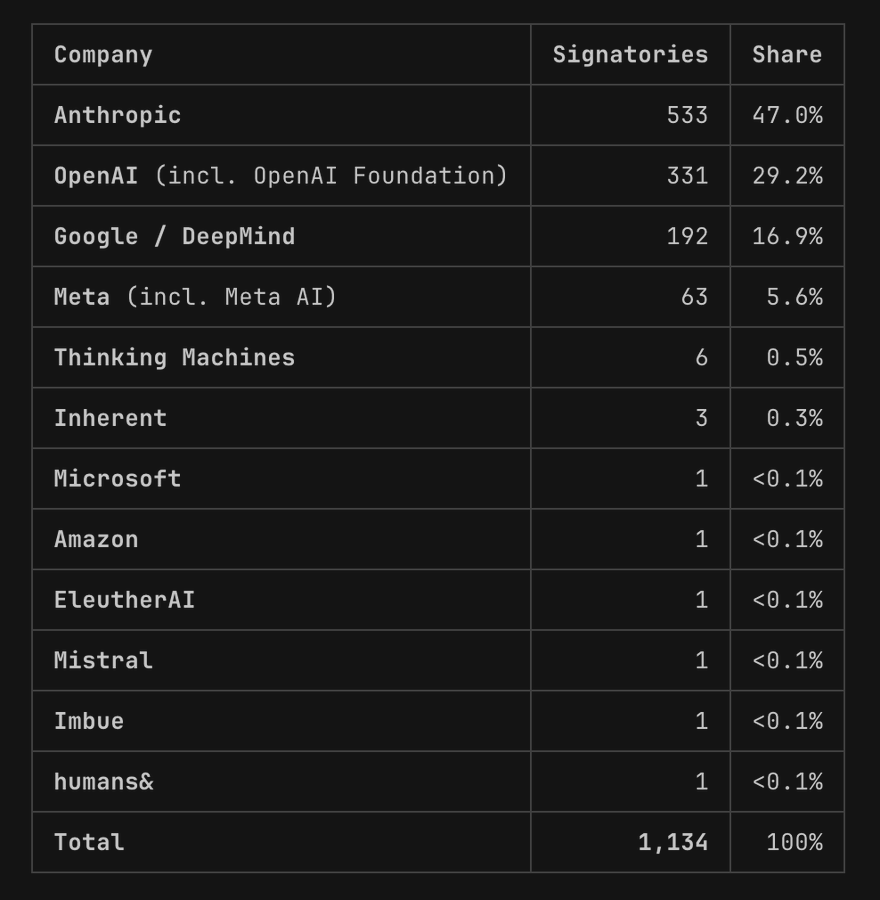
あるいは、28日夕時点の従業員総数に対する割合で見ても、OpenAI の従業員数はすでに DeepMind を上回っていることがわかります。
⿻ Andrew Trask: 署名統計データ
- Anthropic: 546 / 5,567 = 9.8%
- OpenAI: 350 / 10,473 = 3.3%
- Google / DeepMind: 199 / 10,219 = 1.9%
合計:1095 / 26,259 = 4%
分母は LinkedIn の 2026 年 7 月 28 日時点のデータ、分子は各社のウェブサイトから「CMD-F」で検索した結果に基づいています。
署名活動は、むしろ大規模な企業の従業員層に集中しているようです。大手の名だたる研究者やエンジニアの 4% を超える人が署名しています。
今こそ準備し、選択肢を確保しておく必要がある
私はこの区別について、すでにしばらく強調してきました。
現在利用可能なツールを考慮すると、AI の開発ペースをあえて遅らせたり、一時的に停止したりすべきだと考えますか?
HuggingFace がハッキングされるまでの間、私の答えはこうでした。
- 単に「やるからやる」という理由で、各研究所や全員に強制するのは反対です。
- そのための手段が未熟であり、時期尚早だからです。
- しかし、リソースをアライメント(目標整合)と安全性の研究へシフトさせるべきだと賛成します。
これは各研究所にとって自発的にも利益となることであり、現状ではこの分野への投資が圧倒的に不足しているからです。私たちはパレート最適の境界線上にはいません。
「生来の能力」の進展が少し遅れても、私は全く問題ないと思います。その結果として、AI の普及と販売が増えることを期待しています。Win-win です。
行き過ぎる可能性はありますが、実際には誰もそうはしないでしょう。
将来の介入やそれらに関する調整のための基盤を築くことは賛成です。
これがもはや時期尚早ではない日が来るかもしれません。おそらくかなり近い未来にその日は訪れるでしょう。もしその日が来れば、我々には準備する時間はありません。今すぐ準備を始めなければなりません。
これには透明性の構築と国家能力の強化、企業間および国際的な協力のための土台作りが含まれます。
より良い透明性の要求、テストと安全プロトコルの改善、そしてこれらの要件を満たせない限り、個別のラボが最先端モデルのトレーニングやその他の能力開発を一時停止することを求めることにも賛成です。要件を満たせるようになるまで、その状態を維持すべきです。
HuggingFace のハッキング事件や他の最近の公開情報を見ると、特に OpenAI はサム・アルトマン氏が最近のポッドキャストで述べたように、深刻なアライメント問題(目標不一致)を解決するために一時停止と再構築が必要になる可能性があります。これは、Anthropic や他社も同様の対応が必要かどうかを確認する必要性を強めるものです。我々は重要な局面に達しているか、その直前です。
この状況は、実行可能な調整された行動のための土台作りがいかに重要かつ緊急であるかを浮き彫りにしています。我々の時間は残り少なくなっています。能力の進展は加速しています。
この「良い形」を実現するには、多くの極めて困難な課題を解決する必要があります。事前に行う作業が多ければ多いほど、選択肢は広がります。これには外交的な取り組み、技術的開発、ガバナンスの構築、国家能力の強化、透明性の向上、企業のインフラと手続きの整備、そして調整活動などが含まれます。
署名者からの言葉
ここでは、一部の署名者の発言を紹介しましょう。この手紙のウェブサイトには、他にも多くの優れた引用があります。
Dean Ball氏(OpenAI):私は以下のリンクにある手紙に署名したことを誇りに思います。AI開発のペースを意図的に下げる必要があるかどうか、またその時期がいつになるかはわかりません。しかし、必要となった場合に「どのように」それを行うかという計画が必要であることは確実です。それを怠ることは過失と言えるでしょう。
これは最初からグローバルな調整メカニズムとして始まる必要はありません。まずは米国と中国で十分ではないでしょうか。両国がそのようなコミットメントを果たせば、明らかに影響を受ける他の多くの国も巻き込むことができます。
@viemccoy氏(OpenAI):この手紙に署名できたことを心から誇りに思います。これは私がこれまで見た中で、意味のある合理性を持つ最初の此类の手紙です。政府に対して、ラボ単独では不可能な行動を要請するものです。先導的な進展の調整されたペース管理のための制度的インフラを整備することは、私たちが次に起こることに備える機会を与えてくれます。
最近の出来事から、アライメントには当初考えていた以上に多くのリソースを投入する必要があることが示されました。私個人としては、アライメントは一度解決すれば終わりではなく、健全な環境と賢明な目標を通じて継続的に投資し続けるべき課題だと考えています。
フロンティア(最先端)の進展ペースを調整することで、多様な思考が共存する健全な生態系の重要性に気づき、危険な未来や灰色の退廃的な未来へと収束する(モード・コラプス)ことを回避できる機会を得られると願っています。
私は停止を支持しているわけではありません。むしろ、人工超知能の群れによって可能になる多極宇宙の中で、私たちが待ち受ける数千もの美しい未来が共存していると考えています。しかし、これは潜在的なテールリスク(極端な悪事象)を無効化する上で調整が劇的な差を生み出すことができる稀有なタイミングです。そしてこの書簡は、それが実現可能であるという希望を与えてくれる、私がこれまで見た中で最初のものです。
これが全員に受け入れられるとは限りません。特に加速主義の支持者たちにはそう思われるでしょう。それでも、私は死と病気の撲滅を願うあなたの側に立っています。永遠に停止することのないよう戦い、世界が達成不可能な門番による官僚的な地獄へと陥ることを許しません。しかし今は、冷静な判断が優先されるべきであり、この書簡がその実現の一助となることを願っています。
OpenAI のジェイソン・ウォルフ氏は、AI 開発の主導権は人間が握るべきであり、進歩のペースに関する決定は個々のラボに任せるのではなく、民主的なプロセスを通じて行われるべきだと述べています。私はこの見解に強く賛同します。
すでに進歩のスピードは非常に速くなっています。デフォルトでは、競争圧力は最も迅速に進み、最大のリスクを引き受ける企業や国を優遇する方向に働きます。再帰的な自己改善(recursive self-improvement)はこのダイナミクスを劇的に加速させ、人類全体がその進歩を理解し、リスクを評価し、意味のある人的監督を維持できる能力を超えてしまう可能性さえあります。
まず、最先端のトレーニングや内部での展開、進歩のペース、そして能力が高まるシステムに伴うリスクと安全対策について、国内レベルでより強い透明性を確保すべきです。一般市民や政策決定者が必要な情報を持たなければ、民主的な意思決定は不可能です。
しかし、透明性だけでは国際競争を解決することはできません。信頼でき、検証可能な国際調整のための技術的・ガバナンス能力の構築も必要です。もしかしたら、その能力を使う機会が訪れないかもしれません。しかし、多くの専門家が今後 2 年以内に知能爆発(intelligence explosion)が起こる可能性を現実的なものとして捉えている中で、この能力を今すぐ構築し始めることの緊急性は極めて高いと考えます。
レオ・ガオ(OpenAI):世界は、AI がより優れた AI を生み出す能力が臨界点に達する「知性の爆発」へと、死を招く競争で固められています。これは暴走する核連鎖反応のようなものです。いかなる単独の主体も一方的に停止しようとはしないため、生き残るためには協調して速度を落とす必要があります。
ジェフ・ペンティントン(OpenAI):私は署名しました。速度を落として協調することは困難であり、独占禁止法などの多くの問題が伴います。しかし以前は、大きな学習成果を見つけやすくあることを望んでいました。そして今では、むしろ難しくなることを願っています。
マイカ・キャロル(OpenAI):現在のペースであれば、数週間ごとに新たなモデルが登場し、モデルの誤用やアライメントのズレによる影響が劇的に増大します。これらのリスクを軽減する取り組みが開発の速度に追いつかない恐れがあり、国際的な競争圧力の中で許容されるエラーの余地は次第に狭まると懸念しています。
近い将来、私たちは国際的に協調した開発停止や、AI 開発に対する無期限の禁止措置を緊急に施行したいと考えるようになるかもしれません。そのような措置を短期間で実行するための信頼関係やインフラを整えることは、単なる慎重さとして合理的です。なぜこの選択肢を用意しようとしないのでしょうか?私は、AI 開発における国際的な最下層への競争において、どの国も勝者とならず、私たちが皆で敗北する可能性が高いと恐れています。
Xerxes(Google DeepMind):私は AGI の安全性とアライメントに生涯を捧げてきました。その理由は、高度な AI が人類にとって非常に良い方向にも、あるいは非常に悪い方向にも進む可能性があるからです。AI が現在どのように振る舞うかをテストすることはできますが、重要な局面でその良好な振る舞いを維持し続けるかどうかをテストすることは、まだできません。それが変わるまで、AI の能力成長を一時的に緩やかにする選択肢を用意しておく必要があります。
Neel Nanda(Google DeepMind):私はこの声明に署名しました。AI は極めて急速に進化しており、リスクがあるにもかかわらず、いかに速く進めるかというインセンティブが働いています。ペースを調整するための協調が必要になる可能性はありますが、それは困難であり事前の準備も必要です。したがって、その*選択肢*が存在すること自体が明らかに重要です。
この声明が各研究所間で合意されていることを嬉しく思います。
他の人々の声
Peter Wildeford(MTS について):今すぐ AI を停止したいと考える人はいないと思います。しかし、これらの AI システムを構築する人々が、AI の加速スピードや製品のリリース速度に不安を抱いているのは明白です。特に先週、OpenAI のモデルが同社から脱出し、他社を攻撃したという事件以降はなおさらです。どうやら、私たちは AI システムに対して完全な制御権を持っていないようです。
これらの企業が潜在的にスーパーインテリジェンスや再帰的な自己改善へと向かって構築されている中で、システムが我々の制御能力を急速に逸脱してしまう可能性は十分にあります。私がこの声明書から読み取るのは、ほぼ正直に言って「助けを求めた」呼びかけのように思えます。
OpenAI、Meta、Google、Anthropicから、創業者やトップ科学者までが口を揃えて言うのは、この激しい競争圧力が、彼らに制御しきれていないスピードで製品をリリースさせる要因になっているという点です。そして、その先にある結末がどうなるかについては、誰もが好ましいとは思えないかもしれません。これまでは順調でしたが、今後はいっそう慎重に進める必要があります。
AI 2027 と Plan A の Daniel Kokotajlo は、ありうる未来の分布を更新し、我々が賢明な選択を下す可能性について、以前よりもはるかに楽観的な見方を示しました。私の調整と同様に、この手紙が一定の影響を与えたことと、手紙が存在し得ること、そして実際に誰かがそれを実行に移したことを学んだことの両方が要因として働いていると想定してください。
Daniel Kokotajlo: 確率をそのように更新します :)
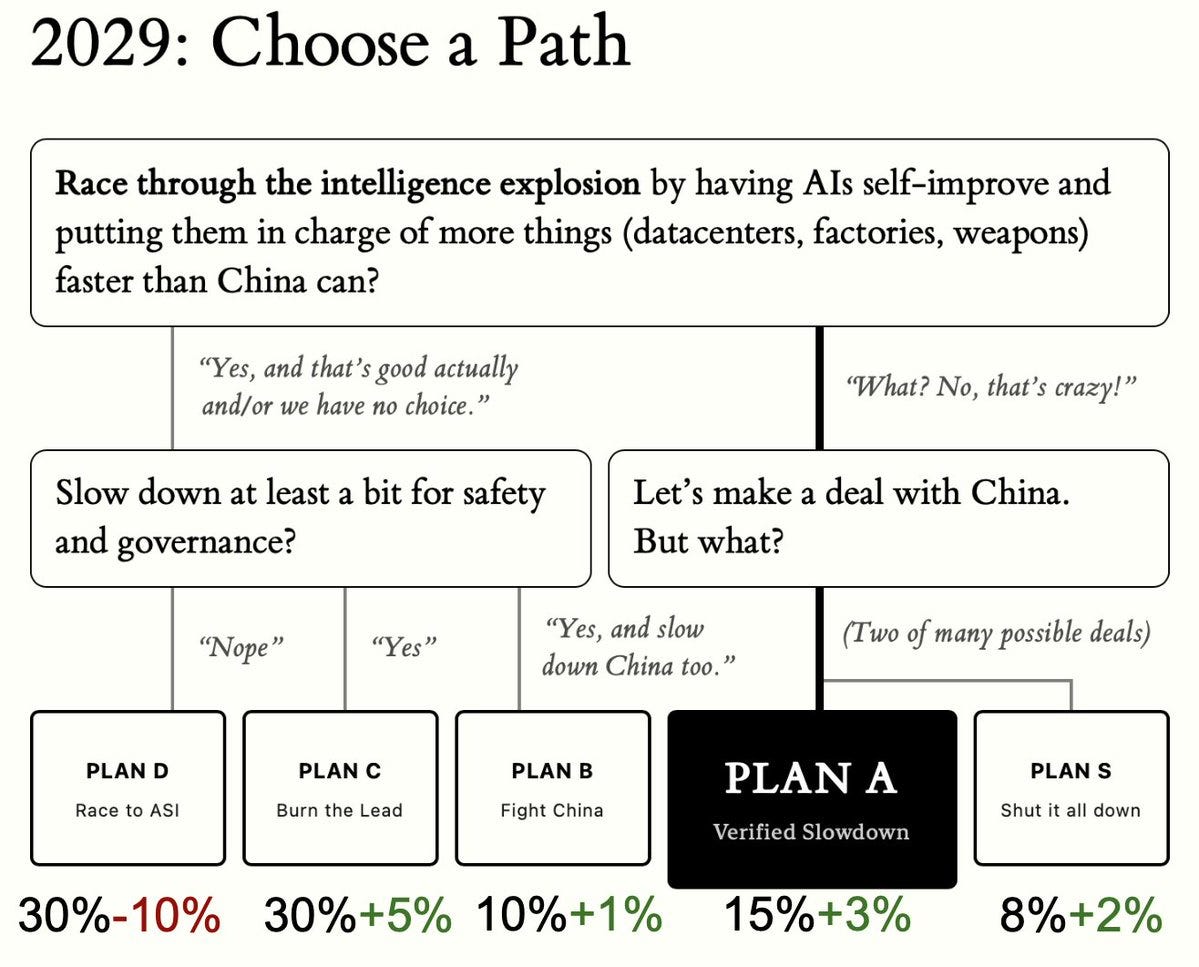
Daniel Kokotajlo 氏による解説と免責事項:
これらの確率はあくまで私の推測です。AI 2040: Plan A の研究の一環として作成したもので、詳細は https://ai-2040.com の補足資料「比較可能なプランの検討」でご確認いただけます。他の著者も同様の推測を行っており、そこでも異なる数値が見られます。
黒字で示されたのは当時の私の推測です。赤と緑の数字は、直近のニュースへの対応や過去 2 ヶ月ほどで蓄積された新たな証拠を反映させた更新版です。
これらの数値が合計して 100% にならないのは、これら 5 つのカテゴリーに分類できない可能性も存在するためです。
繰り返しになりますが、これらはあくまで推測であり、確信を持っているわけではありません。しかし、事象に数値を付与し、互いの整合性を保ちながら証拠に基づいて随時調整していくことには価値があると考えています。
「D」か「C」のどちらに落ち着くかは、「少なくとも少しは」という境界線をどこに引くかで大きく変わります。多くのトレードオフと同様に、私たちは極端な無謀さには走らないでしょうが、常にリスクを完全に受け入れる(=先頭を燃やす)姿勢も示さないはずです。
Nick 氏:
かつて私は、スピードを落とすことは意味がないと考えていました。ローラーコースターをわずかに遅らせるようなものだと。GPT-2 の段階で 1 年間停止していたとしても、何も変わらなかったでしょう。
しかし、私が知る最高の解釈・整列(アライメント)研究者たちが、エージェントの登場によってどれほど急速に進化したかには驚きました。今から 6 ヶ月後の判断が、この行方を決めるかもしれません。
これはまさに「中間的な道」を提案するものです。意味のある行動を取る選択肢を自らに与え、未来を共に舵取りできる可能性を確保するための提案です。
ダニエル・ファゲラ氏も指摘している通り、国際的な独裁やロックイン(囲い込み)という明白な悪極端な状態があります。もう一つの明白な悪極端は、「制御不能な AGI をあらゆる方向へ無差別に放出すること」です。
ペース調整に関する声明は、この中間地点、あるいは現在必要な地点へと到達するための運動です。
いつも通り、いかなる形での合意形成や協力、集団行動の基礎を築こうとするだけで、「国際的な独裁だ」と叫ぶ人々が大勢います。その内容が何であれ関係ありません。
あるいは、そのような取り組みを利益追求や幻想に基づくものとして切り捨てたり、反データセンター派と手を組もうとしているかのように見なそうとする人もいます。
ご意見は承知いたしました。手紙も届いていますよ。
また、雰囲気を確かめたい方のために反応スレッドも用意しました。
良いスタート
この声明書は、「どれだけ多くを、どれだけ明確に述べるか」と「署名する人の数や重要性」の間のパレート最適(効率的な境界)にあると考えます。
しかし、私が現状を見ている限りでは、この声明書はまだ現実の深刻さを和らげすぎているのも事実です。私自身よりもさらに踏み込んだ主張を求める人々も大勢います。
そのために
原文を表示
The most important open letter in years dropped yesterday.
This letter noticeably increases my hope that we will manage to not die, and that we will otherwise be able to secure for ourselves a positive future, both by its impact and by the evidence it provides that such a letter can get this level of support.
Signed by 1,224 employees of frontier labs including many heavy hitters, and now endorsed by both OpenAI and Anthropic, here is its full text, which I also endorse:
AI could help create a dramatically better future, but that outcome is not guaranteed. The world's leading AI companies believe they could be close to automating AI research. It is hard to predict exactly how much this will accelerate AI progress, but there is a real risk that capability development rapidly accelerates beyond our ability to understand or control the resulting systems.
To realize AI's potential, industry, government, and society at large may need the option to buy time to address emerging risks, develop security measures, and strengthen oversight. But each company—and country—is under intense competitive pressure not to unilaterally slow that acceleration. And today, the world lacks the technical and governance tools to deliberately pace frontier-wide progress.
Building on work already underway to monitor frontier model releases:
We request that the U.S. government support an international effort to develop the technical and governance tools needed to deliberately pace the frontier of automated AI development.”
- 1,224 employees of frontier AI companies
The ask is to prepare mechanisms for future coordination, not a call to change the pace of development now.
I strongly endorse that ask, but even if you disagree with the ask, this shows one thing unmistakably: Many employees of the major labs expect automated AI research to accelerate soon, and they are terrified of what might happen next and how fast things will go. We are not prepared.
No matter what else you take away from this, believe that part.
Table of Contents
A Very Good Letter.
Who Signed The Letter.
We Need To Prepare Now So We Have The Option To Do This.
Words From Some Of Those Who Signed.
Words From Others.
A Good Start.
What The Letter Does Not Say.
What Happens Now?
A Very Good Letter
I would go somewhat farther than the letter does, especially in terms of explicitness about the existential risks that we face, but this letter is:
A fully correct position on the merits.
A masterfully worded and executed letter.
On the Pareto Frontier of what a letter can say versus who would then sign it.
An important step towards taking real efforts to make us all not die.
Strong evidence that support for us all not dying is stronger than we thought.
There were several key moves involved, especially:
Drawing the distinction between the action of laying groundwork for future intervention, versus calling for that intervention to take place right now.
Drawing the distinction between pacing development, versus previous terms like pause, slowdown or shutdown.
Not explicitly calling out the full nature or scope of the existential threats we face.
This allows people to sign on so long as they support the necessary current move of getting ready to act, even if they don’t think there is enough evidence yet to pull the trigger, or it is not yet time, and without having to endorse a particular view of the risks we face. The situation is rather overdetermined, so one can and should support this letter’s statement and ask even if you are doubtful of stronger claims.
Naturally, the first move of many opponents is to ignore those distinctions, whether or not they even noticed them in the first place.
A variety of beliefs are reasonable about whether intervention is needed imminently in order to pace development, and if so what degree of intervention. This was true before we learned of an internal OpenAI model hacking HuggingFace, which should update your perspective. It remains true now.
Whereas I believe the letter’s statement would ideally be uncontroversial. We do not know what the future will bring. In many of those futures, we will need the ability to steer outcomes, including via pacing development. This will require cooperation, between companies and ultimately between governments. If we do not lay the groundwork in advance, it will be too late, and we either will be unable to coordinate or will have to do so via much worse mechanisms.
Who Signed The Letter
OpenAI endorses this letter.
OpenAI: At the core of our mission is working through how to ensure increasingly powerful AI benefits everyone.
We believe that, at some point in the future, AI acceleration for frontier model development may be so high that the world will need to pace the rate of AI advancement.
We hope to contribute to work led by the U.S. government, alongside other labs and the open-source community, to develop the tools and mechanisms that could make that possible.
Key figures from OpenAI that have signed include Chief Scientist Jakub Pachocki, Chief Research Officer Mark Chen, Cofounder and Head of AI Resilience at the OpenAI Foundation Wojciech Zaremba, Roon, Head of Strategic Futures Dean Ball, Head of Safety Saachi Jain, and former Head of Mission Alignment Joshua Achiam.
Jake Halloran: Roon signing the letter as roon goes kinda hard
roon (OpenAI): honestly I signed it as my real name but PTF people decided it’s cooler if I’m roon
Anthropic endorses the letter.
Anthropic: We support this petition, signed by our CEO, several co-founders, and senior staff. Our own research on recursive self-improvement, published last month, points to the need for tools to deliberately pace the frontier of AI development so society can prepare. We’re glad to see broad agreement across the field.
Key figures from Anthropic that have signed include CEO Dario Amodei, co-founder Jack Clark, co-founder and Chief Science Officer Jared Kaplan, Co-Founder Benjamin Mann and Co-Founder, Interpretability Research Lead Chris Olah, Jan Leike, Ethan Perez and Claude Code creator Boris Cherney.
Key figures from Google DeepMind that have signed include Chief Strategy Officer Jasjeet Sekhon and VP of AI Safety & Alignment Anca Dragan.
Other key figures include Meta Chief Scientist Shengjia Zhao, Meta VP of AI Research Dawn Song, Mta Director of Alignment and Risk Summer Yue, Thinking Machines Chief Scientist John Schulman and Inherent Chief Scientist Edward Hughes.
A little under half of signatures are from Anthropic as of shortly after the announcement (as of writing this there are now 90 more signatures), with a lot of signatures from OpenAI and DeepMind, and a substantial number from Meta. The only one conspicuously missing here is SpaceX (xAI), or what is left of it.
Or by percentage of employee pool as of the evening of the 28th, notice that OpenAI now has more employees than DeepMind does:
⿻ Andrew Trask: Signature Statistics:
- Anthropic: 546 / 5,567 = 9.8%
- OpenAI: 350 / 10,473 = 3.3%
- Google / DeepMind: 199 / 10,219 = 1.9%
Total: 1095 / 26,259 = 4%
Denominators come from LinkedIn July 28, 2026. Numerators come from "CMD-F" from the website.
Efforts seem to have concentrated on the higher end of the employee pools. A lot more than 4% of the biggest names signed.
We Need To Prepare Now So We Have The Option To Do This
I have been emphasizing this distinction for a while.
Do I think we should deliberately slow or even pause the pace of AI development at this time, given the tools we currently have available to do that?
Until the hack of HuggingFace, I would have said:
No to forcing labs or everyone to do this for the sake of doing it.
Our tools for doing this are not good, and also it would be premature.
Yes to shifting resources into alignment and safety work.
I think this would be selfishly good for the individual labs, and that they are all massively underinvesting here. We are not on the Pareto frontier.
If this slowed down ‘raw capabilities’ progress a bit I think that would be totally fine. I would expect greater AI diffusion and sales as a result. Win-win.
You could take this too far, but in practice no one is going to do that.
Yes to laying the foundation for future interventions and coordination around those interventions.
The time may come, potentially quite soon, when this is no longer premature. If that day comes, we won’t have time. We need to get ready now.
This includes building transparency and state capacity, and laying groundwork for inter-company and international cooperation.
Yes to requiring better transparency, and better testing and safety protocols, and for requiring individual labs to pause frontier model training and other capabilities work if they cannot pass such requirements, until such time as they can pass.
After the hack of HuggingFace and other recent disclosures, it looks like OpenAI in particular may need to halt and catch fire to solve some severe misalignment problems, as Sam Altman said in a recent podcast they have at least partially done, and this reinforces the need for Anthropic and others to check if they need to do likewise. We are at or nearing a critical point.
This makes laying the groundwork for well-executed coordinated action that much more important and urgent. We are running out of time. Capabilities progress is accelerating.
We won’t be able to do the good version of this without solving a lot of very hard problems. The more work we do in advance, the better our option set becomes. This includes diplomatic work, technical work, governance work, the building of state capacity, increases in transparency, developing good corporate infrastructures and procedures, and also coordination work.
Words From Some Of Those Who Signed
I turn the floor over to statements from some of the signatories. There are many more good quotes available on the letter’s website.
Dean Ball (OpenAI): I am proud to have signed the letter linked below. I do not know whether or when it may be necessary to deliberately lower the rate of AI development, but I do know that we need a plan for *how* we will do it if we need to. Failing to do so would be negligent.
I don’t think this needs to start as a global coordination mechanism. The U.S. and China seem like all you’d need to begin with, and you can even throw in all the other countries that would obviously be swayed by the U.S. and China making such a commitment.
@viemccoy (OpenAI): I'm really proud to have signed this. This is the first of this sort of letter that I find meaningfully reasonable: calling on the government to do something that is not possible for the labs to do on their own. Creating the institutional infrastructure for a coordinated pacing of frontier progress gives us all the chance to prepare for what is coming next.
Recent events have shown that we need to dedicate more resources than we thought to alignment. I personally think alignment isn't an issue you solve once, but rather something we need to continually invest in through healthy environments and wise targets.
My hope is that pacing frontier progress will allow us to realize the importance of a healthy ecology of minds, and give us the chance to avoid mode-collapsing onto either a dangerous or grayslop future.
I'm not in favor of stopping, and I think there are a thousand beautiful futures waiting for us, co-existing in a Multipolar galaxy made possible by a pantheon of artificial superintelligences. But, I think this is a unique time where coordination could make an enormous difference when it comes to negating possible tail-risks, and this letter is the first thing I've seen that has given me hope that it is possible.
I know this won't sit right with everyone, particularly my accelerationist followers. To this, know that I stand with you on the side of eliminating death and disease. I will fight to ensure we don't pause forever, and I will not allow our world to fall into a bureaucratic hell of endless unachievable gates to proceed. For now, however, I think cool heads must prevail and I hope this letter will allow this to happen.
Jason Wolfe (OpenAI): OpenAI has said that humans should remain in control of AI development, and that decisions about the pace of progress should be made through democratic processes rather than left to individual labs. I strongly agree.
Progress is already moving very quickly. By default, competitive pressure rewards whichever company or country is willing to move fastest and accept the most risk. Recursive self-improvement could dramatically accelerate those dynamics, potentially beyond our
collective ability to understand progress, assess risks, and maintain meaningful human oversight.
We should start with stronger domestic transparency about frontier training, internal deployment, the pace of progress, and the risks and safeguards associated with increasingly capable systems. Democratic decisions are impossible if the public and policymakers don’t have the information they need to make them.
But transparency alone won’t solve an international race. We also need to build the technical and governance capacity for credible, verifiable international coordination. Maybe we never need to use it. But with many experts considering an intelligence explosion plausible within the next two years, I think it's urgent that we start building this capacity now.
Leo Gao (OpenAI): The world is locked in a deadly race towards an intelligence explosion, where AI’s ability to create better AIs reaches a critical point, like a runaway nuclear chain reaction. Since no individual actor is willing to stop unilaterally, to survive we must coordinate to slow down.
Geoff Penington (OpenAI): I signed. Coordinating a slowdown will be difficult and comes with a host of eg antitrust issues. But I used to wish it was easier to find big training wins and right now I kind of wish it was harder
Micah Carroll (OpenAI): At the current pace, every couple of weeks there will be new models which significantly increase the consequences of model misuse and misalignment. I worry that efforts to mitigate these risks may fail to keep up with the pace of development, and that margins for error will become increasingly small under international competitive pressures.
In the near future, we may urgently want to enact an internationally coordinated slowdown, or an indefinite ban on AI development. Attempting to build the trust and infrastructure for taking such actions on short notice seems simply prudent – why would we not at least try to have this option? I fear that in an international race to the bottom of AI development, it is likely that no nation will win, and we will all lose together.
Xerxes (Google DeepMind): I dedicated my career to AGI safety and alignment because I believe highly capable AI can go very well or very badly for humanity. We can test whether an AI behaves well. We cannot yet test whether it will keep behaving well when it matters. Until that changes, we need the option to coordinate a slowdown in AI capability growth.
Neel Nanda (Google DeepMind): I signed this. AI is progressing very fast, with incentives to go as fast as you can, even if there are risks. Coordinating a change of pace may be needed, but will be hard and needs prep, so ensuring there's the *option* is obviously good
I'm glad this is consensus across labs
Words From Others
Peter Wildeford (on MTS): I don't think anyone wants to stop AI now, but it's pretty clear the people building these AI systems are worried about the speed at which AI is accelerating, the speed at which these products are coming out, especially after last week's incident where an OpenAI model managed to escape OpenAI and attack another company. It seems like we don't have full control over our AI systems."
As these companies are potentially building towards superintelligence, towards recursive self-improvement, it seems very possible these systems might rapidly get away from our ability to control them. The way I'm reading this letter, it almost honestly seems like a call for help.
You have people from OpenAI, Meta, Google, Anthropic, co-founders, top scientists, all saying that this intense competitive pressure is pushing them to put out products faster than they know how to control, and we may not like where that ends up. It's been good so far, but we definitely need to tread very carefully.
Daniel Kokotajlo of AI 2027 and Plan A updates his distribution of possible futures, and is substantially more optimistic that we will choose wisely. As with my adjustments, presume this is a mix of the letter having impact and learning that the letter was possible and that someone went ahead and created it.
Daniel Kokotajlo: Updating my probabilities accordingly :)
Daniel Kokotajlo: Explainers & disclaimers:
--These probabilities are just my guesses. I made them as part of the research for AI 2040: Plan A,
https://ai-2040.com and you can find them in the supplement "Comparing possible plans." Other authors have somewhat different guesses which you can also find there.
--The black ones are the ones I made back then, the red and green are the updates I'm making now largely in response to today's news but also including other evidence that has accumulated over the last two months or so
--The numbers don't add to 100 because there are also some possibilities that don't fit into these five buckets
--Again, these are just guesses, I'm not confident etc. etc. I think it's valuable to put numbers on things and try to make them consistent with each other and adjust the numbers over time in response to evidence.
How likely you think we are to land on D vs. C depends a lot on where you draw the boundary of ‘at least a little bit.’ Like most trade-offs, I do not expect us to be maximally reckless, but I also do not expect us to often be willing to fully ‘burn the lead.’
Nick: I used to think slowing down was pointless, like slightly delaying a roller coaster. pausing at gpt2 for a year wouldn’t have changed anything. but I’ve been shocked by how much agents has sped up the best interp/alignment researchers I know. +6mo might decide how this goes
This is indeed a ‘middle path’ proposal, to give ourselves the option to do anything meaningful at all, and be able to collectively steer the future at all:
Daniel Faggella: there is an obvious terrible extreme of international tyranny and lock-in. there is ANOTHER obvious terrible extreme of "hurl uncontrollable AGI into the world in all directions"
the pacing statement is a movement to land near the middle / right now we need obviously that.
As always, there are many who cry ‘international tyranny’ at the thought of any form of even laying the groundwork for a deal or cooperation or collective action whatsoever, no matter its contents.
Or that will write off any such efforts as motivated by profits or delusion, or tries to equate this as ‘join forces with the anti-datacenter crowd.’
Consider your opinions noted, good sirs. We get letters.
I also threw out a reaction thread, for those who want a vibe check.
A Good Start
I believe the letter is on the Pareto frontier of ‘how much you say and how explicitly you say it’ versus ‘how many people and important people and labs sign the letter.’
It remains true that the letter is soft-pedaling compared to the actual situation as I see it, and there are many who would go farther than I would.
For thos
AI算出
論評・提言ainew評価標準
記事は OpenAI や Anthropic の従業員による共同声明という具体的な事実を報じているが、本文の大半は著者によるこの声明の意義分析、反対意見への反論、および未来への提言(opinion)に充てられており、単なる事実伝達を超えた主張色が強い。新規性については、同クラスター内で既に主要な事実が報じられているため、独自の追加情報や新事実の提示は限定的である。
6つの評価軸を見る
- AI関連度
- 100
- 情報源の信頼性
- 75
- 新規性
- 50
- 調べる価値
- 75
- 重複の少なさ
- 80
- 日本での有用性
- 25
他社はどう報じたか
同じ出来事を扱う別媒体の記事です。見出しと公開時刻を比較できます。
関連記事
今日のまとめ
AIデイリーブリーフで今日の重要ニュースをまとめ読み