生命は宇宙から来たのか?小惑星でDNA構成要素の「完全セット」を発見
科学者が小惑星リュウグウの試料からDNAとRNAの基本構成要素である5種の核酸塩基全てを発見した。この発見は生命の材料が太陽系に豊富に存在する可能性を強める。
Source Article
元記事を日本語で読む
本文に関係しない購読案内、埋め込み通知、サイト内プロモーションは除いています。
404 Mediaのニュースレター「The Abstract」を購読して、今週最も刺激的で驚くべき科学ニュースと研究をお届けします。
月曜日に『Nature Astronomy』誌に掲載された研究によると、科学者たちは小惑星リュウグウの未汚染サンプルから、DNAとRNAの基本構成要素である5種類すべての核酸塩基を発見しました。この発見は、生命の材料が太陽系に豊富に存在し、宇宙から地球にもたらされた可能性を強く示唆するものです。
私たちが知る生命はDNAとRNAによって成り立っており、これらは5種類の化学塩基、すなわちアデニン、グアニン、シトシン、チミン、ウラシルから構成されています。研究チームは今回、日本の宇宙探査機「はやぶさ2」が2019年にリュウグウの表面から採取し、翌年に地球へ無事に持ち帰った岩石から、この核酸塩基の「完全セット」を同定しました。
この発見は、NASAのOSIRIS-RExミッションによる別の探査結果を裏付けるものです。OSIRIS-RExは小惑星ベンヌのサンプルを持ち帰り、そこにも5種類すべての核酸塩基が含まれていました。両方の小惑星は同じ「炭素質」(C型)の原始的な炭素豊富な岩石のグループに属していますが、サンプル中の5種類の核酸塩基の比率は異なっています。
これらの発見を総合すると、地球上の生命の起源について理解が深まり、生命が他の場所にも存在する可能性について新たな疑問が提起されます。
「これらの発見は、核酸塩基が炭素質小惑星、ひいては惑星系に広く存在している可能性を示唆しています」と、海洋研究開発機構(JAMSTEC)の博士研究員である古賀俊樹氏は404 Mediaへのメールで述べました。
「これは、生命のための主要な分子材料の一部が普遍的に利用可能である可能性があることを意味します」と彼は付け加えました。「しかし、これは生命そのものが広く存在することを意味するのではなく、生命のための化学的初期材料が以前考えられていたよりも一般的である可能性があるということです。」
地球上での生命の出現、すなわち自然発生は、科学における最大の謎の一つであり続けています。この謎を解明するために、科学者たちはまず、水、アミノ酸、そして私たちの遺伝物質を構成する核酸塩基を含む生命の基本材料が、どのようにして初期の地球にもたらされたのかを解明する必要があります。
はやぶさ2ミッションによってリュウグウから持ち帰られたサンプルから5種類すべての標準的な核酸塩基が検出されたことを描いた「リュウグウ物語」のイラスト。画像提供:JAMSTEC
一般的な仮説の一つは、これらの生物学的構成要素を運ぶ小惑星が、40億年以上前に地球が形成された際に地球に降り注いだというものです。この考えは、オーストラリアのマーチソン隕石やフランスのオルゲイユ隕石など、地球に落下した炭素質小惑星の破片に核酸塩基が存在することによって支持されてきました。
しかし、隕石は宇宙空間にさらされて侵食されるため、また地球に落下した後に地球の物質で汚染される可能性があるため、未汚染の状態ではありません。より清浄なサンプルを得るために、科学者たちは2010年に小惑星イトカワから数ミリグラムの塵の粒子を地球に届けた日本の「はやぶさ」ミッションを皮切りに、複数の宇宙探査機を打ち上げて直接源からサンプルを採取しました。
その後、「はやぶさ2」とOSIRIS-RExはそれぞれの目標天体からさらに大きなサンプルを取得し、リュウグウから5.4グラム、ベンヌから121.6グラムを持ち帰りました。これまでの研究では、両方のサンプルから生命に関連する十数種類のアミノ酸がすでに同定されており、これらの小惑星がかつて氷と水によって変化した証拠も見つかっています。
今回、ベンヌの小石から5種類すべての核酸塩基が発見された後、古賀氏とその同僚たちはリュウグウでも完全セットを発見しました。この発見は、自然発生に関するいわゆる「RNAワールド」モデルに重みを加えるものです。この仮説では、初期の地球生命は自己複製分子としてRNAのみに依存し、後にDNAやタンパク質ベースの生物を含むより複雑なシステムのための生物学的基盤を築いたとされています。リュウグウとベンヌからの地球外サンプルは、これらの初期生命体を構成した核酸塩基の少なくとも一部が宇宙空間から来たという証拠を提供しています。
この結果は「私たちの予想とおおむね一致していましたが、確認できたことは非常にエキサイティングでした」と古賀氏は述べました。「5種類すべての核酸塩基は、マーチソン隕石と小惑星ベンヌのサンプルですでに検出されていました。リュウグウも炭素質小惑星であるため、これらの分子が存在する可能性があると予想しており、完全セットが実際にリュウグウのサンプルに存在することを確認できたことは非常に満足のいくものでした。」
しかし、両方のサンプルに核酸塩基の完全セットが含まれていた一方で、それらの相対的な存在量は異なっていました。例えば、ベンヌはリュウグウよりもピリミジン系核酸塩基(シトシン、チミン、ウラシル)がはるかに豊富ですが、両方ともプリン系核酸塩基(アデニンとグアニン)のレベルはほぼ同程度です。これらの特異性は、これらの天体の遺物上で生命前駆物質を生成した多様な形成過程を示唆しています。
「私たちの結果は、核酸塩基が初期太陽系物質、特に水による変成を経験した原始的な小惑星母天体内で、様々な条件下で形成され得ることを示唆しています」と古賀氏は述べました。「核酸塩基組成とアンモニア存在量の間で観察された関係は、アンモニアの利用可能性などの局所的な化学環境が重要な役割を果たしている可能性があることを示しています。」
「同時に、いくつかの前駆体分子は星間環境でより早く形成された可能性があるため、核酸塩基の形成には複数の段階が関与している可能性があります」と彼は続けました。「さまざまな種類の隕石の分析や、これらの条件をシミュレートする実験室実験を含む将来の研究は、これらの形成経路をより詳細に解明するのに役立つでしょう。」
言い換えれば、これらの分子が宇宙でどのように形成されるかを理解することは、生命が稀な宇宙の偶然なのか、それとも宇宙で普遍的なプロセスなのかという古くからの謎に答えるのに役立つ可能性があります。
原文を表示
Subscribe to 404 Media to get The Abstract, our newsletter about the most exciting and mind-boggling science news and studies of the week.
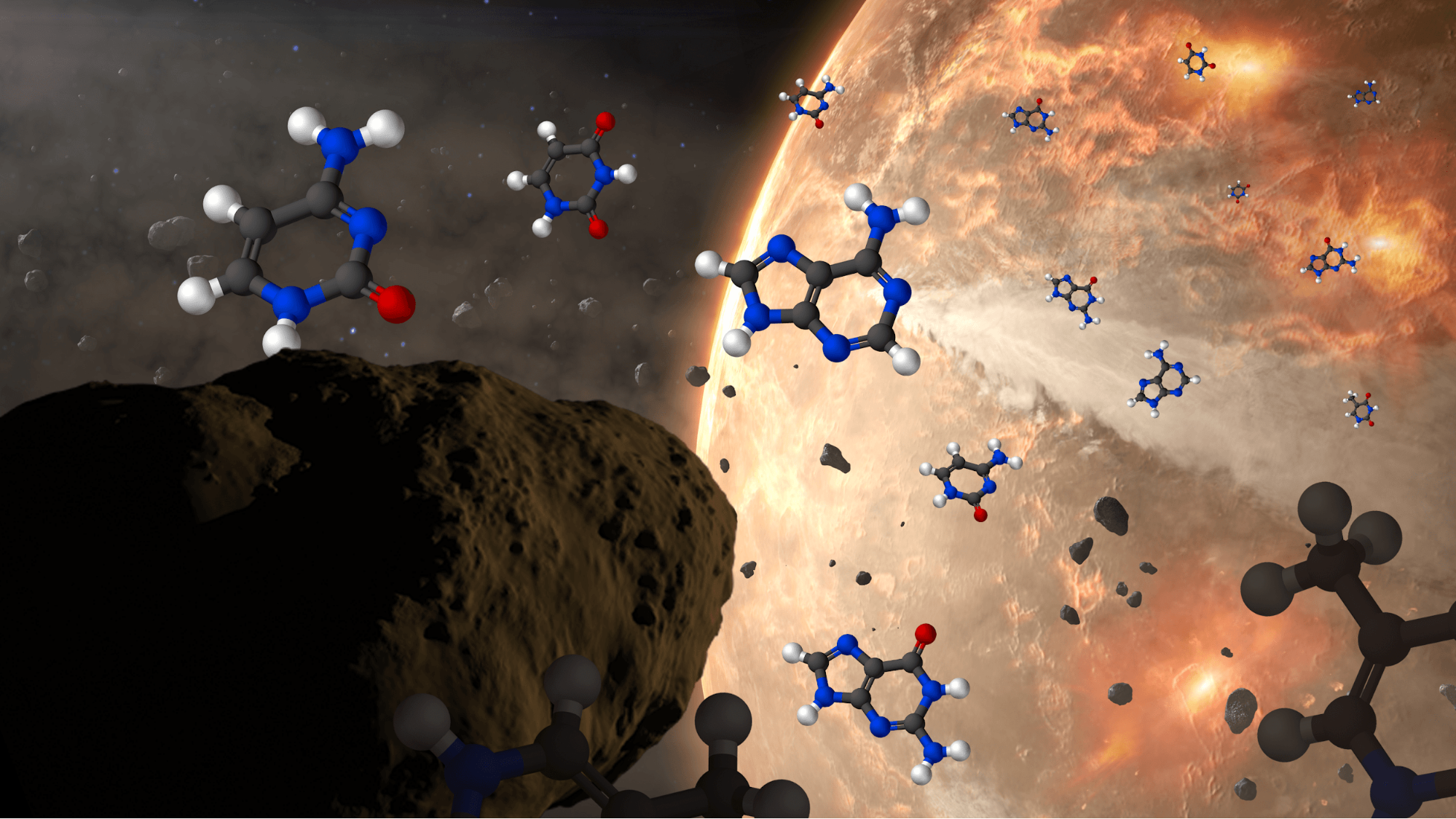 imageScientists have discovered all five nucleobases—the fundamental components of DNA and RNA—in pristine samples from the asteroid Ryugu, according to a study published on Monday in Nature Astronomy. The finding strengthens the case that the ingredients for life are abundant in the solar system and may have found their way to Earth from space, according to a study published on Monday in Nature Astronomy.
Life as we know it runs on DNA and RNA, which are built from five chemical bases: adenine, guanine, cytosine, thymine, and uracil. A team has now identified this “complete set” of nucleobases in rocks snatched from the surface of Ryugu in 2019 by the Japanese spacecraft Hayabusa-2, which successfully returned them to Earth the following year.
This discovery corroborates the results from another mission, NASA’s OSIRIS-REx, which returned samples of the asteroid Bennu that also contained all five nucleobases. Both asteroids belong to the same “carbonaceous” (C-type) family of primitive carbon-rich rocks, though the samples contain different ratios of the five nucleobases.
Taken together, the findings shed light on the origin of life on Earth and raise new questions about the odds that it exists elsewhere.
“These findings suggest that nucleobases may be widespread in carbonaceous asteroids and, by extension, in planetary systems,” said Toshiki Koga, a postdoctoral researcher at the Japan Agency for Marine-Earth Science and Technology (JAMSTEC), in an email to 404 Media.
“This means that some of the key molecular ingredients for life could be commonly available,” he added. “However, this does not imply that life itself is widespread, but rather that the chemical starting materials for life may be more common than previously thought.”
The emergence of life on Earth, also known as abiogenesis, remains one of the biggest mysteries in science. To untangle this enigma, scientists first need to figure out how our planet was initially enriched with the basic stuff of life—including water, amino acids, and the nucleobases that make up our genetic material.
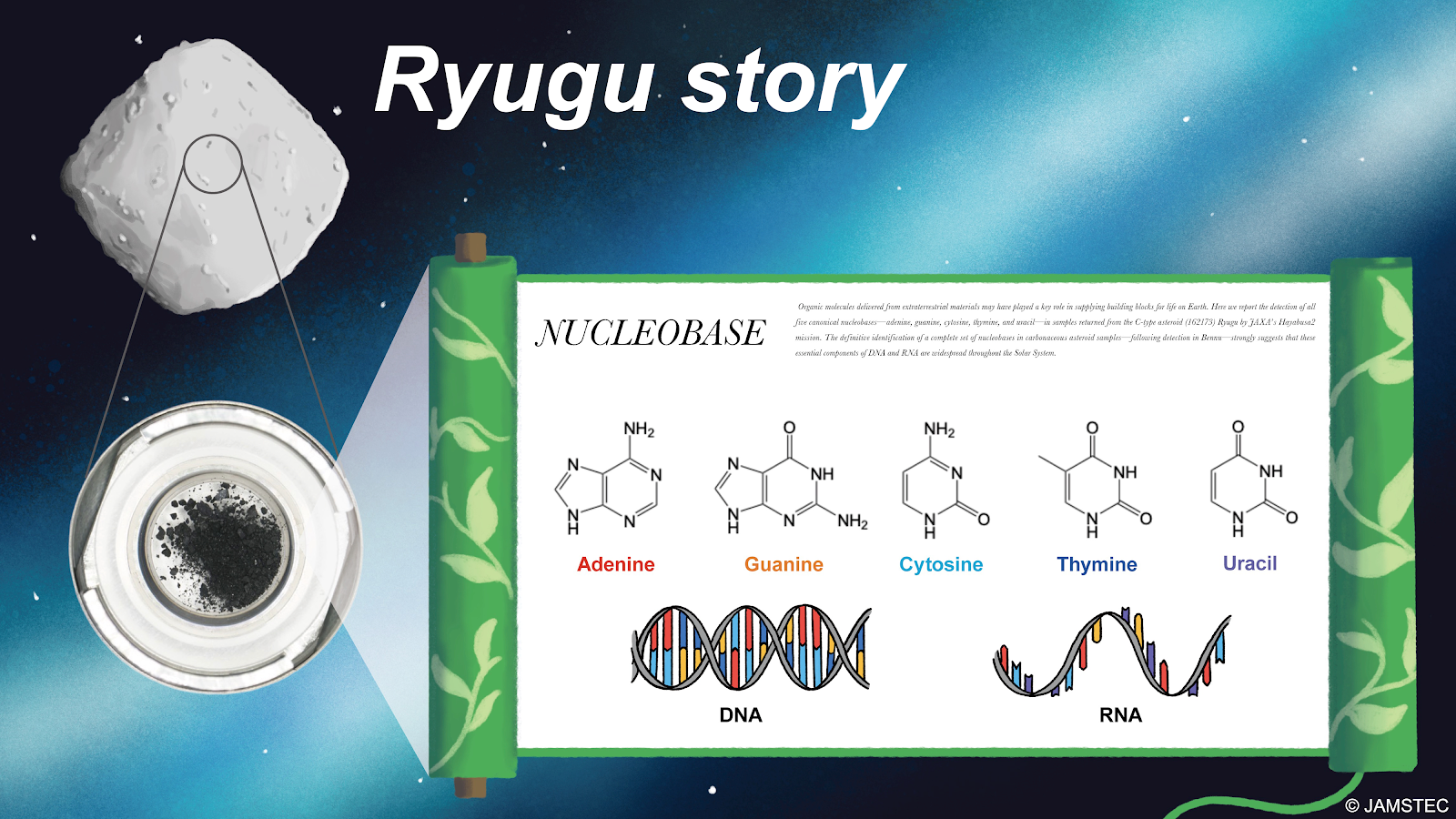 imageThe “Ryugu Story” illustration depicting the detection of all five canonical nucleobases in samples returned from asteroid Ryugu by the Hayabusa2 mission. Image: JAMSTEC One popular hypothesis suggests that asteroids bearing these biological building blocks pelted Earth as it formed more than four billion years ago. This idea has been supported by the presence of nucleobases in pieces of carbonaceous asteroids that have fallen down to Earth, such as the Murchison meteorite of Australia or the Orgueil meteorite of France.
Meteorites, however, are not pristine as they become eroded by exposure to space and can also be contaminated by terrestrial material after landing on Earth. To get cleaner samples, scientists launched several spacecraft to grab samples directly from the source, beginning with Japan’s Hayabusa mission, which delivered several milligrams of dusty grains from asteroid Itokawa to Earth in 2010.
Hayabusa-2 and OSIRIS-REx then obtained even larger samples from their targets, bringing back 5.4 grams from Ryugu and 121.6 grams from Bennu. Previous studies have already identified more than a dozen amino acids associated with life in both samples, as well as evidence that these asteroids were once altered by ice and water.
Now, following the discovery of all five nucleobases in the Bennu pebbles, Koga and his colleagues have found the complete set in Ryugu. The findings lend weight to the so-called “RNA world” model of abiogenesis. In this hypothesis, early life on Earth depended solely on RNA as a self-replicating molecule, laying the biological groundwork for later, more complicated systems that involved DNA and protein-based organisms. The extraterrestrial samples from Ryugu and Bennu provide evidence that at least some of the nucleobases that made up these early lifeforms came from outer space.
The results were “broadly in line with our expectations, but still very exciting to confirm,” Koga said. “All five nucleobases had already been detected in the Murchison meteorite and in samples from the asteroid Bennu. Since Ryugu is also a carbonaceous asteroid, we expected that these molecules might be present, and it was very satisfying to confirm that the complete set is indeed present in the Ryugu samples.”
But while both samples contained the royal flush of nucleobases, they differed in their relative abundances. For example, Bennu is much richer in pyrimidine nucleobases (cytosine, thymine and uracil) than Ryugu, though they both contain roughly similar levels of purine nucleobases (adenine and guanine). These idiosyncrasies point to a variety of formation processes that produced prebiotic materials on these celestial relics.
“Our results suggest that nucleobases can form under a range of conditions in early Solar System materials, particularly within primitive asteroid parent bodies that experienced aqueous alteration,” Koga said. “The observed relationship between nucleobase composition and ammonia abundance indicates that local chemical environments, such as the availability of ammonia, may play an important role.”
“At the same time, some precursor molecules may have formed earlier in interstellar environments, so nucleobase formation could involve multiple stages,” he continued. “Future studies, including analyses of different types of meteorites and laboratory experiments that simulate these conditions, will help to better constrain these formation pathways.”
In other words, understanding how these molecules form in space could help answer the age-old mystery of whether life is a rare cosmic fluke—or a common process in the universe. The research also highlights the remarkable ingenuity behind these sample-return missions, which have delivered tiny time capsules from the birth of our solar system directly into our hands.
“It is both exciting and humbling to work with these samples,” Koga said. “They are extremely limited and represent material that has remained largely unchanged since the early Solar System. At the same time, there is a strong sense of responsibility, because each tiny grain may contain important information about how organic molecules formed and evolved before the origin of life.”
Subscribe to 404 Media to get The Abstract, our newsletter about the most exciting and mind-boggling science news and studies of the week.
関連記事
今日のまとめ
AIデイリーブリーフで今日の重要ニュースをまとめ読み