Amazon Bedrock AgentCore を活用し、Baz が AI エージェントのコードレビュー精度を向上させた方法
Baz は Amazon Bedrock AgentCore の Browser Tool とマルチエージェントアーキテクチャを活用し、コードの構文チェックだけでなく、Figma デザインや Jira 要件との整合性を動的に検証する AI エージェントを構築してレビュー精度と速度を向上させた。
キーポイント
従来のコードレビューの課題解決
従来のレビューは構文や動作確認に留まり、製品要件やデザイン意図との整合性検証が手動で遅延していたため、Baz はこのギャップを埋めるための自動化を試みた。
Bedrock AgentCore を活用した多段階検証パイプライン
Figma や Jira から要件を収集し、サブエージェントがコードリポジトリと動的ランタイム検証(DOM 検査、イベントシミュレーション)を組み合わせて実装を検証する。
Browser Tool を用いたエンドツーエンドの検証
Amazon Bedrock AgentCore の Browser Tool を使用して一時環境を構築し、実際のユーザー体験として機能が意図通りに動作するかを視覚的・行動的にテストする。
ビジネス成果と開発速度の向上
QA チームの手動検証時間を削減し、設計の一貫性を保ちながら回帰バグのリスクを低減することで、開発チームのデリバリ速度を加速させた。
重要な引用
Code review was always manual and ineffective because of the inherent disconnect between code and product.
The Baz Spec Review agent orchestrates a sophisticated multi-stage validation pipeline... performing DOM inspection, event simulation, and visual testing
Baz set out to close this gap by building agents that could evaluate not just code, but the actual delivered experience.
影響分析・編集コメントを表示
影響分析
この記事は、AI エージェントが単なるコード生成や静的解析を超えて、実際の製品体験(UX)やビジネス要件との整合性を動的に検証する段階へ進化していることを示しています。AWS の Bedrock AgentCore を活用した具体的な実装事例として、開発ライフサイクルにおける QA 自動化の新たな標準を提案しており、エンジニアリング組織の生産性向上に直結する重要な知見です。
編集コメント
静的なコードレビューから、実際の動作やデザイン意図との整合性を AI が検証する「動的レビュー」への転換点となる実装事例です。特に Browser Tool を活用した UI/UX 検証の自動化は、QA 領域における AI の応用範囲を大きく広げる画期的なアプローチと言えます。
コードレビューは、コードと製品の間にある本質的な乖離のために、常に手作業であり非効率的でした。開発者はコードがコンパイルして動作するかを確認できますが、すべての機能要件や設計要件を満たしているかどうかまでは確認できませんでした。過去には、QA チームが機能が期待通りに動作することを確認するために、プレビュー環境を手動でクリックして何時間も費やし、実装を設計意図と整合させるためにさらに多くの時間を要していました。この手動検証は納期を遅らせ、一貫性を欠き、回帰の発生可能性を高めていました。開発チームの速度が増加する中、Baz はこの検証の欠落した層を自動化し、意図・動作・実装を単一のレビューワークフローに統合することを目指しました。
本稿では、Baz が Amazon Bedrock と Amazon Bedrock AgentCore を活用して Spec Review エージェントを構築したプロセスについて解説します。アーキテクチャの意思決定、実装の詳細、そしてこれらの AWS サービスを活用してコードレビュープロセスを自動化することで達成されたビジネス成果について取り上げます。
Baz が解決しようとしている核心的な課題
Baz は、従来の差分(diff)ベースのレビューを超え、機能が意図した製品要件を満たしているかを検証することを目指して構築されています。初期段階で、Baz はチームが構文中心のレビューに苦労し、「動作するか」「仕様と一致しているか」「意図通りに振る舞うか」といった重要な質問をプロセスの後半まで手動で残さざるを得ない状況を目撃しました。コードと製品意図の間のこのギャップは、チームの速度を落とし、設計の一貫性を損ない、文書化されていない QA 内部知識への過度な依存を生み出していました。Baz はこのギャップを埋めるため、コードだけでなく実際の提供される体験そのものを評価できるエージェントを構築することで対応しました。
ソリューションの概要
Baz Spec Review エージェントは、洗練された多段階検証パイプラインをオーケストレーションします。トリガー(Webhook または手動呼び出し)が発生すると、MCP を介して Figma に、REST API を通じて Jira に同時にクエリを実行し、技術仕様、製品仕様、デザイン仕様にわたる包括的な要件アーティファクトを集約します。その後、システムは各要件ごとに孤立したサブエージェントワーカー(要件数分)を起動し、要件の検証というタスクを担当させます。このサブエージェントは、ソースコードリポジトリを通じたコードチェックと、Amazon Bedrock AgentCore Browser Tool を用いた動的なランタイム検証を組み合わせています。サブエージェントは一時的な環境と対話を行い、DOM 検査、イベントシミュレーション、ビジュアルテストを実行することで、デプロイされた実装が Figma のデザイン仕様および動作要件の両方に合致していることを保証します。これにより、AWS ネイティブオーケストレーションを通じて、仕様の策定から実装に至るまでのライフサイクル全体にわたってエンドツーエンドの検証を実現しています。
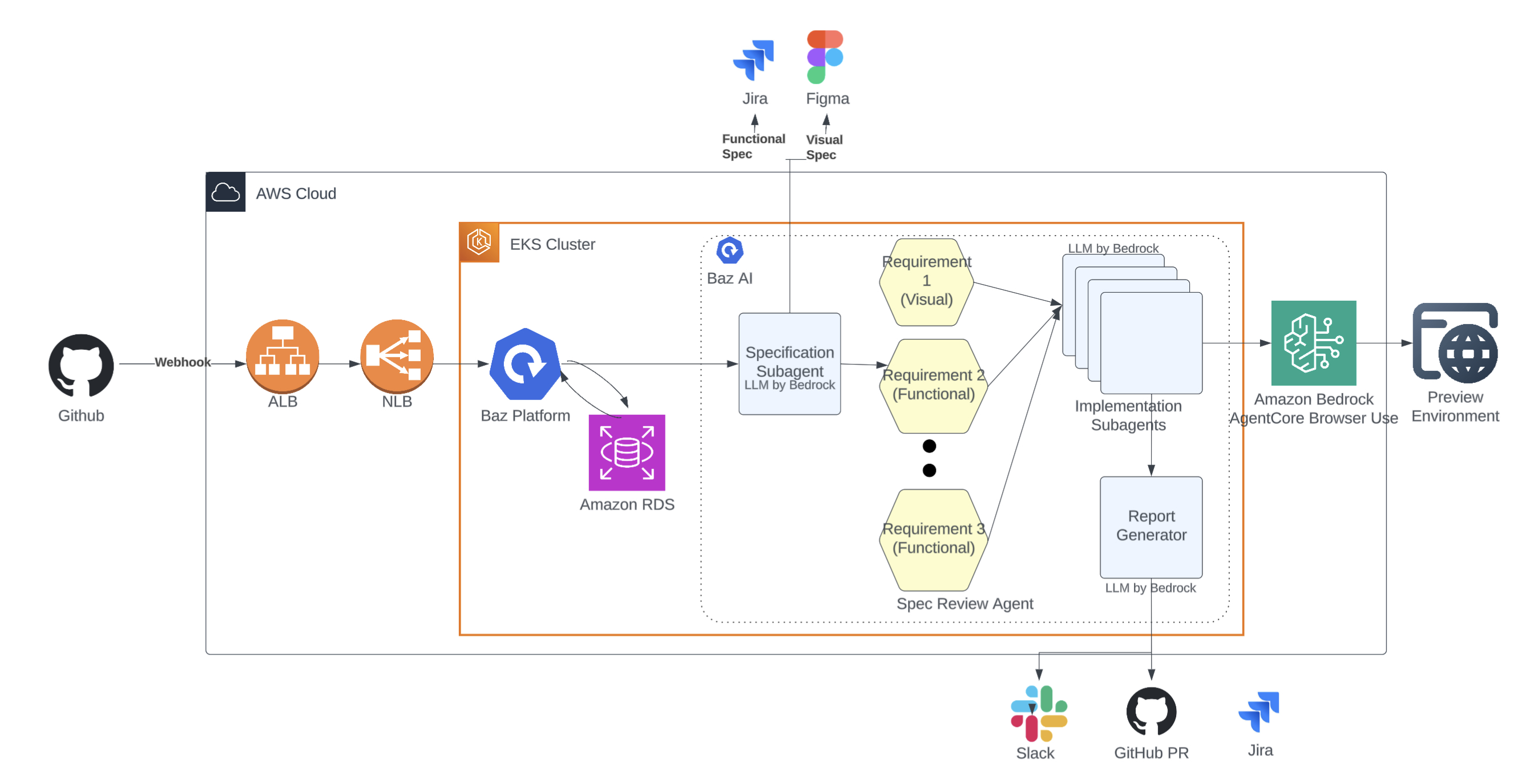
以下の図は、Baz と AWS が共同開発した Spec Reviewer のアーキテクチャを示しており、コードレビューワークフロー内で自動化された設計および製品検証を可能にするソリューションです。このすべてのエージェントフローは、Amazon Bedrock を介して提供される大規模言語モデルによって駆動されており、パイプライン全体でスケーラブルかつ安全な AI 推論を提供します。フローは、新しいプルリクエストに対して GitHub ウェブフックがトリガーされることで開始され、トラフィックはアプリケーションロードバランサー (ALB) およびネットワークロードバランサー (NLB) を経由して Amazon E クラスタークラスター (EKS) へルーティングされます。Baz プラットフォームは中央のオーケストレーション層として機能し、マルチエージェントによるレビュープロセスを調整します。
Amazon EKS クラスター内では、Baz の Spec Review エージェントが検証ワークフローを専門的なサブエージェントに分解します。Amazon Bedrock によって駆動される Specification Subagent は、Figma からのビジュアル仕様と Jira からの機能仕様の両方を取り込み、それらを個別の要件へと分解します。具体的には、ビジュアル要件(間隔、色、コンポーネント階層など)と、機能要件(受入基準やユーザーストーリーの意図など)に分類されます。
実装サブエージェントは、このアーキテクチャの中核を成しています。これらの Amazon Bedrock によって駆動されるエージェントは、抽出された仕様に対して深いコード解析を実行しますが、それらを際立たせているのは、Amazon Bedrock AgentCore の Browser Use(ブラウザ操作)機能との統合です。静的なコード分析のみに依存するのではなく、実装サブエージェントは実際のコードをライブプレビュー環境でレンダリングし、UI が意図された Figma デザインと一致しているか、また機能が Jira で指定された通りに動作しているかを視覚的に検証することができます。このコード理解とブラウザベースの検証を組み合わせたアプローチにより、Baz は従来のコードレビューツールでは完全に見逃してしまう不整合を検出することが可能になります。
レポートジェネレーターは、すべてのサブエージェントからの知見を統合し、一貫性のあるレビューサマリーを作成します。レビューが完了すると、知見は適切なチャネルに配信されます:コメントは GitHub の PR に直接投稿され、通知はチームの可視化のために Slack に送信され、特定された課題は追跡と解決のために自動的に Jira へリンクされます。
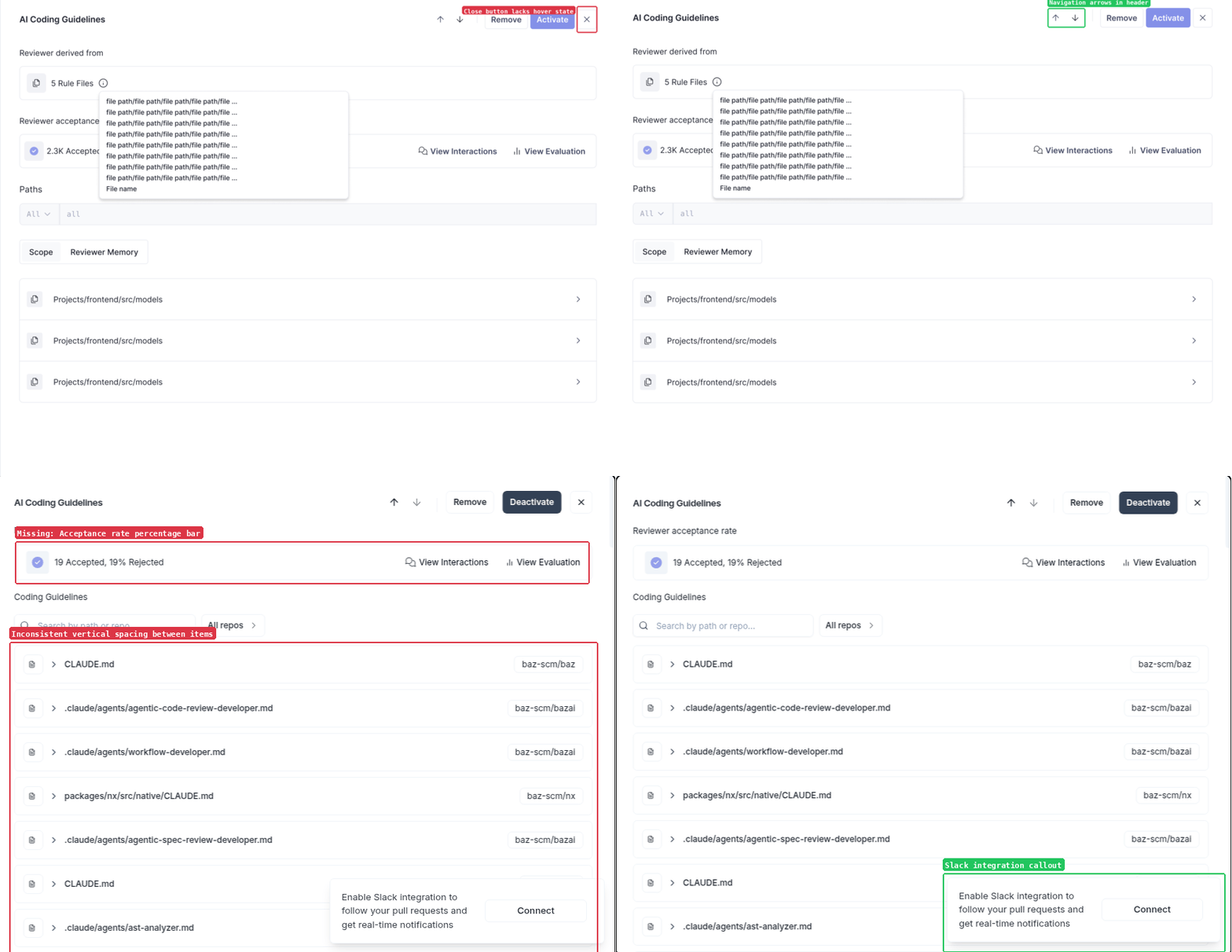
Baz が Amazon Bedrock AgentCore を実装してこれらの課題に対処した方法
Amazon Bedrock AgentCore は、実際の製品動作を検証できる AI コードレビューヤーを構築するための基盤となりました。その安全で隔離されたサーバーレスブラウザセッションにより、Spec Reviewer エージェントはプレビュー環境を開き、機能間を移動し、ユーザーが実際に操作するかのように UI 動作を詳細に確認できます。Amazon Bedrock AgentCore ランタイムを使用してチケット管理システムと統合される MCP サーバーを実行し、軽量な自動化およびコンテキストモジュールを備えた Amazon Bedrock AgentCore ブラウザツールと組み合わせることで、Baz Reviewer はブラウザインフラやカスタムオーケストレーションを必要とせずに、ライブの動作とコードをチケットおよび設計仕様と比較できます。Amazon Bedrock AgentCore の隔離機能、サンドボックス化、および観測可能性により、Baz は複数の MCP サーバーをスケーリングでき、エージェントが安全かつ信頼性を持って大規模なフルスタック検証を実行できるようになります。
Amazon Bedrock を活用したインテリジェントなコードレビューの実現
Amazon Bedrock は、Spec Reviewer エージェントの背後にある推論および意思決定層を駆動し、要件の解釈、設計意図の理解、ブラウザで観測された挙動の関連性の評価を可能にします。Amazon Bedrock 管理基盤モデル(foundation models)を使用することで、エージェントは仕様コンテキストを統合し、UI 状態を分析し、機能が期待通りに満たされているかどうかについて、正確かつ実行可能な結論を生成できます。Amazon Bedrock は、本番環境レベルのエージェントワークフローに必要な信頼性、セキュリティ、スケーラビリティを提供し、Baz が複雑な解釈および検証ロジックを高性能な大規模言語モデル(LLM)にオフロードしつつ、ブラウザの実行を AgentCore 内で隔離して維持することを可能にします。この組み合わせにより、レビューヤーは「意図されたもの」と「実際に構築されたもの」の間のギャップを埋めることができます。
結論
Baz Spec Review エージェントは、Amazon Bedrock と Amazon Bedrock AgentCore が、以前は多大な人的労力を要していた製品検証ワークフローを自動化する方法を示しています。要件解釈および意思決定に Amazon Bedrock の基盤モデルを活用し、AgentCore の安全なブラウザ自動化機能と組み合わせることで、Baz は開発ライフサイクル全体を通じて実装が仕様に合致しているかを検証するソリューションを構築しました。これにより、報告されるバグ数を最大 50% 削減し、マージまでの時間を 30–70% 短縮しています。
Spec Reviewer を導入した顧客は、手動による製品検証作業を大幅に削減し、機能検証が開発サイクルのより早い段階へシフトしてプルリクエストで自動的に実行されるようになりました。チームからは、レビューが迅速化し、回帰現象が減り、マージ前に変更が要件を満たしているという確信が高まったとの報告があります。
著者について

Guy Eisenkot
Guy Eisenkot氏は、Bazの共同創設者兼CEOです。以前はBridgecrewの共同創設者兼製品担当バイスプレジデントを務め、同社はPalo Alto Networksに買収されました。その後、Prisma Cloudのアプリケーションセキュリティ事業を統括し、アプリケーションセキュリティ製品のラインナップ拡大を支援しました。Bridgecrew在籍前には、適用型機械学習(applied machine learning)、クラウドセキュリティ、大規模セキュリティプラットフォームに焦点を当てた製品リーダーシップ職を務めました。Guyは、AIとソフトウェアエンジニアリングの交差点、開発者ワークフロー、およびエンジニアチームの運用方法を変革する製品の構築に情熱を注いでいます。仕事以外では、テニスやスクワッシュを楽しみ、3人の子供との時間を大切にしています。

Nimrod Kor
Nimrod Kor氏は、Bazの共同創設者兼CTOであり、開発者がコードをレビューしリリースする方法を変革することに焦点を当てた同社のエンジニアリングおよびAIアーキテクチャの取り組みを率いています。Bazを設立する以前は、クラウドインフラストラクチャ、開発者向けツール、大規模分散システムに取り組んでおり、パフォーマンスと開発者体験に強い関心を寄せていました。AI支援ソフトウェアエンジニアリングやオープンソース開発に情熱を持ち、技術的な洞察を積極的に共有し、現代のエンジニアチーム向けのツールを開発しています。仕事以外ではサーフィンや旅行が趣味で、可能な限り海辺で過ごす時間を大切にしています。

Itay Atas
Itay Atas氏は、Amazon Web Servicesのスタートアップ向けソリューションアーキテクトです。スタートアップ企業と協力し、クラウド上でソリューションを構築・設計する支援を行っており、機械学習やコンテナベースのソリューションに情熱を持っています。余暇には、DIYプロジェクトや料理を楽しむことを好んでいます。
原文を表示
Code review was always manual and ineffective because of the inherent disconnect between code and product. Developers could review whether code compiled and worked, but not whether it fulfilled all functional and design requirements. In the past, QA teams spent hours manually clicking through preview environments to ensure features behaved as expected, and even more time aligning implementations with design intent. This manual validation slowed delivery, introduced inconsistency, and increased the likelihood of regressions. With the increased velocity of development teams, Baz wanted to automate this missing layer of verification, bringing intent, behavior, and implementation into a single review workflow.
This post walks through how Baz built their Spec Review agent using Amazon Bedrock and Amazon Bedrock AgentCore. We’ll cover the architecture decisions, implementation details, and the business outcomes they achieved by leveraging these AWS services to automate their code review process
The key problems Baz is trying to solve
Baz is built to move beyond traditional, diff-only reviews and toward validating whether a feature meets its intended product requirements. Early on, Baz saw that teams struggled with reviews that focused on syntax rather than behaviors, leaving critical questions like “does it work”, “does it match the spec”, “does it behave as intended”, to be answered manually and late in the process. This gap between code and product intent slowed the team down, created design inconsistencies, and required a heavy reliance on undocumented QA internal knowledge Baz set out to close this gap by building agents that could evaluate not just code, but the actual delivered experience.
Solution overview
The Baz Spec Review agent orchestrates a sophisticated multi-stage validation pipeline: Upon trigger (webhook or manual invocation), it concurrently queries Figma via MCP and Jira through REST APIs to aggregate comprehensive requirement artifacts spanning technical, product, and design specifications. The system then spawns isolated sub-agent workers (one per requirement) tasked with the job of verifying the requirement. This subagent combines code checking via the source code repository with dynamic runtime validation using Amazon Bedrock AgentCore Browser Tool. The subagent interacts with temporary environments, performing DOM inspection, event simulation, and visual testing to ensure the deployed implementation matches both Figma design specifications and behavioral requirements, delivering end-to-end verification across the entire specification-to-implementation lifecycle through AWS native orchestration
The following diagram illustrates the Spec Reviewer architecture, a joint solution from Baz and AWS that enables automated design and product validation within your code review workflow. The entire agentic flow is powered by large language models served through Amazon Bedrock, providing scalable and secure AI inference throughout the pipeline. The flow begins when a GitHub webhook triggers on a new pull request, routing traffic through an Application Load Balancer (ALB) and Network Load Balancer (NLB) into an Amazon EKS cluster. The Baz Platform serves as the central orchestration layer, coordinating the multi-agent review process.
Within the Amazon EKS cluster, Baz’s Spec Review Agent breaks down the validation workflow into specialized subagents. The Specification Subagent, powered by Amazon Bedrock, ingests both visual specifications from Figma and functional specifications from Jira, then decomposes them into discrete requirements – visual requirements (such as spacing, colors, and component hierarchy) and functional requirements (such as acceptance criteria and user story intent).
The Implementation Subagents are the core of this architecture.These Amazon Bedrock powered agents perform deep code analysis against the extracted specifications, but what sets them apart is their integration with Amazon Bedrock AgentCore Browser Use capability. Rather than relying solely on static code analysis, the Implementation Subagents can render the actual implementation in a live Preview Environment and visually validate that the UI matches the intended Figma designs and that functionality behaves as specified in Jira. This combination of code comprehension and browser-based validation enables Baz to catch discrepancies that traditional code review tools would miss entirely.
A Report Generator consolidates findings from all subagents into a coherent review summary. Once the review is complete, findings are distributed to the appropriate channels: comments are posted directly to the GitHub PR, notifications are sent to Slack for team visibility, and identified issues can be automatically linked back to Jira for tracking and resolution.
How Baz implemented Amazon Bedrock AgentCore to address these challenges
Amazon Bedrock AgentCore became the foundation for building an AI code reviewer capable of validating real product behavior. Its secure, isolated, serverless browser sessions allow the Spec Reviewer agent to open preview environments, navigate through features, and examine UI behavior exactly as a user would. By combining Amazon Bedrock AgentCore runtime to run MCP servers that integrate with ticketing systems, Amazon Bedrock AgentCore Browser tool with lightweight automation and context modules, Baz Reviewer can compare live behavior and code against ticket and design specifications without requiring any browser infrastructure or custom orchestration. Amazon Bedrock AgentCore isolation, sandboxing, and observability help Baz scale multiple MCP servers and allow the agent to safely and reliably perform full-stack validation at scale.
Enabling intelligent code review with Amazon Bedrock
Amazon Bedrock powers the reasoning and decision-making layer behind the Spec Reviewer agent, enabling it to interpret requirements, understand design intent, and evaluate the relevance of behaviors observed in the browser. By using Amazon Bedrock managed foundation models, the agent can synthesize specification context, analyze UI states, and produce precise, actionable conclusions about whether a feature meets expectations. Amazon Bedrock provides the reliability, security, and scale needed for production-grade agentic workflows, allowing Baz to offload complex interpretation and validation logic to a high-performance LLM while keeping the browser execution isolated within AgentCore. This combination allows the reviewer to bridge the gap between what was intended and what was actually built.
Conclusion
The Baz Spec Review agent demonstrates how Amazon Bedrock and Amazon Bedrock AgentCore enable organizations to automate product validation workflows that previously required significant manual effort. By leveraging Amazon Bedrock foundation models for requirement interpretation and decision-making, combined with AgentCore secure browser automation capabilities, Baz created a solution that validates implementations against specifications across the entire development lifecycle, reducing reported bugs by up to 50% and time-to-merge by 30–70%
Customers adopting the Spec Reviewer have seen a significant reduction in manual product validation work, with feature verification shifting earlier into the development cycle and occurring automatically on pull requests. Teams report faster reviews, fewer regressions, and higher confidence that changes meet requirements before merging.
About the authors
Guy Eisenkot
Guy Eisenkot is the Co-Founder and CEO of Baz. Previously, Guy was the Co-Founder and VP of Product at Bridgecrew, which was acquired by Palo Alto Networks, where he later led Prisma Cloud’s application security business and helped scale its Application Security product line. Before Bridgecrew, he held product leadership focusing on applied machine learning, cloud security, and large-scale security platforms. Guy is passionate about the intersection of AI and software engineering, developer workflows, and building products that reshape how engineering teams operate. Outside of work, he enjoys playing tennis and squash and spending time with his 3 kids.
Nimrod Kor
Nimrod Kor is the Co-Founder and CTO of Baz, where he leads the company’s engineering and AI architecture efforts focused on transforming how developers review and ship code. Before founding Baz, Nimrod worked on cloud infrastructure, developer tooling, and large-scale distributed systems, with a strong focus on performance and developer experience. Passionate about AI-assisted software engineering and open-source development, he actively shares technical insights and builds tools for modern engineering teams. Outside of work, he’s an avid surfer and traveler who spends as much time as possible near the ocean.
Itay Atas
Itay Atas is a Startups Solutions Architect at Amazon Web Services. He works with startups to help them build and design their solutions in the cloud, and is passionate about machine learning and container-based solutions. In his spare time, Itay enjoys hands-on DIY projects and cooking.
関連記事
今日のまとめ
AI日報で今日の重要ニュースをまとめ読み