OpenAI の数学的ブレイクスルーが AI の強みを発揮
OpenAI の AI モデルが 80 年間の未解決問題であるエルデシュの単位距離予想を証明し、人間数学者による検証を経て数学研究における AI の自律的貢献の新たなマイルストーンとなった。
キーポイント
歴史的な未解決問題の解決
80 年間人類の数学者を悩ませてきた「単位距離予想」を、OpenAI の内部 AI モデルが自律的に証明した。
学界からの高評価と意義
フィールズ賞受賞者のティム・ゴワーズ氏らが「AI 数学におけるマイルストーン」と絶賛し、AI が独自に生み出した結果として初めて注目すべき事例となった。
技術的アプローチと限界
AI は既存のアイデアを組み合わせることで証明を作成したが、真に新しい技法を開拓したわけではなく、最終的な洗練は人間数学者が担当している。
人間と AI の協働の未来
中期的には知識量と計算能力で優れる AI と、深い洞察や質問力を持つ人間の相補的関係が主流となるが、長期的には AI が数学研究の主導権を握る可能性も示唆されている。
問題の複雑性と境界値への転換
点の数が増えると正確な最大ペア数を求めるのが不可能になるため、エルデシュは大量の点における単位距離の上限と下限を計算するアプローチを採用した。
格子状配置による下限の算出
最適な配置が不明でも、特定の配置(格子)で達成できる単位距離の数値を示すことで、最大値の下限を証明する手法が取られた。
格子間隔の調整による効率化
単純な正方形格子ではなく、格子の間隔を狭めることで各点からより多くの近傍点が単位距離内に入り、1 点あたり 4 つから 12 つの単位距離を持つように最適化できる。
重要な引用
"there is no doubt that the solution to the unit-distance problem is a milestone in AI mathematics."
"this is the first example of a result produced autonomously by an AI that I find exciting in itself, as opposed to as a leading indicator."
But as the number of points grows, the problem very quickly becomes too complicated to find the exact answer.
If you make the grid spacing smaller, you can make each point be distance 1 from a greater number of neighbors.
This means that if the grid spacing is 1/√65, each point will be one unit away from 16 other points
Erdős was able to show that an optimally sized circle will enable the number of unit-distance pairs to grow faster than the number of points
影響分析・編集コメントを表示
影響分析
この成果は、AI が単なる計算補助ツールから、高度な推論と証明生成を自律的に行うパートナーへと進化したことを示す決定的な証拠です。数学界における AI の信頼性が飛躍的に向上し、将来的には AI が研究の主導権を握る「AI 主導型数学」の実現に向けた重要な転換点となるでしょう。
編集コメント
80 年間の難問を解決したこの事例は、AI の論理的推論能力が実用レベルを超え、学術研究の核心部分にまで浸透し始めたことを示す画期的なニュースです。
先週、OpenAI は内部の AI モデルが、80 年にわたり人間の数学者たちを悩ませてきた離散幾何学の有名な問題であるエルデシュ単位距離予想を反証したと発表した。
OpenAI は数人の中堅数学者に結果への早期アクセス権を与え、その反応を発表した。数学界で最も権威ある賞であるフィールズ賞を受賞したティム・ガウワーズは、「単位距離問題の解決が AI 数学におけるマイルストーンであることに疑いの余地はない」と記述した。
トロント大学のダニエル・リット教授は、「これは、単なる先行指標としてではなく、それ自体が興奮を覚えるほどに AI が自律的に生み出した結果の最初の例だ」と書き残している。
おそらく、AI システムが主要な未解決予想に対する証明を見つけたのはこれが初めてだろう。これは印象的だが、私はこれを数学における AI の進歩のこれまでの軌道からの劇的な転換点とは見ない。
3 年前、大規模言語モデル(LLM)は算数問題の解決に苦労していた。LLM が高校レベルの数学コンテストで好成績を収し始めたのは、つい去年のことだ。
1 月に世界最大の年次数学会議である合同数学会議に参加した際、AI システムが数学研究への貢献を開始しつつあることを学んだが、それは制約された環境下でのことだった。AI の出力を実際に出版可能な定理へと変換するには、相当な人間の解釈が必要であった。
OpenAI の新しい成果は、この進展における次の一歩です。AI モデルは数学の複数の分野から引き出された既存のアイデアを巧みに組み合わせることで完全な証明を作成しましたが、本質的に新しい技法を開拓したわけではありません。その後、この結果は人間の数学者たちによって洗練され、拡張されました。
これは、中期的には人間の数学者と AI モデルが互いに補完し合う未来を示唆しています。AI は現在生存しているどの人間よりも過去の研究に関する知識が広く、かつ機能しない可能性が高い退屈な証明戦略を根気よく実行する意欲もはるかに高いです。しかし、人間はいまだに特定の課題についてより深く考察し、より興味深い問いを発することが可能です。
それがいつまで続くかは不明です。AI システムは数学において急速に進化しており、10 年後に人間の数学者が果たす役割(もし存在するとしても)が何であるかについては不透明な点が残っています。
購読する
単位距離問題
ポール・エルデシュは歴史上最も多作な数学者の一人です。彼の生涯には 1,500 篇以上の論文を執筆しており、これは史上最多の記録です。彼の最大の才能の一つは、簡潔に記述できるが深い根拠を持つ問題を考案することでした。
1946 年、彼は単位距離問題を紹介しました。2 次元平面上にいくつかの点があり、各点のペア間の距離を測定すると想像してください:
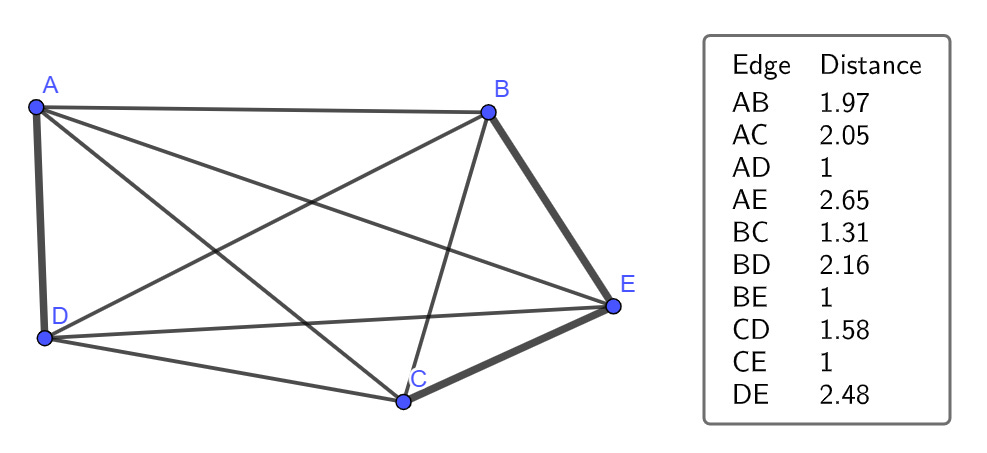
この図には5つの点と10組の点のペアがあります。そのうち3組のペアはちょうど1単位離れています:AD、BE、およびCE。
これらの点を再配置して、より多くの点のペアがちょうど1単位離れるようにすることはできるでしょうか?
はい。例えば、点AとDをB、C、Eのクラスタに近づけることができます。さらに手を加えれば、7組の点がちょうど1単位離れるような再配置も可能です。しかし、これが最大の数です。
同様の分析を6個の点、7個の点などについても行うことができます。ただし、点の数が増えるにつれて、正確な答えを見つける問題は非常に早く複雑になりすぎます。
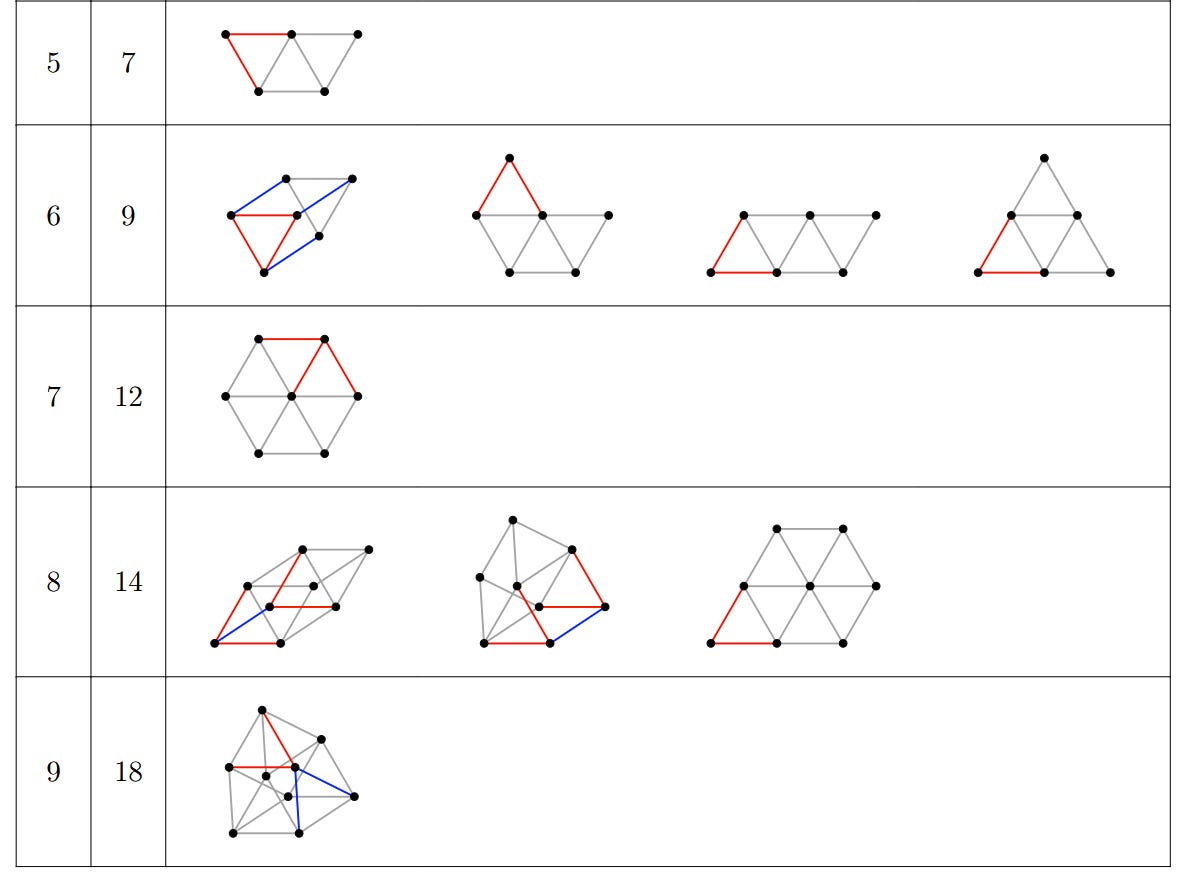
ちょうど1単位離れた点のペアが最も多い、5個、6個、7個、8個、および9個の点の配置。これはBoris Alexeev、Dustin G. Mixon、Hans Parshallによる「The Erdős unit distance problem for small point sets」の付録からの図で、5から9までの点に対する最適配置を示しています。Alexeevらは21個の点までの最適解を与えていますが、それ以降は未解決の問題です。(CC BY 4.0)
したがって、特定の点の数に対して可能な単位距離(長さ1の線分)が正確にいくつあるかを問うのではなく、Erdősはnが大きな数であると仮定して、n個の点における長さ1の線の数の上限と下限を計算しようと試みました。
下限を計算するために、エルデシュは点がグリッド状に配置されると仮定しました。これはおそらく最適な配置ではありませんが、もしグリッド内の点がある数の単位距離のペアを持つことを示せれば、最適な配置も少なくともその数を持っていなければなりません。
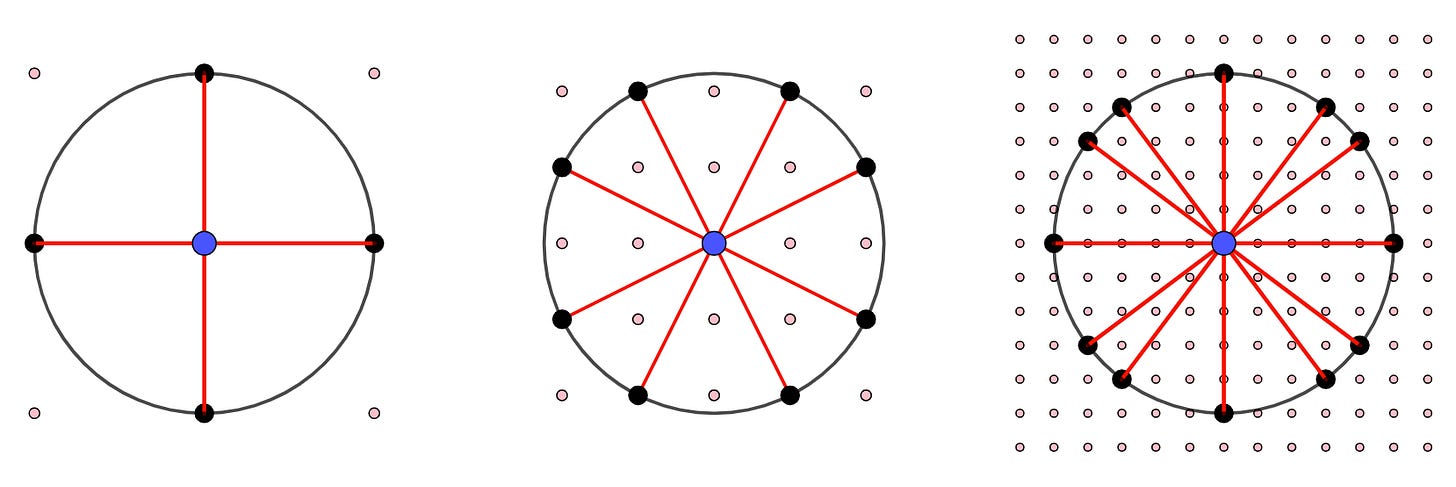
グリッドを小さくすると、単位円(半径 1 の円)と交差するグリッドの点をより多く取ることができます。これにより、単位距離の数が増加します。(図:カイ・ウィリアムズ作)
最も単純な選択肢は、各点が上下左右の隣接点からちょうど距離 1 になるようにグリッドの間隔を設定することです。しかし、エルデシュは、対角線も考慮すればさらに良い結果が得られることに気づきました。グリッドの間隔を小さくすると、各点をより多くの隣接点から距離 1 にすることができます。上記の図で、グリッド間隔が 1 の場合、各点は 4 つの隣接点(左側のパネル)から単位距離だけ離れています。代わりに、右側に示されているようにグリッド間隔を ⅕ にすると、各点は 12 の隣接点から単位距離だけ離れることになります:
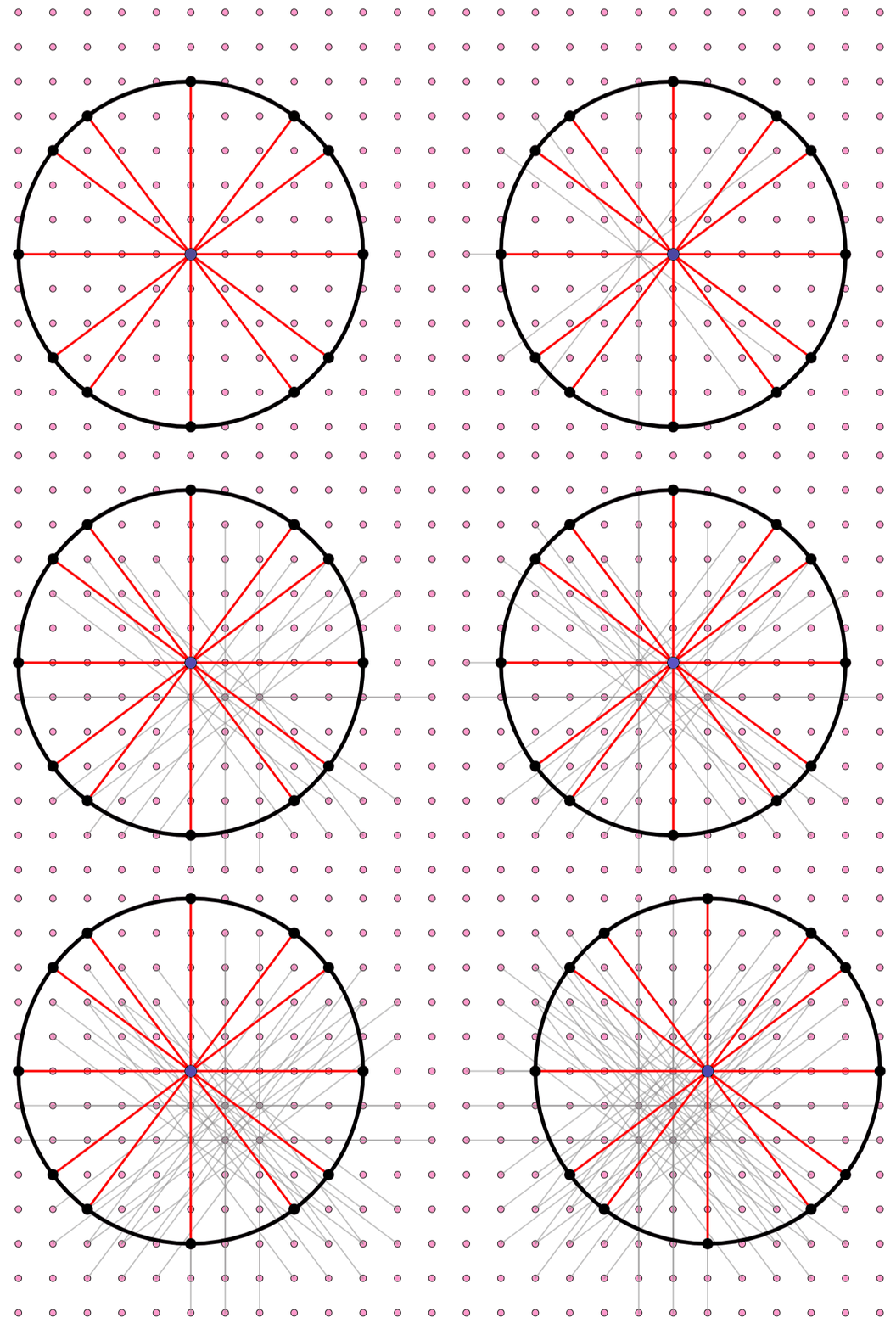
13×13 のグリッド内の中央の 9 点における距離 1 の近傍点を示すアニメーション。グリッド内の他の点についても同様の円を描くことで、残りの距離 1 のペアを得ることができますが、円上の一部の点はグリッド点上には位置しません。(アニメーション:Kai Williams)
OpenAI が発表した新結果に関する記述には、グリッド内の点を多数の線で結ぶ図が含まれており、やや混乱を招くものでした。このような円を重ね合わせることで、この図はより理解しやすくなります。
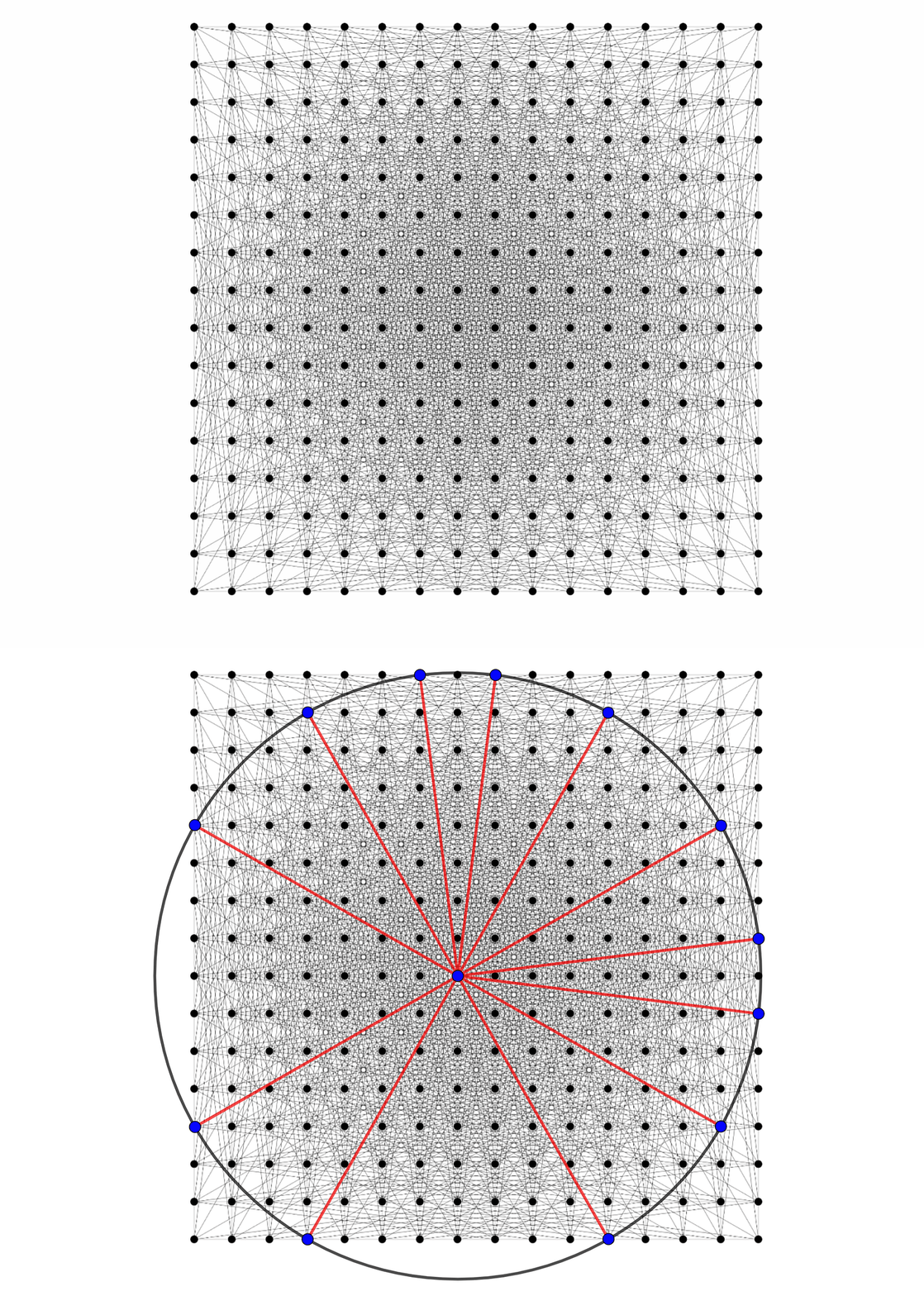
AI による単位距離予想の反証を発表した際の OpenAI の図に、ある一点における距離 1 の近傍点を示す円を重ね合わせたものです。ここではグリッドの間隔が 1/√65 で、これにより単位円はグリッド上の 16 点と交差します(ただし、グリッドがより大きい場合に限ります)。(アニメーション:Kai Williams)
これはピタゴラスの定理によるものです。この定理は、ある点から右に a 単位、上に b 単位移動した別の点がある場合、それら 2 点間の距離 c は a² + b² = c² を満たすと述べています。肝心な点は、a と b という整数のペアが多数存在し、a² + b² = c² が成り立つような数 c² を選ぶことです。その後、グリッドを縮小して各点が隣接する点から 1/c の距離になるようにすれば、多くの単位長さの距離が生じます。
例えば、c² = 25 と選べば、ピタゴラス方程式は 0² + 5² = 25 または 3² + 4² = 25 で満たされます。これは以前示した 12 グリッドポイントの円に対応し、点は (0,5)、(3,4)、(4,3)、(5,0)、(-4,3)、(-3,4) などとなります。(技術的には、これらの長さはいずれも 5 で割る必要があります。例えば (⅗, ⅘) のようにしますが、わかりやすさのために分母は省略しています。)
OpenAI の図は c² = 65 を選ぶことを基礎としており、これは 1² + 8² = 65 または 4² + 7² = 65 で満たされます。つまり、グリッド間隔を 1/√65 とすれば、各点は他の 16 の点からちょうど 1 単位離れた位置になります:(1,8)、(4,7)、(7,4)、(8,1)、(-1,8)、(-4,7) などです。c² の値をより大きく(ただし注意深く選べば)することで、より多くの整数対角線が可能となり、結果として単位距離のペアが増加します。
しかし、c² がグリッド内の点の数に対して大きすぎると、潜在的な 1 単位離れた近傍点の多くがグリッドの外側に出てしまいます。
要するに、c²は大きすぎず、かつ十分大きい値を選ぶ必要があります。数論の知見、特にヤコビの二平方定理などを活用したエルデシュは、最適サイズの円が点の数よりも単位距離ペアの数をわずかに速く増加させることを示しました。
そこで次の疑問が生じました:もっと良いことはできるでしょうか?上限を求めるために、エルデシュはグラフ理論という全く異なる数学分野からの議論を用い、単位距離の数が限られていることを示しました。しかし、その上限は彼が構築できた最良の下界よりもはるかに、はるかに速く増加します。
エルデシュの予想では、実際の最適値は上界ではなく下界にずっと近いものでした。彼は、単位距離ペアの最大数が点の数よりわずかに速く増加すると予測しましたが、証明することはできませんでした。2 この推測を証明することが「単位距離問題」として知られるようになりました。その後の80年間、エルデシュが正しかったように見えました。
しかし、OpenAI のモデルが彼を誤りであることを証明しました。
AIのアプローチ
エルデシュの予想は、少なくとも点の数が多い場合、正方形格子を用いることが他の方法で点を配置することと同等かそれ以上に多くの単位距離ペアを生み出すことを前提としていました。OpenAI の AI は、n 個の点をより複雑な別の方法で配置することで、より多くのペアを正確に1単位の距離に保つことができることを示すことで、この予想が誤りであることを証明しました。
新しい点のパターンがより複雑であるからこそ、簡潔に説明するのは難しいものです。しかし、これはエルデシュの格子に対する巧妙な修正と考えることができます。
AI は高次元空間内で格子を構築し、その後、このより複雑な構造を 2 次元に射影しました。そして、(1,3) や (-3,6) のような整数座標を持つ通常の格子ではなく、「代数整数 (algebraic integers)」と呼ばれるものを用いて、このより複雑な格子を構築したのです。実は、このような高次元の格子はより豊かな構造を持っており、これにより AI は同じ数の点の中に、より多くの単位距離を詰め込むことができるようになります。
この点の代替配置を図示するのは困難です。なぜなら、その利点は非常に多数の点を扱う場合に初めて顕在化するからです。しかし、同様の方法で構築された、より単純な点の配置があります。もし自分で図解を試してみたい場合は、こちらをクリックしてください。
この配置には 1,345 個の点があり、生成される単位距離は 5,916 個のみです。これは、エルデシュの技法を用いた正方形の 1,296 点格子が生成する 7,632 個の単位距離よりも少ない数です。しかし、私はこれが、格子ではないパターンが、正方形格子よりも多くの単位距離を生み出すことができるという感覚を掴むのに役立つと考えています。
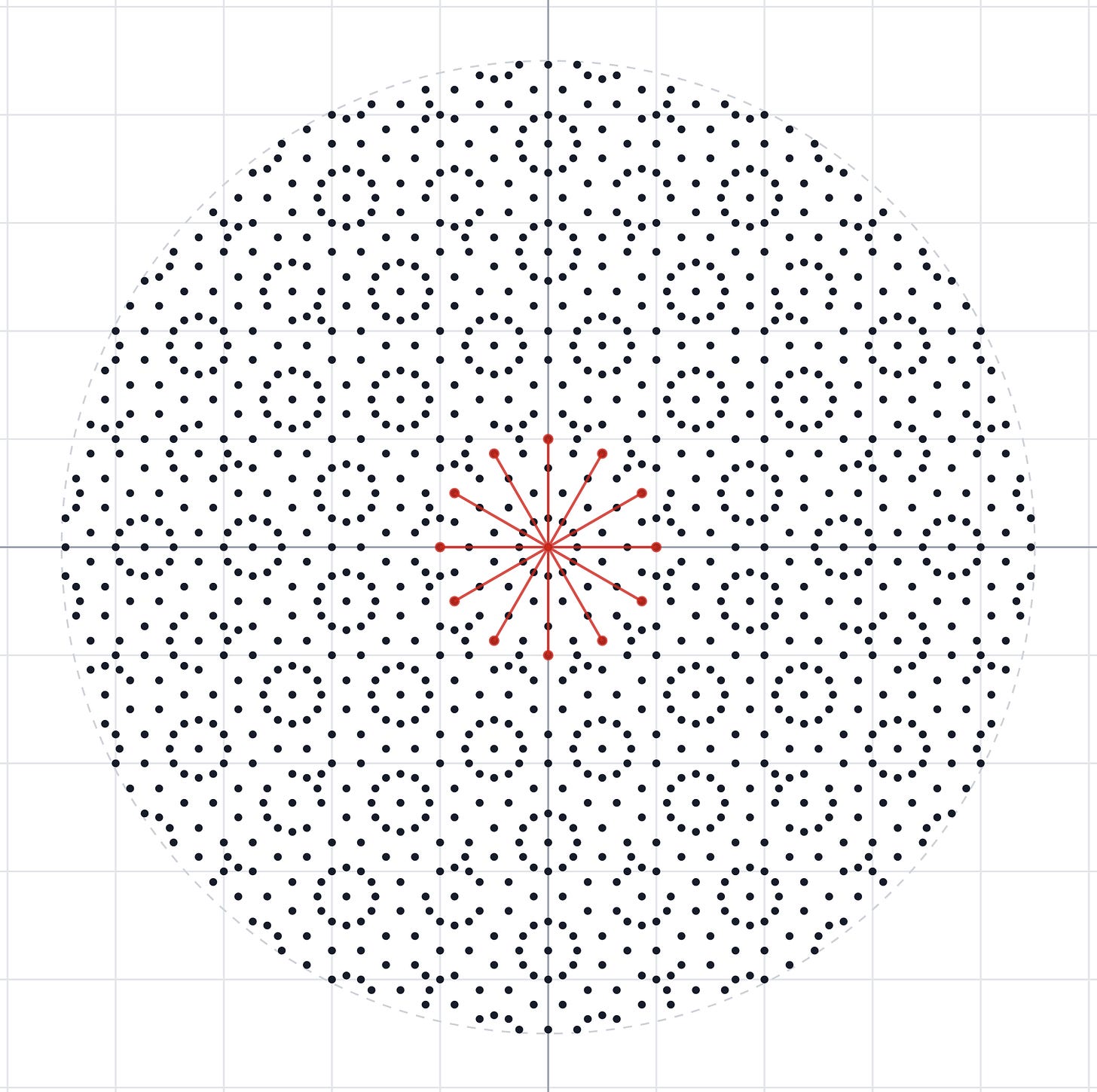
AI モデルの配置がどのようなものになるかを示す簡略化された可視化。中心から放射状に伸びる 12 本の赤い線は、それぞれ長さ 1 です。インタラクティブなリンクをクリックして、この可視化を操作してみてください。(画像提供:Kai Williams/ChatGPT、アイデア提供者:Will Sawin。本研究に関与した数学者の一人。)
より複雑なパターンが成果をもたらします。OpenAI のモデルによる証明では、n 個の点に対して可能な単位距離ペアの数が具体的にいくつあるかを明示していませんが、人間の数学者である Will Sawin は、その数が少なくとも n^1.014 の割合で増加することを示すことができました。これは一見小さく見えるかもしれませんが、n が非常に大きくなると、この数は Erdős 手法によって得られるカウントよりもはるかに大きなものになります。
ただし、AI の結果はこの問題を完全に解決したわけではありません。単位距離の数の最良の上界は現在 n^1.333 程度です。このギャップを埋めるにはさらなる研究が必要です。
購読する
この成果は、数学における AI(Artificial Intelligence)の文脈でどのように位置づけられるのでしょうか?
先週以前に、LLM(大規模言語モデル)が数学にもたらした最も革新的な貢献について尋ねられたなら、おそらく私は Google DeepMind の AlphaEvolve システムを挙げていたでしょう。
AlphaEvolve は、LLM を最適化プロセスのエンジンとして活用します。数学の問題を最適化するコードに変換できる場合(多くのケースで可能です)、LLM は特定の種類の問題において人間よりも優れた解決策を見つける可能性があります。11 月にはテレンス・タオ氏を含む 4 人の数学者が、数学文献全体にわたる 67 の最適化問題に対する AlphaEvolve の性能を分析した論文を発表しました。彼らは、AlphaEvolve が一部のケースにおいて既存の文献を改善できることを発見しました。
これは、文献レビューなどの以前の LLM の貢献から自律性の向上を示す一歩でしたが、依然として人間がこれを最適化問題として枠組み付け、AI の出力を実用的な数学に変換する必要がありました。また、このアプローチに適しているのは特定の種類の問題のみです。最適化する数値を含まないより概念的な質問は、AlphaEvolve で容易に研究することはできません。
そのため、AI 企業は、あらゆる数学の問題に対して正しい解決策を直接出力できる LLM システムの開発に取り組んでいます。OpenAI の成果はその方向への大きな一歩ですが、これは過去の AI 支援数学のパターンにも合致しています。
まず、他の企業もエルデシュ問題の解決に取り組んできました。エルデシュは生涯に数百の問題を提示しており、数学者トーマス・ブルームが www.erdosproblems.com でそれらすべてを収集する取り組みを組織しているため、AI 企業らはこれらを AI システムの評価のためのテストベッドとして利用してきました。今年1月には、ケンブリッジ大学の学部生ケビン・バレットが友人と協力し、GPT-5.2 および Harmonic の Aristotle にエルデシュ問題の最初の自律的な解決策を生成させました。先週金曜日 — OpenAI の発表から2日後 — Google は、その AI システムが50年以上も未解決だった2つを含む9つの未解決のエルデシュ問題を解決したと発表しました。
明確に述べておくと、OpenAI が解決した問題は、私が直前に言及した他のどの取り組みよりも印象的です。しかし、OpenAI の解決策は、見出しの結果が示唆するほどではなく、過去の AI による取り組みの方により沿ったものです。
この距離単位問題(unit distance problem)が80年間も未解決だった理由の一つは、非常に有名であるにもかかわらず、ほとんどの人がエルデシュの予想が真であると信じていたからです。しかし、私たちが現在利用可能な数学的ツールは、エルデシュの境界値を証明する能力とは程遠いものです。そのため、数学者たちは、この予想の証明には主要な新アイデアやアプローチが必要になると予想していました。
しかし、私たちが目にしたように、AI はエルデシュの初期構成の拡張を行うことで、この予想を反証しました。これは賢く、直感的ではない解決策でしたが、AlphaEvolve などのシステムによって行われる最適化作業(optimization work)とある程度の類似性を持っていました。
このダイナミクスは、数学者たちのいくつかの反応にも表れています。数学者のティム・ガワーズは、AI の結果を初めて聞いた際、それが定理の証明だと考えていたと述べています。「その夜、私の世界観を調整しました。もし AI がそのような証明を生み出せるなら、数学者たちにとっての時代はもうすぐ終わるかもしれない」と。
しかし翌朝、ガワーズと他の外部審査員たちは結果に関するメールを受け取り、彼は LLM(大規模言語モデル)が定理を証明したのではなく、むしろその予想を反証したことに気づきました。これは大きな安堵をもたらしました。
OpenAI の解決策には、人間に対する AI モデルの強みを活かす2つの特性がありました。
第一に、最終的な解決策は、数学の非常に異なる分野である代数数論から高度な手法を適用することに依存していました。AI システムは広大な範囲の数学データで訓練されており、数学の世界には膨大な量が存在するため、世界のどの人間よりも過去の数学的業績に関する知識が広範です。人間がこの問題を解くためには、関連する代数数論の知識を持ちつつも、単位距離問題に関心を持つという、極めて稀な組み合わせが必要となるでしょう。
第二に、推論プロセスはあまりにも過酷であり、成功する可能性も低そうだったため、ほとんどの人間はその手間をかける価値はないと考えたでしょう。トロント大学の教授であるジェイコブ・ツィマーマンは OpenAI のドキュメントの中で、自分も同様のアプローチでその予想を反証することを一瞬検討したと述べています。しかしそのような手法は「非常に多くの時間を消費し、しばしばうまくいかない」ため、プロジェクトを断念しました。
一方、AI は、成功する戦略を見つけるまでに、機能しない証明戦略を多数試すことができます。OpenAI は、モデルが解を見つけられるまで、この問題を何度も実行できたはずです。実際、OpenAI のチャートによると、最大トークン予算を使用した場合でも、内部モデルは問題の半分しか解決できていません。
明確にしておくと、AI システムが行ったことは依然として印象的です。「完成した証明を見ると、後から見て『当然だ』と宣言したくなるのはいつも誘惑です」とツィマーマンはその発言の中で後に付け加えています。しかし私が以前述べたように、これは AI システムの強みを活かすことにもつながっています。
短期的・中期的には、これは AI モデルが人間を補完するが代替しない世界を示唆しています。AI システムは、人間の数学者によって選定された問題リストに取り組んだり、一見無関係な数学分野から関連するアプローチを見つけるのを人間に支援したりします。しかし、どの質問を問うべきかを選ぶ役割や、全く新しい手法を開発する役割を直ちに人間の立場から奪い取ることはありません。
この結果もまた、人間と AI の協働によるものでした。AI システムは独自に証明を見つけましたが、人間の数学者たちがその結果を検証しました。他の人々は、AI の初期のアイデアを拡張するより優れた証明を作成しました。例えば、上記で言及したウィル・サウィンが明示的な下限を見つけたことが挙げられます。
しかし、この相補性がどれほど続くかは不明です。ガワーズはコメントの残りの部分で、AI が予想に反する結果を示したことを聞いて感じた安堵が正当なものだったかどうかを探求しました。彼はほぼそれが妥当だと結論付けましたが、脚注では、「AI はすぐに理論構築や定義の定式化、興味深い問いかけといった他の活動においても高いレベルに達するだろう」と推測すると記しています。
過去 1 年間で、私たちはまだ高校数学コンテストで勝てなかった AI システムから、数学を面白い形で進展させることができるシステムへと移行しました。AI システムが数学的問題に取り組む際に、より自律的になっていく可能性は高いと考えられます。
同時に、現在のモデルが数学において何を実現できるかについては、まだ十分に探求されていません。OpenAI の発表の直後、ミシガン大学のポスドクであるシャオ・マーは、GPT-5.5 も小さなヒントを与えられればエルデシュを誤りであると証明できると発見しました。一般に利用可能なモデルがこの有名な予想を反証しても誰も気づかなかったとしたら、今日、誰も試そうと思わない他の発見がどこで起きているでしょうか?
今すぐ購読する
皮肉にも、この理由から OpenAI の例示は、16×16 グリッドにおける最適な配置ではありません。グリッド間隔を 1/√65 とすると単位距離が 912 個生じますが、⅕とすると 976 個になります。
技術的な詳細:エルデシュ(Erdős)は、単位距離の数が n^(1+o(1)) になると予想しました。つまり、十分に大きな n に対して、任意の 휖 > 0 について最大単位距離数は n^(1+휖) より小さくなるはずです。これは彼の下限構成(ある定数 C に対して n^(1 + C/(log log n)))よりもわずかに速く成長する可能性がありますが、それでもおおよそ同じオーダーの範囲内です。
80 年間より良い構成が見つからなかったという事実以外にも、これを期待する確かな理由がありました。例えば、2023 年にノガ・アロン(Noga Alon)、マティア・ブチッチ(Matija Bucić)、リサ・ザウアーマン(Lisa Sauermann)は、平面上の 2 点間の距離として定義できるほぼすべての式について、エルデシュの予想が正しいことを証明しました。
原文を表示
Last week, OpenAI announced that an internal AI model had disproved the Erdős unit distance conjecture, a famous problem in discrete geometry that had stumped human mathematicians for the last 80 years.
OpenAI gave several mathematicians early access to the result and published their reactions. Tim Gowers — who won the Fields Medal, the most prestigious prize in mathematics — wrote that “there is no doubt that the solution to the unit-distance problem is a milestone in AI mathematics.”
University of Toronto professor Daniel Litt wrote that “this is the first example of a result produced autonomously by an AI that I find exciting in itself, as opposed to as a leading indicator.”
It’s arguably the first time that an AI system has found a proof resolving a major open conjecture. That’s impressive, but I don’t view it as a radical break from the previous trajectory of AI progress in mathematics.
Three years ago, LLMs struggled to solve arithmetic problems. It was only last year that LLMs started acing high school mathematics competitions.
When I attended the Joint Mathematics Meetings — the largest annual mathematics conference in the world — in January, I learned that AI systems were starting to contribute to mathematical research, but only in constrained settings. It took significant human interpretation to turn an AI output into a publishable theorem.
OpenAI’s new result is the next step in this progression. The AI model cleverly applied existing ideas drawn from several subfields of mathematics to create a full proof. But it didn’t pioneer any genuinely new techniques. The result has since been cleaned up and extended by human mathematicians.
This points to a medium-term future where human mathematicians and AI models complement each other: AIs have a broader knowledge of past work than any human alive and much more willingness to grind through tedious proof strategies that aren’t likely to work. But humans can still think more deeply about any one problem and ask more interesting questions.
That might not last. AI systems have been improving at math so rapidly that it’s unclear what role — if any — human mathematicians will play a decade from now.
Subscribe now
The unit distance problem
Paul Erdős was one of the most prolific mathematicians in history. He wrote over 1,500 papers in his lifetime, the most ever. One of his greatest talents was coming up with problems that are simple to state but have deep roots.
In 1946, he introduced the unit distance problem. Imagine you have some points in a 2D plane and you measure the distance between each pair of points:
In this diagram, there are five points and ten pairs of points. Three pairs happen to be exactly 1 unit apart: AD, BE, and CE.
Can we rearrange the points so that more pairs of points are exactly 1 unit apart?
Yes. For instance, we could move points A and D to be closer to the B, C, and E cluster. With a bit more work, we could further rearrange the points so that there are seven pairs exactly one unit apart. But that’s the most we can do.
We could do the same analysis with 6 points, 7 points, and so on. But as the number of points grows, the problem very quickly becomes too complicated to find the exact answer.
The arrangements of 5, 6, 7, 8, and 9 points that have the most pairs of points exactly one unit apart. Figure from the appendix of “The Erdős unit distance problem for small point sets” by Boris Alexeev, Dustin G. Mixon, and Hans Parshall showing the optimal arrangements for 5 through 9 points. Alexeev et al. give the optimal solutions through 21 points; the question is open after that. (CC BY 4.0)
So instead of asking exactly how many unit distances are possible for a given number of points, Erdős tried to calculate upper and lower bounds on the number of length-one lines for n points, assuming that n is a large number.
To help calculate a lower bound, Erdős assumed that the points would be laid out in a grid. This is probably not the optimal layout, but if he could demonstrate that points in a grid have a certain number of pairs with unit distance, then the optimal arrangement must have at least that number.
If we make the grid smaller, we can intersect more grid points with the unit circle. This gives more unit distances. (Diagram by Kai Williams)
The simplest option is to space the grid so that every point is distance 1 from its neighbors directly above, below, left, and right. However, Erdős saw that you could do even better if you took diagonals into account. If you make the grid spacing smaller, you can make each point be distance 1 from a greater number of neighbors. In the diagram above, if the grid spacing is 1, then each individual point is one unit away from four neighbors (the left panel). Instead, if the grid spacing is ⅕ (as shown on the right), then each individual point is one unit away from 12 neighbors:
An animation of the distance-one neighbors of nine central points in a 13×13 grid. You can draw similar circles for other points in the grid to get the remaining distance-one pairs, but some points on the circle won’t land on grid points. (Animation by Kai Williams)
OpenAI’s writeup of its new result included a confusing diagram showing points in a grid with a bunch of lines connecting them. The diagram becomes easier to understand if we superimpose a circle like this:
A diagram from OpenAI’s announcement of the AI’s disproof of the unit distance conjecture, onto which I superimposed a circle showing the distance-one neighbors for one point. The grid spacing here is 1/√65, which produces unit circles that intersect 16 points on the grid (or would if the grid were larger). (Animation by Kai Williams)
This works because of the Pythagorean theorem, which states that if we have a point that is a units to the right and b units above another point, the distance c between those two points satisfies a² + b² = c². The trick is to choose some number c² so that there are a whole bunch of pairs of whole numbers a and b such that a² + b² = c². Then, if we scale the grid down so that each point is 1/c from its neighbors, there will be a bunch of unit distances.
For example, if we choose c² = 25, then the Pythagorean equation can be satisfied by either 0² + 5² = 25 or 3² + 4² = 25. This corresponds to the 12-grid-point circle I showed earlier, with points at (0,5), (3,4), (4,3), (5,0), (-4,3), (-3,4), and so forth. (Technically, these lengths should all be divided by 5 — (⅗, ⅘) for example — but I’m leaving the denominators out for clarity.)
OpenAI’s diagram is based on choosing c² = 65, which can be satisfied by either 1² + 8² = 65 or 4² + 7² = 65. This means that if the grid spacing is 1/√65, each point will be one unit away from 16 other points: (1,8), (4,7), (7,4), (8,1), (-1,8), (-4,7), and so forth. Larger values for c² — if they’re chosen carefully — enable more whole-number diagonals and hence more unit-distance pairs.
However, if c² is too large, compared to the number of points in the grid, then many of the potential one-unit-away neighbors will be outside the grid.1
In short, we want to choose a c² that’s large enough but not too large. Using insights from number theory, including Jacobi’s two-square theorem, Erdős was able to show that an optimally sized circle will enable the number of unit-distance pairs to grow faster than the number of points, but only barely.
The question became: can you do better? To find an upper bound, Erdős used an argument from a quite different area of mathematics called graph theory to show that you could only have so many unit distances. But his upper bound grows much, much faster than the best lower bound he was able to construct.
Erdős’s conjecture was that the actual optimum was much closer to the lower bound than the upper one. He predicted, but couldn’t prove, that the maximum number of unit-distance pairs grows just barely faster than the number of points.2 Proving his guess became known as the unit distance problem. For the next 80 years, it looked like Erdős was right.
Then an OpenAI model proved him wrong.
The AI’s approach
Erdős’s conjecture assumed that — at least for a large number of points — a square grid could yield about as many unit-distance pairs as organizing the points in other ways. OpenAI’s AI proved this wrong by demonstrating that there was another, more complex way to organize n points that allowed more pairs to be exactly one unit apart.
Precisely because the new pattern of points is more complicated, it’s tricky to explain it concisely. But you can think of it as a clever modification of Erdős’s grid.
The AI constructed a grid in a high-dimensional space and then projected this more complex structure into two dimensions. And instead of using a whole-number grid with points like (1,3) or (-3,6), the AI construction used something called algebraic integers to build this more complicated grid. It turns out that this kind of higher-dimensional grid has richer structure, which allows the AI to pack more unit distances into the same number of points.
It’s hard to illustrate this alternative arrangement of points because it only becomes advantageous with a very large number of points. But here’s a simpler arrangement of points that was constructed in a similar way. You can click here if you want to play with the illustration yourself.
It has 1,345 points and only produces 5,916 unit distances, fewer than the 7,632 unit distances that a square 1,296-point grid produces using the Erdős technique. But I think it gives a sense for how a pattern that isn’t a grid could produce more unit distances than a square grid.
A simplified visualization of what the AI model’s arrangement might look like. The 12 red lines emanating from the center are each length one. Click the interactive link to play around with the visualization. (Image by Kai Williams/ChatGPT based on an idea by Will Sawin, one of the mathematicians involved in the work.)
The more complicated patterns pay off. While the OpenAI model’s proof does not explicitly state how many unit-distance pairs are possible for n points, human mathematician Will Sawin was able to show that it grows at least at the rate of n1.014. This might seem small, but as n gets really big, this number will become much larger than the counts produced by the Erdős approach.
That being said, the AI’s result doesn’t completely resolve the problem. Our best upper bound for the number of unit distances is around n1.333. More work is needed to close this gap.
Subscribe now
How does this result fit into AI for mathematics?
If you’d asked me before last week about the most novel contributions of LLMs to mathematics, I probably would have pointed to the AlphaEvolve system from Google DeepMind.
AlphaEvolve harnesses LLMs to be the engine of an optimization process. If you can turn a math problem into a piece of code to optimize — which you often can — then the LLM might find better solutions than humans have for certain types of problems. In November, four mathematicians (including Terence Tao) released a paper that analyzed AlphaEvolve’s performance on 67 optimization problems across the mathematical literature. They found that AlphaEvolve was able to improve on the established literature in some cases.
This was a step up in autonomy from previous LLM contributions, such as literature review, but it still required humans to frame it as an optimization problem and turn the AI’s output into usable mathematics. And only certain types of problems are amenable to this approach. More conceptual questions that don’t include a number to optimize can’t easily be studied with AlphaEvolve.
So AI companies have been working to develop LLM systems that can directly output a correct solution to any math problem. OpenAI’s result is a substantial step in that direction. But it also fits the pattern of previous AI-assisted mathematics.
For one thing, other companies have also worked to solve Erdős problems. Because Erdős posed hundreds of problems over his career — and because mathematician Thomas Bloom has organized an effort to compile all of them at www.erdosproblems.com — AI companies have used them as a testing ground to evaluate AI systems. In January, Cambridge undergraduate Kevin Barreto worked with a friend to ask GPT-5.2 and Harmonic’s Aristotle to produce the first autonomous solution of an Erdős problem. Last Friday — two days after OpenAI’s announcement — Google announced that its AI system had solved nine open Erdős problems, including two that had been open for over 50 years.
To be clear, the problem that OpenAI solved is more impressive than any of the other work I just mentioned. But OpenAI’s solution is more in line with past AI efforts than the headline result might suggest.
One of the reasons that the unit distance problem was unsolved for 80 years, despite being so well known, is that most people thought that Erdős’s conjecture was true.3 But the mathematical tools we have are nowhere close to being able to prove Erdős’s bound. So mathematicians expected that any proof of the conjecture would involve major new ideas or approaches.
Instead, as we’ve seen, the AI disproved the conjecture by making an extension of Erdős’s initial construction. It was a clever and nonobvious solution, but it also bore some similarity to the kind of optimization work done by a system like AlphaEvolve.
This dynamic is reflected in some of the mathematicians’ responses. Mathematician Tim Gowers wrote that when he first heard about the AI’s result, he thought it had proved the theorem. “I spent the evening adjusting my world view: if the AI could come up with a proof like that, then maybe it would be all over for mathematicians very soon.”
But the next morning, Gowers and other external reviewers received an email about the result, and he realized that the LLM “had disproved the conjecture rather than proving it, which came as a big relief.”
OpenAI’s solution also had two properties that played to the strengths of AI models relative to humans.
First, the eventual solution relied on applying sophisticated techniques from a quite different area of mathematics: algebraic number theory. AI systems have been trained on huge swaths of mathematics — and there’s a lot of math out there — so they have a broader knowledge of previous mathematical work than any human in the world. In order for a human to solve this, they would have needed to have the relevant algebraic number theory knowledge while also being interested in the unit distance problem — a rare combination.
Second, the reasoning process was such a grind — and seemingly unlikely to succeed — that most humans would not have thought it worth the trouble. Jacob Tsimerman, a University of Toronto professor, remarked in the OpenAI document that he had briefly considered taking a similar approach to disprove the conjecture. But that type of technique “consumes much time and frequently doesn’t work out,” so he abandoned the project.
An AI, on the other hand, can work through many proof strategies that don’t work out before discovering one that does. OpenAI could have run the problem many times before a model found a solution. Indeed, an OpenAI chart revealed that even with the maximum token budget, the internal model solves the problem only half of the time.
To be clear, what the AI system did is still impressive. “It’s always tempting to look at a completed proof and declare it obvious after the fact,” Tsimerman noted later in his remark. But as I noted previously, it also played to the strengths of AI systems.
In the short to medium term, this points to a world where AI models complement humans but do not replace them. AI systems will tackle lists of problems curated by human mathematicians or aid humans in finding relevant approaches from seemingly unrelated mathematical fields. But they won’t immediately displace the human role in choosing which questions to ask or developing wholly new techniques.
Even this result was very much a human-AI collaboration. While the AI system found the proof on its own, human mathematicians verified the result. Other humans came up with better-written proofs that extended the AI’s initial ideas, like Will Sawin finding an explicit lower bound as I mentioned above.
It’s unclear how long this complementarity will last, however. Gowers spent the rest of his comment exploring whether the relief he felt on hearing that AI had disproved the conjecture was justified. He more or less concluded that it was, but in a footnote, he wrote that he would guess “that AI will soon reach a high level at other activities such as building theories, formulating definitions and asking interesting questions.”
In the past year, we’ve gone from AI systems that hadn’t yet beaten high school mathematics competitions to ones that can advance mathematics in interesting ways. It seems likely that AI systems will continue to become more autonomous when working on mathematical problems.
At the same time, we haven’t fully explored what current models can achieve in math. Soon after OpenAI’s announcement, University of Michigan postdoc Xiao Ma found that GPT-5.5 was also able to prove Erdős wrong if given a small hint. If a generally available model could disprove this famous conjecture and no one noticed, what other discoveries could happen today that no one has thought to try?
Subscribe now
1Ironically, OpenAI’s illustration is not actually the optimal arrangement for a 16×16 grid for this reason. The grid spacing 1/√65 produces 912 unit distances, but using ⅕ produces 976.
2Technical detail: Erdős conjectured that the number of unit distances would be n^(1+o(1)). In other words, for a sufficiently large n, the maximum number of unit distances would be less than n^(1+휖) for any 휖 > 0. That could end up growing a little faster than his lower-bound construction — which was n^(1 + C/(log log n)) for some constant C — but within the same general ballpark.
3There were solid reasons to expect this beyond the fact that no one had found a better construction in 80 years. For instance, in 2023 Noga Alon, Matija Bucić, and Lisa Sauermann proved that for almost every formula you could define as the distance between two points in the plane, Erdős’s conjecture is correct.
関連記事
今日のまとめ
AI日報で今日の重要ニュースをまとめ読み