Amazon Nova モデルを用いた医療文書処理変革「Guardoc」の取り組み
Guardoc Health は Amazon Nova モデルを活用し、複雑な医療文書の処理を自動化することで、記録エラーを 46% 削減し、年間 40 万ドル以上の投資収益を実現した。
AI深層分析を開く2026年7月28日 02:08
AI深層分析
キーポイント
Amazon Nova の活用と成果
Guardoc Health は Amazon Bedrock を介して提供される Amazon Nova モデルを活用し、長期療養施設や介護施設の文書処理を自動化している。
具体的な数値効果の報告
同社によると、この導入により文書エラーが 46% 減少し、監査罰金も 70% 削減されたほか、単一施設で年間 40 万ドル以上の ROI が得られた。
医療文書の複雑性と課題
手書き注釈やフォームのチェックボックス状態など多様な形式が存在する医療記録は、人手による処理に多くのエラーとコストを生み出している。
重要な引用
Guardoc reports a 46 percent reduction in documentation errors, 70 percent fewer audit fines, and over $400K in annual return on investment (ROI) for a single facility.
In a single day, a healthcare organization might process multi-page PDFs with handwritten physician annotations alongside printed text.
編集コメントを表示
編集コメント
医療分野における AI の実用化事例として、具体的な数値効果(エラー削減率や ROI)を提示した点は非常に説得力がある。Guardoc Health が Amazon Nova を活用して解決した課題は、多くの医療機関が抱える共通の痛点であり、業界全体への波及効果が期待される。
毎日、看護師やケアチームは、断片的で不整合があり、ミスが起きやすい臨床記録に基づいて重要な判断を下しています。不完全または不正確な記録は認知負荷を増大させ、臨床リスクを招き、すでに厳しい環境においてコンプライアンス上の課題を生み出します。医療記録は患者のアウトカムと規制基準の両方を満たすべきものですが、残念ながらその両面で不足しているケースが多々あります。
Guardoc Health の使命は、正確で完全かつコンプライアンスに準拠した臨床記録を可能にすることで医療データの価値を最大限に引き出すことにあります。これにより、看護師やケアチームがより安全で質の高いケアを提供できるよう支援します。本稿では、Amazon Bedrock を通じて利用可能な Amazon Nova モデルファミリーを活用し、長期療養施設における臨床記録のあり方を変革する Guardoc Health の取り組みについて紹介します。
Amazon Nova モデルを活用した Guardoc Health は、介護施設や共同生活支援センターが複雑な文書を人手に頼らずにすばやく抽出・分類し、適切な対応を行うことを可能にします。このアプローチにより、米国全体の医療機関は年間数億ドル規模に達する手作業による文書処理コストを大幅に削減できます。Guardoc によると、単一の施設で文書エラーが 46% 減少し、監査での罰金も 70% 減り、年間の投資対効果(ROI)は 40 万ドルを超えると報告されています。
医療文書には決まったルールがない
医療記録はあらゆる形式で届きます。ある医療機関では、1 日のうちに以下のような多様な文書を処理することになります:
手書きの医師の注釈が印刷されたテキストと併記された多ページPDF、
特定の医療サービスや処置、薬物の承認を健康保険プランが行うために医師または薬剤師が記入する「事前承認フォーム」で、チェックボックスの状態が補償決定を左右するもの、
表組み、自由記述欄、スキャン画像に埋め込まれた服薬リスト、
入力フィールド、手書き、ゴム印が混在した患者問診票。
BMJ Quality and Safety に発表された研究 1 によると、外来診療において診断ミスは年間約1,200万人の米国人に影響を与えており、情報の扱いにおける失敗がその一因となっています。Guardoc Health はこの課題に対応するために設立されました。同社が直面する最大の難題は、スケーラビリティと精度の両立です。ピーク時には1日あたり100万枚以上の文書を処理します。そのような膨大な量において、状態検出でわずか1%のエラー率が生じれば、毎日数千件の誤ったレコードが発生し、それぞれが患者の安全リスクやコンプライアンス上の責任問題に直結する可能性があります。
この課題を解決するには、臨床文書処理における3つの難問を克服する必要がありました。すなわち、患者記録から特定の医療状態を高感度で検出すること、数十種類のフォームタイプにわたるPDFのチェックボックスを確実に解釈すること、そして1ページ内で複数のフォーマットが混在するドキュメントから正確に情報を抽出することです。
Amazon Nova モデルを活用したソリューション
Guardoc Health は、Amazon Nova ファミリーと Amazon Bedrock を基盤としたパイプラインを構築し、文書処理の各工程に対応するために複数の AWS サービスを組み合わせています。以下では、それぞれの構成要素がどのように機能するかを解説します。
RAG による医療状態の分類
Guardoc Health は、患者記録から医療状態を特定するために、検索拡張生成(RAG: Retrieval Augmented Generation)技術を採用しています。RAG とは、モデルがまず外部ソースから関連情報を取得し、その文脈を活用してより精度の高い回答を生成する手法です。Guardoc のパイプラインでは、患者自身の記録から根拠となる情報を直接取得し、それらを推論しながら最終的な分類結果を導き出します。
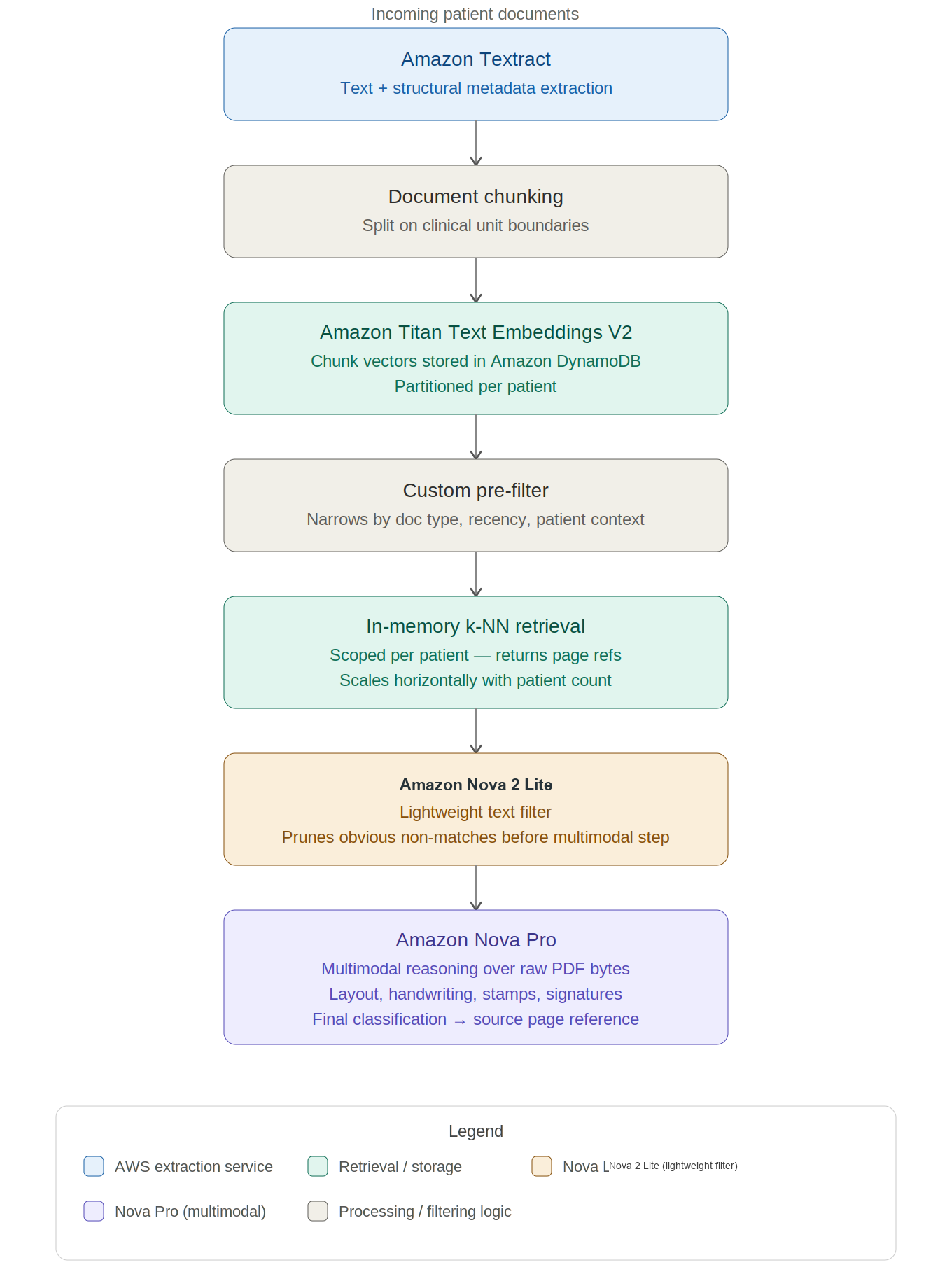
*図 1 — Guardoc の検索拡張生成パイプライン*
前述の図に示す通り、このパイプラインは以下の順序で実行されます。
患者から届いた文書はまずAmazon Textractを通過します。このAWSの機械学習(ML)サービスは、スキャンされたドキュメントやPDFからテキスト、手書き文字、フォーム、表、レイアウト情報を自動的に抽出します。単なる光学式文字認識(OCR)を超え、構造化情報も識別するため、出力結果は下流のアプリケーションや文書ワークフローでそのまま利用可能です。これが、1ページあたりのコストを抑えつつ包括的なデータ抽出を実現するパイプラインの第一段階です。
抽出されたコンテンツは、ドキュメントの種類に応じた境界線でチャンク(断片)に分割されます。これにより、文字数やバイトサイズで無作為に切り取られるのではなく、薬剤リストや診断セクション、医師のメモなど、意味のある臨床単位に対応した断片が生成されます。このアプローチにより、パイプラインが関連情報を検索する際、文脈を欠いた断片的な情報ではなく、正確な分類に必要な文脈を含んだ完全で整合性の取れた臨床単位が取得されます。
各チャンクはAmazon Titan Text Embeddings V2を使用して埋め込みベクトル化され、患者ごとにパーティション分割されたAmazon DynamoDBに格納されます。これにより、検索時に他患者のデータと混在することが防がれます。
検索開始前に、カスタム事前フィルタがドキュメントの種類、鮮度、患者コンテキストなどのシグナルを評価し、候補セットを絞り込みます。この段階で無関係な文書を早期に除外することで、検索対象となるコンテンツ量を削減し、検索全体のコストを下げることができます。
事前フィルタリングされたセット内では、インメモリ型のk近傍(k-NN)検索が実行され、疾患分類クエリに関連するチャンクが抽出されます。k-NNはベクトル表現間の距離を測定して最も類似したアイテムを特定する技術で、クエリに最も近い一致結果を返します。検索範囲が患者ごとに限定されているため、このシステムは共有ベクトルインデックスに依存せず、患者数の増加に合わせて水平方向にスケーリング可能です。この段階ではページ参照のみを返すため、後続のより計算集約型のマルチモーダル処理前にデータ転送量を最小限に抑えています。
前段で特定されたページは、軽量かつコスト効率の高いモデルであるAmazon Nova 2 Liteを経由します。同社はテキストベースのレビューを行い、明らかに一致しないものを除外してから、より計算負荷の高いマルチモーダル段階へと進みます。Amazon Nova 2 Liteは、テキスト、画像、動画の入力を高速かつ安価に処理するために設計された、Amazon Novaファミリーの低コストなマルチモーダル基盤モデル(FM)です。
すべての前段を通過したページと、生PDFデータがAmazon Nova Proへ送られます。Novaモデルはレイアウト、手書き文字、署名、スタンプ、その他の視覚的文脈を推論して最終的な分類結果を生成し、その出力は必ず元の特定のソースページに紐付けられます。
このパイプラインは、意図的なコスト階層化の原則に従って設計されています。各段階では、その作業を遂行可能な最も安価なコンポーネントが使用されます。Amazon Titan Text EmbeddingsとAmazon Nova 2 Liteは、埋め込み、インデックス作成、粗いフィルタリングといった高ボリュームかつ軽量なタスクを担当し、生PDFデータに対するマルチモーダル推論が必要な最終段階にはAmazon Nova Proが割り当てられます。
パイプラインが生成するすべての分類結果は、元の文書内の特定のページに遡ることができます。臨床現場では意思決定が患者の安全に直結するため、Guardoc Health はこのレベルの追跡可能性を絶対条件として扱っています。
Guardoc は、抽出・分類・検索といった各分野における具体的な臨床課題に対応するために設計された複数のドキュメント処理パイプラインを運用しています。以下でその概要を説明します。
Amazon Nova モデルファミリーによる PDF 処理
医療文書の多くは、スキャン画像や写真、あるいはデジタルネイティブな形式として PDF で存在しています。これらを正確に処理するには、単なるテキストとしてではなく、ページを視覚的に読み取る能力を持つモデルが必要です。評価において、Amazon Nova Pro はレイアウトの解釈、フォーム構造、チェックボックスの状態、署名、手書き注釈、そしてページ上のフィールド間の空間関係など、マルチモーダルな PDF 処理において顕著な改善を示しました。
この改善こそが、Amazon Nova Pro を Guardoc パイプラインの中核となる多モーダルコンポーネントとして機能可能にしている理由です。条件分類、筆跡の解釈、薬剤情報の抽出はすべて、注釈や訂正、レイアウトの手がかりを損なうことなく、文書を実際に存在する姿のまま読み取ることに依存しています。この能力は、チェックボックス、筆跡、複数列の薬剤リスト、スタンプ付き証明、取り消し線による編集など、あらゆる種類の文書で一定して発揮されます。これらはテキストストリームとしてではなく、視覚的なドキュメントとして処理されるため、残りの多モーダルスタックが成立する土台となっています。
筆跡認識
現実の医療文書には筆跡が含まれています。医師のメモや患者の署名、注釈欄、印刷されたフォームへの修正はすべて、手書きで記されます。Amazon Nova モデルファミリーはこれらを正確に処理します。筆記体のテキスト、臨床現場特有の略語、印刷体と筆跡が混在するページにも対応可能です。
Guardoc Health にとって、この能力が最も重要となるのは2つの文書タイプです。1つ目は、事前承認フォームにある医師の証明欄で、手書きのメモが印刷されたチェックボックスを上書きできるケースです。2つ目は、患者が報告した症状のセクションで、筆跡によってしか記録されない情報が含まれる場合です。Guardoc Health の以前のバージョンでは、このテキストを見逃すことが情報損失の大きな原因となっていました。
薬剤情報抽出のためのハイブリッド OCR パイプライン
患者記録において、薬剤データは最も重要なコンテンツの一つです。薬名、用量、投与経路、および頻度は臨床判断に直接影響を与え、これらに誤りがあると患者の安全に関わる重大な問題となります。薬剤の再確認(メディケーション・リコンシリエーション)、事前承認、保険適用の可否の決定など、すべてのプロセスが、文書から正確にこの情報を抽出することに依存しています。しかし、これらの情報は文書上で明確に整理されていることは稀です。
課題は多様性にあります。薬剤情報は、構造化された表の中に、医師のメモ内の非構造化文章の中に、印刷リストへの手書き追加として、また複数の手順を経たファックスや写真撮影によって生じたスキャンページの中など、さまざまな形式で出現します。単一の患者カルテにも、異なるページにこれらすべてのフォーマットが混在していることが珍しくありません。
Guardoc Health は、Amazon Textract と Amazon Nova シリーズのモデルを組み合わせたハイブリッドパイプラインを実行しています。
Amazon Textract は OCR を実行し、境界ボックス、表構造、フォームフィールド認識を備えた構造化された出力を生成します。清潔な表や印刷された薬物リストについては、Amazon Textract は高速でコスト効率が高く、精度も高いです。
Amazon Nova Pro は、元の PDF と Amazon Textract の出力の両方を受け取ります。これには、ソースページの視覚的レイアウトと並行して機械可読テキストが含まれています。
Amazon Nova モデルは、Amazon Textract を補完し、折り返された表列にまたがる薬物、印刷リストへの手書き追加、非標準的な表形式、医師のメモに埋め込まれたインライン言及など、複雑な抽出シナリオを解決します。
このパイプラインでは、各コンポーネントが得意とする処理を担当します。Amazon Textract は高ボリュームの構造化抽出を処理し、Amazon Nova ファミリーは多角的推論を用いてより複雑なケースに対応します。その結果、下流の臨床ワークフローで直接活用できる薬物データが得られ、手動での照合が必要なくなります。
ビジネスへの影響
ドキュメントのエラーには、臨床面と財務面の両面で重大な影響があります。見落としや不正確な記録は、請求書の却下、監査による罰金、患者駆動型支払いモデル(PDPM)における補償の喪失、そして訴訟リスクの高まりを招きます。PDPM は介護施設に対するメディケアの支払いシステムであり、補償額は臨床ドキュメントの精度に直接依存しています。
Guardoc の導入結果は、その効果を如実に示しています。200 人の患者を対象に 2 つの施設で四半期ごとに実施された展開では、847 件のドキュメント修正を導き出し、PDPM(Patient Driven Payment Model)に影響を与える課題 86 件に対応しました。さらに、入院 100 件あたりの病院搬送が 74% 減少したという結果も出ています。
この数値は特に重要です。長期療養施設において、患者にとっても運営側にとっても、病院への搬送は最もコストが高く、体制を不安定にする出来事の 1 つだからです。
より広範なケーススタディでは、7 つの施設で 1,618 人の入所者に対して Guardoc が導入され、10,612 件の課題が特定されました。これにより、施設レベルでのリスクパターンを可視化できる能力が向上しています。
この規模の問題検出が重要なのは、長期療養におけるドキュメントの不備は、請求拒否や規制監査が発生するまで表面化しないことが多いためです。そのため、事前の特定は実務上の大きな優位性となります。
別の四半期分析では、ドキュメントエラーが平均 46% 減少したと報告されています。その結果として、単一の施設で年間 40 万ドル以上の ROI(投資対効果)を達成し、監査による罰金も 70% 減、訴訟リスクも 65% 削減されました。これは、ドキュメントの精度向上が施設の財務面やコンプライアンス面で直接的な成果につながっていることを示しています。
長期療養における臨床文書作成は、長年自動化が困難とされてきた高リスクな課題です。書類は散漫でフォーマットも多様であり、その誤りが及ぼす影響は患者の安全から規制遵守、さらには財務パフォーマンスまで及びます。Guardoc は、適切な AWS サービスを組み合わせることで構築された設計思想に優れたパイプラインが、この問題をスケールして解決できることを示しています。Amazon Textract、Amazon Titan Text Embeddings V2、Amazon DynamoDB、そして Amazon Bedrock を通じて利用可能な Amazon Nova モデルファミリーを統合することで、Guardoc は医療分野で最も複雑な文書タイプに対しても、正確で追跡可能かつコスト効率の高いドキュメント処理を実現しています。
「Nova ファミリーを活用することで、医療機関は高リスクのケースを早期に検出し、問題が深刻化する前に行動を起こしやすくなります。以前は人的監督が必要だったワークフローを自動化できるため、Nova ファミリーはチームがコンプライアンス上の隙間を減らし、エラーを防ぎ、より多くの時間を患者アウトカムの改善に集中することを支援します。」
— Assaf Amiaz 氏、Guardoc Health プロダクトディレクター
施設や患者集団全体での成果を見ると、文書作成の質向上は単なる業務効率化ではありません。それは、より安全で高品質なケアを実現するための重要な一歩なのです。
Amazon Nova モデルで変革する Guardoc の医療文書処理
Guardoc のロードマップはコンプライアンス対応の枠を超え、より広範な臨床ワークフローへと拡大しています。今後予定されているモジュールには「AI NoteAssist」「MDSAssist」「CarePlanAssist」「AdmissionAssist」、そして「Pharmacy Reconciliation」が含まれます。これらはチームが正確に記録を残し、手作業による負荷を減らし、電子カルテ(EHR)システム内で臨床ワークフロー全体をスムーズに進めることを支援するために設計されています。
Amazon Nova 2 シリーズのモデルで拡張されたコンテキストウィンドウにより、複数文書にわたる推論がより現実的なものとなりました。これによって、パイプラインは一度の処理で大量の臨床コンテンツを跨いで推論できるようになります。また、マルチモーダル機能の継続的な向上により、現在も人間のレビューが必要なエッジケース——劣化したスキャン画像や混合フォーマットのページ、非標準的なレイアウトなど——が着実に減少しています。基盤となるシステムの方向性は、Guardoc Health が解決しようとしている課題の要求と密接に一致しています。
結論
医療文書処理は、エンタープライズにおける AI の応用の中でも最もリスクの高い分野の一つです。文書の多様性が極めて激しく、許容される誤りの余地は狭く、失敗した場合の影響は現実的なものとなります。具体的には、治療の遅れ、コンプライアンス上のリスク、そして不必要なコストとして現れます。
医療機関が臨床文書処理に AI を導入する際、実践的な指針はシンプルです。自社の実際の文書タイプでベンチマークを行い、再現率と適合率を別々に測定し、各エラータイプの現実的なコストを反映した信頼度閾値を設定してください。Amazon Nova モデルファミリーと Amazon Bedrock は、デモだけでなく本番環境でも耐えうるパイプラインを構築するためのインフラと柔軟性を提供します。重要なのは、このインフラを自社のワークフローの具体的な要件や文書タイプ、そして正確な記録が不可欠な患者たちのニーズに合わせて調整することです。
Guardoc Health は、AI を活用した臨床 OS 企業として、専門的介護施設(SNF)や共同生活施設(ALF)で働く長期的ケアチームを支援し、ドキュメンテーションの質向上とリスク低減を実現しています。詳細は www.guardoc.health または info@guardoc.health までお問い合わせください。
Amazon Nova は、Amazon Bedrock を通じて提供される基盤モデルファミリーです。テキスト、画像、文書を入力として扱い、ドキュメント処理や情報抽出、マルチモーダル推論などエンタープライズワークロードに最適化された機能を備えています。特に Amazon Nova Pro は、PDF 処理、筆跡認識、構造化データ抽出といった複雑な文書タスクにおいて、業界をリードするパフォーマンスを発揮します。Amazon Bedrock を使ってすぐに始めましょう。
執筆者について

Wrick Talukdar氏
Wrick Talukdar氏は、Amazon Web Services(AWS)でテックリード兼シニアジェネレーティブAIスペシャリストを務めています。マルチモーダルAIや生成モデル、コンピュータビジョン、自然言語処理を通じてイノベーションを推進しています。
また、「Building Agentic AI Systems」というベストセラー書籍の著者でもあり、受賞歴も有しています。キーノートスピーカーとしても活躍し、AWS re:Invent や ICCE などの主要なグローバルフォーラムで、自身の革新的な技術やソリューションを発表し続けています。
原文を表示
Every day, nurses and care teams make critical decisions based on clinical documentation that is often fragmented, inconsistent, and prone to errors. Incomplete or inaccurate records increase cognitive load, introduce clinical risk, and create compliance challenges in an already demanding environment. Medical documentation must serve both patient outcomes and regulatory standards, yet too often it falls short on both fronts.
Guardoc Health’s mission is to unlock the full value of medical data by facilitating accurate, complete, and compliance-aligned clinical documentation, empowering nurses and care teams to deliver safer and higher-quality care. In this post, we explore how Guardoc Health uses the Amazon Nova family of models, available through Amazon Bedrock, to transform clinical documentation in long-term care.
With Amazon Nova models, Guardoc Health helps skilled nursing facilities and assisted living centers extract, classify, and act on complex documents faster and more accurately than manual review. This approach helps healthcare organizations reduce the hundreds of millions of dollars spent annually on manual document processing across the United States. Guardoc reports a 46 percent reduction in documentation errors, 70 percent fewer audit fines, and over $400K in annual return on investment (ROI) for a single facility.
Medical documents don’t follow rules
Medical records arrive in every format imaginable. In a single day, a healthcare organization might process:
- Multi-page PDFs with handwritten physician annotations alongside printed text.
- Prior authorization forms where checkbox states determine coverage decisions. A prior authorization form is a document the doctor or pharmacist fills out so a health-insurance plan can approve certain medical services, procedures, or medications.
- Medication lists embedded in tables, free text, or scanned images.
- Patient intake forms combining typed fields, handwriting, and rubber stamps.
According to research published in BMJ Quality and Safety 1, diagnostic errors affect approximately 12 million U.S. adults each year in outpatient care, with information-handling failures identified as a contributing factor. Guardoc Health was built to address this variable. For Guardoc Health, the challenge is scale combined with precision. On peak days, they process more than 1 million documents. At that volume, even a 1 percent error rate in condition detection generates thousands of incorrect records daily, each one a potential patient safety risk or compliance liability.
Achieving this required solving three of the hardest challenges in clinical document processing: detecting special medical conditions from patient records with high recall, reliably interpreting PDF checkboxes across dozens of form types, and accurately extracting information from documents that mix formats within a single page.
The solution: Amazon Nova models on Amazon Bedrock
Guardoc Health built its pipeline on the Amazon Nova family of models and Amazon Bedrock, combining several AWS services to handle each stage of document processing. The following sections describe how each part works.
Medical condition classification with RAG
Guardoc Health uses Retrieval Augmented Generation (RAG) to identify medical conditions from patient records. RAG is a technique in which a model first retrieves relevant information from an external source, then uses that context to generate a more accurate response. In this pipeline, Guardoc retrieves evidence directly from a patient’s own documentation and reasons across it to produce a final classification.
*Figure 1 — The Guardoc retrieval-augmented generation pipeline*
As shown in the preceding diagram, the pipeline runs in the following order:
- Incoming patient documents pass through Amazon Textract, which extracts text and structural metadata from each page. This is the first stage of the pipeline for a comprehensive extraction at a low per-page cost. Amazon Textract is an AWS machine learning (ML) service that automatically extracts text, handwriting, forms, tables, and layout information from scanned documents and PDFs. It goes beyond basic optical character recognition (OCR) by identifying structure, so the output is usable in downstream apps and document workflows.
- The extracted content is chunked along boundaries appropriate to the document type, so chunks correspond to meaningful clinical units rather than arbitrary byte ranges. Chunks are smaller segments of the document aligned to meaningful clinical boundaries such as a medication list, a diagnosis section, or a physician note, rather than split arbitrarily by character count or byte size. This makes sure that when the pipeline searches for relevant information, it retrieves complete, coherent clinical units rather than fragments that lack the context needed for accurate classification.
- Each chunk is embedded using Amazon Titan Text Embeddings V2 and stored in Amazon DynamoDB, partitioned by patient so retrieval doesn’t cross patient boundaries.
- Before retrieval begins, a custom pre-filter narrows the candidate set by evaluating document type, recency, and patient-context signals. This step removes irrelevant documents early in the pipeline, reducing the volume of content that needs to be searched and lowering the overall cost of retrieval.
- Within the pre-filtered set, an in-memory k-nearest neighbor (k-NN) search retrieves the chunks most relevant to the condition classification query. k-NN is a technique that identifies the most similar items by measuring the distance between vector representations, returning the closest matches to the query. Because retrieval is scoped per patient, the system scales horizontally with patient volume without relying on a shared vector index. This stage returns page references only, keeping data transfer lightweight before the more intensive multimodal step that follows.
- The pages identified in the previous step pass through Amazon Nova 2 Lite, a lightweight, cost-efficient model that performs a text-based review to remove obvious non-matches before the pipeline advances to the more computationally intensive multimodal step. Amazon Nova 2 Lite is a low-cost, multimodal foundation model (FM) in the Amazon Nova family, designed for fast, affordable processing of text, images, and video inputs.
- The pages that survive all prior stages reach Amazon Nova Pro along with the raw PDF bytes. The Nova model reasons over layout, handwriting, signatures, stamps, and other visual context to produce the final classification, and every output resolves back to the specific source page it came from.
The pipeline follows a deliberate cost-tiering principle. Each stage uses the least expensive component capable of the work. Amazon Titan Text Embeddings and Amazon Nova 2 Lite handle high-volume, lightweight tasks such as embedding, indexing, and coarse filtering, while Amazon Nova Pro is reserved for the final stage where multimodal reasoning over raw PDF bytes is required.
Every classification produced by the pipeline traces back to a specific source page in the original document. In a clinical setting, where decisions carry direct patient safety implications, Guardoc Health treats this level of traceability as non-negotiable.
Guardoc operates multiple document processing pipelines, each purpose-built to address a specific clinical challenge across extraction, classification, and search, as described in the following sections.
PDF processing with Amazon Nova family of models
Most medical documents exist natively as PDFs, whether scanned, photographed, or born-digital, and processing them accurately requires a model that reads pages visually rather than as plain text. During evaluation, Amazon Nova Pro demonstrated a meaningful improvement in multimodal PDF handling, including layout interpretation, form structure, checkbox states, signatures, handwritten annotations, and the spatial relationships between fields on a page.
This improvement is what makes Amazon Nova Pro viable as the core multimodal component in the Guardoc pipeline. Condition classification, handwriting interpretation, and medication extraction all depend on reading pages as they actually exist, with annotations, corrections, and layout cues intact. The capability is consistent across document types including checkboxes, handwriting, multi-column medication lists, stamped attestations, and struck-through edits, all read as visual documents rather than text streams, and that is what makes the rest of the multimodal stack possible.
Handwriting recognition
Real-world medical documents include handwriting. Physician notes, patient signatures, annotation fields, and amendments to printed forms all arrive in freehand. Amazon Nova family of models handles these accurately, including cursive text, clinical shorthand, and mixed print-and-handwritten pages.
For Guardoc Health, this capability is most critical in two document types. The first is physician attestation fields on prior authorization forms, where a handwritten note can override a printed checkbox. The second is patient-reported symptom sections, where handwriting often carries information not captured elsewhere in the record. Missing this text was a significant source of information loss in earlier pipeline versions for Guardoc Health.
Hybrid OCR pipeline for medication extraction
Medication data is among the most consequential content in a patient record. Drug names, dosages, routes, and frequencies feed directly into clinical decision-making, and getting any of them wrong has patient-safety implications. Medication reconciliation, prior authorization, and coverage decisions all depend on extracting this information accurately from documents that rarely present it cleanly.
The challenge is variety. Medications show up in structured tables, in unstructured prose within physician notes, in handwritten additions to printed lists, and in scanned pages that have been faxed or photographed through multiple hands. A single patient chart can contain all of these formats on different pages.
Guardoc Health runs a hybrid pipeline that pairs Amazon Textract with Amazon Nova family of models:
- Amazon Textract performs OCR, producing structured output with bounding boxes, table structures, and form field recognition. For clean tables and printed medication lists, Amazon Textract is fast, cost-efficient, and accurate.
- Amazon Nova Pro receives both the original PDF and the Amazon Textract output, which includes machine-readable text alongside the visual layout of the source page.
- Amazon Nova models complement Amazon Textract by resolving complex extraction scenarios including medications split across wrapped table columns, handwritten additions to printed lists, non-standard table formats, and inline mentions buried in physician notes.
In the pipeline, each component handles what it does best. Amazon Textract processes high-volume, structured extraction while the Amazon Nova family of models applies multimodal reasoning to handle the more complex cases. The result is medication data that downstream clinical workflows can act on directly, without the need for manual reconciliation.
Business impact
Documentation errors carry both clinical and financial consequences. Missed or inaccurate documentation can result in denied claims, audit fines, lost reimbursement under the Patient-Driven Payment Model (PDPM), a Medicare payment system for skilled nursing facilities where reimbursement is tied directly to the accuracy of clinical documentation, and increased litigation exposure.
The results from Guardoc deployments reflect this impact. In a quarterly deployment across two facilities covering 200 patients, Guardoc drove 847 documentation corrections, addressed 86 PDPM-impact issues, and was associated with a 74 percent reduction in hospital transfers per 100 admissions. This last figure is particularly significant, as hospital transfers represent one of the most costly and destabilizing events in long-term care, both for patients and for facility operations.
In a broader case study spanning seven facilities and 1,618 residents served, Guardoc identified 10,612 issues and improved visibility into facility-level risk patterns. This scale of issue detection matters because documentation problems in long-term care rarely surface until they trigger a denied claim or regulatory audit, making proactive identification a meaningful operational advantage. A separate quarterly analysis reported an average 46 percent reduction in documentation errors, with outcomes including over $400K in annual ROI for a single facility, a 70 percent reduction in audit fines, and a 65 percent reduction in litigation exposure, demonstrating that improvements in documentation accuracy translate directly into measurable financial and compliance outcomes for facilities.
Clinical documentation in long-term care is a high-stakes problem that has historically resisted automation. Documents are messy, formats vary widely, and the consequences of errors extend from patient safety to regulatory compliance to financial performance. Guardoc demonstrates that a well-architected pipeline, built on the right combination of AWS services, can address this problem at scale. By combining Amazon Textract, Amazon Titan Text Embeddings V2, Amazon DynamoDB, and the Amazon Nova family of models available through Amazon Bedrock, Guardoc delivers accurate, traceable, and cost-efficient document processing across some of the most complex document types in healthcare.
“With the Nova family, we’re making it easier for healthcare organizations to detect high-risk cases earlier and act before issues become costly. By automating workflows that once required manual oversight, the Nova family helps teams reduce compliance gaps, prevent errors, and focus more of their time on improving patient outcomes.”
— Assaf Amiaz, Director of Product, Guardoc Health
The results across facilities and patient populations show that better documentation is not just an operational improvement. It’s a meaningful step toward safer, higher-quality care.
What’s next for Guardoc Health with Amazon Nova family of models
Guardoc’s roadmap expands beyond compliance into the broader clinical workflow. Planned modules include AI NoteAssist, MDSAssist, CarePlanAssist, AdmissionAssist, and Pharmacy Reconciliation, designed to help teams document accurately, reduce manual workload, and move efficiently through the full clinical workflow inside the electronic health record (EHR) system.
The expanded context windows in the Amazon Nova 2 family of models make multi-document reasoning more tractable, enabling the pipeline to reason across larger volumes of clinical content in a single pass. Continued improvements in multimodal capabilities are steadily reducing the edge cases, such as degraded scans, mixed-format pages, and non-standard layouts, that currently require human review. The direction of the underlying system aligns closely with the demands of the problem Guardoc Health is solving.
まとめ
Medical document processing is one of the highest-stakes applications of AI in enterprise. Document diversity is extreme, the margin for error is narrow, and the consequences of failure are real, measured in delayed care, compliance risk, and unnecessary cost.
For healthcare organizations evaluating AI for clinical document processing, the practical guidance is straightforward: benchmark on your actual document types, measure recall and precision separately, and set confidence thresholds that reflect the real cost of each error type. The Amazon Nova family of models and Amazon Bedrock provide the infrastructure and the flexibility to build pipelines that hold up in production, not just in demos. The work lies in calibrating that infrastructure to the specific demands of your workflows, your document types, and the patients whose records depend on getting it right.
About Guardoc
Guardoc Health is an AI-powered clinical OS company helping long-term care teams across skilled nursing facilities (SNFs) and assisted living facilities (ALFs) improve documentation and reduce risk. Website: www.guardoc.health | Contact: info@guardoc.health
About Amazon Nova
Amazon Nova is a family of foundation models from Amazon, available through Amazon Bedrock. Nova models support text, image, and document inputs, with capabilities optimized for enterprise workloads including document processing, information extraction, and multimodal reasoning. Nova Pro delivers leading performance on complex document tasks, including PDF processing, handwriting recognition, and structured data extraction. Get started with Amazon Bedrock.
About the authors
Wrick Talukdar
Wrick is a Tech Lead and Senior Generative AI Specialist at Amazon Web Services, driving innovation through multimodal AI, generative models, computer vision, and natural language processing. He is also an award winning author of the bestselling book “Building Agentic AI Systems”. He is a keynote speaker and often presents his innovations and solutions at leading global forums, including AWS re:Invent, ICCE, Global
関連記事
今日のまとめ
AIデイリーブリーフで今日の重要ニュースをまとめ読み