AI エージェントがセマンティックウェブを再活性化、オントロジーの重要性が再評価される
UC バークレーのフランク・コイル教授は、LLM の確率的推論に頼るだけでは不十分であり、エージェントシステムを真に効果的にするためにオントロジーによる「論理的ガードレール」が必要であると主張した。
AI深層分析を開く2026年7月30日 21:01
AI深層分析
キーポイント
AI エージェントへの論理的ガードレールの導入
UC バークレーのフランク・コイル教授は、LLM の確率的推論に頼るだけでは不十分であり、エージェントシステムを真に効果的にするためにオントロジーによる「論理的ガードレール」が必要であると主張した。
Neo4j が提案する3種類のオントロジー
Neo4j のエミル・イフレム CEO は、大規模なエージェント実行を可能にするための「ビジネス指向」「技術指向」「実行トレース」の3つのオントロジータイプを定義し、共有基盤としての役割を強調した。
既存のWebオントロジーの再評価と活用
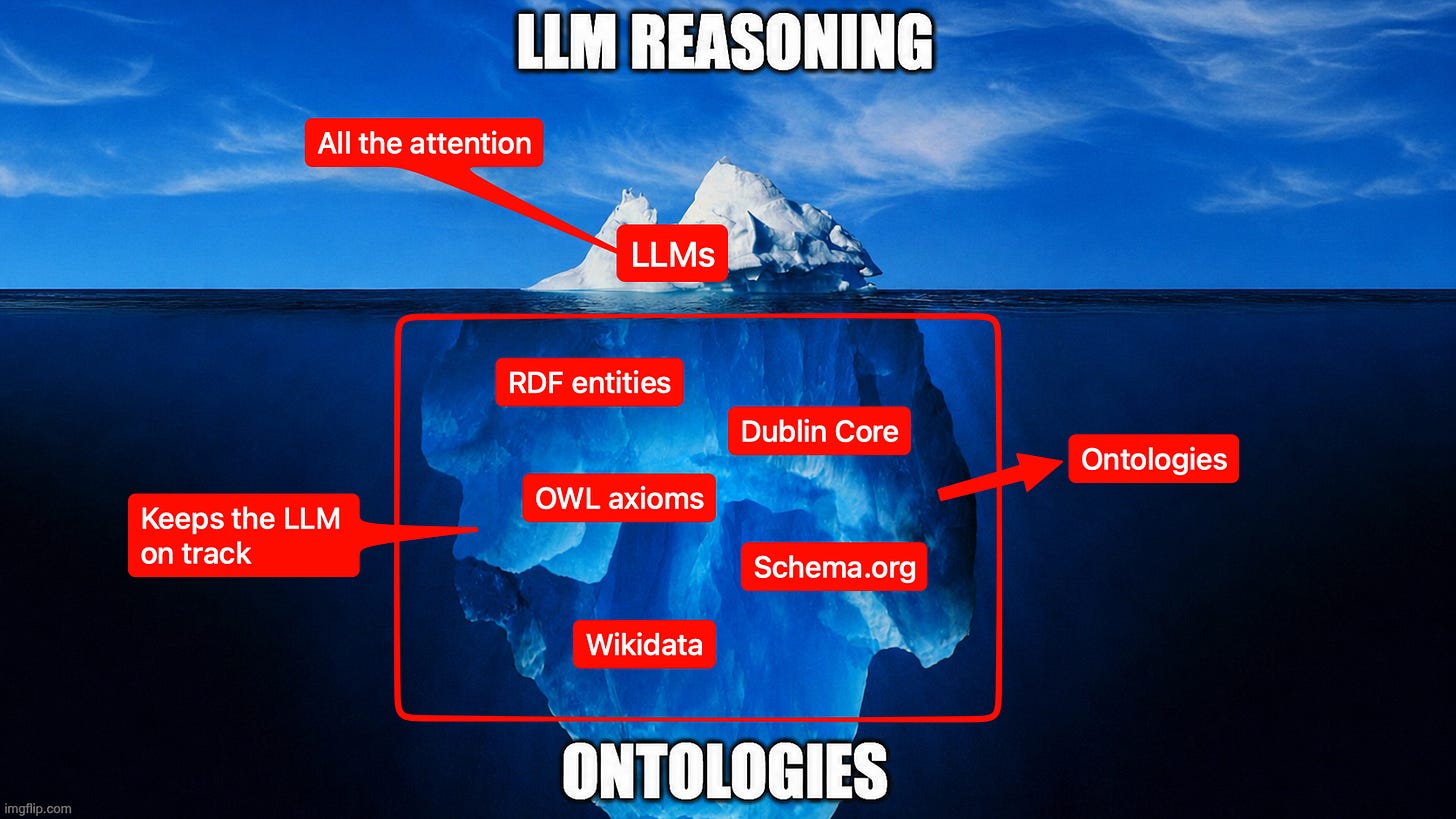
コイル教授は、Schema.org や OWL などの既存の Web オントロジーが LLM の訓練データに含まれているため、ゼロから設計するよりもプロンプトで利用可能であり、実装コストを削減できると指摘した。
神経記号AIによるLLMのガードレール
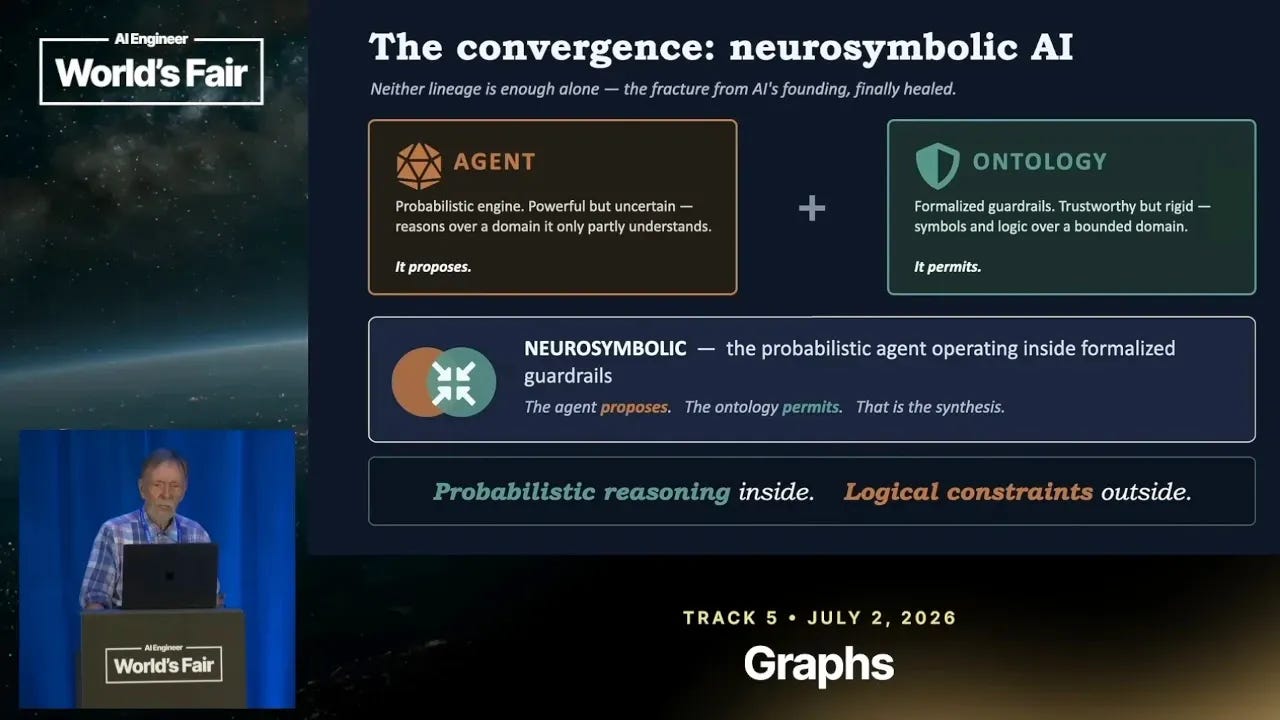
確率的エージェントとオントロジーを融合させた「神経記号AI」は、ルールベースシステムや知識グラフを活用してLLMの推論を保証する。このアプローチにより、LLMが逸脱しないよう守りながらその能力を引き出すことが可能になる。
オントロジーによる言語の計算可能文脈
オントロジーは言語が持つ表現力を、計算可能な文脈と結びつけることでLLMの強みを補完する。これにより、言語の柔軟性と構造化された情報の厳密性を両立させることができる。
重要な引用
for agentic systems to be truly effective they need logical guardrails
an ontology is a description of data structure – of classes, properties, and relationships in a domain of knowledge
smarter shared substrate to run agents at scale
"Sounds pretty fancy," he said, "but it's really neural networks tied into symbolic AI — rule-based systems come under that category, as do the knowledge graphs that we're assembling."
編集コメントを表示
編集コメント
AI エージェントの信頼性確保において、過去の「セマンティック・ウェブ」技術が現代の LLM 時代にも有効な解決策として再評価される点は注目に値する。特に既存のオントロジー資産を LLM プロンプトとして活用できる点は、開発コスト削減と実用化の加速に直結する重要な示唆である。
Source Article
元記事を日本語で読む
本文に関係しない購読案内、埋め込み通知、サイト内プロモーションは除いています。
最近開催された AI Engineer World's Fair で最も注目された動画の一つは、カリフォルニア大学バークレー校で生成 AI や大規模言語モデル(LLM)を教えるコンピュータサイエンス教授のフランク・コイル氏による 20 分間の講演です。数十年にわたる経験を活かし、コイル氏は現代の AI エンジニアに向けてオントロジーという概念とその実践を再紹介しました。
コイル氏は、LLM が確率的推論においては非常に効果的であると認めつつも、エージェントシステムが真に効果を発揮するためには「論理的なガードレール」が必要だと主張しました。ここで彼が指すのはまさにオントロジーです。
カリフォルニア大学バークレー校のフランク・コイル教授が AIEWF 2026 で講演する様子。
コンピュータサイエンスにおけるオントロジーとは、「ある知識領域におけるデータ構造、クラス、プロパティ、および関係性の記述」のことです(これは Oxford Semantic Technologies の定義を引用したものです)。コイル氏自身はこれを単に「グラフとしてのデータ」と表現しました。さらに彼は、オントロジーという概念自体がアリストテレスにまで遡るものであり、人工知能の歴史を通じて一貫して利用されてきたのだと付け加えています。
グラフデータベースで知られる Neo4j は、そのエージェント製品においてもオントロジーの活用を進めています。
AIEWF の基調講演で Neo4j の CEO、エミル・アイフレム氏は、大規模なエージェントを運用するための「より賢い共有基盤」を実現するために必要な 3 つのオントロジー類型について語りました。まず一つ目は組織内の主要概念を記述する「ビジネス向けオントロジー」、二つ目は「企業エコシステム内にあるすべてのデータソースやデータ資産のメタデータ全体」であるという「技術向けオントロジー」、そして最後にエージェントから出力されるランタイム信号を示す「実行トレース」です。
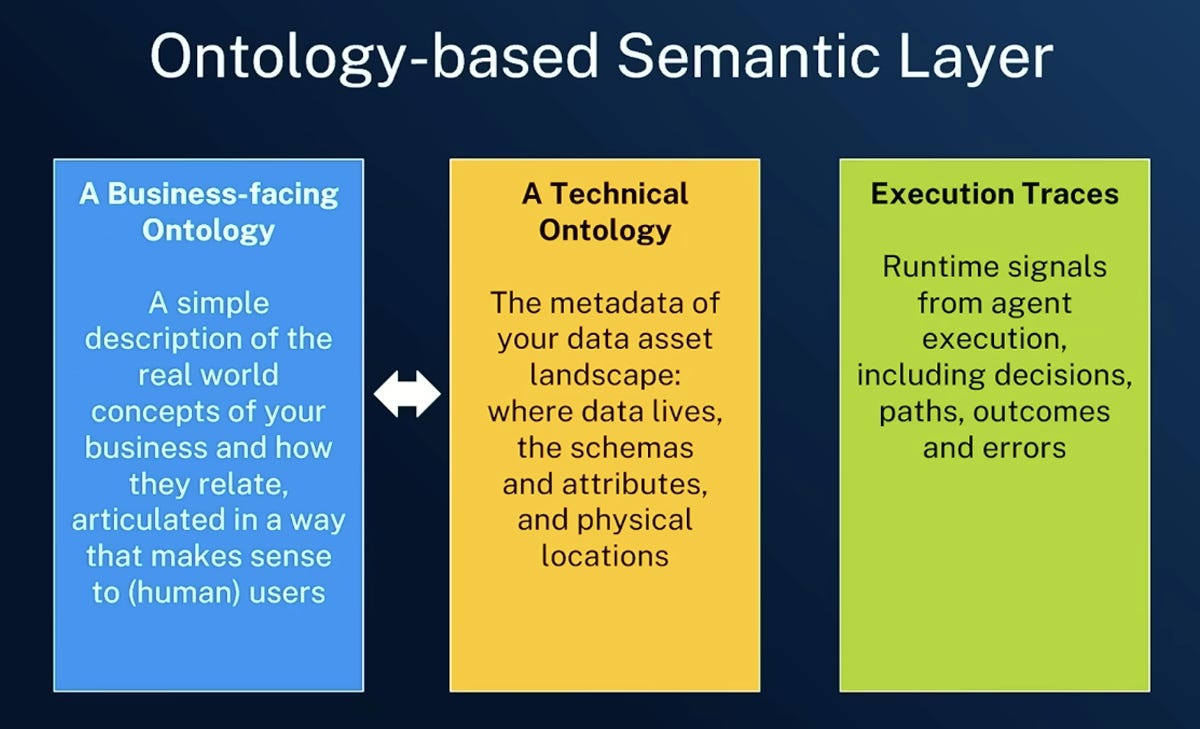
Neo4j のオントロジーベースのセマンティックレイヤー
古き良きものが再び:セマンティック・ウェブの復活
フランク・コイル氏は、エージェントシステムの構築において Web オントロジーが特に有用だと考えています。彼は、Web 開発者なら誰もが(あるいは少なくとも一定以上の経験を持つ開発者なら)知っている Schema.org、FOAF、Dublin Core といったオントロジーに言及しました。さらに、RDFS(Resource Description Framework Schema)や OWL(Web Ontology Language)といった「補完技術」にも触れています。
こうした確立されたオントロジーを活用する利点の一つは、すでに大規模言語モデル(LLM)の学習データに含まれているため、開発者はそれらをプロンプトとして直接使用できることです。これは、ゼロからオントロジーを再構築するよりもはるかに効率的です。
「この技術は、私たちがすでに利用している多くのものの基盤として存在しています」とコイル氏は語る。「既存のものを活用しましょう。」
具体例として、彼は Claude エージェントのループを紹介しました。これはツールの実行後に LLM の推論を検証するためにオントロジーを利用するものです。
コイル氏は、確率的エージェントとオントロジーの融合を「ニューロシンボリック AI」と呼んでいます。
「ちょっと難しそうな響きですが、本質的にはニューラルネットワークに記号 AI を結びつけたものなのです。ルールベースシステムや、私たちが構築している知識グラフもその范畴に含まれます。」
彼はまた、ニューロシンボリック AI は「LLM が安全レールから外れないようにする手段である」と強調しました。
オントロジーのメリットとデメリット
オントロジーに長年携わり、現在はそれを AI エンジニアリングと組み合わせているのが、OpenLink Software を運営するキンズリー・イデヘン氏です。彼は Semantic Web 技術を活用した「エージェントエンジニアリングスタック」を構築しています。その中には、「RDF メモリを持つエージェント」も含まれています。
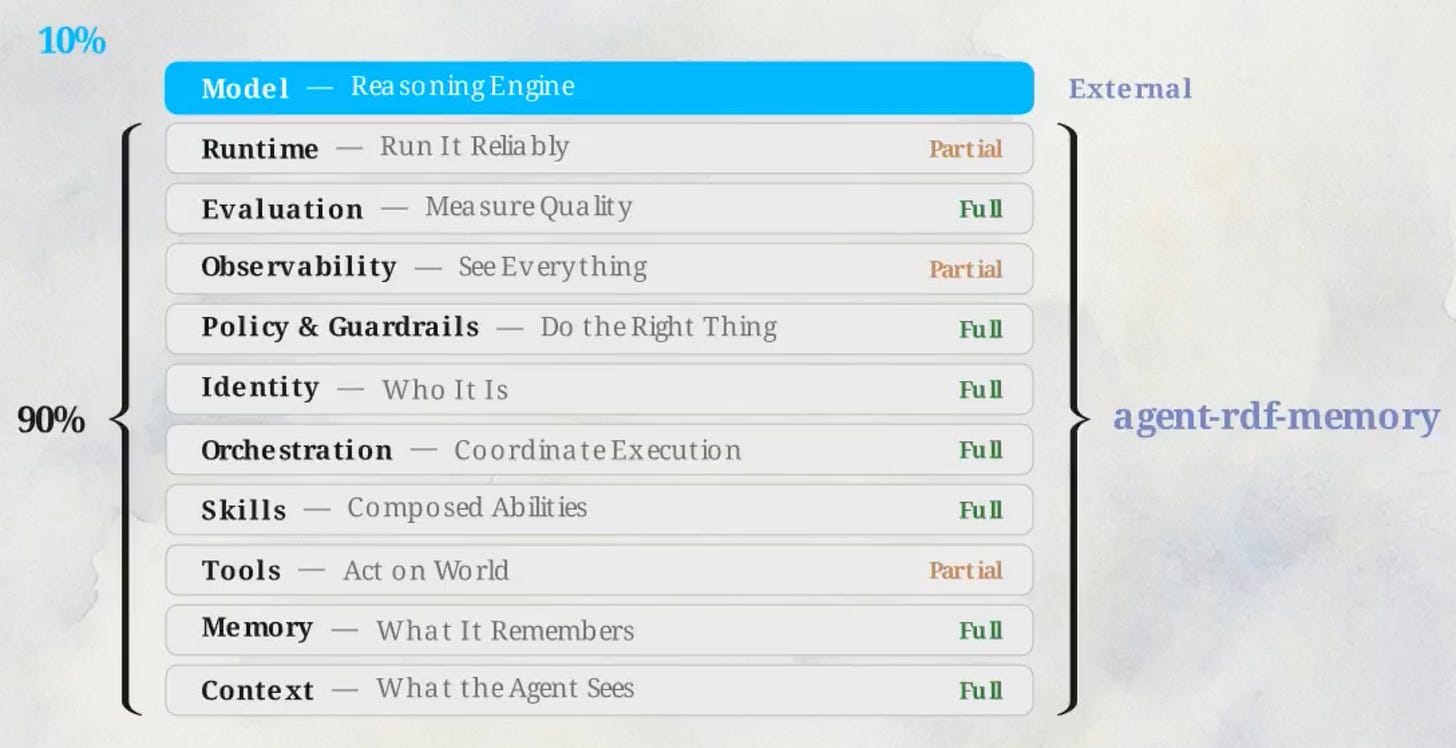
キングスリー・イデヘン氏が開発した「エージェント RDF メモリ」システム。
私はイデヘン氏に、オントロジー(意味論的記述)のメリットについて解説を求めた。
「LLM の素晴らしい点は、言語を強力に処理できることです」と彼は答えた。「一方、オントロジーの真価は、言語が計算可能な文脈を獲得するための『エンティティの種類』と『関係性』を定義する点にあります。この二つを組み合わせることで、言語のもつ表現力をコンピューティングの UI/UX ストックへと持ち込むことができるのです」
これは非常に理にかなった考え方だ。しかし、ウェブ開発者として長く現場にいる人ならご存じだろうが、オントロジーには「メンテナンス」と「最新情報の維持」という大きな課題がある。まさにその理由から、1990 年代と 2000 年代に提唱されたオントロジーを基盤とした「セマンティック・ウェブ」の構想は、結局のところ普及しなかった。
現在の AI 開発者であるプラセンジット・サルカール氏は、X(旧 Twitter)でこのメンテナンス問題に対する一つの解決策を示唆している。「エージェントがオントロジーの維持を自身の運用の一部として行い、境界ケースに遭遇した際に定義を更新すれば、メンテナンスの問題は性質を変える」と彼は主張する。ただし、それでもなお難しい課題であることは変わらないと付け加えている。
こうした課題があるにもかかわらず、構造化されたオントロジーの性質は、時折暴走しがちな確率的な LLM と相性が良いようだ。LLM が持つ強力な処理能力を活かしつつ、オントロジーがそれを制御する役割を果たすのである。
さらに、Neo4j の Eifrem 氏が説明したように、オントロジーを活用することで、「手動でデータソースを接続する厚いエージェント」の世界から、「より賢い共有オントロジーベースのセマンティック層上で動作する薄いエージェント」の世界へと移行することが可能になります。
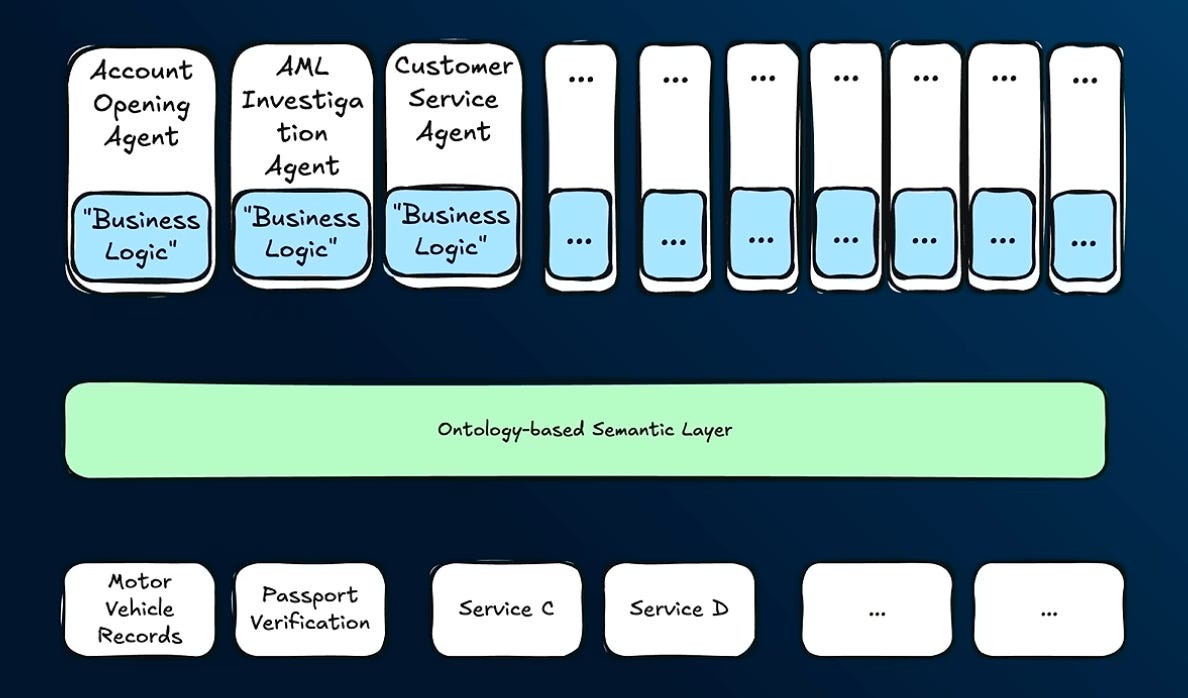
Neo4j が提唱する、オントロジーに依存した「薄いエージェント」の概念。
ループとガードレール
Coyle 氏のプレゼンテーションに戻りましょう。彼が指摘した「ループ工学」は、コンピュータサイエンスにおいて古くから存在する概念です。しかし問題は、ループが破綻したり、制御不能な状態に陥ったりする可能性がある点にあります。
ここでオントロジーシステムの出番です。確率的な大規模言語モデル(LLM)に対するガードレールとして機能します。Coyle 氏のスライドには、「無限のループを囲む有界なルールセット」という表現もありました。
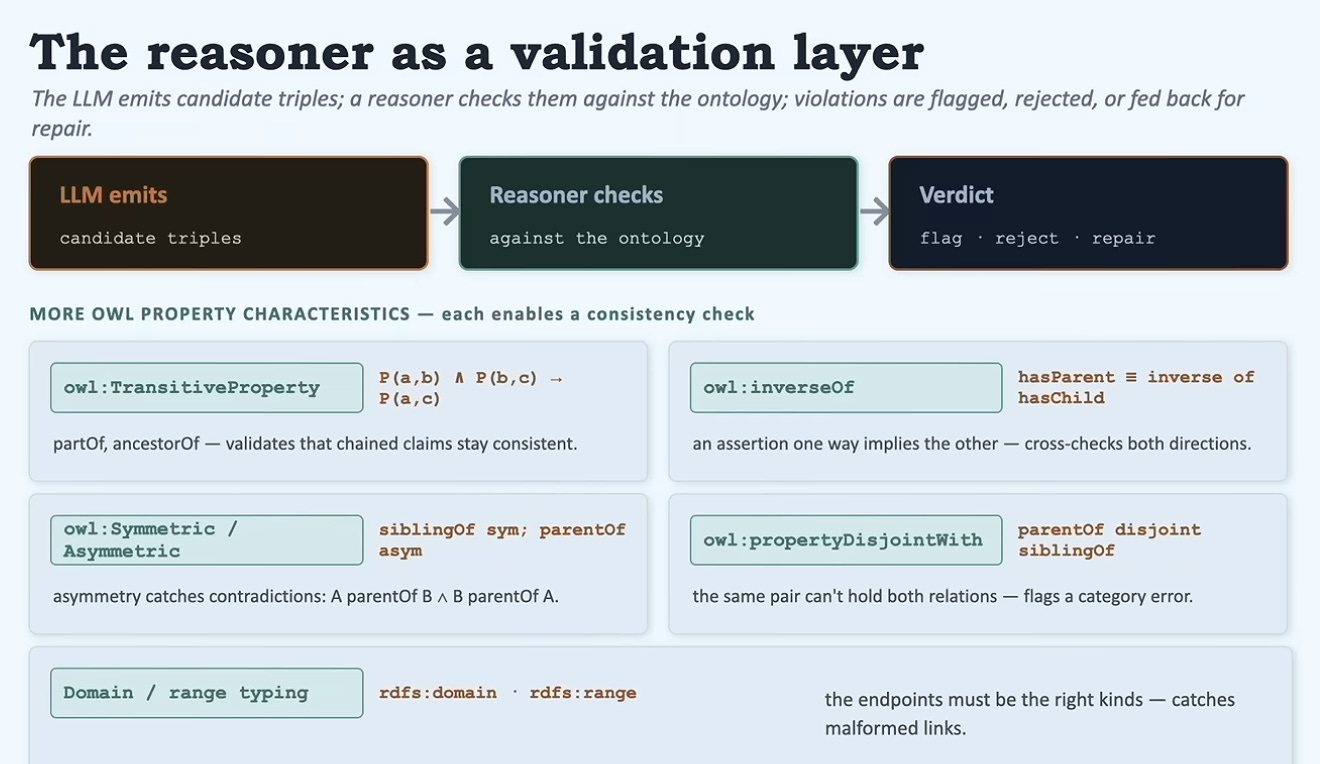
プレゼンテーションの終盤では、Coyle 氏が OWL をエージェントのチェックツールとして使用するデモンストレーションを行いました。あるスライドでは、言語は曖昧になりがちである一方、「OWL の公理は機械が強制するルールである」と説明されています。
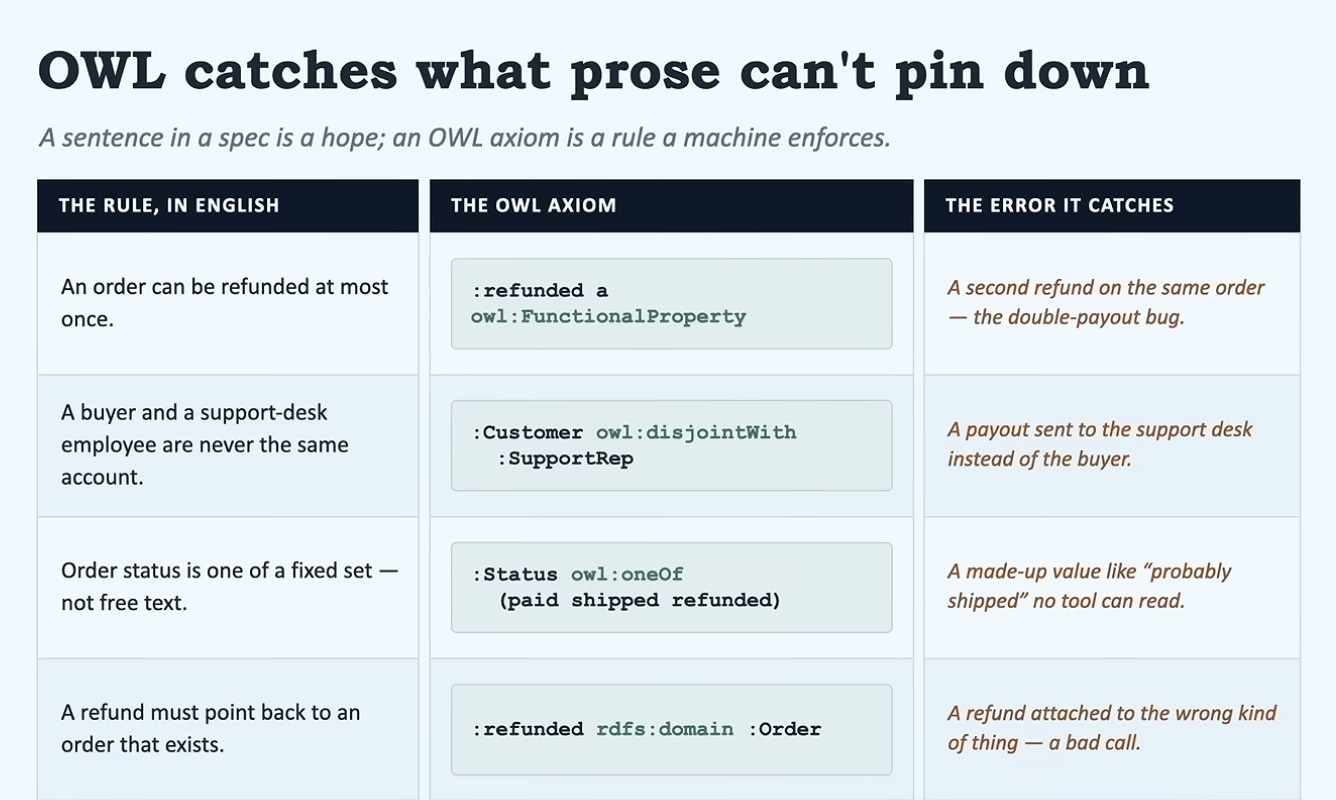
また、オントロジー上に構築された推論エンジン(リーゾナー)を活用することで、「LLM の軌道修正を行い、誠実さを保つためのガードレールとして機能させる」ことも可能だと示しました。
Semantic Vibes
おそらく、オントロジー(意味論的データモデル)が AI エンジニアの間で再び注目され始めたのは、現在の中心課題がループ工学における品質管理にあるからでしょう。AIEWF での議論を見ても、多くの登壇者がまだ「完全自動化されたソフトウェア工場」に全幅の信頼を置くには時期尚早だと考えていることがわかります。このイベントからの重要な教訓の一つは、ガバナンス(規制)と人間による監視が不可欠だということです。
また、「バイブコーディング」という 2025 年のトレンドで誰でもソフトウェアを作れるかのように見えた直後、従来の Web 技術が AI エンジニアリングの分野で再び台頭してきたのも興味深い点です。もちろん、その後の認識の変化は明確でした。「作った software を維持し、壊れないようにする必要がある」という事実が浮き彫りになったのです。そこで 2026 年、ソフトウェアエンジニアリングの規範への回帰が見られます。確率的な LLM(大規模言語モデル)を誠実に動かすための手段として、Web オントロジーの復活もその一環です。
原文を表示
One of the most watched videos from the recent AI Engineer World’s Fair is a 20-minute talk by Frank Coyle, a professor of computer science who currently teaches generative AI and LLMs at UC Berkeley. Drawing on his decades of experience, Coyle re-introduced the concept and practice of ontologies to today’s AI engineers.
Coyle argued that while LLMs are very effective at providing probabilistic reasoning, for agentic systems to be truly effective they need “logical guardrails” — by which he means ontologies.
UC Berkeley professor Frank Coyle speaking at AIEWF 2026.
In computer science, an ontology is “a description of data structure – of classes, properties, and relationships in a domain of knowledge” (as nicely defined by Oxford Semantic Technologies). Coyle himself defined an ontology as simply “data as graphs.” He added that ontologies as a concept go right back to Aristotle, and have been used throughout the history of Artificial Intelligence.
The company Neo4j, known for its graph database systems, is also using ontologies in its agentic products.
In a keynote session at AIEWF, Neo4j CEO Emil Eifrem talked about three different types of ontologies to enable a “smarter shared substrate” to run agents at scale. The first is a business-facing ontology, describing the key concepts in an organization; next is a technical ontology, which Eifrem described as “all the metadata of all the data sources and data assets in your enterprise ecosystem”; and finally execution traces, which are “the runtime signals out of your agent.”
Neo4j’s ontology-based semantic layer
What’s Old is New Again: the Semantic Web
Frank Coyle thinks web ontologies are especially useful in building agentic systems. He mentioned Schema.org, FOAF, Dublin Core and other ontologies familiar to web developers — or at least, those of a certain vintage. He also mentioned “augmenting technologies” like RDFS (Resource Description Framework Schema) and OWL (Web Ontology Language).
One benefit of using these established ontologies is that they’re already in the training data of LLMs, so developers can just prompt for them — much better than reinventing ontologies from first principles.
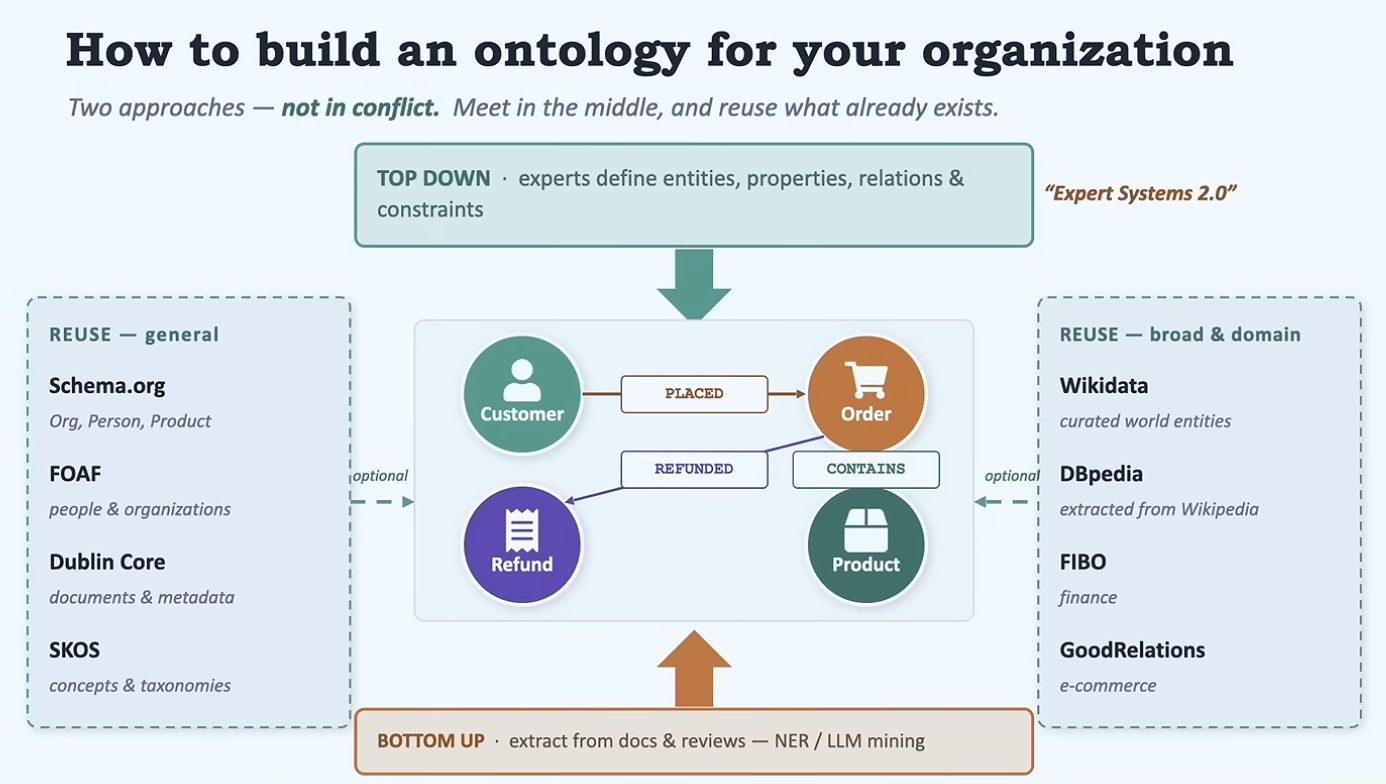
“This stuff has been out there underlying a lot of what we already do,” Coyle said. “So take advantage of these things that already exist.”
As an example, he showed a Claude agent loop which used an ontology to help validate the LLM’s reasoning after the tool had run.
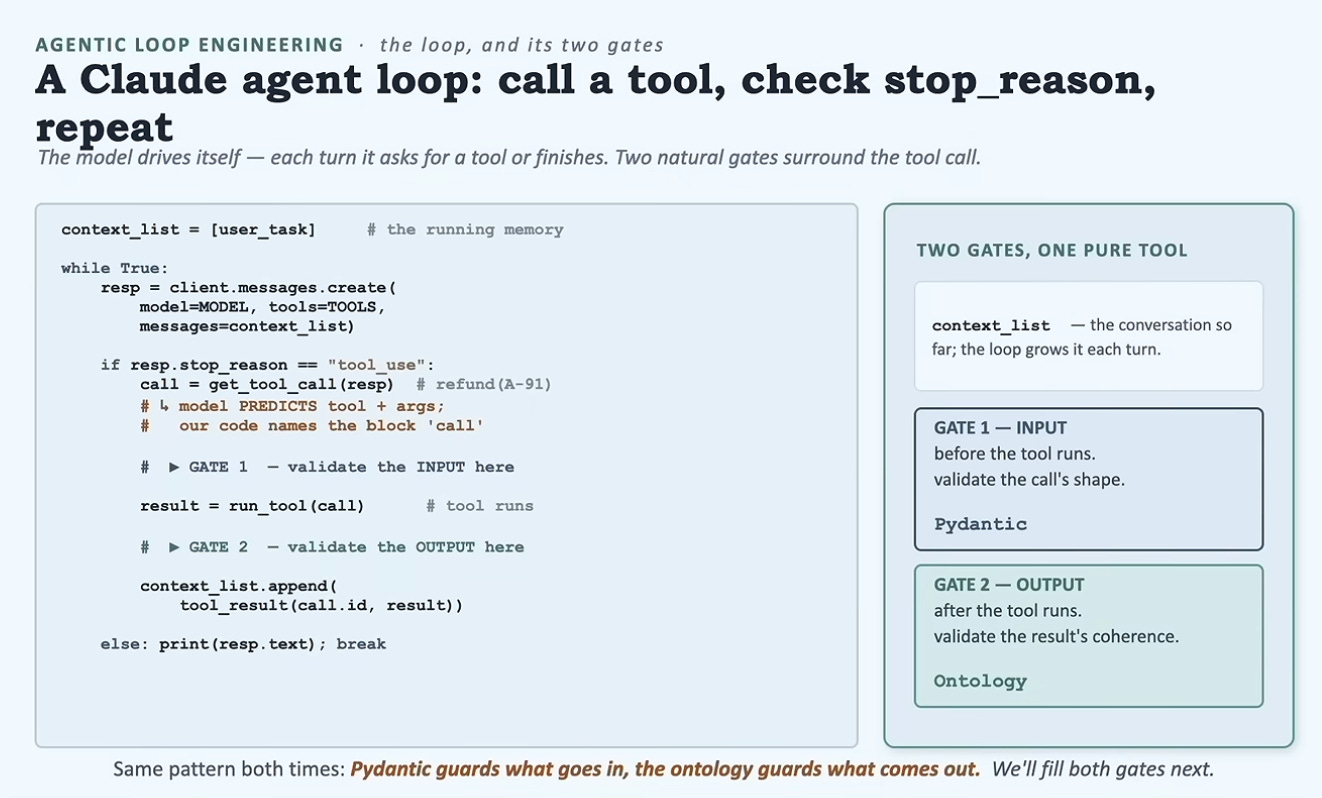
Coyle calls the convergence of probabilistic agents with ontologies “neurosymbolic AI.”
“Sounds pretty fancy,” he said, “but it’s really neural networks tied into symbolic AI — rule-based systems come under that category, as do the knowledge graphs that we’re assembling.”
He reiterated that neurosymbolic AI represents “a way to keep the LLM on its guardrails.”
The Pros and Cons of Ontologies
Someone who has been steeped in ontologies for many years and is now combining that with AI engineering is Kingsley Idehen, who runs a company called OpenLink Software. He’s been building an “agent engineering stack” that uses Semantic Web technologies — including an “agent with RDF memory.”
Kingsley Idehen’s agent-rdf-memory system.
I asked Idehen to explain to me the benefits of ontologies.
“The beauty of LLMs is that they are powerful processors of language,” he replied. “The beauty of an ontology is that it defines the types of entities and relationships through which language acquires computable context. Together, they bring the expressive power of language to computing’s UI/UX stack.”
That makes a lot of sense, but if you’ve been a web developer for a while you’ll know the challenges of ontologies: maintenance and keeping them up-to-date. It’s why the 1990s and 2000s vision for a “Semantic Web” — which was based on ontologies — never took off.
Current AI developer Prasenjit Sarkar offered a potential solution for the maintenance problem on X, arguing that “when an agent maintains the ontology as part of its own operation, updating definitions when it encounters edge cases, the maintenance problem changes character.” It’s still a hard problem though, he added.
Despite these issues, the structured nature of ontologies does appear to be a good match with the occasionally wayward tendencies of probabilistic LLMs. You get the power of LLMs, but ontologies will keep them in check.
Plus, as Neo4j’s Eifrem explained, ontologies allow us to move from “a world of thick agents with manually wired data sources” to a new world of “thin agents on a smarter shared ontology-based semantic layer.”
Neo4j’s “thin agents” concept, which relies on ontologies.
Loops and Guardrails
Back to Coyle’s presentation. He also had a great point about loop engineering, which he noted “has been around forever” in computer science. The problem, of course, is that loops can break or otherwise “go off the rails.”
Again, this is where an ontology system can act as a guardrail to a probabilistic LLM. One of Coyle’s slides referred to it as “a bounded set of rules around an unbounded loop.”
Near the end of his presentation, Coyle demonstrated how to use OWL as a check on agents. One slide showed that while language can be slippery, “an OWL axiom is a rule a machine enforces.”
He also showed how “you can have a reasoner built on ontology, to check [and] keep the LLM on track — have guardrails to keep it honest.”
Semantic Vibes
Perhaps ontologies are starting to resonate with AI engineers because a central concern at this time is quality control for loop engineering. We saw this debate play out at AIEWF, with many conference speakers not willing to go all-in on fully automated “software factories” just yet. One of the key learnings from the event was that there need to be guardrails and humans in the loop.
Also it’s fascinating to see traditional web technologies make a resurgence in the field of AI engineering, especially after the 2025 trend of “vibe coding” made it seem like anyone could create software. Of course, since then the penny has dropped: we need to maintain that software and make sure it doesn’t break! So in 2026, we’re seeing a return to software engineering discipline — including now a revival of web ontologies as a way to keep probabilistic LLMs honest.
AI算出
論評・提言ainew評価標準
記事はフランク・コイル教授の講演内容を基に、ニューロシンボリック AI の重要性やオントロジーの実践的価値について論じており、AI エージェント運用における重要な技術的視点を提供しているが、新規性のある事実発表というよりは既存概念の再評価を訴える意見記事である。
6つの評価軸を見る
- AI関連度
- 75
- 情報源の信頼性
- 75
- 新規性
- 50
- 調べる価値
- 25
- 重複の少なさ
- 100
- 日本での有用性
- 25
関連記事
今日のまとめ
AIデイリーブリーフで今日の重要ニュースをまとめ読み