LangChainとMongoDBのパートナーシップ発表:信頼できるデータベース上で動作するAIエージェントスタック
LangChainとMongoDBは、エージェントのメモリ・検索・観測を統合した単一プラットフォーム「LangChain + MongoDB Partnership」を発表し、プロトタイプから本番環境への移行を加速させる。
キーポイント
エージェント基盤の一元化
モデルとプロンプトに加え、取得・永続メモリ・運用データ・観測を単一データベースで提供し、並列インフラ構築と同期コストを削減する。
Atlas Vector Searchのネイティブ統合
LangChain SDKにドロップイン対応で組み込まれ、セマンティック検索、ハイブリッド検索(BM25+ベクトル)、GraphRAGを単一デプロイメントで実行可能。
永続的なエージェント状態管理
LangSmith DeploymentsのMongoDB Checkpointerにより、マルチターン会話メモリ、人間承認ワークフロー、クラッシュ後の再開、タイムトラベルデバッグを実現。
本番環境向けRAG評価パイプライン
LangSmithと連携し、取得品質の正確性を時間軸で追跡・評価する組み込みパイプラインを提供し、RAGシステムの改善サイクルを可視化する。
MongoDB Checkpointerによる永続的なエージェント状態管理
LangSmithデプロイメント向けにMongoDBへエージェントの状態を直接保存し、マルチターン会話メモリ、人間承認ワークフロー、タイムトラベルデバッグ、障害耐性のある実行を実現する。
Text-to-MQLによる自然言語データクエリ
Plain EnglishをMongoDB Query Languageに変換し、カスタムAPIを作成せずにエージェントが運用・分析データを自律的にクエリできるようになる。
LangSmithによるフルスタック可観測性
取得呼び出し、ツール実行、ルーティング判断、状態書き込みまでをエンドツーエンドでトレースし、LLM-as-judgeや人間レビューなどの評価ツールと連携してエージェント品質を継続的に改善できる。
影響分析・編集コメントを表示
影響分析
エージェント開発のボトルネックであった「取得・メモリ・観測」のインフラ統合コストを、既存データベース基盤で解決する実用的なアプローチを示している。エンタープライズ向けAI開発の標準スタックが「LangChain + MongoDB Atlas」に収束しつつあり、プロトタイプから本番デプロイまでのサイクルが大幅に短縮される見込みだ。
編集コメント
LangChainの公式ブログ発表でありPR色は否めないが、エージェント開発における「状態管理」と「RAG取得」のインフラ統合という実務課題に真正面から取り組んでいる点は評価できる。既存データベース基盤をAIバックエンドとして再利用する発想は、コスト削減とセキュリティ面でも企業導入のハードルを下げる可能性がある。
 imageエージェントには、モデルとプロンプトだけでは不十分です。必要なものは、検索機能、永続的なメモリ、運用データへのアクセス、観測性(observability)、そしてパイプライン全体にわたる信頼性の高いデプロイメントです。私たちは MongoDB と協力し、これらすべてを単一のオープンプラットフォームに統合しました。これにより、チームはデータ層の再構築を行わずに、プロトタイプから本番環境へとスムーズに移行できます。
私たちが連携するチームには共通のパターンがあります。エージェントのプロトタイプを作成し、動作を確認した後、本番環境での要件が浮上します。具体的には、クラッシュ後も持続する永続的な状態(durable state)、実際のエンタープライズデータに対する検索機能、構造化データベースへのクエリ実行能力、そして問題発生時のエンドツーエンドのトレーシングです。一般的な対応策は、ベクトルデータベースをここに追加し、状態保存庫をそこに配置し、分析 API を別の場所に設けることです。それぞれが新たにプロビジョニング、セキュリティ確保、同期維持が必要なシステムとなります。
MongoDB は、膨大な数のエンタープライズチームがすでに運用データを格納している場所です。65,000 社以上の顧客が Atlas 上でミッションクリティカルなアプリケーションを稼働させています。私たちが共同で問いかけた戦略的な質問はこうでした。「もしエージェントが、チームに並列インフラの構築を要求するのではなく、同じ基盤上で動作できたらどうだろうか?」
これが、この協力がもたらすものです。LangSmith、LangGraph、および LangChain 全体にわたる深い統合により、MongoDB Atlas はベクトル検索、永続的なエージェントメモリ、自然言語によるデータアクセス、フルスタックの観測可能性、そして状態を保持するデプロイメントを実現する完全な AI エージェントバックエンドへと進化します。これらはすべて、単一のオープンでマルチクラウド対応プラットフォーム上で動作します。
統合がもたらすもの
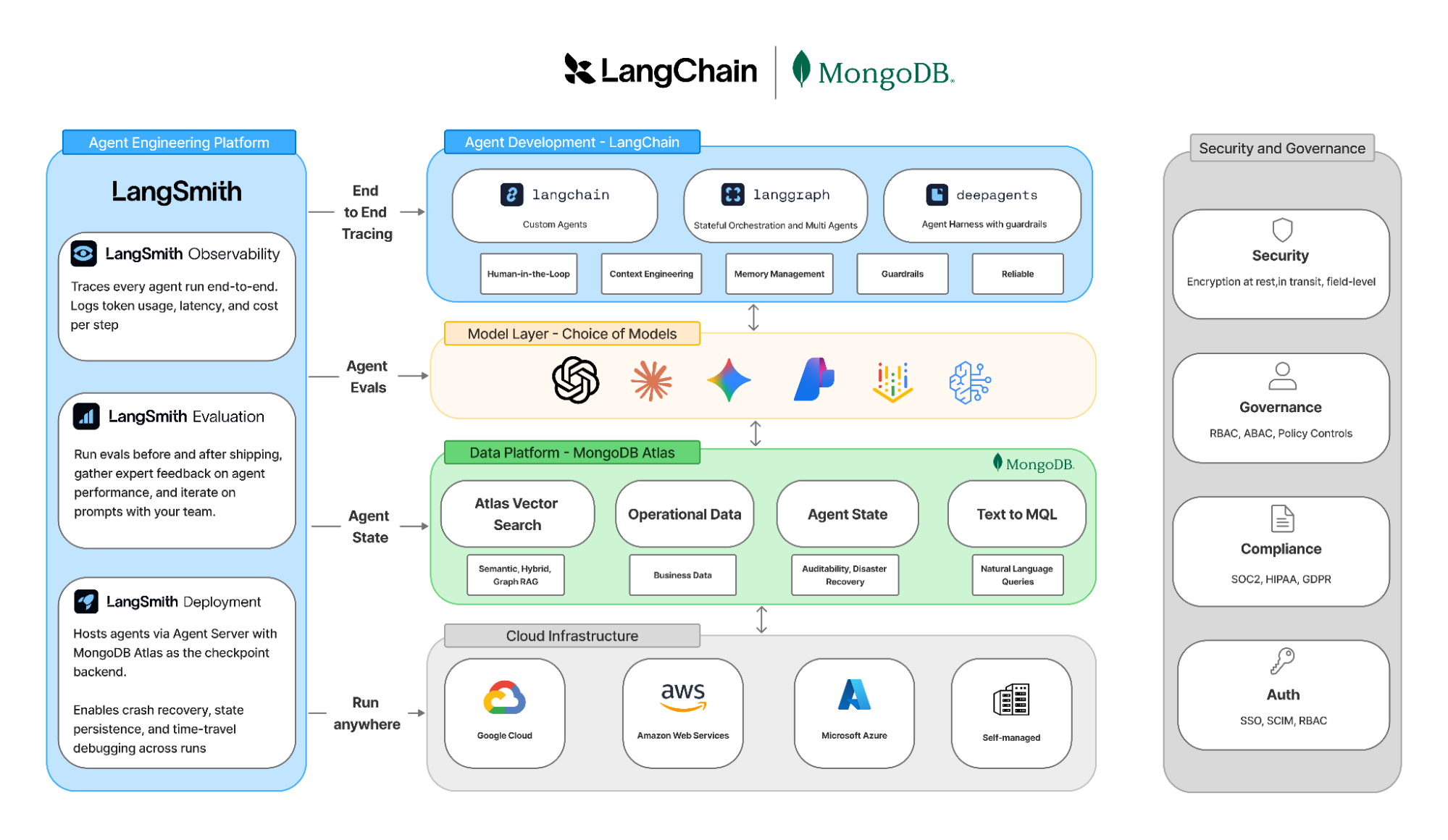 imageMongoDB の本番データを用いて LangSmith で信頼性の高いエージェントを構築する。Atlas Vector Search(ベクトル検索)による拡張生成(Retrieval-augmented generation: RAG)。Atlas Vector Search は、Python および JavaScript SDK の両方で利用可能な、LangChain へのネイティブ統合型ドロップイン・リトリーバーとして組み込まれています。単一の MongoDB デプロイメントから、セマンティック検索、ハイブリッド検索(BM25 + ベクトル)、GraphRAG、および事前フィルタリングされたクエリを実行できます。すでに Atlas を運用中であれば、追加のインフラストラクチャを構築する必要はありません。ベクトルデータは運用データと並存して保存されるため、同期ジョブが不要となり、システム間の最終整合性の問題も生じず、アクセス制御は単一のセットで管理可能です。検索品質の評価を検討しているチーム向けには、LangSmith と統合された組み込みの RAG 評価パイプラインも用意されており、時間経過に伴う精度を追跡することができます。
LangSmith の MongoDB Checkpointer を用いた、永続的なエージェントメモリと状態管理。本番環境のエージェントには耐久性のある状態が必要です。セッション途中で会話履歴を失うカスタマーサポートエージェント、クラッシュ後に再開できないインシデント対応エージェント、監査証跡のない多段階ワークフロー:これらは、エージェントを実運用に投入するのを妨げる問題です。LangSmith デプロイメント向けの MongoDB Checkpointer は、エージェントの状態を直接 MongoDB に永続化することでこの課題を解決します。マルチターン会話メモリ、人間が関与する承認ワークフロー、タイムトラベルデバッグ(過去の任意の状態の再生)、耐障害性実行が可能になります。このチェックポインタは、セルフホスト型の LangGraph デプロイメントと、LangSmith デプロイメント内の設定可能なバックエンドの両方でサポートされています。LS_DEFAULT_CHECKPOINTER_BACKEND を設定し、Atlas クラスターを指すようにすれば、エージェントの状態はアプリケーションデータと同じデータベースに永続化されます。
Text-to-MQL による運用データへの自然言語クエリ。私たちが最も頻繁に要望されるパターンとして挙げられるのは、各質問に対してカスタム API エンドポイントを手書きする必要なく、構造化されたビジネスデータを照会できるエージェントです。Text-to-MQL インテグレーションは、平易な英語を MongoDB Query Language(MQL)に変換し、エージェントが運用データや分析データを自律的に照会できるようにします。会話型アナリティクスエージェントは、「配送遅延のある過去 30 日間の全注文を表示して」といった質問に応え、それを正しい MML アグリゲーションパイプラインに変換できます。カスタム統合コードの必要はありません。
推論、計画、ツールアクセスへの完全な可視性を備えたテキストから MQL への変換パイプラインを構築
LangSmith を活用したフルスタックの観測機能。LangSmith は、MongoDB の検索呼び出し、ツールの呼び出し、エージェントのルーティング決定、チェックポイントへの書き込みを含む、すべてのエージェント実行をエンドツーエンドで追跡します。エージェントが不適切な回答を返した場合、出力に至った正確な検索結果、モデルの推論プロセス、および状態遷移を遡って追跡できます。本番環境でエージェントを実行しているチームにとって、これは盲目でのデバッグと、問題が検索品質、プロンプトの挙動、あるいは状態管理のエッジケースのいずれにあるかを特定できることの決定的な違いです。LLM-as-judge(LLM を判事として用いる評価)、人間によるレビュー、ペア比較を含む LangSmith の評価ツールはこれらの上に重ねて機能し、時間経過とともにエージェントの品質を測定・改善することを可能にします。
ロックインなし。この統合スタックは、あらゆる LLM プロバイダーで動作し、任意のクラウド(AWS、Azure、GCP)上で稼働でき、Atlas クラウドデプロイメントとセルフマネージドの MongoDB Enterprise Advanced の両方をサポートします。Deep Agents、LangGraph、および LangChain はオープンソースです。特定のベンダーの AI エコシステムに縛られることはありません。
各チームが構築しているもの
これらの統合はすでに業界全体で本番環境で稼働しています。以下に 2 つの事例を示します:
Kai Security は、セキュリティワークフローに AI エージェントを導入したいと考えているサイバーセキュリティ企業であり、MongoDB の顧客でもあります。しかし、インフラストラクチャの壁に直面していました。エージェントの状態を永続化させるためには、セキュリティチームが所有・運用していない別データベース層を構築する必要があったのです。MongoDB Checkpointer for LangSmith Deployment は、この障壁を完全に解消しました。彼らは、アーキテクチャ決定に 1 か月かけるのではなく、わずか 1 日で一時停止と再開機能、クラッシュからの回復機能、そして完全な監査証跡を実装し、すべてがすでに信頼しているインフラストラクチャ内で実現したのです。
Fortune 500 企業のエンタープライズチームは既に、LangChain と MongoDB を組み合わせてアジェンティックワークフローを構築しています。その範囲は、金融サービスやヘルスケア分野におけるコンプライアンスおよび規制対応の自動化から、大規模な AI ドライブ型のセキュリティ運用や顧客体験プラットフォームの稼働まで多岐にわたります。私たちはこれらの企業数社と協力し、この統合を実環境へ導入する取り組みを行っており、その事例については近日中に共有していく予定です。
製品間の連携箇所
本統合は、オープンソース版と LangSmith の両方にまたがっています。
オープンソース向け統合:
- 意味的検索、ハイブリッド検索、GraphRAG クエリに対応する Atlas Vector Search リトリーバー(Python および JavaScript)
- キーワードによる全文検索とベクトル類似度を単一の Atlas クエリで組み合わせるハイブリッド検索
- MongoDB データを自然言語で照会するための Text-to-MQL ツールキット
- 検索品質および回答の精度を測定するための RAG 評価パイプライン
LangSmith 向け統合:
MongoDB Checkpointer for LangSmith Deployment Agent Server は、LangSmith を介してデプロイする際に MongoDB 内でエージェントの状態を永続化するためのものです(Atlas クラウド、セルフマネージド、バンドルされた開発インスタンスのすべてに対応)。
LangSmith の観測機能によるエンドツーエンドのトレーシングでは、MongoDB からの検索呼び出し、ツールの呼び出し、およびパイプライン全体にわたるエージェントの意思決定をカバーします。
「LangChain と MongoDB は以前から Atlas ベクトル検索リトリーバーや Text-to-MQL ツールキットなどを通じて深いオープンソース統合を行ってきました。今や LangSmith の MongoDB Checkpointer により、チームはエージェントの状態を直接 Atlas に永続化でき、クラッシュからの回復、タイムトラベルデバッグ、そして標準で耐久性のある実行が可能になります。LangSmith の観測機能、評価パイプライン、マネージドデプロイメントと組み合わせることで、MongoDB の顧客は、すでに信頼しているインフラストラクチャから離れることなく、プロトタイプから本番のエージェントまでを完結したパスで実現できるようになりました。」
– Harrison Chase, LangChain 共同創設者兼 CEO
「AI エージェントの信頼性は、その背後にあるデータインフラストラクチャに依存します。LangSmith や LangChain との統合により、MongoDB Atlas の顧客は、既存の運用データを本番の AI エージェントへと直接つなぐことができます。ベクトル検索、永続的な状態管理、自然言語による照会機能が、すでに稼働しているプラットフォームに組み込まれています。これが AI 導入のあるべき姿です:追加的であり、破壊的ではない。」
– Chirantan「CJ」Desai, MongoDB 社長兼 CEO
始め方
すべての統合は本日、本番環境で利用可能です。
LangSmith: smith.langchain.com
Atlas Vector Search + LangChain (Python): mongodb.com/docs/atlas/ai-integrations/langchain
Atlas Vector Search + LangChain (JavaScript): mongodb.com/docs/atlas/ai-integrations/langchain-js
ハイブリッド検索ガイド: mongodb.com/docs/atlas/ai-integrations/langchain/hybrid-search
RAG 評価: mongodb.com/docs/atlas/ai-integrations/langchain/evaluate-rag
LangSmith MongoDB チェックポインタ: docs.langchain.com/langsmith/configure-checkpointer
LangGraph (オープンソース): github.com/langchain-ai
LangChain について
LangChain は、AI スタートアップからグローバル企業まで、トップのエンジニアリングチームを支えるエージェント工学プラットフォームです。LangChain、LangGraph、Deep Agents を含むそのオープンソースフレームワークは累積ダウンロード数が 10 億回を超え、100 万人以上の実践者に利用されています。観測性、評価、デプロイメントを担う LangSmith は、300 社以上の企業顧客とフォーチュン 500 社のうち 5 社をサポートしています。LangChain はシーコイアキャピタル、ベンチマーク、IVP の支援を受けています。詳細は langchain.com をご覧ください。
原文を表示
imageAgents need more than a model and a prompt. They need retrieval, persistent memory, access to operational data, observability and reliable deployment across the full pipeline. We've worked with MongoDB to build all of that into a single, open platform, so teams can go from prototype to production without rearchitecting their data layer.
The teams we work with have a common pattern. They build an agent prototype, it works, and then production requirements show up: durable state that survives crashes, retrieval over real enterprise data, the ability to query structured databases, and end-to-end tracing when something goes wrong. The typical answer is to bolt on a vector database here, a state store there, an analytics API somewhere else. Each one is another system to provision, secure, and keep in sync.
MongoDB is where a massive number of enterprise teams already store their operational data. Over 65,000 customers run mission-critical applications on Atlas. The strategic question we asked together was: what if agents could run on that same foundation, rather than requiring teams to stand up parallel infrastructure?
That's what this collaboration delivers. Deep integrations across LangSmith, LangGraph, and LangChain that turn MongoDB Atlas into a complete AI agent backend: vector search, persistent agent memory, natural-language data access, full-stack observability and stateful deployment. All on a single, open, multi-cloud platform.
What the integration delivers
imageBuilding reliable agents with LangSmith with production data in MongoDBRetrieval-augmented generation with Atlas Vector Search. Atlas Vector Search is natively integrated into LangChain as a drop-in retriever, available in both Python and JavaScript SDKs. You can run semantic search, hybrid search (BM25 + vector), GraphRAG, and pre-filtered queries, all from a single MongoDB deployment. If you're already running Atlas, there's no additional infrastructure to stand up. Your vector data live alongside your operational data, which means no sync jobs, no eventual consistency between systems, and one set of access controls. For teams evaluating retrieval quality, there's also a built-in RAG evaluation pipeline that integrates with LangSmith to track accuracy over time.
Persistent agent memory and state with MongoDB Checkpointer in LangSmith. Production agents need a durable state. A customer support agent that loses its conversation history mid-session, an incident response agent that can't resume after a crash, a multi-step workflow that has no audit trail: these are the problems that block agents from going live. The MongoDB Checkpointer for LangSmith Deployments solves this by persisting agent state directly in MongoDB. You get multi-turn conversation memory, human-in-the-loop approval workflows, time-travel debugging (replay any prior state), and fault-tolerant execution. The checkpointer is supported both in self-hosted LangGraph deployments and as a configurable backend in LangSmith Deployment. You set LS_DEFAULT_CHECKPOINTER_BACKEND, point it at your Atlas cluster, and agent state persists in the same database as the rest of your application data.
Natural-language queries over operational data with Text-to-MQL. One of the most requested patterns we see is agents that can query structured business data without someone writing custom API endpoints for every question. The Text-to-MQL integration converts plain English into MongoDB Query Language, letting agents autonomously query operational and analytical data. A conversational analytics agent can field questions like "show me all orders from the last 30 days with shipping delays" and translate that into the correct MQL aggregation pipeline. No custom integration code required.
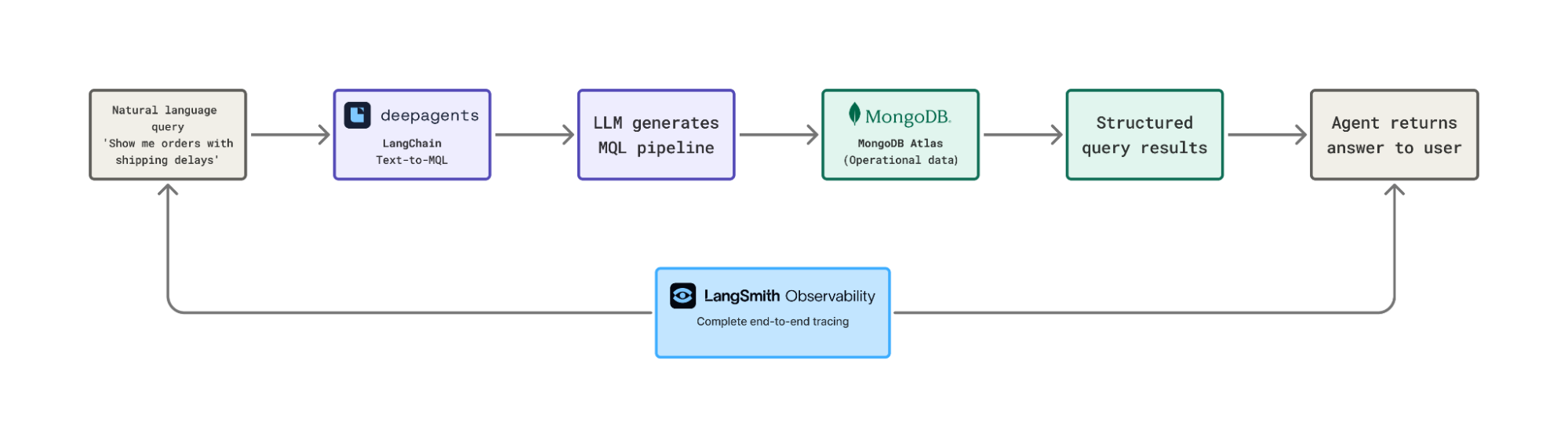 imageBuild Text-to-MQL Pipeline with full visibility into reasoning, planning and tool accessFull-stack observability with LangSmith. LangSmith traces every agent run end to end, including MongoDB retrieval calls, tool invocations, agent routing decisions, and checkpointer writes. When an agent returns a bad answer, you can trace back through the exact retrieval results, the model's reasoning, and the state transitions that led to the output. For teams running agents in production, this is the difference between debugging blind and being able to pinpoint whether the problem was retrieval quality, prompt behavior, or a state management edge case. LangSmith's evaluation tools, including LLM-as-judge, human review, and pairwise comparison, layer on top so you can measure and improve agent quality over time.
Zero lock-in. The combined stack runs with any LLM provider, on any cloud (AWS, Azure, GCP), and supports both Atlas cloud deployments and self-managed MongoDB Enterprise Advanced. Deep Agents, LangGraph, and LangChain are open-source. You're not locked into a single vendor's AI ecosystem.
What teams are building
The integrations are already in production across industries. Here are two examples:
Kai Security is a cybersecurity company and MongoDB customer that wanted AI agents in their security workflows but kept hitting an infrastructure wall. Persistent agent state meant standing up a separate database layer that their security team didn't own or operate. The MongoDB Checkpointer for LangSmith Deployment removed that blocker entirely. They shipped pause-and-resume, crash recovery, and a full audit trail in a day rather than spending a month on architecture decisions, all within infrastructure they already trusted.
Enterprise teams at Fortune 500 companies are already using LangChain and MongoDB to build agentic workflows, from automating compliance and regulatory intake in financial services and healthcare to powering AI-driven security operations and customer experience platforms at scale. We're working with several of them to bring this integration into production, and we'll be sharing those stories soon.
Where the products connect
The integration spans both open-source and LangSmith:
Open-source integrations:
Atlas Vector Search retriever (Python and JavaScript) for semantic, hybrid, and GraphRAG queries
Hybrid search combining keyword full-text search with vector similarity in a single Atlas query
Text-to-MQL toolkit for natural-language querying of MongoDB data
RAG evaluation pipeline for measuring retrieval quality and answer accuracy
LangSmith integrations:
MongoDB Checkpointer for LangSmith Deployment Agent Server for persisting agent state in MongoDB when deploying via LangSmith (supports Atlas cloud, self-managed, and bundled development instances)
End-to-end tracing from LangSmith Observability covering MongoDB retrieval calls, tool invocations, and agent decisions across the full pipeline
"LangChain and MongoDB have had deep open-source integrations for a while, from Atlas Vector Search retrievers to the Text-to-MQL toolkit. Now with LangSmith's MongoDB Checkpointer, teams can persist agent state directly in Atlas, giving them crash recovery, time-travel debugging, and durable execution out of the box. Combined with LangSmith's observability, evaluation pipelines, and managed deployments, MongoDB customers now have a complete path from prototype to production agent without leaving the infrastructure they already trust."
– Harrison Chase, Co-founder and CEO of LangChain
"AI agents are only as reliable as the data infrastructure behind them. The integration with LangSmith and LangChain gives MongoDB Atlas customers a direct path from their existing operational data to production AI agents, with vector search, persistent state, and natural-language querying built into the platform they already run. This is how AI adoption should work: additive, not disruptive."
– Chirantan “CJ” Desai, President and CEO of MongoDB
Get started
All integrations are production-ready today.
LangSmith: smith.langchain.com
Atlas Vector Search + LangChain (Python): mongodb.com/docs/atlas/ai-integrations/langchain
Atlas Vector Search + LangChain (JavaScript): mongodb.com/docs/atlas/ai-integrations/langchain-js
Hybrid search guide: mongodb.com/docs/atlas/ai-integrations/langchain/hybrid-search
RAG evaluation: mongodb.com/docs/atlas/ai-integrations/langchain/evaluate-rag
LangSmith MongoDB Checkpointer: docs.langchain.com/langsmith/configure-checkpointer
LangGraph (open-source): github.com/langchain-ai
About LangChain
LangChain is the agent engineering platform powering top engineering teams, from AI startups to global enterprises. Its open-source frameworks, including LangChain, LangGraph, and Deep Agents, have surpassed 1 billion cumulative downloads and are used by over one million practitioners. LangSmith, the observability, evaluation, and deployment platform, serves over 300 enterprise customers and 5 of the Fortune 10. LangChain is backed by Sequoia Capital, Benchmark, and IVP. For more information, visit langchain.com.
関連記事
今日のまとめ
AI日報で今日の重要ニュースをまとめ読み