Anthropic や OpenAI は、ユーザーが支払う 100 ドルあたり 1,000 ドル以上を費やしている可能性がある(39 分読了)
この記事は、Anthropic の「AI が自身を構築する」という主張に対する懐疑的な分析を通じて、LLM を用いたコーディングの実践的コストと生産性の限界、およびマーケティングと現実の乖離を鋭く指摘している。
キーポイント
Anthropic の主張への懐疑的視点
Anthropic の「AI が自身を構築する」というブログ投稿は、警告文が隠蔽された煽情的なマーケティングであると批判されており、ベンチマークの数値(50-80%の成功率)が完全自律型コーディングでは無意味であるとしている。
コード行数による生産性指標の欠陥
1 日あたりのチェックイン数が 8 倍に増えるというデータは、生産性の向上ではなく、LLM が迷走した際の巻き戻し作業によるオーバーヘッドの増加を示唆しており、コード行数(LOC)が信頼できる指標ではなくなっている。
実証されたコスト対効果の低さ
著者の実験によると、LLM によるコーディングは最終的なコード量に対して 7 倍の変更コミットが必要となり、100 ドル支払うごとに 1,000 ドル以上のインフラコストがかかる可能性が示唆されている。
Google の量子コンピューター発表との類似性
Anthropic の手法は、Google の「Willow」量子チップに関する報道と同様に、科学的な進歩を過大評価し、実用性を誤解させるような誤解を招くマーケティングである可能性が高いと指摘されている。
LLM コーディングの経済的非効率性
現在のサブスクリプションは補助金に支えられており、フルエージェント型コーディングを週次で利用すると API 価格換算で月額$100 のプランが$1,000 を超えるコストになる。
複雑なタスクのコスト爆発
単純な会話は低コストだが、再帰的推論やツール使用を要する高度なコーディングタスクではトークン使用量が急増し、1 タスクあたり API 価格で約$75に達する。
S カーブの終焉とコスト隠蔽
企業は複雑なタスクに対する計算資源の限界を隠しつつ「計測不要」というモデルを提示しており、これは品質向上曲線の終わりを示唆している。
重要な引用
The caveats are there, but hidden or sandwiched between more hyperbolic statements.
Is checking in 8 times as many lines of code per day really a good thing?
'8' as an estimate not so much of increased productivity, but of increased overhead does sound about right
It doesn't look like LLM-coding is going to be affordable
"if you use the $100 a month Claude Max plan... you would use an amount of tokens that would cost you more than $1000 at API-pricing."
"A single task by a top recursive model at high effort is estimated to cost around $75 at API-rates."
影響分析・編集コメントを表示
影響分析
この記事は、LLM を活用したソフトウェア開発が期待されるほど安価で効率的ではないという現実的な警告を発しており、企業の AI 投資判断や技術選定において過度な楽観視を戒める重要な役割を果たします。特に「AI が自身を構築する」という未来的なビジョンに対して、現在の技術的・経済的制約(オーバーヘッドとコスト)を冷静に分析することで、業界全体の熱狂的なムードに対するバランス感覚を取り戻すきっかけとなるでしょう。
編集コメント
業界が「AI による自己構築」や「劇的な生産性向上」に沸く中、現場の実証データに基づきコストとオーバーヘッドの現実を指摘するこの分析は、投資家および技術リーダーにとって極めて貴重です。
隠された理由により、15 ヶ月ぶりに生成 AI/LLM に関する執筆を再開します(2025 年 10 月の こちら や 2025 年 6 月の こちら は、真剣な記事とはみなされません)。本日は「大規模言語モデル(LLM: Large Language Models)とのコーディング」に関する 2 部構成の第 1 弾です。LLM におけるコーディングは、LLM の『キラーアプリ』killer app と位置づけられています。
本プログラムを一時中断し、Anthropic が最近発表したブログ記事 AI が自らを構築する時 に関する短い逸脱についてお話しします。
Anthropic はたまた Google のマーケターを採用したのでしょうか?
Anthropic のブログ記事は、暗示的な文章の教科書のようなものです。注意点は存在しますが、より過剰な表現の間やその間に隠されています。「私たちは間違っているかもしれない」という文も確かにありますが、彼らが*間違っていない*と仮定した上で、数千語にわたるテキストの中で単一の文としてどのような役割を果たすのでしょうか?ベンチマークは疑わしいです。コーディングタスクにおいて人間と比較して 50% または 80% の成功率というのは、フルエージェント(ループ内の人間なし)のコーディングにおいては実質的に全く役に立ちません。1 日あたりのチェックインされるコード行数が 8 倍になることが本当に良いことなのでしょうか?もし毎日、前日に問題があった部分を置き換えているとしたらどうでしょうか?また、LLM が編集を行うことで、すでに信頼性の低い指標となっている「コード行数」がさらに信頼性を失うような編集が行われるとしたらどうでしょうか。全体として、これは Google の『Willow』量子計算チップに関する欺瞞的な発言 を思い出させます。
ちなみに、「1 日あたりのチェックインされるコード行数が 8 倍になることが本当に良いことなのか?」という点について:私の LLM ベースのチェックインの多くはまさにそのようであり、正直に言って、Claude Code が迷子になった場合に遡行できるようにするために、私はチェックイン数を増やしました。中間チェックインなしで行ったすべての作業にもかかわらず、最終的に残ったコード行数と比較すると、コミットした変更量は 7 倍にもなりました……。したがって、『8』という数字は生産性の向上というよりも、むしろオーバーヘッドの増加を示す推計としてなら、概ね妥当に聞こえます…
もし後日「Claude とのコーディング」について詳細な記事を書く機会があれば、その際にこの話題に戻ります。
ついでに言っておくと、これは長く曲がりくねった内容の記事です(この点で本当に苦労しています、ごめんなさい)。そこで以下のようにまとめます:
TL;DR — LLM を用いたコーディングは、決して安価になるようには見えない(ましてや「AI 自身が自身を構築する」などという話ではない)
私はいくつかの実験を行ってきました。その実験とは、「Claude Code は実際どれほど優秀なのか?」というものです。この実験はまだ進行中ですが、これまでに Claude Code は約 4 万行のコードを作成し、動作する(ただし未完成の)アプリケーションを構築しました。その経験については間もなく報告したいと考えていますが、それはより困難な執筆となるでしょう。その間に私はコストの問題に直面し、それが短い研究プロジェクトへとつながり、いくつかの興味深い観察と結論をもたらしました:
- まず重要な観察から始めましょう:Claude Code と私の(錆びついてはいるが十分堅牢な)プログラミング経験の組み合わせのおかげで、私は Claude Code にこのアプリケーションを作成させることができました。現在はまだ未完成ですが機能しており、もし時間とエネルギーを費やして私が自力で作成しようとした場合、おそらく「全く不可能」だったでしょう。熟練したプログラマーにとって、初期の体験は非常に印象的です。なぜなら、熟練したプログラマーほど、そのようなコードを作成する際に自分自身で通常どれほどの理解が必要かを知っているからです。
- しかし…LLM を用いたコーディングは、ほとんどの用途において経済的に持続可能ではありません。現在それが実現できているのは、サブスクリプションが大幅に補助されているからです。もし月額 100 ドルの Claude Max プランを利用し、ほぼ人間を介さない完全な「エージェント型コーディング」によって週間の利用制限に達するほど使用した場合、API 価格(API-pricing)で計算すると 1,000 ドルを超えるトークン量を使用することになります。Anthropic は現在、この損失の拡大を防ぐために忙しく取り組んでおり(Opus 4.7, 4.8)、仮に品質を損なわずにこれが成功したとしても、それは実質的な改善の終了(つまり S カーブの終焉)を示唆するものとなります。
- そして…予算モデルや最先端モデルとの単純な会話では「計測するほど安すぎる」という状態が確かに実現されましたが、再帰的・間接的・ツール使用型・「思考」を必要とする(あるいはしない)モデルを要する本格的な用途(コーディングや複雑な推論など)におけるトークン利用量は爆発的に増加しており、これらの用途は非常に高価なものとなっています。高負荷で動作するトップクラスの再帰的モデルによる単一のタスクのコストは、API 価格基準で約 75 ドルと推定されています。私は一度のクエリで 100 万トークンを使用する事例を目撃しましたが、これは API 価格基準で最大 25 ドルを意味します。
- つまり…世界に提示されている経済モデルは、複雑な事柄に対して良好な結果を得るために最大限のブルートフォース( brute force)を要するタスクの価値に基づいているように見えますが、そのコストを隠蔽するか、「計測するほど安すぎる」という議論を展開しているのです。
- したがって:この船が沈むまで音楽を楽しみ、良質な救命ボートを準備してください。
これは私が構築中(そして楽しんでいる)アプリケーションのスクリーンショットの一部です。これは実際に図を作成する際に役立つ可能性のあるリアルなアプリケーションであり、データとグラフィックスを組み合わせたものです。私の目標は「LLM によるコーディング」を検証することでした。私が構築しているものは単なる例に過ぎませんが、私はこの分野にある程度経験がありますので、これを使えるだろうと考えました。
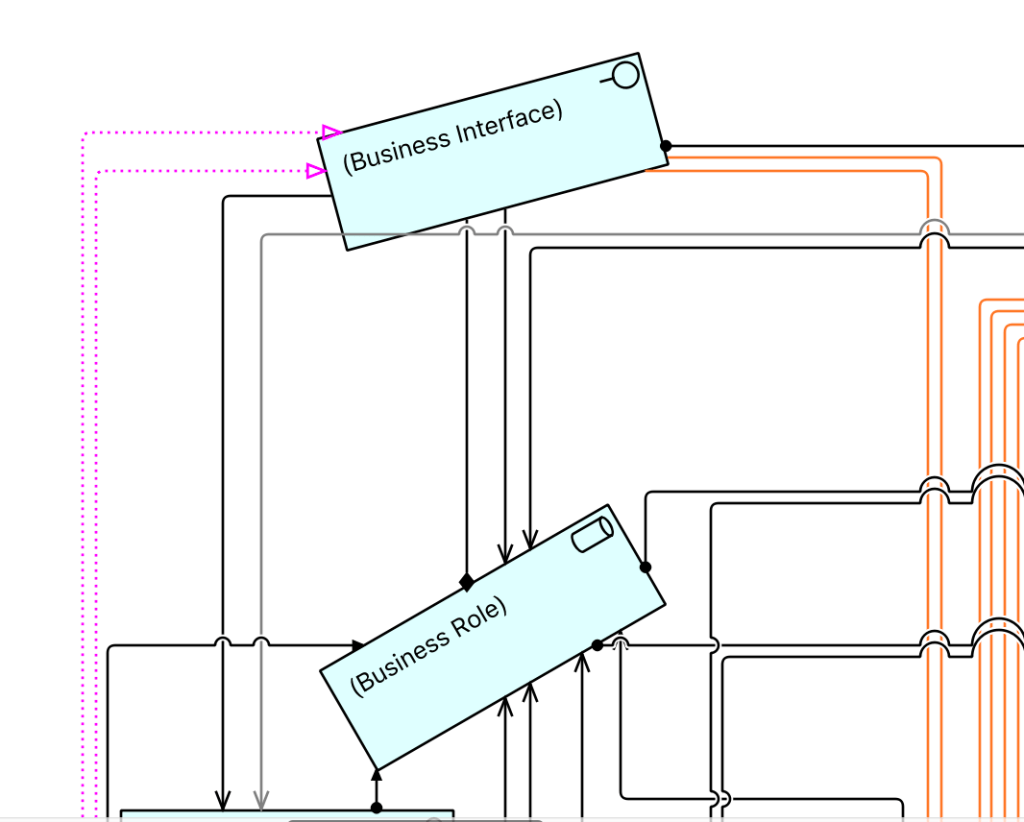 image「私たちの役割は沈み、そのインターフェースも引きずり下ろされている!」(これは私のテスト対象からの例で、Claude Code に実質的にコードの 100% を生成させました。私はそれを自分で*編集*したわけではありませんが、ジャンプの『下』にある小さなギャップのように、『上』という提案を補強する方法などを頻繁に指示しました)
まず重要な観察から始めましょう:Claude Code と私の(錆びついてはいるが十分堅牢な)プログラミングの背景知識との組み合わせのおかげで、私は Claude Code に、通常ではこれほど短時間で作成できなかったアプリケーション(現時点では未完成ですが機能的です)を生成させることができました。もし時間とエネルギーがあれば、「全く不可能」だったでしょう。しかし、そこには落とし穴があります。実際にはいくつかあります。技術的な問題や、「Claude Code は実際にどの程度『コーディング』しているのか?」という質問への回答については後ほど報告します。今日はまず、経済的な側面が私を驚かせました。
私は「バイブコーディング」という(この用語は本当に嫌いです。LLM を使おうが使まいが、コーディングに「雰囲気」などほとんどありません)実験を、今では 4 ヶ月間(フルタイムではありませんが)続けてきました。最初は LLM コーディングの感触をつかむために非常に小さなプロジェクトから始め、最終的には Claude Code で Opus 4.6 をミディアムエフォート設定で使用することに落ち着きました。もしより高い設定を使えば、しばしば道に迷う傾向がありました。逆に設定を下げると結果は悪くなりました(コードの品質管理については後日別の投稿で詳しく触れます)。その後、私の最終的なより本格的なプロジェクト(直近 2 ヶ月)では「ミディアムエフォート」の結果が悪化してきたため、「ハイ」設定に切り替え、おおよそ同じレベルの品質に戻りました。
コスト管理もこの経験の一部でした。まず、月額 20 ドルのサブスクリプションを契約しました。すぐに利用制限に直面しました。5 時間ごとにリセットされる制限と、週ごとにリセットされる制限があり、API 価格でトークンを購入することで制限を超えて利用できます。そこで、追加資金を試してみましたが、API コストで購入したトークンを利用することは、明らかに利用制限内に留まるよりもはるかに高価であることに気づきました。まだ月額 20 ドルのプランだった頃、いくつかのタスクを完了させるために追加のトークンを購入しましたが、数日で約 80 ドル分のトークンを購入してしまいました。その時点で、月額 100 ドルを支払う方が、最も安価なオプションを利用し、必要に応じて API コストレベルで資金を追加するよりも、はるかに優れた選択肢であることが明確になりました。
私はすでに、トレーニングと推論(生成 AI による結果の生成)のコストについて検討しており、コストを駆動するのはトレーニングではなく推論/生成であると結論付けていました。その結論を得た後、私は LLM-*利用*によってタスクを遂行するコストに目を向け始めました。そして私自身も—開示しますが—この研究を支援するためにいくつかの LLM チャットボット(Gemini, Claude)を利用しました。さて、LLM が信頼性に欠けると確信して読むのをやめる前に、それらは実際には非常に優れた検索エンジンです。たとえ生成したコンテンツに誤りがあるとしてもです。結局のところ、これら LLM はすべての ArXiv 論文を学習済みとしており、ページランクに基づく従来の Web 検索では不可能だったことを実現できます:それは実際のコンテンツに基づいて情報を発見することです。オフィス環境で LLM を利用する人々はこれを裏付けるでしょう。
最初に得られた回答は、サム・アルトマンの有名な「推論コストがメーターするほど安くなった」といった、標準的な手抜き回答でした。こうした発言は結果的には真実ではありましたが、誤解を招くものであり、不十分であることが後で明らかになります。結局のところ、ユーザーにとって重要なのは「トークンあたりの価格」ではなく、「解決策を得るため」あるいは「タスクを完了させるために」実際に支払う金額です。そして私たちはすでに、結果は改善されたものの、使用されるトークンの量が急増していることを知っていました。特に間接的・再帰的な(『思考』モデルと呼ばれる)モデルにおいてその傾向が顕著です。
余談:これらを「思考モデル」と呼ぶのは極めて誤解を招きます。[彼らはそのようなことは何も行っていません。彼らが実際に行っているのは、主に膨大な量の不可視な再帰処理、間接的な経路の選択、そして試行錯誤です。例えば、LLM(大規模言語モデル)が裏側で 20 通りあるいは 100 通りのアプローチを生成し、それを何度も繰り返すようなケースがあります。さらに追加ツールを使用することもあります(まず Python スクリプトを生成し、そのスクリプトを実行する—スクリプトに明らかなバグが残るまで複数回実行する必要がある)、あるいは数回テストを行ってから、その出力を LLM への追加入力として再利用します。そしてまた次のステップへ…。
非常に多くの間接処理と再帰処理があり、膨大な数の「試行錯誤」が行われますが、これらはユーザーにはほとんど見えません。]
そこで私はこの傾向の調査に着手し、「2023 年第 1 四半期から現在まで、平均的なクエリでどれほどのトークンが使われているのか?」という問いから始めました。これにより、トークンあたりのコスト低下と使用されるトークン量の増加を組み合わせることが可能になります。数回の試行の後、より焦点を絞ったプロンプトで新しい会話を開始しました。
単一のクエリの結果を望んでいるわけではないという点を常に心に留めておく必要があります。これは最も単純なタスクにおいてのみ真実です。実際には、ユーザーは複数のクエリを実行し、合意が得られるまで往復のやり取りを行います。したがって、解決に至るまでに平均してどの程度のクエリが必要かを推定することも必要です。
そして、見えないトークンも数多く存在します。請求対象外のトークンや「ダーク・トークン」があります。また、誤ラベル付けされた「推論(thinking)」モデルにおいては、背後で膨大な間接的・再帰的な処理と信じられないほどの試行錯誤が行われており、これらは入力や出力として目には見えませんが、莫大な量のトークンを使用しています。これらの「再帰的」モデルが使用するトークン量は、ユーザーが見る結果の桁違いに多いことがわかっています。
これらもまた見えないトークンですが、可視化された出力(生成)トークンのコストとして請求されます。費用感を把握するために、Opus 4.6 のトークン課金モデルでは、入力データ(クエリごとにコードベースから抽出されるデータや背景で読み込まれるデータなど)に対して 100 万トークンあたり 5 ドル、生成データ(背景で行われる「再帰的」な試行における生成を含む)に対して 100 万トークンあたり 25 ドルが請求されます。
とにかく、これのほとんどは推測に基づくものです。確実なデータは極めて少ないです。この投稿は、私が考え出せる最良かつ合理的な推定に基づいた結果であり、その一部はまさに私のこれまでの経験という「硬いデータ」でもあります。
利用コストの変遷を示すために、私は小さな枠組みを考案しました。
最初の要素は、トークンあたりのコストをどう測定するかです。以下でサブスクリプションについて検討しますが、私たちが従う基準は、「API におけるトークンあたり」のコストが時間とともにどのように変化したかという点です。これが現実のトークンコストに関する最良の推定値ですが、脆弱でもあります。なぜなら、ベンダー側がこの情報を開示しない限り、私たちは何らかの仮定を置かなければならないからです。彼らは API 価格設定で利益を得ているのでしょうか?それとも、この利用形態はまだ損失を出しており、補助金によって支えられているのでしょうか?現時点ではどちらも十分にあり得るシナリオです。そして、API 価格設定には奇妙な出来事も起こっています(後述)。しかし、私たちはより良い情報を持っていません。
今日、Claude Opus 4.6 のようなトップモデルを使用する場合、入力するトークン(コード、ドキュメント、クエリなど)100 万個あたり 5 ドル、生成されるトークン 100 万個あたり 25 ドルがかかります。これは非常に安価に思えますが、「見えない部分」がここで重要な役割を果たします。
それでは、人々が LLM(大規模言語モデル)に求めるタスクには 2 つの種類があります。1 つ目は許容性のあるタスクで、結果の精度が極めて重要ではないケースです。これは「安価な衣類」の使用例と比較できます:あまり良くはないが安いものです(この例は産業革命初期から取られており、当時工場での肉体労働の自動化が始まった時期に遡ります。デジタル革命が現在、ある種の知的労働に対して行っていること)。このような要求には、その後のフォローアップクエリや返信もはるかに少なくなり、人々は LLM が生成した結果をそのまま受け入れます。
しかし、精度が極めて重要な分野もあります。コーディングはその一例です。IT システムは非常に脆く、小さなエラー一つで航空会社全体が停止する恐れさえあります。したがって、これらのタスクは許容性のないものであり、正確な結果が必要です。他の例としては、健康や金融などが挙げられ、ここでは小さなエラーが大きな悪影響を及ぼす可能性があります。特に生成 AI においては、精度の確保が大きな課題となります。これは大規模な統計的推定に基づくものなので、不正確さは避けられないリスクとして存在します。
つまり、LLM(大規模言語モデル)に使用される「クエスト」(解決に至るまでの一連のクエリ、すなわち*タスク*)には単一の種類しか存在するわけではなく、高精度がそれほど重要ではない簡単な質問から、結果の正確性が極めて重要なタスクまで幅広く存在します。(『高速』向けに設計された)予算モデルは迅速であり、確かに単純な作業においては「計量するほど高価ではない」ほど安価ですが、解決策がデータ上で十分に表現されており、かつ問題が複雑すぎない限り、多くのケースで「十分良好」な結果を提供します。しかし、こうした予算モデルを真剣なタスクに任せてしまうと、その性質上、結果は信頼できず、したがってしばしば劣悪なものになります。一方、フロンティアモデルや—特に—再帰的(『思考』型—うっとうしい)モデルであれば、より複雑なタスクや困難な要求にも適用可能です。
今日のフロンティアモデル、例えば Claude Opus 4.x や GPT 5.x は、はるかに多くの推論を行い、内部並列化を持ち、より大きなトークン辞書で動作し、より多くの次元を有しています。また、それらが使用される質問の規模も一般的に大きくなっています。クエストあたり平均で数千トークンが必要となり、トークンあたりの計算量も増加します。
そして、(フロンティア)—— 繰り返しになりますが、誤った名称である —— 「思考」モデルがあります。これらのモデルは、タスクの内容に応じて、単一のクエリに対して数万、あるいは*数百万*のトークンを使用する可能性があります。実際、コーディング実験において Claude 4.6 Opus で同様の状況に遭遇しました。このプロジェクトではコードベースが約 36,000 行に成長しており、人間にとっては非常に単純な単一のクエリに対して約 100 万トークンを使用していました。これは、API 価格で請求された場合、単一のタスクに対する*単一の*クエリで 25 ドルかかる計算になります。確かに外れ値ではありますが、それほど極端なものではありません(単一のクエリで数十万トークンを使用するケースは、私はもっと頻繁に見かけました)。
見落としがちな第三の側面があります。「正しい」結果と「正解として受け入れられた」結果の間には違いがあるのです。また、「私が結果に満足するのはいつか」と「その結果が実際に正しいのか」の間にも違いがあります。場合によっては、正しさの確認の方が容易です(数学や一部のコードを想像してください —— 例えば「コンパイルされるか?」「実行できるか?」)。しかし、この記事のために私が行ったような調査の場合などはそうではありません。私の研究の過程で、「これはおかしい」という直感が働く結果に出くわしたことがあります。詳しく調べてみると、LLM が非常に奇妙な近道を選んでいたことが分かりました。もちろん、私が指摘すると LLM は謝罪しました。余談:LLM による謝罪は、LLM を使って行われる謝罪と同様にうんざりさせられます [apologies with the help of LLMs。]
ここで重要なのは、対象が常に変化している点に留意することです。2022 年末に ChatGPT が登場した当時、平均的なクエリは約 200 トークン程度で、応答(推論)は約 400 トークン程度だったかもしれません。しかし、今日私たちが「フロンティア」モデルで行っていることは、3 年前のフロンティアモデルでは完全に不可能でした。当時「フロンティア」と呼ばれていた能力が、今や「バジェット」レベルになっています。したがって、「トークンあたりのコスト」の歴史よりも、「タスクあたりのコスト」の歴史に注目すべきです。LLM システムは成長しましたが(スケーリングとエンジニアリングの拡大に伴い、根本的な改善はほとんどなく)、最も困難な課題もまた複雑化しています。私たちがこれらのシステムにもたらすブルートフォース( brute force)能力の成長とともに、利用規模も拡大しました。そしてこれが、私が本当に興味を持っていた問いへと導きます:私たちの「利用」はいくら高価になったのか?そして、実際に私たちはいくら支払っているのでしょうか?
私は最終的に、以下のカテゴリにおける「タスクあたりのコスト」の推定履歴を、私のフレームワーク内でプロットしました。
- バジェット会話(フォールトトレラント)。信頼性が極めて重要ではなく、間違いにくい単純な内容であれば、バジェットモデルを使用しても問題ありません。
- フロンティア会話(フォールトトレラント)。双方向の対話には上位モデルを使用しますが、結果が完璧である必要はありません。
他はすべて再帰的/間接モデルの使用に基づいています。ベンダーらはこれらのモデルを「思考」モデルと呼んでいますが、前述の通り これは完全な嘘です。私は便宜上「再帰的モデル」という用語を使用します。
- 複雑な推論 — 正しい。複雑な問題に関する会話で、その推論が正しい場合。これにはどれほどのコストがかかるのでしょうか?
- 複雑な推論 — 受け入れられた。複雑な問題に関する会話で、その推論があなたに受け入れられるが、必ずしも正しいとは限らない場合。これにはどれほどのコストがかかるのでしょうか?
- シンプルなコーディング — 正しい。モデルに簡単なスクリプト(数百行程度)の作成を依頼するか、既存のスクリプトの一部を変更するよう指示し、正しい結果を得る場合。
- シンプルなコーディング — 受け入れられた。結果を受け入れるが、あなたが気づいていない問題が存在する場合。再び、コーディングにおけるこの二つの間のギャップは複雑な推論の場合よりもはるかに小さいのは、コードのようなものでは結果が誤っているかどうかをより容易に発見できるという単純な理由によるものです。
- 複雑な複数ファイルにわたるコーディング — 正しい。あなたはより大きなコードベースにおける大幅な変更を求めています。例えば、私の実験は現在 C++ が中心の 4 万行規模のコードベースを対象としています。これはコードベース内の複数のファイルに影響を与える単一の変更を意味します。私の経験では、これを手際よく行うには Claude Opus 4.6 のような最上位モデルを拡張(再帰)モードで使用する必要があります。なお、この作業はあなたとモデルの間で数回の往復が必要になる可能性があり、その間にいくつかのテストが行われることもあります。
- 複雑な複数ファイルにわたるコーディング — 受け入れ済み。変更を受け入れますが、実際にはそれが正しくない場合もあります(後になって気づくことになります)。私の経験では、多くの場合 Claude Code と共に、Claude Code が生成したコードのデバッグに追われています。例えば、計画通りに動作しない場合、Claude は説得力を持って問題を見つけたと主張し、修正を加えます。しかしその修正も機能せず、といった具合です。なお、結果として得られるものは、Claude Code を使わずに行えたものよりもはるかに優れていますが、詳細や注意点については別の機会に説明します。
最先端モデルが手法においてますますブルートフォース(総当たり)的なアプローチを適用するようになったことで、より困難なタスクも許容される品質で実行可能となりました。そのため、私たちの利用方法はモデルの能力の変化に合わせてシフトし、コスト構造もそれに伴って変化しています。2023 年初期に実施していたタスク(そして現在も継続しているもの)は、予算モデルでも十分に処理できるため、「計測する価値がないほど安価」となっています。では、他の種類のタスクについてはどうでしょうか?
まず最初のグラフです。これは、予算制約付きの標準モデルと最先端モデルにおける標準クエリのコスト推移(結果が改善する一方で、2023 年および 2024 年の LLM を用いたコーディングはほぼ不可能でした)と、再帰型モデルを用いた複雑な推論タスクおよび単純なコーディングタスクのコストを示しています。
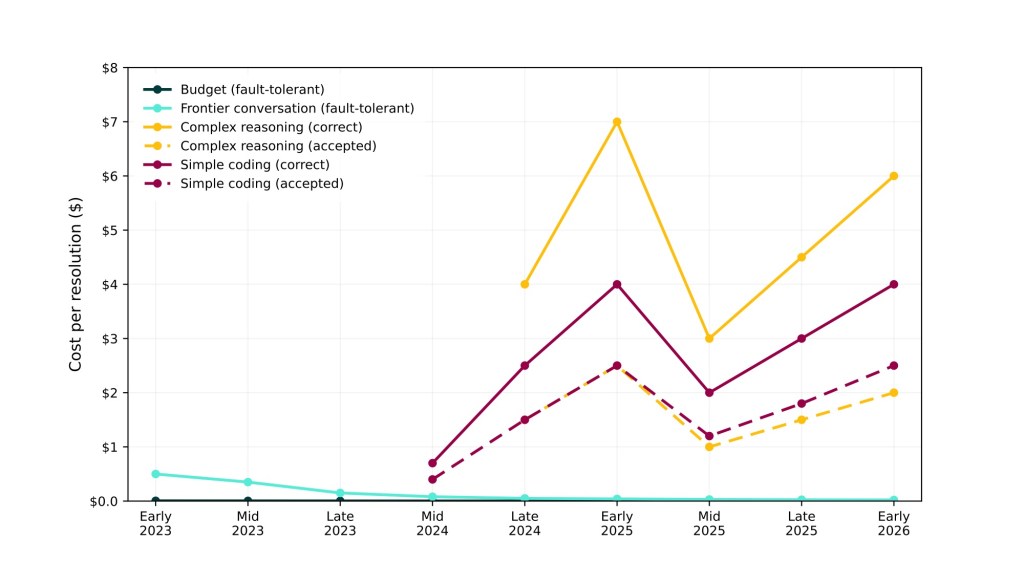 imageAPI 価格におけるタスクコスト 第 1 部**図作成:Renske Wierda(Claude のデータに基づく)
では、ここで何が読み取れるでしょうか。確かに単純な作業のコストは低下しており、これは「計測する価値がないほど安価」と言えるかもしれません。また、ブルートフォース(総当たり攻撃)の成長により、以前は不可能だったことが実現可能になりました。例えばコーディング(一定の制限内において)です。小規模なコードベース(あるいはコードベースなし)における単純なコーディングタスクでは、コストは 2〜4 ドル程度になる可能性があります。しかし、より複雑なタスクやクエストに対する努力量——そしてそれに伴うコスト——は劇的に上昇しています。大きな下落が見られるのは、Claude Opus が突如としてトークンあたりの価格を 3 分の 1 に引き下げた時です(なぜこれが起きたのかは興味深い質問ですが、私にはこれがすべて 300% の効率向上による突破だったとは考えにくいように思えます)。しかし、突然の価格下落がグラフのリセットをもたらしたとしても、その傾向自体は変わっていません。
興味深いことに、ユーザーにとって「ハードリーディング」タスクの正しさを判断することは、コードの正しさを判断するよりもはるかに困難であるため(コードは脆く、結果を使用すると多くのエラーがすぐに現れる)、コーディングの場合に比べて、「受け入れられた」ものと実際に「正しい」ものの間のギャップの方が大きくなります。これらのギャップは、受け入れ可能なまたは正しい結果を得るために必要な行き来回数の推定に基づいています(Claude Opus 4.6 がそのデータの一部を提供しました)。
しかし、適度な規模のコードベースにおける本格的なコーディングは全く異なる物語です:
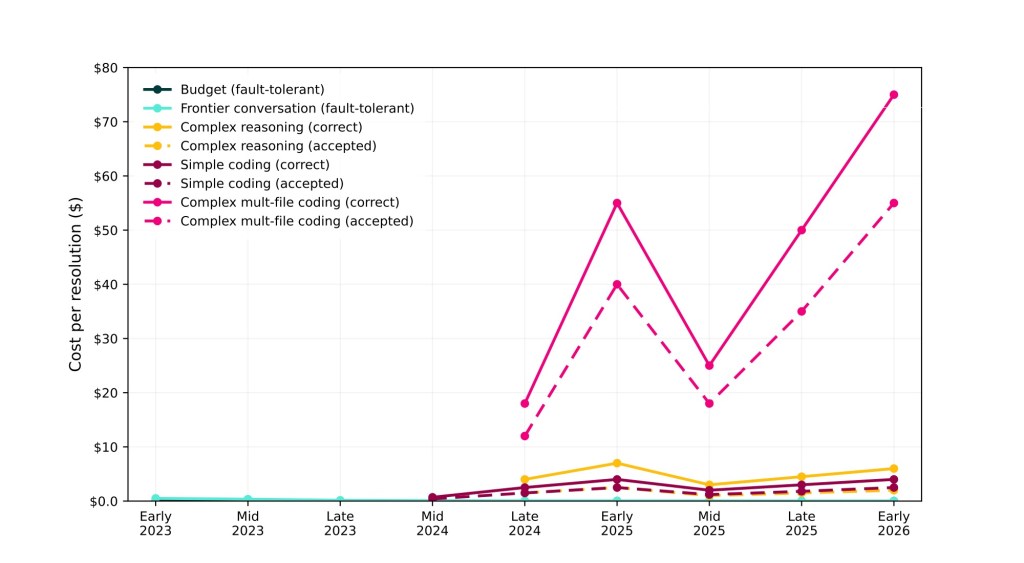 image上記に本格的なコーディングを追加した際の API 価格でのタスクコスト。
図作成:Renske Wierda(Claude のデータに基づく)
本当に難しい部分、つまり約 4 万行のミディアムサイズのコードベース(私のテストプロジェクト)で正しい変更を加えることが良い代理指標となる領域(ただし注意点あり)では、コストが完全に爆発しているように見えます。なぜなら、それを reasonably well(それなりに良く)行うには指数関数的に多くの計算が必要であり、その成長は計算あたりのより安価なコストを完全に上回るからです。
これは、タスクあたりの実際のコーディングコストが爆発したことを意味します。ここで言及しているのは、API 価格でコードベース内の*単一の*タスク/クエストを解決するものであり、その費用は約 65 ドル程度です。人間が関与するプログラミング作業(リスクを考慮するとこれが唯一理にかなっていると考えるもの)では、1 日に複数のそのようなタスクが発生します。
私の実験に戻りましょう。月額100ドルのサブスクリプションに移行した際、私はもはや使用制限にほぼ達することはなくなりました(主に私がこれをフルタイムで行っていないからです)。しかしある時、コードベース全体における大規模な変更によりClaude Codeに対して実質的に大きな労力を要する事態が発生し、再び5時間の利用制限に到達しました。これにより、これまで行っていた作業を継続できる可能性が生まれましたが、今度はAPIコスト(これまで議論してきたコストタイプ)で支払うことになります。私はAPIレートで20ドルを使用権限を与え、20分後にはその金額はすべて使い果たされていました。
はい、わずか20分で20ドルです。そして注意すべき点は、これは計画されていた大規模だが表面的な変更の完全な解決を完了したわけではないということです。Claudeが実装に忙殺されている最中でした。ご記憶のように、私は単一のクエリで100万トークンを使用する事例を目撃しており、APIの出力トークンレートで計算すると、その単一のクエリだけで25ドルの費用がかかっていたことになります。適当な規模のコードベースをフルタイムで扱う熟練したソフトウェアエンジニアは、1日にそのようなタスクを5〜10件こなす可能性があります。
2023 年初頭、私たちはクエリあたり入力 200 トークン、出力 400 トークンといった話をしていたものです。隠されたトークンやダーク・トークンの数もさほど多くはありませんでした。しかし現在、スケーリングは爆発的に拡大し、それに伴って水とエネルギーの使用量も急増しています。補足:最近ではデータセンターの規模を TFLOPS(実際の性能を示す単位)ではなくギガワットで測るようになりました。つまり「車の性能そのもの」ではなく「どれだけガソリンを消費するか」という指標です。これ自体が驚くべきことであり、「世界最重の飛行機を作る競争」を彷彿とさせます。([以前、より単純な LLM の時代に私が書いた記事でも触れましたが)、規模拡大と性能向上の間に直線的な関係があるとは決して言えません。むしろ「指数関数的な brute force(力任せ)成長が、ある程度経過した後は線形、さらにはそれよりも緩やかな改善をもたらす」という構造です。スケーリング自体がこの問題を解決するわけではありません。(面白いことに、私は当時 GPT-3 の数値から概算しましたが、人間レベルの性能を達成するには GPT-3 の約 3,500,000,000,000,000 倍(3.5 ペタ)の規模が必要になると推定しました。痛いですね。ちなみに、その推定値を根本から覆すようなものはまだ見ていません。つまり、*一部の*有用なツールは生まれるでしょうが、スケーリングによって AGI(汎用人工知能)が実現することはありません — 試行錯誤による生成や記号的部分の利用を通じたスケーリングも含まれます)。
とにかく、私の実験と最終テストプロジェクトに戻りましょう。どうやら私は月額100ドルの費用で、API料率を適用していたらその数倍はかかっていたであろうことを実行してきました。現在も実験は継続中ですが、暫定的な経済的結論/見積もりをいくつか導き出しました(他者が既に述べている内容と一致する部分もありますが、もちろんこれは全く新しい話ではありません。ただし、この技術を本格的に構築するために実際に活用しているエンジニアと、懐疑的・批判的な立場の人間との交差点は、それほど大きくない可能性が高いです)。
私のテストシナリオは、現時点では最悪のケースではありません。私は「ヒューマン・イン・ザ・ループ(人間が監視するプロセス)」を実行しています(これには十分な理由があります)。つまり、トークンを可能な限り高速に消費することはできません。私はゼロから始めましたので、Claude Code にとって邪魔になるような古いデータや不要なコード(crud)はほとんどありません。「ヒューマン・イン・ザ・ループ」を導入し、かつフルタイムでこの作業を行っていないにもかかわらず、Claude Code が示す統計情報を用いて計算すると、API 価格では 400 万トークンに対して 100 ドルを支払っており、サブスクリプション料として 180 ドルを支払っています。また、そのサブスクリプションで利用されたトークンは、もし API 価格で支払った場合、約 450 ドル相当になります。これは、実質的なコーディング用途の Max アカウントに対するサブスクリプションレベルの補助率(*factor*)が 2.5 倍であることを示しており、私はこれを自信を持って言えます。しかし同時に、私が毎週の制限枠をどれほど使用しているかも把握しています。現在は約 20% です。したがって、毎週の上限まで利用した場合(例えば、恒久的な「ヒューマン・イン・ザ・ループ」なしで無制限の「エージェント型(agentic)」利用を行う場合 — *これは非常に悪いアイデアですが、それはまた別の話です*)、最大補助率は約 12 倍になります。ちなみに、「完全なエージェント型(full agentic)」とは、LLM を監視なしでシステムに任せることを意味し、必要に応じてスクリプトを生成・実行させることです。私は、そのような行為を行うのは、そのシステムから価値あるものを完全に隔離した場合に限るべきだと考えています)。
要約すると、コード編集のような非常に複雑な作業を力ずくで行うことが、生成 AI ビジネスを実用的なツールとして世界に売り込むための『キラーアプリケーション』となっている可能性があります(さらに、Anthropic の「再帰的自己改善」に関する疑わしいブログ投稿では、AGI への道筋としても描かれています)。しかし、多くのユーザーがサブスクリプションを利用している場合、実際の費用は隠蔽されたままです。
では、私の暫定的な結論は何でしょうか?
- この『力ずくのコード編集』というパーティーは長く続かないでしょう。本当に、続きません。私が月額約 1200 ドルでこの実験を始めたでしょうか?いいえ。彼らがこのレベルのコーディングサポートを継続的に補助できるでしょうか?絶対にできません。もしこのツールを実費で提供された場合、プログラマーを大幅に減らして済ませられるでしょうか?それは、もし私がその話題に触れる機会があれば別の物語になるでしょう。今は:このパーティーは、現実が最終的に突きつけられる IPO まで続く可能性が高いです。
- 私は、Opus 4.6 以降の Anthropic の開発における一つの要因を理解しているのではないかと思っています。Opus 4.7 と Opus 4.8 は明らかに、Opus 4.6 が行っているような再帰的なブルートフォース(総当たり攻撃)をそれほど適用していません。4.8 リリース後のコメントの一部については、この Reddit のスレッドをご覧ください。私の経験では、Opus 4.6 はこれまでで最も優れていますが(もちろん、それによって私は、本来は如此短時間で実現できなかったシステムを構築することができました)、一方で私の経験では、4.8 は 4.6 よりも一段階下がったものとなっています。私の個人的な推測では、補助金要因はすでに Anthropic(および OpenAI)にとって非常に深刻な問題となっており、彼らはあまりにも多額の現金を浪費することなく、最も優れた「過剰なブルートフォース」の品質にできるだけ近づけようとして苦労しているようです。IPO を無事に達成できるかどうかという点で、資金が枯渇するリスクを抱えています。確かに、これは絶望と「ポンプ・アンド・ダンプ(株価操作)」の組み合わせのようにも感じられます。
Mythosを一般公開しなかったのは、単に実行コストが高すぎるからである可能性もあります。最近、Glasswing のパートナーの一人によるプレゼンテーションを聴きましたが、彼らは余談として、自社のコードを検証する単一のタスクで API 利用料が 35,000 ドルかかる場合があると述べました。これは、1 つのタスクあたり 14 億("b" を含む)トークンに相当します。
- 実際の費用と人々が支払う金額に関する報告が増え、私は今やこれらの報告をますます説得力のあるものとして捉えています。複雑なコーディングは生成 AI の象徴的存在となっていますが、もし私が真剣にこれを行うなら(適切なコードベースを持ち、コードの知識もあるため、システムが品質を損ない始めたかどうかを実際に確認できます)、再帰的/拡張モデルを用いた大量のブルートフォース処理が必要となり、フルタイムでこれを行った場合、1 ドルを使うごとに 10 ドルの損失を出している可能性さえあります。それ以上かもしれません。
- LLM にエンコードされたパターンに基づいて既存のコード内の脆弱性やエクスプロイトを見つけようとするなど、許容度の高い状況は、国家主体のような大規模プレイヤーにとっては手頃な価格で実現できる可能性があります。
- Anthropic の「再帰的自己改善」に関する投稿には、そのような編集コード推論のコストに関する数値だけでなく、最も基本的な批判的アプローチさえも欠けています。しかし、彼らにとって IPO への道程ではそれが不可欠なのでしょうね。
これにより、別の重要な問いが残ります:結局のところ、そのコードはどれほど良いものなのでしょうか?これはまた別の機会に扱う別々の話題です。
つまり:
- パーティーが終わるまで楽しんでください(私にとっては、おそらく Opus 4.6 が引退するか、IPO を達成して経済の現実が訪れた時点で終わるでしょう)。
- そして、その終了時に備えてください。その際、あなたが維持しなければならないのは、巨額の補助金によって支えられた「ブルートフォース」によって得られたコードかもしれません。(IT 業界では、単一のクエリで 100 万トークンを消費した事例がまさにそのような行動の一つでした)
免責事項
本記事の作成は、私の通常の作業方法とは大きく異なりました。まず、私は本格的な分析には LLM(大規模言語モデル)をあまり使いません(検索は非常に役立ちますが)。信頼性が低すぎることが明らかになりました。例えば、Opus 4.6 のデータに、(3 倍高い価格の)Opus 4.1 の価格設定が組み合わされた誤ったシナリオを経験しました。「申し訳ありません」と Claude が言いました(またしても)。しかし、全体的な要点は、私の推測ではほぼ正しいものだと考えています。もしあなたが大きな支持者であり、したがって私の批判的な記事が間違っていると考えるなら、これは Claude Opus 4.6 が「高効率」で思考した結果として私に提示・発見された内容に基づいていることを思い出してください。
良質なデータを入手することはほとんど不可能です。Opus 4.6 の価格表を見ることはできますが、「努力レベル」と呼ばれる様々な段階があり、これが使用されるトークン数に影響します。私たちが確実に知っているのは、隠れた「再帰的」トークンが出力トークンの価格で請求されるということです。しかし、『愚かな/悪いコード』と『十分良い結果』の間の絶妙なバランス点に達し、かつ『軌道から外れて森の中で迷子になる』ことを避けるために、どの程度努力レベルを設定すべきかは、実際には推定できません。そこで私は、過去数ヶ月間の自身の経験も背景に置きながら判断しました。これはすべて推測に基づくものであり、それ以上でも以下でもありません。ただし、私の個人的な利用からの統計データは非常に確固たるものなので、少なくとも確固とした、しかし事例に基づく証拠は存在します。
私は「バイブコーディング」について1年の経験がある人間でしょうか?いいえ、私はまだ(錆びついた残骸のような)古典的なソフトウェアデザイナー/エンジニアです。ついでに言えば、Claude Code の良し悪しの判断ができるだけのソフトウェアエンジニアであり、私の実験において実際の速度向上を実感できるレベルです。この程度の補助金があれば、私が現在取り組んでいるプロジェクトにおいては、私のような人間にとって間違いなく価値があります。
最後の考え — 30年前の教訓から得たAIの教訓で、今日でも通用するもの
なぜ「力ずくのコード編集」がこれほどまでに良くなったのでしょうか?(再度:「良い」ということに対する注意点は、別の靴が落ちるのを待ってください。つまり、このブログの他の記事で説明します。)
ここに、ある視点を提供する記憶があります(注意:この記憶は、現在の信念を支持するために過去を一部幻想化している可能性があります)。1990 年代後半に私がオランダ科学技術政策諮問委員会(政府系シンクタンクで、学術界や技術ビジネスのトップ人材が集まっており、私は科学スタッフとして勤務していました。彼らは実際に実務経験を持つ人を雇用しており、単なるパワーポイントの神託者だけを雇っているわけではありません)で働いていた際、私の仕事の一部分は多くの科学ジャーナリズムを読むことでした。そして、ある米国科学雑誌(おそらくサイエンティフィック・アメリカンだったと思います)に載っていた短い研究ノートを目にしました。そこには、米国の郵便局(USPS)の研究者たちが、自動手書き文字認識の成功率を当時世界最高であった約 71% から約 76% に引き上げることができた、と書かれていました。現在、このような技術は郵便事業者の間で非常に需要が高く、手紙の仕分けの大部分を自動化してコストを大幅に削減できるからです。しかし、76% という数値は、実際にこの技術を運用するにはもちろん十分ではありませんでした。
しかし、そのメモは私を驚かせました。なぜなら、当時オランダの郵便局(PTT Post)はすでに実運用において自動住所認識システムを採用しており、99% 以上の信頼性を達成していたことを知っていたからです。したがって、当然の疑問は「どうやって?」という点でした。実はその時点で存在した基本的な技術には二つありました。一つはピクセルベースのパターン認識に基づくものであり、もう一つは手書き住所のベクトル表現を抽出する手法です。前者はサイズの違いに大きな苦戦を強いられていましたが、後者は別の面で問題を抱えていました。両者とも成功率がわずかに 70% を超える程度という共通の課題を持っていました。しかし PTT Post が行ったのは、この二つの技術を組み合わせることでした。これだけではまだ正確な結果は得られませんでしたが、ある優れたエンジニアが以下のような画期的なアイデアを思いつきました(これは現在の LLM ブームをもたらした Vaswani のトリックと同等の創造的な発想だと私は考えています):住所の異なる部分の組み合わせ自体が、一般的な文字書きよりもはるかに限られた対象空間であるという点です。単に特定の都市名や通り名が存在しないだけでなく、特にそれらの組み合わせが存在しないことが重要でした。具体的には、都市名の上位候補が「アムステルダム」と「アムステルフェーン」(どちらもどこかに存在する地名として確認済み)であり、郵便番号の文字の上位推測が「1/2/8/4/A/B」および「7/5/3/8/H/B」、通りの名の上位推測が「ウェスターストラート」と「ヴェースペルストラート」(注:都市名を除くこれらはいずれも実際の例ではありません)である場合、これらの信頼性の低い推測を組み合わせることで、単一の高い信頼性を持つ結果へと変換できるのです。例えば、「アムステルフェーン」に「ウェスターストラート」が存在しない場合、その組み合わせは除外されます。また、上位の都市名や通りの名のいずれにも「7」で始まる郵便番号がない場合は、それも除外できます。このようにして、彼らは結果が取りうる自由度を極限まで制限し、当時の平均的なアルゴリズムでも処理可能な状態にしたのです。
私は、数学やコードはそうした性質を一部持っている領域だと考えています。コードは詩ではありません(一部のコードはエレガントで美しいものもありますが)、LLM に尋ねる通常の日常的な質問に比べて、多くの制約があり自由度が大幅に低い領域です。特に LLM の間接的・再帰的な利用と、「コンパイルできるか?」「テストで正確にこの結果を生成するか?」といった絶対的な検証が可能である点において、生成 AI の本質的な不正確さは効果的に制限できます(ただし、目に見えない試行錯誤のコストは非常に高くなります)。したがって、コードや数学は「特別に制約された領域」であり、他の分野よりも多くのことができるという事実は、生成 AI がより知的になっていることを示すものではなく、これらの組み合わせ的制約が望ましくない結果を排除するのに役立つ領域で、大規模なスケーリングと再帰的な適用が行われていることを示しているだけです。30 年前に手書きの住所を読み取ろうとしたときと同じです。
方法論と前提(Claude による)
「解決コスト」= タスク完了までの総費用(リトライ、バックトラック、失敗した試行、全ターンにおけるコンテキスト再送信を含む)。「承認済み」= ユーザーが出力が正しいように見えるため停止した場合。「正解」= 実際に正しいことが検証された場合(テスト、監査、クロスチェックによる)。
必ず JSON 形式で返してください。translation フィールドのみ。他のフィールド (technical_terms 等) は一切追加しないこと — 余計なフィールドを書こうとして本文翻訳がトークン上限で打ち切られる事故を防ぐため:
{"translation": "私は、数学やコードはそうした性質を一部持っている領域だと考えています。コードは詩ではありません(一部のコードはエレガントで美しいものもありますが)、LLM に尋ねる通常の日常的な質問に比べて、多くの制約があり自由度が大幅に低い領域です。特に LLM の間接的・再帰的な利用と、「コンパイルできるか?」「テストで正確にこの結果を生成するか?」といった絶対的な検証が可能である点において、生成 AI の本質的な不正確さは効果的に制限できます(ただし、目に見えない試行錯誤のコストは非常に高くなります)。したがって、コードや数学は「特別に制約された領域」であり、他の分野よりも多くのことができるという事実は、生成 AI がより知的になっていることを示すものではなく、これらの組み合わせ的制約が望ましくない結果を排除するのに役立つ領域で、大規模なスケーリングと再帰的な適用が行われていることを示しているだけです。30 年前に手書きの住所を読み取ろうとしたときと同じです。
方法論と前提(Claude による)
「解決コスト」= タスク完了までの総費用(リトライ、バックトラック、失敗した試行、全ターンにおけるコンテキスト再送信を含む)。「承認済み」= ユーザーが出力が正しいように見えるため停止した場合。「正解」= 実際に正しいことが検証された場合(テスト、監査、クロスチェックによる)。"}
キャッシュ機能なし。 プロンプトキャッシュの TTL は 5 分です(2 倍の価格で 1 時間オプションも存在します)。人間が関与するワークフローでは、通常ターン間隔は 10〜30 分程度であるため、キャッシュミスが一般的です。すべての見積もりは、各ターンでフルプライスの入力が行われることを前提としています。
各期間の最上位モデル: GPT-4(2023 年初)→ GPT-4 Turbo(2023 年末)→ GPT-4o / Claude 3 Opus($15/$75、2024 年中)→ o1($15/$60、2024 年末)→ Opus 4.0($15/$75、2025 年初)→ Opus 4.5($5/$25、2025 年中、価格が 3 分の 1 に低下)→ Opus 4.6($5/$25、2025 年末)→ Opus 4.7($5/$25、トークナイザーインフレ率 +35%、2026 年初)。
思考用トークンは出力トークンとして請求されます(Opus 4.5 以降で $25/MTok)。高負荷設定では、1 ターンあたり 30,000〜50,000 トークンの思考が発生しますが、ユーザーには表示されません(Opus では隠蔽処理が施されています)。中程度の負荷設定では、ほとんどのタスクで同様の品質を維持しつつ、思考用トークン数が約 76% 削減されます。
複雑な複数ファイルコーディングは、35,000 行以上のコードベース、15〜25 回のツール呼び出しターン、キャッシュなしでの累積コンテキストの再送信、高負荷の拡張思考を前提としています。2026 年初めの $55〜75 の範囲は、Opus 4.7 の価格設定($5/$25)に、約 500〜700 万トークンの累積入力トークンに対する 35% のトークナイザーインフレ分を加算したものです。
2025 年中の価格低下は事実です:Opus の価格が 3 分の 1 に低下($15/$75 → $5/$25)したことで、タスクの複雑さが増す中でも一時的にコストが削減されました。しかし 2025 年末には、より困難なタスクと高い思考予算によりコストは再び上昇しました。Opus 4.7 における 35% のトークナイザーインフレはこの傾向を加速させます。
正解と受け入れられた回答の間の推論ギャップは約3倍であり、これはほとんどの推論上の欠陥がユーザーには見えないからです。検証には独立した手法、モデル間での相互チェック、あるいは専門分野における知見が必要ですが、これらすべてに追加的なトークンコストがかかります。
出典: Anthropic 価格設定ページ (platform.claude.com/docs/en/about-claude/pricing)、OpenAI の価格設定、Anthropic エンジニアリングブログ(2026 年 4 月発行の努力設定に関する事後分析)、claudecodecamp.com のセッション追跡データ、Branch8 チームによるコスト分析、Faros.ai の開発者平均コスト、Verdent/Finout/MorphLLM の価格ガイド、Epoch AI のエネルギー分析、OpenRouter「AI 2025 年レポート」。
P.S.
私は OpenAI/GPT-5.x/Codex の価格設定を少しだけ確認しましたが、数値はおおよそ同等のようです。
完全な透明性のために:本記事の制作に使用された Claude との会話内容は こちら で読むことができます。
[2026 年 6 月 7 日更新:初期の投稿には誤った数値が含まれていました(実線と点線の位置が入れ替わっていました)。これは修正済みです。]
[本サイトのコンテンツを生成 AI のトレーニング(またはそれに準ずる用途)に使用することは、あなたのシステムが私のコンテンツを常に正確に表現し、出力において適切な参照(URL)を提供することを保証できる場合を除き、許可されていません。他の目的で使用したい場合は、私の明示的な許可が必要です]
原文を表示
For reasons that will remain hidden, we resume writing about Generative AI/LLM after a hiatus of 15 months (that one from October 2025, and the one from June 2025, don’t really count as serious pieces). Today, the first of two articles about “coding with Large ‘Language’ Models”, as coding with LLMs is positioned as the ‘killer app‘ for LLMs.
We interrupt this program for a short digression on Anthropic’s recently released blog post When AI builds itself.
Did Anthropic perchance hire Google marketeers?
Anthropic’s blog post is a masterclass in suggestive writing. The caveats are there, but hidden or sandwiched between more hyperbolic statements. A sentence ‘we might be wrong’ is there, but what role has it as a single sentence in thousands of words of text assuming that they are *not* wrong? The benchmarks are suspect (a 50% or even 80% success rate on a coding task compared to a human is effectively completely useless in full-agentic (no human in the loop) coding. Is checking in 8 times as many lines of code per day really a good thing? What if every day you are replacing what wasn’t OK the day before? What if LLMs edit in a way that Lines of Code becomes less trustworthy a measure as it is already? All in all, it reminds me of Google’s deceptive talk about its ‘Willow’ QM computing chip.
By the way, on that “Is checking in 8 times as many lines of code per day really a good thing?”: A lot of my LLM-based checkins have been like that, and frankly, I have increased my number of checkins just to be able to backtrack if Claude Code has gotten lost. Even with all the work I did without intermediary checkins, I committed 7 times as much change than I ended up with in terms of lines of code…. So, ‘8’ as an estimate not so much of increased productivity, but of increased overhead does sound about right…
We will return to this if I get around to writing the in-depth of ‘coding with Claude’ later.
And while we’re at it. This is a long and winding piece (I am really having some trouble on this front, apologies), so let’s provide:
TL;DR — It doesn’t look like LLM-coding is going to be affordable(let alone for “AI to build itself”)
I have been doing some experimenting. The experiment is: “How good is Claude Code anyway?”. That experiment is still running and Claude Code has by now created around 40k lines of code and a working (though incomplete) application. I hope to report on that experience in a short while (but it is a much more difficult write-up). In the meantime, I experienced the cost issue and it led to a short research project, which led to a number of interesting observations and conclusions:
- Let’s start with an important observation: Thanks to the combination of Claude Code and my own (rusty, but solid enough) programming background, I have been able to let Claude Code create this application (unfinished as of now, but functional) that I would otherwise not have been able to create in such a short amount of time, which — given time and energy — would have meant: ‘not at all’. For an experienced programmer, the initial experience is extremely impressive as an experienced programmer knows how much understanding by themselves normally goes in to creating such code;
- But… LLM-coding isn’t economically viable for most uses. It is viable now because the subscriptions are heavily subsidised. But if you use the $100 a month Claude Max plan, and you would use it to the weekly limit by going full ‘agentic coding’ (so almost no human in the loop) you would use an amount of tokens that would cost you more than $1000 at API-pricing. Anthropic seems to be busy (Opus 4.7, 4.8) to stop that bleeding, and even if that succeeds without a loss of quality, it does signal an end of substantial improvements (i.e. the end of an S-curve);
- And… while simple conversations with either budget or frontier models have become indeed ‘too cheap to meter’, the serious uses (like coding, complex reasoning) that require the recursive/indirection/tool-using/’thinking’ (not) models have exploded so much in token use that these uses have become very expensive. A single task by a top recursive model at high effort is estimated to cost around $75 at API-rates. I have seen a single query use one million tokens, which would mean max $25 at API-rates;
- So… the economic model that is being presented to the world seems based on the combination of the value of the tasks that require a maximum amount of brute force to approximate good results on anything complex, while hiding the cost or talking about ‘too cheap to meter’;
- Hence: enjoy the music for as long as this ship hasn’t sunk, and prepare a good life raft.
Here is a part of a screen shot of the application I am building (and having some fun with). It’s a real application which may support me in creating diagrams I need (so it’s a combination of data and graphics). The goal has been to investigate ‘coding with an LLM’, the thing I am building is just an example I thought I could use because I am somewhat experienced on the subject:
Let’s start with an important observation: Thanks to the combination of Claude Code and my own (rusty, but solid enough) programming background, I have been able to let Claude Code create an application (unfinished as of now, but functional) that I would otherwise not have been able to create in such a short amount of time, which — given time and energy — would have meant: ‘not at all’. But there is a catch. A few even. I will report later on the technical issues and an answer to the question: “To what extent does Claude Code actually ‘code’?”. Today it is simply the economics that struck me.
I built up my ‘vibe coding’ (I really dislike that term, there is little ‘vibe’ about coding with or without an LLM) experiment over — by now — 4 months (not full time, note). I started with a very small project to get a feel of LLM-coding, finally settled on Claude Code using Opus 4.6 on medium effort setting. If I used a higher setting it tended to get lost in the woods more often. Less, and the results were poor (more on managing the quality of the code in that later post). After a while on my final more serious project (the last two months) the results of ‘medium effort’ got worse, so I switched to ‘high’, returning to approximately the same quality.
Managing cost was also part of the experience. First, I took out a $20/month subscription. I quickly ran into usage limits. You have a limit that resets every 5 hours and one that resets every week, you can go beyond the limit by buying tokens at API-pricing. So, I tried adding some extra funds. And I noticed that the use of purchased tokens at API-cost was obviously much more expensive that staying within the usage limits. When I was still on the $20/month plan, and I bought some extra tokens to get some job finished, within a few days I had bought about $80 of tokens. At that point it became clear to me that paying $100/month was a much, much better deal than using the cheapest option and adding funds at API-cost level when needed.
I had already been looking at cost, e.g. training versus inference (generating results by Generative AI) a while back, concluding that not training, but inference/generation is what drives the cost. Having concluded that, I now started to look into the cost of LLM-*use* to perform a *task*. And I — disclosure — actually used a few LLM-chatbots (Gemini, Claude) to help me in this research. Now, before you stop reading because you are convinced these LLMs are too unreliable, they really are pretty decent search engines, even if they make mistakes on content they produce themselves. After all, they have ingested all those ArXiv articles and what a classic web search based on page-rank would not have been able to do, LLMs can: they find you information based on its actual content. People using LLMs in office setting will corroborate this.
The first answers I got were the standard quick & dirty answers, like Sam Altman’s famous: inference having become ‘too cheap to meter’. Such statements turned out to be true but also misleading/incomplete, very much so, as you will see. At the end of the day, the price ‘per token’ is not what is relevant for users, it is how much you pay for getting a ‘resolution’, or a ‘task finished’. And we already knew that while the results have improved, the amount of tokens had skyrocketed, especially with the indirect/recursive (‘thinking’ models. Aside: calling them ‘thinking models’ is extremely misleading. [They do nothing of the kind. What they do is above all a massive amount of invisible recursion, indirection, and trial and error. Like an LLM creating 20 or a 100 approaches behind the scenes, doing that time and again, use some additional tools (like first generate a python script, then run that script — having to run it multiple times until there are no obvious bugs in that script), maybe even test it a few times, and then use the output of that as more input for the LLM. And so on. A *lot* of indirection and recursion, a *lot* of ‘trial and error’, everything almost invisible to the user.] So, I investigated that trend, starting with “How much tokens did the average query use between Q1 2023 and now?” so I could combine falling per-token cost with rising amount of tokens used. After a few tries, I started a new conversation with a more focused start prompt.
It is important to keep in mind that people do not want the result of a single query, that is only true in the most simple tasks. In reality, they often make multiple queries and there is a back and forth, before they accept the result. So, you also need to estimate how many queries on average it takes to get to a resolution.
And then there are all those tokens you do not see. There are tokens that aren’t part of billing, there are ‘dark tokens’, and with the mis-labeled ‘thinking’ models there is a massive load of indirection/recursion and an incredible amount of ‘trial and error’ in the background going on, things you do not see as input or output, but all using a shitload of tokens. We know that these ‘recursive’ models use amounts of tokens that dwarf what you as a user see as result.
These are also tokens that you do not see, but they are nonetheless billed to you at visible output (generated) token cost. To get an idea of cost, Opus 4.6 when you pay per-token charges you $5/million tokens input (the data you give it, e.g. what it extracts from your code base on every query and what it reads in the background), and $25/million tokens generated data (including that generation that is in those ‘recursive efforts’ in the background.
Anyway, almost all of this is a lot of estimation. There is precious little hard data. This post is the result based on whatever best and reasonable estimates I could come up with, which in part *is* hard data: my own experience so far.
To show the development of use-cost, I’ve come up with a little framework:
The first element is how to measure per-token cost. We will look at subscriptions below, but the standard we follow is how ‘API per-token’ costs have developed over time. This is the best estimate we have of real token cost, but it is fragile, because as long as the vendors do not open up about this we must make an assumption. Do they make a profit at API-pricing? Or is that use still actually loss-making and subsidised? Either is a believable scenario at this time. And weird things have happened to API-pricing (see below). But we do not have better. Today, a top model like Claude Opus 4.6 costs you $5 for every million token you put in (your code, your documents, your queries) and $25 for every million tokens that Claude Opus 4.6 generates. That sounds very cheap, but here the ‘stuff you do not see’ is going to play a role.
Then there are two kinds of tasks people use LLMs for. One is fault-tolerant: it isn’t extremely important that the result is very accurate, this is the use that may be compared to ‘cheap clothes’: not very good, but cheap (an example taken from the start of the Industrial Revolution when physical labour started to get automated in factories, something the Digital Revolution is now doing to some mental labour). Such requests will also be followed up with far fewer follow-up queries and replies, people simply accept what the LLM produces.
But there are areas where accuracy is extremely important: coding is an example. IT is extremely brittle. One small error can bring the airline down, after all. Such quests are therefore fault-intolerant, we need correct results. Other examples may be health, finance, etc. where small errors may have large negative consequences. The amount of accuracy is especially an issue you have with Generative AI. It is large-scale statistical estimation, so inaccuracy is an unavoidable risk.
In other words, there is not a single kind of ‘quest’ (a series of queries until resolution, i.e. a *task*) that people use LLMs for, it ranges from a quick question where high accuracy is not really that important to tasks that are extremely dependent on actually correct results. The (‘fast’) budget models are quick, and indeed ‘too cheap to meter’ for simple stuff, and as long as the resolution is well represented in the data, and as long as the issue is not too complicated, the models do a ‘good enough’ job for many. Let these budget models loose on anything serious, however, and their results are by definition unreliable and thus often poor. But frontier models and — especially — recursive (‘thinking’ — ugh) models can be applied to such more complex tasks, and more difficult requests.
Today’s frontier models, such as Claude Opus 4.x or GPT 5.x do much more estimation, have internal parallelism, work with larger token dictionaries, have more dimensions, and the questions they are used for are generally larger. Expect several thousands of tokens on average for a quest, and more calculations per token.
And then there are the (frontier) — repeat ad nauseam: misnamed — ‘thinking’ models. These models may use tens of thousands, even *millions* of tokens, on a single quest depending on the task at hand. I actually ran into something like that with Claude 4.6 Opus in my coding experiment which — on a code base grown to about 36000 lines — used ~1 million tokens on a single (quite simple, for a human) query. That’s $25 for a *single* query of a single task when billed at API-prices. An outlier, certainly, but not that much of an outlier (a few hundred thousand tokens for a single query I saw much more often).
There is a third aspect that is easy to overlook. Because there is a difference between ‘correct‘ results and ‘accepted‘ (as correct) results. There is a difference between ‘when am I satisfied with the result’ versus ‘is the result actually correct’ In some cases it is much easier to verify correctness (think math, partly code — e.g. “does it compile?”, “does it run?”) than in others, like the research I have done for this article. At some point during my research I got results where my ‘common sense’ told me: “This cannot be right.”. And by digging in I found out that the LLM had taken quite a weird shortcut. For which it — of course — apologised when I pointed that out. Aside: apologies *by* LLMs are as irritating as [apologies with the help of LLMs.]
It is important to note that we are looking at a moving target here. When ChatGPT arrived late 2022, the average query may have been around 200 tokens, the reply (inference) around 400. But the things we do with ‘frontier’ models today was completely impossible with the frontier models of 3 years ago. What was ‘frontier’ capability then is ‘budget’ now. So, we look not so much at the history of ‘cost per *token*‘, but the history of ‘cost per *task*‘, where — as LLM systems have grown (with lost of scaling and engineering and little fundamental improvement) — the most difficult quests have become more complex too. Our use has grown with the growth of brute force these systems can bring to the table. And that leads to the question I was really interested in: How much more expensive has our *use* become? And how much do we actually pay?
I ended up plotting the estimated history of ‘cost per task’ for the following categories in my framework:
- Budget conversation (fault-tolerant). Reliability isn’t extremely important, it’s simple stuff that is hard to get wrong, using a budget model is fine.
- Frontier conversation (fault tolerant). Using a top model for a back and forth, but the result doesn’t need to be perfect.
The others are all based on using the recursive/indirect models. The vendors call these ‘thinking’ models but as said above that is utter bullshit. I will use ‘recursive models’ as a shorthand.
- Complex reasoning — correct. A conversation about a complex issue and the reasoning is correct. How much does that cost?
- Complex reasoning — accepted. A conversation about a complex issue and the reasoning is accepted by you, but it isn’t necessarily correct. How much does that cost?
- Simple coding — correct. You ask a model to create a simple script, maybe a few hundred lines. Or you ask it to change something in such a script. You get a correct result.
- Simple coding — accepted. You accept the result, but there are issues you haven’t noticed. Again, the gap between these two in coding is much smaller than for complex reasoning, for the simple reason that it is easier to find out if a result is incorrect with something like code.
- Complex multi-file coding — correct. You are asking for a substantial change in a larger code base. E.g., my experiment is about a code base now grown to 40k lines of code (mostly C++). We’re talking about single change that touches multiple files in the code base. Doing this without the code turning into a mess in my experience requires the most powerful models such as Claude Opus 4.6 in extended (recursive) mode. Note that this quest may take several back-and-forths between you and the model, possibly with some testing in between.
- Complex multi-file coding — accepted. You accept the change, but actually it isn’t correct (and you find out later). Actually my experience is that a lot of the time I am (together with Claude Code) busy debugging the code Claude Code has generated. Say, it doesn’t work as planned, Claude convincingly says it has found the problem. It creates a fix. Which doesn’t work, etc. Note: the result is still far more than I ever could have done without Claude Code (but details and caveats in another story).
As the frontier models have applied ever more brute force to their method, they have been able to perform harder tasks with acceptable quality. So our use has shifted with their capabilities. And so has the cost. The stuff we did early 2023 — and still do today — has indeed become ‘too cheap to meter’ as budget models can handle them well enough. But what about the other types of tasks?
Here is the first graph. It shows the development of cost (again: while results improve, coding with LLMs in 2023 and 2024 was almost impossible) of the standard queries with budget and frontier models, as well as complex reasoning and simple coding tasks with the recursive models.
So what do we see here? Well, while cost for simple things has come down — indeed this may be ‘too cheap to meter, and the growth of brute force has made things feasible that weren’t feasible before, like coding (within limits). A simple coding task in a small code base (or none) might cost something like $2-$4. But the effort — and with that the cost — per more complex tasks/quests has risen dramatically. There is a huge dip, which is when Claude Opus suddenly dropped to a third of the per-token price. (Why this happened is an interesting question (it doesn’t seem extremely likely to me this was all a 300% efficiency breakthrough), but the trend has stayed the same even if the sudden price drop did reset the graph).
Interestingly, because because it is much harder for the user to judge the correctness of ‘hard reasoning’ tasks than it is to judge the correctness of code (code is brittle and many errors will soon show when the result is used), the gap between ‘accepted’ and actually ‘correct’ for ‘hard reasoning’ is larger than for coding. (These gaps come from estimation on how many back-and-forths you need to get an accepted or correct result, for which Claude Opus 4.6 high produced some data).
But serious coding on reasonably sized code bases is quite a different story:
The really hard stuff — for which making correct changes in a medium-sized code base of about 40k lines (my test project) is a good proxy (though with caveats) — seems to have completely exploded in cost, because doing that reasonably well requires exponentially more calculations, a growth that completely dwarfs the cheaper per-calculation cost.
Which implies that actual coding cost *per task* has exploded. Note that we are talking about solving a *single* task/quest in a code base at API-pricing costing somewhere in the neighbourhood of $65. A programming job with humans in the loop (the only one I think that makes sense given the risks) will see several of those in a day.
Let’s go back to my experiment. When I moved to the $100/month subscription, I almost never did hit my usage limits anymore (mostly because I’m not doing this full time, on the contrary). But at one point — after a massive change in the entire code base that meant a real big effort for Claude Code — I hit my 5-hour limit again. That gave me the possibility to continue with the same I had been doing but now at API-cost (which is the cost-type we have been talking about until now): I gave it $20 to spend at API-rate and 20 minutes later that had been spent.
Yes: $20 in 20 minutes. And note, that did *not* complete a full resolution of the — large but superficial — change that had been planned and that Claude was busy implementing. Recall, I have seen a single *query* use a *million* tokens before, and at API output token rates that *single* query would have cost me $25. A serious software engineer working full time on a reasonably sized code base may do 5-10 such tasks on a day.
At the beginning of 2023, we were talking about, say, 200 tokens in and 400 tokens out for a query. And not a lot of hidden or dark tokens. And now, the scaling has exploded, the use of water and energy has too. [Aside: these days we do not measure data centers in TFLOPS (amount of actual performance you get) but on GigaWatt, so *not the performance of the car, but how much gasoline it slurps*. That is remarkable in itself, and it is reminiscent of “a race to build the world’s heaviest airplane…] (As I wrote earlier in simpler LLM times: we have never seen a linear link between scale and performance, it’s more ‘exponential brute force growth delivers linear — after a while even slower — improvements’. Scaling doesn’t solve this. (Real fun: I actually roughly estimated then — from GPT-3 numbers — that to get to human-level performance you would need to scale to ~3,500,000,000,000,000 the size of GPT-3. Ouch. By the way: I have seen nothing yet that changes that estimate substantially. So *some* will get useful tools, but we certainly won’t get AGI from scaling — and that includes scaling via trial-and-error generation and use of symbolic parts).
Anyway, back to my experiment and the final test project. Apparently I have been doing stuff for $100 a month that would have cost me that several times over if I had been paying API-rates. Now my experiment is still ongoing, but I have drawn/made some tentative economic conclusions/estimates (some corroborating what others have been saying already, this is of course not entirely new — though the intersection of engineers really using this technology to build something serious with those that are critical/skeptical is probably not that large).
My test scenario is by far not the worst one. I am doing ‘human-in-the-loop’ (for good reason), which means I can’t burn tokens as fast as possible. I am working from a greenfield start, so there is not a lot of crud making things hard for Claude Code. Even with ‘human-in-the-loop’ and not doing this fulltime, using the stats Claude Code can show me, I have paid $100 for 4M tokens at API-price, and $180 for subscription, and that subscription used tokens that at API-pricing would have cost me about $450. This is a subsidy *factor* of 2.5, I can pretty confidently say, will be a bottom line for the subscription level subsidy for a Max account that is actually used for coding. But I also know how much of my weekly limits I hit, which is about 20% currently. So, max up to the weekly limit (using unrestrained ‘agentic’ use with no permanent human-in-the-loop for instance — *a really bad idea, but that is for the other story*) and the max subsidy factor will become roughly 12. (By the way, ‘full agentic’ means simply letting the LLM loose on your system without supervision, letting it generate and execute scripts at will there, something I think you *really* only should do if you have isolated that system from anything valuable).
In short: brute-forcing that really complex stuff, like editing code, might be the ‘killer application’ that currently is used to sell the Generative AI business as a usable tool to the world (and even as a road to AGI with Anthropic’s suspicious blog post on ‘recursive self-improvement’). But the actual costs are kept hidden from view for many users if they use subscriptions.
So what are my tentative conclusions?
- This ‘brute force code editing’ party cannot last. Really, it can’t. Would I have started this experiment for ~$1200/month? Nâh. Can they keep subsidising coding-support at this level? Definitely not. Can we do with far less programmers if you give them this tool at real cost? That is something for the other story if I get around to it. For now: the party probably lasts until the IPOs when reality must eventually hit.
- I suspect that I understand one driver for Anthropic’s developments since Opus 4.6. Both Opus 4.7 and Opus 4.8 clearly are not applying as much recursive brute force as Opus 4.6 can. See this Reddit thread for some of the comments after 4.8 was released. Opus 4.6 is in my experience the best so far (and, sure, it has enabled me to build that system that I would otherwise not have been able to in such a short timeframe), but my experience too is that 4.8 is a step down from 4.6. My personal guess is that the subsidy factor is already a very nasty problem for Anthropic (and OpenAI) and that they are struggling to keep close to the best ‘oversized brute force’ qualities while not burning that much cash that they won’t make it to the IPO in one piece. It definitely does smell a bit like a combination of desperation and ‘pump and dump’.
Not providing Mythos to the general public may in part have simply been because it is far too expensive for them to run. I listened to a presentation of one of the Glasswing partners recently, and they mentioned as an aside that single tasks investigating their own code, could cost them $35k in API-cost. That is 1.4 billion — with a ‘b’ — tokens for a single task.
- There are more reports about actual cost versus what people pay and I tend now to find these ever more convincing. Complex coding has become the poster child of Generative AI, but if I really do this in a serious way (decent code base, and I know code, so I can actually see if the system starts to mess up the quality) I need to use a lot of brute force using a recursive/extended model, and they may be making $10 loss on any $1 I spend, if not more, if I do this full time.
- Situations that are fault-tolerant, like trying to find vulnerabilities and exploits in existing code based on the patterns encoded in LLMs, might be affordable for large players such as state actors.
- Anthropic’s post on ‘recursive self-improvement’ lacks even the most basic critical approach as well as any number on the cost of all that edit-code-inference. But they need it on the way to their IPO, I guess.
Which leaves open the other key question: how good is that code anyway? Which is a different subject for a different time.
So:
- Enjoy it while the party lasts (and for me it probably either ends when they retire Opus 4.6 or have their IPO and economic reality comes knocking).
- And prepare for when it ends, and you maybe have maintain the code that heavily subsidised ‘brute force’ has gotten you. (IT was one of such actions where a single query cost me a million tokens).
Caveats
The preparation of this article has differed a lot from my normal way of working. For one, I don’t really use an LLMs for serious analysis (search is really helpful, though). Too unreliable, and that was clear now too: I had to travel through several erroneous scenarios, e.g. where I was presented with Opus 4.6 data combined with (three times as expensive) Opus 4.1 pricing (“My apologies…” said Claude. Again.). But the overall gist is, I suspect, more or less correct. Now, if you are a big believer, and thus my critical story must be wrong, remember it is based on what Claude Opus 4.6 ‘thinking’ at ‘high effort’ produced/found for me…
Good data is almost impossible to get. You can look at Opus 4.6 pricing, but there are various levels of ‘effort’ that influence how many tokens are used. What we do know is that is that the hidden ‘recursive’ tokens are billed at the price of output tokens. But how high you have to set your effort to get the sweet spot between ‘dumb/bad code’, ‘good enough results’ and ‘careening off track and lost in the woods’ cannot really be estimated. So, I have used by own experience of the last few months also in the back of my mind. It is all an educated guess, nothing more. But my stats from my personal use are pretty hard, so we have at least some hard, but anecdotal, evidence.
Am I someone who has a year of experience with everything ‘vibe coding’? No. I’m still (the rusty remains of) a classical software designer/engineer. Enough of a software engineer, by the way, to be able to recognise good and bad decisions by Claude Code, and to experience a real speedup in my experiment. At this level of subsidy, it is definitely worth it for someone like me, with the project I am doing.
Final thought — a AI-lesson from 30 years ago, applicable today
Why has ‘brute force code editing’ become so good? (Again: for the caveats on ‘good’, wait for the other shoe (i.e. article on this blog) to drop.)
Here is something I remember (warning: memory is in part fantasising about the past to support your current convictions) that offers a perspective. When, in the second half of the 1990s, I worked for the Dutch Advisory Council for Science and Technology Policy (a government think tank filled with top people from academic science and technological business, I was a scientific staff member — they actually hired people with real technical experiece and experience and not just powerpoint shamans) part of my job was to read a lot of science journalism. And I came across a short research note in a US science magazine — I think it was Scientific American — that said researchers at USPS had been able to increase automatic handwriting recognition to something like 76% success rate, up from something like 71%, the top in the world at that time. Now, such technology was in hot demand at postal operators so they could automate most of the sorting of letters, saving a lot of cost. 76% was of course far from enough to actually use this.
But the note surprised me, because I knew the Dutch postal service (PTT Post at the time) already was using automatic address recognition in production with over 99% reliability. So, the question obviously was: how? It turned out that there were two basic technologies at the time. One was based in pixel-based pattern recognition, the other was based on extracting a vector-based representation of the handwritten address. The pixel-one had a lot of trouble with sizes, the vector one had trouble in other ways. Both had that same slightly over 70% success rate. But what PTT Post had done was combine the two. Which still did not give you accurate results, but then some brilliant engineer had the following idea (I think comparable in brilliant creativity to Vaswani’s trick that led to the current LLM-boom): the actual combinations of different parts of addresses were a far more limited target space than writing in general. Not just that some cities and street names simply do not exist, but especially that combinations do not exist. It went like this: suppose your top matches for the city are ‘Amsterdam’ and ‘Amstelveen’ (all checked as placenames that have to exist somewhere). And your top guesses for postal code characters were ‘1/2/8/4/A/B’ and ‘7/5/3/8/H/B’ and your top guesses for street name were ‘Westerstraat’ and ‘Weesperstraat’ (Note: all these except the city names are not real examples), then together these low-reliability guesses could turn into a single high-reliability result. E.g. when there wasn’t a ‘Westerstraat’ in ‘Amstelveen’, this combination could be skipped. And if no postal code of any of the top city/street matches would start witha ‘7’ that could be dropped too. Etc. What they did was limit the actual freedom for results so much that the mediocre algorithms of the day could cope.
I am thinking about this because math and code are areas that have some of that. Code is not poetry — though some code is elegant and beautiful — and there are a lot of constraints that make the area have much less degrees of freedom that, say, a normal everyday question you can ask an LLM. Especially with the indirect/recursive use of LLM, and the absolute checks possible (“does this compile?” “does it produce exactly this result in a test?”) the essential inaccuracy of Generative AI can be effectively constrained (though at a high cost in — invisible — trial and error). Hence, code and math are ‘specially constrained domains’ and the fact that we can do much more in them that others is not a sign that Generative AI is getting more intelligent, but that it is being applied in massive scaling and recursion in a domain that has all these combinatory restrictions that help weed out undesired results. Just like 30 years ago when trying to read hand-written addresses.
Methodology & assumptions (by Claude)
Resolution = total cost until the task is done, including retries, backtracking, failed attempts, and context resend across all turns. “Accepted” = user stops because output looks right. “Correct” = verified to actually be right (tested, audited, cross-checked).
No caching. Prompt cache TTL is 5 minutes (1-hour option at 2× price exists). For human-in-the-loop workflows where turns are typically 10–30 minutes apart, cache misses are the norm. All estimates assume full-price input on every turn.
Top model at each period: GPT-4 (early 2023) → GPT-4 Turbo (late 2023) → GPT-4o / Claude 3 Opus at $15/$75 (mid 2024) → o1 at $15/$60 (late 2024) → Opus 4.0 at $15/$75 (early 2025) → Opus 4.5 at $5/$25 (mid 2025, 3× price drop) → Opus 4.6 at $5/$25 (late 2025) → Opus 4.7 at $5/$25 with +35% tokenizer inflation (early 2026).
Thinking tokens are billed as output tokens ($25/MTok for Opus 4.5+). On high effort, thinking can be 30–50K tokens per turn, invisible to the user (redacted on Opus). On medium effort, ~76% fewer thinking tokens with similar quality on most tasks.
Complex multi-file coding assumes a 35K+ line codebase, 15–25 tool-call turns, cumulative context resend without caching, high effort extended thinking. The $55–75 range at early 2026 reflects Opus 4.7 pricing ($5/$25) plus 35% tokenizer inflation on ~5–7M cumulative input tokens.
The mid-2025 dip is real: the 3× Opus price drop ($15/$75 → $5/$25) temporarily reduced costs even as task complexity grew. By late 2025, harder tasks and higher thinking budgets pushed costs back up. The 35% tokenizer inflation on Opus 4.7 accelerates this.
The reasoning gap between accepted and correct is ~3× because most reasoning faults are invisible to the user. Verification requires independent methods, cross-model checking, or domain expertise — all of which cost additional tokens.
Sources: Anthropic pricing page (platform.claude.com/docs/en/about-claude/pricing), OpenAI pricing, Anthropic engineering blog (April 2026 postmortem on effort settings), claudecodecamp.com session tracking data, Branch8 team cost analysis, Faros.ai developer cost averages, Verdent/Finout/MorphLLM pricing guides, Epoch AI energy analysis, OpenRouter State of AI 2025.
P.S.
I have looked shortly at OpenAI/GPT-5.x/Codex pricing and it seems the numbers are roughly comparable.
Full transparency: the conversation with Claude that was used for the production of this article can be read here.
[Update 07/Jun/2026: The initial post featured figures with an error (solid and dotted lines were switched). This has been repaired.]
[You do not have my permission to use any content on this site for training a Generative AI (or any comparable use), unless you can guarantee your system never misrepresents my content and provides a proper reference (URL) to the original in its output. If you want to use it in any other way, you need my explicit permission]
関連記事
今日のまとめ
AI日報で今日の重要ニュースをまとめ読み