科学者たちが地球外に存在するはずのない巨大な「空洞」を発見
研究者チームがドローンを用いてドミニカ沖でマッコウクジラの出産を初めて詳細に撮影・記録し、出産後の群れによる新生児と母親への協力的な支援行動を観察した。
キーポイント
マッコウクジラの出産の初詳細記録
2023年7月8日、ドミニカ沖で研究者チームがドローンを用いてマッコウクジラの34分間の出産全過程を高解像度で初めて詳細に撮影・記録した。
出産後の群れによる協力的行動
出産後、群れの他の成体メスが母親と新生児の周囲に密集し、新生児を水面に押し上げるなど物理的に支援する「クジラのドゥーラ」のような協力的行動が約1時間にわたり観察された。
複雑な社会性への新たな洞察
この観察は、世代を超えたメス中心の緊密な母系クランを形成するマッコウクジラの複雑な社会性について「前例のない洞察」を提供する。
研究プロジェクトと観察の文脈
観察はマッコウクジラの行動とコミュニケーションを研究するプロジェクト「CETI」の研究者らによって行われ、既知の個体(ラウンダー/クジラ#5714)を対象とした。
クジラの出産介助行動の発見
研究チームは、霊長類以外の種で初めて出産介助行動を確認し、これまで人間と近縁種に特有と考えられていた行動が他の種にも存在する証拠を示した。
マッコウクジラの頭突き行動の初映像記録
ドローンを用いた観測により、アゾレス諸島とバレアレス諸島の若いマッコウクジラ同士の頭突き行動が初めて映像で記録され、科学的に記述された。
地球と月の間に発見された宇宙線空洞
中国の月探査機Chang'e-4の観測データから、地球の磁場によって銀河宇宙線が遮られる巨大な空洞が地球と月の間に存在することが明らかになった。
重要な引用
"Other adult females positioned themselves closely around [Rounder]"
"The group rapidly transitioned to cohesive and highly active behavior; individuals took turns lifting the newborn, physically supporting and pushing it to the surface"
It also offers "unprecedented insights" into the complex sociality of sperm whales
“These analyses provide evidence of birth attendance, or assistance, in a nonprimate species, a behavior long considered characteristic only of humans and their close relatives,” the team concluded.
“To our knowledge, this behavior has not previously been positively confirmed in sperm whales with supporting documentation, or scientifically described,” the team said.
Rats exposed to radiation exhibited altered “cost–benefit decision-making…in both sexes” and “males displayed a global degradation of reward sensitivity...whereas females exhibited a selective shift toward high-risk, low-probability choices,”
影響分析・編集コメントを表示
影響分析
この発見は海洋生物学・動物行動学において、従来観察が困難だった深海生物の社会行動を非侵襲的に記録する方法論を示した点で意義がある。しかし、直接的にはAIやテクノロジー業界への影響は限定的であり、主に学術的な価値に留まる。
編集コメント
記事タイトルは宇宙の「空洞」発見を暗示するセンセーショナルなものだが、実際の内容はクジラの出産観察に関するものであり、AI/テクノロジーニュースとしての直接的な関連性は低い。技術的観点ではドローンを用いた観測手法にのみ軽微な関わりがある。
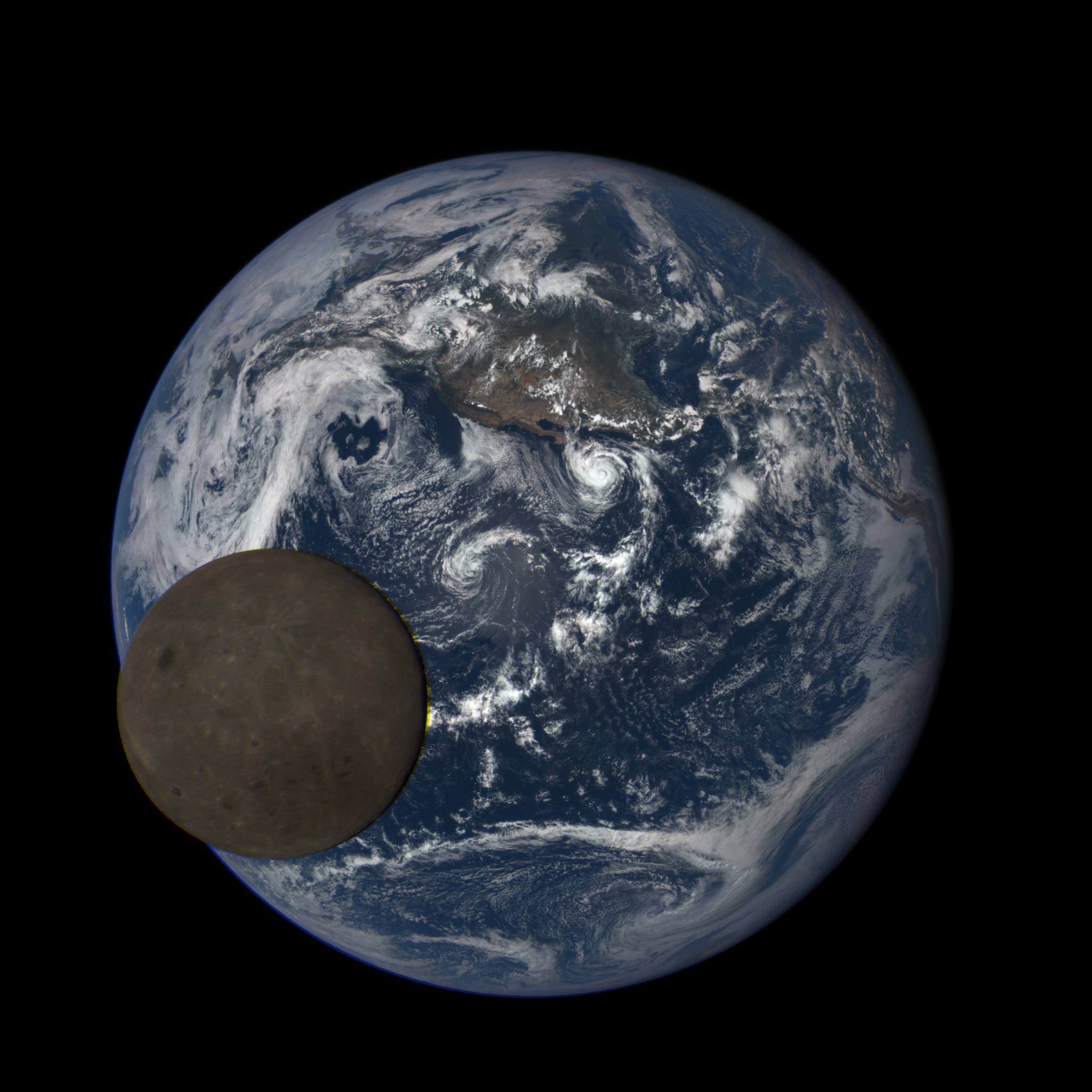 image『アブストラクト』へようこそ!今週は、1トンの赤ちゃんの誕生、伝説的な動きの撮影、宇宙空間の「穴」の発見、そして火星環境下での脳の働きに関する研究など、興味深い報告が集まりました。
まずは、ラウンダーという名のマッコウクジラが、思いがけない訪問者たちに囲まれながら、カメラの前で出産を遂げた様子から。続いて、外洋で繰り広げられる最強の頭突き、宇宙の脅威から守られる天然の避難所、そして宇宙シミュレーターへ旅したラットたちの実験結果をご紹介します。
いつものように、私の他の作品にご興味があれば、著書『First Contact: The Story of Our Obsession with Aliens』をご覧になるか、個人ニュースレター『the BeX Files』の購読をご検討ください。
約900キロの赤ちゃん、おめでとう
Maalouf, Alaa, DelPreto, Joseph, Lucas, Maxime, and Poetto, Simone et al. 「Cooperation by non-kin during birth underpins sperm whale social complexity.」 Science.
最も威厳ある生物、マッコウクジラに関するニュースにとって、今週は特別な一週間でした。どうしても『白鯨』の語り手イシュメールばりの口調になってしまいます。というのも、二つの独立した研究が、この神秘的な海洋哺乳類の水中世界に迫り、これまで映像で捉えられたことのない習性を観察したからです。
まず研究者らが、マッコウクジラの出産の詳細な初映像を報告しました。科学者たちは2023年7月8日の朝、ドミニカ沖でドローンを使い、その全過程を記録することに成功しました。
これまで少数例の出産観察例はありましたが、この高解像度の空撮映像は、はるかに包括的な記録です。研究チームは34分間に及ぶ分娩の全過程を追跡し、その後も継続して観察を続け、クジラの群れのメンバーが子クジラとその母親(よく研究されたメス個体、ラウンダー、別名#5714)を援助する様子を捉えました。
「他の成体のメスたちは(ラウンダーの)周囲に密着するように位置取りました」と、マッコウクジラの行動とコミュニケーションを研究するプロジェクト「CETI」の共同リーダー、Alaa Maalouf、Joseph DelPreto、Maxime Lucas、Simone Poettoは述べています。「血の噴出と、その直後の新生児の観察により、出産の瞬間は午前11時46分と確認されました」
「群れは速やかに結束した、非常に活発な行動へと移行しました。個体が順番に新生児を持ち上げ、物理的に支え、水面へと押し上げたのです」とチームは続けます。「この段階は約1時間続き、その間、群れ全体が密集した状態を保ちました。さらに、フレイザーイルカ(Lagenodelphis hosei)が群れの近くを通過し、マッコウクジラの群れを取り囲んだり、時折その下を潜ったりするパイロットクジラ(Globicephala macrorhynchus)との短い交流も見られました」
これは、新たな命の誕生、クジラの「助産師」たち、そして「産室」に現れた好奇心旺盛な傍観者たちによる崇高な光景です。研究によれば、この観察は、多くの世代にわたるメンバー間で役割を分担する緊密な母系氏族を形成するマッコウクジラの複雑な社会性について、「前例のない洞察」をもたらすものです。
「これらの分析は、非霊長類において、出産時の介助(援助)が行われている証拠を提供します。この行動は長らく、人類とその近縁種にのみ特徴的と考えられてきたものです」と研究チームは結論づけています。
潮を吹く、そして頭突きを喰らわす!
Burslem, Alec et al. 「Headbutting Behavior Between Sperm Whales Documented Using Unoccupied Aerial Vehicles.」 Marine Mammal Science.
水の中の「産褥」を覗き見た報告に加え、別の研究チームがマッコウクジラ同士の頭突きを捉えた初の映像を報告しました。
「ここでは、アゾレス諸島とバレアレス諸島における若いマッコウクジラ間の頭突きおよび頭部接触について、3件のUAV(ドローン) 観察結果を提示します」と、セント・アンドリューズ大学での以前の職務においてこの研究を行った、ハワイ大学マノア校のAlec Burslem率いる研究者らは述べています。
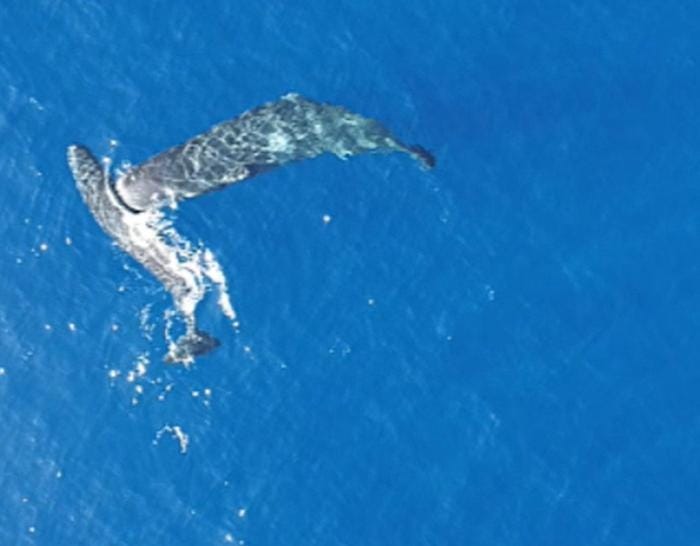 imageその通り、頭突きです。画像: Association Tursiops「私たちの知る限り、この行動が裏付け資料とともに確実に確認され、科学的に記述されたのは初めてです」とチームは述べています。
頭突しが映像に捉えられたのは今回が初めてですが、その行動は何世紀にもわたり、多くの船乗りによって伝聞的に語られてきました。研究論文は、1820年にマッコウクジラの頭突きによって船体を破壊され沈没した捕鯨船エセックスの生存者、オーウェン・チェイスの言葉から始まっています。この事件はハーマン・メルヴィルの『白鯨』のインスピレーションとなりました。小さな捕鯨船で数か月にわたって漂流する中で、乗組員のほとんどが死亡し、チェイスは生き延びるために死亡した仲間の肉を食べることを余儀なくされました。
要するに、マッコウクジラは命を与え、また命を奪うこともある。以上、マッコウクジラニュースでした。
マッコウクジラ以外のニュースでは…
銀河宇宙線の空白域に注意
Shang, Wensai, Liu, Ji, and Xu, Zigong et al. 「A galactic cosmic ray cavity in Earth-Moon space.」 Science Advances.
科学者たちが、地球と月の間に、どんな歯科医も埋められないほどの巨大な「空洞」を発見しました。こう思うかもしれません――宇宙自体がすでに巨大な空洞なのでは? 確かに宇宙の大部分は空虚ですが、超新星爆発やガンマ線バーストなどの宇宙的惨事によって放出される高エネルギー粒子、銀河宇宙線(GCRs) が大量に存在しています。
今回、月の裏側に着陸した世界初の探査機、中国の嫦娥4号の観測により、地球の磁場によってGCRsが遮られる巨大な空洞の存在が明らかになりました。これらの宇宙線は人体に有害であるため、この空洞は将来のミッションにおいて、宇宙飛行士が微小な「宇宙の弾丸」から身を守る有用な遮蔽空間を提供する可能性があります。
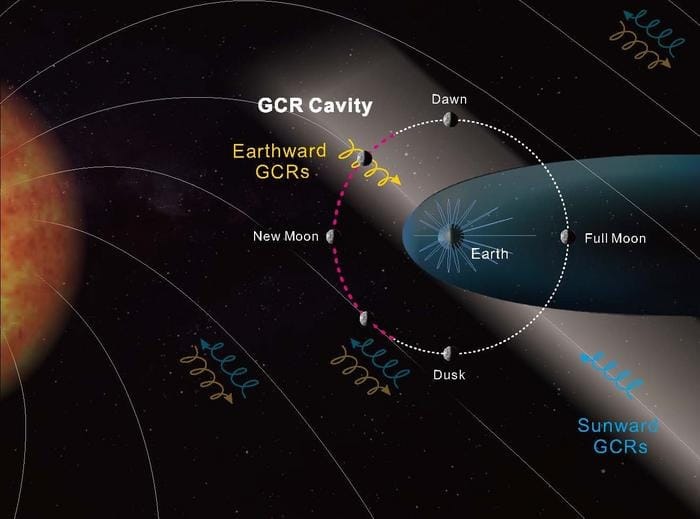 imageGCR空洞を示す図。画像: Shang et al., Sci. Adv. 12, eadv1908
「GCRsは以前、地球-月空間全体にほぼ均一に分布していると考えられていました」と、山東大学(威海)のShang Wensai、アルバータ大学のJi Liu、キール大学のZigong Xuが共同で率いる研究者らは述べています。この巨大な空洞の存在は、「被曝リスクを低減するために、作業をこれらの低放射線期間に合わせるなど、ミッション計画における潜在的な戦略を提供します」
巨大な新たな宇宙シールドが発見される日はめったにありません! 時には、空洞も悪くないのです。
宇宙飛行士ラットの脳
Britten, Richard et al. 「Exposure to low (10 cGy) doses of simulated space radiation impairs reward-guided decision making in both male and female rats.」 Life Sciences in Space Research.
人類が宇宙探査を続けるのであれば、奇妙な空洞よりもはるかに多くの防護が必要です。新しい研究で、科学者たちはラットを実験室内で模擬宇宙放射線に曝露し、それが脳の報酬とリスクに関する回路に測定可能な影響を与えることを発見しました。
放射線を浴びたラットは「オスメス両方において」変化した「費用便益意思決定…を示し」、「オスは報酬感受性の全体的な低下を示した…一方、メスは高リスク・低確率の選択肢への選択的偏りを示した」と、オールド・ドミニオン大学のRichard Brittenが率いる研究者らは報告しています。
この発見は、宇宙空間における長期滞在の多くの有害な健康影響に関する、増え続ける研究の一端をなすものです。NASAが来月、アポロ時代以来初めて有人月周回飛行となるアルテミス2ミッションの打ち上げを準備している今、宇宙旅行の夢と現実的なトレードオフについて考える絶好の機会です。
すべてが計画通りに進めば、アルテミス2の乗組員が宇宙に滞在するのは10日間のみで、受ける放射線量は無視できるレベルです。しかし、有人火星旅行には少なくとも数年を要します。この新研究は、「慢性的な低線量の宇宙放射線が、宇宙飛行士のパフォーマンスとミッション安全の重要な要素である行動調節をどのように損なう可能性があるかについての理解を深めるもの」です。
それでは、地球上でも地球以遠でも、安全な旅と健康な脳をお祈りします。
お読みいただきありがとうございました!また来週。
原文を表示
imageWelcome back to the Abstract! Here are the studies this week that gave birth to a one-ton baby, captured a legendary move on film, discovered a hole in space, and imagined our brains on Mars.
First, a sperm whale named Rounder gives birth on camera, complete with some surprise guests. Then: the deadliest headbutts on the high seas, a natural refuge from cosmic wrath, and rats take a trip to the space simulator.
As always, for more of my work, check out my book First Contact: The Story of Our Obsession with Aliens or subscribe to my personal newsletter the BeX Files.
Congratulations on your 2,000-pound baby
Maalouf, Alaa, DelPreto, Joseph, Lucas, Maxime, and Poetto, Simone et al. “Cooperation by non-kin during birth underpins sperm whale social complexity.” Science.
What a week it has been for the most majestic of all beats: sperm whale news. I’m going to have to go a little Ishmael on your asses, because two unrelated studies have peered into the underwater realm of these mysterious marine mammals and observed customs that have never been captured on film before.
First, researchers report the first detailed footage of a sperm whale birth, which scientists recorded in full with drones on the morning of July 8, 2023, off the coast of Dominica.
Though a handful of sperm whale births have been previously observed, this high-resolution aerial imagery is by far the most comprehensive footage. The team tracked the entire 34-minute delivery, followed by an extended postpartum period that revealed the members of the whale clan providing assistance to the calf and its mother, who is a well-studied female named Rounder (a.k.a whale #5714).
“Other adult females positioned themselves closely around [Rounder],” said researchers co-led by Alaa Maalouf, Joseph DelPreto, Maxime Lucas, and Simone Poetto of Project CETI, a collaboration that studies sperm whale behavior and communication. “Plumes of blood and the subsequent observation of the newborn marked the moment of delivery at 11:46 a.m.”
“The group rapidly transitioned to cohesive and highly active behavior; individuals took turns lifting the newborn, physically supporting and pushing it to the surface,” the team continued. “This phase continued for about an hour, during which time the entire unit remained tightly grouped. In addition, there were close passes by Fraser’s dolphins (Lagenodelphis hosei) and brief interactions with pilot whales (Globicephala macrorhynchus), which encompassed the sperm whale cluster and occasionally dove beneath them.”
It’s a sublime scene of new life, whale doulas, and curious bystanders in the delivery room. It also offers "unprecedented insights” into the complex sociality of sperm whales, a species that forms tight-knit matrilineal clans that share labor among members that span many generations, according to the study.
“These analyses provide evidence of birth attendance, or assistance, in a nonprimate species, a behavior long considered characteristic only of humans and their close relatives,” the team concluded.
Thar she blows, and headbutts!
Burslem, Alec et al. “Headbutting Behavior Between Sperm Whales Documented Using Unoccupied Aerial Vehicles.” Marine Mammal Science.
In addition to that glimpse into the watery birthing bed, a separate team reports the first ever video footage of sperm whales headbutting each other.
“Here, we present 3 UAV (drone) based observations of head-butting and head-first contact between young sperm whales in the Azores and Balearic archipelagos,” said researchers led by Alec Burslem of the University of Hawaii at Manoa, who conducted the study in a previous role at the University of St. Andrews.
imageYup, that’s a headbutt. Image: Association Tursiops“To our knowledge, this behavior has not previously been positively confirmed in sperm whales with supporting documentation, or scientifically described,” the team said.
While this is the first time the headbutting has been captured on film, it has been anecdotally described by many sailors over the centuries. The study even opens with a quote from Owen Chase, a survivor of the whaling ship Essex, which was sunk by a sperm whale that rammed its head into the hull in 1820, providing the inspiration for Herman Melville’s Moby Dick. Over the course of months adrift on small whaleboats, most of the crew died and Chase was forced to resort to cannibalism of deceased crewmates to survive.
In short: The sperm whales give life, and the sperm whales taketh life away. This has been sperm whale news.
In non-sperm-whale news…
Mind the galactic cosmic ray gap
Shang, Wensai, Liu, Ji, and Xu, Zigong et al. “A galactic cosmic ray cavity in Earth-Moon space.” Science Advances.
Scientists have discovered a giant cavity between Earth and the Moon that no dentist could ever hope to fill. You might be thinking—isn’t space already one big cavity? But while space is mostly sparse, it contains plenty of galactic cosmic rays (GCRs), energetic particles shot out by cosmic cataclysms like supernovas or gamma ray bursts.
Now, observations from China’s Chang’e-4, the first spacecraft ever to land on the far side of the Moon, has revealed a huge void where GCRs are warded off by Earth’s magnetic field. Given that these rays are hazardous to human health, the cavity could provide astronauts with some helpful cover from tiny cosmic bullets in future missions.
imageA figure depicting the GCR cavity. Image: Shang et al., Sci. Adv. 12, eadv1908
“GCRs were previously considered to be approximately uniformly distributed throughout the Earth-Moon space,” said researchers co-led by Wensai Shang of Shandong University at Weihai, Ji Liu of the University of Alberta, and Zigong Xu of Kiel University. The presence of the giant cavity “provides a potential strategy for mission planning…as operations could be timed to coincide with these lower radiation periods to reduce exposure risk.”
It’s not every day you unlock a giant new space shield! Sometimes, a cavity can be a good thing.
The brains of rats-tronauts
Britten, Richard et al. “Exposure to low (10 cGy) doses of simulated space radiation impairs reward-guided decision making in both male and female rats.” Life Sciences in Space Research.
If humans do continue to explore space, we’ll need a lot more than a weird cavity to protect us. In a new study, scientists exposed rats to simulated space radiation in a lab and discovered that it had measurable impacts on the reward and risk circuits in their brains.
Rats exposed to radiation exhibited altered “cost–benefit decision-making…in both sexes” and “males displayed a global degradation of reward sensitivity...whereas females exhibited a selective shift toward high-risk, low-probability choices,” said researchers led by Richard Britten of Old Dominion University.
The findings add to a growing body of research on the many deleterious health effects of prolonged periods in space. As NASA prepares to launch Artemis 2 next month—the first mission to send humans to fly by the Moon since the Apollo era—it’s the perfect time to reflect on the realistic tradeoffs of our spacefaring dreams.
Assuming all goes to plan, the Artemis 2 crew will only be in space for 10 days, and will experience a negligible radiation dose. But a crewed trip to Mars would take at least a few years. To that end, the new study “advances understanding of how chronic low-dose space radiation may compromise behavioral regulation—a critical component of astronaut performance and mission safety.”
With that, here’s to happy travels and healthy brains—on Earth and off it.
Thanks for reading! See you next week.
関連記事
今日のまとめ
AI日報で今日の重要ニュースをまとめ読み