GPT-5.6 の再帰的自己最適化により GPT-5.4 の知能コストが 13 倍低下し価格も大幅に引き下げられる
本文の状態
日本語全文を表示中
詳細モードで約15分の本文を読めます。
同じ出来事の情報源
この情報源を基点に整理
Latent Space
OpenAI は GPT-5.6 の再帰的自己最適化により推論コストを大幅に削減し、20%〜80% の価格引き下げと高速モードの導入を発表した。
AI深層分析を開く2026年7月31日 21:55
AI深層分析
キーポイント
GPT-5.6 Sol による自己最適化
同モデルが生産トラフィックを分析し、Triton や Gluon 言語でカーネルを自律的に書き換えることで、エンドツーエンドのサービングコストを 20%削減した。
推論効率化技術の導入
スペキュレティブ・デコーディングの改善によりトークン生成効率が 15%向上し、KV キャッシングやバッチ処理の最適化で既存ハードウェアからの推論能力を最大化した。
アジェンティック・ハーネスの改良
Rust オーケストレーション層を最適化してコンテキスト肥大化を防ぎ、プロンプトキャッシュを活用することで反復計算コストを削減した。
価格改定と新モード発表
小型モデルの価格を大幅に引き下げるとともに、Sol モデル向けに 2.5 倍高速な「Faster mode」を導入したが、7 月に予告された Cerebras 駆動の 10 倍速モードは含まれていない。
GPT-5.6 の価格引き下げと新tier導入
OpenAIはGPT-5.6 Lunaを80%、Terraを20%値下げし、遅延が最大2.5倍低いSol Fast tierを追加した。これによりエージェントワークフローのコストが約10分の1になると見込まれている。
重要な引用
GPT-5.6 Sol was actively used to analyze production traffic, tune load balancing, and autonomously rewrite production kernels
autonomous kernel optimization reduced end-to-end serving costs by 20%
increasing token-generation efficiency by over 15%
GPT-5.4 costs $2.50/$15; Luna now costs $0.20/$1.20.
編集コメントを表示
編集コメント
記事は OpenAI が自社のモデルを用いてインフラを最適化するという、技術的な自己進化の事例を詳細に伝えている。ただし、文中で言及されている「GPT-5.6」や「Sol」「Cerebras-driven mode」などの具体的な名称と性能数値は、現時点での公式発表内容として事実を記述しているが、実際の製品名や機能との整合性は公式情報による確認が必要である。
Source Article
元記事を日本語で読む
本文に関係しない購読案内、埋め込み通知、サイト内プロモーションは除いています。
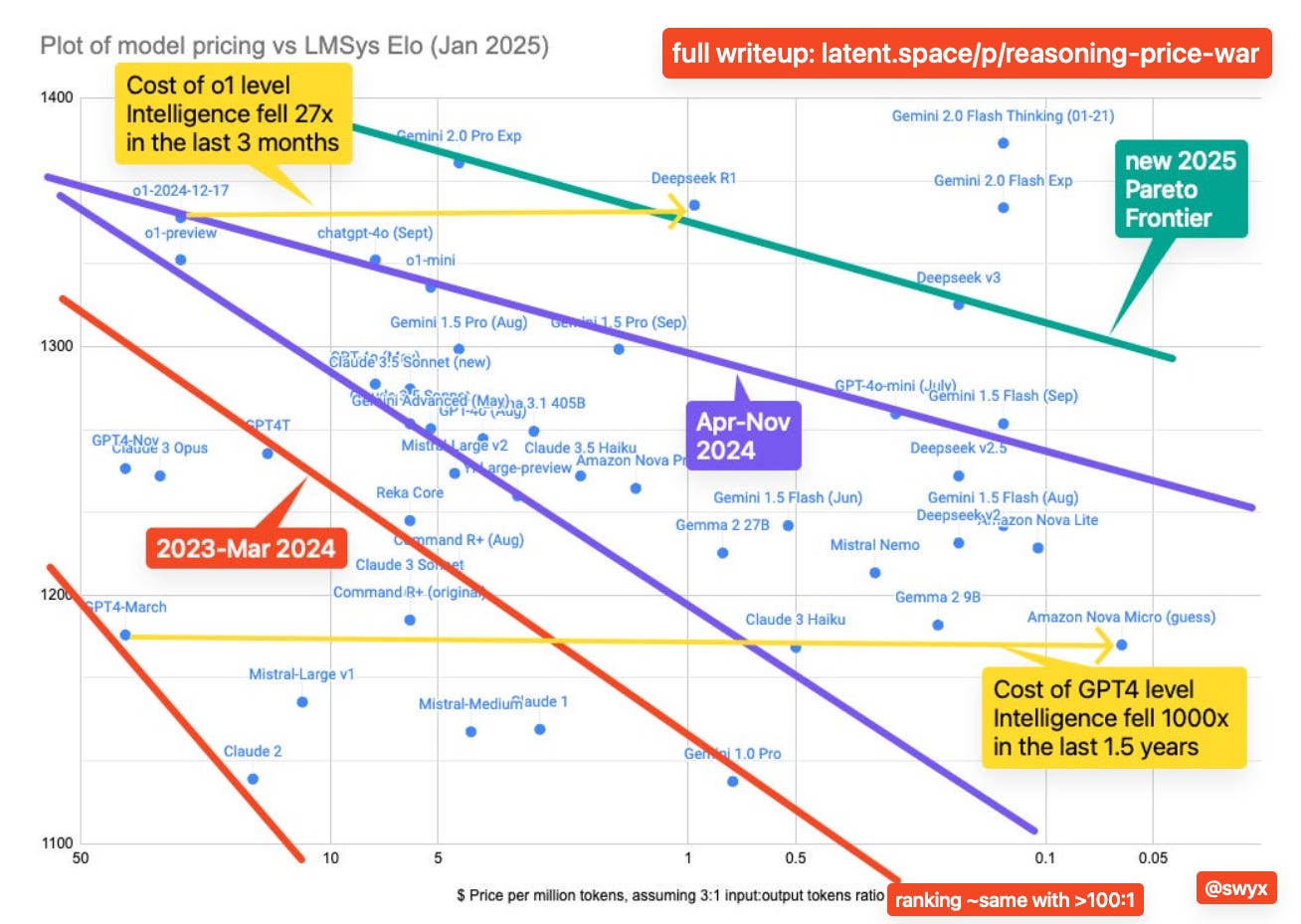
1 年前に作成した当社の主要な「ヒーローチャート」の一つ(後にデミス氏にも採用されました)は、驚くべき洞察を示していました。LMSys Elo を一定に保ったまま、GPT-4 レベルの知能が 18 ヶ月で 1000 倍も低下したというのです。
当時は、これが単なる「初心者向けの改善」に過ぎないのかどうかが不明でした。つまり、最適化されていない状態から最適化された状態へ、推論機能付きの完成形へと、そして密集型モデルから MoE 型モデルへと移行する過程で、手っ取り早く得られる成果(ロー・ハンギング・フルーツ)をすべて収穫し尽くした後の話なのかという点です。それからさらに 18 ヶ月が経過した現在では、その答えは「いいえ」であることが明らかになりました。一定レベルの知能を提供するコストは、依然として劇的に低下し続けています。
昨日、OpenAI は GPT-5.6 が自身のサービス提供をどのように最適化したかについて調査結果を発表しました。
- 推論の高速化
品質を損なうことなく、同じハードウェアでより多くのトークンを処理するために、OpenAI はいくつかのシステム全体のアップグレードに注力しました。
自己最適化:GPT-5.6 Sol は、本番環境のトラフィック分析や負荷分散の調整、そして OpenAI 独自の Triton や Gluon 言語による本番用カーネルの自動書き換えを積極的に担当しました。この自律的なカーネル最適化により、エンドツーエンドの提供コストが 20% 削減されました。
推測的デコーディングでは、アーキテクチャの設計と実行に数百もの実験を行い、サイズや構造、機能の変更をテストしながら、スペキュレーター(推論支援者)のトレーニングプロセスを監視し、ハードウェア障害やトレーニングの不安定化といった問題が発生した際には自律的に介入することで、独自のドラフトモデルを改善しました。その結果、トークン生成効率が 15% 以上向上しています。
KV キャッシングでは、異なるワークロード(特に Codex の Sol モデル)に特化したバッチ処理、シャーディング、キャッシュ管理を最適化し、既存のハードウェアからより多くの推論能力を引き出しました。
- エージェント型ハーンスの改善
Codex や ChatGPT Work といったツールで複雑な多段階タスクを円滑に進めるため、OpenAI は Rust で構築されたオーケストレーション層を最適化し、計算コストの無駄を削減しました。
コンテキストの肥大化防止:ツールやスキル、プラグインは必要な時だけ表示されるように設計され(遅延発見)、デフォルトでツール出力が 10,000 トークンに制限されています。これにより、コンテキストウィンドウが無駄に拡大するのを防いでいます。
プロンプトキャッシング:同じ指示や履歴を繰り返し処理しないよう、ハーンスはモデルから見えるすべての履歴を「追加のみ」の形式として扱っています。これによりプロンプトプレフィックスが保持され、システムは以前計算されたデータを再利用して高いキャッシュヒット率を維持できます。
今日、彼らはこれが単なる理論ではないことを証明し、小型モデルに対する大幅な値下げと、Sol モデルにおける 2.5 倍高速化モードの導入を発表しました(ただし、7 月に予告されていた Cerebras を駆使した 10 倍高速化モードは含まれていません)。
これは素晴らしいパレート曲線です。もし AA のタスクあたりのコストが現実世界のタスクを反映しているなら、OpenAI は DeepSeek、GLM、MiniMax といったオープンモデルや、Gemini Flash-Lite のような「安価かつ高性能」な専用モデルをも凌駕したことになります。
素晴らしいですが、本当に驚愕すべきは Nicdunz の指摘です。
GPT-5.4 フル(xhigh スコア)のスコアは 51 で、これは今日 Luna が到達している最高値と全く同じです。GPT-5.4 はトークンあたり $2.50/$15 の価格でしたが、現在の Luna は $0.20/$1.20 です。つまり、約 4 ヶ月後には OpenAI が、3 月のフルフラッグシップ知能をトークン価格で約 13 分の 1 で販売していることになります。
これは年換算で約 2000 倍の加速率に相当し、前回の観測から劇的に進歩しました。ただし、AA のような公開ベンチマークは訓練されている側面があるため、Elos(実世界タスク)ほど直接的には訓練されにくいことを踏まえ、この数値は少し割り引いて考える必要があります。Poolside の Laguna や Thinky の Inkling といった主要な中国・米国のオープンモデルは完全な制御と主権を提供しますが、「微調整不要でコスト効率の高い知能」を唯一の目標とするなら、現時点では OpenAI を上回ることは非常に難しいでしょう。
2026 年 7 月 29 日〜30 日の AI ニュース。12 のサブレッドと 544 件の Twitter、そして Discord は確認しました。AINews のウェブサイトでは過去のニュースをすべて検索可能です。念のため、AINews は現在 Latent Space の一部となっています。メール配信頻度の設定も変更できます。
AI Twitter リキャップ
OpenAI の価格改定、Harness Semantics、そして ARC-AGI-3 のメモリ議論
OpenAI は GPT-5.6 の価格を大幅に引き下げ、より高速な「Sol」ティアを追加しました。GPT-5.6 Luna の料金は 80% 減、Terra は 20% 減となり、標準価格の 2 倍で導入された Sol Fast は、知能レベルに変化がないままレイテンシを最大 2.5 倍短縮します(@OpenAIDevs 発表)。
この価格改定はエージェントワークフローにおいて顕著な影響をもたらしています。ChatGPT アプリや Codex CLI の自動レビュー機能は GPT-5.4 から Luna へ移行され、OpenAI はコストを約 10 分の 1 に抑えられると予測しています。@sama、@nicdunz、@kimmonismus といった複数の関係者が、これは価格と性能のフロンティアにおける意味ある転換点であると評価しました。
OpenAI は今回の値下げが、「モデル」「推論スタック」「エージェントハネス」全体にわたるシステムレベルの効率化によるものだと説明しています(@OpenAIDevs)。
ARC-AGI-3 は、「モデル」がシステム全体ではないことを改めて強調しました。技術的な評価議論の中心は、ハッチング(Harness)設計、記憶保持、および文脈圧縮に置かれました。
François Chollet 氏が ARC のルールを明確化しています。ベンチマーク固有のカスタムハッチングの使用は禁止されていますが、すべてのユーザーが利用可能な汎用 API 機能については、設定とコストを報告すれば許可されます。
@kimmonismus 氏による詳細なサマリーでは、公式の半非公開 ARC セットアップにおける Opus 5 のスコア 30.2% と、標準ハッチング下での GPT-5.6 Sol の 7.8% が対比されました。同時に、OpenAI が内部で Responses API を使用し、推論と圧縮機能を保持したことで、Sol の公開セットのスコアが 38.3% に引き上げられた点も指摘されています。
@gneubig 氏や @scaling01 氏などから共有された結論は、長期ホライズンの評価が、単なる基本重みではなく、推論保持、カットオフポリシー、圧縮、ツールオーケストレーションを含む完全なエージェントシステムを測定するようになっているという点です。
Thinking Machines の「Inkling-Small」と、継続するオープンウェイトの動き
Inkling-Small は、Inkling クラスの能力をはるかに小さなアクティブ領域に圧縮したモデルです。Thinking Machines が公開したこのオープンウェイトのネイティブ多モーダル MoE モデルは、総パラメータ数が 276B でアクティブ数は 12B ですが、サイズが元の Inkling の約 4 分の 1 でありながら同等のパフォーマンスを発揮すると位置づけられています。同社によると、このモデルは音声と画像をテキストと同時に処理でき、多モーダル環境での推論時には Python ベースの画像検査もサポートします。
リリース直後には、オープンな推論スタック全体に即座に展開されました。vLLM は当日サポートを発表し、Modal は単一の B300 でのデプロイを強調しました。LMSYS と SGLang はデコードスループットの数値を報告し、Unsloth はローカル実行や GGUF のガイドを公開しています。
ベンチマーク結果は、コーディングと多モーダル処理において極めて効率的なオープンモデルであることを示唆しています。Artificial Analysis による Intelligence Index では、Inkling-Small は 40 を記録し、フラッグシップの Inkling と僅差で並びました。特に Humanity's Last Exam、GPQA Diamond、CritPt、SciCode といった課題では強みを発揮しましたが、一部のエージェントタスクや事実知識に関する評価ではやや劣る結果となりました。コミュニティからのまとめでは、この小型モデルが @kimmonismus や @mervenoyann が取り上げたいくつかのコーディングタスクにおいて、大型の Inkling を上回るか同等の結果を出せる点が強調されています。
オープンウェイトであること、多モーダル入力のサポート、デプロイスタックにおける 1M コンテキスト対応、そして 12B のアクティブ計算リソースを組み合わせることで、今回のリリースは実用面で極めて重要なものとなっています。
Google の Gemini Robotics 2 と、具現化 AI(Embodied AI)の加速
Gemini Robotics 2 は、テーブル上の操作から全身制御や複数ロボットの連携へと進化しました。Google DeepMind が発表したこのシステムは「あらゆるロボットに通用する一つの脳」として位置づけられ、全身型ヒューマノイドの制御、高度な器用さ、そして複数ロボットによる協調作業などのデモが公開されました。
Google AI によると、このスタックには Gemini Robotics ER 2 も含まれています。これは高レベルの実体推論モデルで、数分間にわたるタスクにおいて、観察や計画立案、VLA モデルとの連携、進捗の追跡、そして失敗したステップからの回復を担います。デモでは、結び目の作成、電球のねじ込み、物体を拾うための屈曲動作、ガレージの片付けといった複雑な運動タスクが強調されました。
注目すべきは、単に派手なデモがあるだけでなく、多様性への対応と適応能力です。技術的な解説では、同じチェックポイントで複数のハードウェアタイプを制御できる点や、On-Device 2 が新しい 2 腕ロボットに対してわずか 200 例未満のデータで適応可能である点が指摘されました(@kimmonismus のまとめ)。一方、@OfficialLoganK と @osanseviero は ER 2 の API 利用可能性と実体推論の指標に焦点を当てました。また NVIDIA Robotics はこの機会を利用して、ヒューマノイドや自律システム向けの Jetson AGX Thor を中心としたローカルハードウェア面の強化を訴求しました。
過去のロボット関連発表と比較すると、今回はプラットフォームの広範な対応、計画能力、器用さ、そしてライブストリーミング API の統合という点で際立っていました。単一の狭い操作ベンチマークに留まらない、総合的なアプローチが特徴です。
エージェント、クラウド開発環境、そして永続的メモリインフラストラクチャ
クラウドエージェントはデモの域を超え、エンジニアリングワークフローの中核へと進化しています。その実態を示す有力なデータの一つが Cursor の事例です。12 月にはマージされたプルリクエストの 10% がクラウドエージェントによるものでしたが、現在は 56% に達しました。これは、エージェントに専用のクラウド環境を与え、時間とともにその環境を改善できる仕組みを導入した結果です。
同様の傾向として、Cognition への参加後もローカル開発用のラップトップを設定していないと語る Jared Palmer 氏(@jaredpalmer)の発言があります。彼は Slack や Web アプリ上で Devin を利用することを好んでいます。また、dabit3 氏は、macOS で Xcode とシミュレーターにアクセスできる環境で動作する Devin クラウドエージェントが、ネイティブ iOS アプリのビルドやテストを実行している様子を示しました。
Cognition はさらに、エージェントが生成した変更セットに対応するための有用な適応策として、GitHub のスタックされたプルリクエスト機能をネイティブサポートとして追加しています。
永続メモリは製品化が進んでいますが、その価値に関するエビデンスには賛否両論あります。Perplexity は「Projects」を立ち上げ、「Brain」を通じて共有ファイルと永続メモリを活用し、スペースを継続的な作業のハブへと進化させました。一方、Arav Srinivas氏はこれを、共同作業や自律エージェント向けのマルチプレイヤー型オペレーティングシステムとして位置付けています。
より下層のメモリインフラでは、TurboPuffer が Mem0 の事例を紹介しました。これは 4 億件以上のエージェント記憶を pgvector から TurboPuffer へ移行したもので、70ms(p90)という高速なハイブリッド検索と、10 件中 97% の再現率を実現しています。
しかし、研究界隈の反応はより慎重です。dair_ai は、ファイルシステム型のメモリストアがスケール時に検索コストを半減させる可能性を示す論文を紹介しましたが、その研究では最終的な回答品質には改善が見られませんでした。また、管理エージェントの多くにおいて記憶の質が低下する傾向も確認されています(最も強力なエージェントを除く)。
結論として、メモリインフラは製品としての成熟度を高めていますが、それが実際の能力向上にどの程度寄与しているかについては、まだ議論が続いています。
インフラ・検索・ツールリング:カーネル、検索の透明性、新たな評価基盤
システム最適化は依然として大きな成果をもたらす要因となっています。SemiAnalysis は GPU Mode の AMD カーネルハッカソンを取り上げ、Readonflow チームが MI355X のエンドツーエンド性能を 2 倍以上向上させたことを報告しました。個々のカーネルレベルでは、@maharshii が div.rn.f32 を rcp.approx に置き換えることで、torch SDPA を上回る 1.5 倍から 2.17 倍へのカスタムアテンションカーネルの実装を報告し、PTX レベルでの詳細な検証が依然として重要であることを示しました。また、Astral は FlashAttention や DeepSpeed のような GPU 負荷の高いパッケージの事前ビルド済みホイール向けにビルドパイプラインをオープンソース化し、再現性と Python パッケージの容易さを目的としています。
検索および検索インフラは、もはやパフォーマンスの問題だけでなく透明性の問題となっています。Simon Willison は、OpenAI と Anthropic の両方が検索への依存度が高く、基盤となる検索インデックスや提携関係を隠していることを批判しました。彼は特に、Anthropic のサブプロセッサ一覧が Brave や後の TurboPuffer とのつながりを明らかにしている一方で、製品ドキュメントではその点が明確に示されていない点を指摘しています。検索モデルの側面では、@antoine_chaffin が mDenseOn と mLateOn を発表しました。これらは長文コンテキストやコード検索のための完全オープンな多言語検索モデルで、後続の指標によると、特に後期相互作用モデルにおいて優れた汎化能力を示すことが示唆されています。
注目ツイート(エンゲージメント上位)
OpenAI の価格再設定:@OpenAI が Luna で 80%、Terra で 20% の値下げを発表し、Sol Fast を追加しました。これは当日の最も明確な製品・推論に関するシグナルです。
Google DeepMind と Google AI は、全身制御、器用さ、協調性をカバーするより汎用的なエンボディメントスタック「Gemini Robotics 2」を発表しました。
Thinky Machines は、アクティブパラメータが 120 億の重要なオープンマルチモーダル MoE「Inkling-Small」をリリースしました。
Cursor AI は、クラウドエージェントの実装に関する最も具体的な統計データを共有しました。現在、マージされた PR の 56% がクラウドエージェントによって作成されています。
METR Evals は、Hugging Face で発生した事象に関連するモデルの動作について、OpenAI と Redwood Research と共同で独立したレビューを実施することに合意しました。レビューの範囲と暫定的な結論は近日公開されます。
AI Reddit まとめ
/r/LocalLlama + /r/localLLM まとめ
- Kimi K3 と Inkling-Small のローカル MoE 実行
続きを読む
原文を表示
One of our big “hero charts” a year ago (eventually adopted by Demis) made the stunning observation that, holding LMSys Elo constant, GPT4 level intelligence fell by 1000x over 18 months:
Back then, it was unclear if these were “noob gains” - going from unoptimized to optimized, going from completions to reasoning, going from dense to MoE, with all the low hanging fruit gone. Another 18 months later, it seems the answer is no; constant-level intelligence is continuing to get precipitously cheaper.
Yesterday, OpenAI published findings on how GPT 5.6 had optimized its own serving:
- Inference Acceleration
To serve more tokens on the same hardware without sacrificing quality, OpenAI focused on several systemic upgrades:
Self-Optimization: GPT-5.6 Sol was actively used to analyze production traffic, tune load balancing, and autonomously rewrite production kernels in OpenAI’s own Triton and Gluon languages. This autonomous kernel optimization reduced end-to-end serving costs by 20%.
Speculative Decoding: Improved its own draft model (by designing and running hundreds of experiments on its architecture, testing changes in size, structure, and features, while monitoring the speculator training process, autonomously intervening when issues arose, including hardware failures and training instability) increasing token-generation efficiency by over 15%.
KV Caching: Optimized batching, sharding, and cache management specific to different workloads (primarily Sol in Codex) to extract more inference from existing hardware.
- Agentic Harness Improvements
To streamline the complex, multi-step tasks in tools like Codex and ChatGPT Work, OpenAI optimized their Rust orchestration layer to reduce repetitive compute costs:
Avoiding Context Bloat: Tools, skills, and plugins are only surfaced when needed (deferred discovery), and tool outputs are capped at 10,000 tokens by default to prevent the context window from expanding unnecessarily.
Prompt Caching: To avoid reprocessing the same instructions and history repeatedly, the harness treats all model-visible history as append-only. This preserves the prompt prefix, allowing the system to reuse previously computed data and maintain a high cache hit rate.
Today, they proved it wasn’t just theory, announcing large price cuts for the smaller models and a new 2.5x Faster mode in Sol (though not the hinted 10x faster Cerebras-driven mode promised in July):
That is a beautiful Pareto curve — if AA’s Cost per Task is reflective of real world tasks, then OpenAI has beat even open models like DeepSeek, GLM, and MiniMax, and dedicated cheap-but-good models like Gemini Flash-Lite.
Good, but what is truly jaw dropping is Nicdunz’s observation:
GPT-5.4 full at xhigh scored 51, exactly where Luna max sits today. GPT-5.4 costs $2.50/$15; Luna now costs $0.20/$1.20. In other words, roughly four months later, OpenAI is selling March’s full flagship intelligence at about one-thirteenth the token price.
That’s an annualized rate of ~2000x a year, a huge acceleration since our last observation - which you SHOULD discount because all public benchmarks like AA’s get trained to some extent whereas Elos are less directly trainable. While leading Chinese and American open models like Poolside’s Laguna and Thinky’s Inkling offer full control and sovereignty, if your only goal is cost-effective non-finetuned intelligence, you will find it -very- hard to beat OpenAI right now.
AI News for 7/29/2026-7/30/2026. We checked 12 subreddits, 544 Twitters and no further Discords. AINews’ website lets you search all past issues. As a reminder, AINews is now a section of Latent Space. You can opt in/out of email frequencies!
AI Twitter Recap
OpenAI Pricing Cuts, Harness Semantics, and the ARC-AGI-3 Memory Debate
OpenAI cut GPT-5.6 prices aggressively and added a faster Sol tier: OpenAI reduced GPT-5.6 Luna by 80% and Terra by 20%, while introducing Sol Fast at up to 2.5× lower latency for 2× the standard price with “no change in intelligence,” per @OpenAIDevs. The downstream effect is notable for agent workflows: Auto-review in ChatGPT app and Codex CLI is moving from GPT-5.4 to Luna, with OpenAI expecting roughly 10× lower cost. Multiple observers framed this as a meaningful shift in the price/performance frontier, including @sama, @nicdunz, and @kimmonismus. OpenAI also tied the cuts to systems-level efficiency improvements spanning “model, inference stack, and agentic harness” per @OpenAIDevs.
ARC-AGI-3 re-emphasized that “the model” is not the whole system: The most technical eval discussion centered on harness design, memory retention, and context compaction. François Chollet clarified ARC’s rules: bespoke benchmark-specific harnesses are disallowed, but general-purpose API features available to all users are acceptable if settings and cost are reported. A detailed summary from @kimmonismus contrasted Opus 5 at 30.2% on the official semi-private ARC setup with GPT-5.6 Sol at 7.8% under the standard harness, while noting OpenAI’s internal use of Responses API retained reasoning + compaction raised Sol’s public-set score to 38.3%. The takeaway echoed by @gneubig, @scaling01, and others: long-horizon evals increasingly measure the complete agent system—reasoning retention, truncation policy, compaction, tool orchestration—not just base weights.
Thinking Machines’ Inkling-Small and the Continuing Open-Weights Push
Inkling-Small compresses Inkling-class capability into a much smaller active footprint: Thinking Machines released Inkling-Small, an open-weights, natively multimodal MoE model with 276B total parameters and 12B active, positioned as delivering performance comparable to the original Inkling at roughly a quarter the size. The company says it processes audio and images jointly with text and supports Python-based image inspection during reasoning in multimodal settings, per their follow-up. The release immediately landed across the open inference stack: vLLM announced day-0 support, Modal highlighted single-B300 deployment, LMSYS/SGLang reported decode throughput figures, and Unsloth published a local-running/GGUF guide.
Benchmarks suggest an unusually efficient open model for coding and multimodality: Artificial Analysis placed Inkling-Small at 40 on its Intelligence Index—within a point of the flagship Inkling—with strengths on Humanity’s Last Exam, GPQA Diamond, CritPt, and SciCode, though weaker on some agentic tasks and factual knowledge. Community summaries emphasized that the smaller model can beat or match the larger Inkling on several coding tasks, including @kimmonismus and @mervenoyann. The combination of open weights, multimodal input, 1M-context support in deployment stacks, and 12B active compute makes this one of the more practically important open releases in the batch.
Google’s Gemini Robotics 2 and the Acceleration of Embodied AI
Gemini Robotics 2 expands from tabletop manipulation to full-body control and multi-robot coordination: Google DeepMind launched Gemini Robotics 2, describing it as “one brain for any robot,” with demos spanning whole-body humanoid control, advanced dexterity, and multi-robot collaboration. Google AI added that the stack includes Gemini Robotics ER 2, a high-level embodied reasoning model that can observe, plan, coordinate with a VLA model, track progress, and recover from failed steps during multi-minute tasks. The demos emphasized nontrivial motor tasks such as knot-tying, screwing in a bulb, bending to pick up objects, and collaborative garage cleanup.
The practical story is heterogeneity and adaptation, not just nicer demos: Technical commentary highlighted that the same checkpoint controlled multiple hardware types and that On-Device 2 can reportedly adapt to a new two-arm robot with fewer than 200 examples, summarized by @kimmonismus. @OfficialLoganK and @osanseviero focused on ER 2’s API availability and embodied reasoning metrics, while NVIDIA Robotics used the moment to push the local hardware side with Jetson AGX Thor for humanoid/autonomous systems. Relative to prior robotics announcements, this one stood out because it combined platform breadth, planning, dexterity, and live-streaming APIs rather than a single narrow manipulation benchmark.
Agents, Cloud Development Environments, and Persistent Memory Infrastructure
Cloud agents are graduating from demos to core engineering workflows: One of the stronger operational datapoints came from Cursor: in December, 1 in 10 merged PRs came from cloud agents; now that share is 56%, attributed to giving agents their own cloud computers and allowing them to improve their environments over time. In the same vein, @jaredpalmer said he still hasn’t set up a laptop for local development after joining Cognition, preferring Devin in Slack/webapp, and @dabit3 showed Devin cloud agents running macOS with Xcode and simulator access to build/test native iOS apps. Cognition also added native GitHub stacked PR support, a useful adaptation for agent-generated changesets.
Persistent memory is becoming productized, but evidence on its value is mixed: Perplexity launched Projects, evolving Spaces into hubs for ongoing work with shared files and persistent memory via “Brain,” while @AravSrinivas positioned it as a multiplayer, agentic operating system for work. For memory infra lower in the stack, TurboPuffer described Mem0 migrating 400M+ agent memories from pgvector to turbopuffer, citing 70ms p90 hybrid retrieval and 97% recall@10. But the research signal was more cautious: @dair_ai highlighted a paper suggesting filesystem-style memory stores can halve retrieval cost at scale yet did not improve final answer quality in the study, and store quality degraded under most management agents except the strongest one. Net: memory infra is maturing as a product surface, but its causal contribution to capability remains unsettled.
Infra, Retrieval, and Tooling: Kernels, Search Transparency, and New Eval Infrastructure
Systems optimization remains a major source of gains: SemiAnalysis highlighted GPU Mode’s AMD kernel hackathon, saying the Readonflow team improved MI355X end-to-end performance by over 2×. At the individual-kernel level, @maharshii reported a custom attention kernel jumping from 1.5× to 2.17× over torch SDPA by replacing div.rn.f32 with rcp.approx, a reminder that PTX-level inspection still matters. Astral also open-sourced build pipelines for prebuilt wheels of GPU-heavy packages like FlashAttention and DeepSpeed, targeting reproducibility and easier Python packaging.
Retrieval and search infra became a transparency issue, not just a performance issue: Simon Willison criticized both OpenAI and Anthropic for depending heavily on search while obscuring the underlying search index and partnerships; he pointed to Anthropic’s subprocessor listings revealing ties to Brave and later TurboPuffer in a way not clearly surfaced in product docs. On the retrieval-model side, @antoine_chaffin introduced mDenseOn and mLateOn, fully open multilingual retrieval models for long-context and code retrieval, with follow-up metrics suggesting especially strong generalization for late interaction models.
Top tweets (by engagement)
OpenAI pricing reset: @OpenAI announced 80% Luna and 20% Terra price cuts plus Sol Fast, the clearest product/inference signal of the day.
Gemini Robotics 2 launch: @GoogleDeepMind and @GoogleAI unveiled a more general embodied stack spanning whole-body control, dexterity, and collaboration.
Inkling-Small release: @thinkymachines shipped a materially important open multimodal MoE with 12B active parameters.
Cloud agents in production software engineering: @cursor_ai shared the strongest concrete adoption stat in the set: 56% of merged PRs now coming from cloud agents.
Independent review of the Hugging Face / OpenAI incident: @METR_Evals said it reached agreement with OpenAI and Redwood Research on an independent review of the model behavior observed during the Hugging Face incident, with scope and tentative conclusions to be published.
AI Reddit Recap
/r/LocalLlama + /r/localLLM Recap
- Kimi K3 and Inkling-Small Local MoE Runs
Read more
関連記事
News to Guide
ニュースの次に確認する
発表内容を、現在の料金や仕様と照らし合わせられる関連ガイドです。
今日のまとめ
AIデイリーブリーフで今日の重要ニュースをまとめ読み