[AI ニュース] コグニションが 260 億ドルのシリーズ D で 10 億ドルを調達
Cognition が Series D で 10 億ドルを調達し企業価値が 260 億ドルに達した一方、中国勢による構造最適化で推論コストが劇的に低下する技術動向が報じられた。
キーポイント
Cognition の急成長とバリュエーション
Cognition は直近の Series D で 10 億ドルを調達し、企業価値は前回の Series C から 2.5 倍増の 260 億ドルに評価され、独立系 AI エージェントラボとして最大規模となった。
中国勢による推論コスト構造の破壊
DeepSeek V4-Pro や Xiaomi MiMo などが、ハイブリッドアテンションや圧縮スパースアテンションを採用し、KV キャッシュ容量を大幅に削減することで、一時的な補助金ではない持続的な価格低下を実現している。
推論効率化のアーキテクチャ転換
EAGLE 3.1 や Perplexity の Unigram トークナイザーなど、カーネルレベルからシステム・アーキテクチャレベルへの最適化が進み、推論速度とコスト効率が劇的に向上している。
中国大手のAPI価格低下は構造最適化による持続可能性
DeepSeek V4-ProやXiaomi MiMoなどのアーキテクチャ改善(ハイブリッドアテンション、圧縮スパースアテンション)により、トークンあたりの推論コストが劇的に低下し、一時的な補助金ではなく構造的な低コスト化が実現されている。
エージェント開発の焦点は「モデル品質」から「ハネス・メモリ適合性」へ
LangChainやLangSmith Engineの進化により、チェックポイントの削減や評価ループの自動化が進み、タスクに特化したベスポンなシステムが汎用ハネスよりも高いパフォーマンスを発揮することが示された。
継続的学習(Continual Learning)がインフラとして確立されつつある
Trajectoryなどの新プラットフォームや、FP8/NVFP4量子化技術の活用により、デプロイ後の利用データに基づいてモデルを継続的にポストトレーニングする仕組みが研究段階から実用的な製品カテゴリへと移行している。
実世界ワークフローのベンチマーク強化
DeepSWE や ITBench-AA などの新基準により、長期的で複雑なリアルワールドタスクや SRE インシデント対応において、主要モデルが依然として課題を抱えていることが示された。
重要な引用
officially the largest remaining independent agent lab in AI
recent API price cuts from Chinese labs look sustainable because they reflect lower serving cost per token, not temporary subsidy
Inference optimization is increasingly architectural, not just kernel-level
The broader takeaway: long-context inference economics are now being pushed by attention design + cache hierarchy + routing, not just cheaper hardware.
task-harness fit matters as much as model quality, and bespoke vertical systems outperform generic harnesses by narrowing tools, prompts, and context to the task.
"all frontier models scored below 50%" (ITBench-AA における SRE ベンチマークの結果)
影響分析・編集コメントを表示
影響分析
このニュースは、AI エージェント分野における市場の再編と、インフラコスト構造の根本的な変化という二つの重要な転換点を示しています。Cognition の成功はエージェント技術の実用化が加速している証左であり、中国勢による推論効率化の突破は、今後 AI サービスの価格競争力と普及速度を決定づける新たな基準となるでしょう。
編集コメント
エージェント分野のトッププレイヤーが急成長する一方で、推論コストを劇的に下げる技術的ブレイクスルーが続出しており、AI インフラのパラダイムシフトが明確に進行しています。
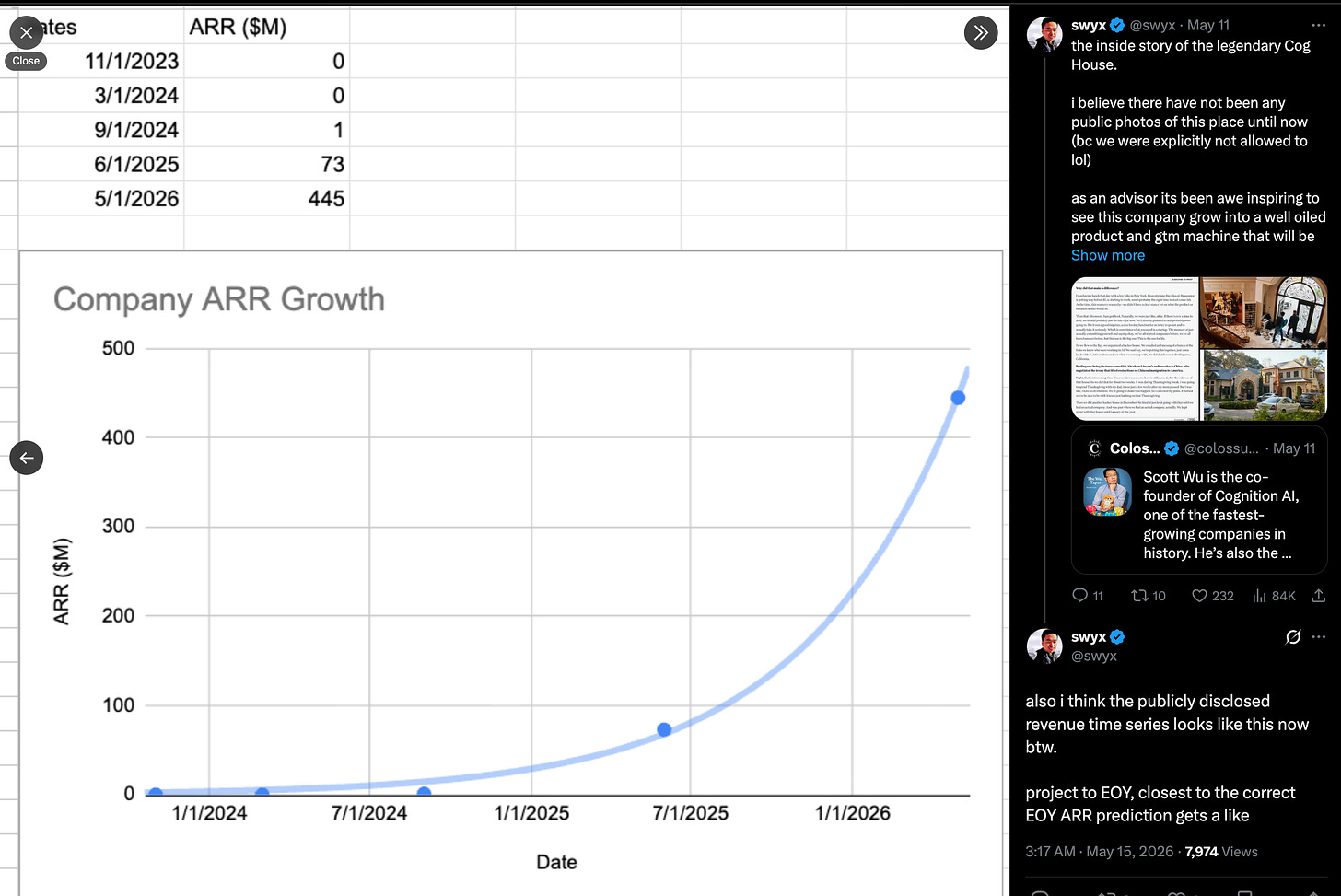
私たちは昨年9月、Smol.aiもCognitionに加わり、AINewsが最終的にLatent Spaceに移された際の10BドルシリーズCラウンドについてCognitionを取り上げました。それから8ヶ月後、その評価額は2.5倍となり、AI分野で残る最大の独立型エージェント研究所となりました。これは昨年に私たちが描いた仮説です。公式な年間経常収益(ARR)の開示(今年末までに10億ドル超のARRを予測)により、成長軌跡を追うことができますが、その様子は「2025年に何が起こったのか」チャートと奇妙にも似ています(これは偶然ではありません):
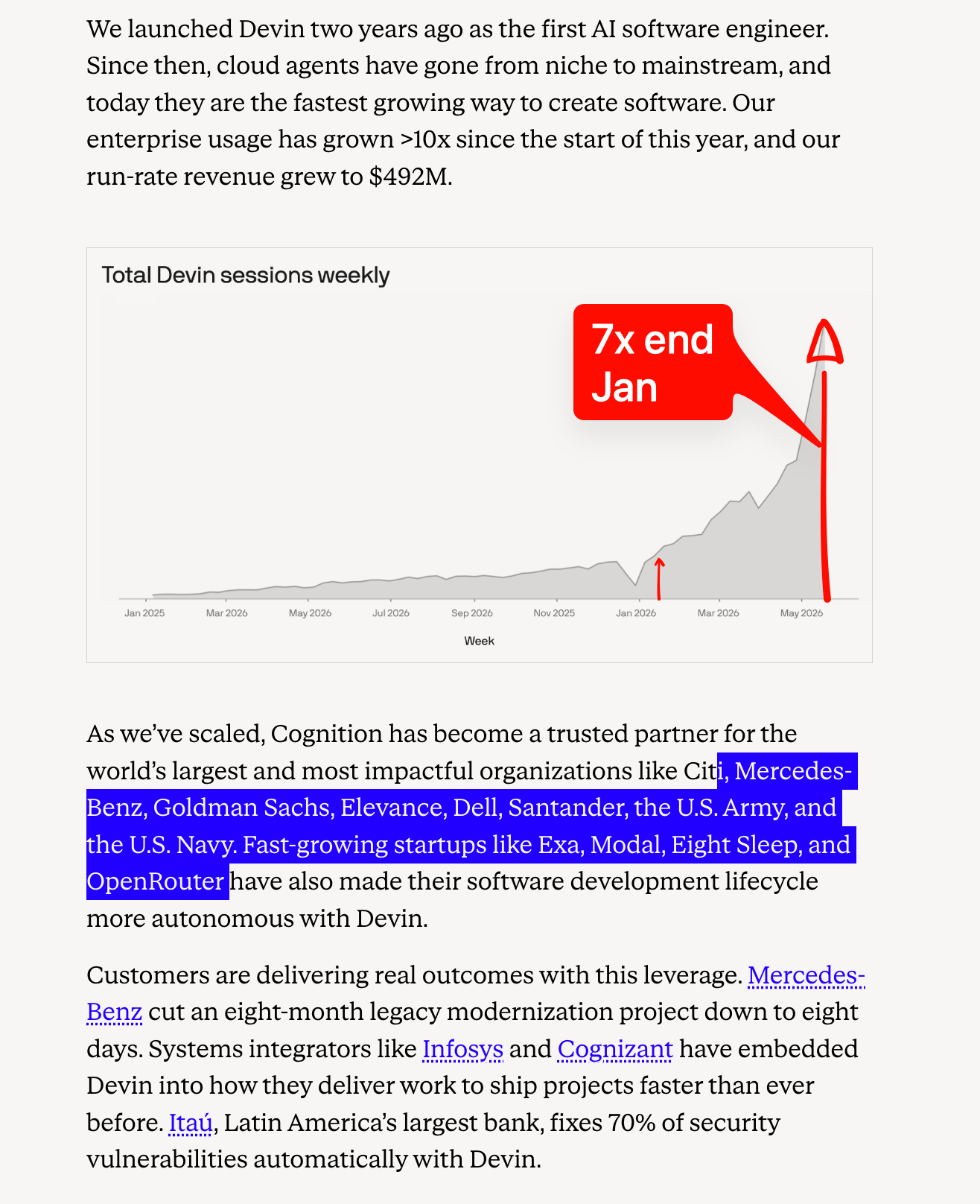
エンタープライズSaaSビジネスにおいて、ARR(年間経常収益)は利用状況の遅行指標であり、エンタープライズおよびスタートアップエコシステムにおける最も厳しく挑剔な顧客の一部のロゴも同様です(先週取り上げられたExaやModalなど)。
Cognitionに関する詳細は、明日のポッドキャストで発表します。
2026年5月26日〜27日のAIニュース。私たちは12のサブレッドと544件のTwitter投稿を確認し、Discordについては追加情報はありませんでした。AINewsのウェブサイトでは過去のすべての号を検索できます。念のためにお知らせしますが、AINewsは現在Latent Spaceの一部門となっています。メール配信頻度のオプトイン・オプトアウトが可能です!
AI Twitter Recap
推論効率、サービングアーキテクチャ、およびコスト曲線
推論最適化は、カーネルレベルだけでなく、アーキテクチャレベルでも重要視されるようになっています。EAGLE 3.1 は、隠れ状態フィードバックの安定化と、より深いデコードステップにおけるアテンションドリフトの低減により、スペキュレーティブ・ディコーディングの堅牢性を向上させます。これには、長文コンテキストでの受容長さの実用性と、実世界でのサービング信頼性に対する明確な強調が含まれています。また、チームは vLLM および TorchSpec との協力関係も強調しました。
カーネル/システム層では、Perplexity が再構築したユニグラムトークナイザーをオープンソース化し、CPU 使用率を 5〜6 倍削減するとともに、ヒープ割り当てゼロで 514 トークン時に 63 マイクロ秒の処理速度を実現しました。一方、Qwen3.5 は TokenSpeed 上で、Alibaba、LightSeek、NVIDIA、Mooncake、FlashAttention-4 の貢献者による共同最適化を通じて、エージェントワークロードにおいて 1 秒あたり 580 トークンの性能を達成したと報告されています。
支援ライブラリも改善されました。MaxSim v2 は逆伝播機能を追加し、Naïve PyTorch(素朴な PyTorch)と比較して H200 で 10.33 倍、A100 で 11.94 倍の高速化を報告しています。
価格引き下げは、構造的な KV キャッシュとアテンションの改変によって正当化されています:複数の投稿が共通するテーマに収束しました。中国のラボからの最近の API 価格引き下げは、一時的な補助金ではなく、トークンあたりの提供コストの低下を反映しているため持続可能であるという点です。@kimmonismus は、DeepSeek V4-Pro がハイブリッドアテンション(Compressed Sparse Attention および Heavily Compressed Attention)を採用し、1M トークンの KV キャッシュを V3.2 の約 10% に削減しつつ、単一トークン推論の FLOPs を 27% に抑えながら、総パラメータ数 1.6T から 49B のアクティブなパラメータをルーティングしている仕組みを要約しました。Xiaomi の MiMo も同様に、SWA(Sliding Window Attention)と階層型キャッシュ管理を活用してキャッシュトラフィックを削減しています。これは @_LuoFuli によって直接裏付けられており、MiMo の最も深い入力キャッシュヒットによる価格引き下げは、キャッシュトークン容量が 5 倍になったこと、キャッシュコストが約 80% 低下したこと、そしてアーキテクチャ上の Full:SWA スパースティ比率が 1:7 であることに起因すると述べています。より広い教訓として、長文コンテキスト推論の経済性は、単に安価なハードウェアだけでなく、アテンション設計+キャッシュ階層+ルーティングによって推進されていることがわかります。
エージェント、ハルネス、メモリ、継続的学習
スタックは「モデルの品質」から「モデル・ハネス・メモリの適合性」へとシフトしている:実用的なエージェント工学に焦点を当てた一連のツイートが注目された。LangChain は Delta Channels を搭載した Deep Agents v0.6 をリリースし、200 ターンにわたるコーディングセッションにおけるチェックポイントストレージを 5.3 GB から 129 MB に削減。さらに Fleet でコンピュータ操作機能を追加し、バージョン管理されたエージェントのコンテキストやスキルを扱う Context Hub も発表した。LangSmith Engine は評価→診断→修正のループを自動化するものとして位置づけられ、複数の実践者が、トレースフィードバックを活用して再利用可能なオンライン/オフライン評価器を構築する価値を強調した。並行して、@Vtrivedy10 が当日最も明確な見解を示した:タスクとハネスの適合性はモデルの品質と同様に重要であり、ツール・プロンプト・コンテキストを特定のタスクに絞り込むことで、特化型の垂直システムは汎用的なハネスを上回る性能を発揮する。
継続学習は、単なる研究トピックではなく、製品カテゴリとして再び浮上しています:ここで最大の発表は Trajectory のローンチでした。これは、プロダクトの使用シグナルやエージェントのトレースを活用して大規模なアジェンシーモデルを継続的にポストトレーニングするためのプラットフォームであり、1500 万ドルの資金調達を行い、Clay、Harvey、Decagon、Mercor、Rogo を含むデザインパートナーを迎えています。Baseten は、FP8/NVFP4 量子化とオートスケールされた H100 インフラをサポートし、引用されている 3970 億パラメータモデルの夜間デプロイメントを含むこれらの展開を支えると述べています。同じ傾向がオープンツールリングにも見られ、LangChain/LangGraph を基盤としたメモリー中心型のオープンソースエージェントは、明示的な検索・保存・推論・学習の分離を評価する複数のビルダーから称賛されました。また、RLM の最小限のトレーニングハーネスにより、小規模チームでも 8×A100 で 1 日以内に長文脈エージェントを RL(強化学習)チューニングできるようになりました。通奏低音は、「デプロイ後の学習」が願望からインフラへと移行しているという点です。
ベンチマーク、スケーリング法則、およびトレーニング手法
新しいベンチマークは、長期にわたる複雑で現実的なワークフローをより重視するようになっています。DeepSWE は、5 つの言語で 91 のリポジトリにまたがる 113 のタスクを対象とした SWE/エージェント・ベンチマークとして注目されました。これは最小限の Bash のみを使用するハーンと短いプロンプトを採用していますが、それでも SWE-Bench Pro に比べて平均して 5.5 倍のコード量が必要となり、7 つのファイルにアクセスします。企業運用においては、Artificial Analysis と IBM が ITBench-AA を立ち上げました。これは Kubernetes のインシデント対応に関する SRE(サイト信頼性エンジニアリング)ベンチマークで、すべての最先端モデルが 50% を下回る結果となりました。Claude Opus 4.7 が 47% で首位に立ち、GPT-5.5 が 46% で続きました。一方、オープンウェイトでは GLM-5.1 Reasoning が 40% でリードしています。もう一つの有用な信頼性の観点として AgingBench があり、これはデプロイされたエージェントの劣化を、圧縮、干渉、メモリ更新によって引き起こされる寿命の問題として捉えています。
トレーニング効率に関する研究は、理論とシステムの両面で活発に進んでいます。Sakana AI の DiffusionBlocks は最も技術的に興味深いリリースの一つでした。これは順次計算を拡散のようなノイズ除去ステップとして再解釈し、ディープネットをブロック単位で訓練できるようにすることで、ViTs(Vision Transformers)、DiTs(Diffusion Transformers)、マスク付き拡散モデル、自己回帰型トランスフォーマー、および再帰的深層トランスフォーマーにおいてエンドツーエンドのパフォーマンスを維持しながら、メモリ使用量を劇的に削減しました。強化学習(RL)システム側では、Snowflake が ZoRRo を発表し、冗長なロールアウト計算を排除することで、長期コンテキストにおける RL を最大 3.5 倍高速化し、コンテキストウィンドウを最大 3.2 倍長くすることに成功したと主張しています。これに加え、専門的な Arctic-Text2SQL-R2 エンタープライズ SQL モデルも提供されています。理論面では、Tiberiu Musat のプレプリントが、固定精度ネットワークにおいて最小ニューラル重みノルムは対数因子を除き最小プログラム長に一致すると論じています。また、Unified Neural Scaling Law は、先行するフィットよりも神経拡張の挙動をより正確に外挿するために設計された多変量関数形式を提案しています。
モデルおよびモダリティのリリース:生物学、ビジョン、OCR、組み込み AI
タンパク質モデリングの日が際立っていました:ESMFold2 は、タンパク質構造の予測と設計のためのオープンな科学エンジンとして発表され、タンパク質相互作用や抗体に関する強力な報告結果に加え、68 億個のタンパク質と 11 億個の予測構造からなるアトラスを伴って公開されました。このリリースでは、実用的な設計成果(5 つの治療標的に対するミニタンパク質結合体および単鎖型抗体)と、創発的なタンパク質表現に関するメカニズム解釈可能性の発見の両方が強調されました。この発表は @proteinrosh によって共有され、@cgeorgiaw によって文脈が補足されました。同氏は、このアトラスは AlphaFold DB の規模を超えていると指摘しています。
より小規模だが実用的なマルチモーダル/オープン系のリリースの波が押し寄せました:Google DeepMind は Gemini Embedding 2 のホワイトペーパーを共有し、これはテキスト、画像、音声、動画にわたる統一表現をサポートするネイティブなマルチモーダル埋め込みモデルとして説明されています。NVIDIA の LocateAnything は Qwen2.5-3B と Moon-ViT を組み合わせて高速なグラウンディングを実現し、密な物体検出において 10 倍の速度向上を謳っています。Hugging Face は Roboflow の RF-DETR を統合し、YOLO スタイルのシステムを上回るリアルタイム検出・セグメンテーションとして位置づけました。ドキュメントパイプライン向けには、Surya OCR 2 が 650M パラメータモデルとして出荷され、OLMOCR ベンチマークで 83.3%、内部の 91 か国語ベンチマークで 87% の精度を達成し、RTX 5090 では 1 秒あたり 5 ページの処理速度を実現しています。LiteParse v2 は Rust でパース処理を書き換え、最大 100 倍の高速化と WASM を介したエッジ/ブラウザでの展開を可能にしました。オンデバイス AI もまた、Google の新しい Coral ボードによってローカル音声・ビジョン・制御デモのために注目されました。
開発者プラットフォーム、エンタープライズ制御、コーディングエージェントの製品化
コーディングエージェントは、エンタープライズ制御を備えた完全なプロダクトスタックへと統合されつつあります。OpenAI は Codex のプロダクト範囲をさらに強化しており、GPT-5.2 および GPT-5.3-Codex は Codex 内で廃止され、代わりに GPT-5.5 が採用されています。一方、エンタープライズ機能には、アウトバウンド専用 HTTPS を介したプライベート MCP(Model Context Protocol)接続、ワークロードアイデンティティフェデレーション、支出アラート、ホワイトリスト、保持ポリシー、ホスト型ツール管理のための拡張された管理者 API 制御などが含まれています。また、OpenAI は Codex を用いた自己改善型税務エージェントに関する具体的なケーススタディも公開しており、これはレビューヤーの修正を評価(evals)や修正プロセスに追跡・反映させることを中核としています。
コーディングエージェントにおける競争は現在、信頼性、ワークフローの幅広さ、およびエンタープライズへの採用が焦点となっています。Claude Code は信頼性とパフォーマンスの更新、ならびにバグ報告の容易化を共有しました。一方、GitHub は Copilot Dev Days や MCP の位置づけを通じて「エージェント化された IDE」の方向性を推進し続けています。最も注目すべき商業的データポイントは Cognition であり、評価額 260 億ドルで 10 億ドル超の資金調達を行い、年初来(YTD)のエンタープライズ利用が 10 倍以上に増加し、年間収益化率(run-rate revenue)は 4.92 億ドルに達しています。これには顧客リストの拡大と、Exa などのユーザーからの強力な推薦も伴っています。一方、より小規模なインフラ・プロダクトの動きからは、エコシステムが広がっている兆候が見られます。Windows 向けの Cua Driver は Windows エージェントにおけるバックグラウンドでのコンピュータ操作を可能にし、Cloudflare のエージェントプラットフォームは「断片化されたコンピューティング(fractional computing)」という経済モデルで繰り返し称賛されています。また、Grok Build のワークツリーサポートは、リポジトリ規模でのマルチエージェントコードスイームを対象としています。
トップツイート(エンゲージメント順)
Cognition のスケールアップ:Cognition は調達額 10 億ドル超、企業価値 260 億ドル、年間収益率 4.92 億ドルを発表し、コーディングエージェントが大手企業向けビジネスへと変貌しつつあることを示す最も明確なシグナルの一つとなりました。
Claude Code の信頼性強化:Anthropic の ClaudeDevs は、応答速度、信頼性、およびフィードバック収集の改善に関する高エンゲージメントの更新を投稿し、製品品質と信頼性が現在の中核的な戦場となっていることを示す証拠となりました。
Sakana AI の DiffusionBlocks:@hardmaru が、エンドツーエンドのパフォーマンスに匹敵しながらメモリ要件を劇的に削減できるブロック単位のトレーニング(block-wise training)に大きな注目を集めました。
ESMFold2 のリリース:@alexrives は、その日の中で最も実質的な科学関連の発表の一つである、治療設計への影響を有するアトラス規模でのオープンなタンパク質モデリング(protein modeling)を発表しました。
OpenAI の企業向け制御機能と MCP:@OpenAIDevs がプライベート MCP および関連する管理者・セキュリティ更新について言及したことは、フロンティア API がいかに大規模組織の採用獲得を競っているかを示しています。
AI Reddit まとめ
/r/LocalLlama + /r/localLLM まとめ
- コンシューマー向けハードウェアでの低ビットローカル AI
PrismML はついに、Binary と Ternary Bonsai Image 4B をリリースしました。これは WebGPU を使用してブラウザ上で 100% ローカル実行が可能な、1 ビット/3 値のテキストから画像への変換拡散トランスフォーマーです。(アクティビティ数:759)PrismML が発表した Binary と Ternary Bonsai Image 4B は、約 3GB のチェックポイントを持ち、Apache-2.0 ライセンスの下で提供され、WebGPU を活用したブラウザデモ(Hugging Face コレクション、デモ)も用意されています。この発表では、FLUX.2 Klein 4B(約 16GB)との比較が行われましたが、技術的なコメントの上位には、「Bonsai Image は主に FLUX.2 Klein 4B の量子化・後学習派生モデルであり、ホワイトペーパー以外での適切な帰属表示が不足している」という主張が含まれています。議論の中心は帰属とブランディングにあります。あるコメント投稿者は、PrismML が量子化や微調整されたベースモデルを「Bonsai」として再ブランドし、元の研究機関へのクレジットを最小限に抑えていると指摘し、これは Qwen の量子化版を新しいモデルとしてリリースするのと同等であると例えています。また別の投稿者は、16GB の RAM を持つ CPU 上で動作可能かどうかを尋ねていますが、提供されたコメントには技術的な回答は含まれていません。
あるコメント投稿者は、PrismML の「Bonsai-Image」が新たに訓練されたベースモデルではなく、品質回復のための追加後学習を施した FLUX.2 Klein 4B のバイナリ/3 値量子化であると主張しています。彼らは、プロジェクトの Hugging Face デモやモデルページ、GitHub リポジトリにおいて、元の FLUX モデルおよびチームに対する明確な帰属表示が欠落していると指摘しており、元のモデルはホワイトペーパー内でのみ言及されていると報告されています。
技術的な使用上の注意によると、ブラウザ/WebGPU モデルのダウンロードには約 2 GB の容量が必要であり、これは 1 ビット/3 値圧縮の主張に関わらず、完全なローカル推論において重要な意味を持ちます。別のユーザーは、16 GB の RAM を備えた CPU で実行可能かどうかを尋ねていますが、スレッド内には具体的なベンチマークや互換性に関する回答は提供されていません。
4GB の GPU で OOM エラーにうんざりしたので、カスタムの Rust ベアメタルエンジンを書き上げ、4B モデル(RTX 3050 上の BitNet 1.58b)で 66.8 TPS を達成しました。(アクティビティ:390): OP は、カスタム Rust/C++ LLM 推論エンジン Cluaiz が、prism-ml/Bonsai-4B-gguf を 1.58 ビット量子化で実行し、RTX 3050 4GB で 66.8 トークン/秒を達成し、動的 KV キャッシュ管理により OOM なく Gemma/Qwen 4B バリアントで約 30–33 TPS を報告していると主張しています。投稿には再現可能なリポジトリやベンチマーク成果物はまだ提供されておらず、コメント欄では明示的なプロジェクトリンク(GitHub、サイト)が指摘され、「直接シリコンへのアクセス」といった曖昧な主張に対して懐疑的意見が出されました。これは単に事前ネイティブコンパイルを意味するだけで、特別な GPU やドライバレベルのメカニズムではないという見解です。添付された Reddit の動画は、Reddit の HTTP 403 制限により独立してアクセスできませんでした。上位コメントは強く懐疑的であり、書き込みやリポジトリの言語が疑似技術的/AI 生成であると特徴づけ、主張される成果は基本的なネイティブコンパイルと単一マシンのデモに過ぎないと論じました。また、コメント投稿者は Apache 2.0 の下でのプロジェクトのライセンス/著作権表記を問題視し、主張された低レベルハードウェアアクセスの背後にある具体的な実装詳細を求めました。
コメント投稿者は、リンクされたリポジトリ(github.com/cluaiz/cluaiz, cluaiz.com)内の技術的主張に異議を唱え、「直接シリコンアクセス」「ベアメタルエンジン」「著作権で保護された Apache ライセンスのソフトウェア」といった記述は、具体的な実装の詳細というよりも、マーケティングや大規模言語モデル(LLM)によって生成された疑似技術用語に見えるとの見解を示しました。ある投稿者は、「直接シリコンアクセス」という表現が、通常の CUDA ドライバー API を超えた実際の低レベル GPU プログラミングではなく、単に Rust による事前ネイティブコンパイルを指しているだけではないかと問うています。
複数のコメント投稿者は、主張されている成果は既存のツール、特にローメモリ推論や量子化モデルを消費者向け GPU で既にサポートしている llama.cpp と比較すべきだと指摘しました。その批判として、4GB の RTX 3050 における OOM(Out Of Memory)問題は、新しいエンジンを記述するのではなく、適切な llama.cpp の設定を通じて解決可能な場合が多いと述べられ、したがって、4B BitNet 1.58b モデルでの 66.8 TPS という主張は、意味を持つためには再現可能なベンチマークと設定の詳細が必要であると結論付けられています。
- Qwen 3.5/3.6 ローカルモデルリリースおよびコーディングテスト
Qwen3.5 35B A3B アンサーサード・ヘレティック・ネイティブ MTP プリザーブドがリリースされました。785 のネイティブ MTP がすべて保持され、Safetensors、GGUF、NVFP4、NVFP4 GGUF、GPTQ-Int4 形式で利用可能です(アクティビティ:602)。llmfan46 が Qwen3.5-35B-A3B-uncensored-heretic-v2-Native-MTP-Preserved をリリースしました。これは Heretic v1.3.0 / Magnitude-Preserving Orthogonal Ablation 方式の編集(attn.o_proj、attn.out_proj、mlp.down_proj にターゲットを絞ったもの)を用いて Qwen/Qwen3.5-35B-A3B から派生したアンサーサード版であり、785 のネイティブ MTP テンソルはすべて保持されています。モデルカードによると、拒否率がベースラインの 92/100 から 14/100 に減少し、KL 発散は 0.0487(ベースライン対比)、MMLU は 7,021 問中 84.12% から 83.72% とわずかに低下しています。リリースには Safetensors、GGUF、NVFP4、NVFP4 GGUF、GPTQ-Int4 の各バリアントが含まれます。著者は Qwen3.5 と Qwen3.6 がどちらも qwen35 アーキテクチャを使用しているが、異なるレジーム向けにチューニングされていると指摘しています。すなわち Qwen3.5 は一般支援用、Qwen3.6 はエージェント/コーディング用途向けであり、両ファミリー間で abliteration の KL 値や品質の挙動は大きく異なると述べています。コメント欄では、NVFP4 GGUF ビルドが通常とは異なる形で利用可能である点に評価の声が上がりました。あるユーザーは Unsloth からも同等のリリースが見つからなかったと指摘し、別のテスターも著者の見解に同意し、Qwen3.6 は Qwen3.5 の単純な後継ではなく「3.5 コーダー+」に近いものだと説明しています。
あるコメント投稿者は、NVFP4 GGUF ビルドの実用的価値を強調し、この形式は他では見つけにくいと指摘しました。「本当に他の誰にも見つからない。Unsloth でさえそうではない」と述べています。これは技術的に重要です。なぜなら、新しい NVIDIA 指向の低精度推論ワークフローを対象としつつも GGUF ベースのランタイムを使用するユーザーにとって、NVFP4 GGUF の利用可能性が重要になる可能性があるからです。
あるテスターは Qwen3.5 と Qwen3.6 を比較し、3.6 は単純な一般アップグレードというよりは「3.5 コーダー版プラス」のように感じると主張しました。彼らはリリース間の期間が短いため、広範な能力の飛躍は unlikely であり、3.6 は 3.5 の単なる後継者ではなく、コーディングに特化したモデルである可能性が高いと示唆しています。
27B モデルは私を信者に変えました(アクティビティ:541):投稿者は、Opencode を介して使用された 27B の Qwen ファミリーモデルが、コンソール API、ゲームパッド操作、TypeScript シェーダーを記述した 3 つの参照ファイルから、ほぼ完全な HTML5 ブレイクアウトスタイルのゲームを一発で生成したと報告しています。出力は即座にプレイ可能で、動作するコントローラー、サウンド、メタデータ、保存/統計/ハートビート API の統合が含まれており、カスタマイズ用とバグ修正用のフォローアップがそれぞれ 1 回必要でしたのみです。あるコメント投稿者は、速度向上のために MTP(Multi-Token Prediction)または推測的デコーディングを有効にし、ドラフトトークンを 2〜3 個使用することを推奨しています。別の重度のユーザーは、このモデルは 64K コンテキスト以下で最も良く動作し、64K を超えると著しく性能が低下し、128K を過ぎると「本当に急激に落ちる」と述べており、長期的なエージェント型コーディングタスクでは定期的にファイルを介した要約とセッションのリセットを推奨しています。コメント投稿者たちは、この密度の高い 27B モデルをローカルでのコーディングにおいて例外的に強力であると評価しており、Web アプリのワンショット生成においては Sonnet クラスに近い性能があると指摘しています。一方で、あるユーザーはサイズやルーティングの利点があるにもかかわらず、35B の A3B モデルの方が能力が劣ると見なしました。主な注意点として、長文コンテキストでのエージェント型実行ではループに陥ったり「愚か」になったりする可能性があるため、ユーザーはコンテキストを積極的に管理すべきです。
あるコメント投稿者は、スループット向上のために MTP(Multi-Token Prediction)または推測的デコーディングを有効化することを推奨し、実用的な速度と品質のトレードオフとして MTP 値を 2 または 3 に設定するよう提案しています。これはモデルの品質に関する主張ではなく、ローカルで 27B モデルを実行するユーザーにとって有用なデプロイメントレベルの最適化です。
あるユーザーは、27B モデルの推論品質が長いコンテキストでは顕著に低下すると報告しました。64K トークン以下で最も良く、64K を超えると劣化し、「128K を過ぎると本当に急激に落ちる」とのことです。彼らの長期的なエージェントタスクに対するワークアラウンドは、定期的に状態をファイルに要約し、ハーンチス/セッションを再起動してその要約を読み込むことで、モデルの品質を回復させ、ループを回避することです。
ベンチマークオペレーターは、Qwen 27B があまりにも外れ値であるため手法を再確認した結果、GPT-5.2 や Sonnet 4.5 とほぼ同等と評価しましたが、パラメータ数の制限が原因で大きなコンテキストサイズでは苦戦すると指摘しました。彼らのデータは gertlabs.com/rankings で公開されています。
続きを読む
原文を表示
We last wrote about Cognition in September’s $10B Series C when Smol.ai also joined Cognition and AINews was eventually moved here to Latent Space. 8 months later, it is worth 2.5x more, and officially the largest remaining independent agent lab in AI, a thesis we mapped out last year. With official ARR disclosures (now projecting >$1B ARR by EOY) you can map out the growth, which looks oddly similar to the WTF Happened in 2025 charts (this isn’t a coincidence):
In the enterprise SaaS business, ARR is a trailing indicator of utilization, as are the logos of some of the toughest/most discerning customers in the enterprise and startup ecosystem (including Exa and Modal, featured last week)
We will release more on the Cognition podcast tomorrow.
AI News for 5/26/2026-5/27/2026. We checked 12 subreddits, 544 Twitters and no further Discords. AINews’ website lets you search all past issues. As a reminder, AINews is now a section of Latent Space. You can opt in/out of email frequencies!
AI Twitter Recap
Inference Efficiency, Serving Architectures, and Cost Curves
Inference optimization is increasingly architectural, not just kernel-level: EAGLE 3.1 improves speculative decoding robustness by stabilizing hidden-state feedback and reducing attention drift at deeper decode steps, with explicit emphasis on long-context acceptance length and real-world serving reliability; the team also highlighted collaboration with vLLM and TorchSpec. At the kernel/system layer, Perplexity open-sourced a rebuilt Unigram tokenizer that cuts CPU utilization 5–6× and reaches 63 µs at 514 tokens with zero heap allocations, while Qwen3.5 on TokenSpeed reportedly hits 580 tokens/s for agentic workloads via joint optimization across Alibaba, LightSeek, NVIDIA, Mooncake, and FlashAttention-4 contributors. Supporting libraries also improved: MaxSim v2 adds backprop and reports 10.33× faster on H200 and 11.94× on A100 versus naïve PyTorch.
Price cuts are being justified by structural KV-cache and attention changes: Several posts converged on the same theme: recent API price cuts from Chinese labs look sustainable because they reflect lower serving cost per token, not temporary subsidy. @kimmonismus summarized how DeepSeek V4-Pro uses hybrid attention with Compressed Sparse Attention and Heavily Compressed Attention to bring 1M-token KV cache to ~10% of V3.2 and single-token inference FLOPs to 27%, while still routing 49B active params out of 1.6T total. Xiaomi’s MiMo similarly reduces cache traffic using SWA plus hierarchical cache management. That was corroborated directly by @_LuoFuli, who said MiMo’s deepest input-cache-hit price cut comes from 5× cached token capacity, roughly 80% lower caching cost, and an architectural 1:7 Full:SWA sparsity ratio. The broader takeaway: long-context inference economics are now being pushed by attention design + cache hierarchy + routing, not just cheaper hardware.
Agents, Harnesses, Memory, and Continual Learning
The stack is shifting from “model quality” to “model-harness-memory fit”: A substantial cluster of tweets focused on practical agent engineering. LangChain shipped Deep Agents v0.6 with Delta Channels, cutting checkpoint storage for a 200-turn coding session from 5.3 GB to 129 MB, and also launched computer use in Fleet, plus Context Hub for versioned agent context/skills. LangSmith Engine was framed as automating the eval → diagnosis → fix loop, with multiple practitioners emphasizing its value for turning trace feedback into reusable online/offline evaluators. In parallel, @Vtrivedy10 made the clearest formulation of the day: task-harness fit matters as much as model quality, and bespoke vertical systems outperform generic harnesses by narrowing tools, prompts, and context to the task.
Continual learning is re-emerging as a product category, not just a research topic: The biggest announcement here was Trajectory’s launch: a platform for using product usage signals and agent traces to continuously post-train large agentic models, with $15M in funding and design partners including Clay, Harvey, Decagon, Mercor, and Rogo. Baseten said it supports these deployments with FP8/NVFP4 quantization and autoscaled H100 infra, including a cited overnight deployment of a 397B-parameter model. The same trend appeared in open tooling: an open-source memory-centric agent built on LangChain/LangGraph was praised by multiple builders for explicit retrieval/storage/reasoning/learning separation, and RLM’s minimal training harness shows small teams can now RL-tune long-context agents in a day on 8×A100. The throughline is that “post-deployment learning” is moving from aspiration to infra.
Benchmarks, Scaling Laws, and Training Methods
New benchmarks are increasingly about long-horizon, messy, real-world workflows: DeepSWE was highlighted as a SWE/agent benchmark with 113 tasks across 91 repos in 5 languages, using a minimalist bash-only harness and shorter prompts that nevertheless require 5.5× more code and touch 7 files on average than SWE-Bench Pro. In enterprise operations, Artificial Analysis and IBM launched ITBench-AA, an SRE benchmark over Kubernetes incident response where all frontier models scored below 50%; Claude Opus 4.7 led at 47%, GPT-5.5 followed at 46%, and GLM-5.1 Reasoning led open weights at 40%. Another useful reliability angle came from AgingBench, which frames deployed agent degradation as a lifespan problem caused by compression, interference, and memory updates.
Training efficiency research remains active across both theory and systems: Sakana AI’s DiffusionBlocks was one of the most technically interesting releases: it reinterprets forward passes as diffusion-like denoising steps so deep nets can be trained one block at a time, dramatically reducing memory while matching end-to-end performance across ViTs, DiTs, masked diffusion, autoregressive transformers, and recurrent-depth transformers. On the RL systems side, Snowflake introduced ZoRRo, claiming up to 3.5× faster long-context RL and 3.2× longer context windows by eliminating redundant rollout computation, alongside the specialized Arctic-Text2SQL-R2 enterprise SQL model. On the theory front, Tiberiu Musat’s preprint argues minimum neural weight norm matches minimum program length up to a log factor for fixed-precision networks, while Unified Neural Scaling Law proposes a multivariate functional form intended to extrapolate neural scaling behavior more accurately than prior fits.
Model and Modality Releases: Biology, Vision, OCR, and Embedded AI
Protein modeling had a standout day: ESMFold2 was announced as an open scientific engine for protein structure prediction and design, with strong reported results on protein interactions and antibodies, plus an accompanying atlas of 6.8B proteins and 1.1B predicted structures. The release emphasized both practical design outcomes—miniprotein binders and single-chain antibodies across five therapeutic targets—and mechanistic interpretability findings about emergent protein representations. The release was echoed by @proteinrosh and contextualized by @cgeorgiaw, who noted the atlas exceeds AlphaFold DB in scale.
A wave of smaller but practical multimodal/open releases landed: Google DeepMind shared the white paper for Gemini Embedding 2, described as a native multimodal embedding model supporting unified representations over text, image, audio, and video. NVIDIA’s LocateAnything combines Qwen2.5-3B + Moon-ViT for high-speed grounding, with a claimed 10× speedup for dense object detection. Hugging Face integrated Roboflow’s RF-DETR, positioning it as real-time detection/segmentation that outperforms YOLO-style systems. For document pipelines, Surya OCR 2 ships as a 650M model with 83.3% OLMOCR bench, 87% on an internal 91-language benchmark, and 5 pages/s on RTX 5090; LiteParse v2 rewrites parsing in Rust for up to 100× speedups and edge/browser deployment via WASM. On-device AI also got a nod with Google’s new Coral board for local speech, vision, and control demos.
Developer Platforms, Enterprise Controls, and Coding-Agent Productization
Coding agents are consolidating into full product stacks with enterprise controls: OpenAI continued tightening Codex’s product surface: GPT-5.2 and GPT-5.3-Codex are being sunset in Codex in favor of GPT-5.5, while enterprise features now include private MCP connectivity over outbound-only HTTPS, Workload Identity Federation, and expanded Admin API controls for spend alerts, allowlists, retention policies, and hosted tool management. OpenAI also published a concrete case study on self-improving tax agents with Codex, centered on tracing reviewer corrections back into evals and fixes.
Competition in coding agents is now visibly about reliability, workflow breadth, and enterprise adoption: Claude Code shared a reliability/performance update and easier bug-report capture, while GitHub kept pushing the “agentized IDE” direction with Copilot Dev Days and MCP positioning. The biggest commercial datapoint was Cognition: >$1B raised at a $26B valuation, enterprise usage up >10× YTD, and $492M run-rate revenue, paired with a growing customer list and strong endorsements from users like Exa. Meanwhile, smaller infra/product moves suggest the ecosystem is broadening: Cua Driver for Windows brings background computer use to Windows agents; Cloudflare’s agent platform was repeatedly praised for “fractional computing” economics; and Grok Build’s worktree support targets multi-agent code swarms at repo scale.
Top tweets (by engagement)
Cognition’s scale-up: Cognition announced >$1B raised, $26B valuation, and $492M run-rate revenue, one of the clearest signals yet that coding agents are converting into large enterprise businesses.
Claude Code reliability push: Anthropic’s ClaudeDevs posted a high-engagement update on responsiveness, reliability, and better feedback collection—evidence that product quality and trust are now central battlegrounds.
Sakana AI’s DiffusionBlocks: @hardmaru drew major attention to block-wise training that can match end-to-end performance while dramatically lowering memory requirements.
ESMFold2 release: @alexrives announced one of the day’s most substantive science releases: open protein modeling at atlas scale with therapeutic design implications.
OpenAI enterprise controls + MCP: @OpenAIDevs on private MCP and related admin/security updates reflects where frontier APIs are competing for large-org adoption.
AI Reddit Recap
/r/LocalLlama + /r/localLLM Recap
- Low-Bit Local AI on Consumer Hardware
PrismML just released Binary and Ternary Bonsai Image 4B: 1-bit/ternary text-to-image diffusion transformers that can even run 100% locally in your browser on WebGPU. (Activity: 759): PrismML released Binary and Ternary Bonsai Image 4B, described as 1-bit/ternary text-to-image diffusion-transformer variants with ~3GB checkpoints, Apache-2.0 licensing, and a WebGPU browser demo (HF collection, demo). The post compares them to FLUX.2 Klein 4B at ~16GB; a top technical comment claims Bonsai Image is primarily a quantized/post-trained derivative of FLUX.2 Klein 4B, with insufficient attribution outside the whitepaper. The main debate is attribution/branding: one commenter argues PrismML is rebranding quantized/fine-tuned base models as “Bonsai” while minimizing credit to original labs, comparing it to releasing a quant of Qwen as a new model. Another commenter asks whether it can run on CPU with 16GB RAM, but no technical answer is provided in the supplied comments.
A commenter alleges PrismML’s “Bonsai-Image” is not a newly trained base model, but a binary/ternary quantization of FLUX.2 Klein 4B with additional post-training to recover quality. They argue the project’s HF demo/model pages and GitHub omit clear attribution to the original FLUX model/team, with the original model reportedly mentioned only in the whitepaper.
A technical usability note says the browser/WebGPU model requires roughly ~2 GB to download, which is relevant for fully local inference despite the 1-bit/ternary compression claims. Another user asks whether it can run on CPU with 16 GB RAM, but no concrete benchmark or compatibility answer is provided in the thread.
Got tired of OOM errors on my 4GB GPU. Wrote a custom Rust bare-metal engine and hit 66.8 TPS with a 4B model (BitNet 1.58b on RTX 3050). (Activity: 390): OP claims a custom Rust/C++ LLM inference engine, Cluaiz, runs prism-ml/Bonsai-4B-gguf with 1.58-bit quantization on an RTX 3050 4GB, reaching 66.8 tokens/s, and reports ~30–33 TPS for Gemma/Qwen 4B variants without OOM via dynamic KV-cache management. No reproducible repo or benchmark artifacts were provided in the post yet; commenters pointed to the apparent project links (GitHub, site) and questioned vague claims like “direct-to-silicon” access, noting this may simply mean ahead-of-time native compilation rather than any unusual GPU/driver-level mechanism. The attached Reddit video could not be independently accessed due to Reddit HTTP 403 restrictions. Top comments were strongly skeptical, characterizing the writeup and repo language as pseudo-technical/AI-generated and arguing the stated achievements amount to basic native compilation plus a single-machine demo. Commenters also challenged the project’s licensing/copyright wording under Apache 2.0 and asked for concrete implementation details behind the claimed low-level hardware access.
Commenters challenged the technical claims in the linked repo (github.com/cluaiz/cluaiz, cluaiz.com), arguing that descriptions like “direct silicon access”, “bare-metal engine,” and “copyrighted Apache licensed software” appear to be marketing or LLM-generated pseudo-technical language rather than concrete implementation details. One commenter asked whether “direct silicon access” merely means ahead-of-time native compilation in Rust, rather than any real low-level GPU programming beyond normal CUDA/driver APIs.
Several commenters argued that the claimed outcome should be compared against existing tooling, especially llama.cpp, which already supports low-memory inference and quantized models on consumer GPUs. The critique was that OOM issues on a 4GB RTX 3050 are often solvable through proper llama.cpp configuration rather than writing a new engine, so the claimed 66.8 TPS with a 4B BitNet 1.58b model needs reproducible benchmarks and configuration details to be meaningful.
- Qwen 3.5/3.6 Local Model Releases and Coding Tests
Qwen3.5 35B A3B uncensored heretic Native MTP Preserved is Out Now With the Full 785 MTPs Preserved and Retained, Available in Safetensors, GGUFs. NVFP4, NVFP4 GGUFs and GPTQ-Int4 Formats (Activity: 602): llmfan46 released Qwen3.5-35B-A3B-uncensored-heretic-v2-Native-MTP-Preserved, a decensored derivative of Qwen/Qwen3.5-35B-A3B made with Heretic v1.3.0 / Magnitude-Preserving Orthogonal Ablation-style edits targeting attn.o_proj, attn.out_proj, and mlp.down_proj, while preserving all 785 native MTP tensors. The model card reports refusals reduced from 92/100 to 14/100, KL divergence 0.0487 vs base, and MMLU dropping only from 84.12% to 83.72% over 7,021 questions; releases include Safetensors, GGUF, NVFP4, NVFP4 GGUF, and GPTQ-Int4 variants. The author argues Qwen3.5 and Qwen3.6 both use the qwen35 architecture but are tuned for different regimes—Qwen3.5 for general assistance, Qwen3.6 for agentic/coding—and notes abliteration KL/quality behavior differs substantially between the families. Commenters appreciated the unusual availability of an NVFP4 GGUF build, with one noting they could not find comparable releases even from Unsloth. Another tester agreed with the author’s positioning, describing Qwen3.6 as closer to “3.5 coder+” rather than a simple across-the-board successor to Qwen3.5.
One commenter highlighted the practical value of the NVFP4 GGUF build, noting that this format is hard to find elsewhere: “I seriously can’t find anyone else doing that, not even Unsloth.” This is technically relevant because NVFP4 GGUF availability can matter for users targeting newer NVIDIA-oriented low-precision inference workflows while still using GGUF-based runtimes.
A tester compared Qwen3.5 and Qwen3.6, arguing that 3.6 feels more like “3.5 coder+” than a straightforward general upgrade. They suggested the short time between releases makes a broad capability leap unlikely, implying 3.6 may be more specialized toward coding rather than a simple successor to 3.5.
Okay 27B made me a believer (Activity: 541): OP reports that a 27B Qwen-family model used via Opencode generated a near-complete HTML5 Breakout-style game in one shot from three reference files describing console APIs, gamepad controls, and a TypeScript shader. The output was immediately playable, with working controls, sound, metadata, save/stat/heartbeat API integration, and only required one follow-up for customization plus one glitch fix; a commenter recommends enabling MTP/speculative decoding with 2–3 draft tokens for speed. Another heavy user says the model performs best below 64K context, degrades noticeably past 64K, and “really drops off” after 128K, recommending periodic summarization-to-file and session resets for long agentic coding tasks. Commenters characterize the dense 27B as unusually strong for local coding—near-Sonnet class for web-app one-shots—while one user found 35B A3B less capable despite its size/routing advantages. The main caution is that long-context agentic runs can induce loops or “stupidity,” so users should manage context aggressively.
A commenter recommended enabling MTP/speculative decoding for better throughput, suggesting an MTP value of 2 or 3 as a practical speed/quality tradeoff. This is a deployment-level optimization rather than a model-quality claim, useful for users running the 27B model locally.
One user reported that the 27B model’s effective reasoning quality drops noticeably with long contexts: best below 64K tokens, degraded past 64K, and “really drops off after 128K.” Their workaround for long-horizon agentic tasks is to periodically summarize state into a file, restart the harness/session, and reload the summary to recover model quality and avoid loops.
A benchmark operator said Qwen 27B was such an outlier that they rechecked their methodology, placing it roughly on par with GPT-5.2 or Sonnet 4.5 in their rankings while noting it struggles at larger context sizes, likely due to parameter-count limits. They linked their data at gertlabs.com/rankings.
Read more
関連記事
今日のまとめ
AI日報で今日の重要ニュースをまとめ読み