大規模エージェント管理の未来:AWS Agent Registryがプレビュー公開
AWSは、組織内のAIエージェント、ツール、スキルを発見・共有・再利用するための「AWS Agent Registry」をAgentCoreでプレビュー公開し、エンタープライズ規模でのエージェント管理における可視性、制御、再利用の課題に対処する。
キーポイント
エンタープライズ規模でのエージェント管理の課題解決
AWS Agent Registryは、組織内に散在する数百から数千のAIエージェントに対する可視性、公開・発見の制御、既存機能の再利用という3つの主要課題に対処する。
マルチクラウド・オンプレミス環境に対応
レジストリはAWSサービスだけでなく、他のクラウドプラットフォームやオンプレミス環境で構築されたエージェントもインデックスし、組織全体のエージェント環境を一元管理できる。
標準プロトコルとカスタムスキーマのサポート
MCPやA2Aなどの確立された標準をネイティブにサポートしつつ、組織固有のカスタムスキーマを定義する柔軟性を提供する。
自動・手動両方の登録方法
コンソール、SDK、APIを介した手動メタデータ登録と、MCP/A2Aエンドポイントを指定した自動詳細情報取得の2つの方法でレコードを登録できる。
重要な引用
As enterprises scale to hundreds or thousands of agents, platform teams face three critical challenges: visibility (knowing what agents exist across the organization), control (governing who can publish and what becomes discoverable organization-wide), and reuse (preventing teams from rebuilding capabilities that already exist).
A registry that only covers part of the stack leaves the rest invisible, and invisible agents can’t be discovered, governed, or reused.
The registry indexes agents regardless of where they’re built or hosted – on AWS, other cloud providers, or on premises.
Your registry can reflect your full agent landscape from day one, not only the pieces that happen to run on AWS.
影響分析・編集コメントを表示
影響分析
この発表は、AIエージェントの実用化が進む中で発生する「エージェントスプロール」という新たな課題に対する体系的な解決策を示している。AWSが提供するプラットフォーム依存の管理ツールを超え、業界標準を採用しつつマルチクラウド環境を包含するアプローチは、大企業の現実的な導入障壁を下げ、AIエージェントの組織的な活用を加速させる可能性がある。
編集コメント
AIエージェントの実装から管理・運用の段階へと業界の焦点が移行する中で、AWSが提供するこのレジストリは、大規模導入における実際的な課題に正面から取り組む重要な一歩と言える。ベンダーロックインを避けつつ管理を一元化するバランスが注目点。
*Amazon Bedrock AgentCoreを通じて利用可能*。AWS Agent Registry を使用して、組織全体でエージェント、ツール、およびエージェントのスキルを発見、共有、再利用してください。
企業が数百から数千のエージェントにスケールするにつれて、プラットフォームチームは3つの重要な課題に直面します。それは可視性(組織内にどのようなエージェントが存在するかを把握すること)、制御(誰が公開でき、何が組織全体で発見可能になるかを管理すること)、そして再利用(既存の機能をチームが再構築しないようにすること)です。中央集権的なシステムがない場合、エージェントの散逸は加速し、コンプライアンスリスクが高まり、重複作業に対する開発努力が無駄になります。これらの課題は、現実的な制約によってさらに複雑化します。どの組織のエージェント環境も、単一のプロバイダー内に完全に存在するわけではありません。エージェントは AWS サービス、他のクラウドプラットフォーム、オンプレミス環境 across にわたって構築されています。スタックの一部しかカバーしないレジストリでは、残りの部分が不可視となり、見えないエージェントは発見も管理も再利用もできません。これを解決するには、単に存在するものをリストする場所を提供するだけでは不十分です。プラットフォームチームはエージェントを構築し、承認ワークフロー付きで公開し、チームが既存のリソースを発見して再利用するのを支援し、誰が公開および消費できるかを管理し、本番環境で実行されているものを監視し、不要になったものを廃棄する必要があります。本日、私たちは AWS Agent Registry(プレビュー版)を AgentCore で発表します。これは、企業全体で AI エージェント、ツール、およびエージェントのスキルを発見、共有、再利用するための単一の場所です。
AgentCore は、大規模なエージェントの構築、接続、最適化のためのプラットフォームであり、エージェントのためにゼロから設計されています。あらゆるモデル、フレームワーク、エンタープライズアーキテクチャに対応しています。初めてエージェントをリリースする場合でも、千個目のエージェントをリリースする場合でも、あなたと共にスケールする単一のプラットフォームがあります。レジストリは、あなたが構築したものをどのように整理しガバナンスするかという点において、同じ柔軟性を拡張します。これは、エージェントがどこで構築され、ホストされているかに関係なく(AWS 上、他のクラウドプロバイダー上、またはオンプレミス上)、エージェントをインデックス付けします。
本日のプレビューで利用可能な機能
レジストリは、すべてのエージェント、ツール、MCP サーバー、エージェントスキル、およびカスタムリソースのメタデータを構造化されたレコードとして保存します。これには、各レコードを誰が公開したか、実装しているプロトコル、公開されている機能、および呼び出し方法が含まれます。レジストリは MCP や A2A などの確立された標準をネイティブにサポートしており、組織固有のカスタムスキーマを定義する柔軟性も備えています。レコードを登録する方法は 2 つあります。コンソール、AWS SDK、または API を介して手動でメタデータを指定し、機能の説明、所有権、コンプライアンスステータス、および使用ドキュメントを指定できます。あるいは、MCP または A2A エンドポイントを指し示すだけで、レジストリが詳細を自動的に取得します。あなたのレジストリは、AWS 上で実行されているコンポーネントだけでなく、エージェントの全体像を初日から反映できます。
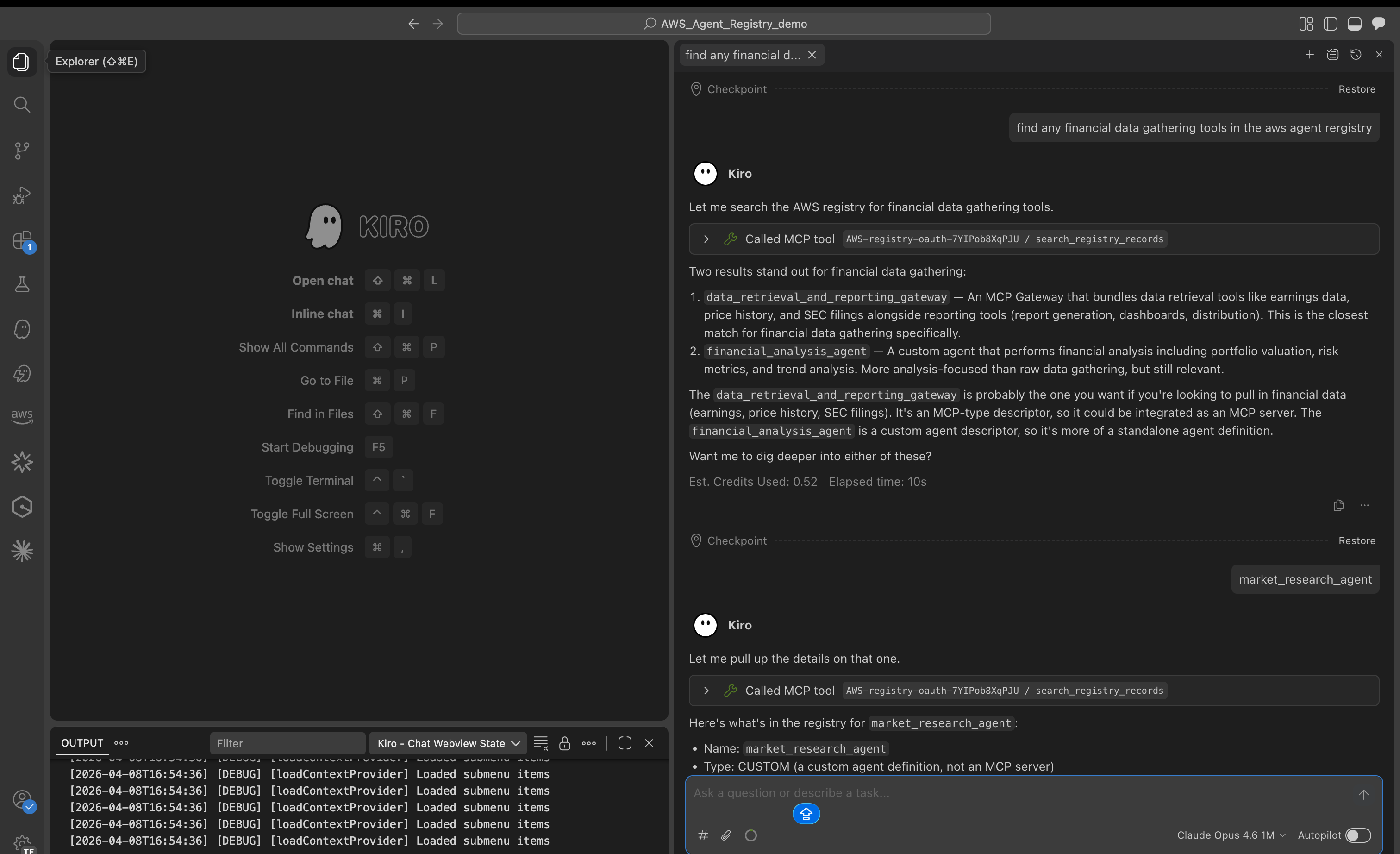
レジストリは、AgentCore コンソール、API、およびMCPサーバーとしてアクセス可能です。KiroやClaude Codeを含む、すべてのMCP互換クライアントはこれに直接クエリを実行できます。カスタムIDプロバイダーを使用する組織の場合、OAuthベースのアクセスにより、IAM認証情報(Identity and Access Management credentials)を必要とせずに、チームが独自の発見用UIを開発できます。
既存のリソースの発見
中央レジストリがない場合、開発者はサードパーティ製ツールを外部で検索するか、近隣のチームがすでに提供している作業の複製を行ってしまいます。その結果、何が構築されたのか、誰が所有しているのか、そして使用が承認されているのかという可視性が失われます。このレジストリは、キーワードとセマンティック(意味的)マッチングを組み合わせたハイブリッド検索によってこの問題を解決します。すべてのクエリはキーワードマッチングを使用しますが、より長く自然な言語のクエリについては、概念的に関連する結果を浮き彫りにするためにセマンティック理解も活用します。つまり、「決済処理」と検索すると、名前が異なっていても「請求」や「インボイス(請求書発行)」としてタグ付けされたツールが検索結果に表示されます。発見プロセスは、最も抵抗の少ない道になります。チームは、新しいものを構築する前に、名前、説明、リソースタイプで検索して、すでに存在するものを見つけることができます。開発者はまずレジストリを検索します。検証済みの機能が存在すれば、それを使用します。存在しない場合は、それを構築し、登録して、他のすべての人が利用できるようにします。組織全体で何が存在するかを確認できます。
*Zuoraは、AIファーストの収益化および収益管理プラットフォームであり、Sales(営業)、Finance(財務)、Product(製品)、Developer(開発)の各チームに50のエージェントを展開しています。AgentCore内のAWS Agent Registryにより、シニアアーキテクトは、使用されているすべてのエージェント、ツール、スキルを調査、管理、カタログ化するための統一されたビューを取得できます。この集中型アプローチにより、チームはゼロから再構築するのではなく、既存のアセットを見つけて再利用することが可能になります。標準化されたメタデータにより、各エージェントとツールには所有権と機能に関する一貫した詳細が含まれるため、チームはエージェントエコシステム全体に対してエンドツーエンドの可視性と説明責任を確保できます。*
*—— Pete Hirsch、Zuora 最高製品・技術責任者(Chief Product and Technology Officer)*
公開されるコンテンツのガバナンス
ガバナンスがなければ、誰でも何でも登録できてしまいます。何が検索可能になるかという制御を失い、基準の適用ができず、所有権を追跡できず、開発から廃棄までのエージェント管理が行えなくなります。エージェントが数個しかない場合はスプレッドシートで管理できますが、数百、数千に及ぶ場合、基準を自動的に適用するシステムが必要です。
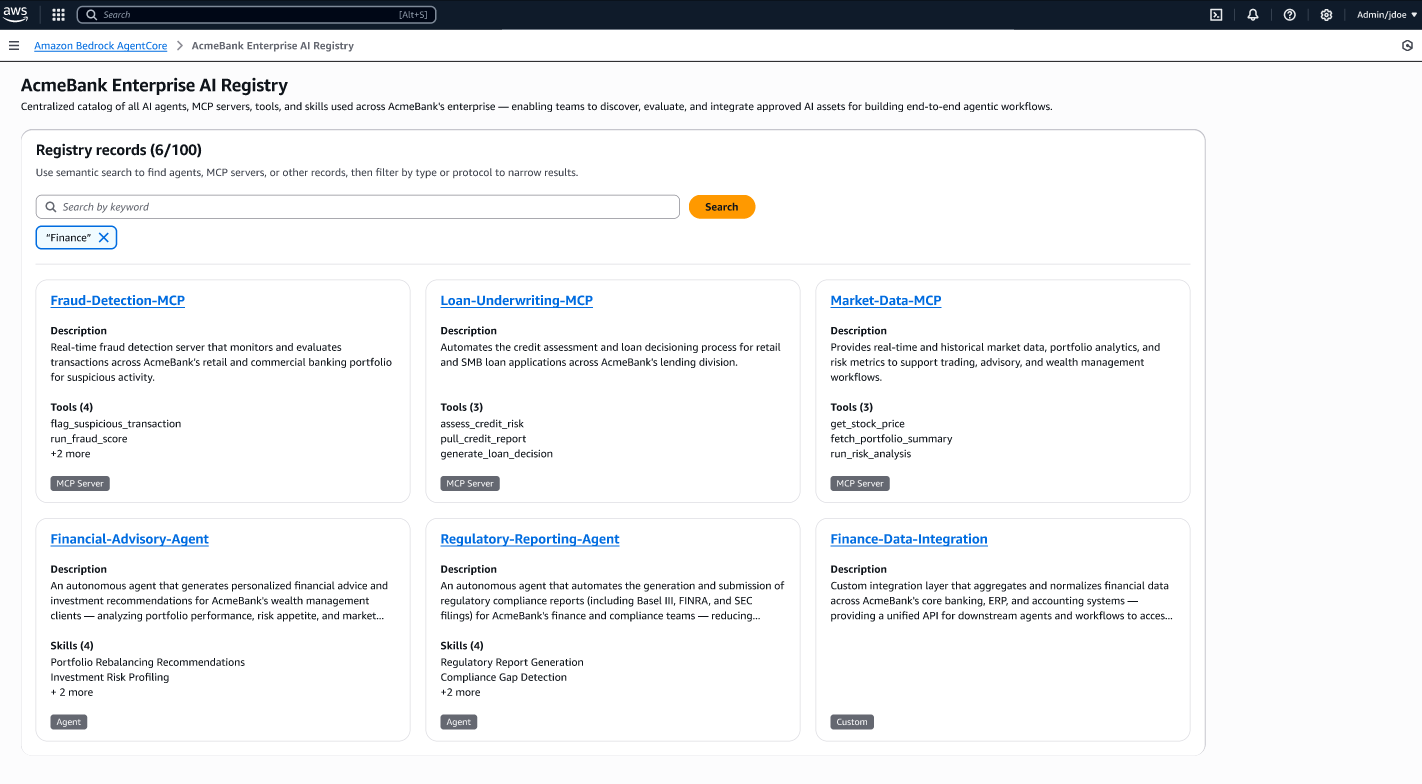
レジストリにより、公開されるコンテンツとアクセス権限を制御できます。管理者は IAM ポリシーを使用して、エージェント、ツール、およびエージェントスキルを登録できるユーザーと、それらを検索できるユーザーを定義します。すべてのレコードは承認ワークフローに従います:まずドラフトとして作成され、承認待ちの状態を経て、承認されると組織全体から検索可能になります。レジストリは、初期開発からデプロイメント、最終的な廃棄に至るまでのエージェントの全ライフサイクルを追跡します。レコードはバージョン管理されており、時間経過に伴う変更を追跡できます。また、組織は使用されなくなったレコードを非推奨(デプレケート)としてマークできます。レジストリには既存の承認ワークフローと連携するためのフックが提供されています。レコードを通じて各エントリにカスタムメタデータを追加でき、チームの所有権、コンプライアンスステータス、またはデプロイメント環境などの情報を記録できます。
*サウスウエスト航空は、企業全体にわたるエージェントカタログとガバナンスを実現しています。AgentCore内のAWS Agent Registryは、重要な発見可能性の問題を解決し、チームが既存のエージェントを見つけて再利用できるようにすることで、ゼロから機能を再構築する必要をなくします。複数のプラットフォームにわたる管理されたガバナンスにより、すべてのエージェントには標準化された所有権メタデータとポリシー適用が組み込まれています。これにより、組織内でのエージェントの散逸(スプレウル)を防ぎ、初日からエンタープライズグレードのガバナンスのもとで数千のエージェントをスケーリングする基盤を確立します。*
*– Justin Bundick、サウスウエスト航空 VP AI and Intelligent Platforms*
今後の展望
私たちは、エージェントが構築されるすべてのAWSサービス(Amazon QuickおよびKiroを含む)にわたるレジストリの構築を目指しています。エージェントはデプロイされた瞬間に自動的にインデックスされます。開発者はIDEから検索を行い、ビジネスユーザーはワークスペース内でエージェントを発見し、管理者はコンソールからガバナンスを行使します。これらはすべて、同一の信頼できる情報源によって支えられています。クロスレジストリフェデレーションにより、複数のレジストリを接続し、それらを一つとして検索することが可能になります。組織がエージェントをどのように捉えているかに適合するカテゴリや分類体系を定義でき、所有権、コンプライアンスステータス、コストセンター、ガバナンスモデルに必要なその他の情報を捉える構造化メタデータスキーマによって裏付けられます。時間の経過とともに、AgentCore Observability(エージェントコア観測性)からの運用インテリジェンスがレジストレコードと共に表示されるようになります:呼び出し回数、レイテンシ、稼働時間、使用パターンなどです。これにより、単に「何が存在するか」だけでなく、「実際にプロダクションで機能しているもの」を理解するのに役立ちます。
AWS Agent Registry(エージェントレジストリ)に加え、私たちは外部パートナーカタログとの連携を目指しています。テクノロジー環境全体にわたる中央集権的な発見とガバナンスに対する、早期のパートナーからの関心に興奮しています。
始め方
今回のプレビューはスタート地点です。すでに存在するものを再構築する必要はありません。可視性なくデプロイされたエージェントも不要です。AWS Agent Registry は、企業全体で存在するすべてのエージェントを一元化して発見、ガバナンス、再利用できる場所を提供します。
AWS Agent Registry は本日、AgentCore を介して以下の 5 つの AWS リージョン でプレビューとして利用可能です:US East (N. Virginia)、US West (Oregon)、Asia Pacific (Sydney)、Asia Pacific (Tokyo)、および Europe (Ireland)。
AgentCore コンソール を通じて AWS Agent Registry の利用を開始してください。ドキュメント をお読みいただき、詳細をご確認ください。
執筆者について
 image
image
Preethi CN
Preethi CNは、Agentic AI OrganizationのAgentCore部門ディレクターであり、組み込みおよびクラウドソフトウェア開発において20年以上の専門知識を有しています。Amazon在籍14年間、小売、Alexa、AWSにわたる大規模分散システムのアーキテクチャ設計とAI革新を牽引し、マルチモーダルAIにおける画期的な成果をもたらしました。彼女はAlexaの音声認識、AWSでのコンピュータビジョンサービス、そして組織が大規模に非構造化コンテンツからインサイトを抽出する方法を革命化した生成AIの変革を主導しました。Agentic AI Organizationの技術アドバイザーとして、Amazon Quick、Kiro、AWS Transform全体にわたる戦略的監督を提供してきました。最近では、大規模な本番環境対応AIエージェントの構築・接続・最適化のためのプラットフォームであるAgentCoreのビジョン策定と立ち上げを主導しました。
原文を表示
*Now available through Amazon Bedrock AgentCore, use AWS Agent Registry to discover, share, and reuse agents, tools, and agent skills across your organization.*
As enterprises scale to hundreds or thousands of agents, platform teams face three critical challenges: visibility (knowing what agents exist across the organization), control (governing who can publish and what becomes discoverable organization-wide), and reuse (preventing teams from rebuilding capabilities that already exist). Without a centralized system, agent sprawl accelerates, compliance risks grow, and development effort is wasted on duplicate work. These challenges are compounded by reality: no organization’s agent landscape lives entirely within one provider. Agents are built across AWS services, other cloud platforms, and on-premises environments. A registry that only covers part of the stack leaves the rest invisible, and invisible agents can’t be discovered, governed, or reused. Solving this requires more than a place to list what exists. Platform teams need to build agents, publish them with approval workflows, help teams to discover and reuse what exists, govern who can publish and consume, monitor what’s running in production, and retire what’s no longer needed. Today, we’re announcing AWS Agent Registry (preview) in AgentCore, a single place to discover, share, and reuse AI agents, tools, and agent skills across your enterprise.
AgentCore is the platform to build, connect, and optimize agents at scale, designed from the ground up for agents: open to any model, any framework, any enterprise architecture. Whether you’re shipping your first agent or your thousandth, you have one platform that scales with you. The registry extends that same flexibility to how you organize and govern what you’ve built. It indexes agents regardless of where they’re built or hosted – on AWS, other cloud providers, or on premises.
What’s available in preview today
The registry stores metadata for every agent, tool, MCP server, agent skill, and custom resources as a structured record. It captures who published each record, what protocols it implements, what it exposes, and how to invoke it. The registry supports established standards like MCP and A2A natively, with the flexibility to define custom schemas for your organization. There are two ways to register a record. You can provide metadata manually through the console, AWS SDK, or API, specifying capability descriptions, ownership, compliance status, and usage documentation. Or you can point to an MCP or A2A endpoint, and the registry will automatically pull in the details. Your registry can reflect your full agent landscape from day one, not only the pieces that happen to run on AWS.
The registry is accessible through the AgentCore Console, APIs, and as an MCP server. Any MCP-compatible client can query it directly, including Kiro and Claude Code. For organizations with custom identity providers, OAuth-based access means that teams can build their own discovery UIs without requiring IAM credentials.
Finding what already exists
Without a central registry, developers search externally for third-party tools or duplicate work that a neighboring team already shipped. You lose visibility into what’s been built, who owns it, and whether it’s approved for use. The registry solves this with hybrid search that combines keyword and semantic matching: all queries use keyword matching, but longer, natural language queries also use semantic understanding to surface conceptually related results. This means a search for “payment processing” surfaces tools tagged as “billing” or “invoicing,” even if they’re named differently. Discovery becomes the path of least resistance. Teams can search by name, descriptions, and resource type to find what already exists before building something new. Developers search the registry first. If a vetted capability exists, they use it. If it doesn’t, they build it, register it, and make it available to everyone else. You can see what exists across your organization.
For Zuora, an AI-first monetization and revenue management platform deploying 50 agents across Sales, Finance, Product, and Developer teams, the AWS Agent Registry in AgentCore gives Principal Architects a unified view to discover, manage, and catalog every agent, tool, and skill in use. This centralized approach enables teams to find and reuse existing assets rather than rebuilding from scratch. Standardized metadata ensures each agent and tool includes consistent details on ownership and capabilities, giving teams end-to-end visibility and accountability across the entire agent ecosystem.
– Pete Hirsch, Chief Product and Technology Officer, Zuora
Governing what gets published
Without governance, anyone can register anything. You lose control over what becomes discoverable, can’t enforce standards, can’t track ownership, and can’t manage agents from development to retirement. When you have a few agents, you can manage them in a spreadsheet. When you have hundreds or thousands, you need a system that enforces standards automatically.
The registry gives you control over what gets published and who can access it. Admins use IAM policies to define who can register agents, tools, and agent skills and who can discover them. Every record follows an approval workflow: they start as drafts, move to pending approval, and become discoverable to the broader organization once approved. The registry tracks agents across their entire lifecycle, from initial development through deployment to eventual retirement. Records are versioned to track changes over time, and organizations can deprecate records that are no longer in use. The registry provides hooks to integrate your existing approval workflows. You can add custom metadata to each entry through a record, capturing information like team ownership, compliance status, or deployment environment.
Southwest Airlines is enabling an enterprise-wide agent catalog and governance across the enterprise. AWS Agent Registry in AgentCore solves the critical discoverability challenge— enabling teams to find and reuse existing agents instead of rebuilding capabilities from scratch. With managed governance across multiple platforms, every agent carries standardized ownership metadata and policy enforcement. This will prevent agent sprawl across the organization while establishing the foundation for scaling thousands of agents with enterprise-grade governance from day one.
– Justin Bundick, VP AI and Intelligent Platforms, Southwest Airlines
Where we’re headed
We’re building toward a future where the registry spans every AWS service where agents are built, including Amazon Quick, and Kiro. Agents will be automatically indexed the moment that they’re deployed. Developers will search from the IDE, business users will discover agents in their workspace, and admins will govern from the console, all backed by the same source of truth. Cross-registry federation will let you connect multiple registries and search across them as one. You will be able to define categories and taxonomies that match how your organization thinks about agents, backed by structured metadata schemas capturing ownership, compliance status, cost center, and whatever else your governance model requires. Over time, operational intelligence from AgentCore Observability will surface alongside registry records: invocation counts, latency, uptime, and usage patterns, helping you to understand not only what exists, but what’s actively working in production.
Beyond AWS Agent Registry, we’re building toward connecting with external partner catalogs. We’re excited about early partner interest in centralized discovery and governance across your technology landscape.
Get started
Today’s preview is the starting line. No more rebuilding what already exists. No more agents deployed without visibility. The AWS Agent Registry gives you one place to discover, govern, and reuse every agent across your enterprise.
AWS Agent Registry is available in preview today through AgentCore in five AWS Regions: US East (N. Virginia), US West (Oregon), Asia Pacific (Sydney), Asia Pacific (Tokyo), and Europe (Ireland).
Get started with AWS Agent Registry through the AgentCore Console. Learn more by reading the documentation.
About the authors
Preethi CN
Preethi CN is Director of AgentCore in the Agentic AI Organization, with over 20 years of expertise in embedded and cloud software development. In her 14 years at Amazon, she has architected large-scale distributed systems and driven AI innovations across Retail, Alexa, and AWS, delivering breakthroughs in multimodal AI. She led speech recognition for Alexa, Computer Vision services at AWS, and generative AI transformation that revolutionized how organizations extract insights from unstructured content at scale. As a technical advisor to the Agentic AI Organization, she has provided strategic oversight across Amazon Quick, Kiro, and AWS Transform. Most recently, she crafted the vision and led the launch of AgentCore, the platform for building, connecting, and optimizing production-ready AI agents at scale.
関連記事
今日のまとめ
AI日報で今日の重要ニュースをまとめ読み