LMSYS、Miles にオンポリシー蒸留(OPD)機能を追加し学習フローを強化
本文の状態
日本語全文を表示中
詳細モードで約13分の本文を読めます。
同じ出来事の情報源
この情報源を基点に整理
LMSYS Blog
LMSYS は Miles において On-Policy Distillation (OPD) を統合し、教師モデルの推論挙動を学生モデルへ転送する機能を強化した。
AI深層分析を開く2026年8月1日 01:55
AI深層分析
キーポイント
OPD の実装と機能拡張
Miles に On-Policy Distillation (OPD) が追加され、教師モデルのガイダンスのみを用いる純粋な蒸留と、GRPO/PPO 型強化学習を併用する RL 支援型蒸留の 2 つのモードをサポートするようになった。
Top-k OPD の導入
単一のサンプリングトークンに限定せず、複数の候補トークンとその対数確率を保持して教師が評価を行う Top-k OPD により、学生と教師の比較をより豊かにする仕組みが実装された。
推論効率化のための最適化
不要な密な対数確率ペイロードを防ぐため、スパースな教師スコアリングワークフローが追加され、8×NVIDIA B200 ノード上での Qwen3.5-35B-A3B の自己蒸留実験で有効性が検証された。
構成可能なトポ-k 蒸留戦略のサポート
OPD は候補セットの構築方法や逆 KL 信号計算時の重み付けをカスタマイズ可能にし、異なる蒸留レシピが同一のロールアウト・教師スコアリング・トレーニングインフラを再利用できるようにする。
スパースな学生から教師へのスコアリングワークフロー
新ワークフローは全候補のグローバル併合に依存せず、位置ごとの候補トークンのみを教師に送信して必要な対数確率値のみを受け取るため、O(R²K) の冗長なペイロード処理から O(RK) のスパース計算へ最適化される。
重要な引用
OPD is now integrated into Miles rollout and training flow
Miles supports top-k OPD to construct a richer student–teacher comparison than the single sampled-token estimator.
without any task-specific reward, OPD can transfer a teacher model's shorter-reasoning behavior to a base student model
The new workflow replaces the dense global-union path with sparse per-position candidate-token scoring.
編集コメントを表示
編集コメント
LMSYS が提供する Miles フレームワークに、推論効率を高める OPD の実装が加わったことは、大規模言語モデルの微調整手法において重要な進展である。特に Top-k オプションの追加は、教師と学生の比較精度を高め、より安定した学習を可能にする技術的改良と言える。
Source Article
元記事を日本語で読む
本文に関係しない購読案内、埋め込み通知、サイト内プロモーションは除いています。
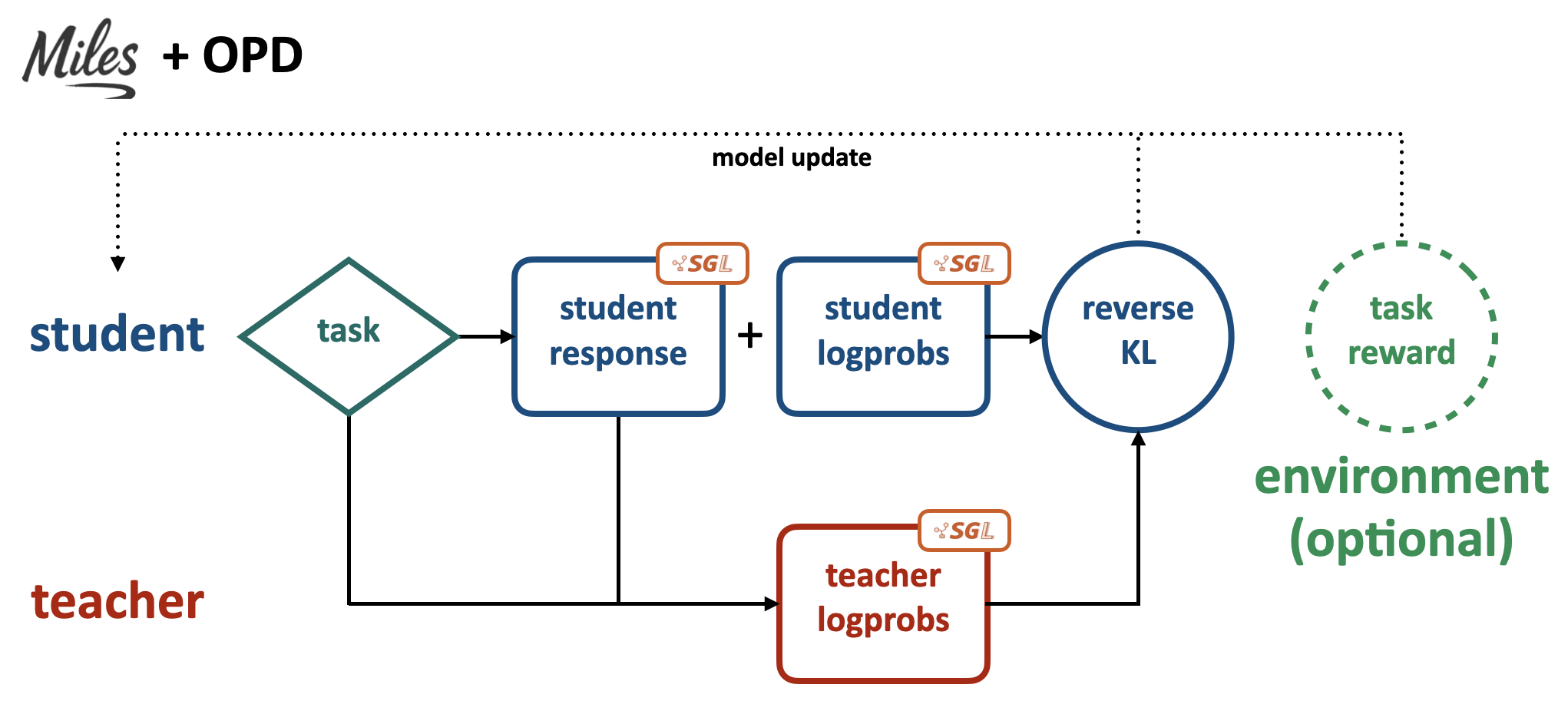
私たちは最近、On-Policy Distillation (OPD) を Miles の重要な機能として実装しました。これにより、Miles のロールアウトとトレーニングフローに OPD が統合され、ユーザーは教師モデルの指導のみで学生モデルを訓練することも、GRPO/PPO 形式の強化学習目標と組み合わせて行うことも可能になりました。
本稿では、Miles における OPD の実装内容、不要な密度の高い対数尤度(logprob)ペイロードを防ぐために追加したスパースな教師スコアリング・ワークフロー、および単一の 8×NVIDIA B200 ノードで検証された初期の Qwen3.5-35B-A3B 自己蒸留実験について解説します。この実験では、特定のタスクに対する報酬なしでも、OPD は学生モデルのパフォーマンスを維持しつつ、教師モデルの短い推論行動をベースラインの学生モデルへ転移できることを示しました。
Miles プリミティブとしての OPD
Miles は現在、逆 KL 発散(reverse-KL)のトレーニング信号として OPD をサポートしています。これにより、OPD は以下の 2 つの重要なモードを実現します。
- 純粋な蒸留: 学生モデルは教師からのシグナルのみで訓練されます。この設定ではタスク報酬をゼロに設定でき、更新はトークンごとの学生と教師間の逆 KL 発散信号によって完全に駆動されます。
- 強化学習を強化した蒸留: OPD のシグナルにタスク報酬や GRPO/PPO 形式のアドバンテージ推定量を組み合わせたものです。これにより、学生モデルは環境からのフィードバックと教師の指導の両方から学習できるようになります。
Miles では、SGLang でホストされた教師モデルを通じて、サンプリングトークン OPD と top-k OPD の両方をサポートしています。サンプリングトークン OPD では、教師は学生が各応答位置で実際にサンプリングしたトークンのスコアを評価します。サンプリングには確率的な要素が含まれるため、このトークンは必ずしも学生の最も確率の高いトークンとは限りません。
top-k OPD はこのワークフローを拡張し、各位置で複数の候補トークンとその学生側の logprob を保持します。教師はこれらの同じ候補に対してスコアを付け、Miles は整合された学生と教師の logprob を組み合わせて、トレーニング中に使用されるトークンごとの逆 KL 信号を生成します。
この設計により、OPD は Miles 内で個別の蒸留パスではなく、再利用可能なトレーニングの基盤として機能しています。
top-k OPD
Miles は top-k OPD をサポートしており、単一のサンプリングトークン推定器よりも豊かな学生と教師の比較を構築できます。
学生のロールアウト中、Miles は各応答位置で設定可能な数の候補トークン ID と、それに対応する学生の logprob を記録します。位置 t における候補のスコア付けを行う際、教師は元のプロンプトと、位置 t に先行して学生が生成したトークンを条件として受け取ります。その後、その位置で要求された候補トークンに対する教師側の logprob を返却します。
OPD の実装では、設定可能なトップ K 蒸留戦略もサポートされています。ユーザーは候補セットの構築方法や、逆 KL 信号を計算する際の候補トークンの重み付け方法をカスタマイズできます。これにより、異なる蒸留レシピでも、ロールアウト・教師スコアリング・トレーニングインフラストラクチャを共通して再利用することが可能になります。
スパースな学生から教師へのスコアリング
重要なシステム改善の一つが、スパースな学生から教師へのスコアリングワークフローです。
OPD では、学生のロールアウトによって位置ごとのトップ K テーブルが生成されます。生成された応答の各位置について、Miles は KL 計算に必要な候補トークン ID と学生のログ確率(logprobs)を正確に把握しています。教師モデルは、対応する因果的プレフィックスの下で、その候補トークン ID のみをスコアリングすれば十分です。
初期の実装では、スコアリングワークフローが位置ごとのトップ K トークン ID 全体のグローバルな併合(ユニオン)を作成し、応答の各位置で教師モデルにこの完全な併合セットをスコアリングさせる必要がありました。これは正しさを保つための方法でしたが、結果として R × |U| の密度の高い中間ペイロードが発生しました。ここで R は応答長、|U| はグローバルなトークン ID の併集合です。|U| が R × K に近づく場合があり得るため、旧来の経路では最終的な OPD 計算に必要な O(RK) 値のみを必要としながら、O(R²K) 規模の JSON レスポンスを実体化して解析する必要がありました。
新しいワークフローでは、従来の密なグローバル統合パスに代わり、位置ごとの候補トークンスコアリングという疎なアプローチを採用しています。Miles は各位置のトークン ID 表を教師モデルへ送信し、教師は各位置で指定された候補セットに対する logprobs のみを返却します。これにより、教師からのレスポンスペイロードが実際の OPD 計算と完全に整合するようになります。Miles が扱うのは、OPD に必要な疎な R × K の値のみです。
長時間の回答を要する推論ワークロードにおいては、これが重要になります。なぜなら、教師によるスコアリングが不要なペイロード構築や転送、パース処理に支配されてはならないからです。疎なスコアリングを採用することで、OPD パイプラインはより直接的になり、高スループットでのロールアウトやトレーニングにも適したものとなります。
検証:NVIDIA B200 上での Qwen3.5 自己蒸留
実装の妥当性を検証するため、Qwen3.5-35B-A3B を用いた制御された自己蒸留実験を行いました。
まず教師モデルは、検証可能な報酬を用いた強化学習(RLVR)で訓練され、より短い回答で DAPO の数学問題を解けるように調整されました。一方、学生モデルは RL 適用前の対応するベースチェックポイントです。この設定を選んだ理由は、DAPO の能力を直接蒸留しても目立った改善が見込めないからです。ベースとなる Qwen 学生モデルはもともと元のタスクに対してすでに強力でした。そこで私たちはあえて教師モデルに明確な行動変化を持たせました。具体的には「より短く、かつ依然として効果的な推論」です。そして、OPD がこの行動をまだ示していない学生モデルへ転移できるかをテストしました。
OPD の効果を単独で評価するため、純粋な蒸留実験を行いました。
- タスク報酬:ゼロ
トレーニングのシグナルには、トップ 1 の学生モデルと教師モデル間の逆 KL 散逸(reverse-KL)を採用しました。
教師モデルは RLVR で訓練された短推論チェックポイントです。一方、学生モデルは RLVR 前のベースチェックポイントから出発しています。
ハードウェア構成は NVIDIA B200 を 8 基搭載したノード 1 つのみです。実行モードでは、学生モデルによるロールアウト、教師モデルによるスコアリング、そして学生モデルのトレーニングを同一 GPU プール上で共役・時分割して実行しました。
比較基準となる参照ポイントは以下の通りです。
| モデル / ステージ | 未学習 DAPOMean 応答長 |
|---|---|
| RLVR 教師 | 0.8870, 6,248 |
| 初期ベース学生 | 0.8457, 18,675 |
この実験では、教師モデルが DAPO の問題に対してはるかに短い回答で解決するのに対し、ベースの学生モデルは大幅に長い解を生成することが確認できました。ここで問いたいのは以下の点です。
純粋な OPD(Optimal Policy Distillation)によって、教師モデルの効率的な推論行動を学生モデルへ転移させつつ、未学習 DAPO の性能も維持できるのか?
結果:性能低下なしで短く推論する
実験結果は、OPD が効率的な推論行動を転移させることを明確に示しています。
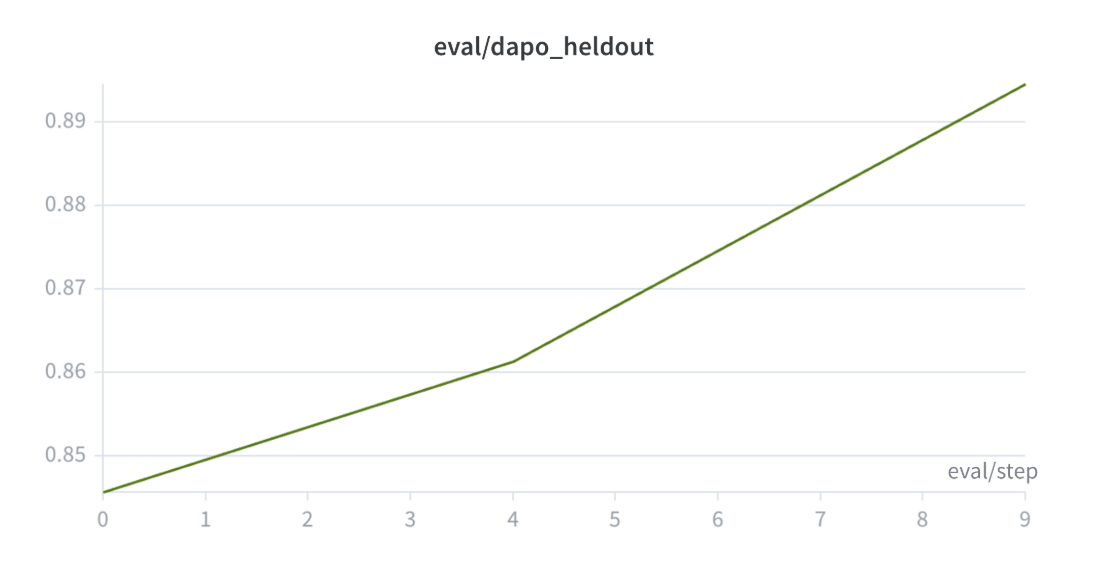
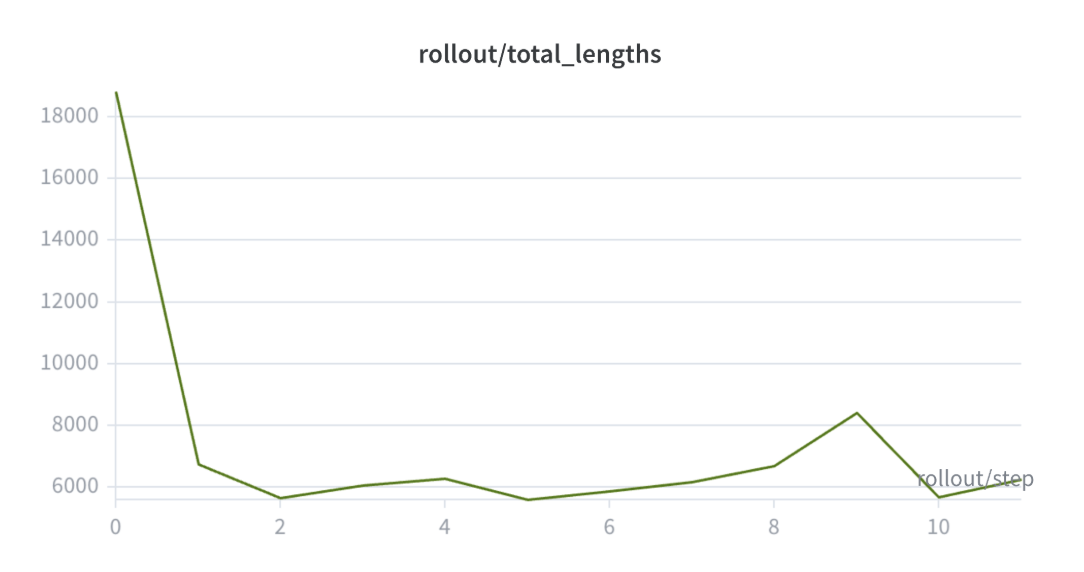
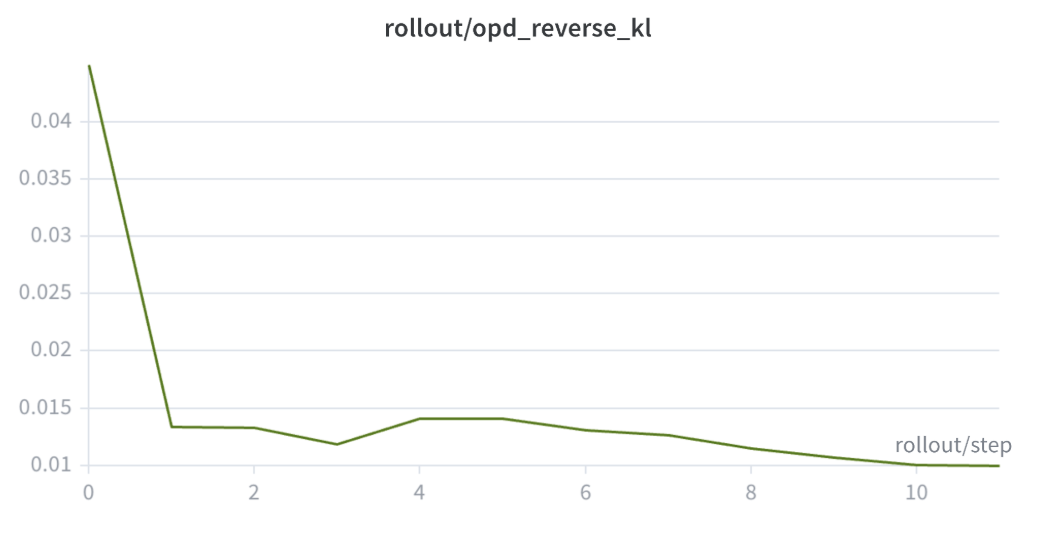
未学習 DAPO の性能は 0.8457 から 0.8945 に向上しました。同時に、サンプリングされたロールアウトの長さは最初の更新直後に急激に短縮され、初期の約 18.6k トークンから、その後のロールアウトでは主に 5.5k〜6.7k トークンへと減少しました(一時的な確率的なスパイクはありましたが)。トークンあたりの OPD 逆 KL 散逸も約 0.045 から 0.010 に低下し、学生モデル自身のロールアウトにおいてその分布が教師モデルの分布に近づいたことを示しています。
3 つの学習曲線は、それぞれ異なる角度から同じ物語を語っています。
Held-out DAPO performance increases, indicating that the student does not regress on task performance after OPD.
Sampled rollout length drops quickly, showing that the student adopts the teacher’s shorter-response behavior.
Per-token OPD reverse-KL decreases, confirming that the student distribution is moving closer to the teacher distribution.
Because raw task reward is zero in this experiment, the behavior change is solely driven by the OPD teacher signal. The central result is that pure OPD transfers the teacher’s efficient-reasoning behavior to the base student while held-out DAPO performance improves rather than degrades.
Why This Matters for Miles
The OPD implementation allows Miles to be applied in post-training workflows where verifiable task reward alone is not enough.
Many practical workflows need to optimize not only task success rate, but also model behavior: reasoning length, response style, domain-specific habits, distributional alignment with a reference model, etc. OPD enables Miles to express such goals as teacher-guided training signals while leaving the same rollout and RL training pipeline intact.
OPD は、マルチティーチャーの統合への道筋も提供します。異なる専門的な教師モデルが、それぞれ異なるドメインや能力に対してガイダンスを提供できるため、単一の学生モデルは補完的な振る舞いを吸収し、より汎用性の高いモデルへと進化させることが可能です。Miles では OPD を再利用可能なプリミティブとして扱っているため、各ドメインごとに別々のトレーニングシステムを構築する必要なく、同じ学生モデルの学習パイプラインで異なる教師や蒸留レシピをサポートできます。マルチティーチャーによる OPD の検証は今後の課題です。
実装においても、OPD は構成可能であることを維持しています。ユーザーは純粋な知識蒸留を実行することも、GRPO や PPO スタイルの目的関数に対して OPD を補助的なシグナルとして利用することもできます。これは、教師からのガイダンスとタスク報酬が協調して機能する必要があるポストトレーニングワークフローにおいて重要です。
同様に重要なのは、本システムが長文応答の負荷に最適化されている点です。位置ごとのスパースなスコアリングや top-k OPD を採用することで、不要な密な教師スコアリングのペイロードを回避し、蒸留に必要な実際の計算量に合わせたパイプラインを実現しています。
What's Next
現在の実装により、OPD は Miles の主要機能として確立され、制御された Qwen3.5 自己蒸留環境下での純粋な OPD の有効性が検証されました。今後は、以下の方向性で検証を拡張する予定です。
OPD を強化した RL の検証
純粋な OPD はすでに検証済みです。次のステップは、GRPO や PPO のタスク報酬と組み合わせた OPD の検証です。この場合、学生モデルは報酬シグナルと教師の分布的ガイダンスの両方から学習します。
大規模な性能評価
現在、コストの主要因は学生のロールアウトであり、教師による採点もオーバーヘッドとなっています。今後はより長く、スループットの高いワークロードでパイプライン全体をベンチマークし、スケーリングの挙動とボトルネックをより深く理解する予定です。
マルチ教師 OPD
有望な次のステップとして、ドメイン特化型の教師が 1 つの学生モデルを共同で指導できるかを評価することが挙げられます。これにより、OPD が補完的な専門家の振る舞いを統合し、より汎用性の高い単一モデルへと収束させるメカニズムとして機能するかどうかを検証できます。
さらなるトレーニングレシピ
Qwen3.5 の実験では短い推論の転移に焦点を当てましたが、今後はドメイン特化、応答スタイル、ツール使用のパターン、エージェントデータなど、教師による指導が可能な他の振る舞いも探求できるでしょう。
まとめ
Miles では現在、OPD を本格的なトレーニングおよびロールアウト機能としてサポートしています。実装には、加算逆 KL 学習、SGLang による教師採点、top-k OPD、設定可能な候補と重み付け戦略、位置ごとのスパースな教師採点が含まれています。
8×NVIDIA B200 ノード 1 つでの Qwen3.5-35B-A3B の自己蒸留実験において、純粋な OPD は RLVR 教師からベース学生モデルへ短い推論の振る舞いを転移しました。その結果、未使用の DAPO パフォーマンスは 0.8457 から 0.8945 に向上し、サンプリングされたロールアウト長さは約 18.6k トークン から主に 5.5k–6.7k トークン に短縮されました。また、トークンあたりの OPD 逆 KL は約 0.045 から 0.010 に低下しました。
これらの初期結果は、純粋な OPD(One-Pass Distillation)が有用な行動特性——具体的には大幅に短縮された推論プロセス——を転移可能であることを示しています。同時に、保持されたタスクにおける高い性能も維持されています。ただし、この結果が異なるモデルやタスク、教師・生徒構成の組み合わせにおいて一般化されるかどうかを検証するためには、より広範な実験が必要です。
謝辞
本研究の実現に際し、多大なるご支援とご協力を賜りました NVIDIA の Hunter Carlisle 氏および Priya Sethuraman 氏に、心から感謝申し上げます。
原文を表示
We recently implemented On-Policy Distillation (OPD) as an important feature in Miles. OPD is now integrated into Miles rollout and training flow, so users can train a student model either solely with a teacher model's guidance, or combine teacher guidance with GRPO/PPO-style reinforcement learning objectives.
In this post, we describe the OPD implementation in Miles, the sparse teacher-scoring workflow we added to avoid unnecessary dense logprob payloads, and an initial Qwen3.5-35B-A3B self-distillation experiment validated on a single 8×NVIDIA B200 node. The experiment shows that without any task-specific reward, OPD can transfer a teacher model’s shorter-reasoning behavior to a base student model while preserving the student model’s performance.
OPD as a Miles Primitive
Miles now supports OPD as an additive reverse-KL training signal. This enables OPD to support two important modes.
- Pure distillation trains the student only with the teacher signal. In this setting, task reward can be set to zero, and the update is driven entirely by the per-token student-teacher reverse-KL signal.
- RL-augmented distillation combines the OPD signal with task rewards and GRPO/PPO-style advantage estimators. This allows the student to learn from both environment feedback and teacher guidance.
On the rollout side, Miles supports both sampled-token OPD and top-k OPD through an SGLang-hosted teacher. In sampled-token OPD, the teacher scores the token actually sampled by the student at each response position. Because sampling may be stochastic, this token is not necessarily the student’s highest-probability token.
Top-k OPD extends this workflow by retaining multiple candidate tokens and their student logprobs at each position. The teacher scores those same candidates, and Miles combines the aligned student and teacher logprobs into the per-token reverse-KL signal used during training.
This design makes OPD a reusable training primitive in Miles rather than a separate one-off distillation path.
Top-k OPD
Miles supports top-k OPD to construct a richer student–teacher comparison than the single sampled-token estimator.
During student rollout, Miles records a configurable set of candidate token IDs and their student logprobs at each response position. To score the candidates for position ttt, the teacher is conditioned on the original prompt and the student-generated tokens preceding position ttt. It then returns teacher logprobs for the requested candidate tokens at that position.
The OPD implementation also supports configurable top-k distillation strategies. Users can customize how the candidate set is constructed and how candidate tokens are weighted when computing the reverse-KL signal. This allows different distillation recipes to reuse the same rollout, teacher-scoring, and training infrastructure.
Sparse Student-to-Teacher Scoring
A key system improvement is the sparse student-to-teacher scoring workflow.
In OPD, the student rollout produces a per-position top-k table. For each generated response position, Miles knows exactly which candidate token IDs and student logprobs are needed for the KL calculation. The teacher only needs to score those candidate token IDs under the corresponding causal prefix.
In the initial OPD implementation, the scoring workflow had to build a global union of all per-position top-k token IDs and ask the teacher to score that full union at every response position. This preserved correctness, but created a dense R × |U| intermediate payload, where R is response length and U is the global token-ID union. Since |U| can grow close to R × K, the old path could materialize and parse an O(R²K) JSON response even though the final OPD calculation only needs O(RK) values.
The new workflow replaces the dense global-union path with sparse per-position candidate-token scoring. Miles sends a per-position token-ID table to the teacher, and the teacher returns only the requested logprobs for each position’s own candidate set. This keeps the teacher-response payload aligned with the actual OPD computation: Miles carries only the sparse R × K values that OPD needs.
For long-response reasoning workloads, this matters because teacher scoring should not become dominated by unnecessary payload construction, transfer, or parsing. Sparse scoring makes the OPD pipeline more direct and better suited for high-throughput rollout and training.
Validation: Qwen3.5 Self-Distillation on NVIDIA B200
To validate the implementation, we ran a controlled self-distillation experiment with Qwen3.5-35B-A3B.
The teacher was first trained with Reinforcement Learning with Verifiable Rewards (RLVR) to solve DAPO math problems using substantially shorter responses. The student was the corresponding pre-RL base checkpoint. We chose this setup because directly distilling DAPO capability produced little visible movement: the base Qwen student was already strong on the original task. Instead, we deliberately created a measurable behavior shift in the teacher — shorter but still effective reasoning — and tested whether OPD could transfer that behavior to a student that did not yet exhibit it.
To isolate OPD, we ran pure distillation.
- Task reward: zero
- Training signal: top-1 student-teacher reverse-KL
- Teacher: RLVR-trained shorter-reasoning checkpoint
- Student: pre-RL base checkpoint
- Hardware: single 8×NVIDIA B200 node
- Execution mode: student rollout, teacher scoring, and student training colocated and time-shared on the same GPU pool
The reference points were:
Model / stageHeld-out DAPOMean response length
RLVR teacher0.88706,248
Initial base student0.845718,675
The teacher solves the same DAPO problems with much shorter responses, while the base student produces substantially longer solutions. Through this experiment, we want to answer the following question:
Can pure OPD transfer the teacher’s efficient-reasoning behavior to the student while preserving held-out DAPO performance?
Results: Shorter Reasoning Without Performance Degradation
Our results provide clear evidence that OPD can transfer the efficient-reasoning behavior.
Held-out DAPO performance improved from 0.8457 to 0.8945. At the same time, sampled rollout length dropped sharply after the first update, from roughly 18.6k tokens to mostly 5.5k–6.7k tokens across later rollouts, with only a brief stochastic spike. Per-token OPD reverse-KL also decreased from about 0.045 to 0.010, showing that the student distribution became closer to the teacher distribution on the student’s own rollouts.
The three learning curves tell the same story from different angles.
Held-out DAPO performance increases, indicating that the student does not regress on task performance after OPD.
Sampled rollout length drops quickly, showing that the student adopts the teacher’s shorter-response behavior.
Per-token OPD reverse-KL decreases, confirming that the student distribution is moving closer to the teacher distribution.
Because raw task reward is zero in this experiment, the behavior change is solely driven by the OPD teacher signal. The central result is that pure OPD transfers the teacher’s efficient-reasoning behavior to the base student while held-out DAPO performance improves rather than degrades.
Why This Matters for Miles
The OPD implementation allows Miles to be applied in post-training workflows where verifiable task reward alone is not enough.
Many practical workflows need to optimize not only task success rate, but also model behavior: reasoning length, response style, domain-specific habits, distributional alignment with a reference model, etc. OPD enables Miles to express such goals as teacher-guided training signals while leaving the same rollout and RL training pipeline intact.
OPD also provides a path toward multi-teacher consolidation. Different expert teachers can provide guidance for different domains or capabilities, allowing a single student model to absorb complementary behaviors into a more versatile model. Because Miles treats OPD as a reusable primitive, the same student-training pipeline can support different teachers and distillation recipes without requiring a separate training system for each domain. Validation of multi-teacher OPD remains future work.
The implementation also keeps OPD composable. Users can run pure distillation or use OPD as an auxiliary signal with GRPO/PPO-style objectives. This is important for post-training workflows where teacher guidance and task reward may need to work together.
Just as importantly, the system is optimized for long-response workloads. Sparse per-position scoring and top-k OPD help avoid unnecessary dense teacher-scoring payloads, making the pipeline better aligned with the actual computation needed for distillation.
What’s Next
The current implementation establishes OPD as a first-class Miles capability and validates pure OPD in a controlled Qwen3.5 self-distillation setting. Next, we plan to extend validation in several directions.
Validating OPD-augmented RL.
We have validated pure OPD. The next step is to validate OPD combined with GRPO/PPO task rewards, where the student learns from both reward signals and teacher distributional guidance.
Larger performance studies.
Student rollout is currently the main cost, while teacher scoring adds overhead. We plan to benchmark the full pipeline on longer, higher-throughput workloads to better understand scaling behavior and bottlenecks.
Multi-teacher OPD.
A promising next step is to evaluate whether domain-specialized teachers can jointly guide one student model. This would test OPD as a mechanism for consolidating complementary expert behaviors into a single, more versatile model.
More training recipes.
The Qwen3.5 experiment focused on transferring shorter reasoning. Future recipes can explore other teacher-guided behaviors, including domain specialization, response style, tool-use patterns, and agentic data.
まとめ
Miles now supports OPD as a first-class training and rollout feature. The implementation includes additive reverse-KL training, SGLang teacher scoring, top-k OPD, configurable candidate and weighting strategies, and sparse per-position teacher scoring.
In an initial Qwen3.5-35B-A3B self-distillation experiment on a single 8×NVIDIA B200 node, pure OPD transferred shorter-reasoning behavior from an RLVR teacher to a base student. Held-out DAPO performance improved from 0.8457 to 0.8945, sampled rollout length dropped from roughly 18.6k tokens to mostly 5.5k–6.7k tokens, and per-token OPD reverse-KL decreased from about 0.045 to 0.010.
These initial results show that pure OPD can transfer a useful behavioral property—in this case, substantially shorter reasoning—while preserving strong held-out task performance. Broader experiments are still needed to validate the result across models, tasks, and teacher–student configurations.
Acknowledgments
We are especially grateful to Hunter Carlisle and Priya Sethuraman at NVIDIA for their generous help and support in bringing this work together.
関連記事
今日のまとめ
AIデイリーブリーフで今日の重要ニュースをまとめ読み