欧州における AI の柔軟性解放:EU データ処理とモデルアクセスのためのクロスリージョン推論ガイド
AWS は、EU のデータ保護規制(GDPR)に準拠しつつ、複数リージョン間でモデル推論を自動ルーティングする「Cross-Region Inference」機能を Amazon Bedrock に導入し、欧州顧客のコンプライアンスとリソース可用性の両立を支援した。
キーポイント
EU データ主権への対応
Amazon Bedrock の Cross-Region Inference (CRIS) は、EU 内のリージョン間でのみ推論リクエストをルーティングする機能を提供し、GDPR に準拠したデータ処理を実現します。
インフラストラクチャの最適化
システム定義済みプロファイルにより、複数の AWS リージョンにまたがる広範な推論容量を活用でき、レイテンシを最小限に抑えつつスループットを最大化します。
レジリエントなアプリケーション構築
地理的な境界内で自動的にリクエストが振り分けられるため、特定リージョンの障害や容量不足に影響されにくい、より堅牢な生成 AI アプリケーションの開発が可能になります。
EU CRIS プロファイルによるデータローカライゼーション
eu.amazon.nova-2-lite-v1:0 というモデルIDを使用することで、リクエストが EU CRIS(Cross-Region Inference Service)の指定された地域内で処理され、EU データ規制に準拠した推論が可能になります。
グローバルプロファイルによる柔軟なリージョン選択
global.amazon.nova-2-lite-v1:0 というモデルIDは、AWS の商用リージョンであればどこでも処理が実行されるため、可用性やコストに基づいて最適な地域を動的に選定できます。
地理的推論プロファイルの静的性質と管理
EU などの地理的推論プロファイルは静的であり、新しいリージョンを追加する必要がある場合は、AWS が新しい ID を持つ別のプロファイルを公開します。
監査可能性とログ管理の仕組み
CloudTrail とモデル呼び出しロギングにより、データ処理の透明性が確保され、クロスリージョン推論でもログはリクエスト発生源のリージョンに保存されます。
重要な引用
Cross-Region Inference (CRIS) on Amazon Bedrock meets these needs by automatically routing requests across multiple AWS Regions within predefined geographic boundaries.
This allows generative AI applications to consume broad capacity in the geography, helping customers to build more resilient applications that reflect their geographic intricacies.
Request can be processed within available destination Regions in EU CRIS
Request can be processed by any AWS Commercial Region
Geographic inference profiles, and therefore the EU inference profile, are static. This means AWS won't add more Regions to the profile.
When using cross-Region inference, Amazon CloudWatch, AWS CloudTrail and Model Invocation Logging continue to record log entries only in the source Region of the customer AWS account where the request originated.
影響分析・編集コメントを表示
影響分析
この発表は、欧州における生成 AI の実装において、コンプライアンス要件とパフォーマンスの両立という最大の課題に対する具体的な解決策を示すものです。AWS が提供するこの機能により、企業は EU 外へのデータ流出を懸念することなく、グローバルなモデル容量を活用した堅牢な AI アプリケーションを迅速に構築・展開できるようになります。
編集コメント
EU の厳格なデータ規制下で AI サービスを運用する企業にとって、この機能は実務的な救世主となる可能性が高い。技術的な柔軟性と法的コンプライアンスの両立を可能にする重要なステップである。
最新の生成 AI モデルへのアクセスと、世界的に需要の高い高性能アクセラレーテッドコンピューティングを利用できる AWS の顧客は、セキュリティおよびプライバシー要件を満たしつつ、複数の AWS リージョン全体でモデルの可用性と容量を活用するためのツールを必要としています。Amazon Bedrock 上のクロスリージョン推論(CRIS)は、事前に定義された地理的境界内にある複数の AWS リージョン間でリクエストを自動的にルーティングすることで、これらのニーズに応えます。これにより、生成 AI アプリケーションはその地域全体で広範な容量を利用でき、顧客が地理的な複雑さを反映したよりレジリエントなアプリケーションを構築できるようになります。
本記事では、クロスリージョン推論(CRIS)についてさらに詳しく掘り下げ、ヨーロッパの顧客がどのように恩恵を受けられるかを解説します。AWS が提供する機能、サービス、リソースを紹介し、顧客が現地のデータ保護および処理要件に適合するよう支援する方法を強調します。これには、CRIS を利用する際の活動に関連して適用される可能性のある一般データ保護規則(GDPR)も含まれます。
クロスリージョン推論プロファイル
クロスリージョン推論(CRIS)は、Amazon Bedrock における管理機能であり、サポート対象の AWS リージョン内でモデル推論リクエストをルーティングします。推論プロファイルは、Amazon Bedrock 上のリソースであり、リクエストがルーティング可能なリージョンを定義するものです。これらのプロファイルは、特定のリージョンセット内でのみリクエストをルーティングします。CRIS のルーティングは、最小限のレイテンシオーバーヘッドでモデルのスループットを最適化するように設計されています。
Amazon Bedrock では、システム定義型の推論プロファイルが導入されました。これらの推論プロファイルは、対応するモデル名と地理的リージョン名にちなんで命名されています。これらのプロファイルにより、Amazon Bedrock の利用者は AWS のグローバルスケールのインフラを活用して、生成 AI ソリューションを構築することが可能になります。クロスリージョン推論プロファイルがどのように推論リクエストを処理するかを理解するためには、以下の主要な概念を理解しておくことが重要です。
ソースリージョン – 推論プロファイルを指定する API リクエストを発行するリージョンです。
宛先リージョン – Amazon Bedrock サービスが、ソースリージョンからのリクエストをルーティング先のリージョンとして選択できる領域です。
システム定義型の CRIS プロファイルには、グローバル範囲と地理的範囲の 2 つがあります。次のセクションでは、グローバル範囲と EU(欧州連合)の地理的範囲について説明し、顧客が異なるプロファイルを活用して規制およびコンプライアンス要件に対応する方法について解説します。
グローバル推論
グローバル推論プロファイルは、モデル推論リクエストを対応するすべての AWS 商用リージョンにルーティングします。入力プロンプトはモデル推論を提供するための宛先リージョンへ送信され、モデル出力は宛先リージョンで生成された後、元のリージョンへ返されます。リージョン間推論中に伝送されるデータは 暗号化され、安全な AWS ネットワーク内に留まります。宛先リージョンは、利用可能なモデル容量を最適化し、最小限のオーバーヘッドで応答を返すために自動的に選択されます。
すべての対応するリージョンを利用することで、グローバル推論プロファイルを使用する生成 AI アプリケーションは、ピーク時の潜在的な容量不足やその他のリージョン固有のモデル可用性の問題に対してより耐性を持ちます。また、グローバル CRIS(Cross-Region Inference Service)を通じて、いくつかのモデルが直接リージョン内または地理的 CRIS 呼び出しと比較して 割引価格 で利用可能であり、これによりグローバル推論はさらに魅力的なものとなっています。
EU の地理ベース推論
Geographic CRIS (Geo CRIS) は、グローバルな推論プロファイルとは異なるシステム定義型の推論プロファイルです。これらのプロファイルはモデルを特定の地理領域に紐付け、プロファイル内で定義された複数のリージョンから同一モデルのコピーを提供します。Amazon Bedrock の顧客は要件に応じて選択可能な、異なる Geo CRIS プロファイルが用意されています。本節では、EU 固有の推論プロファイル(EU CRIS)について解説します。
EU CRIS プロファイルは、EU 居住性に関する課題に対応する顧客を支援するために作成されました。CRIS は、特定の宛先リージョン群内でのトラフィックのみを最適化できます。EU CRIS の場合、すべての宛先リージョンは欧州連合(EU)内に位置します。EU 外から発信されるリクエストも EU CRIS を用いて最適化可能です。此类のリクエストでは、ソースリージョンが EU 外となります。このようなリクエストに対しては、CRIS は EU 内のリージョン内での推論に加え、それぞれのソースリージョン内でも最適化を行います。EU CRIS プロファイルを利用する顧客には、以下の影響が生じます:
- EU に位置するソースリージョンからのリクエストは、EU に属する他の AWS リージョンにのみルーティングできます。
- EU CRIS を使用している場合、EU ソースリージョンからのリクエストを非 EU リージョンへルーティングすることはできません。例えば、チューリッヒとロンドンは、そのようなリクエストの宛先リージョンとして考慮されません。
- ロンドンリージョンから発信されたリクエストは、利用可能な EU リージョンおよびロンドンリージョン間でのみルーティングできます。
- チューリッヒリージョンから発信されたリクエストは、利用可能な EU リージョンおよびチューリッヒリージョン間でのみルーティングできます。
- EU 外から発信され、EU CRIS を使用するリクエストの場合の最適化では、ソースリージョンと EU リージョンのみが考慮されます。
クロスリージョン推論におけるセキュリティと制御
AWS では顧客データのセキュリティが最優先事項であり、これは Amazon Bedrock のクロスリージョン推論(cross-Region inference)の設計にも反映されています。
AWS から AWS へのトラフィックフロー、すなわちリージョン間(エッジロケーションおよび AWS Direct Connect パスを含む)は、常に AWS が運用するバックボーン経路を経由します。クロスリージョン操作中に送信されるデータは AWS ネットワーク上に留まり、パブリックインターネットを通過することはありません。AWS は、AWS リージョン間で転送中のデータを暗号化します。
消費者アプリケーションは、クロスリージョン推論のためにモデルを呼び出す際、コード内で明示的に CRIS プロファイル ID を提供し、通常のモデル ID の代わりに使用することでこれを示す必要があります。例えば、以下のコードスニペットは Amazon Nova Lite モデルの 2 つの呼び出しを示しています – 1 つは EU CRIS を使用し、もう 1 つはグローバル CRIS を使用します:
import boto3
import json
from botocore.exceptions import ClientError
bedrock_runtime = boto3.client("bedrock-runtime", region_name="eu-south-1") # ソースリージョン:ミラノ
model_id = "eu.amazon.nova-2-lite-v1:0"
Amazon Nova Lite EU CRIS プロファイル ID
リクエストは、EU CRIS 内の利用可能な宛先リージョン内で処理可能
response = bedrock_runtime.converse(modelId=model_id, messages=[...], additionalModelRequestFields={...})
model_id = "global.amazon.nova-2-lite-v1:0"
Amazon Nova Lite グローバル CRIS プロファイル ID
リクエストは、任意の AWS コマーシャルリージョンで処理可能
response = bedrock_runtime.converse(modelId=model_id, messages=[...], additionalModelRequestFields={...})
地理的推論プロファイル、したがって EU 推論プロファイルも静的です。これは AWS がプロファイルにさらにリージョンを追加しないことを意味します。地理固有のプロファイル(EU CRIS を含む)に新しい宛先リージョンを追加する必要がある場合、Amazon Bedrock は新しい推論プロファイル ID を持つ新しい地理固有のプロファイルを公開します。
設計によるデータ保護は GDPR で導入された重要な概念です。AWS Identity and Access Management (AWS IAM) を使用することで、顧客は AWS リソースおよびデータへのアクセスを安全に制御でき、どのアプリケーションがデータをアクセスしたり、Amazon Bedrock 上で異なる基盤モデルや CRIS プロファイルを呼び出すことが許可されるかを管理できます。IAM は、権限を持つ管理者、ユーザー、およびアプリケーションのみが AWS リソースおよびデータにアクセスできるようにすることで、顧客がこの要件への準拠を支援します。IAM は、最小権限の原則を適用して、ソースリージョンで誰がデータにアクセスできるかを制御するのに役立ちます。これにより、顧客が宛先リージョンで処理されたくないコンテンツが入力プロンプトに含まれるのを防ぐことができます。Amazon Bedrock のクロスリージョン推論のセキュリティ では、地理的およびグローバルプロファイルと IAM の設定に関する詳細が紹介されています。
透明性と監査可能性
多くのデータ処理規制では、管理者または消費者がデータ処理活動の記録を維持することを要求しています。グローバルおよび地理的 CRIS の両方でこれを達成できます。
AWS CloudTrail を利用することで、顧客は AWS アカウントのアクティビティを継続的に監視できます。CloudTrail は、AWS マネジメントコンソール、AWS SDK、コマンドラインツール、および上位レベルの AWS サービスを通じて行われた API 呼び出しを含む、顧客アカウントの AWS API 呼び出しの履歴を記録します。具体的には Amazon Bedrock において、管理イベント とみなされるすべての API 呼び出しのメタデータはデフォルトでログに記録されます。これには Converse や InvokeModel などのモデル呼び出し API が含まれますが、実際のペイロードではなくメタデータのみに限定されます。これらのログは、「bedrock.amazonaws.com」をイベントソースとしてフィルタリングした際に、イベント履歴から過去 90 日分のデータにアクセス可能です。継続的なイベント記録が必要な場合は、CloudTrail を設定 してこれらのイベントをより長く保存できます。
CloudTrail で関連するイベントを検査する場合、顧客はモデル呼び出しのソースおよび宛先リージョンを確認でき、追加データイベントセクション内の inferenceRegion フィールドにより、リクエストが実際に処理された場所を示すことができます。
オプションとして、お客様は [モデル呼び出しログ] (https://docs.aws.amazon.com/bedrock/latest/userguide/model-invocation-logging.html) の有効化を選択できます。この機能では、お客様のアカウントのソースリージョンにおけるすべての呼び出しに関する詳細情報が収集され、完全なリクエスト、レスポンス、およびメタデータが含まれます。お客様は、これらのログを Amazon CloudWatch Logs または Amazon Simple Storage Service (Amazon S3) に送信することができます。モデル呼び出しログはデフォルトで無効になっており、必要な場合にのみお客様が明示的に有効化する必要があります。
クロスリージョン推論を使用する場合でも、Amazon CloudWatch、AWS CloudTrail、およびモデル呼び出しログは、リクエストの発生源であるお客様の AWS アカウントのソースリージョンでのみログエントリの記録を継続します。この設計により、監視とログ管理が簡素化され、どの宛先リージョンで実際にリクエストが処理されるかに関わらず、ログをソース場所で保存することで、ローカルデータ処理要件が維持されます。
利用可能な CRIS プロファイルを確認するにはどうすればよいですか?
システムプロファイルの利用状況を確認したいお客様には、以下の方法があります:
- すべてのシステム定義推論プロファイルと、関連するソースおよび宛先リージョンをリストした公式ドキュメントページを使用してください。
- AWS コンソールページの「クロスリージョン推論」に移動して、利用可能な推論プロファイルをソースリージョンごとに確認できます。以下のスクリーンショットは、ロンドン (eu-west-2) のコンソールページを示しています。
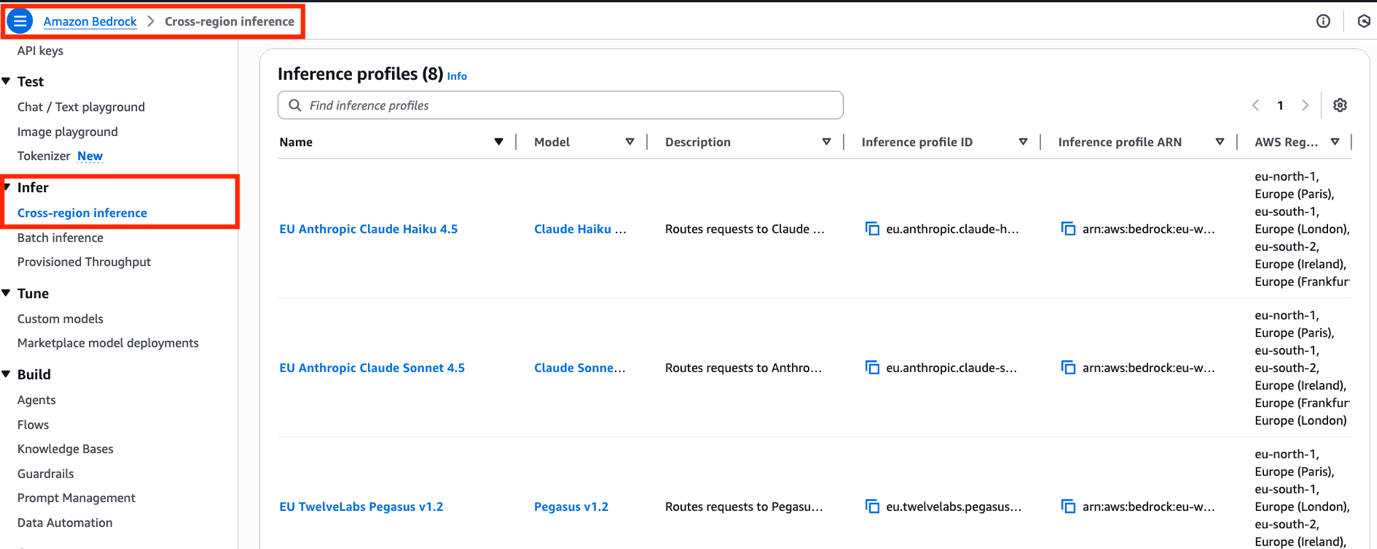
Amazon Bedrock > クロスリージョン推論
- 以下のコードスニペットに示されているように、Boto3 などの AWS SDK を使用してください:
# pip install boto3
import boto3
region = "eu-central-1" # フランクフルトリージョン
bedrock = boto3.client('bedrock', region_name=region)
system_response = bedrock.list_inference_profiles(typeEquals='SYSTEM_DEFINED')
#https://boto3.amazonaws.com/v1/documentation/api/latest/reference/services/bedrock/client/list_inference_profiles.html
推論プロファイルとローカルデータ処理
多くの顧客には、データの処理場所に関する透明性を必要とするローカルデータ処理の要件があります。これはグローバル推論プロファイルおよび地理的推論プロファイルの両方に適用されます。
AWS の顧客は、GDPR に準拠して、自社の AWS アカウント(カスタマーデータ)にアップロードされた個人データ(GDPR で定義されるもの)を処理するために AWS サービスを使用できます。
Amazon Bedrock は、CISPE データ保護行動規範 の対象となる多くのサービスの 1 つです。これにより、クラウドサービスが一般データ保護規則(GDPR)に準拠して使用できることについて、顧客に対して独立した検証と追加の保証が提供されます。CISPE 行動規範は、クラウドインフラストラクチャサービスプロバイダー向けの初の欧州横断的なデータ保護行動規範です。2021 年 5 月、この CISPE 行動規範は、ヨーロッパ全域の 27 のデータ保護当局を代表して活動する欧州データ保護委員会(EDPB)によって承認されました。2021 年 6 月には、主導監督機関として機能する CNIL によって正式に採択されました。
AWS の顧客は、GDPR に準拠しながら、欧州委員会から十分性認定を受けていない非 EEA 諸国(米国を含む)へ顧客データを転送するために引き続き AWS サービスを利用できます。グローバルおよび地理的な CRIS プロファイルの両方がモデル推論の消費に役立つ一方で、顧客には推論に関するコンプライアンス要件やリスク姿勢に対する選択肢も提供されます。
AWS では、顧客データのセキュリティを最優先事項としており、顧客が選択した AWS リージョン に関わらず、機密性、完全性、可用性を保護するために厳格な技術的および組織的な対策を実施しています。私たちは透明性が顧客にとって重要であることを理解しており、顧客データの転送を伴う AWS サービスを プライバシー機能 ウェブページに記載しています。
規制や立法の状況が変化する中で、AWS は顧客がどこで事業を展開していても AWS サービスの恩恵を受け続けられるよう支援することに引き続きコミットします。詳細については、EU-US プライバシーシールドに関する顧客向けアップデート および AWS データ処理補足条項の付加書 に関するブログ記事をご覧ください。
結論
クロスリージョン推論(CRIS: Cross-Region Inference)により、生成 AI アプリケーションはプライマリ AWS リージョンでは利用できないモデルにアクセスできるようになります。これにより、予期せぬトラフィックの急増やリージョン固有の容量不足に対する耐性が高まりつつも、最高レベルの信頼、プライバシー、セキュリティを維持することができます。
本稿では、EU のローカルデータ処理要件を遵守しながら CRIS をどのように活用できるかについて解説しました。Amazon Bedrock では、顧客の具体的なユースケースに応じて、グローバルまたは地理的に制限されたクロスリージョン推論プロファイルを選択する柔軟性を提供しています。両方のアプローチは GDPR などのデータ保護規制に適合していますが、顧客がワークロード要件やリスク許容度に応じたより大きな柔軟性を得られるようになっています。
AWS は、お客様のアーキテクチャおよび規制上のニーズを満たすお手伝いをするため、継続的に新しいサービスをコンプライアンスプログラムの対象範囲に追加することを目指しています。AWS チームは、リスクの評価やデータプライバシー影響評価の作成をサポートいたします。AI ワークロードやクロスリージョン推論に関するご質問については、[お客様の AWS アカウントチーム] (https://pages.awscloud.com/global-ln-gc-400-ai-contact-us.html) までお問い合わせください。当社のコンプライアンスおよびセキュリティプログラムについて詳しく知りたい場合は、AWS コンプライアンスプログラム をご覧ください。
著者紹介
 image
image
ムハンマド・ハムザ・ウスマニ
Muhammad Hamza Usmani は、Amazon Bedrock の EMEA 全域における GTM(Go-To-Market)トピックを担当しています。彼は顧客やパートナーとの協働に情熱を注いでおり、生成 AI からビジネスが新たな価値を引き出せるよう、モデルのコンテキスト内学習能力を活用することを目指して活動しています。

マーゴ・クロニン
Margo Cronin は、セキュリティとコンプライアンスを専門とする EMEA 地域のシニアソリューションアーキテクトです。スイスのチューリッヒに拠点を置いています。彼女の関心領域は、セキュリティ、プライバシー、暗号化、およびコンプライアンスです。彼女は AWS の顧客が直面するセキュリティ上の課題を解決し、クラウド移行の成功を支援することに情熱を注いでいます。また、「AWS User Guide to Finan」の著者でもあります。
原文を表示
With access to the latest generative AI models and high-performance accelerated compute in high global demand, AWS customers need tools to take advantage of model availability and capacity across multiple AWS Regions, while still meeting their security and privacy requirements. cross-Region Inference (CRIS) on Amazon Bedrock meets these needs by automatically routing requests across multiple AWS Regions within predefined geographic boundaries. This allows generative AI applications to consume broad capacity in the geography, helping customers to build more resilient applications that reflect their geographic intricacies.
In this post, we dive deeper into cross-Region Inference (CRIS) and explain how customers in Europe can benefit. We highlight features, services, and resources that AWS offers customers to help them align with the local data protection and processing requirements. This includes the General Data Protection Regulation (GDPR) that might apply to their activities while using CRIS.
Cross-Region inference profiles
Cross-Region Inference (CRIS) is a managed capability in Amazon Bedrock that routes model inference requests within supported AWS Regions. Inference profiles are a resource in Amazon Bedrock that define the Regions where the requests can be routed to. These profiles route requests within certain sets of Regions. CRIS routing is designed to optimize model throughput at lowest possible latency overhead.
Amazon Bedrock has introduced system-defined inference profiles. These inference profiles are named after the model and the geographic Regions that they support. These profiles help Amazon Bedrock consumers use the AWS global-scale footprint to build their generative AI solutions. To understand how a cross-Region inference profile handles inference requests, it’s important to understand the following key concepts:
Source Region – The Region from which you make the API request that specifies the inference profile.
Destination Region – A Region to which the Amazon Bedrock service can route the request from your source Region.
System-defined CRIS profiles have either a global or a geographic scope. In the next sections, we explain the global and EU geographic scopes and how customers can use the different profiles to help to navigate their regulatory and compliance obligations.
Global inference
Global inference profiles route model inference requests to any supported AWS commercial Regions. Input prompts are transmitted to a destination Region for serving the model inference, model outputs are generated in the destination Region and returned to the source Region. Data transmitted during cross-Region inference is encrypted and remains within the secure AWS network. The destination Region is automatically selected to optimize for available model capacity and return the response with minimal overhead.
By using all available supported Regions, generative AI applications using global inference profiles are more resilient to any potential capacity shortages during peak hours or other Regional model availability issues. Several models are also available at a discounted price through global CRIS as compared to direct in-Region or geographic CRIS invocation, making global inference even more attractive.
EU geography-based inference
Geographic CRIS (Geo CRIS) are system-defined inference profiles that differ from global inference profiles. These profiles attach models to a geography, serving copies of the same model from different Regions defined within the profile. Different Geo CRIS profiles are available for Amazon Bedrock customers to choose from based on their requirements. In this section, we highlight the EU-specific inference profiles (EU CRIS).
EU CRIS profiles have been created to help customers on EU residency topics. CRIS can only optimize traffic within a set of destination Regions. For EU CRIS, all destination Regions lie within the European Union. Requests originating from outside of the EU can also be optimized with EU CRIS. Such requests have source Region outside of the European Union. For such requests, CRIS optimizes inference within the EU Regions in addition to respective source Regions. Customers using the EU CRIS profile will have the following effects:
- Requests from a source Region that lies in the EU can only be routed to other AWS Regions with the European Union.
- Requests from EU source Regions can’t get routed to non-EU Regions while using EU CRIS. For example, Zurich and London aren’t considered as destination Regions for such requests.
- Requests originating from London Region can only be routed between available EU Regions and London Region.
- Requests from Zurich Region can only be routed between available EU Regions and Zurich Region.
- For requests originating from outside of the EU, using EU CRIS: the optimizations only consider the source Region and the EU Regions.
Security and control with cross-Region inference
The security of customer data is our highest priority at AWS, and this is reflected in the design of Amazon Bedrock cross-Region inference too.
The AWS-to-AWS traffic flows, such as Region-to-Region (inclusive of Edge Locations and AWS Direct Connect paths), will always traverse AWS-operated backbone paths. Data transmitted during cross-Region operations remains on the AWS network and doesn’t traverse the public internet. AWS encrypts data in transit between AWS Regions.Consumer applications must explicitly indicate in code when invoking models for cross-Region inference, by providing a CRIS profile ID in place of a plain model ID. For example, the following code snippet shows two invocations of the Amazon Nova Lite model – one using EU CRIS and one using global CRIS:
import boto3
import json

from botocore.exceptions import ClientError
bedrock_runtime = boto3.client("bedrock-runtime", region_name="eu-south-1") # Source Region: Milan

model_id = "eu.amazon.nova-2-lite-v1:0"
# Amazon Nova Lite EU CRIS profile ID
# Request can be processed within available destination Regions in EU CRIS

response = bedrock_runtime.converse(modelId=model_id, messages=[...], additionalModelRequestFields={...})

model_id = "global.amazon.nova-2-lite-v1:0"
# Amazon Nova Lite Global CRIS profile ID
# Request can be processed by any AWS Commercial Region

response = bedrock_runtime.converse(modelId=model_id, messages=[...], additionalModelRequestFields={...})
Geographic inference profiles, and therefore the EU inference profile, are static. This means AWS won’t add more Regions to the profile. If a new destination Region must be added to a geographic specific profile, including EU CRIS, Amazon Bedrock will publish a new geographic specific profile with a new inference profile id.
Data protection by design is a key concept introduced in the GDPR. With AWS Identity and Access Management (AWS IAM), customers can securely control access to their AWS resources and data, including which applications are permitted to access data or invoke different foundation models or CRIS profiles on Amazon Bedrock. IAM can help customers comply with this requirement by allowing only authorized administrators, users, and applications to get access to AWS resources and data. IAM helps to enforce least privilege principles to control who can access your data in your source Region. This helps prevent content that customers don’t want to be processed in a destination Region from being included in the input prompts. Securing Amazon Bedrock cross-Region inference shares more on detail on configuring Geographic and global profiles and IAM.
Transparency and auditability
Many data processing regulations require the controller or consumer to maintain a record of data processing activities. Both Global and Geographic CRIS can achieve this.
With AWS CloudTrail, customers can continuously monitor AWS account activity. CloudTrail captures a history of the AWS API calls for the customer account, including API calls made through the AWS Management Console, the AWS SDKs, the command line tools, and higher-level AWS services. Specifically with Amazon Bedrock, the metadata of every call to an API counted as a management event is logged by default. This includes model invocation APIs like Converse and InvokeModel, but only their metadata, not the actual payloads. These logs are accessible from the past 90 days under Event History when filtering for event source “bedrock.amazonaws.com”. For an ongoing record of events, you can configure CloudTrail to store these events longer.
When examining relevant events in CloudTrail, customers can see source and destination Regions of the model invocation, with the inferenceRegion field in the additionalEventData section showing where the request was actually processed.
Optionally, customers can choose to enable Model Invocation Logging. This feature collects detailed information about every call in your account’s source Region, including the full request, response, and metadata. Customers can send the logs to Amazon CloudWatch Logs or Amazon Simple Storage Service (Amazon S3). Model invocation logging remains off by default, and customers must enable it explicitly if needed.
When using cross-Region inference, Amazon CloudWatch, AWS CloudTrail and Model Invocation Logging continue to record log entries only in the *source Region* of the customer AWS account where the request originated. This design streamlines monitoring and logging management and maintains local data processing requirements by storing logs in the source location, regardless of which destination Region actually processes the request.
How can I check available CRIS profiles?
Customers interested in checking available system profiles have the following possibilities:
- Use this official documentation page that lists all system-defined inference profiles and associated source and destination Regions.
- See available inference profiles a source Region by navigating to cross-Region inference in the AWS Console page. The following screenshot shows this console page for London (eu-west-2).
Amazon Bedrock > cross-Region inference
- Use AWS SDKs, such as Boto3, as shown by the following code snippet:
# pip install boto3
import boto3
region = "eu-central-1" # Frankfurt Region
bedrock = boto3.client('bedrock', region_name=region)
system_response = bedrock.list_inference_profiles(typeEquals='SYSTEM_DEFINED')
#https://boto3.amazonaws.com/v1/documentation/api/latest/reference/services/bedrock/client/list_inference_profiles.html
Inference profiles and local data processing
Many customers have local data processing requirements and need transparency into where their data is processed. This also applies to both global inference profiles and geographic inference profiles.
AWS customers can use AWS services to process personal data (as defined in the GDPR) that is uploaded to the AWS services under their AWS accounts (customer data) in compliance with the GDPR.
Amazon Bedrock is one of the many services in scope for the CISPE Data Protection Code of Conduct. This provides an independent verification and an added level of assurance to our customers that our cloud services can be used in compliance with the General Data Protection Regulation (GDPR). The CISPE Code is the first pan-European data protection code of conduct for cloud infrastructure service providers. In May 2021, the CISPE Code was approved by the European Data Protection Board (EDPB), acting on behalf of the 27 data protection authorities across Europe. In June 2021, the Code was formally adopted by the CNIL, acting as the lead supervisory authority.
AWS customers can continue to use AWS services to transfer customer data from the EEA to non-EEA countries that haven’t received an adequacy decision from the European Commission (including the United States) in compliance with the GDPR. While both global and geographic CRIS profiles can help customers consume model inference, they also give customers a choice for their inference compliance requirements and risk posture.
At AWS, our highest priority is securing customer data, and we implement rigorous technical and organizational measures to protect its confidentiality, integrity, and availability, regardless of which AWS Region the customer has selected. We know that transparency matters to our customers. We list the AWS services that involve a data transfer of customer data on our Privacy Features webpage.
As the regulatory and legislative landscape evolves, we remain committed to helping our customers continue to enjoy the benefits of AWS services wherever they operate. For more information, see our customer update on the EU-US Privacy Shield and our blog posts on the Supplementary Addendum to the AWS Data Processing Addendum.
Conclusion
Cross-Region inference (CRIS) allows generative AI applications to access models that might not be available in their primary AWS Region. It increases resiliency to unplanned traffic bursts or Region-specific capacity shortages, while maintaining the highest levels of trust, privacy, and security.
In this post we showed how CRIS can be used while respecting EU local data processing requirements. Amazon Bedrock offers the flexibility for customers to select global or geographically constrained cross-Region inference profiles, depending on the needs of their specific use-case. Both approaches align to data protection regulations like the GDPR, but allow customers greater flexibility in meeting their workload requirements and risk appetite.
AWS strives to continuously bring new services into the scope of its compliance programs to help you meet your architectural and regulatory needs. AWS teams are there to help you evaluate risk and create data privacy impact assessments. Contact your AWS account team for questions about your AI workloads and cross-Region Inference. To learn more about our compliance and security programs, see AWS Compliance Programs.
About the authors
Muhammad Hamza Usmani
Muhammad Hamza Usmani works on GTM topics for Amazon Bedrock pan EMEA. He is passionate about working with customers and partners, motivated by the goal of harnessing model in-context learning capabilities to help businesses unlock new value from generative AI.
Margo Cronin
Margo Cronin is an EMEA Principal Solutions Architect specializing in Security & Compliance. She is based out of Zurich Switzerland. Her interests include security, privacy, cryptography and compliance. She is passionate about her work unblocking security challenges for AWS customers’ enabling their successful cloud journeys. She is an author of the “AWS User Guide to Finan
関連記事
今日のまとめ
AI日報で今日の重要ニュースをまとめ読み