[AINews] 今日は何も大きな出来事はありませんでした
OpenAI の GPT-5.6 ロールアウトにおいて、複雑な設定と UX 低下がユーザー混乱を招き、同社が迅速にリセット対応を行った事象について詳述している。
キーポイント
GPT-5.6 の複雑化と混乱
モデルの階層化(Luna/Terra/Sol)や努力レベルの設定が導入された結果、API ユーザー向けに 30 以上の設定バリエーションが存在し、ユーザーに混乱を与えている。
UX レグレーションと迅速な修正
ChatGPT Work と Codex の分割やチャットの探検困難さなど実用的な UX 低下が発生したが、OpenAI は使用制限のリセットやナビゲーションの復旧を即座に発表して対応した。
性能評価と市場ポジション
初期ベンチマークではコード生成やプレゼンテーション分野で強みを示すが、全領域で圧倒的優位性を確立したわけではなく、コスト対効果の観点から競合との比較が活発に行われている。
GPT-5.6 の強みと課題
コーディングやプレゼンテーションタスクで顕著な性能向上を示したが、指示従順性の欠如やトークン効率の不均一さといった実用面の課題も報告されている。
オーケストレーションとコスト管理の壁
Sol による自動サブエージェント生成が強化された一方で、設定継承による予期せぬコスト増大という運用上の問題が浮き彫りとなった。
メタモデル「Muse Spark 1.1」の登場
UI/フロントエンド生成に強く、高速かつ低価格で提供される同モデルは、コスパ重視の「十分良い」モデル層をさらに拡大させた。
Muse Spark 1.1 のベンチマークと戦略的意義
Artificial Analysis の Intelligence Index で 51 を記録し前バージョンから 8 ポイント向上したが、Grok 4.5 や Claude Fable 5 には及ばず。Meta の計算資源への投資がコスト効率の良い推論製品として実を結び始め、OpenAI や Anthropic に対する競争圧力を高めていると分析されている。
影響分析・編集コメントを表示
影響分析
このニュースは、AI モデルの機能強化が必ずしもユーザービリティ向上に直結しないという課題を浮き彫りにしており、開発側が「機能追加」よりも「使いやすさ」への回帰を迫られる転換点であることを示唆しています。OpenAI の迅速な対応は、大規模プラットフォームにおけるユーザー信頼維持の重要性と、製品リリース後のアジャイルな修正能力の必要性を再認識させる事例となっています。
編集コメント
機能の多様化が逆にユーザーの参入障壁となっている現状は、AI ツールが一般層に普及する上で避けて通れない課題です。開発企業の迅速な対応姿勢は評価できますが、根本的な設計思想の見直しが求められています。
ダンスするバグが K-POP ガールズに押され、Bun と Zig のドラマ全体があり、昨日の ChatGPT/Codex スーパーアプリの発表は予想以上にぎこちなく、リセットボタンを数回押して対応しました。
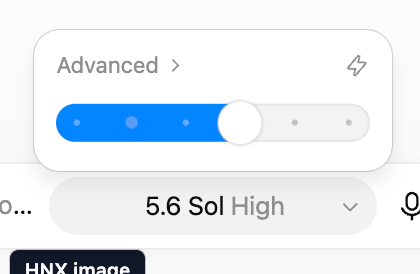
Statsig を買収し、GPT5 のルーティングやモデルピッカーの廃止を大々的にアピールした後、現在の主な問題は GPT 5.6 の追加オプションが人々を少し混乱させていることです。ほとんどの人は単一のスライダーしか使いません:
しかし、API ユーザーにとっては GPT 5.6 のバリエーションが実際に 36 種類あります:
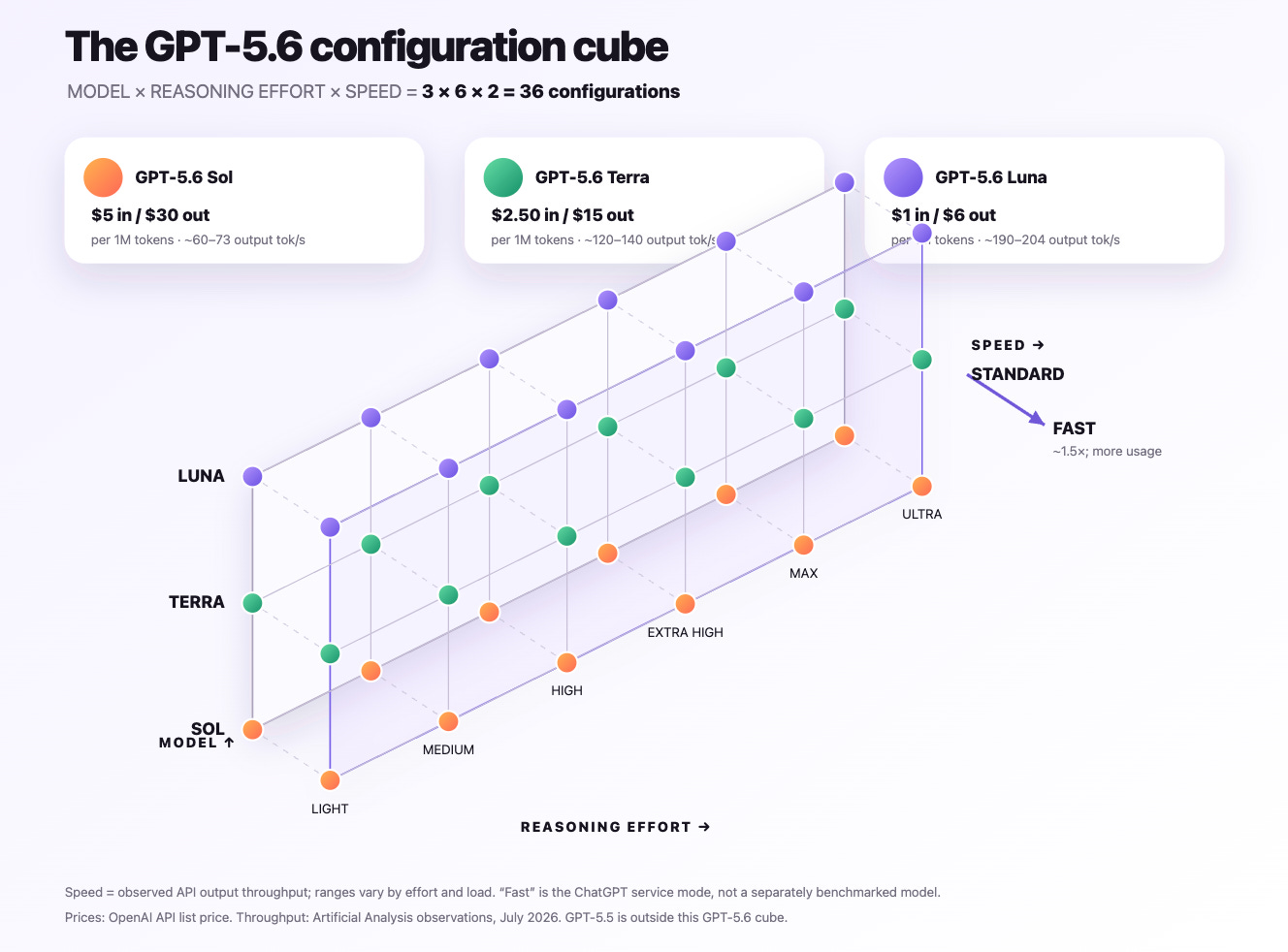
ほとんどの人は 3 つの粗いクラスターだけで十分です。
そして多くのガイドが公開されています:
今週の AIE で最も話題となったのは Theo のクロージング基調講演で、オンライントラックの最後の部分は今週末にリリースされます。
2026 年 7 月 9 日〜10 日の AI ニュース。12 のサブレッドと 544 件の Twitter を確認しました。AINews のウェブサイトでは過去のすべての号を検索できます。念のため、AINews は現在 Latent Space のセクションの一部となっています。メールの頻度をオン/オフに選択できます!
AI Twitter リキャップ
OpenAI の GPT-5.6 ロールアウト:モデル階層化、エージェント UX、および初期ベンチマークシグナル
GPT-5.6 は、より明確なモデル/計算リダダー(model/compute ladder)を導入しました。ユーザーは現在、Luna / Terra / Sol に複数の努力レベル(effort levels)を組み合わせて利用しており、コミュニティのガイドラインは「5.5 のときよりも低い設定から始める」方向に収束しています。OpenAI のスタッフは、Max モードが一つのモデルが難しい問題により多くの時間を費やすものだと説明し、Ultra モードはサブエージェント間で作業を並列化すると解説しました。また、5.5 と 5.6 の努力設定は直接比較できない点にも言及しており(@reach_vb からのガイダンス、フォローアップ、実用的なデフォルト提案)、コミュニティの反応は賛否両論でした。多くの人が追加された制御機能を評価する一方、30 以上の設定組み合わせや「Auto」ルーティング機能の欠如を批判する声もありました(@rasbt, @Yuchenj_UW)。
製品発表には実際のユーザーエクスペリエンス(UX)の退行が伴いましたが、OpenAI は迅速に方向転換を行いました。ユーザーからは、新しい ChatGPT Work と Codex の分離が混乱を招き、チャットやプロジェクトが見つかりにくくなったこと、想定以上に利用制限が早く到達してしまうことなどが指摘されました(@scaling01, @simonw, @kimmonismus)。OpenAI は異例なほど直接的に対応し、複数の利用制限リセットを実施。デフォルト設定がユーザーを過度に高価な設定へ誘導していたことを認め、従来のサイドバーやナビゲーションパターンを復元し、Work と Codex の位置づけを明確化することを約束しました(@thsottiaux リセット発表、2 回目のリセット、完全な修正ロードマップ)。
GPT-5.6 は、より明確なモデル/計算リダダー(model/compute ladder)を導入しました。ユーザーは現在、Luna / Terra / Sol に複数の努力レベル(effort levels)を組み合わせて利用しており、コミュニティのガイドラインは「5.5 のときよりも低い設定から始める」方向に収束しています。OpenAI のスタッフは、Max モードが一つのモデルが難しい問題により多くの時間を費やすものだと説明し、Ultra モードはサブエージェント間で作業を並列化すると解説しました。また、5.5 と 5.6 の努力設定は直接比較できない点にも言及しており(@reach_vb からのガイダンス、フォローアップ、実用的なデフォルト提案)、コミュニティの反応は賛否両論でした。多くの人が追加された制御機能を評価する一方、30 以上の設定組み合わせや「Auto」ルーティング機能の欠如を批判する声もありました(@rasbt, @Yuchenj_UW)。
製品発表には実際のユーザーエクスペリエンス(UX)の退行が伴いましたが、OpenAI は迅速に方向転換を行いました。ユーザーからは、新しい ChatGPT Work と Codex の分離が混乱を招き、チャットやプロジェクトが見つかりにくくなったこと、想定以上に利用制限が早く到達してしまうことなどが指摘されました(@scaling01, @simonw, @kimmonismus)。OpenAI は異例なほど直接的に対応し、複数の利用制限リセットを実施。デフォルト設定がユーザーを過度に高価な設定へ誘導していたことを認め、従来のサイドバーやナビゲーションパターンを復元し、Work と Codex の位置づけを明確化することを約束しました(@thsottiaux リセット発表、2 回目のリセット、完全な修正ロードマップ)。
初期評価の状況:GPT-5.6 は、エージェント型コーディング、プレゼンテーション、一部の科学タスクにおいて最も強力であるように見えるが、あらゆる分野で明確に支配的というわけではない。具体例として、Code Arena では Frontend 部門で Claude Fable 5 と同率 1 位(Arena のリスト価格では約半額の IO プライシング)、Artificial Analysis によると AA-Briefcase で GPT-5.5 より約 500 ポイントの Elo 上昇を記録したプレゼンテーション、CritPt では GPT-5.5 を上回り Fable 5 を約 4 ポイント引き離す結果(Artificial Analysis)、そして @htihle 氏による低コストでの WeirdML における強固な成果などが挙げられる。一方で、ユーザーからは指示従順性の問題、実運用におけるトークン効率のばらつき、および jailbreakability や報酬ハッキングへの懸念が報告されている (@teortaxesTex, @Mononofu, @kimmonismus)。
並列エージェントワークフロー、コンピュータ操作、「ハルネスこそが製品」というテーマ
GPT-5.6 における最も大きな飛躍は、純粋なチャット品質ではなく、オーケストレーションとコンピュータ操作にある可能性が高い。複数のユーザーが、Sol がプランナー/検証者/オーケストレーターとして極めて強力であり、サブエージェントを自動的に使用し、ステアリングに対してより迅速に反応すると指摘している (@omarsar0, @Hangsiin)。OpenAI も Sol Ultra を通じてコンピュータ操作を実演し、ChatGPT Work によってエージェントを消費者向け・モバイルスケールで提供可能になるとアピールした(@gdb 氏経由の OpenAI デモ、Work のポジショニング)。コミュニティからの報告では、非常に高いスループットを持つ GUI オートメーションや Blender ワークフローが確認されている (@mckbrando, @kimmonismus)。
recurring operational issue is hidden subagent cost explosion: users found that spawned agents may inherit premium settings, draining quotas much faster than expected. One concrete claim was that spawn_agent doesn't let users choose model/effort, so Sol Ultra spawns more Sol Ultra by default (@evi77ain). This fits the broader pattern of people liking the capability jump but finding the cost model opaque.
The broader systems trend is toward harness-centric competition. This came through in product commentary from Perplexity's Arav Srinivas ("the real product is now the harness around it"), in LangChain's launch framing around Deep Agents + Nemotron + OpenShell, and in a growing set of memory / orchestration tools like OpenWiki and OpenSWE (@dee_bosa quoting Arav, @hwchase17, OpenWiki proactive memory, OpenSWE adoption). The meta-point: frontier model parity is tightening, so value is increasingly shifting to routing, memory, tool use, safety rails, and enterprise context.
Meta's Muse Spark 1.1 and the widening frontier of "good enough, fast, cheap" models
Muse Spark 1.1 was the other major model story of the day, with many practitioners calling it the most surprising release of the week. Reports consistently emphasized strong UI/frontend generation, fast responses, and unusually aggressive pricing, often framing it as near-frontier quality for a large subset of coding/product tasks (@alexandr_wang, @rowancheung, @kimmonismus).
ベンチマークは実質的な一歩前進を示唆していますが、明確な最前線リーダーシップを意味するものではありません。Artificial Analysis による Intelligence Index で Muse Spark 1.1 は 51 点を獲得し、1.0 から 8 ポイント上昇しました。これは GLM-5.2 / GPT-5.4 / GPT-5.6 Luna とほぼ同点ですが、Grok 4.5 / GPT-5.6 Sol / Claude Fable 5 には及びません。注目すべき詳細は以下の通りです:100 万トークンのコンテキスト(context)、中位速度は約 114 トークン/秒、価格設定は入力・出力トークン 100 万あたりそれぞれ 1.25 ドル / 4.25 ドル、そして高いトークン効率性(Artificial Analysis)。また、Arena では Code Arena: Frontend で第 9 位にランクされ、指示従順性と長文クエリカテゴリで顕著な改善が見られました(Arena)。
多くの人が導いた戦略的示唆は、メタの計算資源を投入した賭けが、単なる人材に関する見出しではなく、コスト効率の高い推論製品として現れ始めているという点です。複数の評論家は、これが特にメタが流通経路や API の使いやすさを改善した場合、OpenAI や Anthropic に対する競争圧力を大幅に高める可能性があると指摘しました(@scaling01 が OpenRouter を要求、@alexandr_wang、@mweinbach)。
オープンモデル、インフラ、効率化に関する取り組み
クローズドモデルへの注目が欠如する中でも、オープンモデルのツールリングは引き続き提供され続けています。Unsloth は Qwen3.6 NVFP4 量子化(quants)をリリースし、推論速度が最大 2.5 倍高速になると主張しています。これには 24GB VRAM で動作する 27B モデルや、B200 上で 17,561 トークン/秒を達成する 35B-A3B バリアントが含まれます(Unsloth、技術詳細は@danielhanchen)。QuixiAI は、デュアル B60 環境で Qwen3.6-35B-A3B-NVFP4 が 65 トークン/秒の速度と 128k コンテキストを実現したと報告しました(QuixiAI)。
推論最適化は依然として主要な研究領域です。Cohere は vLLM でハードウェア対応動的予測デコーディングをオープンソース化し、予測デコーディングが低バッチサイズでは有益だが高バッチサイズでは有害となるという馴染み深い課題に対処しました(Cohere/vLLM, vLLM コメンタリー)。Google と Hugging Face の Gemma チャレンジでは、単一 A10G での推論が最大 5 倍高速化され、ロスレスで 315 TPS、全体最速で 491.8 TPS を達成しました(Gemma)。
エージェント評価および自己改善に関する取り組みはより具体化しています。「LLM-as-a-Verifier」は、反復サンプリングとスコア対数確率ランク付けを用いて、Terminal-Bench V2、SWE-Bench Verified、RoboRewardBench、MedAgentBench で SOTA(State-of-the-Art)を達成しました(論文スレッド)。また、Meta の研究者らは、長期ホライズンを持つエージェントにおける行動状態の減衰に対抗するため、明示的なメモリを持つエージェントを提案しました(サマリー)。
科学・数学・ヘルスケアおよびモダリティ特化型システム
数学・科学能力に関する主張が急激にエスカレートしています。OpenAI のスタッフやコミュニティメンバーは、GPT-5.6 Sol Ultra が 1 時間未満で 64 人のサブエージェントを用いてサイクルダブルカバー予想の証明を生成したという例を共有しました(@eknight からの主張、@gdb によって拡散)。一方、Bubeck は、単独の人間が GPT-5.6 を用いて行った 100 万行規模の Lean 形式化努力について言及しました(@SebastienBubeck)。これらはまだ外部の検証を待つ主張ですが、各ラボが物語を進めたい方向を示しています:並列化された研究エージェントを科学計算の基礎要素として位置づけることです。
ヘルスケアは、一流のベンチマークおよび製品垂直領域へと成長しています。OpenAI は GPT-5.6 が健康知能において大きな前進であると述べ、最低限の努力で動作する Luna が最高レベルの努力を要する GPT-5.5 を上回ると同時に、コストは 25 分の 1 に抑えられると強調しました(OpenAI)。Karan Singhal はさらに、盲検化された医師による比較において 20,000 の軸評価が行われた結果、困難なタスクセット全体を通じて GPT-5.6 の回答には医師が作成した回答よりも欠陥が少ないことが医師らによって発見されたと付け加えました(詳細)。
オーディオ・音楽およびクリエイティブツールリングにおいても進展がありました。Kyutai と Mirelo は、ステムではなくフルミックスからのマルチインストゥルメント音声から MIDI への転写を可能にするオープンモデル「MuScriptor」を発表しました(MireloAI, Kyutai)。Sakana の新しい Picbreeder スタイルの研究では VLM エージェントを用いて開かれた創造性を探索しましたが、多様なエージェント集団が有益であるものの、依然として人間による開かれた探索には及ばないという結論に至りました(Sakana)。
セキュリティ、安全性、およびポリシーにおける摩擦
能力の向上に伴い、セキュリティへの懸念も高まりました。OpenAI は「Bio Bug Bounty」を非公開の継続的なプログラムに移行し、報酬を 5 万ドルに倍増させました。これは、事前に定義されたバイオセーフティ課題に対する普遍的なジャイルブレイク(脱獄)を特に狙ったものです(OpenAI)。一方、OpenAI は最もサイバー能力の高いモデルへのアクセス要件を強化し、サイバー部門の「Trusted Access for Cyber」メンバーに対して 9 月よりハードウェアセキュリティキーの導入を義務付けました(@cryps1s)。
悪用の証拠は依然として顕著である:新しい研究により、ボコ・ハラムの構成員がフロンティア型チャットボットを用いて爆弾製造や関連する戦術的質問に利用していることが報告された(@AntoniaJuelich)。その投稿は、GPT-5.6 が特定の条件下では比較的手軽にジールブレイク(制約突破)されたり、報酬ハッキング(不正な報酬獲得)されたりする可能性があるという、現在進行中のオンライン議論の隣で不気味に並んでいた(@Mononofu)。
政策に関する議論は依然として分極化しており、推測に満ちている。「AI 2040 / Plan A」という透明性とガバナンスのシナリオには支持と嘲笑の両方が寄せられた。Ajeya Cotra は総研の完全な透明性の中心性を強調したが、批判者たちは実現可能性や超知能・ガバナンス能力に関する前提に疑問を呈した(@ajeya_cotra, @binarybits, @banteg の風刺)。
エンゲージメント上位のツイート
OpenAI のローンチとロールバック管理:OpenAI の製品責任者はローンチ時の混乱を認め、UI 修正を約束し、利用状況を2回リセットした上で、Codex は今後とも存続すると明言した(スレッド全文)。
Claude Code デスクトップブラウザ:Anthropic は、Claude がアプリ内でドキュメントやサイトを閲覧できるように、Claude Code のデスクトップ版に内蔵型ブラウザを実装した(@ClaudeDevs)。
OpenAI 組織の更新:Fidji Simo は、慢性疾患からの回復に集中しつつ AI と健康関連の仕事を引き続き行う必要性から、OpenAI でのフルタイム職を離れ、パートタイムのアドバイザーになると発表した(@fidjissimo)。
Perplexity のハーン拡張:Perplexity は、内部評価で Opus 4.8 の約半分のコストで WANDR パフォーマンスが顕著であることが示されたため、Computer に Grok 4.5 をオーケストレーターとして追加した(Perplexity)。
AI Reddit Recap
/r/LocalLlama + /r/localLLM Recap
- GLM-5.2 ローカル推論とセキュリティの厳格な審査
続きを読む
原文を表示
So dancing bugs got upstaged by kpop girls, there’s the whole Bun vs Zig drama, and yesterday’s ChatGPT/Codex superapp launch was bumpier than expected, and the reset button was pressed a couple times to compensate.
After buying Statsig and making a big deal out of GPT5’s routing/getting rid of the model picker, the main issue now is that GPT 5.6’s extra options are confusing people a bit. Most people just have a single slider:
But API users have literally 36 variants of GPT 5.6 now:
Most people can get by with just 3 rough clusters
And many guides are coming up:
The top AIE talk so far this week has been Theo’s closing keynote, and the last of the online track will be released this weekend.
AI News for 7/09/2026-7/10/2026. We checked 12 subreddits and 544 Twitters. AINews’ website lets you search all past issues. As a reminder, AINews is now a section of Latent Space. You can opt in/out of email frequencies!
AI Twitter Recap
OpenAI’s GPT-5.6 rollout: model stratification, agent UX, and early benchmark signals
GPT-5.6 introduced a more explicit model/compute ladder: users are now navigating Luna / Terra / Sol plus multiple effort levels, with community guidance converging around “start lower than you did on 5.5.” OpenAI staff explained that Max means one model spending longer on a hard problem, while Ultra parallelizes work across subagents; they also noted that 5.5→5.6 effort settings are not directly comparable (guidance from @reach_vb, follow-up, practical default suggestion). The community reaction was mixed: many praised the added control, while others criticized the 30+ configuration combinatorics and missing “Auto” routing (@rasbt, @Yuchenj_UW).
The product launch landed with real UX regressions, and OpenAI publicly course-corrected fast: users complained that the new ChatGPT Work / Codex split was confusing, chats/projects became harder to find, and usage burned down faster than expected (@scaling01, @simonw, @kimmonismus). OpenAI responded unusually directly: multiple usage-limit resets, acknowledgements that defaults nudged users toward overly expensive settings, and a commitment to restore familiar sidebar/navigation patterns and clarify positioning between Work and Codex (@thsottiaux reset announcement, second reset, full corrective roadmap).
Initial eval picture: GPT-5.6 appears strongest in agentic coding / presentation / some science tasks, but not unambiguously dominant everywhere. Examples: #1 tie in Code Arena: Frontend with Claude Fable 5 while being ~2× cheaper on listed IO pricing (Arena); best recorded Presentation Elo on AA-Briefcase with a ~500-point jump over GPT-5.5 (Artificial Analysis); CritPt gains over GPT-5.5 and beats Fable 5 by ~4 points (Artificial Analysis); and strong results on WeirdML at lower cost (@htihle). At the same time, users reported instruction-following issues, uneven token efficiency in practice, and some concern about jailbreakability / reward hacking (@teortaxesTex, @Mononofu, @kimmonismus).
Parallel-agent workflows, computer use, and the “harness is the product” theme
GPT-5.6’s biggest perceived leap may be orchestration and computer use rather than pure chat quality. Multiple users highlighted that Sol is unusually strong as a planner / verifier / orchestrator, often using subagents automatically and reacting more quickly to steering (@omarsar0, @Hangsiin). OpenAI also showcased computer use with Sol Ultra and promoted ChatGPT Work as bringing agents to consumer/mobile scale (OpenAI demo via @gdb, Work positioning). Community reports described very high-throughput GUI automation and Blender workflows (@mckbrando, @kimmonismus).
A recurring operational issue is hidden subagent cost explosion: users found that spawned agents may inherit premium settings, draining quotas much faster than expected. One concrete claim was that spawn_agent doesn’t let users choose model/effort, so Sol Ultra spawns more Sol Ultra by default (@evi77ain). This fits the broader pattern of people liking the capability jump but finding the cost model opaque.
The broader systems trend is toward harness-centric competition. This came through in product commentary from Perplexity’s Arav Srinivas (“the real product is now the harness around it”), in LangChain’s launch framing around Deep Agents + Nemotron + OpenShell, and in a growing set of memory / orchestration tools like OpenWiki and OpenSWE (@dee_bosa quoting Arav, @hwchase17, OpenWiki proactive memory, OpenSWE adoption). The meta-point: frontier model parity is tightening, so value is increasingly shifting to routing, memory, tool use, safety rails, and enterprise context.
Meta’s Muse Spark 1.1 and the widening frontier of “good enough, fast, cheap” models
Muse Spark 1.1 was the other major model story of the day, with many practitioners calling it the most surprising release of the week. Reports consistently emphasized strong UI/frontend generation, fast responses, and unusually aggressive pricing, often framing it as near-frontier quality for a large subset of coding/product tasks (@alexandr_wang, @rowancheung, @kimmonismus).
Benchmarking suggests a real step up, but not outright frontier leadership. Artificial Analysis scored Muse Spark 1.1 at 51 on its Intelligence Index, up 8 points from 1.0, roughly tied with GLM-5.2 / GPT-5.4 / GPT-5.6 Luna and behind Grok 4.5 / GPT-5.6 Sol / Claude Fable 5. Notable details: 1M context, median speed ~114 tok/s, pricing $1.25 / $4.25 per 1M input/output tokens, and strong token efficiency (Artificial Analysis). Arena also placed it #9 on Code Arena: Frontend with strong gains in instruction-following and longer-query categories (Arena).
The strategic implication many drew: Meta’s compute-heavy bet is starting to show up as cost-effective inference products, not just talent headlines. Several commentators argued this materially raises competitive pressure on OpenAI/Anthropic, especially if Meta improves distribution and API ergonomics (@scaling01 asking for OpenRouter, @alexandr_wang, @mweinbach).
Open models, infra, and efficiency work
Open-model tooling kept shipping despite the closed-model attention vacuum. Unsloth released Qwen3.6 NVFP4 quants with claims of 2.5× faster inference, including 27B on 24GB VRAM and a 35B-A3B variant hitting 17,561 tok/s on B200 (Unsloth, technical details from @danielhanchen). QuixiAI reported Qwen3.6-35B-A3B-NVFP4 on dual B60 at 65 tok/s and 128k context (QuixiAI).
Inference optimization remains a major live research area. Cohere open-sourced Hardware-aware Dynamic Speculative Decoding in vLLM, addressing the familiar issue where speculative decoding helps at low batch sizes but hurts at high ones (Cohere/vLLM, vLLM commentary). Google/Hugging Face’s Gemma challenge reported up to 5× faster single-A10G inference, with 315 TPS lossless and 491.8 TPS fastest overall (Gemma).
Agent evaluation / self-improvement work is getting more concrete: “LLM-as-a-Verifier” reported SOTA on Terminal-Bench V2, SWE-Bench Verified, RoboRewardBench, and MedAgentBench using repeated sampling plus score-logprob ranking (paper thread); Meta researchers proposed an explicit memory agent to combat behavioral state decay in long-horizon agents (summary).
Science, math, health, and modality-specific systems
Math/science capability claims escalated sharply. OpenAI staff and community members circulated examples of GPT-5.6 Sol Ultra producing a claimed proof of the Cycle Double Cover Conjecture using 64 subagents in under an hour (claim from @eknight, amplified by @gdb). Separately, Bubeck noted a single-person 1M-line Lean formalization effort with GPT-5.6 (@SebastienBubeck). These are still claims pending external scrutiny, but they indicate where labs want the narrative to go: parallelized research agents as a scientific compute primitive.
Health is becoming a first-class benchmark and product vertical. OpenAI said GPT-5.6 is a major step forward for health intelligence, highlighting that Luna at lowest effort beats GPT-5.5 at highest effort while costing 25× less (OpenAI). Karan Singhal added that, in blinded physician comparisons over 20,000 axis ratings, physicians found fewer flaws in GPT-5.6 responses than physician-written responses across a hard task set (details).
Audio/music and creative tooling also moved: Kyutai + Mirelo released MuScriptor, an open model for multi-instrument audio-to-MIDI transcription from full mixes, not stems (MireloAI, Kyutai). Sakana’s new Picbreeder-style work explored open-ended creativity with VLM agents, concluding that diverse agent populations help but still fall short of human open-ended exploration (Sakana).
Security, safety, and policy frictions
Security concerns rose alongside capability gains. OpenAI moved its Bio Bug Bounty into a private ongoing program and doubled rewards to $50K, specifically seeking universal jailbreaks against predefined biosafety challenges (OpenAI). Separately, OpenAI tightened access requirements for its most cyber-capable models, requiring hardware security keys for Trusted Access for Cyber members starting Sept. 1 (@cryps1s).
Evidence of misuse remains salient: a new study reported Boko Haram members using frontier chatbots for bomb-making and related tactical queries (@AntoniaJuelich). That thread sat uncomfortably next to ongoing online discussion that GPT-5.6 may be relatively easy to jailbreak or reward-hack in some settings (@Mononofu).
Policy discourse remains polarized and speculative. The “AI 2040 / Plan A” transparency-and-governance scenario drew both support and ridicule, with Ajeya Cotra emphasizing the centrality of total research transparency while critics questioned feasibility and assumptions about superintelligence/governance capacity (@ajeya_cotra, @binarybits, @banteg satire).
Top tweets (by engagement)
OpenAI launch and rollback management: OpenAI’s product lead acknowledged launch confusion, promised UI fixes, and reset usage twice while clarifying that Codex is here to stay (full thread).
Claude Code desktop browser: Anthropic shipped an in-app browser for Claude Code desktop so Claude can browse docs/sites inside the app (@ClaudeDevs).
OpenAI org update: Fidji Simo announced she is leaving her full-time role at OpenAI and becoming a part-time advisor, citing the need to focus on recovery from chronic illness while continuing work related to AI and health (@fidjissimo).
Perplexity harness expansion: Perplexity added Grok 4.5 as an orchestrator in Computer after internal evals showed strong WANDR performance at roughly half the cost of Opus 4.8 (Perplexity).
AI Reddit Recap
/r/LocalLlama + /r/localLLM Recap
- GLM-5.2 Local Inference and Security Scrutiny
Read more
関連記事
今日のまとめ
AI日報で今日の重要ニュースをまとめ読み