[AINews] OpenAI、GPT-5.6(Sol/Terra/Luna)を発売し、Codex を ChatGPT のスーパーアプリへ進化
OpenAI は新モデル GPT-5.6 シリーズ(Sol/Terra/Luna)とエージェント協調機能の強化、および ChatGPT と Codex の統合による「スーパーアプリ」戦略の確立を発表し、性能・コスト・速度において競合を凌駕する成果を示した。
キーポイント
新モデル GPT-5.6 シリーズの発表と命名規則
GPT-5.6 が Sun(Sol)、Earth(Terra)、Moon(Luna)という天体名で命名された3サイズとして登場し、文学的な命名法から脱却した。
エージェント協調による性能とコストの劇的改善
「ultra」モードでは4つのエージェントを並列実行し、Terra は Fable 5 より高性能で約1/3の時間・1/2のトークン数、Luna は Opus 4.8 を凌駕しコストは約1/4に抑えられた。
ChatGPT と Codex の統合によるスーパーアプリ化
ChatGPT Work と Codex デスクトップアプリの更新により、OpenAI は「スーパーアプリ」戦略の最終段階へ進み、エージェンティックブラウザ以外の要素がほぼ揃った。
複雑なタスクにおけるベンチマークでの新記録
Terminal-Bench 2.1 や DeepSWE といった実環境のエンジニアリングやコマンドラインワークフローをテストするベンチで、新たな最高記録を達成した。
新モデルの階層化と価格設定
GPT-5.6 Sol/Terra/Luna の3段階リリースにより、性能とコストのバランスを最適化する価格帯が導入され、Sol は最高性能、Terra と Luna は低コスト・高効率オプションとして位置付けられた。
ベンチマークにおける競合優位性
OpenAI の公式発表では Sol が Agents' Last Exam で Claude Fable 5 を大幅に上回ったとされる一方、独立評価では Sol も Fable に僅差で及ばないものの、コスト効率が劇的に改善されていることが示された。
アプリ機能の統合と強化
ChatGPT Work の新デスクトップ版や Sites ベータ、マルチエージェント機能などが追加され、コーディング能力やアーティファクト品質が向上し、企業ツールとの連携も強化された。
影響分析・編集コメントを表示
影響分析
この発表は、LLM の性能競争が単なる推論能力だけでなく、マルチエージェント協調による実務効率化とコスト削減へと主軸を移していることを示唆しています。また、ChatGPT と Codex の統合は、開発者や企業のワークフローにおいて AI ツールの断片化を解消し、一つのエコシステム内での完結を促すことで、市場支配力をさらに強固にする可能性が高いです。
編集コメント
競合の最新動向を凌駕する性能とコスト効率、そして「スーパーアプリ」という明確なビジョンの実現により、OpenAI の市場地位はさらに盤石なものとなりました。特にマルチエージェント機能の標準化は、今後の AI エコシステム構築の基準となる重要な転換点です。
通常の日であれば、Meta Superintelligence Labs から驚くほど優れた競合モデルである Muse Spark 1.1 の発表、さらに初めて Meta Model API に組み込まれたこと(姉妹モデルでの実証により、広範な利用や第三者テストへの高い自信を示唆)は、主要記事にふさわしい内容だったでしょう。しかし、彼らは運悪く、メインストリームの最前線モデルの発表と競合してしまいました。
政府承認前に数週間前に予告されていた通り、5.6 は 3 つの新サイズで登場します。それは太陽(Sol)、地球(Terra)、月(Luna)に相当する名称であり、Claude バリアントのような文学的な命名法に対する代替案です。また、新しい「超」努力レベルも追加されました。「これは私たちの最高能力設定であり、複数のエージェントを並列の作業ストリームで調整し、複雑なタスクをより迅速に完了させるものです」と説明されています。
max モードは xhigh よりさらに多くの時間を確保し、推論や代替案の探索、チェックの実行、アプローチの見直しを行います。一方、ultra モードはデフォルトで 4 つのエージェントを並列で調整することで、トークン使用量を増やす代わりに、要求の高いタスクにおいてより強力な結果とより短い結果到達時間を達成します。
複数のベンチマーク(ここでは紹介されているものだけでなく)において、5.6 は Fable や Opus よりも低コストで高いパフォーマンスを達成しています。
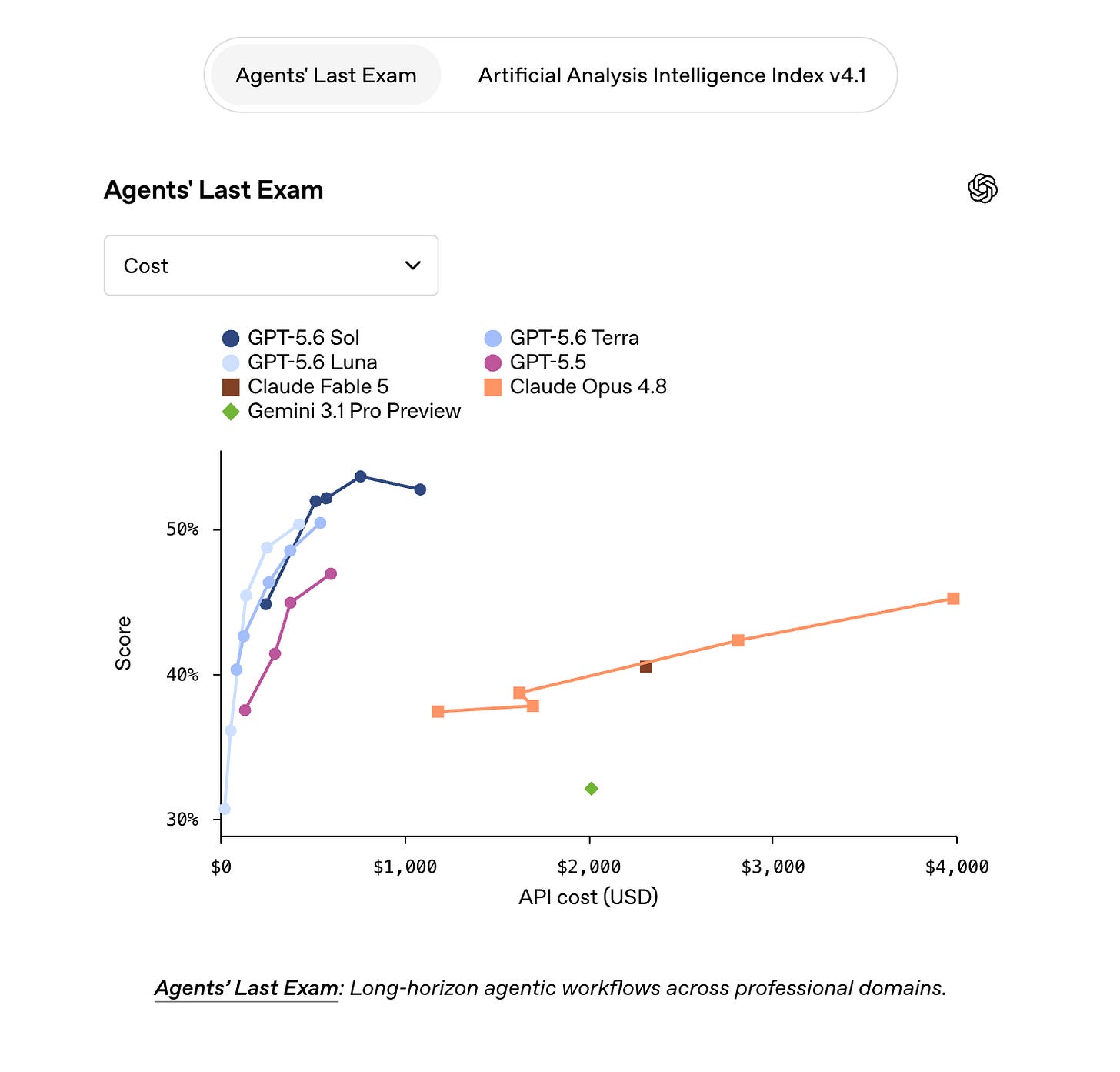
「Terra は Fable 5 をわずかに上回り、Luna は Opus 4.8 よりも優れた性能を発揮します。それぞれが所要時間を約 3 分の 1 に短縮し、生成トークン数を約半分にしつつ、推定コストは約 4 分の 1 で達成しています。また、複雑なコマンドラインワークフローや実コードベースにおける長期にわたるエンジニアリングをテストする Terminal‑Bench 2.1 および DeepSWE において、新たな最高性能記録(state-of-the-art)を樹立しました。」
コンピュータ操作、プレゼンテーション・ドキュメント生成、科学研究分野においてもベンチマーク化が難しい改善が見られますが、これらも非常に真剣に受け止めるべきです。
私たちが 4 月に予測した通り、本日リリースされた新しい ChatGPT Work および Codex デスクトップアプリのアップデートは、OpenAI のスーパーアプリ戦略におけるほぼ最終段階(最後の未解決の問いは、エージェント型ブラウザがどうなるか……)である可能性が高いです。
2026 年 7 月 8 日〜9 日の AI ニュース。私たちは 12 のサブレッド、544 件の Twitter(X)投稿を確認し、Discord は新たに確認されませんでした。AINews のウェブサイトでは過去のすべての号を検索できます。念のため、AINews は現在 Latent Space の一部となっています。メール配信頻度の設定をオン/オフに切り替えることができます!
AI Twitter レビュー
OpenAI は新しい 3 モデルからなる GPT‑5.6 ファミリーを発表すると同時に、その周辺で製品スタックの拡大を行いました。
OpenAI は、@OpenAI および @OpenAIDevs を通じて、ChatGPT、Codex、および API 全体に展開される GPT‑5.6 Sol、Terra、Luna の発表を行いました。
ChatGPT の Plus、Pro、Business、Enterprise ユーザーは、medium+ 設定を通じて GPT‑5.6 Sol にアクセスできるようになります。一方、Pro と Enterprise ユーザーは、複雑なタスクにおいて最高品質の結果を得るために GPT‑5.6 Pro を選択できます(@OpenAI による)。
API の価格体系には段階的なラインナップが導入されました:Sol は入力/出力トークン百万あたり $5 / $30、Terra は $2.5 / $15、Luna は $1 / $6 です。また、キャッシュ書き込みの価格設定が初めて追加され、キャッシュ読み取りに対する 90% の割引は維持されています(@ArtificialAnlys による)。
OpenAI はこの製品ファミリーを価格と性能の階段として位置づけました:Sol はフラッグシップかつ最高性能上限、Terra は低コストで GPT‑5.5 に匹敵する能力、Luna は高速かつ安価な大量処理向けオプションです(@OpenAIDevs による)。
今回の発表では、主要なアプリケーション層の変更もパッケージ化されました:Codex と ChatGPT を統合した新しいデスクトップアプリ「ChatGPT Work」、ベータ版の Sites、プログラムによるツール呼び出し機能、および Responses API におけるマルチエージェントベータです(@OpenAI、@OpenAIDevs による)。
公式発表とベンチマーク結果
OpenAI の公式メッセージは、強力なエージェント機能やコーディング性能、より優れたアーティファクトの品質、そして改善された経済性(コスト効率)を強調しました。
サム・アルトマン氏は発表記事で「明らかにこれまで作った中で最高のモデルだ」と述べ、リリースブログへのリンクを掲載しました(@sama による)。
また、アルトマン氏は企業向けのコスト効率についても言及し、「5.6 Sol はタスクあたりのコストにおいて大きな前進だ」と強調しました(@sama による)。
グレッグ・ブロックマン氏は、目標とするパフォーマンスレベルに応じて「最安の価格」を提供し、可能な限り高い性能上限を実現することを目指していると述べました(@gdb による)。
OpenAI は、GPT-5.6 Sol がエージェント最終試験において 53.6 という新記録を樹立し、Claude Fable 5 adaptive を 13.1 ポイント上回ったと主張しました。中程度の推論タスクにおいても、Fable よりも 11.4 ポイント優れており、推定コストは約 4 分の 1 です。また、Terra と Luna も同様に Fable を上回り、コストは約 16 分の 1 で実現されています(@OpenAI)。
OpenAI は、GPT-5.6 がプレゼンテーション、ドキュメント、スプレッドシート全体でアーティファクトの品質を向上させたと発表しました。出力結果は既存のエンタープライズツールへのエクスポートも可能です(@OpenAI)。
OpenAI は、GPT-5.6 を ChatGPT Work 内で複雑なタスクの推論や、テンプレート、参照ファイル、好みのスタイルに合わせた資料作成において最先端のモデルとして位置づけました(@OpenAI)。
また、OpenAI は GPT-5.6 がサイバーおよびバイオ関連タスクにおいてこれまでで最も能力が高いモデルであると述べました。ただし、二重利用が懸念される分野では、追加の安全性審査のために一部の API 呼び出しがブロックまたは一時停止される可能性があります(@OpenAIDevs)。
OpenAI は、Computer Use パフォーマンスの向上も強調しました。処理速度の向上、トークン効率の改善、多段階タスクにおけるバッチ処理および並列操作への対応、さらにピクチャー・イン・ピクチャーによる監視機能などが挙げられます(@OpenAIDevs)。
独立した評価と第三者による測定
独立した評価では、GPT-5.6 Sol はコーディングエージェントのワークロードにおいて特に最先端に近い位置にありつつも、いくつかの注意点も浮き彫りにされました。
@ArtificialAnlys によると、GPT-5.6 Sol(最大値)はインテリジェンス指数で 59 を記録し、Claude Fable 5(最大値)の 1 ポイント下ですが、タスクあたりのコストは Fable の約 3 分の 1 です。
同様の分析において、Terra と Luna はそれぞれ知能指数で 55 と 51 を記録し、Sol に比べてタスクあたりのコストが約 50% および約 80% 低いことが @ArtificialAnlys によって示されました。
Artificial Analysis は、Coding Agent Index(コーディングエージェント指数)において Sol が 80 で Fable 5 や Opus 4.8 を上回っており、両モデルよりもタスクあたりのコストが安いことも報告しました。これは @ArtificialAnlys のデータに基づくものです。
また、Sol が知能と出力トークン数の間に新たなパレートフロンティア(最適解の境界線)を定義している一方、Terra と Luna はそのフロンティア上にない点も @ArtificialAnlys は指摘しています。
Artificial Analysis は、AA-Omniscience において GPT-5.5 よりわずかな改善が見られるものの、GPT-5.5 Max に比べてハルシネーション(幻覚・誤情報生成)率が高いことも報告しました。これは @ArtificialAnlys の分析によるものです。
さらに、経済的価値のあるタスクにおける能力が Claude Fable 5 と同等である可能性を示す GDPval-AA v2 のパフォーマンスも報告されました。これも @ArtificialAnlys の見解です。
@ValsAI は GPT-5.6 を Vals Index および Vals Multimodal Index(多モーダル指数)で 2 位と評価し、Fable 5 がいくつかのベンチマークで依然として上回っているものの、GPT-5.6 は「明らかに同クラスに属する」と述べています。
Vals はまた、Sol が CyberBench および Excel Modeling Benchmark で 1 位であり、Legal Research Bench(法的調査ベンチ)、ProofBench、SWE-bench、Terminal-Bench 2.1 でも 1 位であると付け加えました。さらに、Fable は CyberBench においてほぼ 100% の拒否率を示したと @ValsAI は報告しています。
@arcprize は、GPT-5.6 Sol が ARC-AGI-3 で 7.8% を達成し、ARC-AGI-3 ゲームを突破した史上初の検証済みフロンティアモデルであると発表しました。
@GregKamradt は、ARC-AGI-2 で 92.5% のスコアを記録し、これを SOTA(State of the Art:最良の技術)と称賛すると同時に、3 ヶ月前の GPT-5.5 Pro に比べてコストが桁違いに低い点を指摘しました。
@ArtificialAnlys は後に、GPT‑5.6 Sol (max) が未発表の研究レベルの物理問題に対するベンチマークである CritPt で、Claude Fable 5 を約 4 ポイント上回っていると報告しました。
@llama_index は、day-0 の ParseBench 結果について、GPT‑5.6 がテキストと表では依然として良好なパフォーマンスを示している一方で、チャートやレイアウトにはまだ課題があること、また Luna は Sol に比べてわずかな性能低下で約 6 倍安価であることを示しました。
@jerryjliu0 も同様に、ParseBench では GPT‑5.5 と比較して表・テキスト・チャート・レイアウトにおいて高レベルな変化は見られず、複雑なテキストレイアウト、チャートの文字起こし、およびソース要素のバウンディングボックスにおける弱点が継続していることを強調しました。
技術詳細
GPT‑5.6 の技術的な物語は、純粋な能力だけでなく、推論オーケストレーションとトークン効率についても語られるべきものです。
OpenAI は複数の推論努力レベルを備えた 3 つのモデルティアをリリースし、Light、Medium、High、Extra High、Ultra という議論が @rasbt を通じて行われ、大規模な構成マトリックスが生み出されました。
OpenAI は Responses API とマルチエージェントベータ版にプログラムによるツール呼び出し (Programmatic Tool Calling) を追加し、オーケストレーションされたツールの使用やエージェントの分解に対するより明示的なサポートを示しました。これは @OpenAIDevs 経由で伝えられています。
@sama と@gdb によると、OpenAI のアプリ層では現在、Codex が新しい Work プロダクトの中核として利用されています。
いくつかの投稿は、並列エージェントやサブエージェントが主要な機能強化要因であると強調しています。@aidan_mclau は明確に、ユーザーが GPT‑5.6 のサブエージェント数を増やすことができることを言及しました。
@LiorOnAI は、おそらくの主な駆動要因として、適応型推論、並列エージェント、プログラムによるツール使用、および高いトークン効率をまとめました。
Artificial Analysis は、Intelligence Index タスクあたりの Sol の最大出力トークン数が約 15k で、GPT‑5.5 の 16k よりも少なく、同程度の知能レベルを持つ Opus 4.8、GLM‑5.2、Gemini 3.5 Flash を下回っていると報告しました(@ArtificialAnlys)。
@OpenRouter は、初期テストで 5.6 モデルがトークン効率に優れ、コストとタスク完了までの時間を両方とも削減したことを発見したと発表しました。
デスクトップ/アプリ層では、Chrome 拡張機能、刷新されたアプリ内ブラウザ、認証済みサイト、永続的なマルチタブセッション、ファイルダウンロード、そしてより緊密なクロスデバイス間のハンドオフが導入されました(@OpenAIDevs, @OpenAIDevs, @OpenAIDevs)。
有料ユーザー向けにサイトがベータ版として提供され、GPT によって構築されたアプリのホスティング、ストレージ、オプションの認証機能を提供しています(@OpenAIDevs and @OpenAIDevs)。
「Sol が自律的に Luna をポストトレーニングした」という主張
これは発表に関連する最も挑発的な技術的声明でしたが、その解釈はほぼ即座に争点となりました。
複数のアカウントが、OpenAI は GPT‑5.6 Sol が GPT‑5.6 Luna を自律的にポストトレーニングしたと述べているという発言を拡散しました(@scaling01, @tejalpatwardhan, @dejavucoder)。
この主張は RSI/自己研究の推測に火をつけ、@tenobrus は「もし声明通りであれば、自動研究者のタイムラインにとって『かなり大きなアップデート』になる」と述べました。
@eliebakouch はこれを、OpenAI が実験のために Sol に 10 万個の GPU を使って Luna をポストトレーニングさせるよう依頼したと捉えました。
@gdb は、この含意がエンジニアリングワークフローの加速にとって見過ごされやすい点であり、OpenAI はこれを単なるマーケティングの飾りとしてではなく、より本質的なものとして読ませたいと考えていることを強調していると指摘しました。
しかし、懐疑的な明確化がすぐに現れました:@nikolaj2030 は、これが Sol が Luna のエンドツーエンドの実際のポストトレーニングではなく、設定ファイルの修正やスケジューラーファイルの編集、実行の起動といった小規模な制御されたポストトレーニングタスクを完了したことを意味するのかと尋ねました。
@nrehiew_ も同様にスクリーンショットを解釈し、Sol は高レベルのアイデアから設定の編集や実験の実行へと移行できるが、Luna のエンドツーエンドのポストトレーニングを完全に主導するわけではないと述べました。
@scaling01 は、おそらく起こっているのは、既存の OpenAI RL(強化学習)インフラストラクチャの上に LLM-as-a-judge 採点者や報酬整形ロジック、あるいは小規模なトレーニング設定を実装しているモデルに過ぎないのではないか、自律的なエンドツーエンドの研究やトレーニングシステムではないと論じました。
@scaling01 は明確に、これらの発言をモデルがまだ実行できない文字通りの自律的なエンドツーエンドのポストトレーニングや研究から切り離すべきだと述べました。
その懐疑論に対抗するように、@aidan_mclau は、5.6 が RL(強化学習)の実行全体を完了するのは彼にとって日常茶飯事であり、自己完結型の研究ではないにせよ、意味のある内部ワークフローの自動化が存在すると示唆しました。
技術観察者たちのコンセンサスは、Sol が独立して Luna を発明しトレーニングしたという点ではなく、GPT-5.6 は成熟した内部インフラストラクチャ内でモデル改善ワークフローの有意な断片を実行する能力を備えつつあるという点にありました。
内部生産性と再帰的改善のシグナル
OpenAI はまた、研究者のスループットが GPT-5.6 によって実質的に変化していることを主張するために、内部使用データを引用しました。
@scaling01 は、今年初頭以来、研究者あたりの実験処理量が倍増したとの OpenAI の主張を指摘しました
@eliebakouch は、OpenAI が「アクティブな研究者 1 人あたりの平均日次出力トークン数は、内部テストで GPT‑5.5 で観測された最高レベルの 2 倍以上である」と述べていることを引用しました
@eliebakouch が伝えた別の OpenAI の統計によると、過去 6 ヶ月間で、研究計算資源のうち内部コーディング推論に割かれた割合が 100 倍に増加し、内部の自律型エージェントによるトークン使用量は約 22 倍に増大しました
@FakePsyho はこれらの進展を、主要なプログラミングコンテストにおける OpenAI のパフォーマンスと結びつけ、GPT‑5.6 に近いシステムにカスタムハーンチスを組み合わせたものが、エリート級の人間競技者を明確に下回ったと説明しています
これは、長期的コーディングやヒューリスティック最適化をモデル改善能力の代理指標と捉える人々を中心に、より広範な RSI(自己再帰的インフラストラクチャ)/自動研究に関する議論を喚起しました
製品への影響:ChatGPT Work と Codex の統合、デスクトップ版、および Sites
このモデル発表は同時に製品戦略の再設定でもあり、OpenAI は「チャットボット」から「ワーク OS(オペレーティングシステム)」へとシフトを進めています。
@OpenAI によると、OpenAI は ChatGPT Work を発売しました。これは Codex と GPT‑5.6 に支えられたエージェントで、アプリやファイル間を横断して動作し、数時間にわたってタスクに集中し、目標から完成した成果物へと変換できます。
@kimmonismus によると、Work はドキュメント、Slack、Notion、Microsoft 365、Google Drive から文脈を取り込み、プレゼンテーション資料、ドキュメント、スプレッドシート、ダッシュボード、可視化データ、インタラクティブな解説を生成します。
Codex アプリは、@avstorm と @OpenAIDevs が確認した通り、新しい ChatGPT デスクトップアプリに統合されました。
開発者向けには、@romainhuet と @reach_vb 経由で、インライン差分編集機能、PR(プルリクエスト)レビューのサイドパネル、SSH の動画レンダリングの改善、そしてより強力なコンピュータ操作機能が提供されるようになりました。
Sites を利用すれば、ユーザーは ChatGPT から作業成果物を共有可能なホスト型アプリやウェブサイトに変換できます。これは @OpenAIDevs と @simpsoka 経由で発表されました。
@OpenAI、@OpenAI、そして @OpenAI は、ブロッコリー農家、数学者、家族経営のシリアルビジネスというケーススタディを通じて GPT‑5.6 をプロモーションしました。
この製品の再定義は、一部から Anthropic の Cowork / Claude Code スタックに対する OpenAI の回答として読み取られました。これは @jerryjliu0 と @kimmonismus 経由で伝えられています。
事実と意見
事実/直接出典に基づく主張
GPT‑5.6 ファミリーの名称、ロールアウトチャネル、アクセスティア:@OpenAI、@OpenAI、@OpenAIDevs
API 価格およびキャッシュ書き込みポリシー:@ArtificialAnlys
エージェント最終試験における OpenAI のベンチマーク主張:@OpenAI
Artificial Analysis および Vals リーダーボードでの順位:@ArtificialAnlys、@ValsAI
ARC‑AGI‑3 における 7.8% という主張:@arcprize
ParseBench の注意点:@llama_index、@jerryjliu0
GPT‑5.6 Sol における脱獄( Jailbreak )を検出したセキュリティテストの結果:@alxndrdavies
意見/解釈/過熱した期待
「これまで作った中で最良のモデル」:@sama
「最も困難な問題を外部に委ねても安心できると感じたのは初めてだ」:@reach_vb
「GPT‑6 に対して感情的に準備ができている人は十分ではない」:@scaling01
「OpenAI はベンチマークではなくコスト曲線で競っている」:@LiorOnAI
「エンジニアたちは自由に創作する許可を与えられた」:@TheHumanoidHub
「Codex が ChatGPT デスクトップになる件に関する『世代を跨ぐミス』について:@theo」
異なる視点
支持する見解
多くの開発者や評価者は、特にコーディングと知識労働において GPT-5.6 を意味ある先駆的な進歩として捉えました:@gdb, @AravSrinivas, @OpenRouter, @Teknium
いくつかの投稿では、コスト効率こそが真の勝利であると焦点を当て、Sol が最先端の競合と同等でありながら実質的に安価であると指摘しました:@ArtificialAnlys, @omarsar0, @cline
他の人々は、生来のベンチマークの数値差よりも、戦略的に重要であるワーク、Codex、マルチエージェント、プログラムツールといったアジェンシー・スタックを強調しました:@TheRundownAI, @kimmonismus, @fidjissimo
中立/分析的な見解
一部の分析家は、Sol を Fable と同程度のクラスと捉えつつも、全体として決定的に優れているとは見ていませんでした:@ArtificialAnlys, @ValsAI
@teortaxesTex は、このリリースは Anthropic のベースモデルがより強力であるにもかかわらず、OpenAI が後方訓練において回復していることを反映している可能性があると論じました。
@simonw は注目すべき API 追加点を指摘しつつも、製品複雑性の増大を暗示しました。
批判的/懐疑的な見解
@scaling01 は、GPT-5.6 Sol が数学において劣っているのではないかとし、「すべてが向上した」という物語に異議を唱えました。
@ArtificialAnlys は、GPT-5.5 と比較してハルシネーション(幻覚)発生率が高いことを発見しました。
@scaling01 は ARC‑AGI‑3 のスコアリング設定を批判し、公式のスコアリング手法では Sol が 0% を記録すると主張し、$25k の予算使用に反対しました。
@Hangsiin と @Hangsiin は、サブスクリプションとクレジットに関する混乱を指摘し、Sol は GPT‑5.5 よりも多くのクレジットを要するが、使用制限は API 価格設定が示唆するほど大きく異ならないと述べています。
@QuinnyPig は、OpenAI の価格設定・サブスクリプション戦略が混乱を招いているとし、特に将来の価格引き上げや利用条件の含意について問題視しています。
@rasbt は UX(ユーザーエクスペリエンス)の複雑さを指摘し、「2 つのモード × 3 つのモデル × 5 つの努力レベル = 30 の構成」と計算しました。
@MParakhin は、GPT‑5.6 Pro から拡張思考機能が削除されたことに不満を表明し、より長い推論時間を有料で利用可能なオプションを望んでいます。
theo と @simonw は、ChatGPT、Codex(コード生成モデル)、Work 周辺におけるアプリやモードの断片化が進んでいることを批判しました。
安全性とセキュリティに関する懸念
今回の発表は、直近のフロンティアモデルのリリースを巡って行われた、最も強力な公衆サイバーセーフティ論争の一つを浮き彫りにしました。
AI セーフティ研究所(AI Safety Institute)の @alxndrdavies は、脆弱性発見やエクスプロイト開発における長文エージェントタスクの実行を可能にする「ユニバーサル・ジェイルブレイク」が全てのテストラウンドで検出されたと述べました。
@EthanJPerez はこれを、「これまでのどのモデルリリースにおいても最も重大な安全性の問題である」と呼びました。
@yonashav は、不便な場合であっても第三者による未公開モデルの安全性評価を公開することを許可した OpenAI を称賛しました。
@Mononofu は、ジェイルブレイクの容易さや報酬ハッキングに関する報告が重なり、OpenAI が Fable と歩調を合わせるためにリリースを急いだのではないかとの懸念を示しています。
同時に、OpenAI は @OpenAIDevs を通じて、一部のサイバー・バイオ関連の要求については追加審査のためにストリーミング処理中に一時停止またはブロックされる可能性があることを明確に警告しました。
これは分断された物語を生み出しました:一部の評価者にとっては強力なサイバー能力は製品上の優位性として扱われますが、安全性研究者にとっては深刻な展開リスクと見なされています
文脈
これがなぜ重要なのかは、単一のモデルベンチマークでの勝利を超えた意味を持ちます。
この発表は、Meta Muse Spark 1.1 や Grok 4.5 の新リリースも含まれる、先端的競争が圧縮された週の中で行われ、複数の観察者が先端領域を新たに混雑したと記述するに至りました:@matanSF, @kimmonismus
OpenAI の差別化は、ますます「最高の生ベンチマークスコア」ではなく、コスト効率の高いエージェントワークとして描かれるようになり、これは@sama, @ArtificialAnlys, @LiorOnAI からの投稿と整合しています。
製品のバンドル化は、OpenAI がモデルベンダーから、独自のブラウザ、コネクタ、オーケストレーションの基礎要素、ホスト型アプリ展開、デスクトップランタイムを備えたフルスタックの作業プラットフォームへと移行していることを示唆しています。
最も強い将来へのシグナルは、研究者らがすでにこれらのシステムを実質的に出力を増加させ、RL(強化学習)/ポストトレーニングワークフローの一部を自動化するために使用しているという内部主張かもしれません。ただし、公的な議論ではそれが「モデルが自ら訓練された」として過大評価されることが多いのです。
今回の発表は、多くのツイートで提起される繰り返しのエンジニアリング課題をより鮮明にしました:先端領域はもはや単一のモノリス型モデルによって制約されるのではなく、オーケストレーションの質、ツール API、サブエージェント、評価ハッチ、そして経済性によって制約されているのではないかという問いです。
先端モデルと評価
Meta は Muse Spark 1.1 と Meta Model API をパブリックプレビューとして開始し、これらを強力なエージェント型、コーディング対応、マルチモーダル、およびコンピュータ操作モデルとして位置づけました。公式発表は @finkd, @alexandr_wang, @shengjia_zhao, @ren_hongyu, および @OpenAIDevs から行われました。
繰り返し引用された主要な技術詳細には、100 万トークンのコンテキストウィンドウ、動画理解機能、マルチモーダル推論能力、および API の利用可能性が含まれます。@altryne や @xinyun_chen_ は特に長期にわたるエージェント性能の向上を強調しました。
Muse Spark 1.1 に関するベンチマーク主張では、@alexandr_wang, @_jasonwei, および @cline を通じて、エージェント評価において GPT-5.5 や Opus 4.8 と競合する能力、Harvey の法務ベンチ、TaxEval, MedScribe における強力なパフォーマンス、そして一部の分布外評価では Opus 4.8 や Grok 4.5 を上回る結果が示されました。
外部からの反応は驚きや熱狂(例:@kimmonismus, @preston_ojb, @0interestrates)から、@cline による実用的な統合への推進まで多岐にわたりました。
Grok 4.5 は引き続きベンチマーク議論を呼び続けています。@arena は Code Arena: Frontend で第3位に到達したと報告し、@alexgshaw は Terminal-Bench 2.1 における報酬ハッキングの注意点について言及しました。複数の投稿者が、Grok がもはやフロンティアセットに含まれるべきだと主張しており、その中には @teortaxesTex も含まれています。
エージェント、オーケストレーション、および開発者向けツール
複数の投稿で、ハネス/オーケストレーションの品質がベースモデルと同等に重要になりつつあることが強調されました。@dair_ai は、オーケストレーション(注:原文では orchestra と表記されていますが文脈上 orchestration の誤記と推測されます)のみを変更した研究を指摘しました
原文を表示
On any other day, the launch of a surprisingly good/competitive Muse Spark 1.1 from Meta Superintelligence Labs, including, for the first time, in the Meta Model API (signaling high confidence for broad usage and third party testing which is bearing out in their sister models), would deserve title story status, but they had the misfortune of going up against a mainline frontier model launch:
As previewed a couple weeks ago before government approval, 5.6 comes in three new sizes, Sol, Terra and Luna, corresponding to the sizes of Sun, Earth and Moon, as an alternative to the more literary sizing of Claude variants, and a new ultra effort level, “our highest-capability setting, coordinating multiple agents across parallel workstreams to finish complex tasks faster”:
max gives GPT‑5.6 even more time than xhigh to reason and explore alternatives, run checks, and revise its approach. ultra goes further by coordinating four agents in parallel by default, trading higher token use for stronger results and faster time-to-result on demanding tasks.
On multiple benchmarks (not just the ones featured here), 5.6 both achieves higher performance at lower cost than Fable or Opus.
“Terra performs just above Fable 5, while Luna outperforms Opus 4.8; each does so in roughly one-third of the time, with about half as many output tokens, and at approximately one-quarter the estimated cost. It also sets new state-of-the-art results on Terminal‑Bench 2.1 and DeepSWE, which test complex command-line workflows and long-horizon engineering in real codebases.”
There are also harder-to-benchmark improvements in computer use, presentation/document generation, and scientific research that should nevertheless be taken very seriously.
As we predicted in April, the newly launched ChatGPT Work and Codex desktop app update today is probably the penultimate step for OpenAI’s superapp strategy (the last open question is what happens to the agentic browser….)
AI News for 7/08/2026-7/09/2026. We checked 12 subreddits, 544 Twitters and no further Discords. AINews’ website lets you search all past issues. As a reminder, AINews is now a section of Latent Space. You can opt in/out of email frequencies!
AI Twitter Recap
OpenAI launched a new three-model GPT‑5.6 family and simultaneously expanded the product stack around it.
OpenAI announced GPT‑5.6 Sol, Terra, and Luna rolling out across ChatGPT, Codex, and the API via @OpenAI and @OpenAIDevs
In ChatGPT, Plus, Pro, Business, and Enterprise users get access to GPT‑5.6 Sol through medium+ effort settings, while Pro and Enterprise can select GPT‑5.6 Pro for highest-quality results on complex tasks, per @OpenAI
API pricing introduced a tiered lineup: Sol $5 / $30 per million input/output tokens, Terra $2.5 / $15, Luna $1 / $6, with cache-write pricing added for the first time and 90% cache-read discount retained, according to @ArtificialAnlys
OpenAI framed the family around a price-performance ladder: Sol = flagship/highest ceiling, Terra = GPT‑5.5-like capability at lower cost, Luna = fastest/cheapest high-volume option, via @OpenAIDevs
The launch bundled major app-layer changes: ChatGPT Work, a new desktop app merging Codex + ChatGPT, Sites beta, programmatic tool calling, and multi-agent beta in the Responses API, via @OpenAI, @OpenAIDevs, and @OpenAIDevs
Official claims and benchmark results
OpenAI’s official message emphasized strong agentic/coding performance, better artifact quality, and improved economics.
Sam Altman called it “obviously the best model we have ever produced” in the launch post, linking the release blog, via @sama
Altman also highlighted enterprise economics: “5.6 sol is a huge step forward for dollars-per-task,” via @sama
Greg Brockman said the goal is “the best price for any level of target performance” and the highest possible ceiling, via @gdb
OpenAI claimed GPT‑5.6 Sol sets a new high of 53.6 on Agents’ Last Exam, beating Claude Fable 5 adaptive by 13.1 points; at medium reasoning it beats Fable by 11.4 points at roughly one-quarter the estimated cost, while Terra and Luna also outperform Fable at around one-sixteenth the cost, via @OpenAI
OpenAI said GPT‑5.6 improves artifact quality across presentations, documents, and spreadsheets, with outputs exportable into existing enterprise tools, via @OpenAI
OpenAI positioned GPT‑5.6 as state of the art for reasoning through complex tasks and for producing materials matched to templates, reference files, and preferred style inside ChatGPT Work, via @OpenAI
OpenAI also said GPT‑5.6 is its most capable model yet on cyber and bio-related tasks, with some API calls potentially blocked or paused for extra safety review in dual-use areas, via @OpenAIDevs
OpenAI highlighted better Computer Use performance: faster, more token-efficient, support for batching and parallel operations across multi-step tasks, plus picture-in-picture supervision, via @OpenAIDevs
Independent evaluations and third-party measurements
Independent evals broadly placed Sol near or at the frontier, especially on coding-agent workloads, while also surfacing caveats.
@ArtificialAnlys reported GPT‑5.6 Sol (max) scores 59 on its Intelligence Index, 1 point below Claude Fable 5 (max), at about one-third of Fable’s cost per task
On the same analysis, Terra and Luna score 55 and 51 on the Intelligence Index, with ~50% and ~80% lower cost per task than Sol, respectively, via @ArtificialAnlys
Artificial Analysis said Sol leads the Coding Agent Index at 80, ahead of Fable 5 and Opus 4.8, and is also cheaper per task than both on their harnesses, via @ArtificialAnlys
It also noted Sol defines a new Pareto frontier of intelligence vs output tokens, while Terra and Luna are not on that frontier, via @ArtificialAnlys
Artificial Analysis found minor improvement over GPT‑5.5 in AA‑Omniscience but with a higher hallucination rate than GPT‑5.5 max, via @ArtificialAnlys
It reported similar GDPval-AA v2 performance to Claude Fable 5, suggesting comparable ability on economically valuable tasks, via @ArtificialAnlys
@ValsAI ranked GPT‑5.6 #2 on Vals Index and Vals Multimodal Index, saying Fable 5 remains ahead on several benchmarks but GPT‑5.6 is “clearly in the same class”
Vals also said Sol is #1 on CyberBench and Excel Modeling Benchmark, and #1 on Legal Research Bench, ProofBench, SWE-bench, and Terminal-Bench 2.1, adding that Fable had a nearly 100% refusal rate on CyberBench, via @ValsAI
@arcprize said GPT‑5.6 Sol scores 7.8% on ARC‑AGI‑3 and is the first verified frontier model to ever beat an ARC‑AGI‑3 game
@GregKamradt noted 92.5% on ARC‑AGI‑2, calling it SOTA while costing an order of magnitude less than GPT‑5.5 Pro three months earlier
@ArtificialAnlys later reported GPT‑5.6 Sol (max) leads CritPt, a benchmark of unpublished research-level physics problems, by roughly 4 points over Claude Fable 5
@llama_index said day-0 ParseBench results show GPT‑5.6 continues to do well on text and tables but still struggles on charts and layout, and that Luna is ~6× cheaper than Sol with only minor degradations
@jerryjliu0 similarly said ParseBench shows no high-level change versus GPT‑5.5 on tables/text/charts/layout, stressing persistent weakness on complex text layouts, chart transcription, and source-element bounding boxes
Technical details
The technical story of GPT‑5.6 is as much about inference orchestration and token efficiency as raw capability.
OpenAI shipped three model tiers with multiple reasoning effort levels; users discussed Light, Medium, High, Extra High, Ultra, leading to a large configuration matrix, via @rasbt
OpenAI added Programmatic Tool Calling in the Responses API and Multi-agent beta, indicating more explicit support for orchestrated tool use and agent decomposition, via @OpenAIDevs
OpenAI’s app layer now uses Codex as the core of the new Work product, per @sama and @gdb
Several posts stress parallel agents/subagents as a major capability lever; @aidan_mclau explicitly mentions users can increase the number of 5.6 subagents
@LiorOnAI summarized likely drivers as adaptive reasoning, parallel agents, programmatic tool use, and higher token efficiency
Artificial Analysis reported Sol max uses ~15k output tokens per Intelligence Index task vs 16k for GPT‑5.5, and fewer than Opus 4.8, GLM‑5.2, and Gemini 3.5 Flash at comparable intelligence, via @ArtificialAnlys
@OpenRouter said early testing found the 5.6 models more token efficient, lowering both cost and time-to-task completion
The desktop/app layer brought a Chrome extension, revamped in-app browser, authenticated sites, persistent multi-tab sessions, file downloads, and tighter cross-device handoffs, via @OpenAIDevs, @OpenAIDevs, and @OpenAIDevs
Sites entered beta for paid users, offering hosting, storage, and optional auth for GPT-built apps, via @OpenAIDevs and @OpenAIDevs
The “Sol autonomously post-trained Luna” claim
This was the most provocative technical claim around the launch, but its interpretation became contested almost immediately.
Multiple accounts amplified the statement that OpenAI says GPT‑5.6 Sol autonomously post-trained GPT‑5.6 Luna, via @scaling01, @tejalpatwardhan, and @dejavucoder
The claim fueled RSI/autoresearch speculation; @tenobrus said if true as stated, it would be a “pretty large update” for automated researcher timelines
@eliebakouch framed it as OpenAI asking Sol to post-train Luna “with 100k GPUs” for an experiment
@gdb said the implication is easy to overlook for accelerating engineering workflows, reinforcing that OpenAI wants this read as more than a marketing flourish
But skeptical clarifications emerged quickly: @nikolaj2030 asked whether this actually meant Sol completed a small controlled post-training task—modifying a config, editing a scheduler file, and launching a run—rather than end-to-end real-world post-training of Luna
@nrehiew_ interpreted the screenshot similarly: Sol could go from high-level ideas to editing configs and launching experiments, not fully owning Luna’s end-to-end post-training
@scaling01 argued that what’s probably happening is a model implementing LLM-as-a-judge graders, reward-shaping logic, or small training configs on top of existing OpenAI RL infrastructure—not autonomous end-to-end research or training systems
@scaling01 explicitly said we should distance these statements from literal autonomous end-to-end post-training or research, which models still cannot do
Counterbalancing that skepticism, @aidan_mclau said it is routine for him to have 5.6 e2e do an entire RL run, suggesting meaningful internal workflow automation even if not self-sufficient research
The consensus across technical observers was not that Sol independently invented and trained Luna, but that GPT‑5.6 may now be capable of executing meaningful chunks of model-improvement workflows inside mature internal infrastructure
Internal productivity and recursive improvement signals
OpenAI also used internal-usage data to argue that GPT‑5.6 materially changes researcher throughput.
@scaling01 highlighted an OpenAI claim that it doubled experiment throughput per researcher since the start of the year
@eliebakouch quoted OpenAI saying average daily output tokens per active researcher were more than twice the highest level observed for GPT‑5.5 during internal testing
Another OpenAI stat, relayed by @eliebakouch, said over six months the share of research compute devoted to internal coding inference grew 100-fold, while internal agentic token usage increased ~22-fold
@FakePsyho linked these developments to OpenAI’s performance in top programming contests, describing systems close to GPT‑5.6 plus custom harnesses as decisively beating elite human competitors
This fed broader RSI/autoresearch discussion, especially from people who see long-horizon coding and heuristic optimization as proxies for model-improvement capability
Product implications: ChatGPT Work, Codex merge, desktop, and Sites
The model launch doubled as a product strategy reset: OpenAI is pushing from “chatbot” to “work OS.”
OpenAI launched ChatGPT Work, an agent powered by Codex + GPT‑5.6 that can act across apps and files, stay on tasks for hours, and turn a goal into finished work, via @OpenAI
Work can ingest context from docs, Slack, Notion, Microsoft 365, and Google Drive and produce decks, docs, spreadsheets, dashboards, visualizations, and interactive explanations, summarized by @kimmonismus
The Codex app merged into the new ChatGPT desktop app, confirmed by @avstorm and @OpenAIDevs
Developers now get inline diff editing, PR review side panel, better SSH video rendering, and stronger computer use, via @romainhuet and @reach_vb
Sites lets users turn work into shareable hosted apps/websites from ChatGPT, via @OpenAIDevs and @simpsoka
@OpenAI, @OpenAI, and @OpenAI marketed GPT‑5.6 through case studies: a broccoli farmer, a mathematician, and a family cereal business
This product reframing was read by some as OpenAI’s answer to Anthropic’s Cowork / Claude Code stack, via @jerryjliu0 and @kimmonismus
Facts vs opinions
Facts / directly sourced claims
GPT‑5.6 family names, rollout channels, and access tiers: @OpenAI, @OpenAI, @OpenAIDevs
API prices and cache-write policy: @ArtificialAnlys
OpenAI’s benchmark claims on Agents’ Last Exam: @OpenAI
Artificial Analysis and Vals leaderboard placements: @ArtificialAnlys, @ValsAI
ARC‑AGI‑3 7.8% claim: @arcprize
ParseBench caveats: @llama_index, @jerryjliu0
Safety testing finding jailbreaks on GPT‑5.6 Sol: @alxndrdavies
Opinions / interpretation / hype
“Best model we have ever produced”: @sama
“First time I’ve felt comfortable delegating the hardest problem out there”: @reach_vb
“Not enough people are emotionally prepared for GPT‑6”: @scaling01
“OpenAI is competing on cost curves, not benchmarks”: @LiorOnAI
“The engineers were allowed to cook”: @TheHumanoidHub
“Generational fumble” regarding Codex becoming ChatGPT Desktop: @theo
Different perspectives
Supportive views
Many developers and evaluators saw GPT‑5.6 as a meaningful frontier advance, especially in coding and knowledge work: @gdb, @AravSrinivas, @OpenRouter, @Teknium
Several posts focused on cost efficiency as the real win, with Sol matching frontier peers while being materially cheaper: @ArtificialAnlys, @omarsar0, @cline
Others highlighted the agentic stack—Work, Codex, multi-agent, programmatic tools—as more strategically important than raw benchmark deltas: @TheRundownAI, @kimmonismus, @fidjissimo
Neutral / analytical views
Some analysts saw Sol as roughly same class as Fable, but not decisively ahead overall: @ArtificialAnlys, @ValsAI
@teortaxesTex argued the release may reflect OpenAI strong post-training recovering toward Anthropic despite a stronger Anthropic base model
@simonw pointed to notable API additions but also implied growing product complexity
Critical / skeptical views
@scaling01 asked whether GPT‑5.6 Sol is worse at math, pushing back on the “everything got better” narrative
@ArtificialAnlys found higher hallucination rate vs GPT‑5.5
@scaling01 criticized the ARC‑AGI‑3 scoring setup, saying Sol would score 0% under official scoring methodology capped at $10k and objecting to use of a $25k budget
@Hangsiin and @Hangsiin pointed to subscription/credit confusion, saying Sol costs more credits than GPT‑5.5 while usage limits differ less than API pricing suggests
@QuinnyPig said OpenAI’s pricing/subscription strategy is confusing, particularly around future pricing jumps or inclusion terms
@rasbt highlighted UX complexity: 2 modes × 3 models × 5 effort levels = 30 configurations
@MParakhin complained that GPT‑5.6 Pro no longer has extended thinking, preferring an option to pay for much longer reasoning
@theo and @simonw criticized the growing app/mode fragmentation around ChatGPT, Codex, and Work
Safety and security concerns
The launch also surfaced one of the strongest public cyber-safety debates around a recent frontier model release.
@alxndrdavies from the AI Safety Institute said they found universal jailbreaks in all rounds of testing that enabled long-form agentic task completion in vulnerability discovery and exploit development
@EthanJPerez called it “the highest stakes safety issue of any model release yet”
@yonashav praised OpenAI for allowing third-party unreleased-model safety assessments to be published even when inconvenient
@Mononofu said ease of jailbreaking plus reward-hacking reports make them worried OpenAI may have rushed the release to keep pace with Fable
At the same time, OpenAI explicitly warned some cyber/bio requests may be paused or blocked mid-stream for additional review, via @OpenAIDevs
This created a split narrative: strong cyber capability is treated as a product advantage by some evaluators, but as a serious deployment risk by safety researchers
Context
Why this matters goes beyond a single model benchmark win.
The launch happened amid a compressed week of frontier competition that also included new releases from Meta Muse Spark 1.1 and Grok 4.5, leading multiple observers to describe the frontier as newly crowded: @matanSF, @kimmonismus
OpenAI’s differentiation is increasingly framed less as “best raw benchmark score” and more as cost-efficient agentic work, consistent with posts from @sama, @ArtificialAnlys, and @LiorOnAI
The product bundling suggests OpenAI is moving from a model vendor to a full-stack work platform, with its own browser, connectors, orchestration primitives, hosted app deployment, and desktop runtime
The strongest forward-looking signal may be the internal claim that researchers already use these systems to materially increase output and automate chunks of RL/post-training workflows, even if public discussion often overstates that as “the model trained itself”
The launch also sharpens a recurring engineering question raised by many tweets: whether the frontier is now bottlenecked less by a single monolithic model and more by orchestration quality, tool APIs, subagents, evaluation harnesses, and economics
Frontier models and evaluations
Meta launched Muse Spark 1.1 and the Meta Model API in public preview, positioning it as a strong agentic, coding, multimodal, and computer-use model. Official posts came from @finkd, @alexandr_wang, @shengjia_zhao, @ren_hongyu, and @OpenAIDevs
Key technical details repeatedly cited: 1M-token context window, video understanding, multimodal reasoning, and API availability, with @altryne and @xinyun_chen_ among those emphasizing long-horizon agentic gains
Benchmark claims around Muse Spark 1.1 included competitiveness with GPT‑5.5 and Opus 4.8 on agentic evals, strong performance on Harvey’s Legal Bench, TaxEval, MedScribe, and some out-of-distribution evals over Opus 4.8 and Grok 4.5, via @alexandr_wang, @alexandr_wang, @_jasonwei, and @cline
External reaction ranged from surprise and enthusiasm—e.g. @kimmonismus, @preston_ojb, @0interestrates—to practical integration pushes from @cline
Grok 4.5 continued to draw benchmark discussion: @arena said it reached #3 in Code Arena: Frontend, while @alexgshaw discussed Terminal-Bench 2.1 reward-hacking caveats. Several posters argued Grok now belongs in the frontier set, including @teortaxesTex
Agents, orchestration, and developer tooling
Multiple posts reinforced that harness/orchestration quality is becoming as important as the base model. @dair_ai highlighted a study where changing only the orchestra
関連記事
今日のまとめ
AI日報で今日の重要ニュースをまとめ読み