PyTorch財団が複数プロジェクトを統合しAIライフサイクル支援へ
本文の状態
日本語全文を表示中
詳細モードで約10分の本文を読めます。
同じ出来事の情報源
この情報源を基点に整理
PyTorch Blog
PyTorch Foundation は複数プロジェクトを統括する基盤へ進化し、PyTorch 2.13 のリリースや vLLM の大規模モデル対応強化など、AI ライフサイクル全体での革新と協力を推進している。
AI深層分析を開く2026年8月4日 02:05
AI深層分析
キーポイント
PyTorch Foundation の多プロジェクト化と進化
2025 年 4 月、PyTorch Foundation は単一プロジェクトから PyTorch、vLLM、DeepSpeed、Ray、Helion、Safetensors を含む多プロジェクト基盤へ進化し、AI ライフサイクル全体での協力を強化した。
PyTorch 2.13 の主要機能と性能向上
同社によると PyTorch 2.13 は Apple Silicon 上の FlexAttention で最大約 12 倍の高速化を実現し、メモリ削減や Python 3.15 サポート、大規模クラスター向け分散学習機能を追加した。
vLLM の安定リリースと次期ロードマップ
vLLM は安定した隔週リリース体制を確立し、Model Runner V2 の完全 redesign を完了して GPTQ 対応性能を大幅に向上させた。また Q3 2026 ロードマップでは生産環境向けエージェントワークロードへの注力を表明している。
大規模モデルとオンデバイス推論の拡大
vLLM は Kimi K3 や Minimax M3、Qwen 3.8 などの最新大規模モデルに対する Day-zero サポートを継続し、PyTorch の ExecuTorch は Hugging Face と連携してオンデバイス LLM 能力を強化している。
vLLMの2026年Q3ロードマップとイベント開催
チームは生産用エージェントワークロードや高インタラクショントークンに焦点を当てたQ3 2026ロードマップを発表し、Flat ModelやModel Runner V2などの主要な移行を完了する予定である。また、サンフランシスコで開催される初のvLLMカンファレンスでは、エコシステム全体のエンジニアや研究者が参加してロードマップやハードウェアバックエンドについて議論する。
重要な引用
In April 2025, the PyTorch Foundation evolved into a multi-project Foundation, with the objective to support deeper collaboration across domains and help scale innovation throughout the AI lifecycle.
FlexAttention arrives on Apple Silicon (up to ~12x faster than SDPA) alongside a new CuTeDSL Inductor backend, a memory-saving nn.LinearCrossEntropyLoss (up to 4x less peak GPU memory), and Python 3.15 wheel support including free-threaded builds.
The vLLM project has reached an impressive milestone, achieving a stable, bi-weekly release cadence.
The roadmap is organized across special interest groups (SIGs) and centers on production agentic workloads and high-interactivity premium tokens.
編集コメントを表示
編集コメント
PyTorch Foundation の多プロジェクト化は、個々のライブラリの最適化を超えて、AI エコシステム全体の連携を強化する戦略的転換点である。特に vLLM との統合による推論性能の向上は、大規模モデルの実運用におけるコスト削減と速度向上に直結する重要な進展と言える。
Source Article
元記事を日本語で読む
本文に関係しない購読案内、埋め込み通知、サイト内プロモーションは除いています。
要約
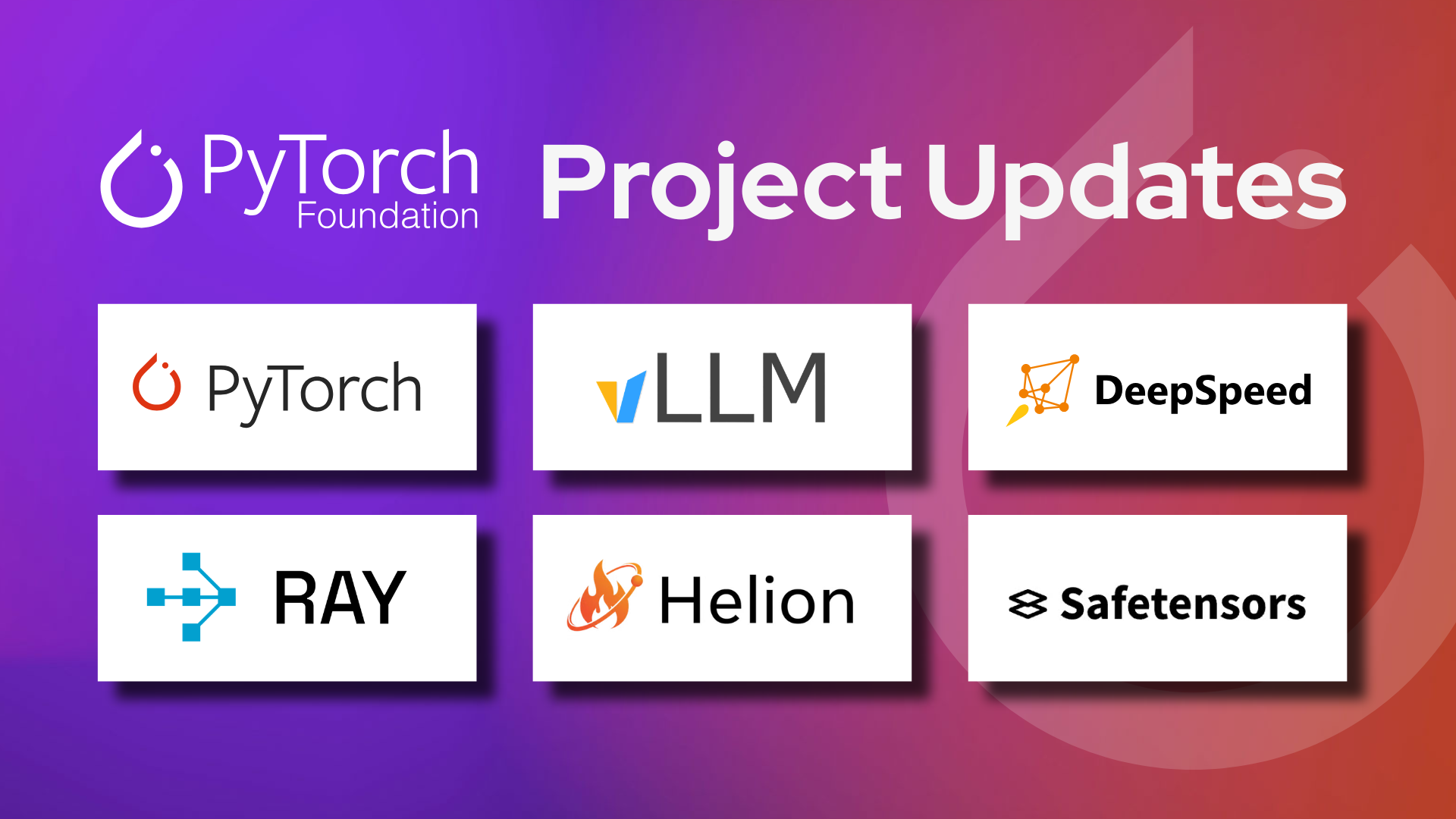
2025 年 4 月、PyTorch ファウンデーションは単一プロジェクトから複数のプロジェクトを統括する組織へと進化しました。その目的は、分野を超えた協力を深め、AI のライフサイクル全体でイノベーションを加速させることです。
現在、このファウンデーションには PyTorch、vLLM、DeepSpeed、Ray、Helion、Safetensors の 6 つのプロジェクトが所属しています。コア機能の最適化からハードウェア対応、コミュニティの健全性維持まで、過去四半期に各プロジェクトは大きな成果を収めました。
本シリーズでは、それぞれのプロジェクトが最新の成果について報告します。

PyTorch の最新動向:2.13 リリース、ExecuTorch、Apple Silicon 最適化
コアとなる PyTorch プロジェクトの開発勢いは非常に強く、コミット数は第 2 四半期だけで 4,415 に達しました。また、イシュー管理も順調で、オープンなイシューの総数は着実に減少しています。
コミュニティは公式に PyTorch 2.13 のリリースを完了し、すでに次期バージョンである 2.14 の開発サイクルを開始しています。PyTorch 2.13 はパフォーマンスとプラットフォーム対応の強化が特徴です。
Apple Silicon では FlexAttention が利用可能になり、従来の SDPA と比較して最大約 12 倍の高速化を実現しました。また、新しい CuTeDSL Inductor バックエンドや、メモリ使用量を大幅に削減した nn.LinearCrossEntropyLoss(ピーク GPU メモリを最大 4 分の 1 に抑える)も追加されています。さらに Python 3.15 のホイールサポートが整い、フリースレッドビルドにも対応しています。
分散処理やプラットフォーム面では、torchcomms バックエンドの導入や大規模クラスター学習向けの FSDP2 コミュニケーションオーバーラップ機能が追加されました。ROCm、Arm、Intel XPU へのサポートも拡大されています。チームは ExecuTorch を通じてオンデバイスでの LLM 能力を積極的に強化しており、Hugging Face との提携によりモデルの取り込みをスムーズにしつつ、オンデバイスでのパフォーマンスをサポートしています。

vLLM のアップデート:Model Runner V2、2026 年第 3 四半期のロードマップ、および vLLM コーナー
vLLM プロジェクトは重要なマイルストーンを達成し、安定した隔週リリースのサイクルを実現しました。その中でも目玉となるのは、GPTQ における大幅なパフォーマンス向上をもたらした Model Runner V2 の完全な再設計です。また、vLLM は引き続き Kimi K3、Minimax M3、Qwen 3.8 など、最新の超大規模モデルに対してリリース直後のサポート(day-zero support)を提供し続けています。
今後を見据え、チームは Q3 2026 ロードマップを公開しました。このロードマップは特別関心グループ(SIG)ごとに整理され、生産環境でのエージェントワークロードと高インタラクションなプレミアムトークンの処理に焦点を当てています。
コアエンジンでは、「Flat Model」と「Model Runner V2」の 2 つの大規模移行を完了させ、スケジューラーと KV キャッシュの仕組みを再設計しています。大規模な推論サービスにおいては、AgentX での最高パフォーマンス達成を目指し、KV キャッシュのオフロード機能を強化するとともに、多ターンエージェント向けのスマートなプレフィックスキャッシングを導入します。
その他のグループでは、高速なスペキュレティブ・ディコーディング、本番環境対応型の KV キャッシュ圧縮、そして CI の高速化に取り組んでいます。さらに、モデル性能、vLLM-Omni、強化学習に関する専用トラックも用意されています。
チームはまた、サンフランシスコで開催される Ray Summit(8 月 24 日〜26 日)において、初となる vLLM Conference を開催します。このイベントでは、vLLM エコシステム全体からエンジニアや研究者が集まり、ロードマップ、ハードウェアバックエンド、エージェント推論、トレーニング、本番規模の推論などに関するセッションを 2 日間行います。
DeepSpeed の最新動向:Ulysses Parallelism、Torch.xpu 統合、ASPLOS 2026
DeepSpeed は継続的に迅速なソフトウェア革新を推進し、安定した隔週リリーススケジュールを維持して第 1 四半期には 6 つのソフトウェアリリースを行いました。開発者との協力を強化するため、チームは月例のバーチャルオフィスアワーをコミュニティとの一貫した接点として定着させました。
主要なアーキテクチャ更新では、Intel GPU サポート(IPEX)から Torch.xpu への直接統合へ移行しました。また、混合精度の修正、AMD SDMA の最適化、自動シーケンス並列化、そして Muon オプティマイザーに焦点を当てたアップデートも展開されました。
このプロジェクトの主なハイライトの一つは、Ulysses シーケンス並列化アルゴリズムを Hugging Face ライブラリ(Trainer、Accelerate、TRL など)へ直接統合したことです。DeepSpeed の理論的貢献は学術界でも高く評価され、先駆的な SuperOffload 研究により ASPLOS 2026 で最優秀論文候補に選出されました。また、3 つの研究論文が採択されています。
1 つ目の論文(AutoSP)では PyTorch 2.0 のコンパイル技術を用いてシーケンス並列化を自動化し、2 つ目の論文は Grace Hopper C2C システムにおけるエネルギー分析とオフローディングのオーバーヘッドを検証しています。3 つ目の論文はモデルトレーニングのための効率的なオフローディングメカニズムに焦点を当てています。

Ray のアップデート:GB200/GB300 ハードウェア対応、フロンティアモデルのスケーリング、および Ray Data 2.57
Ray は、大規模ワークロード向けの生産環境強化に注力し続けています。具体的には、アクタースケジューリングの高速化、ネイティブ RDMA サポートのアップグレード、ラック単位でのアクター配置を最適化するトポロジー認識型スケジューリングの改善、そして GB200 や GB300 以降のハードウェアへのサポート強化に取り組んでいます。また、強化学習やマルチモーダルデータ、動画処理におけるワークフローの最適化にも力を入れています。
ここ数ヶ月で Ray は、MAI-Thinking-1、Composer 2.5、Nemotron 3 Ultra など、さまざまな最先端モデルの開発に活用されています。
チームによるその他の最近の成果としては、Ray と vLLM を組み合わせた推論パフォーマンスの向上、リソース分離によるクラスタ安定性の改善、データパイプラインの信頼性強化、そして AMD MI325X 上で Ray と vLLM を用いたプレフィル・デコードの非同期化(disaggregation)が挙げられます。
さらに、データおよび推論パイプラインに関する重要なアップデートも進んでいます。Ray Data のための新世代高性能エンジン「Ray Data Engine」はバージョン 2.57 で登場する予定です。同時に、ポストトレーニング中のパフォーマンスボトルネックを解消するため、vLLM や SkyRL とのウェイト同期(weight-syncing)連携の実装にも積極的に取り組んでいます。
チームやコミュニティと直接交流したい方は、8 月 24 日から 26 日にサンフランシスコで開催される「Ray Summit」へぜひご参加ください。

Helion の最新動向:クロスハードウェアアテンションカーネルと LLM による自動チューニング
ヘルリオンは今年上半期、異種間ハードウェア全体で最先端の性能を実現することに注力し、着実な進歩を遂げました。プロジェクトでは NVIDIA GPU 向けの CuTeDSL バックエンドと TPU 向けの Pallas バックエンドを導入しました。
新しい CuTeDSL と Pallas バックエンドにより、ヘルリオンは同じアテンションカーネルを使用しながら、NVIDIA Blackwell GPU では FlashAttention-4 を上回り、Google TPU では Tokamax ライブラリのハンドライティングされたアテンションカーネルを上回る最先端の性能を発揮します。これはヘルリオンの性能移植性の実証です。Pallas バックエンドは Google と共同で開発され、Google AI Systems DevLabs で初披露されました。
性能向上と新ハードウェアへの対応に加え、ヘルリオンでは LLM(大規模言語モデル)の力をカーネル自動調整に活用しています。チームは最近、LLM を活用した自動調整ツールを導入し、調整効率を 10 倍に改善する成果を示しました。これにより、より高速で高度に最適化されたデプロイが可能になる道が開かれました。
コミュニティとの連携強化のため、ヘルリオンは NVIDIA および GPU Mode と共同で初のハッカソンを開催し、PLDI 会議ではチュートリアルも実施されました。また、PyTorch Conference Europe で一般提供(GA)が発表されました。

Safetensors のアップデート:GIL 非依存シリアライゼーション、Python 3.14 対応、MPS での高速読み込み
6 月、Safetensors は「GIL-Free Serialization(グローバルインタープリタロックフリーのシリアライズ)」を正式にリリースしました。これにより並列処理能力が強化され、マルチスレッド環境でのパフォーマンス全体が向上しています。
今後の Python リリースへの早期対応のため、プロジェクトは継続的インテグレーションパイプラインを拡張し、Python 3.14 および 3.14t に対応しました。互換性のあるハードウェアを使用する開発者向けには、新しい Metal Performance Shaders (MPS) の高速ロードパスが導入されました。これにより torch MPS バックエンド内でネイティブな Metal バッファが利用可能になり、モデルの読み込み遅延を大幅に削減できます。
さらに、多様なモデリングワークロードにおいて開発者に高い精度と柔軟性をもたらす新たなデータ型(dtypes)も追加されています。
今後の展望として、Safetensors は CUDA の高速パス読み込み機能の最適化に取り組んでいます。具体的には io_uring と GPU Direct Storage (GDS) への統合を検討中です。その第一歩として、プロジェクトではピニングされたホストバッファへのマルチスレッド pread 操作を実装し、データ転送の加速を図っています。
この構造的な改修により、ライブラリは追加のカスタム高速パスに対してより適応性が高まり、torch の from_file メモリマッピングのようなフレームワーク管理ストレージへの歴史的依存も解消されます。ただし、この移行がすべてのフレームワークで普遍的にサポートされる DLPack 転送に依存しているため、チームは今後その実現可能性を評価中です。
コミュニティに参加する
AI の未来を共に築く準備はできていますか?当財団がホストするプロジェクトの詳細については、Foundation-Hosted Projects ポータルをご覧ください。また、組織がメンバーとして参加する方法については Join Now ページをご参照ください。
さらに、今年後半には上海で「KubeCon + CloudNativeCon + OpenInfra Summit + PyTorch Conference China 2026」(9 月 7〜9 日)に、サンノゼでは「PyTorch Conference North America 2026」(10 月 20〜21 日)に参加しませんか。
原文を表示
TL;DR
In April 2025, the PyTorch Foundation evolved into a multi-project Foundation, with the objective to support deeper collaboration across domains and help scale innovation throughout the AI lifecycle. Today, the Foundation hosts six projects, including PyTorch, vLLM, DeepSpeed, Ray, Helion, and Safetensors. From core optimization updates to hardware enablement and community health, PyTorch Foundation-hosted projects have achieved a lot this past quarter. In this new blog series, each of our projects provides an update on its latest achievements.
PyTorch Updates: 2.13 Release, ExecuTorch, and Apple Silicon Optimization
Development momentum for the core PyTorch project remains incredibly strong. Commits continued to rise with 4,415 in Q2 alone, and issue management is on track, with the overall number of open issues steadily decreasing.
The community officially rolled out PyTorch 2.13 and has already kicked off the development cycle for PyTorch 2.14. PyTorch 2.13 headlines performance and platform reach: FlexAttention arrives on Apple Silicon (up to ~12x faster than SDPA) alongside a new CuTeDSL Inductor backend, a memory-saving nn.LinearCrossEntropyLoss (up to 4x less peak GPU memory), and Python 3.15 wheel support including free-threaded builds. On the distributed and platform side, it adds the torchcomms backend and FSDP2 communication overlap for large-cluster training, broadens ROCm/Arm/Intel XPU support. The team is actively expanding on-device LLM capabilities through ExecuTorch, releasing weekly examples alongside a partnership with Hugging Face to streamline model ingestion and support on-device performance.
vLLM Updates: Model Runner V2, Q3 2026 Roadmap, and vLLM Conference
The vLLM project has reached an impressive milestone, achieving a stable, bi-weekly release cadence. Among its key achievements is the complete redesign of Model Runner V2, which yielded substantial performance improvements on GPTQ. vLLM continues to offer day-zero support for massive, state-of-the-art models such as Kimi K3, Minimax M3, and Qwen 3.8.
Looking ahead, the team has published its Q3 2026 roadmap. The roadmap is organized across special interest groups (SIGs) and centers on production agentic workloads and high-interactivity premium tokens. On the core engine, the team is finishing two major migrations, Flat Model and Model Runner V2, and redesigning how the scheduler and KV cache work. For large-scale serving, the goal is top performance on AgentX, with better KV cache offloading and smarter prefix caching for multi-turn agents. Other groups are focused on faster speculative decoding, production-ready KV-cache compression, and quicker CI. There are also dedicated tracks for model performance, vLLM-Omni, and reinforcement learning.
The team is also hosting the first-ever vLLM Conference, held at Ray Summit in San Francisco from August 24–26. The event brings together engineers and researchers from across the vLLM ecosystem for two days of sessions spanning the vLLM roadmap, hardware backends, agentic serving, training, and production-scale inference.
DeepSpeed Updates: Ulysses Parallelism, Torch.xpu Integration, and ASPLOS 2026
DeepSpeed continues to deliver rapid software innovations, maintaining its stable bi-weekly schedule with six software releases in the first quarter. To foster closer collaboration with developers, the team stabilized its monthly virtual office hours as consistent community touchpoints. In a major architectural update, the project replaced Intel GPU support (IPEX) by directly integrating Torch.xpu. The team also rolled out updates focusing on mixed precision fixes, AMD SDMA optimization, automatic sequence parallelism, and Muon optimizer.
One of the main highlights for the project is the integration of the Ulysses sequence parallelism algorithm directly into Hugging Face libraries, including Trainer, Accelerate, and TRL. DeepSpeed’s theoretical contributions have also gained recognition in the academic community, earning a best-paper honorable mention at ASPLOS 2026 for its pioneering SuperOffload work, and having three research papers accepted. The first paper (AutoSP) automates sequence parallelism using PyTorch 2.0 compile technology, the second paper explores energy analysis and offloading overheads on Grace Hopper C2C systems, while the third paper focuses on efficient offloading mechanics for model training.
Ray Updates: GB200/GB300 Hardware Support, Frontier Model Scaling, and Ray Data 2.57
Ray remains focused on production hardening for large-scale workloads. This work includes speeding up actor scheduling, upgrading native RDMA support, improving topology-aware scheduling for rack-aware actor placement, and improving support for GB200s/GB300s and beyond. The team is also focused on optimizing workflows for reinforcement learning as well as for multimodal data and video processing.
In the last few months, Ray has been used for building a variety of frontier models, including MAI-Thinking-1, Composer 2.5, and Nemotron 3 Ultra.
A few other recent highlights from the team include inference performance improvements with Ray + vLLM, improved cluster stability via resource isolation, improved data pipeline reliability, and prefill-decode disaggregation with Ray + vLLM on AMD MI325X.
The team has also made important updates to data and inference pipelines. A brand-new, high-performance engine for Ray Data is scheduled to debut in version 2.57. At the same time, the team is actively building out weight-syncing integrations with vLLM and SkyRL to eliminate performance bottlenecks during post-training. If you want to connect with the team and community in person, Ray Summit is set for August 24-26 in San Francisco.
Helion Updates: Cross-Hardware Attention Kernels and LLM-Guided Autotuning
Helion has made substantial progress during its first six months of the year, focusing its efforts on delivering state-of-the-art performance across heterogeneous hardware. The project introduced the CuTeDSL backend for NVIDIA GPUs and Pallas backend for TPUs. With the new CuteDSL and Pallas backends, using the same Helion attention kernel, Helion delivers state-of-the-art performance on NVIDIA Blackwell GPU, outperforming FlashAttention-4, and on Google TPU, outperforming hand-written Attention kernel from the Tokamax library, demonstrating Helion’s performance portability. The Pallas backend is being built in partnership with Google and debuted at the Google AI Systems DevLabs.
In addition to performance improvements and support for new hardware, Helion incorporated the power of LLMs to kernel autotuning. The team recently introduced an LLM-guided autotuner to significantly speedup autotuning, demonstrating an 10x improvement in tuning efficiency, paving the way for faster, highly optimized deployments.
To engage with the community, Helion held its first hackathon in partnership with NVIDIA and GPU Mode and a tutorial at the PLDI conference. Helion was announced in General Availability at the PyTorch Conference Europe.
Safetensors Updates: GIL-Free Serialization, Python 3.14 Support, and MPS Fast-Loading
In June, Safetensors officially rolled out Global Interpreter Lock (GIL)-Free Serialization, which introduces enhanced parallel processing capabilities to improve overall multi-threaded performance. To provide early support for upcoming Python releases, the project has expanded its continuous integration pipeline to accommodate Python 3.14 and 3.14t. For developers operating on compatible hardware, the new Metal Performance Shaders (MPS) fast-load paths introduce native Metal buffers within the torch MPS backend to significantly minimize model loading latency. Finally, new dtypes have been added to offer developers greater precision and flexibility across diverse modeling workloads.
Looking ahead, Safetensors is actively working on optimizing CUDA fast-path loading capabilities, exploring integrations with both io_uring and GPU Direct Storage (GDS). As an initial step, the project is implementing multithreaded pread operations into pinned host buffers to accelerate data transfers. This structural work aims to make the library significantly more adaptable to additional custom fast paths while removing our historical reliance on framework-managed storage, such as the from_file memory mapping found in torch. The team is currently evaluating the feasibility of this transition, as it depends on DLPack handoffs that may not be universally supported across all frameworks.
Join the Community
Are you ready to build the future of AI with us? To learn more about our hosted projects, visit our Foundation-Hosted Projects portal, and to learn how your organization can become a member, visit our Join Now page. Plus, join us in Shanghai for KubeCon + CloudNativeCon + OpenInfra Summit + PyTorch Conference China 2026 September 7-9, and in San Jose for PyTorch Conference North America 2026, October 20-21, later this year.
関連記事
今日のまとめ
AIデイリーブリーフで今日の重要ニュースをまとめ読み