AIを法廷での自己弁護に利用する人が増え、システムが混乱している
本文の状態
日本語全文を表示中
詳細モードで約6分の本文を読めます。
ChatGPTなどの生成AI普及後、弁護士なしで自己弁護するケースが急増。その結果、司法システムに過度な負担がかかり、処理能力が限界に近づいていると研究論文で指摘されている。
Continue in AI NEW LAB
このニュースを、実務の判断につなげる
AI NEW LABで、試したことや先に確認したい条件を共有できます。まずはログインなしで読めます。
AI NEW LABで論点を見るSource Article
元記事を日本語で読む
本文に関係しない購読案内、埋め込み通知、サイト内プロモーションは除いています。
ChatGPTやClaudeなどの生成AIツールの普及以来、弁護士を雇わずに被告または原告が自ら法廷で自己弁護を行う「pro se(自己弁護)」の法的ケース数が劇的に増加していることが、査読前の研究論文で示された。
「生成AIが自己弁護訴訟のコストを劇的に低下させれば、その結果として提出件数が急増し、審理のすべての段階で人間の判断に依存するシステムを圧倒してしまうかもしれない」と、Shah氏とLevy氏は論文の中で述べている。
この論文は、2005年から2026年の間に処理された450万件以上の被告人以外の民事裁判事件の行政記録と、それらの事件に該当する4,600万件のPublic Access to Court Electronic Records(PACER)事件簿エントリに基づいています。その結果、LLM(大規模言語モデル)であるChatGPTが広く利用されるようになるまで、2022年までは弁護士を雇わない当事者(pro se)による事件の割合は11%でほぼ安定していましたが、それ以降は急激に上昇し、2025年には16.8%に達しました。
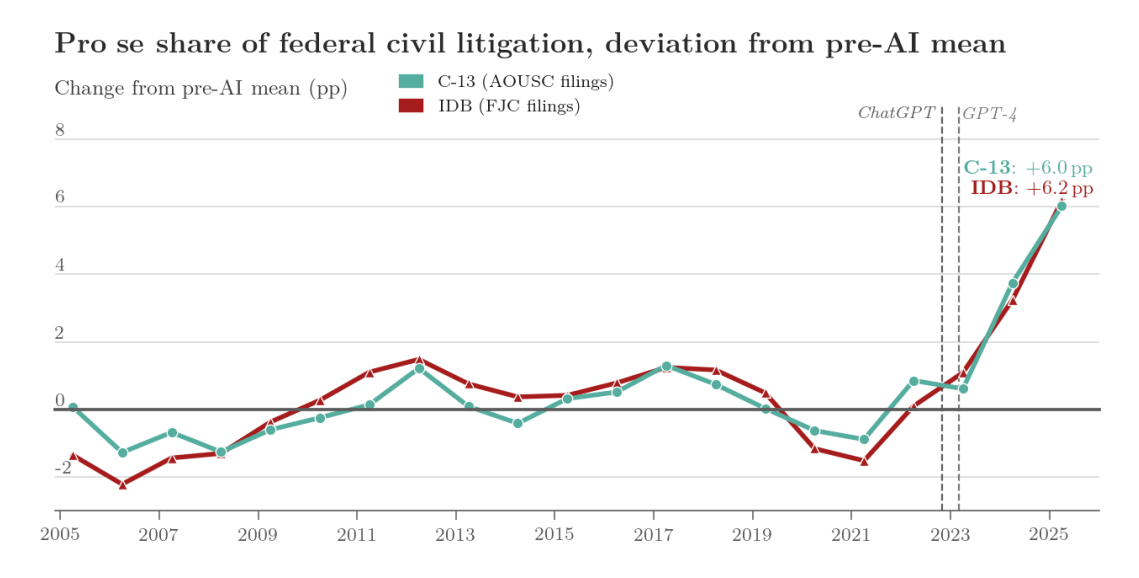 image「この安定性は、構造的な障壁を反映しているようです。ほとんどの人にとって、自己弁護は費用がかかりすぎて現実的ではありません」と論文は述べています。「連邦民事訴訟の訴状を提出するには、適切な管轄権の根拠を特定し、却下動議を生き残るのに十分な事実を主張し、文脈や事件の種類によって異なる手続要件を乗り越える必要があります。能力のあるLLMの広範な公的普及は、この計算式を変えました。法学の学位を持たず、ほぼゼロのコストで、インターネット接続があれば誰でも、対話形式の事件固有の法的助言(訴状の起草、法令の特定、手続のナビゲーション)を得るだけでなく、特に2023年3月にGPT-4がリリースされて以降は、妥当な法的文書を生み出すことも可能になりました。」
研究者らは、この論文が記述的なものであるため、AIツールの普及による増加を前提としているものの、個別の事例と特定のLLM(大規模言語モデル)を結び付けてはいないと指摘しています。「GPT-4が自己弁護での申立てに因果関係を持つことを特定するものではなく、生成AIの役割なしには観測された時系列を合理的に説明するのは困難であることのみを示すものです」と論文は述べています。
彼らの主張を裏付けるため、研究者らはまた、2019年(生成AIの普及以前)から2026年の8年間にわたる期間から抽出した1,600件の訴状の無作為標本を、AI検出ソフトウェア「Pangram」にかけて分析しました。その結果、AI以前の数値は「ほぼゼロ」でしたが、2026年には18%超に上昇していることが判明しました。
注目すべきは、単に自己弁護のケースが増加しているだけでなく、「事件内活動」つまり、事件記録への申立てや動議などの総活動量が、AI以前と比べて158%増加していることです。これは、自己弁護ケースの増加 alone に見られる以上に、裁判所の業務負荷がさらに高い可能性があることを意味します。
論文はまた、AI 導入後の自己弁護(pro se)の増加が主に原告側から来ていることを発見しました。つまり、人々は主に AI を使用して訴状を提出しており、それに対する反論を行うためではありません。「2015 年度から 2022 年度の財政年度(FY)にかけて、原告側の自己弁護事件数は年間平均 19,705 件でしたが、2025 年度には 39,167 件に達し、ほぼ倍増しました」と論文は述べています。「一方、被告側の自己弁護件数は同じ期間に 4,650 件から 3,896 件へとわずかに減少しています。」
「想像してみてください。世界中に存在しうる潜在的な苦情のレベルが、人々が職場などで常に被害を受けている状況です」と、電話での会話で Levy 氏は語りました。「しかし、潜在的な事件の分布は時間とともにほぼ変化していません。ところが、大規模言語モデル(LLM)が人々に可能にしたのは、裁判所へのアクセスのハードルを下げることでした。つまり、定型化された苦情を多数提出することを大幅に容易にしたのです。」
一方、事件数の増加は、以前は司法制度へのアクセスが得られなかった、正当な苦情を持つより多くの人々に機会を与える点で良い側面があります。他方、このような劇的な増加はシステムに負担をかけ、AI を活用した自己弁護事件だけでなく、すべての事件の解決に時間がかかるようになる可能性があります。
「それが純粋な社会的利益になるかどうかは未だ結論が出ていません」と Levy 氏は言います。「しかし、私たちが民主主義的に、人々が当然のように裁判所にアクセスできることを維持し続けるならば、大規模言語モデル(LLM)にはこうしたトレードオフが存在すると考えます。裁判所への扉はより広く開かれますが、その分、入場待ちの列が長くなるかもしれません。」
経験則として、裁判所で弁護士が AI を使用して発覚した事例を扱った記事を作成する際、私たちは pro se(自己弁護)のケースがあまりにも多いため、それらは除外し、実際に弁護士が AI を使用して発覚したケースに焦点を当てることにしました。その記事で使用したデータベースには現在 1,353 のケースが含まれており、そのうち 804 が pro se(自己弁護)のケースです。
連邦裁判所が求めるこの急増する需要に対応するため、連邦裁判所は供給量を増やすか、あるいは事件を処理する能力(キャパシティ)を何らかの形で高める必要があります。残念ながら、論文で指摘されているように、「追加の裁判官のキャパシティを『購入』できるような簡単な調整余地はありません。すでに事件のバックログ(滞留案件)は連邦司法制度における恒久的な特徴となりつつあり、追加のキャパシティを提供するための裁判官の急増は見込めず、米国の連邦裁判所が事件を審理することを全面的に拒否することもできません。」
レヴィ氏は、一つの解決策として、人間が実際の審理を行うことを確保しつつ、裁判官も一部の「定型化可能な」作業に AI ツールを使用することを認めることが可能だと提案しました。
私たちは、弁護士が裁判所で AI を使用して発覚した多くの事例を取り上げてきましたが、その多くは、AI が実際に存在しない事件の引用を幻覚(ハルシネーション)として生成したことが原因でした。このような事態が発生すると裁判官は非常に怒り、この行為に対して罰金を科す判決を複数回下しています。
原文を表示

The authors of the paper, titled “Access to Justice in the Age of AI: Evidence from U.S. Federal Courts,” which has yet to undergo peer review, argue more people are representing themselves in court because they’re able to use AI to do a lot of the work that previously required a lawyer. The authors, Anand Shah and Joshua Levy, also say that these pro se cases are “heavier,” meaning each case includes more motions that demand more work out of judges and the justice system. Overall, they argue, the use of AI tools and the increase in pro se cases could put a new burden on the courts.
“If generative AI dramatically lowers the cost of self-represented litigation, the resulting surge in filings could overwhelm a system that depends on human judgment at every stage of adjudication,” Shah and Levy say in the paper.
The paper draws on administrative records covering more than 4.5 million non-prisoner civil court cases between 2005 and 2026 and 46 million Public Access to Court Electronic Records (PACER) docket entries matching those cases. It found the share of pro se cases was pretty stable at 11 percent until 2022, after LLMs like ChatGPT became widely used, at which point it started to rise sharply, up to 16.8 percent in 2025.
image“This stability seems to reflect a structural barrier: for most people, self-representation is prohibitively hard,” the paper says. “Filing a federal civil complaint requires identifying the correct jurisdictional basis, pleading sufficient facts to survive a motion to dismiss, and navigating procedural requirements that vary by context and case type. The widespread, public diffusion of capable LLMs changes that calculus. Without a law degree and at de minimis cost, any person with an internet connection can not only obtain interactive, case-specific legal guidance—drafting complaints, identifying statutes, navigating procedure—but also generate passable legal documents, particularly so after the release of GPT-4 in March 2023.”
The researchers note that the paper is necessarily descriptive, meaning it assumes the rise is due the the prevalence of AI tools, but does not link individual cases to individual LLMs. “We do not claim to identify a causal effect of GPT-4 on pro se filing, only that the observed time series is difficult to rationalize without generative AI playing a role,” the paper says.
To support their argument, the researchers also used a random sample of 1,600 complaints drawn from the eight year period between 2019 (prior to the prevalence of generative AI) and 2026 which they ran through the AI detection software Pangram. They found a rise from "essentially zero” in the pre-AI period to more than 18 percent in 2026.
Notably, it’s not just that there are more pro se cases, but that the “intra-case activity” for those cases, meaning the total volume of activity in those cases as measured by docket entries—filings, motions—are up by 158 percent from the pre-AI period. This means the workload for courts could be even higher that it appears based on the rise in pro se cases alone.
The paper also found that the post-AI rise in self-representation is mostly coming from plaintiffs as opposed to defendants, meaning people are mostly using AI to file complaints rather than respond to them. “Plaintiff-side pro se case counts averaged 19,705 per year from FY2015 to FY2022 and reach 39,167 in FY2025, nearly doubling,” the paper says. “Defendant-side pro se counts fall slightly over the same window, from 4,650 to 3,896.”
“Imagine that you have just a latent level of complaints that could exist in the world, people are constantly getting hurt at work whatever it happens to be,” Levy told me on a call. “But that distribution of potential cases is sort of unchanged over time. But what LLM allowed people to do was it lowered the cost of entry to the courts. Basically, it made it much easier to file many templatable complaints.”
On the one hand, the increase in the number of cases is good because it potentially gives more people with legitimate grievances access to the justice system that they didn’t have previously. On the other hand, a dramatic increase like this could burden the system and make all cases, not just AI-enabled pro se cases, take longer to resolve
“Whether or not it's a net social benefit is an open question,” Levy said. “But if we remain democratically committed to people having access to the courts as a matter of course then we think that the LLMs have this trade-off. The door to the courts opens wider but maybe the queue to enter gets longer.”
Anecdotally, when we were writing an article about lawyers getting caught using AI in court, we decided to not include pro se cases because there were so many, and to focus only on cases in which actual lawyers were caught using AI. The database we used for that article currently contains 1,353 cases; 804 of them are from pro se cases.
To handle this surge in demand for the Federal courts, Federal courts have to somehow increase its supply, or the courts’ capacity to take on cases. Unfortunately, as the paper notes, “there is no easy margin along which to ‘buy’ extra judge capacity. Already case backlog is becoming a persistent feature of the federal judicial system, there is no coming influx of judges to supply additional capacity, and federal courts in the United States cannot wholesale decline to hear cases.”
Levy suggested that one possible solution is to allow judges to use AI tools to do some of their “templatable” work as well, while still ensuring that human judges do the actual judging.
We’ve covered many instances of lawyers getting caught using AI in court, often because the AI hallucinated a citation of a case that didn’t actually exist. Judges are pretty mad when this happens and have issued fines for this behavior several times.
同じ出来事を2媒体で確認
同じ出来事を扱う別媒体の記事です。見出しと公開時刻を比較できます。
関連記事
News to Guide
ニュースの次に確認する
発表内容を、現在の料金や仕様と照らし合わせられる関連ガイドです。
今日のまとめ
AIデイリーブリーフで今日の重要ニュースをまとめ読み