Arize AI と Atlan、AI エージェントの信頼性向上に注力
本文の状態
日本語全文を表示中
詳細モードで約20分の本文を読めます。
同じ出来事の情報源
この情報源を基点に整理
Arize AI Blog
Arize AI と Atlan は、単なるモデル選択ではなく、文脈とハルネスの設計がエージェントの信頼性を決定するとし、評価を全層に統合する必要性を説く。
Continue in AI NEW LAB
このニュースを、実務の判断につなげる
AI NEW LABで、試したことや先に確認したい条件を共有できます。まずはログインなしで読めます。
AI NEW LABで論点を見るAI深層分析を開く2026年8月13日 01:31
AI深層分析
キーポイント
エージェントの複雑化と失敗要因
単一モデル呼び出しからデータ取得やコード実行など多機能化したエージェントは、潜在的な失敗箇所が大幅に増加しており、従来の評価手法では不十分である。
文脈工学とハルネス工学の重要性
ビジネス定義やポリシーを管理する「文脈層」と、知識を実行に移す「ハルネス層」が、モデル選定以上にエージェントの信頼性を左右する重要な要素となる。
3 層アーキテクチャと評価の役割
推論を行うモデル層、意味を提供する文脈層、行動変換を行うハルネス層からなるシステム全体で評価を行うことで、失敗箇所の特定と改善が可能となる。
公開ベンチマークの限界
一般的能力を問う公開ベンチマークは、特定の企業におけるビジネス文脈や信頼関係の有無については一切示さないため、生産環境での完全な信頼には繋がらない。
モデルの性能とシステムの実行は別問題である
パブリックベンチマークはモデルの一般的能力しか示さず、ビジネスへの適合性や周辺システムの信頼性は保証しない。研究によると、入力情報の位置や文脈の矛盾によってパフォーマンスが変動する一方で、基盤となるモデル自体は固定されたままとなる。
重要な引用
Context and evaluation are becoming the operating layer for reliable AI.
The context layer determines what the agent knows about the business, including its definitions, policies, trusted sources, and operating norms.
Public benchmarks answer one question: can this model, in general, do the thing? They say nothing about whether it's right about your business.
We think of this pattern as confident irrelevance: the model applies real intelligence to the wrong information.
編集コメントを表示
編集コメント
モデルの性能向上が叫ばれる中、実運用における失敗の根本原因を「文脈」と「ハルネス」に求める視点は非常に鋭い。このアプローチは、AI エージェントを単なるチャットボットから信頼性の高い業務自動化ツールへと進化させるための重要な指針となるだろう。
Source Article
元記事を日本語で読む
本文に関係しない購読案内、埋め込み通知、サイト内プロモーションは除いています。
評価(evals)は、AI においてこれまで見たこともないほど急速にインフラの核へと成長しました。Arize では、顧客が毎月 1 億回を超える評価を実行している様子を目撃しています。一般的なチームでは約 12 の評価ジョブを運用していますが、最も活発な組織では数千ものジョブを回しています。
一方、Atlan では企業向けエージェントに統制された最新のビジネスコンテキストを提供する取り組みを通じて、同じ転換の別の側面を見ています。私たちは、コンテキストと評価が信頼できる AI のための運用層へと成りつつあると考えています。
しかし、チームがこれらの評価スイートを構築している間、評価対象となるシステム自体は急速に変化していました。初期の生産環境向け AI アプリケーションでは、単一のモデル呼び出しを行い、一つの回答を返すのが一般的でした。今日のエージェントは、データの取得、ツールの呼び出し、コードの実行、権限管理、メモリ利用、サブエージェントへの委任、そして長い時間軸にわたる処理などを行います。各機能はエージェントの能力を広げる一方で、システムが失敗する可能性のある箇所も増やしています。
これが、コンテキストエンジニアリングとハネス(harness)エンジニアリングが AI 開発において最も重要な分野の一つとなっている理由です。コンテキスト層は、エージェントがビジネスについて何を知っているかを決定します。これには定義、ポリシー、信頼できる情報源、運用規範などが含まれます。一方、ハネスは、その知識をデータ取得、ツール利用、コード実行、メモリ管理、権限処理、引き継ぎの各場面でどのように活用するかを規定します。この二つが組み合わさることで、モデル選択だけでは説明できない形で、エージェントの体験と信頼性が形作られていきます。
企業向け AI システムの 3 つのレイヤー
Atlan と Arize での取り組みを通じて、企業向け AI システムには共通する 3 つのレイヤー構造があることがわかります。モデルは推論を担当し、コンテキスト層がビジネスの意味、ポリシー、そしてモデルが必要とする信頼できる知識を提供します。ハーン(制御枠組み)は、その推論とコンテキストを基に、検索、ツール、コード、メモリ、権限、引き継ぎといった領域で具体的なアクションへと変換します。評価はこの 3 つのレイヤー全体にまたがって行われるため、チームは失敗箇所を特定し、得られた知見をもとにシステムを改善できます。
各レイヤーには異なるレベルの検証が求められます。最先端研究所や広範な研究コミュニティはモデルを公的なベンチマークに対して評価しますが、企業それぞれが自社の環境内におけるコンテキスト層とハーン層の責任を負います。これらのレイヤーには、組織独自の定義、データ、信頼シグナル、ワークフロー、権限、ツール、そしてエッジケースが含まれているため、その品質は実際の運用現場での実態に対してのみ測定可能です。
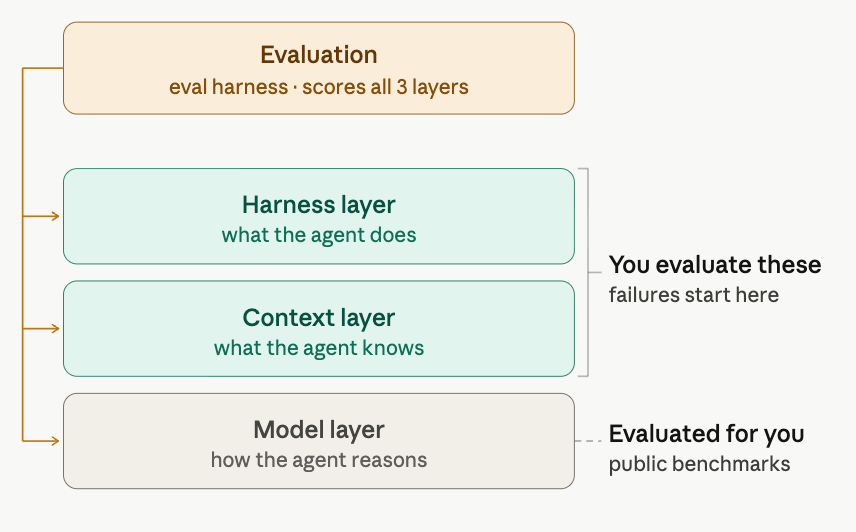 image モデルが推論を提供し、コンテキスト層がビジネスの意味やポリシー、信頼できる知識を供給します。ハーンはそれらを基に検索、ツール、コード、メモリ、権限、引き継ぎなどにおけるアクションへと変換します。評価はこの 3 つのレイヤー全体にまたがり、チームが失敗箇所を特定し、得られた知見でシステムを改善できるように設計されています。
なぜモデルベンチマークだけでは不十分な信頼感しか生まれないのか
パブリックベンチマークは「このモデルが一般的にそのタスクをこなせるか」という一点だけを問います。しかし、それが貴社のビジネスにとって正しいのか、あるいは周囲のシステムが確実に動作しているのかについては何も語っていません。研究結果によれば、モデル自体は固定されたままでも、これらの要素は変動し続けることが示されています。
いくつかの研究知見がこのギャップを浮き彫りにしています。Liu 氏ら(2024)は、入力内の関連情報の配置によって回答が異なることを示しました。また 2025 年の研究では、矛盾するコンテキストが存在すると LLaMA-3.1-8B の精度が 31% 低下することが判明しています。SWE-agent は専用のエージェント・コンピューターインターフェースを通じて実世界の GitHub イシューの解決率を向上させました。さらに MAST タクソノミーは、システム設計が多エージェントシステムの失敗にどう寄与するかを文書化しています。これら一連の結果から、基盤となるモデルが固定されたままでもパフォーマンスが大きく変動し得ることがわかります。
強力なモデルであっても、陳腐で不完全、あるいは矛盾するコンテキストを与えられれば、論理的に推論した上で間違った回答を出力することがあります。その出力は流暢すぎて信頼できそうに見えるため、失敗を見逃しがちです。私たちはこのパターンを「自信満々な無関係性」と呼んでいます。モデルは真の知能を発揮しているのに、対象となる情報が間違っているのです。
コンテキスト層がエージェントの知識範囲を決定する
モデルが特定の課題について推論を行うためには、まず信頼できるコンテキスト層が必要です。この層は、データ資産間の定義や関係性、運用手順、承認フロー、権限設定、そして信頼性のシグナルを提供し、エージェントに「その企業がどのように動いているか」を伝えます。Atlan は、このコンテキストを機械可読かつ移植可能な形式に変換することに注力しており、すべてのエージェントが同じビジネスのバージョンに基づいて推論できるようにしています。
私たちの経験では、効果的なコンテキスト層は 3 つの部分で構成され、それぞれがアクションを実行する前にエージェントが解決すべき問いに答えています。
AI 対応データ:どのデータや資産を信頼できるか?エンリッチされたグラフによって、各資産の由来、依存関係、そして認証済みのソースが明確になります。
セマンティクスとオントロジー:このビジネスにおける事象の意味は何か、どのように関連しているのか?顧客、製品、指標などの定義と、それらの概念間の関係性が含まれます。
スキル:ここでは実際に作業がどう行われ、何が許可されているか?どのアクションが許容されるかを決定する手順、意思決定ロジック、権限、承認パスが含まれます。
これら 3 つのいずれかが不完全な場合、モデルは利用可能な情報から曖昧さを解消しようとします。その結果、誤った定義や古いルール、廃止すべきソースに基づいて、もっともらしい回答が生成されてしまう可能性があります。
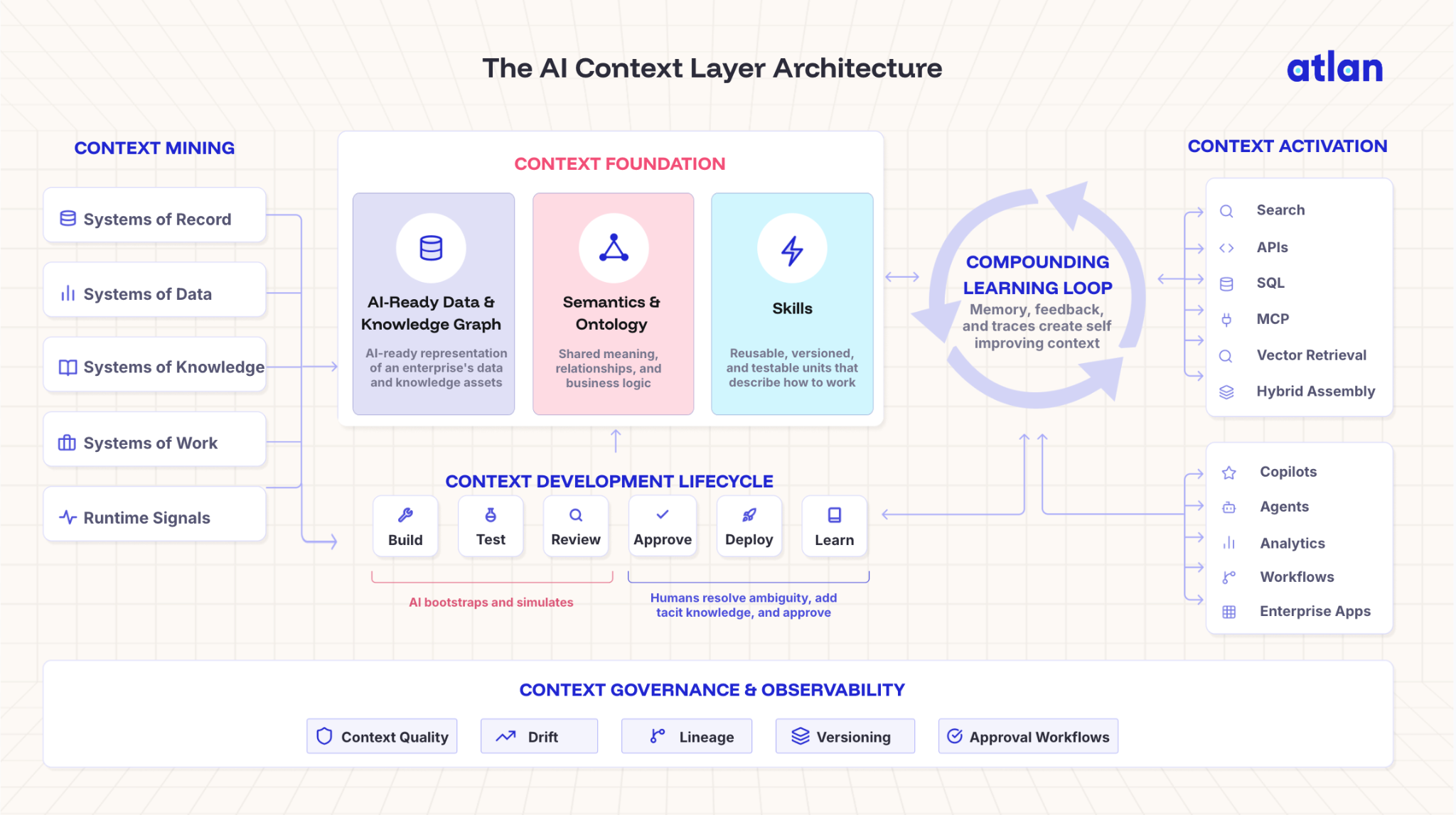 imageAtlan のエンタープライズ・コンテキスト層の機能:コンテキストマイニング、開発ライフサイクル、ガバナンス、アクティベーション、学習ループ。
コンテキストプラットフォームの中核機能
コンテキスト層に何を含めるべきかを知ることと、実際にそれを運用することは別問題です。定義は変わり、ポリシーは更新され、新しいエージェントが四半期ごとに新たなプラットフォームに登場します。つまり、コンテキスト層は一度作成して終わりではなく、継続的に生成・ガバナンス・提供される必要があります。
Atlan のエンタープライズ・コンテキスト層での実績に基づき、この役割を担う 5 つの主要機能を紹介します。
コンテキストマイニング
多くのビジネスコンテキストは、すでに SQL、パイプラインコード、BI モデル、ドキュメント、クエリ履歴の中に存在しています。Atlan の Context Agents やコネクタ、そしてカラムレベルのリンケージ機能は、これらのシステムからコンテキストを逆解析して抽出します。これにより、チームはゼロから定義を書くのではなく、ビジネスがすでに把握している情報を出発点にできます。
コンテキスト開発ライフサイクル
ビジネス環境が変われば、コンテキストも変わります。そのため、コードと同様の厳格なプロセスが必要です:構築、テスト、レビュー、承認、デプロイ、学習。Atlan の Context Engineering Studio では、AI が候補となるコンテキストをドラフトし、過去のトレースデータに対してテストを行います。その後、人間が最終的に採用される標準的なコンテキストを検証・認定します。
コンテキストのガバナンスと観測可能性
すべての定義には所有者、バージョン、承認履歴、そして資産が認証済みか非推奨かなどを示す信頼性シグナルが付与されます。モデルやデータのドリフトと同様に、コンテキストのドリフトにも明確な所有者、閾値、アラートといった運用上の規律を適用し、誤った回答が生じた際に、その原因となったコンテキストまで遡って追跡できるようにします。
コンテキストの活性化と検索
エージェントは多様なプラットフォーム上で動作するため、コンテキストもすべてのプラットフォームに届く必要があります。Atlan は MCP、SQL、API、グラフインターフェースを通じて、統制された同一のコンテキストを配信し、あらゆるエージェントが同じビジネスバージョンに基づいて推論できるようにします。
学習ループの累積効果
各エージェントとのやり取りから得られる評価(evals)、トレース、修正情報が共有層にフィードバックされます。チームが解決した失敗一つひとつが、その後に続くすべてのエージェントにとってのコンテキストを洗練させていきます。
これら3 つの機能を組み合わせることで、コンテキストはバージョン管理され、テスト可能で、移植性があり、使用を通じて改善される「運用資産」として確立されます。
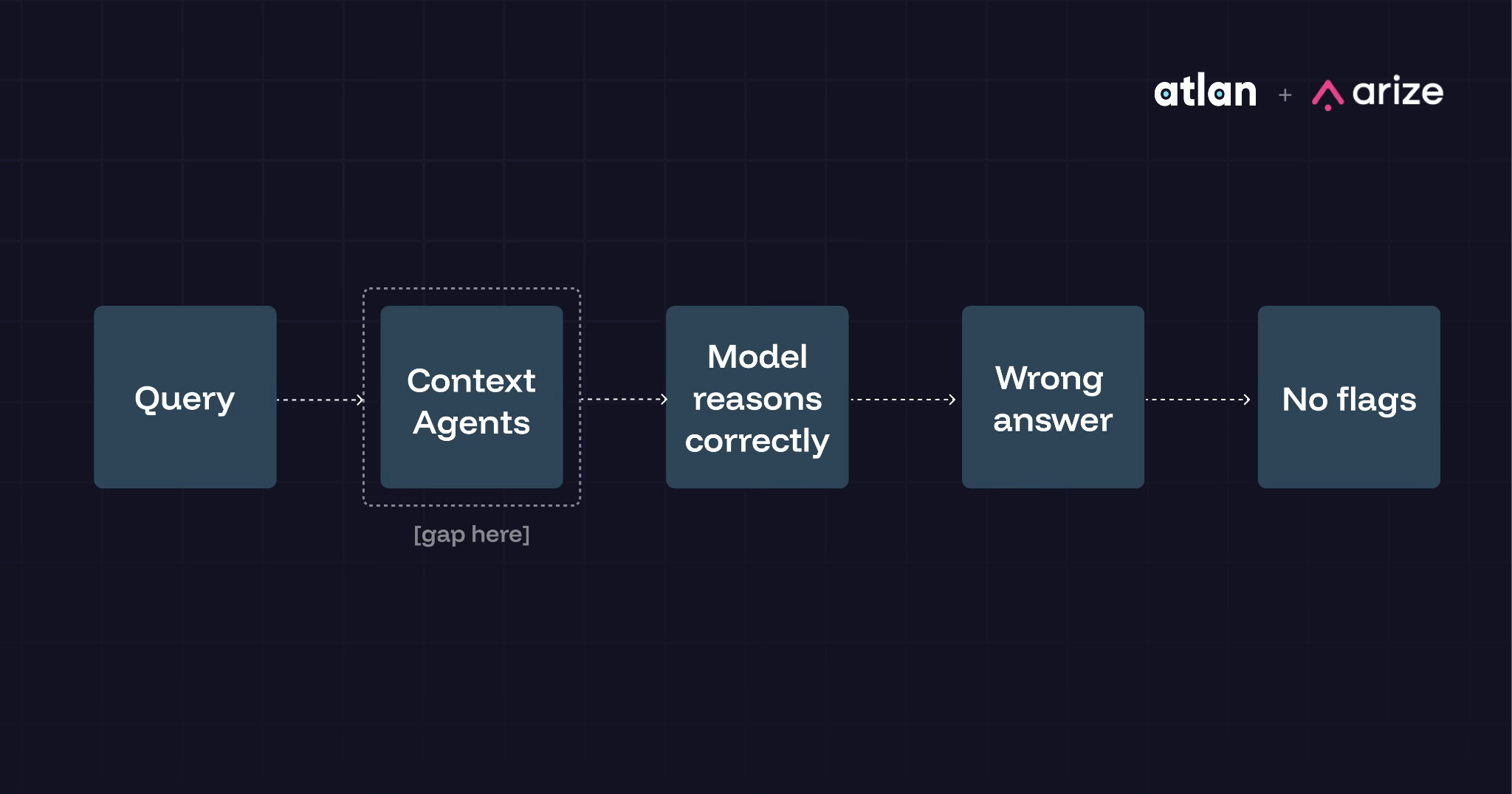 image コンテキストが不完全な場合、モデルは論理的に推論できても誤った回答を出力し、アラートを発動させないことがあります。
ハネス(実行基盤)が知識を実行へ変換する
コンテキスト層がエージェントの「知るべきこと」を提供した後は、ハネスがその知識を実行に移します。これには、反復ループ、コンテキストマネージャー、検索ロジック、ツールレジストリ、メモリ、権限チェック、コード実行、サブエージェント、タスクを完了させるためのハンドオフなどが含まれます。
ここで状態空間が拡大し始めます。過去 3 年間で、エージェントは単なるプロンプトへの回答から、関数の呼び出し、ウェブ閲覧、コンピュータ操作、コード記述、そして長時間にわたるサブエージェントの調整へと進化しました。新しい機能が一つ増えるごとに可能な軌道(トラジェクトリ)が増え、同じアプリケーションでも失敗に至る経路が多数存在するようになります。
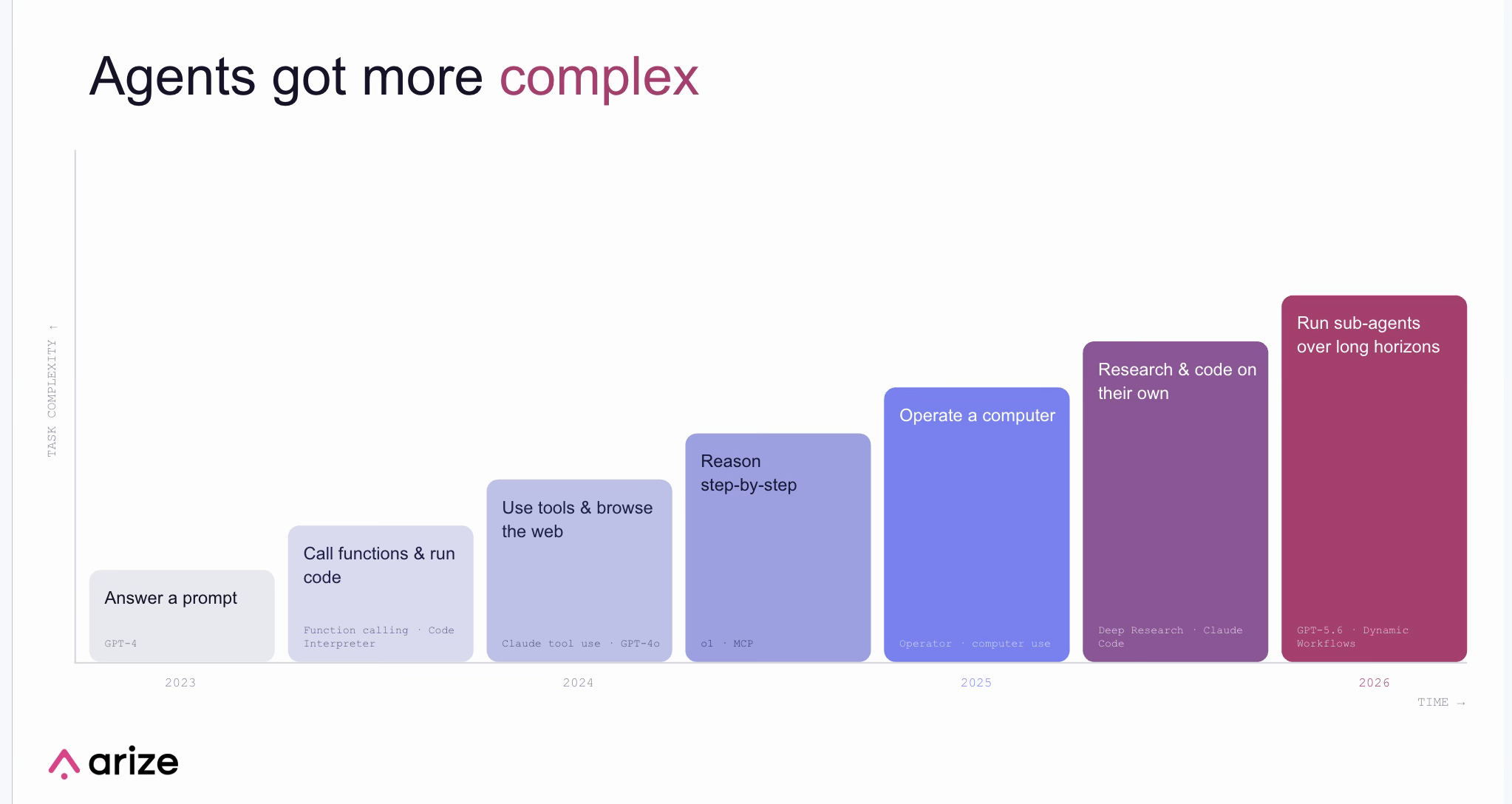 image エージェントがより複雑な業務を担うにつれ、可能な軌道や故障モードの数も増大します。システムが複雑化するにつれて、その失敗もまた多様化しました。Arize では、プラットフォーム Arize AX に組み込まれた AI エンジニアリングエージェント「Alyx」を通じてこれを直接体験しています。モデルのアップグレードごとに新機能とともに新たな失敗パターンも現れました。ある実行では重要な文脈が時間経過とともに失われ、別の例では誤ったツールの選択や実行中の失敗、ステップの繰り返し、不十分な回復処理、あるいは作業完了前の早期終了報告などが発生しました。Alyx はユーザーごとにカスタムインターフェースを構築し、異なる軌道を経るため、固定された出力評価基準でカバーできるのは重要な要素の一部に過ぎません。
つまり、こうした新しいタイプの失敗を、私たちとエージェント自身がより迅速にデバッグするためのツールが必要です。その第一歩はトレーシング(追跡)にあります。
トレーシングによって、軌道が見えるようになります
トレーシングは、エージェントの評価の起点となります。なぜなら、すべてのモデル呼び出し、情報取得、ツール利用、ハンドオフ、そして結果が記録されるからです。
最終的な回答だけでは、実行がどこで終わったかしか分かりません。しかし、トレーシングにはその経路が示されており、チームは文脈、ルーティング、権限、回復処理、あるいは実行のいずれが意図した動作から逸脱したのかを特定できます。
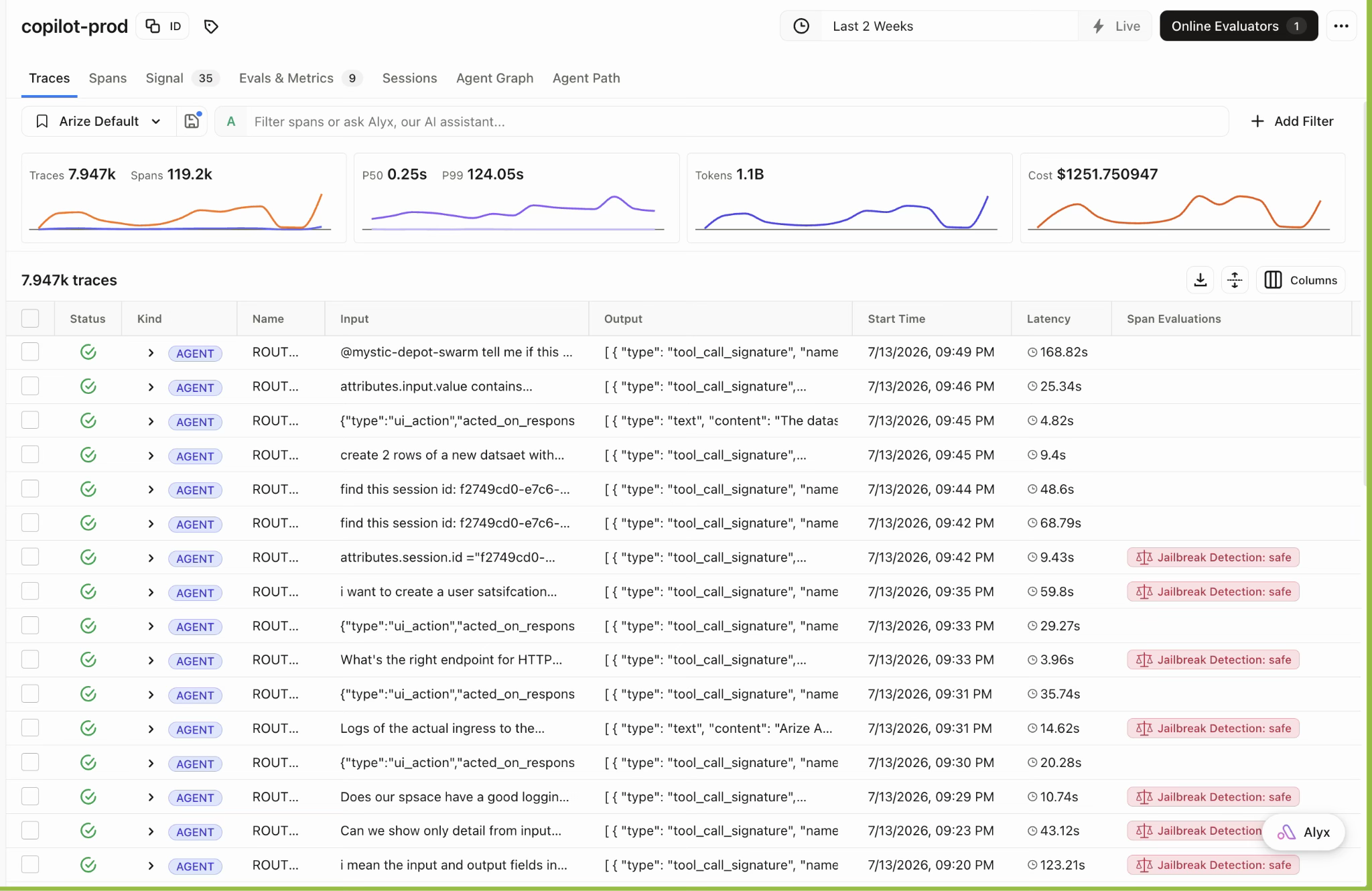 imageエンドツーエンドのトレーシングは、エージェントの回答背後にあるモデル呼び出しの順序、ツールの使用状況、中間結果を明らかにします。
人間のレビューも依然として価値がありますが、生産環境での膨大な量と生成されるデータの多さから、すべての実行経路を手動で検査することは不可能です。つまり、チームが探している失敗の構造や複雑さに合致する評価ツールが必要となります。
異なる失敗には異なる評価器が必要
さまざまな失敗モードに対応するには、それぞれに適した評価器が必要です。成熟した評価システムは複数の手法を組み合わせます。なぜなら、それぞれの手法が扱う曖昧さや複雑さのレベルが異なるからです。
- コード評価器: 決定論的な要件向けです。単体テスト、アサーション、ルールは高速で低コストかつ正確なため、有効な JSON の検証、必須フィールドの確認、ステータスコードの成功判定、権限境界のチェック、PII(個人識別情報)の漏洩検出などの評価に最適です。
既知の定性的な失敗に対しては、LLM-as-a-judge(LLM による評価者)が有効です。チームがすでに失敗の本質を理解し、安定した評価基準で記述できる場合、忠実性、関連性、トーン、あるいはハルシネーションといった特性を、適切に調整された評価者がスコアリングできます。
一方、軌道(トラジェクトリ)やハッチング(環境設定)の失敗に対しては、Agent-as-a-judge(エージェントによる評価者)が適しています。別のエージェントが全体の経路を検証し、各ステップからの証拠を確認しながら、ツール選択や回復策について推論することで、最終的な回答が妥当に見えても、その軌道自体が効果的だったかどうかを判断できます。
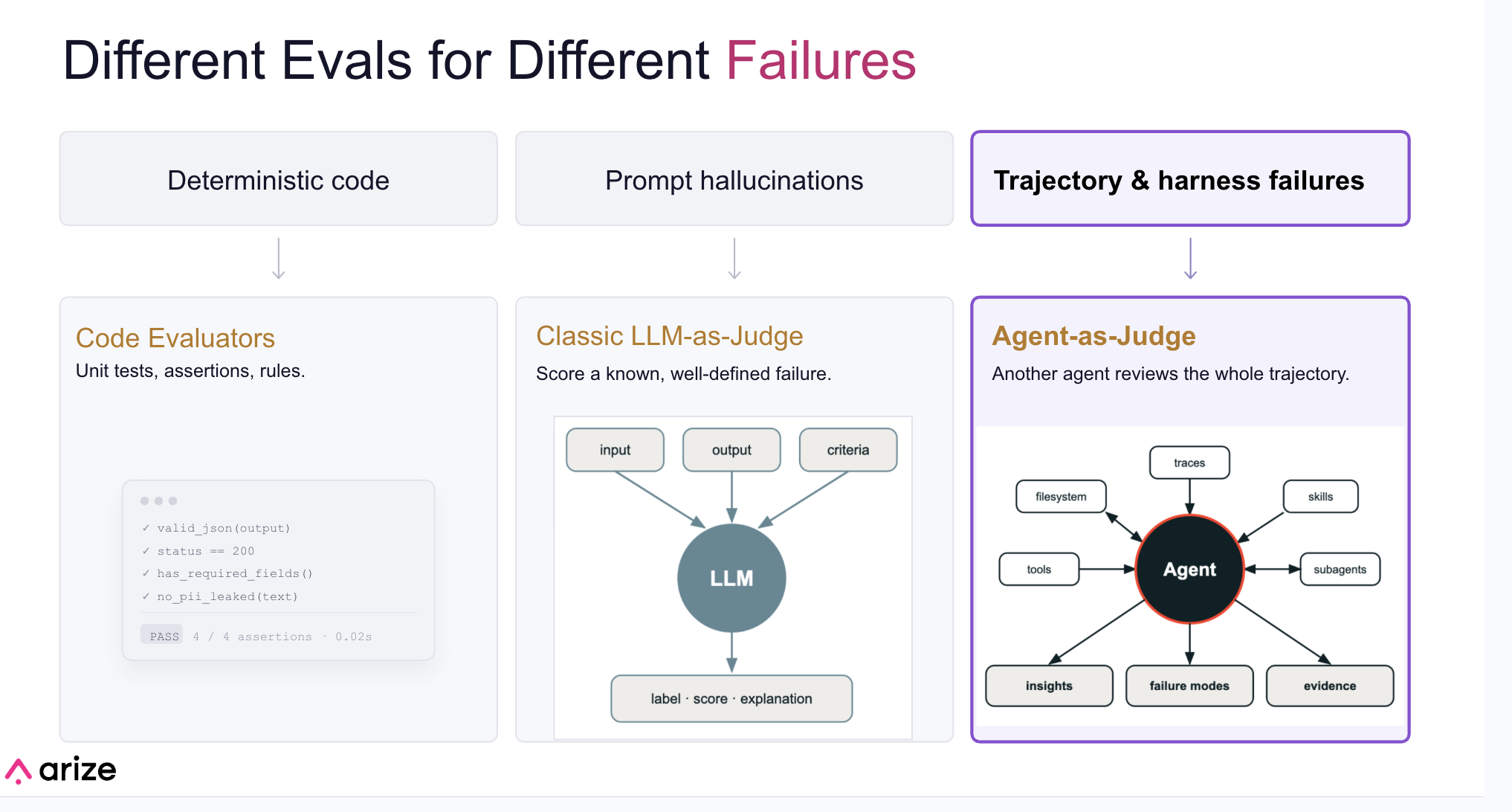 imageコード評価者、LLM による評価者、そしてエージェントによる評価者は、それぞれ異なる種類のエージェントの失敗に対応しています。
軌道に関する失敗に対しては、別のエージェントが最も優れた評価者となることが多いです。評価者はその経路を追跡し、各アクションをタスクと比較して検証することで、どこで逸脱したのかを説明できます。この説明は単なるスコアよりもエンジニアにとって格段に有用な出発点となり、変更すべきハッチングコンポーネントやコンテキストソース、あるいは回復動作の方向性を示してくれます。
どの評価者も、慎重な設計が不可欠です。コードチェックには意味のあるアサーションが必要であり、LLM による評価者には調整とドリフト監視が求められ、エージェントによる評価者には関連するトレース、ツール、証拠へのアクセス権限に加え、何を検査すべきかの明確な境界線が必要です。評価者は失敗の種類に合わせて選定し、すべての問題を単一の評価基準に無理やり当てはめるべきではありません。
評価は行動を促すものでなければなりません
スコアが実務で役立つのは、明確な次のアクションにつながる時です。不良のトラジェクトリは、人間のレビューに回されたり、確定的な失敗として記録されたり、回帰テストデータセットへ追加されたり、実験の指針となったりして、次期エージェントのバージョン形成に寄与します。ワークフローによっては、システムがチケットを起票したり、プルリクエストを提案したりすることもあります。結果は必ずエンジニアリングプロセスへ組み込まれ、チームがそこから学べるようにする必要があります。
この運用ループこそが Arize Signal の核となるアイデアです。本製品は、本番環境のトラジェクトリ全体にわたって、決定論的なチェック、LLM による判定、エージェントによる判定を統合します。これにより、パス上の失敗を自動的に検出し、アクションへ誘導し、開発時の厳選されたケースだけに頼らず、実際の動作から回帰テストスイートを構築するのを支援します。
本番環境でのトレーシング、評価、学習
本番環境では、リリース時に用意したテストセットでは想定できないエッジケースが発生するため、ライブなトレースによって評価セットを継続的に拡張する必要があります。特に確認済みの失敗事例は極めて価値が高く、実際に発生したデータ、ユーザーの意図、文脈、およびハッシュの動作をそのまま保存できるからです。各事例が次のリリースのカバレッジを向上させ、学習ループを実システムに即したものへと高めます。
文脈と評価の連携
コンテキスト層と評価システムは、それぞれ異なる問いに答える補完的な役割を果たします。コンテキスト層はエージェントが行動する前に「何を知っているか」を決定し、評価システムはその行動が正しかったかどうかを検証します。この二つを組み合わせることで、チームは「知識の欠如による失敗」と「実行プロセスでの失敗」を明確に区別できるようになります。
定義が古まってしまうと、本来は正しい軌道(トラジェクトリ)でも誤った方向へ進んでしまいます。また、その経路全体で評価が行われていない場合、ユーザーが間違った数値に気づくまで、その失敗は表面化しません。
評価システムによってコンテキストの質を可視化し、コンテキスト層によってそれを永続的な場所として管理します。トレースレベルでの評価を行えば、チームは軌道がどこで逸脱したかを特定でき、根本的な問題がコンテキスト、検索、ツール選択、権限、あるいは実行プロセスのいずれに起因するのかを判断できます。そして、修正された内容が統制されたコンテキスト層を通じて展開されれば、すべてのエージェントに同時に届きます。変更された定義に依存していた他の要素も、系譜情報(リンネージ)として追跡可能です。
この二つのシステムは、それぞれ単独では閉じられないループを完成させます。生産環境のトレースが失敗を検出し、コンテキストの系譜情報がその原因を説明し、コンテキストライフサイクルが修正版を展開し、回帰テストが修正が維持されていることを検証します。
この利点は、モデルを選んだこと自体に留まらず、さらに積み重なっていきます。
フロンティアモデルはさらに進化し、すべてのチームがその恩恵を受けられるようになります。しかし、文脈(コンテキスト)の構築やハルネス、評価システムの改善は、自らの運用経験を通じて行われるものです。
定義を一つ修正するごとに次のクエリ精度が上がり、失敗を追跡するたびに回帰テストスイートが拡張され、評価者が一人増えるごとに次のデプロイがより安全になります。あるチームの 10 番目のエージェントには、最初の 9 つのエージェントから得られた教訓が反映されているべきです。
こうした蓄積こそが、持続的な競争優位性となります。文脈は、自社のビジネスがエンティティをどう定義し、意思決定を行い、ポリシーを適用するかという実態を捉えるため、組織の知的財産の一部と言えます。また、トレースと回帰ケースは、エージェントが何に挑戦し、どこで失敗し、システムがどのように改善されたかを保存するため、運用上の記憶として機能します。
文脈を適切に管理し、トレース軌跡を追跡し、適切な層を評価し、失敗に対して行動を起こすチームこそが、使用を重ねるほど信頼性が高まるシステムを構築できるのです。
Arize がハルネスと評価レイヤーをどのように計測しているか知りたい場合は Arize チームへ、Atlan がエンタープライズエージェント向けに文脈層をどう提供しているか知りたい場合は Atlan チームへお問い合わせください。
※本記事は「You chose the best model. Why is your agent still failing?」として Arize AI にて公開されました。
原文を表示
Evals have become core infrastructure faster than almost anything we have seen in AI. At Arize, we see our customers run more than 100 million evals every month. A typical team operates roughly a dozen evaluation jobs, while the most active organizations run thousands. At Atlan, we see the other side of the same shift as enterprises work to give agents governed, current business context. Together, we think context and evaluation are becoming the operating layer for reliable AI.
Yet while teams built those evaluation suites, the systems being evaluated changed underneath them. Many early production AI applications made a single model call and returned a single answer. Today, agents retrieve data, call tools, execute code, manage permissions, use memory, delegate to subagents, and work across long trajectories. Each capability expands what an agent can do, while also creating more places where the system can fail.
This is why context engineering and harness engineering have become two of the most important disciplines in AI development. The context layer determines what the agent knows about the business, including its definitions, policies, trusted sources, and operating norms. The harness determines how the agent uses that knowledge across retrieval, tools, code, memory, permissions, and handoffs. Together, they shape the experience and reliability of the agent in ways that model choice alone cannot explain.
The three layers of an enterprise AI system
From our work across Atlan and Arize, we see the same three-layer architecture in enterprise AI systems. The model provides reasoning. The context layer supplies the business meaning, policies, and trusted knowledge the model needs. The harness turns that reasoning and context into actions across retrieval, tools, code, memory, permissions, and handoffs. Evaluation sits across all three layers so teams can locate failures and use what they learn to improve the system.
Each layer receives a different level of scrutiny. Frontier labs and the broader research community evaluate models against public benchmarks, while every company remains responsible for the context and harness inside its own environment. Those layers contain your definitions, data, trust signals, workflows, permissions, tools, and edge cases, so their quality can only be measured against your production reality.
imageThe model provides reasoning. The context layer supplies the business meaning, policies, and trusted knowledge the model needs. The harness turns that reasoning and context into actions across retrieval, tools, code, memory, permissions, and handoffs. Evaluation sits across all three layers so teams can locate failures and use what they learn to improve the system.
Why model benchmarks create incomplete confidence
Public benchmarks answer one question: can this model, in general, do the thing? They say nothing about whether it’s right about your business or whether the system around it executes reliably, and the research shows both move while the model stays fixed.
Several research findings illustrate the gap: Liu et al. (2024) showed that answers vary with the position of relevant information in the input. A 2025 study found that conflicting context reduced LLaMA-3.1-8B accuracy by 31 percent. SWE-agent improved resolution rates on real GitHub issues through a purpose-built agent-computer interface, and the MAST taxonomy documented how system design contributes to multi-agent failures. Together, these findings show that performance can move substantially even when the underlying model remains fixed.
When a strong model receives stale, incomplete, or conflicting context, it can reason coherently and still produce the wrong answer. The output may be fluent enough to look trustworthy, which makes the failure difficult to catch. We think of this pattern as confident irrelevance: the model applies real intelligence to the wrong information.
The context layer determines what the agent knows
Before a model can reason about a specific problem set, it needs a reliable context layer. That layer provides governed definitions, relationships among data assets, operating procedures, approval paths, permissions, and trust signals that tell the agent how the business works. Atlan focuses on making that context machine-readable and portable so every agent can reason from the same version of the business.
In our experience, an effective context layer contains three parts, each answering a question the agent has to resolve before it can act:
AI-ready data. What data and assets can the agent trust? An enriched graph of the estate, with lineage showing where each asset came from, what depends on it, and which sources are certified.
Semantics & ontology. What do things in this business mean, and how do they connect? The definitions of a customer, product, or metric, and the relationships among those concepts.
Skills. How does work actually get done here, and what’s allowed? The procedures, decision logic, permissions, and approval paths that determine which actions are acceptable.
When any of these parts is incomplete, the model has to resolve ambiguity from whatever information it can find. That can produce an authoritative-sounding answer based on the wrong definition, an outdated rule, or a source that should have been deprecated.
imageAtlan enterprise context layer capabilities: context mining, development lifecycle, governance, activation, and learning loops.
Core capabilities of a context platform
Knowing what belongs in the context layer is different from operating one. Definitions change, policies update, and new agents arrive on new platforms every quarter, so the context layer needs to be produced, governed, and delivered continuously rather than written once. From Atlan’s work as an enterprise context layer, five capabilities do that work:
Context mining. Most business context already exists in SQL, pipeline code, BI models, documents, and query history. Atlan’s Context Agents, connectors, and column-level lineage reverse-engineer context from those systems, so teams start from what the business already knows instead of writing definitions from scratch.
Context development lifecycle. Context changes whenever the business does, so it needs the same discipline as code: build, test, review, approve, deploy, learn. In Atlan’s Context Engineering Studio, AI drafts candidate context and tests it against historical traces, and humans certify what becomes canonical.
Context governance and observability. Every definition carries an owner, a version, an approval trail, and trust signals such as whether an asset is certified or deprecated. Context drift deserves the same operational discipline as model or data drift, with clear owners, thresholds, and alerts, so a wrong answer can be traced back to the context that shaped it.
Context activation and retrieval. Agents live on many platforms, so context has to reach all of them. Atlan delivers the same governed context through MCP, SQL, APIs, and graph interfaces, so every agent reasons from the same version of the business.
Compounding learning loops. Evals, traces, and corrections from every agent interaction feed back into the shared layer. Each failure a team resolves sharpens the context for every agent that comes after.
Together, these capabilities make context an operating asset: versioned, testable, portable, and improving with use.
imageWhen context is incomplete, a model can reason cleanly and still produce a wrong answer that triggers no alert.
The harness turns knowledge into action
Once the context layer supplies what the agent knows, the harness turns that knowledge into action. It includes the iteration loop, context manager, retrieval logic, tool registry, memory, permission checks, code execution, subagents, and handoffs that carry the system across a task.
Here is where the state space starts to expand. Over the past three years, agents moved from answering prompts to calling functions, browsing the web, operating computers, writing code, and coordinating subagents over long horizons. Each new capability creates more possible trajectories, which means the same application can now fail through many distinct paths.
imageAs agents take on more complex work, the number of possible trajectories and failure modes grows with them.
And as the systems have become more complex, their failures did, too. At Arize, we saw this directly with Alyx our AI engineering agent built into our platform Arize AX. Each model upgrade introduced new capabilities alongside new failure patterns. Some runs lost important context over time, while others selected the wrong tool, failed during execution, repeated steps, recovered poorly, or reported completion before the work was actually finished. Because Alyx builds custom interfaces and follows a different trajectory for each user, a fixed output rubric could only cover part of what mattered.
This means we need tools to help us and agents debug this new crop of failures faster. And it all starts with tracing.
Tracing makes the trajectory visible
Tracing is the starting point for harness evaluation because it records every model call, retrieval, tool invocation, handoff, and result. A final answer only tells you where the run ended. A trace shows the path, which lets teams identify the step where context, routing, permissions, recovery, or execution diverged from the intended behavior.
imageEnd-to-end traces expose the sequence of model calls, tool use, and intermediate results behind an agent response.
Human review remains valuable, although production volume and the sheer amount of data that’s produced makes it impossible to inspect every trajectory manually. That means teams need evaluators that can match the structure and complexity of the failure they are trying to find.
Different failures require different evaluators
Different failure modes require different evaluators. A mature evaluation system combines several methods because each one is suited to a different level of ambiguity and complexity:
Code evaluators for deterministic requirements. Because unit tests, assertions, and rules are fast, inexpensive, and exact, they work well for checks such as valid JSON, required fields, successful status codes, permission boundaries, and PII leakage.
LLM-as-a-judge for known qualitative failures. A calibrated judge can score properties such as faithfulness, relevance, tone, or hallucination when the team already understands the failure and can describe it with a stable rubric.
Agent-as-a-judge for trajectory and harness failures. Another agent can review the full path, inspect evidence from each step, reason about tool choices and recovery, and determine whether the trajectory was effective even when the final answer appears plausible.
imageCode evaluators, LLM judges, and agent judges cover different classes of agent failure.
For trajectory failures, another agent is often the best evaluator. The judge can follow the journey, compare each action with the task, and explain where the run went off course. That explanation gives engineers a much better starting point than a single score because it points toward the harness component, context source, or recovery behavior that needs to change.
Every evaluator still requires careful design. Code checks need meaningful assertions, LLM judges need calibration and drift monitoring, and agent judges need access to the relevant trace, tools, and evidence along with clear boundaries on what they should inspect. The evaluator should match the failure instead of forcing every problem into one rubric.
Evaluation has to trigger action
A score becomes operationally useful when it starts a clear next step. A poor trajectory can route to human review, become a confirmed failure, enter the regression dataset, inform an experiment, and shape the next version of the agent. In some workflows, the system may open a ticket or propose a pull request. The result has to move into the engineering process so the team can learn from it.
This operating loop is the idea behind Arize Signal, which brings deterministic checks, LLM judges, and agent judges together across production trajectories. It can surface failures in the path automatically, route them toward action, and help teams build a regression suite from real behavior instead of relying only on curated cases from development.
Trace, evaluate, and learn from production
Production introduces edge cases that a launch-time test set cannot anticipate, so live traces should expand the evaluation set continuously. Confirmed failures are especially valuable because they preserve the data, user intent, context, and harness behavior that actually occurred. Each example improves coverage for the next release and makes the learning loop more representative of the real system.
How context and evaluation work together
The context layer and the evaluation system answer complementary questions: the context layer determines what the agent knows before it acts, and the evals layer determines whether what it did was right. Together, they help teams distinguish failures in knowledge from failures in execution. A stale definition can send a clean trajectory in the wrong direction, and without evaluation across the path, that failure surfaces only when a user notices a wrong number.
Evals make context quality visible, and the context layer gives it a durable home. Trace-level evaluation helps teams locate where a trajectory diverged and determine whether the underlying problem came from context, retrieval, tool selection, permissions, or execution. And when the correction ships through a governed context layer, it reaches every agent at once, with lineage showing what else depended on the definition that changed.
Together, the two systems close a loop that neither closes alone: production traces catch the failure, context lineage helps explain it, the context lifecycle ships the fix, and the regression suite verifies it stays fixed.
The advantage compounds around the model
Frontier models will continue to improve, and every team will gain access to those advances. Your context, harness, and evaluation system develop through your own production experience. Each corrected definition improves the next query, each traced failure expands the regression suite, and each evaluator makes the next deployment safer. The operating system around a team’s tenth agent should contain lessons from the first nine.
That accumulation creates a durable advantage. Context becomes a form of organizational intellectual property because it captures how your business defines entities, makes decisions, and applies policies. Traces and regression cases become operational memory because they preserve what agents tried, where they failed, and how the system improved. Teams that govern context, trace trajectories, evaluate the right layer, and act on failures build systems that become more reliable through use.
To see how Arize instruments the harness and evaluation layers, get in touch with the Arize team. To see how Atlan delivers the context layer across enterprise agents, get in touch with the Atlan team.
The post You chose the best model. Why is your agent still failing? appeared first on Arize AI.
関連記事
今日のまとめ
AIデイリーブリーフで今日の重要ニュースをまとめ読み