Netflix、LLMネイティブ推薦システム「GenRec」の方向性を発表
本文の状態
日本語全文を表示中
詳細モードで約25分の本文を読めます。
同じ出来事の情報源
この情報源を基点に整理
Netflix AI Engineering
Netflix は大規模言語モデルを基盤とした推薦システム「GenRec」を開発し、手動特徴設計への依存を減らしつつ、短期・長期の指標で既存システムを上回る成果を達成したと発表した。
AI深層分析を開く2026年8月4日 14:09
AI深層分析
キーポイント
LLM による推薦ランクの再構築
Netflix はユーザー履歴やアイテムメタデータを自然言語に変換し、社内基盤モデルに特化してポストトレーニングを行うことで、LLM ベースのランク付けシステム「GenRec」を構築した。
手動特徴設計からの脱却
従来の数千の手動特徴や複雑なアーキテクチャに依存するアプローチから転換し、ラベル付きデータと入力信号の大幅な削減で同等以上の性能を達成した。
大規模 A/B テストでの成功
既存の最適化済みシステムとの比較において、GenRec は短期および長期のオンライン指標で統計的に有意な改善を示し、ビジネス目標への整合性も確保した。
コスト効率と実用性の両立
vLLM を使用してプレフィルのみモードで実行することでコストを抑制しつつ、カタログ外アイテムの生成(ハルシネーション)やビジネス制約の無視といった課題に対処した。
LLM を推薦ランク付けモデルに変換する2段階学習フレームワーク
Phase 1 ではNetflix固有のデータで基礎的なユーザー理解とコンテンツ理解を習得し、Phase 2 でランキング品質やコスト制約に特化したポストトレーニングを行う。
重要な引用
GenRec shows that an LLM‑based ranker can match or exceed a mature production system while relying on far fewer labeled examples and input signals.
It reduces our reliance on hand-engineered features and shifts the focus from feature engineering to context engineering.
We optimize π for expected long‑term member utility (a proxy for satisfaction and retention), not just short‑term engagements.
The conversational format is primarily used during training to support the LM objective and preserve strong language understanding over the verbalized text.
編集コメントを表示
編集コメント
Netflix が提示した GenRec のアプローチは、LLM を推薦エンジンに統合する際の具体的な実装パターンと課題解決策を明確にした点で価値が高い。手動特徴設計の限界を超え、文脈工学へ焦点を移す動きは業界全体の推薦システム進化の方向性を示唆している。
Source Article
元記事を日本語で読む
本文に関係しない購読案内、埋め込み通知、サイト内プロモーションは除いています。
著者:Ying Li, Arjun Rao, Shradha Sehgal
導入
Netflix の体験において、レコメンデーションは中核をなしています。現在の運用モデルでは、ユーザー、アイテム、相互作用に関する数千もの手作業で設計された特徴量と、シーケンスモデリング、特徴量の相互作用、マルチタスク目的に特化したアーキテクチャが用いられています。このスタックは何年にもわたって進化し、映画、シリーズ、ゲーム、ライブ配信、ポッドキャストなど多様なコンテンツタイプや製品画面に対応してきました。しかし、その複雑さゆえに、新しいユースケースの導入には多大なコストがかかります。コンテンツタイプや画面を追加する際にも、特徴量のエンジニアリング、アーキテクチャの変更、インフラストラクチャの整備、そして実験が必要になるのです。
一方、大規模言語モデル(LLM)は、PLUM、GLIDE、OneRec-Think といった最近の研究が示すように、レコメンデーションに対する考え方を根本から変えつつあります。広範な世界知識と強力な言語理解能力により、ユーザーの履歴やアイテムのメタデータをテキストとして直接表現し、共有された意味空間内で豊かな関係を捉え、自然言語のプロンプトを通じてレコメンデーションを制御することが可能になります。しかし、市販の LLM はまだ本格的なレコメンデーションシステムとして実用化できる段階にはありません。グローバルに人気のあるコンテンツを過剰に推薦したり、カタログ外のアイテムをでっち上げたり、ビジネス上の制約を無視したり、個人化の程度が限定的であったりする問題があります。
これに対処するため、Netflix は GenRec を構築しました。これは内部基盤大規模言語モデル(LLM)を Netflix 固有のデータと目的でポストトレーニングする LLM ベースの推薦ランク付けシステムです。GenRec は、LLM を活用したランク付けが、成熟した既存のプロダクションシステムに匹敵し、あるいはそれを上回る性能を発揮できることを示しています。さらに、必要なラベル付き事例や入力信号の数ははるかに少なくて済みます。
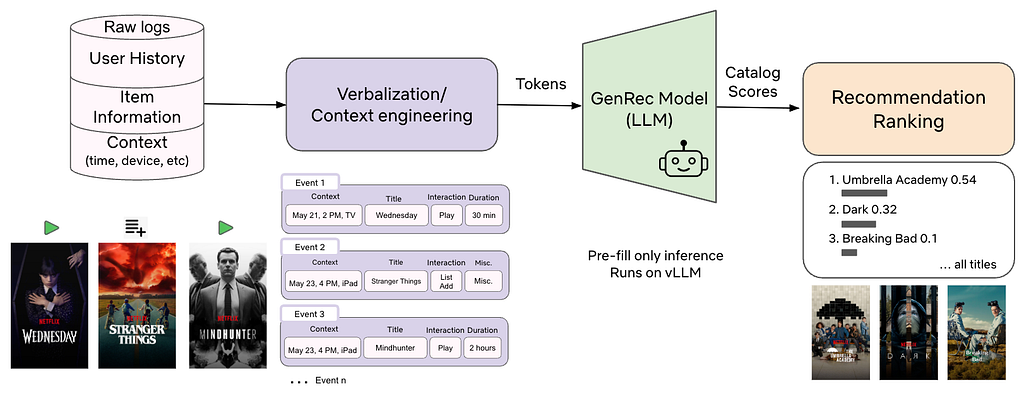 image図 1: GenRec のパイプライン。ユーザー履歴、アイテムメタデータ、コンテキストの生ログを「コンテキストエンジニアリング」によって自然言語のプロンプトに変換し、GenRec に投入します。GenRec は vLLM 上でプレフィルのみモードで動作し、カタログ内の各アイテムに対するスコアを出力して推薦ランキングを生成します。
GenRec の概要は以下の通りです。
- ユーザー履歴、アイテムメタデータ、コンテキストをテキストとして記述化(Verbalize)する。
- ランク付け用に Netflix 向けに適応させた基盤 LLM をポストトレーニングする。
- Netflix タイトルに特化したカタログ認識型のスコアリングヘッドを追加する。
- リワード信号を用いて、長期的なメンバー価値とビジネス目標との整合性を図る。
- コスト効率化のため、Netflix の LLM サービングスタック上でプレフィルのみモードで動作させる。
Netflix で大規模に実施した A/B テストでは、よく調整された既存の生産用ランクャーと比較して、GenRec は短期・長期のオンライン指標の両方で統計的に有意な改善を達成しました。これは、Phase 2 のラベル付きデータと入力信号のごく一部のみを使用しながら実現されています。このアプローチにより、手作業による特徴量の設計への依存を減らし、焦点を「特徴量エンジニアリング」から「コンテキストエンジニアリング」へとシフトさせることに成功しています。
本ブログ記事では、GenRec の仕組み、その性能、そしてなぜこれが Netflix における推薦システムのより LLM 中心の未来を示唆しているのかについて解説します。
問題設定
私たちが取り組んでいるのは、全カタログを対象としたランキングタスク(または候補セットが提供された場合の上位 K 件ランキング)です。
ユーザー u とそのインタラクション履歴 H、そして現在のコンテキスト τ(デバイス、表示面、地域、時間など)が与えられたとき、GenRec は各アイテムにスコアを付与し、推薦システムとして直接活用できる、あるいは下流のパーソナライゼーションシステムの入力として機能するパーソナライズされたランキングを生成します。
形式的には、ユーザー、コンテキスト、時間、履歴からなるリクエスト (u,τ,t,H) を、カタログ C 上のランキング π にマッピングします。ここで π(i) はアイテム i に割り当てられた順位を表します。このランキング π の最適化目標は、短期的なエンゲージメントだけでなく、長期的なメンバーの利便性(満足度や継続率を代理する指標)を最大化することにあります。
基盤 LLM から推薦ランクャーへ
GenRec は、2 つのフェーズからなるトレーニングフレームワークを採用しています(図 2)。
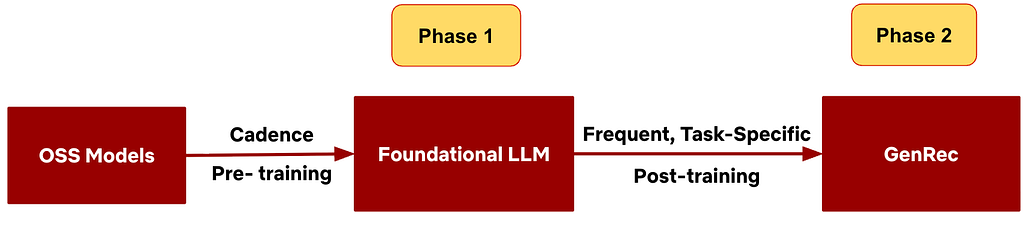 image図 2: 2 フェーズのフレームワーク。フェーズ 1 では Netflix データを用いて基盤 LLM を訓練し、ユーザーとコンテンツの理解を深めます。フェーズ 2 ではランキングに特化したデータと目的でポストトレーニングを行います。
フェーズ 1 — Netflix 適応型基盤 LLM
オープンソースの LLM を出発点とし、Netflix の独自コーパスで適応させます。これにより、以下の基礎的な能力を習得します。
- Netflix コンテンツの理解
- メンバーの行動と嗜好のパターン
- 一般的な言語理解と生成能力
フェーズ 1 は比較的頻繁には更新されず、多くのアプリケーションに共通する Netflix 対応のバックボーンとして機能します。
フェーズ 2 — GenRec
次に、この基盤モデルをランキング品質の高いモデルへと昇華させるため、ランキング特化型のデータと目的でポストトレーニングを行います。フェーズ 2 の特徴は以下の通りです。
- ランキングの質向上と制御に焦点を当てる
- リワード加重損失を通じて複数の報酬信号を取り込む
- 新しいコンテンツや変化する嗜好に対応するため、より頻繁に更新される
- サービス提供時のコスト制約下で明示的に最適化される
会話形式での訓練データ
Netflix のメンバーは、視聴、再生、再生時間、高評価・低評価、リスト追加、離脱など、多様なタッチポイントで数百億件のインタラクションイベントを生成します。私たちはこのログデータを、ユーザーとレコメンダーとの間の 1 回限りの、あるいは複数回の「会話」に変換します。各ターンには以下の要素が含まれます:
ユーザーからのメッセージには、言語化されたコンテキスト、プロファイル、履歴、アイテムのメタデータ、そして「次に何を見るか」や「高評価をつけるべきか」といったタスクが含まれます。
アシスタントからのメッセージは、メンバーの実際のエンゲージメント(どのタイトルが再生され、どれくらい視聴され、どのようなフィードバックが提供されたか)です。
フェーズ 2 のトレーニング中、LLM はアシスタントメッセージがユーザーメッセージにどう依存するかを学習します。これにより、豊富な推薦シグナルをテキストとして表現でき、言語モデル化(LM)とランキングの両方の目的を同時にサポートできます。
推論時には、言語化されたコンテキストを入力し、カタログ認識型のスコアリングヘッドを用いてアイテムをランク付けします。アシスタントメッセージをデコードすることはありません。会話形式は主にトレーニング時に使用され、言語モデル化の目的をサポートするとともに、言語化されたテキストに対する強力な言語理解能力を維持するためです。
言語化とコンテキストエンジニアリング
従来のレコメンダーシステムは、密集した特徴量や埋め込みベクトルに基づいて動作します。一方、GenRec は異なるアプローチを採用しています。これは、豊富なユーザー履歴やコンテキストを自然言語として言語化し、生のインタラクションシグナルを LLM の意味空間に直接エンコードするものです。これにより、アイテム間の関係性や変化するユーザーの興味といった高次パターンを、手動の特徴量エンジニアリングに頼るのではなく、モデル自身が発見することを可能にします。
ユーザーの履歴にあるすべてのインタラクションを無作為に言語化すると、トークンの予算をすぐに超過し、Netflix のスケールではコストが高騰してしまいます。コンテキストウィンドウが新たな「特徴量の予算」となるため、ここではコンテキストエンジニアリングを適用しています。
高シグナルのエンゲージメント(例:長時間視聴や「いいね」)は詳細を保持し、低シグナルのイベント(例:短時間の視聴や素早いホバー動作)は除外します。また、反復的な行動(例:連続視聴など)については要約または圧縮を行います。一方で、重要度が高いアイテムや新規リリースのような「コールドスタート」状態のアイテムについては、必要に応じて詳細を補足します。
トークン数に制限がある中で、私たちは最近の高シグナル履歴を優先し、古い履歴は圧縮するか除外します。さらに、プレフィックスキャッシングの効率化を図るため、プロンプト構造も最適化しています。目標は、 prohibitive なコストをかけずにランキング品質を維持しつつ、情報を凝縮した高効率なプロンプトを実現することです。
目的:ランキング、言語モデル、報酬
GenRec モデル全体は、推薦のランキングタスク、言語モデリングタスク、そして報酬重み付き学習によるアライメントを組み合わせた多目的損失関数を用いて訓練されます。
- カタログ認識型ランキング目標
主要なタスクは、エンゲージメントの質に基づいてアイテムにスコアを付与する能力をモデルに習得させるためのランキング目標です。ポジティブサンプルには、十分な長さの視聴や明確なフィードバックなど、高価値なエンゲージメントを用います。閾値の設定とノイズ除去ロジックを経て、モデルはクロスエントロピー損失関数を通じてカタログ全体または候補セット上で訓練され、言語化された文脈が与えられた場合にこれらのポジティブサンプルに高いスコアを付与するように学習します。
- 言語モデリング目標
また、言語モデル(LM)の目的を、テキスト化された入力と出力にも適用しています。これにより、モデルの一般的な言語理解能力が維持され、豊かな自然言語での履歴やアイテムメタデータを解釈する能力が向上します。さらに、推薦の説明など、テキスト生成を活用できるユースケースへの道も開かれます。
- アライメントのための報酬重み付き損失
単純なランキング精度だけでなく、GenRec は (1) ビジネス要件の尊重(映画、シリーズ、ゲーム、ライブ配信、ポッドキャストなどのバランス調整など)と、(2) 即座のクリックや再生数ではなく、長期的なメンバー満足度の最適化を追求する必要があります。
生のインタラクションシーケンスのみでトレーニングを行うと、 binge-watching(連続視聴)への過度な偏りや、特定のコンテンツタイプへの集中といった望ましくない行動が生じる恐れがあります。これを解決するため、ランキング損失に別個の報酬モデルからの信号を用いて重みを付けます。各トレーニング例には、以下の 2 種類の信号から導き出されたスカラー値の重みが付与されます。
・長期的満足度の代理指標:短期的なエンゲージメントが、リターン行動やカタログ探索、持続的な関与といった長期的な成果にどの程度寄与するかを推定します。
・行動の再バランス調整:コンテンツタイプ間(ゲーム対映画など)やローンチ段階間(新作リリース対恒久タイトルなど)で行動を調整し、ビジネス目標との整合性を高めます。
この例では、ランキング損失に重み付けを適用します。具体的には、価値の高いエンゲージメントには大きな重みを付与し、価値の低いものには重みを下げることで調整します。この報酬重み付けアプローチは、完全な強化学習(RL)よりもシンプルでコスト効率が良く、実用上も効果的なアライメントを実現できます。RL 方式の手法(例:GRPO など)からも追加の改善効果が得られることを確認していますが、コストが高くなるため、これらは今後の課題として残しています。
モデルアーキテクチャと推論
バックボーンとスコアリングヘッド
GenRec のアーキテクチャは、Netflix が基盤とする LLM にほぼ沿っています。これは次トークン予測の目的で訓練されたデコーダー専用 Transformer で、Netflix Catalog 内のアイテムのみを評価するカタログ対応型のランキングヘッドを追加したものです。スコアリングパイプラインは以下の通りです。
Verbalization: ユーザー履歴 H、文脈 τ、関連するアイテムメタデータを、1 つのテキストシーケンス x にシリアライズします(Verbalizer V を使用)。
Pooled representation: LLM が x を処理し、ユーザーの現在の嗜好と文脈を要約したプーリングされた隠れ状態 h を抽出します。
Catalog-aware scoring: Catalog 内の各アイテム i には学習済みの埋め込みベクトル eᵢ が対応しています。スコアリングヘッド ϕ は h と eᵢ を組み合わせ(例:ドット積または小さな MLP)、スコア sᵢ を生成します。このスコア群に softmax を適用して確率分布を得た後、これをランキング π へ変換します。
バックボーン、スコアリングヘッド、アイテム埋め込みなどすべてのパラメータは共同で訓練されます。非常に大規模なカタログの場合、効率的な学習と推論のためにサンプリングソフトマックスや候補セットを利用できます。このアーキテクチャにより、推薦は Netflix のカタログ内に制約されつつ、大規模な候補セットに対する効率的なスコアリングが可能になります。
Serving and Cost Optimization
GenRec は Netflix 内部の LLM スタック上で vLLM を用いて提供されています。Netflix スケールにおける提供コストは主に以下の 3 つの要因によって決定されます。1) モデルサイズ、2) コンテキスト長、3) 推論モード(プリフィル vs. 自己回帰デコーディング)。コスト制御には以下の 3 つの戦略を採用しています。
- より小型または蒸留されたモデル:GenRec は、より大型またはよりターゲットを絞ったデータセットを用いて訓練されることが多く、これにより大規模モデルと同等の品質を維持しつつ、提供コストを低減できます。
- 積極的なコンテキスト圧縮:前述のコンテキストエンジニアリングを活用し、ランキング品質を維持しながらトークン数を最小限に抑えます。
- プリフィルのみでの推論:大規模な候補セットに対する自己回帰デコーディングは費用が高すぎるため、プリフィルのみモードで実行します。このモードではモデルはプロンプトを一度消費するだけで、トークンを逐次デコードすることなく、単一の順方向パスで候補セット全体をスコアリングします。
これらの選択により、計算リソースの予算内で高負荷なワークロードでも GenRec を提供することが可能になります。
Offline and Online Experiments
GenRec は、長年にわたりチューニングが重ねられてきた成熟した本番ランク比較対象モデルに対して評価を行いました。ベースラインモデルは、数千もの手作業で設計された密な特徴量と埋め込み特徴量に加え、特徴量の相互作用やシーケンスをモデル化するためのカスタムアーキテクチャに依存しています。
性能評価には、オフライン評価指標と大規模なオンライン A/B テストの両方を用いました。
GenRec と本番ベースラインの比較
オフライン評価では、GenRec は入力信号やラベル付き学習例を圧倒的に少ない数で使いながら、ランキング指標において本番ランクを上回りました。Phase‑2 のラベル付き学習例が約 40 分の 1 という条件下でも、GenRec は平均逆順位(MRR)で約 +1.6% の改善を実現しています。Phase‑2 の訓練データを増やし、入力信号を強化するにつれて、GenRec のオフライン指標はさらに向上しました。
オンラインでは、バッチ計算による推薦画面を対象に大規模な A/B テストを実施しました。これは Netflix 全体のトラフィックの約 10% を対象に、約 4 週間にわたって行われました。この低データ・低信号構成において、GenRec は短期および長期の両方のオンライン指標で本番ベースラインに対して統計的に有意な改善をもたらしました(図 3)。
これらの結果は、適切にポストトレーニングされアライメントされた LLM ベースのランクが、従来の推薦モデルに対する強力な代替手段となり得ることを示しています。さらにデータと入力信号をスケールさせることで、さらなる性能向上の可能性も残されています。
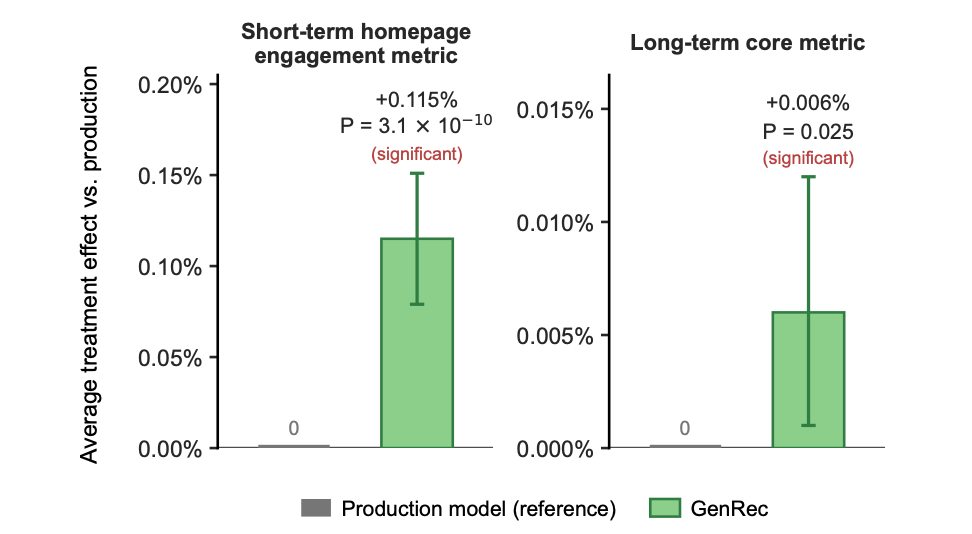 image図 3: GenRec と既存の生産モデルを比較したオンライン指標。GenRec は短期および長期の両方のオンライン指標において統計的に有意な改善を実現しています。
データ、モデル、フェーズごとの貢献度分析
GenRec の性能向上がどこから生じているかを理解するため、アブレーション実験(要因除去実験)を行いました。
データとモデルのスケーリング効果
データのスケールアップ:パラメータ数が約 10 億(~1B)および約 100 億(~10B)のバックボーンモデルにおいて、Phase‑2 のポストトレーニングに使用するデータを増やすほど、オフラインでの MRR(平均順位)が向上します。大規模なモデルはより高い絶対的な MRR を達成しますが、スケーリング曲線の傾向は小規模モデルと同様です(図 4 参照)。
モデルのスケーリング:一定のトレーニング予算の下で、GenRec のバリアントを約 10 億パラメータから約 100 億パラメータまで拡張してポストトレーニングを行いました。この予算内では、大規模なバックボーンモデルは小規模なものよりも一貫して高いオフライン MRR を達成しました。
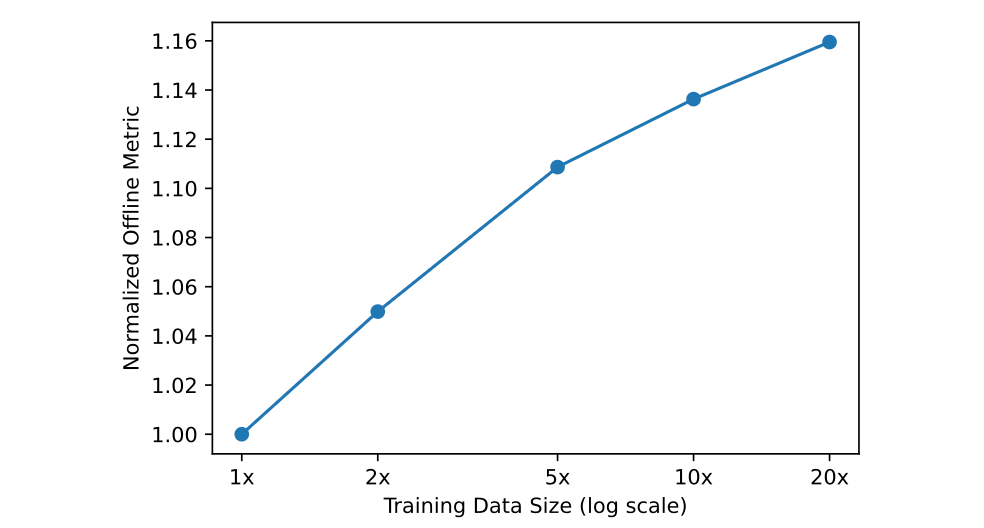 image図 4: 約 10B モデルにおける GenRec の Phase‑2 データスケーリング効果。
Phase‑1 と OSS(オープンソースモデル)の比較、Phase‑2 と Phase‑1 の比較
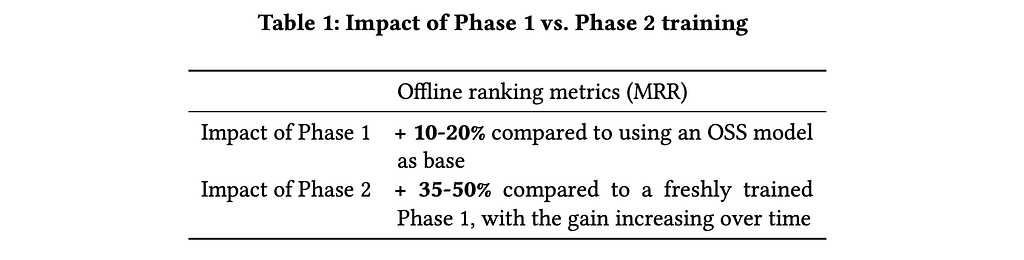
Phase‑1 vs. OSS:Netflix 向けに適応させた基盤 LLM をベースモデルとして使用した Phase‑1 は、市販のオフ・ザ・シェルフ LLM から直接開始する場合と比較して、オフラインのランキング指標を約 10〜20% 向上させます。
Phase‑2 vs. Phase‑1:Phase‑2 のポストトレーニングを追加することで、Phase‑1 の学習カットオフ時点(つまり Phase‑1 モデルが最も新鮮な状態)で評価した場合、オフラインのランキング指標にさらに 35〜50% の改善をもたらします。時間が経過し、新しいコンテンツや嗜好の変化により Phase‑1 が陳腐化すると、Phase‑2 の相対的な効果は約 2 週間後には約 80% にまで拡大します。
 imageデータ効率とプロダクションランクの比較
強力な Phase‑1 モデルを基盤とする GenRec は、設定にもよりますが、Phase‑2 のラベル付きサンプル数を 10~40 倍削減しながらも、既存のプロダクションランクモデルに匹敵する、あるいはそれを超える性能を発揮します。このわずかなデータ効率の向上は特に重要です。なぜなら、Phase 2 は Phase 1 に比べてはるかに頻繁に更新されるためです。
コンテキスト長の最適化
コンテキスト長は品質とコストの両方に直結します。より長い記述(verbalization)は行動や文脈の詳細を多く含みますが、その分、トレーニングと推論のコストが増大します。このトレードオフを検討するため、私たちはコンテキスト長と言語表現の冗長度を変化させ、以下の 3 つのステップで最適化を行いました。
- イベントのクリーニングと圧縮:信号値の低いエンゲージメントを除外し、反復的な行動を圧縮して、クリーンなイベントシーケンスを構築します。
- 「肘点(elbow point)」の特定:含める履歴イベントの数を変化させ、MRR とイベント数の関係をプロットします。これにより、追加のコンテキストがもたらす効果が頭打ちになる「肘点」を超えた領域を特定します(図 5 を参照)。
- 冗長度の最適化:残されたイベントに対して、詳細度の異なる記述や簡略化した表現を試行し、そのたびに MRR を測定します。
実験の結果、オフラインでのランキング指標への悪影響は無視できるレベルに抑えながら、コンテキストトークンを元の予算の約 3 分の 1 に削減できました。推論コストは概ねコンテキスト長に比例するため、同程度のコスト削減効果も確認されています。
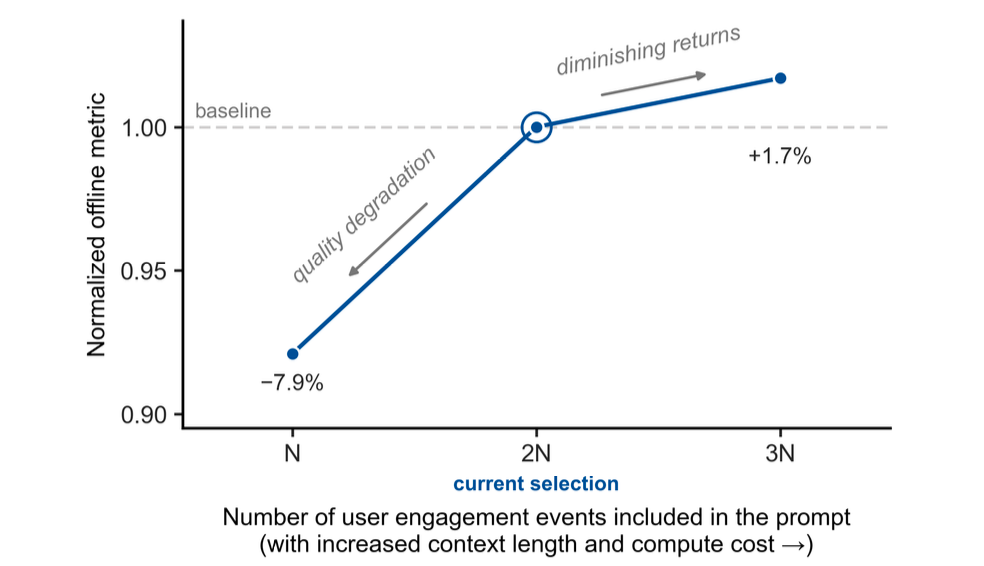 image図 5: プロンプトに含まれるユーザーエンゲージメントイベント数に対するオフラインランキング指標(MRR)の推移。破線は「ひじ点」を示しており、これ以上のイベント数を増やしても効果の逓減が見られる。
LLM ネイティブな推薦へ向けて
GenRec は既存のランクャーに単に Transformer を差し替えるだけの話ではありません。これは Netflix における LLM ネイティブな推薦へのより広範な転換を示唆するものです。いくつかの注目すべき変化があります。
特徴量エンジニアリングからコンテキストエンジニアリングへ
従来の推薦システム(RecSys)スタックは、大規模な特徴量セットと重厚な特徴量インフラを中心に回っています。一方、LLM 中心のシステムでは、生ログやメタデータ、ツールから豊かなテキストコンテキストを構築することに焦点が移ります。「プロンプト」が新たな特徴量ベクトルとなるのです。
モデル開発における努力は、特徴量を設計することから、どのシグナルを含めるか、どれほどの過去まで遡るか、トークン予算の範囲内で履歴をどう圧縮・要約するかという判断へとシフトします。言語化による圧縮に関する私たちの実験はこの変化を示しています。注意深いコンテキスト設計によって、品質を維持しつつサービスコストを劇的に削減できることがわかります。
カスタムアーキテクチャから基盤モデルへ
従来、各レコメンデーションタスクには独自のアーキテクチャ(ツータワーモデルや DLRM スタイルのネットワーク、特化型のアテンションブロックなど)が用意されていました。しかし、LLM 中心の世界では、多くのタスクが共通の基盤バックボーンを共有し、差別化はデータと言語化戦略、ポストトレーニングにおける目的関数と報酬、推論最適化によって実現されます。
GenRec はゼロから構築された新しいアーキテクチャを導入するのではなく、既存のファウンデーション LLM と同じバックボーンを活用します。これにより、アプリケーション間で知見を共有しやすくなり、将来的には自然言語による制御も可能になります。
スケーリング法則を設計指針として
従来のレコメンデーションシステム(RecSys)は、ID のスパース性や重厚なエンジニアリング要件、タスク固有のアーキテクチャが原因で、スケーリングに伴うリターンの逓減に直面することがあります。一方、LLM をバックボーンとするレコメンダーでは、データとモデルのスケーリングに関する明確な挙動を引き継ぎます。コストの制約内であれば、より多くのデータと大規模なモデルが常に品質向上につながります。これにより、RecSys の設計はスケーリング法則がモデルやデータの投資判断を導く広範な LLM パラダイムに近づきます。
RecSys インフラから LLM インフラへ
LLM をバックボーンとするレコメンダーは、GPU アクセラレーションや vLLM/Triton ベースの採用、慎重なバッチ処理とキャッシュ管理など、LLM スタイルのインフラへと移行を促します。時間の経過とともに、レコメンデーションのサービス提供基盤は、MLP や因子分解モデルを中心とした従来の RecSys スタックではなく、一般的な LLM インフラに似ていくことになります。
結論
Netflix は、内部基盤大規模言語モデル(LLM)を大規模なパーソナライゼーションに適応させた「GenRec」という LLM 支援型推薦ランク付けシステムを発表しました。ユーザーの履歴やコンテキスト、アイテムのメタデータを自然言語で記述し、カタログ情報を認識するランク付けヘッドを追加し、長期的な満足度とビジネス目標に合致した報酬重み付き目的関数を用い、LLM インフラ上で効率的に推論を行うことで、強力な既存の生産用ランク付けモデルを上回る性能を実現しました。さらに、このモデルは Phase-2 のラベルや入力信号を大幅に削減しながらも高い精度を達成しています。
GenRec は、Netflix において LLM を中核とした推薦スタックへと移行するための初期かつ有望な一歩です。私たちの結果は、コスト管理、インフラ整備、そして目標への整合性に細心の注意を払うことで、LLM 支援型レコメンダーが大規模パーソナライゼーションの中心役割を果たし得ることを示しています。
謝辞
GenRec は、Netflix 内の複数のチームおよび組織間での緊密な協力によって実現されました。本稿への貢献者(アルファベット順):
メンバー向け AI: Arjun Rao, Ashish Rastogi, Baolin Li, Fernando Amat Gil, Grace Huang, Justin Basilico, Kamelia Aryafar, Linas Baltrunas, Moumita Bhattacharya, Ogheneovo Dibie, Rein Houthooft, Shradha Sehgal, Sejoon Oh, Sergi Perez, Sourabh Medapati, Thea Wang, Yaochen Zhu, Yesu Feng, Ying Li, Yun Li, Yucheng Shi, Yunan Hu
AI プラットフォームおよびサービング: Abhishek Agrawal, Adam Singer, Binh Tang, Daneo Zhang, Derek Olejnik, Ed Maddox, Erik Osheim, Lingyi Liu, Liping Peng, Meghana Chilukuri, Nicolas Hortiguera, Shaojing Li, ZQ Zhang
製品担当:イルケ・カイヤ、ミシェル・キスラック、スカーレット・チェン、シ・チェン
![ima
原文を表示
Authors: Ying Li, Arjun Rao, Shradha Sehgal
Introduction
Recommendations sit at the heart of the Netflix experience. Our current production models rely on thousands of hand‑crafted features over users, items, and interactions, along with specialized architectures for sequence modeling, feature interactions, and multi‑task objectives. This stack has evolved over many years to support diverse content types (movies, series, games, live, podcasts) and product surfaces, but its complexity makes it costly to onboard new use cases: adding a content type or surface can require significant feature engineering, architecture change, infrastructure work, and experimentation.
At the same time, large language models (LLMs) are changing how we think about recommendation, as shown by recent work such as PLUM, GLIDE, and OneRec-Think. Their broad world knowledge and strong language understanding make it possible to represent user histories and item metadata directly as text, capture rich relationships in a shared semantic space, and steer recommendations via natural‑language prompts. However, off‑the‑shelf LLMs are still far from production‑ready recommenders: they often over‑recommend globally popular content, hallucinate out‑of‑catalog items, ignore business constraints, and provide only limited personalization.
To address this, we built GenRec, an LLM‑backed recommendation ranker that post‑trains an internal foundation LLM on Netflix‑specific data and objectives. GenRec shows that an LLM‑based ranker can match or exceed a mature production system while relying on far fewer labeled examples and input signals.
imageFigure 1: GenRec pipeline. Raw logs of user history, item metadata, and context are transformed via context engineering into natural-language prompts and fed into the GenRec, which runs on vLLM in prefill-only mode and outputs scores for each catalog item, yielding a recommendation ranking.At a high level, GenRec:
Verbalizes user histories, item metadata, and context as text.
Post‑trains a Netflix‑adapted foundation LLM for ranking.
Adds a catalog‑aware scoring head over Netflix titles.
Uses reward signals to align with long‑term member value and business goals.
Runs in prefill‑only mode on Netflix’s LLM serving stack for cost efficiency.
In a large‑scale A/B test against a well‑tuned production ranker, GenRec achieves statistically significant improvements in both short‑term and long‑term online metrics, while using only a small fraction of the Phase‑2 labeled data and input signals. It reduces our reliance on hand‑engineered features and shifts the focus from feature engineering to context engineering. In this blog post, we will describe how GenRec works, how it performs, and why we believe it points toward a more LLM‑centric future for recommendation at Netflix.
Problem Setting
We focus on a full‑catalog ranking task (or top‑K ranking when a candidate set is provided).
Given a user 𝑢, their interaction history 𝐻, and the current context 𝜏 (device, surface, locale, time, etc.), GenRec scores each item and produces a personalized ranking that can directly power recommendations or serve as input for downstream personalization systems.
Formally, we map a request (u,τ,t,H) — user, context, time, and history — to a ranking 𝜋 over the catalog C, where π(i) is the position assigned to item i. We optimize π for expected long‑term member utility (a proxy for satisfaction and retention), not just short‑term engagements.
From Foundation LLM to Recommendation Ranker
GenRec follows a two‑phase training framework (Figure 2):
imageFigure 2: Two Phase Framework. Phase 1 trains a foundational LLM on Netflix data for user and content understanding, and Phase 2 post-trains on ranking-specific data and objectives.Phase 1 — Netflix-Adapted Foundation LLM.
We start from an open‑source LLM and adapt it on proprietary Netflix corpora, so it learns foundational capabilities such as
Netflix content understanding
Member behavior and preference patterns
General language understanding and generation.
Phase 1 is updated relatively infrequently and serves as a shared, Netflix‑aware backbone for many applications.
Phase 2 — GenRec.
We then turn this foundation model into a high‑quality ranking model by post‑training on ranking‑specific data and objectives. Phase 2:
Focuses on ranking quality and steering
Incorporates multiple reward signals via reward‑weighted losses
Is refreshed more frequently to track new content and evolving tastes
Is explicitly optimized under serving cost constraints.
Training Data as Conversations
Netflix members generate hundreds of billions of interaction events spanning many surfaces (views, plays, durations, thumbs up/down, add to list, abandons, etc.). We convert this log data into single‑turn or multi‑turn “conversations” between a user and a recommender. Each turn contains:
User message: verbalized context, profile, history, item metadata, and task (e.g., recommend what the user will watch or thumb next).
Assistant message: the member’s actual engagement (e.g., which titles were played, for how long, what feedback they provided).
During Phase‑2 training, the LLM learns how assistant messages depend on user messages. This allows us to express rich recommendation signals as text, jointly supporting both the language-modeling (LM) and ranking objectives.
At inference time, we feed in the verbalized context and apply a catalog‑aware scoring head to rank items; we do not decode assistant messages. The conversational format is primarily used during training to support the LM objective and preserve strong language understanding over the verbalized text.
Verbalization and Context Engineering
Traditional recommenders operate on dense features and embeddings. GenRec takes a different approach: it verbalizes rich user histories and context as natural language, encoding raw interaction signals directly in the LLM’s semantic space. In doing so, it relies on the model to discover higher‑level patterns — such as item relationships and evolving user interests — rather than on manual feature engineering.
Naively verbalizing every interaction in a user’s history can quickly exceed the token budget and be too expensive at Netflix scale. The context window becomes our new “feature budget”, so we apply context engineering:
Retain in full: high‑signal engagements (e.g., long plays, thumbs‑up) with richer details
Omit: low‑signal events (e.g., very short plays or quick hovers)
Summarize or compress: repetitive behaviors (e.g., binge‑watching )
Elaborate selectively: important or cold‑start items (e.g., new releases)
Within a fixed token budget, we prioritize recent, high‑signal history and compress or drop older history. We also structure the prompt to maximize shared prefixes for better prefix caching. The goal is a compact, high‑information prompt that preserves ranking quality without prohibitive costs.
Objectives: Ranking, Language, and Rewards
The overall GenRec model is trained with a multi‑objective loss that combines a recommendation ranking objective, language modeling objectives, and alignment via reward‑weighted training.
- Catalog‑Aware Ranking Objective
The primary task is a ranking objective that teaches the model to score items by engagement quality. We label positives using high‑value engagements (e.g., sufficiently long plays, strong explicit feedback), with thresholds and denoising logic, and train the model — via a cross‑entropy loss over the catalog or candidate set — to assign higher scores to these positives given a verbalized context.
- Language Modeling Objective
We also retain a language modeling (LM) objective over the verbalized inputs and outputs. This helps preserve the model’s general language understanding, improves its ability to interpret rich natural‑language histories and item metadata, and keeps the door open for text‑generation use cases such as recommendation explanations.
- Reward‑Weighted Loss for Alignment
Beyond raw ranking accuracy, GenRec must (1) respect business requirements — for example, balancing movies, series, games, live, and podcasts — and (2) optimize long‑term member satisfaction rather than just immediate clicks or plays.
Training only on raw interaction sequences can lead to undesirable behaviors, such as over‑favoring binge‑watching or over‑focusing on a single content type. To address this, we weight the ranking loss using signals from separate reward models. Each training example receives a scalar weight derived from two types of signals:
Long‑term satisfaction proxies: estimate how much a short‑term engagement contributes to long‑term outcomes, such as return behavior, catalog exploration, or sustained engagement.
Behavior rebalancing: adjust behaviors across content types and launch stages (for example, games vs. movies, new releases vs. evergreen titles) to better align with business goals.
The example’s ranking loss is then scaled by this weight: high‑value engagements receive larger weights, and low‑value ones are down‑weighted. This reward‑weighted approach is simpler and more cost-efficient than full reinforcement learning, yet provides effective alignment in practice. We have seen additional gains from RL‑style methods (e.g., GRPO), but leave them to future work due to their higher cost.
Model Architecture and Serving
Backbone and Scoring Head
GenRec’s architecture closely follows our foundational LLM: a decoder‑only Transformer trained with next‑token‑prediction style objectives, augmented with a catalog‑aware ranking head that scores only Netflix in-catalog items. The scoring pipeline works as follows:
Verbalization: A verbalizer V serializes user history H, context 𝜏 , and relevant item metadata into a single text sequence x.
Pooled representation: The LLM processes x, and we extract a pooled hidden state h that summarizes the user’s current preferences and context.
Catalog‑aware scoring: Each catalog item i has a learned embedding eᵢ. A scoring head ϕ combines h and eᵢ (e.g., via dot product or small MLP) to produce a score sᵢ. Applying a softmax over scores yields a probability distribution which we convert into a ranking π.
All parameters — the backbone, scoring head, and item embeddings — are trained jointly. For very large catalogs, we can use sampled softmax or candidate sets for efficient training and inference. This architecture constrains recommendations to the Netflix catalog while supporting efficient scoring over large candidate sets.
Serving and Cost Optimization
GenRec is served on Netflix’s internal LLM stack using vLLM. At Netflix scale, serving cost is driven primarily by 1) Model size; 2) Context length; 3) Inference mode (prefill vs. autoregressive decoding). We control cost through three strategies:
Smaller / distilled models: We train GenRec on smaller or distilled foundation models, often with larger or more targeted datasets, to capture most of the quality of larger models at lower serving cost.
Aggressive context compaction: Using the context engineering described earlier, we minimize tokens while preserving ranking quality.
Prefill‑only inference: Autoregressive decoding over large candidate sets would be prohibitively expensive. Instead, we run in prefill‑only mode: the model consumes the prompt once and scores the entire candidate set in a single forward pass, with no token‑by‑token decoding.
Together, these choices make it feasible to serve GenRec on high‑volume workloads within compute budgets.
Offline and Online Experiments
We evaluated GenRec against a mature production ranker that has been tuned over many years. The baseline model relies on thousands of engineered dense and embedding features, as well as custom architectures for modeling feature interactions and sequences. We assessed performance using both offline evaluation metrics and a large‑scale online A/B test.
GenRec vs Production Baseline
Offline, GenRec outperformed the production ranker on ranking metrics despite using far fewer input signals and labeled examples. With roughly 40× fewer Phase‑2 labeled training examples, GenRec achieved about +1.6% improvement in Mean Reciprocal Rank (MRR). As we increased Phase‑2 training data and enriched the input signals, GenRec’s offline metrics continued to improve.
Online, we ran a large A/B test on batch‑compute recommendation surfaces, covering ~10% of Netflix traffic over ~4 weeks. In this low‑data, low‑signal configuration, GenRec delivered statistically significant gains over the production baseline on both short‑term and long‑term online metrics (Figure 3).
These results indicate that a properly post‑trained and aligned LLM‑backed ranker can be a strong alternative to traditional recommendation models, with substantial headroom as we further scale data and input signals.
imageFigure 3: Online metrics of GenRec vs. production model. GenRec achieves statistically significant improvements on both short-term and long-term online metrics.Data, Model, and Phase Contributions
We ran ablations to understand where GenRec’s gains come from.
Data and Model Scaling
Data scaling: For both ~1B and ~10B parameter backbones, offline MRR improves as we increase Phase‑2 post‑training data. Larger models reach higher absolute MRR but follow a similar scaling curve (see Figure 4).
Model scaling: Under a fixed training budget, we post‑trained GenRec variants from ~1B to ~10B parameters. Within this budget, larger backbones consistently achieved higher offline MRR than smaller ones.
imageFigure 4: GenRec Phase-2 data scaling for the∼10B model.Phase-1 vs. OSS, Phase-2 vs. Phase-1
Phase-1 vs. OSS: Using the Phase‑1 Netflix‑adapted foundation LLM as the base model improves offline ranking metrics by roughly 10–20% compared to starting directly from an off‑the‑shelf LLM.
Phase-2 vs. Phase-1: Phase‑2 post‑training adds another 35–50% gain in offline ranking metrics when evaluated near the Phase‑1 training cutoff (i.e. when Phase‑1 model is the freshest). As time passes and Phase‑1 becomes stale with new content and shifting tastes, the relative benefit of Phase 2 grows to about 80% after 2 weeks.
imageData efficiency vs. production ranker
Starting from a strong Phase‑1 model, GenRec matches or exceeds the production ranker using 10–40× fewer Phase‑2 labeled examples, depending on configuration. This marginal data efficiency is especially valuable because Phase 2 is refreshed far more frequently than Phase 1.
Context Length Optimization
Context length drives both quality and cost: longer verbalizations expose more behavior and context but increase training and serving cost. To study this trade‑off, we varied context length and verbosity and optimized them in three steps:
Clean and compress events: drop low‑signal engagements and compress repetitive behavior to form a cleaned sequence of events.
Find the “elbow point”: vary how many historical events we include and plot MRR vs. number of events to identify an elbow beyond which additional context yields diminishing returns (see Figure 5).
Optimize verbosity: for the retained events, test different levels of details and simplified wordings, measuring MRR each time.
In our experiments, we can reduce the context tokens to roughly one-third of the original budget with negligible degradation in offline ranking metrics. Since serving cost is approximately proportional to context length, we observed a similar reduction in serving cost.
imageFigure 5: Offline ranking metric (MRR) vs. number of user engagement events included in the prompt. The dashed line marks the elbow point: increasing the number of events beyond this yields diminishing returns.Towards LLM‑Native Recommendation
GenRec is more than “swapping in a Transformer” for an existing ranker. It hints at a broader shift toward LLM‑native recommendation at Netflix. A few notable changes:
From Feature Engineering to Context Engineering
Traditional RecSys stacks revolve around large feature sets and heavy feature infrastructure. LLM‑centric systems instead revolve around constructing rich textual contexts from raw logs, metadata, and tools. The “prompt” becomes the new feature vector.
Modeling effort shifts from designing features to deciding which signals to include, how far back in time to go, how to compress or summarize history within a token budget. Our experiments on verbalization compaction illustrate this shift: careful context design can preserve quality while dramatically reducing serving cost.
From Customized Architectures to Foundation Backbones
Historically, each recommendation task often had its own custom architecture (two‑tower models, DLRM‑style networks, bespoke attention blocks). In an LLM‑centric world, many tasks share a common foundation backbone, with differentiation coming from data and verbalization strategies, post‑training objectives and rewards, and inference optimization.
GenRec leverages the same backbone as our foundation LLM rather than introducing a new architecture built from scratch. This makes it easier to share learnings across applications, and opens the door to natural‑language steering for future experiences.
Scaling Laws as Design Guides
Traditional RecSys can hit diminishing returns due to sparse IDs, heavy engineering objectives, and task‑specific architectures. With an LLM‑backed backbone, recommendation inherits clearer data and model scaling behavior: within cost limits, more data and larger models consistently improve quality. This brings RecSys design closer to the broader LLM paradigm, where scaling laws help guide model and data investment.
From RecSys Infra to LLM Infra
LLM‑backed recommenders push us toward LLM‑style infrastructure: GPU‑accelerated, vLLM/Triton‑based, with careful batching and caching. Over time, recommendation serving infra starts to look more like general LLM infra than classic RecSys stacks built around MLPs or factorization models.
Conclusions
We have presented GenRec, an LLM‑backed recommendation ranker at Netflix that adapts an internal foundation LLM for large‑scale personalization. By verbalizing user histories, context, and item metadata, adding a catalog‑aware ranking head, using reward‑weighted objectives aligned to long‑term satisfaction and business goals, and serving efficiently on our LLM infrastructure, we obtain a model that improves on a strong production ranker while using far fewer Phase‑2 labels and input signals.
GenRec is an early but promising step toward a more LLM‑centric recommendation stack at Netflix. Our results suggest that, with careful attention to cost, infrastructure, and alignment, LLM‑backed recommenders can play a central role in large‑scale personalization.
Acknowledgments
GenRec is the result of close collaboration among multiple teams and organizations across Netflix. The contributors to this work (in alphabetical order):
AI for members: Arjun Rao, Ashish Rastogi, Baolin Li, Fernando Amat Gil, Grace Huang, Justin Basilico, Kamelia Aryafar, Linas Baltrunas, Moumita Bhattacharya, Ogheneovo Dibie, Rein Houthooft, Shradha Sehgal, Sejoon Oh, Sergi Perez, Sourabh Medapati, Thea Wang, Yaochen Zhu, Yesu Feng, Ying Li, Yun Li, Yucheng Shi, Yunan Hu
AI platform and serving: Abhishek Agrawal, Adam Singer, Binh Tang, Daneo Zhang, Derek Olejnik, Ed Maddox, Erik Osheim, Lingyi Liu, Liping Peng, Meghana Chilukuri, Nicolas Hortiguera, Shaojing Li, ZQ Zhang
Product: Ilke Kaya, Michelle Kislak, Scarlet Chen, Si Cheng
![ima
AI算出
主要ニュースainew評価高い
記事は GenRec という新システムの設計思想、実装詳細(プレフィルのみモード、コンテキストエンジニアリング)、および既存システムとの比較データを含んでおり、AI/ML の核心トピックとして極めて関連性が高い。同クラスターに先行記事がないため、独立した情報増分を持つ初報として高い新規性を付与する。検索機会については「GenRec」という固有名詞が含まれるため 0.75 と判定し、日本企業との直接的な関わりや日本語一次情報の欠如から関連性は低めとする。
6つの評価軸を見る
- AI関連度
- 100
- 情報源の信頼性
- 100
- 新規性
- 75
- 調べる価値
- 75
- 重複の少なさ
- 100
- 日本での有用性
- 25
今日のまとめ
AIデイリーブリーフで今日の重要ニュースをまとめ読み