AI システム設計面接の質問に答える方法
本文の状態
日本語全文を表示中
詳細モードで約15分の本文を読めます。
同じ出来事の情報源
この情報源を基点に整理
KDnuggets
KDnuggets は、AI エンジニアリング求人急増に伴い面接課題が従来のシステム設計から LLM を製品に統合する設計へとシフトしたと分析し、候補者が暗記ではなく汎用フレームワークで対応すべきだと指摘している。
AI深層分析を開く2026年8月20日 00:10
AI深層分析
キーポイント
AI 採用の急拡大と面接課題の変化
2025 年に AI エンジニアの求人が前年比 143% 増加し、面接では「YouTube の設計」から「ChatGPT や GitHub Copilot の設計」といった LLM 統合型システムの構築が問われるようになった。
LLM 内部知識より実装・統合能力の重視
面接の焦点はモデル内部の詳細な知識から、アジェンティックループの設計や検索機能(Retrieval)の統合、コスト計算といった LLM を製品にどう包み込むかという実践的スキルに移行している。
暗記型対策からの脱却とフレームワークの必要性
各質問ごとに個別に答えを暗記するのではなく、あらゆる AI システム設計課題に応用可能な再利用可能なフレームワークを習得することが合格への鍵であると提言されている。
評価基準のシフト
面接は確率的でコスト制約のあるシステムを推論する能力を試すものであり、決定論的な CRUD サービスとは異なる。
層ごとの理由付け
各レイヤーが存在する理由と、それが欠けた場合に何が壊れるかを説明できるかが重要であり、単に名前を列挙するだけでは浅い評価となる。
重要な引用
"Companies hiring AI Engineers, Applied Scientists, and GenAI Engineers now ask a different set of questions: 'Design ChatGPT,' 'Design a customer support AI,'..."
"Deep knowledge of model internals matters less than it used to."
"We will give you one reusable framework that works across all of these prompts, so you stop memorizing a separate answer for each."
these interviews test your ability to reason about probabilistic, cost-constrained systems rather than deterministic CRUD services
編集コメントを表示
編集コメント
本記事は、AI エンジニアリング分野の成長が面接プロセスをどのように変容させたかを明確に示しており、求職者にとって戦略的な準備指針となる。特に LLM の内部構造よりも製品統合やコスト最適化への関心が高まっている点は、現場の実情を反映した重要な洞察である。
Source Article
元記事を日本語で読む
本文に関係しない購読案内、埋め込み通知、サイト内プロモーションは除いています。
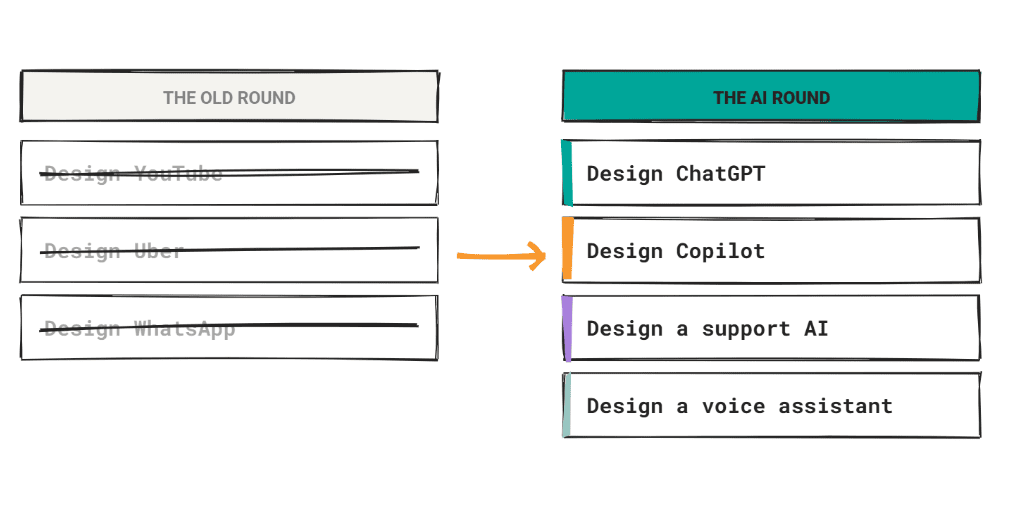
長年、システム設計面接では「YouTube を設計せよ」「Uber を設計せよ」「WhatsApp を設計せよ」といった課題が出題されてきました。しかし現在、AI エンジニアや応用科学者、生成 AI エンジニアを募集する企業は、異なる種類の質問を投げかけています。「ChatGPT を設計せよ」「カスタマーサポート AI を設計せよ」「GitHub Copilot を設計せよ」「コードレビュー AI を設計せよ」「法文書アシスタント AI を設計せよ」——それが現在のトレンドです。
多くのエンジニアは LLM の API を呼び出すことはできますが、周囲のアーキテクチャを説明し、プレッシャーのかかる状況でも設計選択を正当化できる人は限られています。この面接ラウンドで問われるのはまさにそのスキルです。本稿では、あらゆる質問パターンに通用する再利用可能なフレームワークを一つ紹介します。それぞれの質問ごとに個別の答えを暗記する必要がなくなります。
なぜ質問が変わったのか
AI 分野の人材採用が急成長し、面接プロセス自体を再構築するほどになりました。AI エンジニア は、米国で 2 年連続して最も成長速度の速い職種にランクインし、2025 年には求人数が前年比 143% 増となっています。
LinkedIn のデータによると、AI 関連の職種は 2023 年から 2025 年の間に米国で 75,000 件の求人が新たに追加され、テック市場における AI や機械学習の求人割合もこの期間に 10% から 50% に急増しました。
こうした需要の高まりに伴い、面接での質問内容も「AI ファースト」なソフトウェア開発へとシフトしています。IGotAnOffer のレポートによれば、現在の選考ラウンドでは、大規模言語モデル(LLM)をどう製品に落とし込むかが焦点となっています。具体的には、エージェントループの設計や検索機能の統合、コストに関する推論などが問われます。かつてほどモデル内部の詳細な知識が重視されることはなくなりました。
2025 年後半から 2026 年初頭にかけての面接報告を基に作成された実務家のガイドブックでは、最も頻出する質問として、「AI チャットボットの設計」「ドキュメント QA または検索拡張生成(RAG)システムの構築」「AI コーディングエージェントの設計」「音声アシスタントの開発」が挙げられています。
面接官が評価するポイント
Educative はこの変化を的確に捉えています。これらの面接では、決定論的な CRUD サービスではなく、確率的でコスト制約のあるシステムについて推論できるかを問われます。本質的に重要なのは、レイテンシ、コスト、品質、安全性といった要素が互いに相反する圧力として働く中で、どうバランスを取りながらトレードオフを判断するかというスキルです。
優れた候補者は、各レイヤーがなぜ存在するのか、そしてそれが欠けると何が壊れるのかを説明できます。単にレイヤーの名前を列挙するだけでは、浅い印象を与えてしまいます。
シニアレベルの報告では、面接官は 3〜5 の領域を選び、失敗モードや「前回何が間違っていたか」について掘り下げて質問し、多くのトピックをざっと確認するだけではないとされています。候補者を引き立てるのは、実際の生産環境での経験と、自分が実際に納品したプロジェクトについて率直に語ろうとする姿勢です。
フレームワーク
ガイド全体を通じて、同じ手順が繰り返されます。The System Design Handbook では 8 つのステップとして示されていますが、ここでは 7 つのステップを使用します。
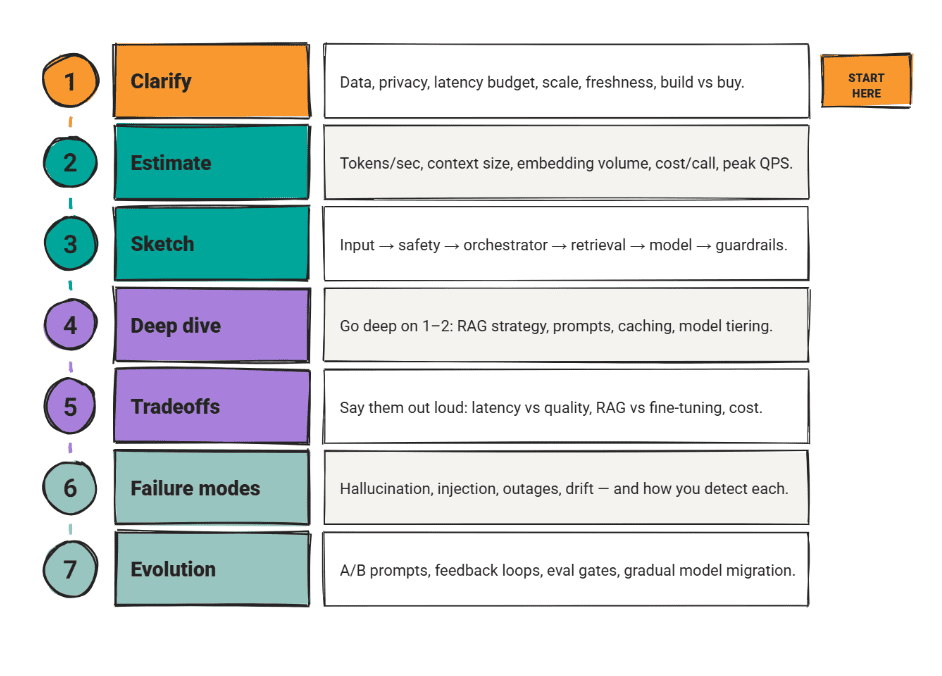
AI システム設計面接で問われる質問に答えるには、以下のステップを体系的に進めるのが効果的です。
まず「要件の明確化」から始めましょう。データソースやプライバシー規制、許容されるレイテンシ(応答遅延)、事実誤認への耐性、想定スケール、データの鮮度要件、そしてサードパーティ製 API の利用可否や自前ホストの必要性などを具体的に固めます。
次に「見積もり」を行います。1 秒あたりのトークン数、コンテキストウィンドウのサイズ、埋め込みベクトルの量、1 回呼び出しあたりのコスト、ピーク時の QPS(1 秒間のクエリ数)を算出します。
その後は「アーキテクチャのスケッチ」です。防御可能なデフォルト構成として、入力層から始まり、安全性と個人識別情報(PII)のフィルタリング層、オーケストレーター、検索機能(ベクトルデータベースと再ランク付け器)、タスクの難易度に応じてルーティングされるモデル、LLM 出力後のガードレール、レスポンスのストリーミング、そして観測性(オプサーバビリティ)へと流れるフローを描きます。
重要なのは「詳細な深掘り」です。RAG の戦略(チャンキング手法、ハイブリッド検索:BM25 と密度ベース検索の併用、再ランク付け)、プロンプト設計、キャッシュ戦略(完全一致と意味的キャッシュ)、モデルのティアリングなど、1〜2 つのコンポーネントを選んで徹底的に議論します。
さらに「トレードオフ」を明確に言語化しましょう。レイテンシと品質のバランス、RAG とファインチューニングの選択、コストの上限設定、リソースが逼迫した際のフォールバックモデルなどです。
「障害モードと観測性」についても触れる必要があります。ハルシネーション(幻覚)、プロンプトインジェクション、プロバイダの停止、埋め込みベクトルのドリフト、マルチテナント環境での分離保証など、どのような問題が発生しうるか、そしてそれぞれをどう検知するかを説明します。
最後に「進化」の視点です。A/B テストによるプロンプト検証、フィードバックループの構築、リリース前の評価ゲート、段階的なモデル移行など、システムがどのように成長・改善していくかを語ります。
最も頻繁に報告される失敗は、要件や制約、成功基準を明確にする前にいきなり解決策へ飛びつくことです。最初の数分間はステップ 1 に費やすべきです。
知っておくべき基本要素
「X を設計せよ」という質問の多くは、同じ構成要素を再利用しています。これら 5 つの基本要素については、図示して説明できるほど理解しておく必要があります。

// Retrieval-Augmented Generation (RAG)
RAG システムの核心は、クエリエンコーダー、コパスから文書リストを取得する検索エンジン、そしてクエリと取得したコンテキストの両方を条件として生成を行うジェネレーターで構成されています。
本番環境での導入では、ドキュメントのカッティング、埋め込みパイプライン、ベクトル検索、キャッシュ機構、評価ログの記録に加え、ユーザーがアクセス権限のないデータを取得できないようアクセス制御を厳格に適用します。
RAG 単体でも、ハルシネーション(幻覚)を約 40〜71% 削減できることが示されています。
// モデルルーティング
コストとレイテンシは現実的な制約です。これらに対してどのように対応するかを明確に説明しましょう。
GPT-4 などの上位モデルは、入力・出力トークン百万個あたり約 10 ドルから 30 ドルのコストがかかり、応答には 3〜5 秒を要します。例えば、単一のプロバイダーで毎日 1 万件の会話を処理し、各会話平均 5,000 トークンのエージェントを運用する場合、月額費用は 7,500 ドルを超えてしまいます。
ルーチンなリクエストは安価なモデルに任せ、複雑なケースのみ最上位モデル(フロンティアモデル)に割り当てるのが賢明です。エージェントへのリクエストの 60〜80% は定型処理であるため、適切なルーティングを行うことでコストを 40〜70% 削減できる可能性があります。
ルーティング、セマンティックキャッシュ、プロンプト圧縮、ストリーミングを組み合わせることで、品質を維持したままコストを 40〜60% 削減できます。
// ガイドライン(ガードレール)
ガードレールは主に 2 つのレイヤーで構成されます。
LLM 処理前(Pre-LLM)では、入力検証、PII のマスキング、プロンプトインジェクションへの防御を行います。
LLM 処理後(Post-LLM)では、スキーマの強制遵守、拒否ポリシーの実装、および取得したコンテキストとの照合による事実確認を担当します。
システムプロンプト、RAG による根拠付け、出典の強制、信頼度スコアリング、監視といった多層的なガードレールを適用することで、3〜20% のベースラインと比較して幻覚(ハルシネーション)リスクを 71〜89% 削減できるというデータがあります。面接ではこれらの数値は複数のソースから得られた範囲値であることを明記し、単一の絶対値として提示しないように注意してください。
// 評価と観測可能性
プロンプトのハッシュ値を用いて、生テキストではなくモデルバージョン、検索メタデータ、ツール実行トレース、安全性判断、レイテンシ、リクエストごとのコストなどをログ記録します。

オフライン評価(正解データに対してキャリブレーションされた LLM-as-judge)と、忠実度、文脈の想起率、回答の関連性といったオンライン指標を組み合わせます。同じログがデバッグ、安全性対策、コンプライアンス対応のすべてを支えます。
// エージェントループ
AI コードレビューアー、リサーチアシスタント、カスタマーサポートエージェントなど、エージェント中心の設計では、以下のパターンに従います。リクエストの受領、文脈の構築、LLM による推論、アクションの検証、サンドボックス内での実行、結果処理、状態更新、そしてループ継続または終了です。

各責務を明確に分離してください。LLM が推論を行い、オーケストレーターがフローを制御し、ポリシーエンジンがルールを管理し、サンドボックスが実行を担当します。
# 名前 worthy な参考アーキテクチャ
実際のシステム名を挙げることで、単なるチュートリアルを超えて実務の知識があることを示せます。
GitHub Copilot** は詳細なドキュメントが公開されています。統合開発環境(IDE)拡張機能は、カーソルの前後のコードと、開いているファイル、インポート、言語メタデータといった文脈信号を抽出し、背後にあるモデル用のプロンプトを構築します。
Fill-in-the-Middle(FIM)は、隣接するタブやファイルパスのヘッダー情報を収集し、組み合わせたプロンプトを GitHub のバックエンドへ送信します。バックエンドでは安全性のフィルタリングが行われた後、Azure 上で稼働しているモデルにルーティングされます。この FIM 方式により、プレフィックス(先頭部分)のみを入力する従来の手法と比較して、約 10% の相対的な採用率向上が実現されています。
GitHub はまた、完成度の高いコード補完を評価するために、品質と安全性のスコアリングを行う別のモデルも運用しています。このモデルは、オフライン環境や本番導入前のテスト、そして実際の稼働環境での評価を通じて継続的に洗練されています。
その他にも、一言触れておくべきシステムがいくつかあります。
- Uber の GenAI Gateway:60 以上のユースケースで PII(個人識別情報)の自動除去機能を実装。
- Airbnb の対話型 AI:思考連鎖(Chain-of-Thought)推論とガードレールを併用。
- Perplexity:Vespa.ai を活用し、1 日あたり 2 億件のクエリに対応。
- Slack のステートレス RAG:モデルをエスクローされた仮想プライベートクラウド(VPC)内で実行。
- Anthropic のマルチエージェント研究システム:Opus をオーケストレーターとし、Sonnet をサブエージェントとして活用。
# 一般的な間違い
**
いくつかのミスは頻繁に繰り返されますが、注意を払えば比較的簡単に修正できます。

最も多い失敗は、要件を明確にする前に設計を始めようとする点です。候補者が「ChatGPT を設計してください」と言われると、すぐに図を描き始め、その後のすべての判断を左右するべき要件や制約、成功基準を確認するステップを飛ばしてしまいます。これは面接の振り返りで最も頻繁に指摘される失敗なので、最初の数分は質問をして情報を集めることに注力しましょう。
2 つ目の失敗は、各コンポーネントがなぜ必要なのかを説明せずにリストアップすることです。ベクトルデータベースやリランカー、ガードレール層といった図を描いても、それぞれの要素を外したときに何が壊れるのか説明できなければ意味がありません。面接官はそれを、表面的な暗記であって実態を理解していないと判断します。
3 つ目はコストとレイテンシーを軽視することです。これらは AI システムにおける主要な制約条件です。トークン使用量や 3〜5 秒の応答時間を無視した設計は、見た目がどれだけ綺麗であっても不十分です。
最後の失敗は、フォールトモード(障害発生時の挙動)を忘れることです。優れた回答では、ハルシネーション(幻覚)、プロンプトインジェクション、プロバイダの停止、マルチテナント環境での分離といった課題と、それぞれを検出する方法をカバーする必要があります。また、ハルシネーション削減に関する数値を引用する際は、ソースや設定によって結果が異なるため、単一の値ではなく範囲を示すべきです。
# 結論
**
AI システム設計の面接では、暗記した答えよりも再現可能なプロセスが評価されます。** 私たちはなぜ質問の内容が変わったのかを見てきました。AI を活用した採用が急成長し、企業は従来の機械学習パイプラインではなく、LLM(大規模言語モデル)を中核に据えた製品を設計する能力を求めているのです。
**

面接官が評価するのは、確率的でコスト制約のあるシステムに対する明確な推論と、トレードオフや本番環境での失敗について率直に語る姿勢です。
核心となるのは 7 つのステップからなるフレームワークです。まず問題を明確にし、負荷を概算し、アーキテクチャのスケッチを描きます。その後、1〜2 のコンポーネントに深く掘り下げ、トレードオフを明示し、障害発生時の対応と観測可能性(オバザビリティ)を計画します。最後に、システムがどのように進化していくかを説明します。
このフレームワークの下には、描画して論理的に守れる 5 つの基礎要素があります。それは RAG、モデルルーティング、ガードレール、評価、そしてエージェントループです。GitHub Copilot などの実際のアーキテクチャを 1〜2 つ知っておくことで、回答の説得力が増します。
このフレームワークを実際の質問で練習すれば、「ChatGPT を設計せよ」「AI コードレビューツールを設計せよ」「GitHub Copilot を設計せよ」といった問題が、入力値の異なる同じ課題として見えてきます。
原文を表示
**
For years, system design interviews meant "Design YouTube," "Design Uber," or "Design WhatsApp." Companies hiring AI Engineers, Applied Scientists, and GenAI Engineers now ask a different set of questions: "Design ChatGPT," "Design a customer support AI," "Design GitHub Copilot," "Design an AI code reviewer," "Design a legal document assistant."
Most engineers can call an LLM API. Fewer can explain the surrounding architecture and defend the design choices under pressure. That second skill is what these rounds test. We will give you one reusable framework that works across all of these prompts, so you stop memorizing a separate answer for each.
# Why The Questions Changed
AI hiring grew fast enough to reshape the interview process. AI Engineer** was ranked the #1 fastest-growing job in the US for the second year running, with postings up 143% year over year in 2025.
LinkedIn data shows that the role added 75,000 US postings between 2023 and 2025, and that the share of AI and machine learning jobs in the tech market rose from 10% to 50% over the same period.
With that volume, the questions shifted toward AI-first software. IGotAnOffer reports that these rounds now center on how you wrap large language models (LLMs) into products: designing agentic loops, integrating retrieval, and reasoning about cost. Deep knowledge of model internals matters less than it used to.
A practitioner field guide built from late-2025 and early-2026 interview reports lists the most common prompts as designing an AI chatbot, a document question-and-answer or retrieval-augmented generation (RAG) system, an AI coding agent, and a voice assistant.
# What Interviewers Evaluate
**
Educative describes the shift well: these interviews test your ability to reason about probabilistic, cost-constrained systems rather than deterministic CRUD** services. The core skill is navigating trade-offs among latency, cost, quality, and safety when these pressures pull in opposite directions.
Strong candidates explain why each layer exists and what breaks without it. Naming the layers without that reasoning reads as shallow.
Senior-level reports say interviewers pick 3 to 5 areas and drill into failure modes and "what went wrong last time" rather than skimming many topics. What sets people apart is production experience and a willingness to talk about what they have actually shipped.
# The Framework
**
Across guides, the same sequence recurs. The System Design Handbook lays it out as eight steps; we use seven.
- Clarify. Pin down the data sources, privacy rules, latency budget, tolerance for factual errors, expected scale, freshness needs, and whether you can call a third-party API or must self-host.
- Estimate. Work out tokens per second, context window size, embedding volume, cost per call, and peak queries per second (QPS).
- Sketch the architecture. A defensible default flows through an input layer, a safety and personally identifiable information (PII) layer, an orchestrator, retrieval (a vector database plus a reranker), the model (routed by task difficulty), post-LLM guardrails, response streaming, and observability.
- Deep dive. Pick one or two components and go deep: RAG strategy (chunking, hybrid BM25 plus dense retrieval, reranking), prompt design, caching (exact and semantic), and model tiering.
- Trade-offs. Say them out loud: latency versus quality, RAG versus fine-tuning, cost ceilings, fallback models when capacity is tight.
- Failure modes and observability. Hallucinations, prompt injection, provider outages, embedding drift, multi-tenant isolation, and how you would detect each.
- Evolution. A/B prompt testing, feedback loops, eval gates before release, and gradual model migration.
The single most reported failure is jumping to a solution before clarifying requirements, constraints, and success criteria. Spend the first few minutes on step 1.
# The Primitives You Need To Know
Most "Design X" prompts reuse the same parts. Know these five well enough to draw and defend them.
// Retrieval-Augmented Generation (RAG)
At its core, a RAG** system has a query encoder, a retriever that fetches a ranked list of documents from a corpus, and a generator that conditions on both the query and the retrieved context.
Production deployments add document chunking, embedding pipelines, vector retrieval, caching, and evaluation logging, and they enforce access boundaries so users cannot pull data they should not see.
RAG alone often cuts hallucinations by roughly 40 to 71%.
// Model Routing
Cost and latency are real constraints, so say how you handle them.
GPT-4-tier models cost about $10 and $30 per million input and output tokens, respond in 3 to 5 seconds, and an agent handling 10,000 conversations a day at 5,000 tokens each runs past $7,500 a month on a single provider.
Send routine requests to cheap models and reserve frontier models for the hard ones. Since 60 to 80% of agent requests are routine, routing usually saves 40 to 70%.
Routing, semantic caching, prompt compression, and streaming together cut costs by 40 to 60% while holding quality steady.
// Guardrails
Guardrails sit at two layers.
Pre-LLM handles input validation, PII redaction, and prompt-injection defense.
Post-LLM handles schema enforcement, refusal policies, and fact-checking against the retrieved context.
Layered guardrails — system prompts, RAG grounding, citation enforcement, confidence scoring, and monitoring — can reduce hallucination risk by 71 to 89% against a baseline rate of 3 to 20%. Present these as ranges in the interview, since the figures come from mixed sources.
// Evaluation And Observability
Log model versions, retrieval metadata, tool traces, safety decisions, latency, and cost per request, using prompt hashes rather than raw text.
**
Combine offline evals (LLM-as-judge calibrated against ground truth) with online metrics such as faithfulness, context recall, and answer relevance. The same logs support debugging, safety, and compliance at once.
// Agentic Loops
For agent-heavy designs (an AI code reviewer, a research assistant, a customer support agent), the pattern is request intake, context assembly, LLM reasoning, action validation, sandboxed execution, result processing, state update, then loop or stop.
Keep concerns separate: the LLM reasons, the orchestrator controls flow, the policy engine governs, and the sandbox executes.
# Reference Architectures Worth Naming
Citing a real system shows you have read past the tutorials.
GitHub Copilot** is well documented. Its integrated development environment (IDE) extension extracts the code before and after the cursor, along with contextual signals such as open files, imports, and language metadata, to construct a prompt for the underlying model.
Fill-in-the-Middle (FIM) gathers neighboring tabs and file-path headers and sends the assembled prompt to GitHub's backend, which filters for safety and routes it to the model running on Azure. FIM gives roughly a 10% relative lift in acceptance over prefix-only prompting.
GitHub also runs a separate model to score completions on quality and safety, refined through offline, pre-production, and production evals.
Other systems worth a sentence:
- Uber's GenAI Gateway with a PII redactor across 60+ use cases.
- Airbnb's conversational AI with chain-of-thought reasoning and guardrails.
- Perplexity serving 200M daily queries on Vespa.ai.
- Slack's stateless RAG with models in an escrow virtual private cloud (VPC).
- Anthropic's multi-agent research system with an Opus orchestrator and Sonnet subagents.
# Common Mistakes
**
A few errors show up again and again, and most are easy to fix once you watch for them.
The biggest is designing before clarifying**. Candidates hear "Design ChatGPT" and start drawing boxes within seconds, skipping the requirements, constraints, and success criteria that should shape all subsequent choices. This is the top reported failure in interview debriefs, so spend the first few minutes asking questions.
A second is listing components without saying why each is there. A diagram with a vector database, a reranker, and a guardrail layer means little if you cannot explain what breaks when you remove each piece. Interviewers read that as memorization without real understanding.
A third is skipping cost and latency. These are first-class constraints in AI systems. A design that ignores the token bill or the 3- to 5-second response time is incomplete, however clean it looks.
The last is forgetting failure modes. Strong answers cover hallucinations, prompt injection, provider outages, and multi-tenant isolation, plus how you would detect each. And when you quote hallucination-reduction numbers, give ranges, since the published results vary by source and setup.
# Conclusion
**
AI system design interviews** reward a repeatable process more than a memorized answer. We looked at why the questions changed: AI hiring grew fast, and companies now ask you to design products built around LLMs rather than classic machine learning pipelines.
**
We looked at what interviewers evaluate: clear reasoning about probabilistic, cost-constrained systems, and honest talk about trade-offs and what has gone wrong in production.
The core is the 7-step framework.** Clarify the problem, estimate the load, sketch the architecture, dig into one or two components, name your trade-offs, plan for failure modes and observability, and say how the system evolves.
Under that sit five primitives you should be able to draw and defend: RAG, model routing, guardrails, evaluation, and agentic loops. Knowing one or two real architectures, such as GitHub Copilot, gives your answer weight.
Practice the framework on a few prompts, and "Design ChatGPT," "Design an AI code reviewer," and "Design GitHub Copilot" start to feel like the same problem with different inputs.
Nate Rosidi is a data scientist and in product strategy. He's also an adjunct professor teaching analytics, and is the founder of StrataScratch, a platform helping data scientists prepare for their interviews with real interview questions from top companies. Nate writes on the latest trends in the career market, gives interview advice, shares data science projects, and covers everything SQL.
関連記事
今日のまとめ
AIデイリーブリーフで今日の重要ニュースをまとめ読み