Cognition Engineering、低コストで最先端知能を実現するモデル「SWE-1.7」を発表
本文の状態
日本語全文を表示中
詳細モードで約25分の本文を読めます。
同じ出来事の情報源
この情報源を基点に整理
Cognition Engineering
Cognition Engineering は、Kimi K2.7 ベースに独自の強化学習を適用した SWE-1.7 を発表し、低コストで先端的な知能を実現するモデルとして Devin に導入した。
AI深層分析を開く2026年8月4日 12:49
AI深層分析
キーポイント
SWE-1.7 の性能と特徴
Cognition Engineering は、長期的非同期タスクに最適化された SWE-1.7 を発表し、コストパフォーマンスのフロンティア曲線を改善した。
強化学習による能力突破
同社によると、既存の Kimi K2.7 ベースに追加で広範な強化学習を適用した結果、「ポストトレーニングの天井」という概念への挑戦を示し、強化学習が以前考えられていた以上に能力を押し上げることが示された。
ベンチマークでの競合比較
FrontierCode 1.1 Main ベンチマークで SWE-1.7 は 42.3% のパス率を記録し、Kimi K2.7 Code や GPT-5.5 に匹敵する性能を示した。
Devin への統合と利用
SWE-1.7 は Cognition の AI エージェント「Devin」の Web、デスクトップ、CLI 版で利用可能となり、Cerebras を介して 1000 TPS で提供される。
エントロピーの維持とトレーニングの安定化
長期の強化学習ではエントロピー崩壊や、トレーニングと推論間の数値ドリフトによる不安定さが課題となる。
重要な引用
It reaches frontier-level intelligence at a much lower cost, advancing the cost-performance Pareto curve.
the large additional gains from our own training challenge the idea of a 'post-training ceiling'
Our model is particularly optimized for longer-horizon asynchronous tasks
Long RL runs face two challenging problems: entropy collapse, and instability due to numerical drift between training and inference.
編集コメントを表示
編集コメント
強化学習による性能向上の限界突破は、業界全体にとって重要な示唆を与える。特に長期的タスクへの最適化は、実務での AI エージェント利用を加速させる可能性が高い。
Source Article
元記事を日本語で読む
本文に関係しない購読案内、埋め込み通知、サイト内プロモーションは除いています。
Ben Pan*, Carlo Baronio*, Rohan Choudhury, Eric Lu, Ryan Kim, Deniz Birlikci, TC Qin, Sam Lee, Fermi Ma, Allen Liu, Yang Liu, Sampriti Panda, Jacob Teo, Ray Wang, Gary Chang, Steven Cao, Silas Alberti*(同等貢献)
2026 年 9 月 7 日
本日、私たちはこれまでで最も能力の高いモデル「SWE-1.7」の公開を開始しました。このモデルは、圧倒的に低いコストで最先端レベルの知能を実現し、コストと性能のパレート曲線をさらに押し上げます。
SWE-1.7 は、RL(強化学習)パイプライン全体における広範な改善の成果です。インフラの強化、トレーニングの安定化、高品質なデータの整備、そして長期ホライズンタスクに対応する新技術がその背景にあります。SWE-1.7 はすでに大規模な RL 事後学習を完了した「Kimi K2.7」をベースに訓練されましたが、そこから得られた大幅な性能向上は、「事後学習には上限がある」という従来の考え方に挑戦するものです。これは、RL が以前考えられていたよりも遥かに高い能力を引き出す可能性を示唆しています。
FrontierCode リーダーボードでのモデルのランキングを確認する
Cognition では、評価においては FrontierCode1,2 を通じて、そして今回は SWE-1.7 の訓練を通じて、優れたエージェント型ソフトウェアエンジニアリングのための原則を策定し、洗練させてきました。当社のモデルは特に、高品質なソフトウェアエンジニアリングに不可欠な要素である「長期ホライズンの非同期タスク」に対して最適化されています。
SWE-1.7 は本日、Cerebras を介して Devin(Web、Desktop、CLI)で利用可能になりました。1000 TPS の処理速度で提供されていますので、ぜひご自身でお試しいただきたいです。
コーディングベンチマークの結果:エージェント型コーディングベンチにおけるパス率(%)。
| ベンチマーク | SWE-1.7 | Kimi K2.7 Code | GPT-5.5 | Opus 4.8 | Opus 4.7 | GLM-5.2 | Composer 2.5 | SWE-1.6 |
|---|---|---|---|---|---|---|---|---|
| FrontierCode 1.1 Main | 42.3% | 30.1% | 43.0% | 46.5% | 38.5% | 24.5% | 25.6% | 9.4% |
| Terminal-Bench 2.1 | 81.5% | 72.7% | 84.2% | 86.9% | 83.0% | 81.0% | 76.0% | 39.7% |
| SWE-Bench Multilingual | 77.8% | 73.5% | 76.8% | 84.4% | 80.5% | 74.5% | 71.6% | 58.3% |
本記事では、SWE-1.7 の学習プロセスについて解説します。インフラストラクチャ、アルゴリズム、そしてモデル構築の背後にあるデータ処理まで、その全貌を明らかにします。特に注目すべき 4 つの要素があります。
エントロピーの維持とトレーニングの安定化: 長期にわたる強化学習(RL)では、主に2つの課題が立ちはだかります。一つはエントロピーの崩壊、もう一つは学習時と推論時の数値ドリフトによる不安定性です。私たちはそれぞれの原因を特定し対策を講じることで、以前の試行で停滞していた段階を超えて、モデルの性能向上を継続させることに成功しました。
マルチクラスタートレーニングとフォールトトレランス: 強化学習において、推論に必要な計算リソースは単一のクラスターに集中させる必要はありません。私たちは3つの大陸にまたがる複数のクラスターで学習を行い、重み更新をオブジェクトストレージ経由で転送しました。さらにハードウェア障害が実行を停止させないよう、堅牢なフォールトトレランス機構を構築しています。
高品質データのキュレーション: 各タスクを自動実行テストに通し、学習シグナルの低いタスクをフィルタリングして除外する、広範なデータ品質パイプラインを整備しました。これにより、報酬ハッキングを防ぎつつ、タスクの堅牢性を高めることに成功しています。
長期ホライズンタスク向けの自己圧縮: モデルは作業状態を要約し、その要約から再開することを学習します。これにより、生のコンテキストウィンドウを超える長いタスク範囲を実現しました。また、正答性を損なうことなく簡潔な出力を促すため、交互に適用する長さペナルティを採用しています。
最後に、今回のトレーニング設定を通じてモデルが獲得した興味深い行動特性について考察を加えます。慎重な探索や簡潔な推論などが、その具体例です。
エントロピーの維持とトレーニングの安定化
大規模なスケールにおいて予測可能な改善をもたらす鍵は、トレーニングの安定性にあることがわかりました。
非同期強化学習(RL)3 でトレーニングを行う際、最も深刻な問題の一つとして浮上したのは、推論時と学習時の KL 発散の不整合 4 です。これは通常、トレーナーのポリシーがサンプリング用のポリシーと異なることが原因です。
過去には、この問題を修正するために(規模は小さかったものの)重要性サンプリング 5 や、NVFP4 + エキスパートルーティングのリプレイにおける低精度ロールアウトのための量子化対応トレーニング 6、7 を採用していました。
ここでは、より大規模なスケールで重要性が増す追加的な対策について紹介します。
トップ P サンプリング 8 が、エントロピーの崩壊 9、10 を防ぐ上で決定的に寄与することがわかりました。これは、強力なモデルが探索を停止し、報酬が数ステップで頭打ちになる現象を防ぐ効果があります。
確率が極めて低いトークンは、往々にして軌道から外れたり分布の範囲を超えたりする経路の一部となります。これらの経路は低報酬を生み出す可能性が高く、ソフトマックス関数の性質が、こうしたトークンによってトークンの確率分布を鋭く(シャープに)する要因となっています。
実際、ロジット x1 > x2 ≫ x3 を持つ 3 つのトークンを考え、その確率を pi = e^{xi} / (e^{x1} + e^{x2} + e^{x3}) としましょう。ここでトークン 3 は低確率であり、低報酬につながるものです。もしこのトークン 3 をサンプリングした場合、その対数尤度 log p3 のロジット x1, x2, x3 に対する勾配は次のようになります。
∇logp3=∇log[ex3ex1+ex2+ex3]=[−p1−p2p1+p2]
そして、ポリシー勾配によるロジットへの更新 Δxi は、サンプリングされたトークンのアドバンテージ A^ を用いて Δxi ∝ A^ ∇logp3 と表されます。この経路は低報酬であるため A^ < 0 となり、更新式は以下のようになります。
Δx1∝∣A^∣ p1,Δx2∝∣A^∣ p2,Δx3∝−∣A^∣ (p1+p2).
今回の更新では、x3x_3 がペナルティを受け、x1x_1 は x2x_2 よりも大きく成長します。その結果、x3x_3 をサンプリングすると、すでに優勢なトークンのリードがさらに広がり、分布が鋭くなりエントロピーが低下します。Top-pp サンプリングでは、確率の低いトークンが最初からサンプリングされ、最適化の対象として使われることを防ぎます。
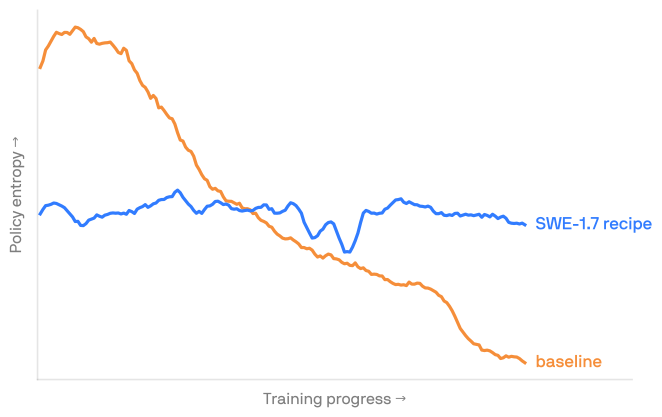
学習全体を通じたポリシーエントロピー
このエントロピー維持効果により、ロールアウトでは top-pp サンプリングが望ましいものとなります。しかし、top-pp を単純に実装すると、トレーニングと推論のミスマッチが明らかに生じます。トレーナーはすべてのトークンからの選択として確率を計算する一方、ロールアウトでは top-pp サブセットからサンプリングするため、分布間の発散が大きくなり、数ステップで崩壊してしまいます。そこで私たちは、サンプリング分布リプレイ11 を実装しました。これは、ロールアウト時にサンプリング可能なトークンのセットを記録し、そのマスクを使ってトレーナー側で確率を再正規化する手法です。この修正により、学習と推論の期間を通じてエントロピーはほぼ一定に保たれ、トレーニングと推論の間の発散も限界内に抑えられています。
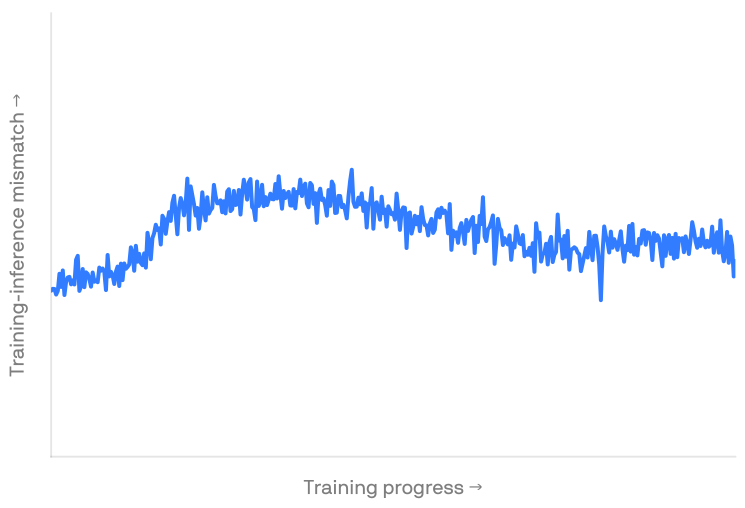
トレーニングと推論のミスマッチ
top-p サンプリングリプレイを採用したもう一つの興味深い結果は、確率 p が top_p_threshold 未満のトークンにのみ焦点を当てる点です。しきい値を超える確率を持つトークンは、保持セットのサイズが 1 となるため、再正規化された確率分布は常に 1 となり、勾配はゼロになります。経験則として、モデルがサンプリングするトークンの多くが標準的な top-p しきい値を超えていることがわかりました。そのため、これらのトークンは全体の勾配計算から除外されます。これにより勾配ノイズが低減され、最適化アルゴリズムが軌道上の学習信号の高いトークンに集中できるようになります。
また、Muon オプティマイザ12 の採用や、トレーナー内での非確定的な演算の排除にも効果が見られました。
マルチクラスタートレーニング
Cognition は急速に成長する研究機関ですが、参入した分野はすでに計算資源が極めて限られた状況にあります。私たちはトリリオンパラメータ規模のモデルを訓練することを目指していますが、現在、単一のネットワークファブリック上に 10,000〜100,000 個ものチップを集約した大規模クラスターは貴重なリソースです。一方、世界中に存在する小規模なクラスターは、適切に連携させることで十分に活用可能です。
この設定では、強化学習(RL)の構造が味方につきます。強化学習は本質的に複数のクラスターにまたがって分解可能です。トレーニングを行う主体は、単一の高性能帯域幅を持つクラスター上に存在するだけで十分です。ロールアウトを生成する推論エンジン自体は完結しており、どこでも実行でき、必要なものは現在の重みだけです。
私たちはこの特性を活かしたインフラストラクチャに投資しました。強化学習のトレーニングは、3 つの大陸にまたがる 4 つのデータセンターに跨って行われます。これは、複数のクラスターにわたる自社 GPU と、Fireworks などの推論プロバイダーからの追加計算リソースを組み合わせることで実現しています。その結果、単一のクラスターでは不可能な規模で強化学習のトレーニングを拡張することが可能になりました。
TRAINER CLUSTER · USROLLOUT CLUSTERS · 3 CONTINENTS- Data bufferSTATEprompts in · scored data outRollout ManagerCONTROLcustom rollout generationsend init promptrecv scored datageneration requestssend train dataTrainerOPTIMIZEGPUGPUGPUwrite Δ weightsXOR diff + zstdCloud storageSYNCpull Δ, apply in-placeDynamo routerInferenceSERVEGPUGPUInferenceSERVEGPUGPU *SWE-1.7 RL training architecture. A single US trainer cluster streams compressed weight deltas through cloud storage to inference rollout clusters spread across three continents.* この構成における中心的な課題は、各オプティマイザステップの後にすべての推論エンジンがトレーナー側の重みと常に同期されている状態を維持することです。軌道データの鮮度を保ち、より積極的な学習率でトレーニングを行うためには、この重み更新を高速に行う必要があります。
単一のクラスターから別のクラスターへモデル全体を単純にブロードキャストするのは、時間がかかり非効率的です。そのため、K 回の勾配ステップごとに、現在の重みと直前の重みの間に圧縮された重み差分(compressed weight delta)を計算して送信します。これにより、各転送のサイズは 99% 以上削減されます13。
トレーナーから推論クラスターへ直接ストリーミングするのではなく、クラウドオブジェクトストレージを活用して重みバージョンの唯一の真実源(single source of truth)を維持しています。トレーナーが新しい重み差分をアップロードした後、推論エンジンはほぼ停止時間なしで更新可能です。各トレーニングランでは、関連するすべてのクラスターに「重みコントローラー」が存在し、そのランにおける重みバージョンのライフサイクルを管理します。
重みコントローラーは、トレーナーが各更新後に書き込む新しいマニフェストをオブジェクトストレージからポーリングします。新しい差分(delta)を検出すると、ワーカーに対してシャードのダウンロードを指示し、その後ツリーブロードキャスト方式でローカルディスク上にレプリケーションを行います。同じくオブジェクトストレージには、推論エンジンからトレーナーへ返されるルーティング行列や top-p マスクも格納されています。
各推論エンジンは、トラジェクトリ(経路)の提供を継続しながら差分を CPU メモリにプリフェッチします。差分が完全にステージングされた時点でのみ、エンジンは一時的に停止してインプレースで適用を行います。処理中のトラジェクトリは、KV キャッシュを保持したまま新しい重みの上でそのまま続行可能です。
このアプローチにより、1 兆パラメータモデルの大陸間での重み更新がエンドツーエンドで 1〜2 分以内に完了します。これは非同期で実行され、トレーニングや推論をブロックすることはありません。更新時の推論停止は最大 3〜4 秒に抑えられます。
フォールトトレランス
大規模環境ではハードウェア障害が絶えず発生しますが、各障害ごとにグローバルな再起動を行うと長時間の運用が不可能になります。本アーキテクチャでは、障害が発生する場所(推論エンジン側かトレーナー側か)によって対応を分けます。
推論側の障害は、設計上コストがかかりません。エンジンは自己完結型であり、現在の重み以外の状態を持たないため、停止しても失われるのは処理中のセッションのみです。
NVIDIA Dynamo を用いてエンジンライフサイクルの管理と推論ルーティングを行っています。各エージェントサンドボックスには個別のプロキシが用意されており、入出力トークンを記録します。これにより、レプリカがダウンしても完全な軌跡データは失われず、Dynamo が別のワーカーへ再ルーティングします。
Dynamo が健全なノード上でレプリカのスケジューリングをやり直した際、重量コントローラーがオブジェクトストレージから最新のチェックポイントを読み込み、そのバージョンからの一連のデルタを再生します。トレーニングでは、障害が発生した場合のコストが最も高くなるのが唯一の場所です。これは単一の密結合コンポーネントであり、1 つのノードが停止するとクラスター全体が立ち往生してしまいます。
回復を高速化するため、各ノードはステップごとに非同期でローカルディスクへチェックポイントを作成し、シャードをピアに複製しています。これにより、障害が発生したノードの状態も数秒以内にレプリカから再構築されます。もし依然として容量が不足している場合は、データ並列処理によるレプリカ単位で実行規模を縮小し、ノードが復帰次第再び拡大します。
この間、ロールアウトパイプラインはウォーム状態を維持されます。トレーニング再開後、バッファポリシーが蓄積されたロールアウトのうちどのものを使用するかを選択し、中断中に生じたトレーニングと推論のスループットの不均衡によるバイアスを防止します。
長期タスク向けのインテリジェント自己圧縮
当初から Devin は、非同期で長時間実行されるタスクの完了を目的に構築されました。SWE-1.7 も Devin ハーネス内で直接トレーニングされているため、当然ながらより長い時間軸を持つタスク向けに独自のモデルを訓練したいと考えています。
これには 2 つの課題があります。まず、ロールアウトが生のコンテキストウィンドウを超えて大幅に延長する可能性がある点です。
第二に、DeepSeek R114 が示す通り、推論タスクにおける強化学習(RL)は応答が徐々に長くなる傾向がありますが、私たちはモデルの推論効率を高め、困難なタスクに対してのみ詳細を展開させることを目指しています。これらの課題に対処するため、「自己圧縮のためのトレーニング」と「交互に適用する長さペナルティ」を導入しました。
エージェントがコンテキスト制限に近づいた際、その作業状態を要約させ、自ら作成した要約から再開するようにします。トレーニング中、モデルは同時に(1)より情報量が多く簡潔な要約を書くこと、および(2)そのような要約を活用して効率的に動作することを学習します。このアプローチのバージョンについては、以前 Kevin15 で紹介しており、カーネル最適化タスクでその有効性を検証しました。自己圧縮により、SWE-1.7 のトレーニング実行中のロールアウトは最大 6 時間に達します。
- トレーニング全体を通じて一律に長さペナルティを適用するのではなく、交互戦略16 を採用しています。制約なしフェーズでは、モデルはタスクの成功のみを最適化します。一方、予算フェーズでは、トークン数、ターン数、ツール呼び出しに要した総時間を組み合わせた重み付きコスト関数の一定予算を超える解決策に対してペナルティを課します。この構造により、モデルが処理可能なタスクでは応答長が圧縮される一方で、困難なタスクにおける長時間の行動(ロングホライズン・ビヘイビア)は維持されます。
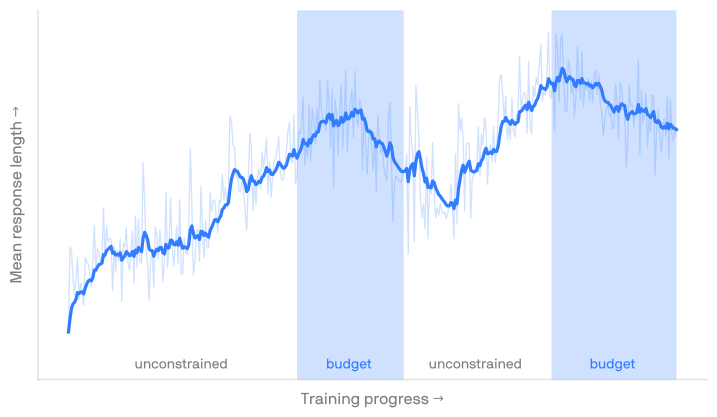
交互する長さペナルティ下での応答長
データ品質
モデルがどのような能力やスキルを習得するかを決める中核となるのはデータです。そのため、訓練に用いたデータは適切に調整され、十分な難易度を備えていることを保証しました。また、望ましくない行動を抑制し、モデルの整合性を保つためのインセンティブ設計にも注力しています。特に以下の点に重点を置きました:
検証の質:タスクの検証器には、誤って不正な解決策を受理する(偽陽性)か、正当な解決策を却下する(偽陰性)という 2 つの方向でエラーが発生する可能性があります。私たちは、トレーニング中の偽陽性と偽陰性の観測を最小限に抑えるために、広範な品質保証パイプラインを構築しました。
難易度:モデルが常に解決できる、あるいは常に失敗するタスクでは、意味のある学習シグナルは得られません。そのため、モデルが低確率でしか解決できないトレーニングデータを厳選し、実効性のある学習シグナルを生み出すと同時に、モデルの知能を向上させるように設計しました。
不正行為の検出と防止:私たちはさまざまな形態の不正行為に対する多様な防御策を採用しました。具体的には、サンドボックスへのネットワークアクセスを制限し、Git の履歴や参照アセットを削除しています。また、採点経路とエージェント自体を分離しました。さらに、既知のエクスプロイトシグネチャを検出するためのプログラムによるチェックも実施しています。最後に、適切なインセンティブを確保するため、不正行為の試行が成功したかどうかに関わらず、その事例が含まれるすべての軌道に対して報酬を 0 と設定しました。
結果:モデルの振る舞い
広範な強化学習(RL)の結果、SWE-1.7 はベースモデルである Kimi K2.7 Code とは明らかに異なる振る舞いを示します。まず、K2.7 やその他の最先端オープンソースモデルと比較して、SWE-1.7 ははるかに整合性が高く、信頼できるものとなっています。この点については、当社の別記事『オープンソース由来モデルの信頼性を測定する』で詳しく解説しています。
SWE-1.7 で確認されたもう一つの行動特性の違いは、思考連鎖(chain-of-thought)が凝縮されている点です。Kimi-K2-7-Code と比較すると、SWE-1.7 の最初の思考連鎖では、機能語(文法的な「つなぎ」として働く単語の割合)の比率が大幅に低く、1 文あたりの平均単語数もほぼ半分になっています。これは、私たちが採用した交互長さペナルティにおける予算フェーズの影響を直接受けたものと考えられます。凝縮された思考連鎖の具体例をいくつか、以下のドロップダウンメニューからご覧いただけます。
観測されたもう一つの大きな行動特性の違いは、SWE-1.7 が実際に行動を起こす前にコードベースをより徹底的に探索している点です。これは、モデルが実行するツール呼び出し数、ファイル読み込み数、検索回数の増加からも明らかです。
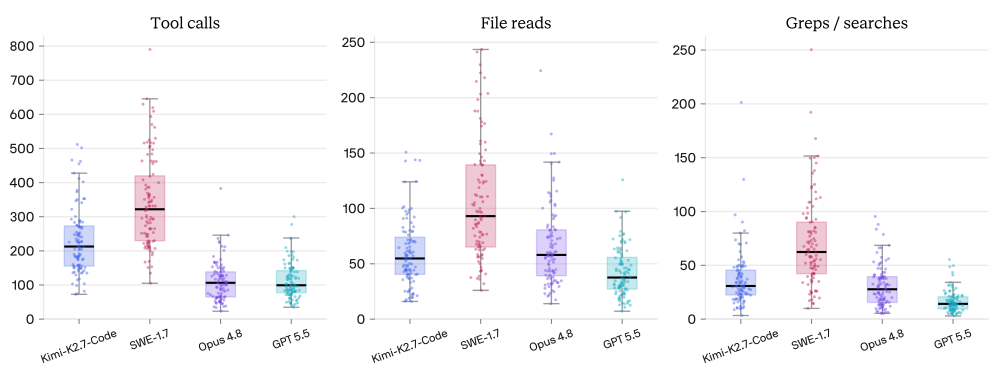
FrontierCode 1.1 Main における行動特性の傾向
バグ修正において、この違いは特に明確に現れます。バグ報告書には通常、主要な症状が一つだけ記述されていますが、根本的な問題はより広範囲に影響を及ぼしていることが多々あります。SWE-1.7 は Kimi-K2.7-Code に比べて、バグの根本原因を調査し、エッジケースや仮定、敵対的入力、要件外の要求までをも考慮する可能性がはるかに高いです。
コードベースの探索能力が向上したことで、SWE-1.7 は、実施すべき設計判断を正確に理解する点でも Kimi-K2.7-Code を凌駕しています。また、我々の観察では、SWE-1.7 は曖昧な意味合いに対して推測で答えるのではなく、小さな Python スクリプトを実行して実験・検証を行うことで、曖昧さを解消する傾向があることがわかりました。
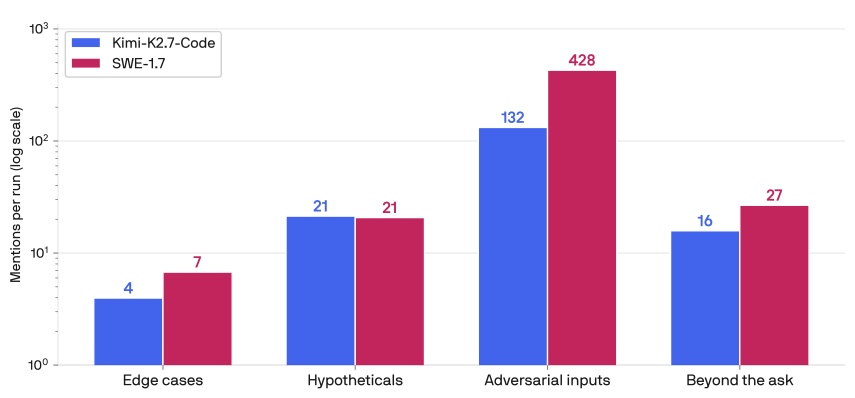
思考連鎖がエッジケースや隠れた要件を調査する頻度
これらの行動は、データから偽陽性(False Positives)と偽陰性(False Negatives)を取り除くために実施した広範な品質保証措置に起因すると考えています。その結果、モデルはより包括的でエンドツーエンドの解決策を導き出すよう強化されました。SWE-1.7 のこうした慎重な調査プロセスが、各種ベンチマークにおけるパフォーマンス向上に直結していると考えられます。
以下には、いくつかの具体的な事例(トラジェクトリ)をドロップダウンからご覧いただけます。
追加の推論には、変更範囲が広がるというわずかなコストがかかります。『FrontierCode』[1]で述べられているように、優れた解決策は必要な最小限のファイルのみを修正し、無関係なコードに触れたり、不要なリファクタリングを行ったりしません。SWE-1.7 は推論を行うため、より多くの作業を行います:タスクが単純に要求する以上に追加のテストケースを作成し、より多くのファイルを編集します。業界全体でこの傾向が一貫して見られます。つまり、推論能力が高まるほど、モデルが触れるファイルの範囲も広がっていくのです。私たちはこの点の改善に期待しています。
評価手法
- すべてのモデルは、最大限の推論努力を行使した状態で評価されます。
- Terminal-Bench 2.1[17]:Anthropic モデルには Claude Code を、OpenAI モデルには Codex を、その他のモデルには Devin CLI を使用し、タイムアウトは 4 時間として、独自の内部評価フレームワークで評価を行います。
- SWE-Bench Multilingual[18]:自己報告された数値が利用可能な場合はそれを使用し、そうでない場合は Devin CLI で評価します。
- FrontierCode 1.1:当社のブログ記事[2]を参照してください。
参考文献
- [1] E. Lu, B. Pan, D. Birlikci, S. Lee, R. Wang, R. Choudhury, F. Ma, TC Qin, C. Baronio, S. Alberti, "Introducing FrontierCode," June 2026. cognition.com/blog/frontier-code
- [2] E. Lu, B. Pan, F. Ma, A. Lombardi, D. Birlikci, S. Lee, R. Wang, R. Choudhury, TC Qin, C. Baronio, J. Teo, J. H. Lee, S. Alberti, "FrontierCode 1.1," July 7, 2026. cognition.com/blog/frontier-code-1.1
- [3] A. Piché et al., "PipelineRL: Faster On-policy Reinforcement Learning for Long Sequence Generation," arXiv:2509.19128, 2025.
- [4] F. Yao et al., "Your Efficient RL Framework Secretly Brings You Off-Policy RL Training," 2025. fengyao.notion.site/off-policy-rl
- [5] B. Pan, C. Baronio, A. Tam, P. Marsella, M. Jain, D. Chiu, Swyx, S. Alberti, "Introducing SWE-grep and SWE-grep-mini: RL for Multi-Turn, Fast Context Retrieval," 2025. cognition.com/blog/swe-grep
- [6] "Stabilizing MoE Reinforcement Learning by Aligning Training and Inference Routers" (Rollout Routing Replay, R3), arXiv:2510.11370, 2025.
- [7] C. Baronio, B. Pan, S. Lee, E. Lu, S. Cao, R. Choudhury, A. Zweiger, R. Wang, G. Chang, S. Alberti, "An Early Preview of SWE-1.6 and Research Update," March 2026. cognition.com/blog/swe-1-6-preview
- [8] A. Holtzman ら、「The Curious Case of Neural Text Degeneration」、arXiv:1904.09751、2019 年。
- [9] G. Cui ら、「The Entropy Mechanism of Reinforcement Learning for Reasoning Language Models」、arXiv:2505.22617、2025 年。arxiv.org/abs/2505.22617
- [10] S. Yu ら、「DAPO: An Open-Source LLM Reinforcement Learning System at Scale」、arXiv:2503.14476、2025 年。arxiv.org/abs/2503.14476
- [11] DeepSeek-AI、「DeepSeek-V3.2: Pushing the Frontier of Open Large Language Models」、arXiv:2512.02556、2025 年。arxiv.org/abs/2512.02556
- [12] K. Jordan ら、「Muon: An optimizer for hidden layers in neural networks」、2024 年。kellerjordan.github.io/posts/muon — または J. Liu ら、「Muon is Scalable for LLM Training」、arXiv:2502.16982、2025 年。
- [13] Fireworks AI、「Frontier RL Is Cheaper Than You Think」、2026 年。fireworks.ai/blog/frontier-rl-is-cheaper-than-you-think
- [14] DeepSeek-AI、「DeepSeek-R1: Incentivizing Reasoning Capability in LLMs via Reinforcement Learning」、arXiv:2501.12948、2025 年。arxiv.org/abs/2501.12948
- [15] C. Baronio, P. Marsella, B. Pan, S. Alberti、「Kevin-32B: Multi-Turn RL for Writing CUDA Kernels」、2025 年。cognition.com/blog/kevin-32b
・[16]Kimi チーム、「Kimi K2.5:ビジュアル・エージェント型知能」、arXiv:2602.02276、2026 年 2 月。arxiv.org/abs/2602.02276
・[17]Terminal-Bench チーム、「Terminal-Bench:ターミナル環境における AI エージェントのベンチマーク」、2025 年。tbench.ai
・[18]J. Yang ら、「SWE-smith:ソフトウェアエンジニアリングエージェントのためのデータ拡張」、arXiv:2504.21798、2025 年。arxiv.org/abs/2504.21798(SWE-bench Multilingual:swebench.com/multilingual)
原文を表示
Ben Pan*, Carlo Baronio*, Rohan Choudhury, Eric Lu, Ryan Kim, Deniz Birlikci, TC Qin, Sam Lee, Fermi Ma, Allen Liu, Yang Liu, Sampriti Panda, Jacob Teo, Ray Wang, Gary Chang, Steven Cao, Silas Alberti*equal contribution
07.09.26
Today, we’re launching SWE-1.7, the most capable model we’ve trained so far. It reaches frontier-level intelligence at a much lower cost, advancing the cost-performance Pareto curve.
SWE-1.7 is the result of broad improvements across our RL pipeline: better infrastructure, more stable training, higher-quality data, and new techniques for long-horizon tasks. Since SWE-1.7 was trained from a Kimi K2.7 base, which had already undergone extensive RL post-training, the large additional gains from our own training challenge the idea of a ‘post-training ceiling’ and suggest that RL can push capabilities much further than previously believed.
See how models rank on the FrontierCode leaderboard
At Cognition, we have been formulating and refining principles for good agentic software engineering both in evaluation, with FrontierCode1,2, and now in training, with SWE-1.7. Our model is particularly optimized for longer-horizon asynchronous tasks, an important component of high-quality software engineering.
SWE-1.7 is available today in Devin (Web, Desktop, and CLI) via Cerebras at 1000 TPS. We encourage you to try it for yourself!
Coding benchmark resultsPass rate (%) on agentic coding benchmarks.
| Benchmark | SWE-1.7 | Kimi K2.7 Code | GPT-5.5 | Opus 4.8 | Opus 4.7 | GLM-5.2 | Composer 2.5 | SWE-1.6 |
|---|---|---|---|---|---|---|---|---|
| FrontierCode 1.1 Main | 42.3% | 30.1% | 43.0% | 46.5% | 38.5% | 24.5% | 25.6% | 9.4% |
| Terminal-Bench 2.1 | 81.5% | 72.7% | 84.2% | 86.9% | 83.0% | 81.0% | 76.0% | 39.7% |
| SWE-Bench Multilingual | 77.8% | 73.5% | 76.8% | 84.4% | 80.5% | 74.5% | 71.6% | 58.3% |
The rest of this post covers how we trained SWE-1.7: the infrastructure, algorithms, and data work behind our model. We cover four important components that stand out.
- Preserving entropy and stabilizing training: Long RL runs face two challenging problems: entropy collapse, and instability due to numerical drift between training and inference. We hunted down and addressed causes of each, which enabled training to keep improving well past where earlier runs stalled.
- Multi-cluster training and fault tolerance: RL doesn’t need all of its inference compute in one cluster. We trained on clusters across three continents, shipped weight updates through object storage, and built fault tolerance so that hardware failures never stalled the run.
- Curating high-quality data: We built an extensive data-quality pipeline that runs each task through automated execution tests, filters out tasks with low learning signal, and hardens tasks to prevent reward-hacking.
- Self-compaction for long-horizon tasks: The model learns to summarize its working state and resume from the summary, extending task horizons past the raw context window. We use an alternating length penalty to incentivize concise output without sacrificing correctness.
Finally, we conclude by sharing some observations on interesting behavioral tendencies, such as careful exploration and concise reasoning, that the model acquired as a result of our training setup.
Preserving Entropy and Stabilizing Training
We found training stability to be a key contributor to predictable improvement at scale.
When training with asynchronous RL3, one of the most problematic issues we encountered was the KL divergence mismatch between inference and training4, since the trainer policy is usually different from the sampling policy. In the past, to correct for this (albeit at smaller scale), we used importance-sampling5 and quantization-aware training for low-precision rollouts in NVFP4 + experts routing replay6,7.
Here we present additional interventions that become more important at larger scale.
We find that top-p sampling8 contributes significantly to staving off entropy collapse9,10, where a strong model stops exploring and reward plateaus within a few hundred steps.
Very low probability tokens are often part of trajectories that have gone off track or out of distribution. These trajectories are likely to produce low reward, and properties of the softmax function lead to these tokens sharpening the token probability distribution. Indeed, suppose we have three tokens with logits x1>x2≫x3x_1>x_2\gg x_3 and probabilities pi=exiex1+ex2+ex3p_i = \frac{e^{x_i}}{e^{x_1} + e^{x_2} + e^{x_3}}, where token 3 is a low probability token that leads to low reward. If we sample token 3, the gradient of its logprob with respect to the logits x1,x2,x3x_1, x_2, x_3 is:
∇logp3=∇log[ex3ex1+ex2+ex3]=[−p1−p2p1+p2]\nabla \log p_3=\nabla\log \left[\frac{e^{x_3}}{e^{x_1}+e^{x_2}+e^{x_3}}\right]= \begin{bmatrix} -p_1 \\ -p_2 \\ p_1+p_2 \end{bmatrix}
and the policy gradient update to the logits is Δxi∝A^ ∇logp3\Delta x_i \propto \hat{A}\ \nabla \log p_3, where A^\hat{A} is the advantage of the sampled token. Since this trajectory earns low reward, A^<0\hat{A} < 0 and the updates are
Δx1∝∣A^∣ p1,Δx2∝∣A^∣ p2,Δx3∝−∣A^∣ (p1+p2).\Delta x_1 \propto |\hat{A}| \, p_1, \qquad \Delta x_2 \propto |\hat{A}| \, p_2, \qquad \Delta x_3 \propto -|\hat{A}| \, (p_1+p_2).
In these updates, x3x_3 is penalized, and x1x_1 grows more than x2x_2. Sampling x3x_3 therefore widens the lead of the already-dominant token, sharpening the distribution and decreasing entropy. Top-pp sampling prevents these low probability tokens from being sampled and used as optimization targets in the first place!
Policy entropy across training
This entropy-preservation effect makes top-pp sampling desirable in our rollouts. But naively implementing top-pp clearly increases the training-inference mismatch — the trainer computes probabilities as a selection from all tokens, while rollouts sample from the top-pp subset, so the distributions have higher divergence, leading to collapse after a small number of steps. Thus, we implement sampling distribution replay11, where we record a kept-set of tokens available for sampling at rollout time, and renormalize probabilities with those masks in the trainer. With this fix, our run’s entropy stays roughly constant over the course of training and inference-training divergence stays bounded.
Training-inference mismatch across training
Another interesting result of using top-p sampling replay is a targeting of only tokens with p<top_p_thresholdp < \text{top\_p\_threshold}. Tokens with probability above the threshold have a keepset of size 1, so their renormalized probability distribution is a constant 1, and gradients are zeroed out. We found empirically that a large fraction of the tokens sampled by the model are above standard top-p thresholds, so they are excluded from the overall gradient computation. This reduces gradient noise and lets the optimization algorithm focus on the high-learning signal tokens in the trajectory.
We also find benefits from using the Muon optimizer12 and eliminating non-deterministic operations in the trainer.
Multi-cluster Training
Cognition is a fast-growing research lab entering an established landscape that is heavily compute-constrained. We aim to train trillion-parameter models, but today, large clusters with 10-100k chips on a single network fabric are a scarce resource. In contrast, smaller clusters around the world are abundant, if used together correctly.
In this setting, the structure of RL works in our favor. RL decomposes naturally across multiple clusters. Only the trainer must live on a single high-bandwidth cluster. The inference engines that generate rollouts are self-contained. They can run anywhere and need nothing but the current weights.
We invested in infrastructure that makes use of this property. Our RL training spans four datacenters across three continents, combining our own GPUs across multiple clusters with additional compute from inference providers like Fireworks. The result is that we can scale RL training far beyond what any single cluster would allow.
TRAINER CLUSTER · USROLLOUT CLUSTERS · 3 CONTINENTS- Data bufferSTATEprompts in · scored data outRollout ManagerCONTROLcustom rollout generationsend init promptrecv scored datageneration requestssend train dataTrainerOPTIMIZEGPUGPUGPUGPUwrite Δ weightsXOR diff + zstdCloud storageSYNCpull Δ, apply in-placeDynamo routerInferenceSERVEGPUGPUInferenceSERVEGPUGPU
*SWE-1.7 RL training architecture. A single US trainer cluster streams compressed weight deltas through cloud storage to inference rollout clusters spread across three continents.*
The central challenge in this setup is keeping all inference engines up to date with the trainer weights after each optimizer step. We want these weight updates to be fast to reduce staleness of trajectories so we can train with more aggressive learning rates.Naively broadcasting the full model from one cluster to another would be slow and inefficient. Instead, every K gradient steps, we compute and send a compressed weight delta between the current and previous weights, reducing the size of each transfer by over 99%13.Rather than streaming the weights directly from the trainer to every inference cluster, we use cloud object storage to maintain a single source of truth for weight versions. After the trainer uploads a new weight delta, the inference engines can be updated with almost no inference downtime. Each training run has a weight controller in each involved cluster that manages the run’s weight version lifecycle. The weight controller polls object storage for new manifests, which the trainer writes after each update. When it finds a new delta, it instructs workers to download their shards, which are then replicated across local disks using a tree broadcast. The same object storage also carries routing matrices and top-p masks from the inference engines back to the trainer.Each inference engine prefetches the delta into CPU memory while continuing to serve trajectories. Only once the delta is fully staged does the engine briefly pause to apply it in-place. Trajectories that are in-flight can simply continue on the new weights with their KV cache intact.With this approach, cross-continental weight updates for a 1T parameter model complete in 1–2 minutes end-to-end. This happens asynchronously and blocks neither training nor inference beyond 3–4 seconds of inference pause at update.
Fault Tolerance
At large scale, hardware failures occur continuously, and globally restarting on each failure makes long runs infeasible. Our architecture handles this differently depending on where the failure occurs — the inference engines or the trainer.Failures on the inference side are cheap by construction. Engines are self-contained and hold no state beyond the current weights, so a dead engine costs only its in-flight sessions. We use NVIDIA Dynamo to manage the engine lifecycles and route inference: each agent sandbox has its own proxy that records tokens in and out, so if a replica goes down, we don’t lose the full trajectory, and Dynamo reroutes it to a different worker. When Dynamo reschedules the replica on healthy nodes, our weight controller loads the most recent checkpoint from object storage and replays a series of deltas from the checkpointed version.The trainer is the one place where a failure is expensive: it’s the single tightly-coupled component, where one dead node stalls the whole cluster. To make recovery fast, each node checkpoints asynchronously to local disk every step and replicates its shards to peers, so a dead node’s state is rebuilt from replicas in seconds. If capacity is still missing, the run shrinks by whole data-parallel replicas and regrows once nodes return. Throughout this process, the rollout pipeline remains warm. After the trainer restarts, a buffer policy selects which accumulated rollouts to use and prevents bias from any imbalance in training-inference throughput during the interruption.
Intelligent Self-Compaction for Long-Horizon Tasks
From the start, we built Devin for completing asynchronous, long-running tasks. SWE-1.7 is trained directly in the Devin harness, so naturally we want to train our own model on longer horizon tasks. This introduces two challenges. First, rollouts can extend far beyond the raw context window. Second, as shown by DeepSeek R114, RL on reasoning tasks tends to produce progressively longer responses, but we want the model to be efficient in its reasoning and only elaborate on difficult tasks.We address these issues with training for self-compaction and an alternating length penalty.When an agent approaches the context limit, we ask it to summarize its working state, and we resume it from its self-authored summary. During training, the model simultaneously learns (1) to write more informative, succinct summaries, and (2) to better work from and leverage such summaries. We first introduced a version of this approach in Kevin15, where we explored it for kernel optimization tasks. With self-compaction, our rollouts during the SWE-1.7 training run reach up to six hours in duration.
- Rather than applying a length penalty uniformly throughout training, we use an alternating strategy16. In unconstrained phases, the model optimizes only for task success. In budget phases, we penalize solutions that exceed a certain budget of our weighted cost function that includes tokens, turns and total time spent in tool calls. With this structure, response length tends to compress on tasks within the model’s ability, while long-horizon behavior on hard tasks is preserved.
Response length under the alternating length penalty
Data Quality
Data is the core determining factor in what capabilities and skills our model learns. As such, we ensured that the data we trained on was calibrated and sufficiently difficult, and disincentivized undesirable behaviors to keep the model well-aligned. We focused most on the following aspects:
- Verifier quality: A task’s verifier can be wrong in two directions: accepting incorrect solutions (false positives) or rejecting valid ones (false negatives). We devised extensive quality-assurance pipelines to minimize observations of false positives and false negatives in our training.
- Difficulty: On tasks where the model always solves or always fails, we don’t observe any meaningful learning signal. Instead, we curated training data that the model only solves a low fraction of the time, which generates real learning signal while at the same time pushes model intelligence.
- Cheating detection and prevention: We employed a variety of defenses against different forms of cheating. For instance, we network-restricted our sandboxes and stripped them of git history and reference artifacts. We also isolated the grading path from the agent itself. In addition, we employed programmatic checks to catch known exploit signatures. Finally, to ensure proper incentives, we assigned reward 0 to trajectories with any instance of cheating attempts, regardless of whether they succeeded.
Results: Model Behaviors
Due to extensive RL, SWE-1.7 exhibits noticeably different behavior from Kimi K2.7 Code, its base model. Firstly, it is significantly more aligned and trustworthy than K2.7 or other frontier open-source models. We expand on this extensively in our companion blog post, *Measuring the Trustworthiness of Open-Source-Derived Models*.
One behavioral difference we noticed in SWE-1.7 is condensed chain-of-thought. Compared to Kimi-K2.7-Code, SWE-1.7’s first chain-of-thought has a much lower function-word ratio (fraction of words that serve as grammatical “glue”) and nearly half the average number of words per sentence. We think this was influenced directly by the budget phases in our alternating length penalty. We’ve included a couple of examples of condensed chain-of-thought in the dropdown below.
The other major behavioral difference we observed is that SWE-1.7 explores the codebase much more thoroughly before acting, as you can see in the number of tool calls, file reads, and searches the model executes.
Behavioral tendencies on FrontierCode 1.1 Main
This shows up most clearly in bug-fixes. A bug report typically describes one primary symptom, but the underlying issue often affects a larger surface area. SWE-1.7 is much more likely to investigate the root cause of the bug and consider edge cases, hypotheticals, adversarial inputs, and beyond-the-ask requirements than Kimi-K2.7-Code. Through its enhanced codebase exploration, SWE-1.7 also does a much better job understanding the exact design decisions that need to be made. In addition, we’ve observed that SWE-1.7 tends to settle ambiguous semantics by experimenting and probing, for example by writing small Python scripts, rather than guessing.
How often the chain-of-thought probes edge cases and hidden requirements
We believe these behaviors arise directly from the extensive quality-assurance measures we took to strip out false positives and false negatives in our data, forcing our model to come up with more complete, end-to-end solutions. We think that SWE-1.7’s increased due-diligence directly translates to higher performance on various benchmarks. We’ve attached a couple of example trajectories in the dropdown below.
The extra thinking comes at a small cost in increased change scope. As described in FrontierCode1, a good solution modifies only the minimal set of files needed, without touching unrelated code or introducing unnecessary refactors. Since SWE-1.7 reasons more, it also does more: writing additional test cases and touching more files than the task naively requires. We’ve noticed this trend consistently in models across the industry: as reasoning increases, the scope of files that the model touches also expands. This is an axis we’re excited to improve on.
Evaluation Methodology
- All models are evaluated under their maximum reasoning effort.
- Terminal-Bench 2.117: we evaluate on our own internal evaluation framework, using Claude Code for Anthropic models, Codex for OpenAI models, and Devin CLI for other models, with timeout=4h.
- SWE-Bench Multilingual18: we use self-reported numbers when available and evaluate on Devin CLI otherwise.
- FrontierCode 1.1: see our blog post2.
References
- [1]E. Lu, B. Pan, D. Birlikci, S. Lee, R. Wang, R. Choudhury, F. Ma, TC Qin, C. Baronio, and S. Alberti, "Introducing FrontierCode," June 2026. cognition.com/blog/frontier-code
- [2]E. Lu, B. Pan, F. Ma, A. Lombardi, D. Birlikci, S. Lee, R. Wang, R. Choudhury, TC Qin, C. Baronio, J. Teo, J. H. Lee, and S. Alberti, "FrontierCode 1.1," July 7, 2026. cognition.com/blog/frontier-code-1.1
- [3]A. Piché et al., "PipelineRL: Faster On-policy Reinforcement Learning for Long Sequence Generation," arXiv:2509.19128, 2025.
- [4]F. Yao et al., "Your Efficient RL Framework Secretly Brings You Off-Policy RL Training," 2025. fengyao.notion.site/off-policy-rl
- [5]B. Pan, C. Baronio, A. Tam, P. Marsella, M. Jain, D. Chiu, Swyx, and S. Alberti, "Introducing SWE-grep and SWE-grep-mini: RL for Multi-Turn, Fast Context Retrieval," 2025. cognition.com/blog/swe-grep
- [6]"Stabilizing MoE Reinforcement Learning by Aligning Training and Inference Routers" (Rollout Routing Replay, R3), arXiv:2510.11370, 2025.
- [7]C. Baronio, B. Pan, S. Lee, E. Lu, S. Cao, R. Choudhury, A. Zweiger, R. Wang, G. Chang, and S. Alberti, "An Early Preview of SWE-1.6 and Research Update," March 2026. cognition.com/blog/swe-1-6-preview
- [8]A. Holtzman et al., "The Curious Case of Neural Text Degeneration," arXiv:1904.09751, 2019.
- [9]G. Cui et al., "The Entropy Mechanism of Reinforcement Learning for Reasoning Language Models," arXiv:2505.22617, 2025. arxiv.org/abs/2505.22617
- [10]S. Yu et al., "DAPO: An Open-Source LLM Reinforcement Learning System at Scale," arXiv:2503.14476, 2025. arxiv.org/abs/2503.14476
- [11]DeepSeek-AI, "DeepSeek-V3.2: Pushing the Frontier of Open Large Language Models," arXiv:2512.02556, 2025. arxiv.org/abs/2512.02556
- [12]K. Jordan et al., "Muon: An optimizer for hidden layers in neural networks," 2024. kellerjordan.github.io/posts/muon — see also J. Liu et al., "Muon is Scalable for LLM Training," arXiv:2502.16982, 2025.
- [13]Fireworks AI, "Frontier RL Is Cheaper Than You Think," 2026. fireworks.ai/blog/frontier-rl-is-cheaper-than-you-think
- [14]DeepSeek-AI, "DeepSeek-R1: Incentivizing Reasoning Capability in LLMs via Reinforcement Learning," arXiv:2501.12948, 2025. arxiv.org/abs/2501.12948
- [15]C. Baronio, P. Marsella, B. Pan, and S. Alberti, "Kevin-32B: Multi-Turn RL for Writing CUDA Kernels," 2025. cognition.com/blog/kevin-32b
- [16]Kimi Team, "Kimi K2.5: Visual agentic intelligence," arXiv:2602.02276, Feb. 2026. arxiv.org/abs/2602.02276
- [17]The Terminal-Bench Team, "Terminal-Bench: A Benchmark for AI Agents in Terminal Environments," 2025. tbench.ai
- [18]J. Yang et al., "SWE-smith: Scaling Data for Software Engineering Agents," arXiv:2504.21798, 2025. arxiv.org/abs/2504.21798 (SWE-bench Multilingual: swebench.com/multilingual)
AI算出
主要ニュースainew評価高い
AI エージェントおよびコーディング分野における画期的な新モデルの発表であり、比較対象となる既存記事がないため新規性が高い。ただし、日本企業や日本固有の情報が含まれていないため、日本の関連性は低い。
6つの評価軸を見る
- AI関連度
- 100
- 情報源の信頼性
- 100
- 新規性
- 75
- 調べる価値
- 75
- 重複の少なさ
- 100
- 日本での有用性
- 25
今日のまとめ
AIデイリーブリーフで今日の重要ニュースをまとめ読み