WPP、AI活用型マーケティングシステム「WPP Open」を運用開始
本文の状態
日本語全文を表示中
詳細モードで約11分の本文を読めます。
同じ出来事の情報源
この情報源を基点に整理
Google Cloud AI
WPP は市場の断片化と経済変動に対応するため、Google Cloud と連携してデータ基盤を統合し、AI を活用した予測分析と迅速なマーケティングキャンペーンの実現を目指している。
Continue in AI NEW LAB
このニュースを、実務の判断につなげる
AI NEW LABで、試したことや先に確認したい条件を共有できます。まずはログインなしで読めます。
AI NEW LABで論点を見るAI深層分析を開く2026年8月11日 01:19
AI深層分析
キーポイント
AI 駆動型マーケティングへの転換
WPP は従来の人間の直感に頼る手法から脱却し、市場動態を予測する AI パワーによるアプローチへ移行して、ブランドが自信を持って投資を行える環境を整えている。
データ断片化という課題の克服
数百のグローバル機関にまたがるマーケティングデータの断片化が大きな障壁となっていたが、WPP はこれを解消するために信頼性の高いデータ取り込み・洗浄・提供基盤を構築した。
Google Cloud とのパートナーシップ
WPP は Google Cloud と提携して統一されたデータバックボーンとカスタムプラットフォームエンジニアリングパスを構築し、サーバーレス計算パターンやデータ処理ワークフローを標準化した。
サービスベース型アーキテクチャの導入
WPP は Google Cloud Storage と BigQuery を共有データプロジェクトに集約し、計算・処理ワークロードを分離するサービスベース型のプロジェクト構造を採用して管理を一元化した。
階層的なセキュリティ制御と単一の真実源の確立
GCS バケットおよび BigQuery データセットレベルで IAM コントロールを適用し、権限を持つチームのみがアクセスできるデータを提供する。これにより、多様なプロダクトラインからのデータを統合した共通の信頼できる情報源を維持しつつ、厳格なセキュリティを担保している。
重要な引用
Between chaotic levels of market fragmentation and economic volatility, marketing and communications agencies can no longer rely on the human intuition they've traditionally used to win clients and optimize their ad spend.
WPP is replacing that guesswork with an AI-powered view of shifting market dynamics, giving brands predictive certainty that lets them invest with confidence while moving at the speed of the market.
Now, by standardizing its serverless compute patterns and data processing workflows, WPP is able to securely deploy targeted marketing campaigns in days instead of months.
By directly applying identity and access management (IAM) controls at the individual GCS bucket and BigQuery dataset levels, the company's teams only see the data they're authorized to access.
編集コメントを表示
編集コメント
WPP が数百の機関にまたがるデータを統合し、AI を活用して意思決定を加速させた事例は、大規模組織におけるデータドリブンマーケティングの実践例として極めて示唆に富んでいる。特に、サーバーレス技術とクラウドストレージを活用したアーキテクチャ転換が、実行速度を劇的に改善した点は注目すべき成果である。
Source Article
元記事を日本語で読む
本文に関係しない購読案内、埋め込み通知、サイト内プロモーションは除いています。
市場の分断や経済の変動という混沌とした状況の中で、マーケティング・コミュニケーション代理店は、これまでクライアント獲得や広告費最適化のために頼ってきた人間の直感に依存できなくなりました。WPP は、その不確実な推測を置き換え、変化する市場動態を AI が分析した視点で捉えることで、ブランドに対して予測的な確信をもたらしています。これにより、ブランドは自信を持って投資を行いながら、市場のスピードに合わせて行動することが可能になります。これが WPP のアジェンシー型マーケティングシステム「WPP Open」が提供する価値です。
しかし、こうした洞察を実現するために高度な AI モデルを適用する前に、WPP は決定的なエンジニアリング課題に直面していました。モデルを構築するためのマーケティングデータが、世界中の数百もの代理店に断片的に散在していたのです。この状況は、AI ツールを効率的かつ安全に展開することをほぼ不可能にしていましたが、モデルへのアクセス権を持つことだけが解決策ではありませんでした。データを収集し、クリーニングし、モデルへ提供するための信頼できる仕組みを構築するまで、WPP が生成 AI の真の可能性を引き出すことはできなかったのです。
この課題を解決するため、WPP は Google Cloud と連携して、統一されたデータ基盤とカスタムなプラットフォームエンジニアリングの道筋を構築しました。現在では、サーバーレスコンピューティングのパターンやデータ処理ワークフローを標準化することで、標的型マーケティングキャンペーンを数ヶ月ではなく数日で安全に展開できるようになっています。
中央集権的でサービス指向型のデータ基盤の設計
この取り組みにおいて重要な要素の一つは、データの入手可能性を加速し、管理を一元化することでした。その実現のために、WPP は現在の生産環境でサービスベースのプロジェクト構造を採用しました。
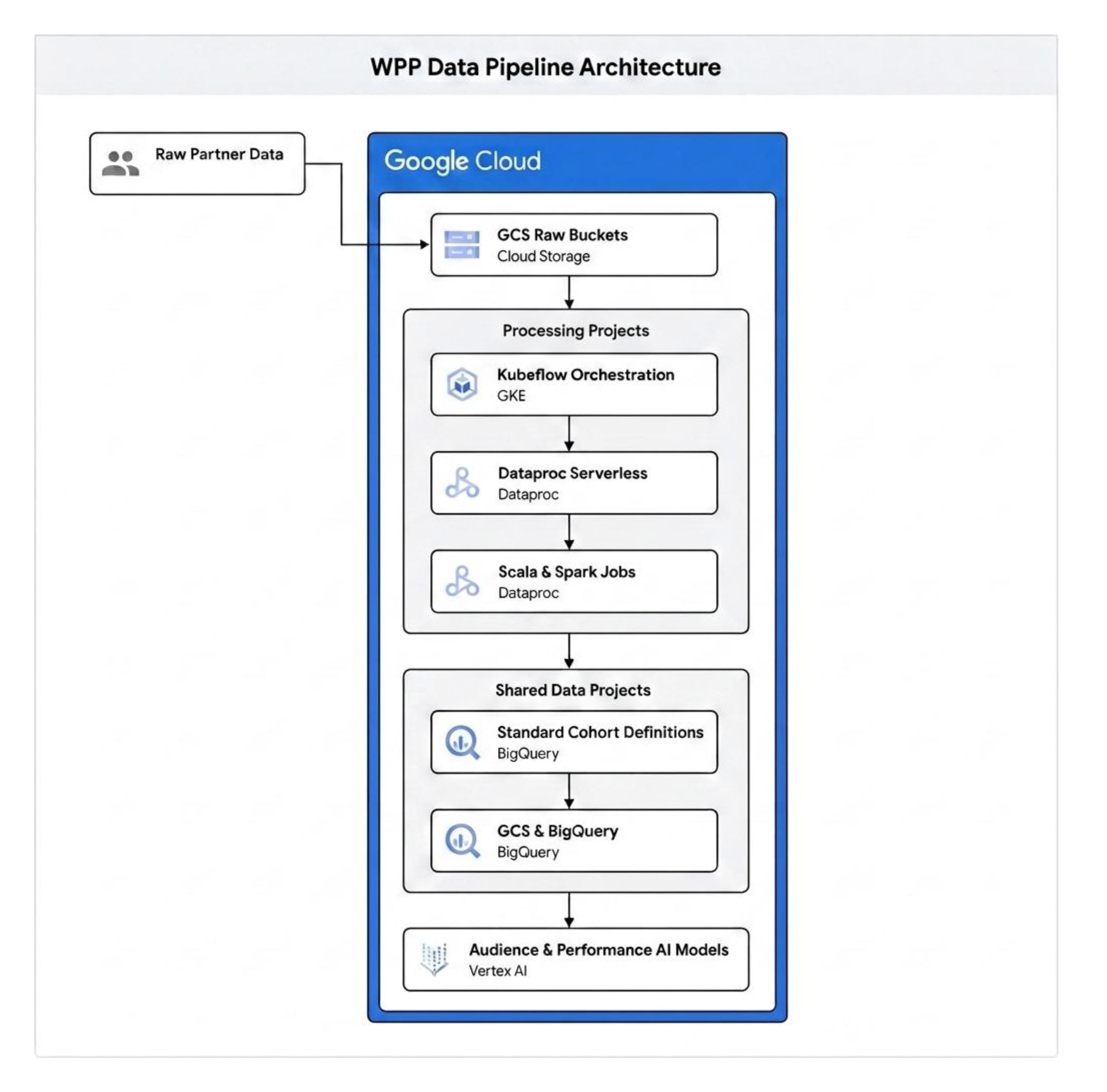
各ワークロードを個別のサイロに隔離するのではなく、エンジニアリングチームは Google Cloud Storage(GCS)と BigQuery を専用の共有データプロジェクトに集約し、一方で計算処理やデータ処理のワークロードは別々の処理プロジェクトとして分離しました。
この構造により、コアチームのユーザー体験が簡素化され、すべてのデータ利用者が統一された信頼できる情報源とやり取りすることが保証されました。WPP のさまざまな製品ラインからのデータが共有インフラストラクチャ上に存在するため、細粒度レベルでセキュリティを厳格に適用することが不可欠でした。GCS バケットや BigQuery データセットの個別レベルで直接アイデンティティ・アクセス管理(IAM)制御を適用することで、各チームは権限のあるデータのみを表示できるようになっています。
同時に、各パートナーから得られる生データは、入力を整理・分離するために専用の GCS バケットに格納されます。そこから Managed Service for Apache Spark がカスタム Apache Scala および Spark ジョブを実行し、情報をクリーニング、正規化、標準化して、統一されたコホート定義(SCD)へと変換します。
サーバーレスアーキテクチャとパイプラインのオーケストレーションに Kubeflow を組み合わせることで、WPP のデータエンジニアリングチームは、クラスターインフラの管理に伴うオーバーヘッドを回避できました。これにより、彼らは下流の GCS および BigQuery レイヤーを支えるデータ変換ロジックに注力することが可能になり、最終的には同社のオーディエンスおよびパフォーマンス AI モデルへとデータを供給しています。
「Google Cloud との協力が成功した理由は、ベストプラクティスにおける妥協のないプロフェッショナリズムと、極めて実用的で現実的なソリューションを迅速に提供するというバランスが取れていた点にあります。」
- Jonas Dahlbaek
WPP シニアデータエンジニアリングリード
データを統一されたコホートへ標準化する
WPP の処理領域に生データが流入すると、プラットフォームはそれを SCD(単一顧客定義)に変換し、フレームワーク全体でキーとして活用される中核概念へと昇華します。これらは「年齢」「性別」「地理情報」「製品」「興味」という 5 つのキーを基盤としています。ただし、これらの基礎的なデータ定義は流動的であり、変化するマーケティング概念を反映するために継続的に標準化されています。その結果、WPP は機密性の高い詳細情報を開示したり、共通識別子に依存したりすることなく、グローバル規模でデータの結合と集計が可能になります。
プラットフォームの中核処理エンジンは、包括的な可視性とコンプライアンスを確保するため、型安全な Scala で構築されました。この独自フレームワークはデータ変換のあり方を厳密に制御し、本質的に完全なソーストレーサビリティをサポートしています。これにより、キュレーションされたデータセット内のすべてのデータポイントがその起源まで遡って追跡可能となります。これはエンタープライズ AI アプリケーションを構築する上で極めて重要な要素です。なぜなら、データサイエンティストや監査担当者は、WPP が将来 Google Cloud の Knowledge Catalog へ移行して自動化された企業全体のデータガバナンスを実現しようとしている最中であっても、モデルに供給される情報が何であるかを正確に理解する必要があるからです。
Google Cloud との連携は、エンジニアリング活動の加速と標準化において決定的な役割を果たしました。断片化した膨大なデータが日常の課題となる世界において、AI 時代を生き抜くためには適切なインフラを整備することが何より重要であり、開発者も AI マーケターもその恩恵を受けます。
- Suleman Khan
WPP OI & Google パートナーシップ プロダクトマネージャー
**エンタープライズソフトウェアライフサイクルの標準化**
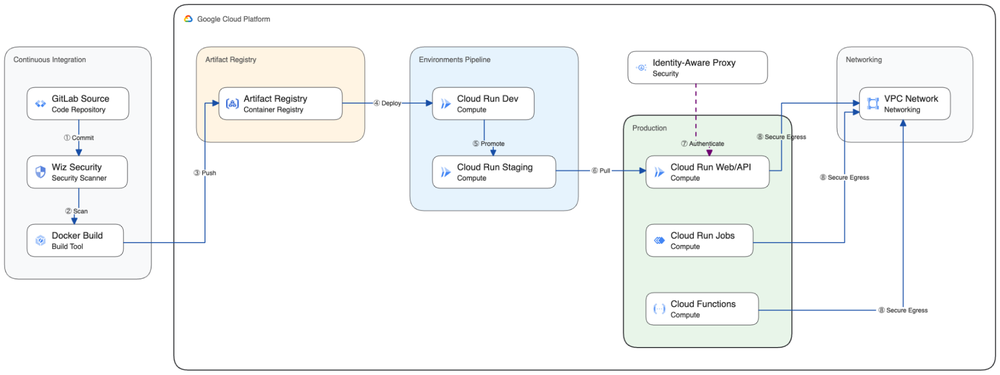
WPP にとって、これらの手順を整えたとしても、データ処理は戦いの半分を占めるに過ぎません。アプリケーションの提供と基盤インフラの管理を行うため、同社のプラットフォームエンジニアリングチームは、再利用可能で中央集権的な GitLab の継続的インテグレーションおよび継続的デプロイメント(CI/CD)テンプレートスイートを開発しました。これにより、個々の開発チームの認知負荷を軽減し、すべてのデプロイが厳格な企業セキュリティ基準を満たすことを保証しています。
これらのテンプレートは、さまざまなエンタープライズワークロードを自律的に管理します。このスイートには、フルスタック Web アプリケーションやバッチデータ処理、スケジュールされたパイプライン向けの汎用 Cloud Run テンプレートが含まれています。また、マルチステージワークフロー用のデプロイ専用テンプレートと、イベント駆動型マイクロサービス向けの Cloud Run functions 展開テンプレートも用意されています。
ゼロ再ビルドプロモーションの実装
本番環境でコンテナイメージを再構築すると、不要なリスクや設定のズレ(構成ドリフト)が生じる可能性があります。環境の一貫性を維持するため、WPP は「一度ビルドすれば多数に展開する」というアプローチを採用し、プロジェクト横断的な IAM ロジックと Google Cloud Artifact Registry の設定を適用しました。
このプロセスでは、開発環境でコンテナイメージの構築とテストを行います。検証済みの正確な不変のコンテナイメージは、本番環境へ直接プロモートされます。このゼロ再ビルドのプロモーションにより、展開ステージ全体での完全な整合性が保たれ、予期せぬ本番環境での挙動を排除できます。また、CI/CD テンプレートは段階的なトラフィック移行も可能にし、チームがフルロールアウトを開始する前に、新しいリビジョンに少量のトラフィックをルーティングできるようになりました。
不変なデプロイ。追跡可能なデータ。揺るぎない信頼。AI に何が含まれるかを正確に把握していれば、光速でリリースできます。
** - Ranjith K Poldas
Associate Director, Devops (I&P), WPP Media
セキュリティとインテリジェントなネットワークの自動化
このモダンなアーキテクチャにおいて、エンタープライズセキュリティは WPP にとって基盤的な役割を果たしており、コードマージ前に脆弱性を検出するため、CI/CD パイプラインのプレプッシュフェーズに Wiz のセキュリティスキャンを直接統合しました。また、社内アプリケーション全体でゼロトラストアクセスを適用するために、Google Cloud Identity-Aware Proxy も活用しています。
運用のさらなる簡素化のため、WPP はインテリジェントな仮想プライベートクラウド(VPC)ロジックを組み込んだテンプレートを採用しました。この設定により、レガシーな VPC コネクタと最新の Direct VPC アクセスの間に発生するネットワーク競合を自動的に特定し、解決します。このような自動化されたネットワーク管理はデプロイメントの失敗を防ぎ、リリースサイクルの加速を実現しています。
運用ヘルスの監視と ROI の最大化
堅牢なプラットフォーム基盤には深い可観測性が不可欠であるため、WPP のエンジニアリングチームは単なるデプロイ頻度ではなく、厳格な運用指標を監視するようになりました。チームでは p50、p95、p99 パーセンタイルにおけるリクエストレイテンシと、4xx および 5xx エラー率を追跡しています。また、コールドスタートの緩和のためにコンテナ起動時間を監視し、CPU とメモリの全体的な利用率も把握します。この詳細な粒度により、データパイプラインとサーバーレスインフラストラクチャが常に高い可用性を維持することが保証されます。
この規模の変革を、データエンジニアリングからプラットフォーム基盤、AI 統合に至る複数の複雑なワークストリームにまたがって推進するには、単なる調整だけでは不十分でした。深い相互信頼が必要だったのです。真のパートナーとして連携した Google Cloud と WPP は、生産環境で使えるプラットフォーム機能を期日通りに提供するために、一丸となって進めました。
Yang Yue(Google Cloud プログラムマネージャー)
WPP にとって、この速度でデータと AI のスタックを運用可能にしたことは、高度なワークロードに必要なインフラを提供するものでした。そのビジネスへの影響は明確かつ定量化可能です。この二つの基盤を構築した結果、クリエイティブや戦略に要する時間が従来の 4 週間からわずか 3 時間に短縮されました。また、生産効率が 70% 向上し、コンテンツの量も 33 倍に増加。キャンペーンの投資対効果(ROI)は 2.8 倍になりました。つまり、Google Cloud とパートナーシップを結び、広範な製品群とツールを導入したことで、WPP は迅速に大きな ROI を実現するとともに、社全体の生産性、効率、信頼性、セキュリティを大幅に向上させることに成功しました。
原文を表示
Between chaotic levels of market fragmentation and economic volatility, marketing and communications agencies can no longer rely on the human intuition they’ve traditionally used to win clients and optimize their ad spend. WPP is replacing that guesswork with an AI-powered view of shifting market dynamics, giving brands predictive certainty that lets them invest with confidence while moving at the speed of the market. That’s the value of WPP Open, its agentic marketing system.
But before it could begin applying sophisticated AI models to power those insights, WPP had to overcome a critical engineering challenge: the marketing data that made up the models was fragmented across hundreds of global agencies. While this dynamic made it nearly impossible to deploy AI tools efficiently and securely, access to models was only part of the equation. And until it built a reliable way to ingest, clean, and serve data to those models, WPP couldn’t unlock the true potential of generative AI.
To solve this, WPP partnered with Google Cloud to construct a unified data backbone and custom platform engineering path. Now, by standardizing its serverless compute patterns and data processing workflows, WPP is able to securely deploy targeted marketing campaigns in days instead of months.
Architecting a centralized, service-based data foundation
An important part of this effort was accelerating data availability and centralizing management. To do this, WPP adopted a service-based project structure for its current production environment. Rather than isolating every workload into separate silos, its engineering team centralized Google Cloud Storage (GCS) and BigQuery into dedicated, shared data projects, while also segregating the compute and processing workloads into distinct processing projects.
This structure simplified the core team’s user experience and ensured that all data consumers interacted with a unified source of truth. Because data from WPP’s various product lines lives in shared infrastructure, it was essential that security be strictly enforced at a granular level. By directly applying identity and access management (IAM) controls at the individual GCS bucket and BigQuery dataset levels, the company’s teams only see the data they’re authorized to access.
At the same time, raw data from various partners lands in dedicated GCS buckets in order to keep the raw inputs organized and isolated. From there, Managed Service for Apache Spark executes custom Apache Scala and Spark jobs to cleanse, normalize, and canonicalize information into standardized cohort definitions (SCDs). By utilizing a serverless architecture combined with Kubeflow for pipeline orchestration, WPP’s data engineering team avoided the overhead that often results from managing cluster infrastructure. This allowed them to focus entirely on the data transformation logic fueling the downstream GCS and BigQuery layers that ultimately feed the company’s audience & performance AI models.
What made our collaboration with Google Cloud successful was the balance they struck between uncompromising professionalism when it comes to best practices and timely delivery of incredibly pragmatic, real-world solutions.**`- Jonas Dahlbaek
`Senior Data Engineering Lead, WPP
Standardizing data into unified cohorts**
When raw data enters WPP’s processing zone, its platform converts it into SCDs that become core concepts used throughout the framework for keying purposes. These are based on five keys: age, gender, geo, product, and interest. But these underlying data definitions are fluid and continuously canonicalized to reflect evolving marketing concepts. As a result, this uniform structure allows WPP to join and aggregate data on a global scale without exposing sensitive underlying particulars or relying on shared identifiers.
The platform's core processing engine was built in type-safe Scala to ensure comprehensive visibility and compliance This custom framework tightly controls how data is transformed, and it inherently supports full source traceability while guaranteeing that every data point within the curated datasets can be traced back to its origin. This is a crucial level of traceability when building enterprise AI applications, as data scientists and auditors must understand exactly what information feeds into the models, even as WPP concurrently prepares to transition to Google Cloud Knowledge Catalog for automated, enterprise-wide data governance in the future.
Working with Google Cloud has been instrumental in accelerating and standardizing our engineering efforts. In a world where massive volumes of fragmented data present a daily challenge, having the right infrastructure is paramount to thriving in the AI age and helps our developers and AI marketers alike.**`-Suleman Khan
`Product Manager for OI & Google Partnerships, WPP
Standardizing the enterprise software lifecycle**
For WPP, even with all these steps in place, processing data is only half the battle. To serve applications and manage the underlying infrastructure, the company’s platform engineering team developed a suite of reusable and centralized GitLab continuous integration and continuous deployment (CI/CD) templates. With this, WPP reduced the cognitive load on individual development teams and ensured that all deployments met strict corporate security standards.
These templates manage various enterprise workloads autonomously. The suite includes universal Cloud Run templates for full-stack web applications and batch data processing and scheduled pipelines. It also includes a deploy-only template for multi-stage workflows and a Cloud Run functions deployment template for event-driven microservices.
Implementing zero-rebuild promotion
Rebuilding container images in a production environment can introduce unnecessary risk and the potential for configuration drift. In order to maintain environmental consistency, WPP embraced a "build once, deploy many" methodology that applied cross-project IAM logic and Google Cloud Artifact Registry configurations.
As part of this process, developers build and test container images in the development environment. Once those exact, immutable container images are validated, they’re promote directly to production. This zero-rebuild promotion ensures total parity across deployment stages and eliminates unexpected production behaviors. The CI/CD templates also facilitate progressive traffic migration, which allowed teams to route a small percentage of traffic to new revisions before initiating a full rollout.
Immutable deployments. Traceable data. Unshakable trust. When you know exactly what goes into your AI, you can ship at the speed of light.**`- Ranjith K Poldas
`Associate Director , Devops (I&P), WPP Media
Automating security and intelligent networking**
With this modern architecture, enterprise security acts as a foundational enabler for WPP, so it integrated Wiz security scanning directly into the pre-push phase of the CI/CD pipeline to catch vulnerabilities before code merges. The company also utilized Google Cloud Identity-Aware Proxy to enforce zero-trust access across its internal applications.
To further simplify operations, WPP adopted templates with intelligent virtual private cloud (VPC) logic. This configuration automatically identifies and resolves networking conflicts between legacy VPC connectors and modern Direct VPC access. This automated networking prevents deployment failures and accelerates the release cycle.
Monitoring operational health and driving ROI
Because a resilient platform foundation requires deep observability, WPP’s engineering team now monitors strict operational metrics instead of relying solely on deployment frequency. The team tracks request latency across p50, p95, and p99 percentiles, alongside 4xx and 5xx error rates. It also monitors container startup times to mitigate cold starts, while tracking overall CPU and memory utilization. This granularity ensures that both data pipelines and serverless infrastructure always remain highly available.
`"Navigating a transformation of this scale across multiple complex workstreams—spanning data engineering, platform infrastructure, and AI integration—required more than just alignment; it demanded deep, mutual trust. Working as true partners, Google Cloud and WPP moved in lockstep to deliver production-ready platform capabilities on time."
`Yang Yue , Program Manager , Google Cloud
For WPP, operationalizing its data and AI stacks at this velocity provided the necessary infrastructure for its advanced workloads, and the business impact was clear and quantifiable. By building this dual foundation, the company reduced creative and strategy time from four weeks to just three hours. It also saw a 70% gain in production efficiency, a 33x increase in content volume, and a 2.8x increase in campaign return on investment. In short, by partnering with Google Cloud and implementing a broad suite of products and tools, WPP was able to quickly realize a significant ROI and boost productivity, efficiency, reliability, and security across the company.
今日のまとめ
AIデイリーブリーフで今日の重要ニュースをまとめ読み