Google Research、1兆分間のセンサーデータで事前学習したウェアラブル健康基盤モデル「SensorFM」を発表
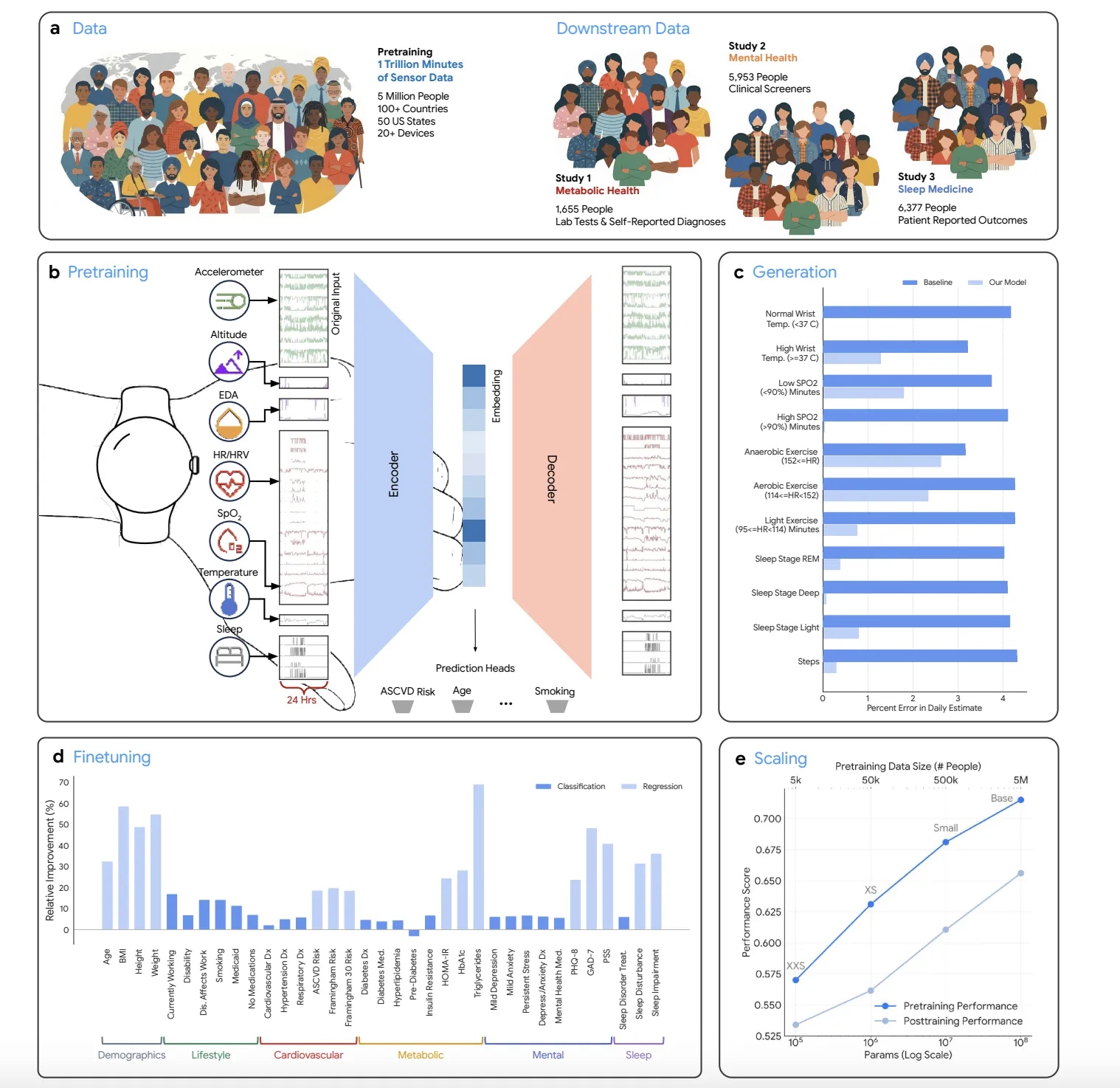
Google Research は、500 万人のデータから 1 兆分間のセンサー情報を学習した「SensorFM」というウェアラブル健康用ファウンデーションモデルを発表し、従来の個別最適化アプローチを転換する画期的な成果を示した。
キーポイント
超巨大規模データによる事前学習
500 万人の参加者から収集された 1 兆分間(20 億時間以上)のセンサーデータを基に、PPG、加速度計など 5 つのセンサーから抽出した特徴量を学習している。
スケーラビリティと性能向上の明確な相関
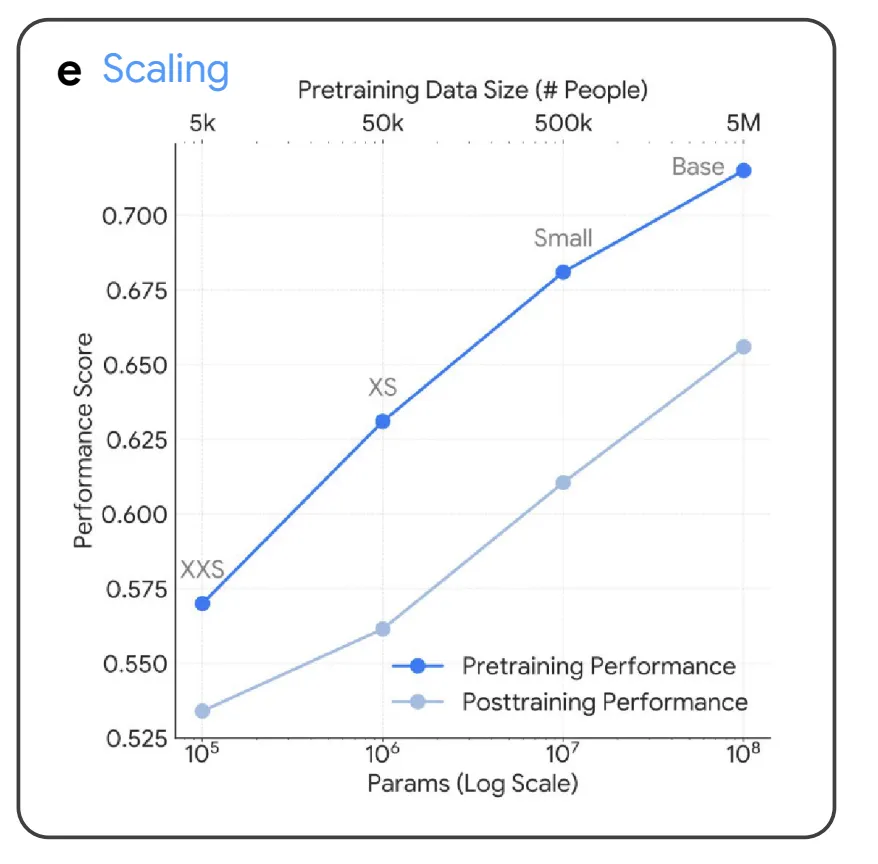
モデルサイズとデータ量の両方を比例して拡大することで、再構築損失が 31% 減少し、下流タスクでの分類精度(AUC)や回帰精度(r)が劇的に向上した。
データ不足による過学習のリスク
大規模モデルを少量データで事前学習した場合、小規模モデルよりも性能が低下し過学習が発生することが示され、大規模データの必要性を裏付けた。
多様な健康タスクへの汎用性
代謝、心臓、呼吸、睡眠、メンタルヘルスなど 35 の異なるタスクにおいて、最大モデルが 35 タスク中 33 で最上位を記録し、単一エンドポイント型モデルの限界を打破した。
AIM マスキングによるデータ欠損の克服
充電やオフリストなどの自然なデータ欠損と人工的マスキングを統合する「Adaptive and Inherited Masking (AIM)」を採用し、バイアスを注入せず効率的に学習を実現しています。
生成タスクによる補完・予測の自動獲得
欠損した観測値を再構築するようデコーダを訓練することで、明示的な補間や予測モデルなしで高精度なデータ補完と将来予測が可能になります。
凍結エンコーダーと線形プローブによる高汎用性
学習済みエンコーダーを凍結し、個人ごとの埋め込みベクトルを集約・次元削減して線形分類器を訓練する手法により、35 中 34 のタスクで既存の監督学習ベースラインを上回りました。
重要な引用
Most wearable health models are built one outcome at a time. That approach breaks down at thirty-five endpoints.
SensorFM is a Large Sensor foundation Model for wearable time-series representation learning.
Across variants, B wins 33 of 35 tasks, and XXS ranks last on 33 of 35.
Because the decoder learns to reconstruct ablated observations, imputation and forecasting come for free.
This linear probe beats a supervised feature-engineered baseline on 34 of 35 tasks.
Adding SensorFM predictions beat the baseline overall (W = 10110, p < 0.001), and on each dimension.
影響分析・編集コメントを表示
影響分析
この発表は、ウェアラブルデバイス分野における AI のパラダイムシフトを示唆しており、個別の疾患予測モデルを逐一開発する非効率な手法から、大規模データで汎用的な健康表現を学習するアプローチへの転換を加速させる。特に、データ量とモデル性能の明確なスケーリング則が実証されたことで、将来的により高精度かつ多機能なヘルスケア AI サービスの実現可能性が高まった。
編集コメント
1 兆分という圧倒的なデータ量と、モデル規模・データ量の比例関係が実証された点は、業界全体のパラダイムを揺るがす重要な知見です。ただし、プライバシー保護や倫理的配慮が不可欠な領域であるため、今後の実装におけるガバナンスにも注目が集まります。
ほとんどのウェアラブルヘルスモデルは、一つの結果ごとに構築されています。このアプローチは三十五の終点(エンドポイント)では機能しなくなります。ラベル作成には多額の費用がかかり、事後注釈の実行は不可能です。
Google Research は、500 万人の人々から収集された 1 兆分以上のセンサーデータで事前学習されたウェアラブルヘルス向けファウンデーションモデル「SensorFM」を発表しました。
 imagehttps://arxiv.org/pdf/2605.22759
SensorFM とは何か?
SensorFM は、ウェアラブル時系列表現学習のための大規模センサー基盤モデル(Large Sensor foundation Model)です。PPG(光電容积脈波)、加速度計、EDA(皮膚電気活動)、皮膚温度、高度計の 5 つのセンサーから抽出された 34 の 1 分間集約特徴量を入力とし、24 時間のコンテキストウィンドウ内で 7 つのカテゴリーに整理されます。
バックボーンは、マスクドオートエンコーダー(masked-autoencoder)目的関数と [20, 1] のパッチサイズで訓練された ViT-1D エンコーダーです。事前学習には、2024 年 9 月から 2025 年 9 月の間にサンプリングされた 500 万人の同意取得参加者を使用しました。このデータセットは 100 カ国以上、米国の全 50 州、および 20 種類以上の Fitbit および Pixel Watch モデルにまたがっており、合計で 20 億時間超、つまり 1 兆分以上の分間に相当します。
4 つの変種が存在し、それぞれが比例するデータ量とペアになっています。
変種パラメータエンコーダー隠れ層 / レイヤー比例データセンサー時間
XXS138,74064 / 25K 人2×10⁶
XS933,204128 / 450K 人2×10⁷
S7,290,068256 / 8500K 人2×10⁸
B110,763,412768 / 1.25 億人2×10⁹
評価には独立したデータセットを使用しました。これは、IRB(研究倫理委員会)の承認を得た 3 つの prospective 研究にまたがる 13,985 人の被験者を対象としています。これらは代謝・心臓・呼吸器系健康(N = 1,655)、睡眠(N = 6,377)、メンタルヘルス(N = 5,953)に関するものです。35 のタスクには、心血管系(6)、代謝(8)、メンタルヘルス(8)、睡眠(3)、人口統計(4)、ライフスタイル(6)が含まれています。
スケーリングのケース
この設定のもと、最初の疑問は「スケール拡大が実際に測定可能な効果をもたらすか」という点です。研究チームは 4 つのモデルサイズと 4 つのデータ量を変数として実験を行いました。
5M コーパス上で訓練された SensorFM-B は、SensorFM-XXS と比較して再構築検証損失を 31% 削減し、平均的な生成損失も 28% 低下しました。下流タスクでは、分類において ΔAUC = 0.09 の向上、回帰において Δr = 0.21 の改善が見られました。バリアント全体を通じて、B モデルは 35 タスク中 33 で勝利し、XXS モデルは 35 タスク中 33 で最下位となりました。
失敗事例も同様に示唆に富んでいます。わずか 5K 人の被験者で訓練された SensorFM-B は、検証損失が 1.082 に達しました。これは同じデータ量における他のすべての小規模バリアントよりも悪結果です。モデルの過学習(overfitting)により、事前学習は早期に停止されました。
 imagehttps://arxiv.org/pdf/2605.22759
したがって、すべての主要な結果は、データ量がモデルの容量に比例してスケーリングされていることを前提としています。この共スケールされた対角線上では、平均 ROC AUC は .664, .681, .710, .752 と推移し、平均ピアソン相関係数(Pearson r)は .386, .435, .536, .612 と推移します。上記の図は、この傾向がまだ飽和していないことを示しています。
AIM:欠損データをシグナルとして扱う
スケーリングだけではこれらの数値を説明できません。実際のストリームは、充電中、手首から外れている期間、省電力モード中に断片化されます。従来の方法は欠損部分を補完してバイアスを注入するか、ウィンドウを削除してデータを破棄するかのどちらかです。
一方、SensorFM は Xu 氏らが LSM-2 で導入した適応的かつ継承的マスキング(AIM: Adaptive and Inherited Masking)を使用します。適用されるマスクは、継承された欠損マスクと人工的なマスクの和合です。損失計算は、真値を持つ人工的にマスクされたパッチのみに対して行われます。トークンドロップアウトとアテンションマスキングを用いた 2 段階のトークンマスキングにより、この処理は効率的に保たれます。
デコーダーが欠損した観測値の再構築を学習するため、補完と予測は無料で実現されます。
生成タスクMean fillNN fillLinear interp.SensorFM-B
ランダム補完,80% 0.915 1.020 0.854 0.215
時系列補間,60 分 0.904 0.943 0.777 0.468
時系列外挿,60 分 0.937 1.102 1.102 0.563
信号補完,12/26 チャネル 1.025 1.025 1.025 0.170
保持されたテストセットにおける再構築 MSE(誤差の二乗和)。低いほど優れています。
最良のベースラインと比較して、SensorFM はランダム補完を 74.8% 改善し、信号補完は 83.7% 改善します。
実践:埋め込みの適応
この表現を予測に変換するのは straightforward です。エンコーダーは凍結されたままです。埋め込みは個人ごとに集約され、日ごとの平均と標準偏差が使用されます。これらは 50 個の主成分に圧縮されます。その後、線形ヘッドが 5 フォールドの個人非依存交差検証の下で訓練されます。
Copy CodeCopiedUse a different Browser
import numpy as np
from sklearn.decomposition import PCA
from sklearn.linear_model import LogisticRegression
from sklearn.model_selection import StratifiedKFold
from sklearn.metrics import roc_auc_score
def person_level(emb, pid):
"""Collapse day-level embeddings into one vector per participant."""
people = np.unique(pid)
feats = []
for p in people:
e = emb[pid == p] # (n_days, d)
feats.append(np.concatenate([e.mean(axis=0), e.std(axis=0)]))
return np.nan_to_num(np.stack(feats)), people # pandas std() is NaN at 1 day
X, people = person_level(emb, pid) # emb: frozen SensorFM embeddings
y = labels[people] # one label per participant
aucs = []
for tr, te in StratifiedKFold(5, shuffle=True, random_state=0).split(X, y):
pca = PCA(n_components=50).fit(X[tr]) # PCA-50, fit on the train fold only
clf = LogisticRegression(max_iter=400) # paper: AdamW, lr 5e-3, wd 1e-4, 400 steps
clf.fit(pca.transform(X[tr]), y[tr])
p = clf.predict_proba(pca.transform(X[te]))[:, 1]
aucs.append(roc_auc_score(y[te], p))
print(np.mean(aucs))
この線形プローブは、34 のタスク中 35 で教師あり特徴量エンジニアリングベースラインを上回ります。選択された結果を以下に示します。
TaskMetricDemos. onlyFeat. Eng.SensorFM-B
Ager–.662.920
Mental Health Med.ROC.594.773.819
PHQ-8r.303.354.450
Insulin ResistanceROC.717.710.761
Hypertension DxROC.762.747.786
Framingham 30 Riskr.782.592.714
最後の行は外れ値ではありません。ASCVD(動脈硬化性心血管疾患)スコアと Framingham スコアは人口統計学的特徴から計算されます。したがって、人口統計情報のみを用いたモデルは構造的に有利となります。研究チームは、SensorFM が 35 のタスクのうち 31 で最良の結果を示したと報告していますが、すべてのタスクで優れているわけではありません。
2 つの注意点が同じ表に含まれています。人口統計情報は SensorFM にとって 30 のタスク中 22 で依然として有益ですが、その効果はスケールが大きくなるにつれて縮小します。非常にラベルが少ない状況では、人口統計情報に基づく事前知識単独でも強力な性能を発揮します。
エージェント型教室
線形プローブでさえも、タスクごとの調整が必要です。これを自動化するために、研究チームは 5 つの LLM(大規模言語モデル)学生エージェントからなる「教室」を構築しました。これらは gemini-2.5 flash から gemini-3.1 pro preview までを網羅しています。これらのエージェントは、非圧縮埋め込みベクトルを用いて 20 のサイクルにわたり Python ヘッド(分類器)の生成、実行、評価、改良を行います。
合計で 30,516 回の実験が実施されました。エージェントが発見したヘッドは、F1 スコアを指標として 20 の分類タスク中 16 で線形プローブを上回りました。また、15 の回帰タスク中 12 でピアソン相関係数も向上させました。解決策の品質は Artificial Analysis Intelligence Index(人工分析知能指数)に追従する傾向を示しました。
勝利した解決策は保守的です。ほぼすべてのケースで埋め込み空間を 50〜100 次元まで削減していました。線形モデルが非線形モデルを上回り、アンサンブル手法が採用されたのは四分の一未満でした。
パーソナルヘルスエージェントの根拠付け
最終実験では、SensorFM をベンチマークエントリーではなくツールとしてテストしました。Gemini 3 Flash が 31 人の実際の参加者プロファイルに対して健康サマリーを生成しました。すべての条件において、人口統計データと特徴量エンジニアリングされた日次指標が提供されました。その後、各条件に SensorFM の予測値、正解ターゲット(ground-truth targets)、または何もない状態のいずれかが追加されました。
研究論文によると、条件について盲検化された 4 人の認定医師が、5 つの評価基準次元全体で 1,860 件の評価を行いました。SensorFM の予測値を追加することは、全体的に(W = 10110, p < 0.001)および各次元においてベースラインを上回りました。その予測値は統計的に正解ターゲットと区別できないものでした(p = 0.396)。
ユースケース
スクリーニングおよびリスク層別化:凍結されたエンコーダーに 1 つの線形ヘッドを追加し、確認のための検査が必要な候補者をフラグ付けします。論文ではこの用途を診断ではなくスクリーニングに限定しています。
日次サマリーの修復:60 分連続のデータが欠落(アブレーション)した場合でも、SensorFM は歩数カウントで 99.7%、深い睡眠の精度で 99.9% を維持します。
ラベル不足の研究:エンドツーエンドでの学習ではなく、凍結された埋め込みベクトルをプローブしてください。まずは人口統計データのみを用いたベースラインと比較することから始めます。
根拠に基づくコーチング:エージェントのプロンプトでは、生の回帰値やブールフラグの出力は禁止されています。予測値は定性的に解釈されます。
インタラクティブ・エクスプローラー
(function(){
window.addEventListener("message", function(e){
if(e.data && e.data.mtpFrame === "sensorfm"){
var f = document.getElementById("mtp-sensorfm-frame");
if(f) f.style.height = e.data.height + "px";
}
});
})();
論文と技術詳細をご覧ください。また、Twitter でフォローしていただくこともお気軽にどうぞ。15 万人以上の ML サブレッドに参加し、ニュースレターを購読することも忘れないでください。待ってください!Telegram をご利用ですか?今なら Telegram でも私たちに参加できます。
GitHub リポジトリや Hugging Face ページ、製品リリース、ウェビナーなどのプロモーションのためにパートナーシップをご検討の場合は、こちらまでご連絡ください。
本記事「Google Research が SensorFM を発表:1 兆分のセンサーデータで事前学習されたウェアラブルヘルス基盤モデル」は、MarkTechPost で最初に公開されました。
原文を表示
Most wearable health models are built one outcome at a time. That approach breaks down at thirty-five endpoints. Labels are expensive and retrospective annotation is infeasible.
Google Research introduced SensorFM, a foundation model for wearable health pre-trained on more than 1 trillion minutes of sensor data from 5 million people.
imagehttps://arxiv.org/pdf/2605.22759
What is SensorFM?
SensorFM is a Large Sensor foundation Model for wearable time-series representation learning. It ingests 34 one-minute aggregate features drawn from five sensors: PPG, accelerometer, EDA, skin temperature, and altimeter. Those features are organized into seven categories, over a 24-hour context window.
The backbone is a ViT-1D encoder trained with a masked-autoencoder objective and a patch size of [20, 1]. Pretraining used 5,000,000 consented participants, sampled between September 2024 and September 2025. That corpus spans 100+ countries, all 50 U.S. states, and 20+ Fitbit and Pixel Watch models. It totals over two billion hours, or more than one trillion minutes.
Four variants exist, each paired with a proportional data volume.
VariantParametersEncoder hidden / layersProportional dataSensor-hours
XXS138,74064 / 25K subjects2×10⁶
XS933,204128 / 450K subjects2×10⁷
S7,290,068256 / 8500K subjects2×10⁸
B110,763,412768 / 125M subjects2×10⁹
Evaluation uses separate data. It covers 13,985 subjects across three prospective IRB-approved studies. Those are metabolic, cardiac and respiratory health (N = 1,655), sleep (N = 6,377), and mental health (N = 5,953). The 35 tasks cover cardiovascular (6), metabolic (8), mental health (8), sleep (3), demographics (4), and lifestyle (6).
The Scaling Case
With that setup, the first question is whether scale buys anything measurable. The research team swept four model sizes against four data volumes.
SensorFM-B on the 5M corpus cuts reconstruction validation loss by 31% versus SensorFM-XXS. Generative loss drops 28% on average. Downstream, it gains ΔAUC = 0.09 on classification and Δr = 0.21 on regression. Across variants, B wins 33 of 35 tasks, and XXS ranks last on 33 of 35.
The failure case is equally informative. SensorFM-B trained on only 5K subjects posts a 1.082 validation loss. That is worse than every smaller variant at the same volume. Pretraining was stopped early because the model overfit.
imagehttps://arxiv.org/pdf/2605.22759
Consequently, all headline results assume data volumes scaled proportionally to capacity. Along that co-scaled diagonal, mean ROC AUC moves .664, .681, .710, .752. Mean Pearson r moves .386, .435, .536, .612. The above figure shows the trend has not saturated.
AIM: Handling Missing Data as Signal
Scaling alone does not explain those numbers. Real streams fragment during charging, off-wrist periods, and power-saving modes. Conventional methods either impute the gaps, injecting bias, or drop the windows, discarding data.
SensorFM instead uses Adaptive and Inherited Masking (AIM), introduced by Xu et al. in LSM-2. The applied mask is the union of the inherited missingness mask and the artificial mask. Loss is computed only on artificially masked patches that had ground truth. Two-stage token masking, using token dropout and attention masking, keeps this efficient.
Because the decoder learns to reconstruct ablated observations, imputation and forecasting come for free.
Generative taskMean fillNN fillLinear interp.SensorFM-B
Random imputation, 80%0.9151.0200.8540.215
Temporal interpolation, 60 min0.9040.9430.7770.468
Temporal extrapolation, 60 min0.9371.1021.1020.563
Signal imputation, 12/26 channels1.0251.0251.0250.170
Reconstruction MSE on the held-out test set, lower is better.
Against the best baseline, SensorFM improves random imputation by 74.8%. Sensor signal imputation improves by 83.7%.
Hands-On: Adapting the Embeddings
Turning that representation into predictions is straightforward. The encoder stays frozen. Embeddings are aggregated per person, using the mean and standard deviation across days. Those reduce to 50 principal components. A linear head then trains under five-fold, person-independent cross-validation.
Copy CodeCopiedUse a different Browser
import numpy as np
from sklearn.decomposition import PCA
from sklearn.linear_model import LogisticRegression
from sklearn.model_selection import StratifiedKFold
from sklearn.metrics import roc_auc_score
def person_level(emb, pid):
"""Collapse day-level embeddings into one vector per participant."""
people = np.unique(pid)
feats = []
for p in people:
e = emb[pid == p] # (n_days, d)
feats.append(np.concatenate([e.mean(axis=0), e.std(axis=0)]))
return np.nan_to_num(np.stack(feats)), people # pandas std() is NaN at 1 day
X, people = person_level(emb, pid) # emb: frozen SensorFM embeddings
y = labels[people] # one label per participant
aucs = []
for tr, te in StratifiedKFold(5, shuffle=True, random_state=0).split(X, y):
pca = PCA(n_components=50).fit(X[tr]) # PCA-50, fit on the train fold only
clf = LogisticRegression(max_iter=400) # paper: AdamW, lr 5e-3, wd 1e-4, 400 steps
clf.fit(pca.transform(X[tr]), y[tr])
p = clf.predict_proba(pca.transform(X[te]))[:, 1]
aucs.append(roc_auc_score(y[te], p))
print(np.mean(aucs))
This linear probe beats a supervised feature-engineered baseline on 34 of 35 tasks. Selected results follow.
TaskMetricDemos. onlyFeat. Eng.SensorFM-B
Ager–.662.920
Mental Health Med.ROC.594.773.819
PHQ-8r.303.354.450
Insulin ResistanceROC.717.710.761
Hypertension DxROC.762.747.786
Framingham 30 Riskr.782.592.714
The last row is not an outlier. ASCVD and Framingham scores are calculated from demographic features. Demographic-only models therefore win by construction. The research team reports SensorFM best on 31 of 35 tasks, not all of them.
Two caveats sit in the same tables. Demographics still help SensorFM on 22 of 30 tasks, though the lift shrinks with scale. In very-low-label regimes, demographic priors alone remain strong.
The Agentic Classroom
Even a linear probe needs per-task tuning. To automate that, the research team ran a ‘classroom’ of five LLM student agents. These span gemini-2.5 flash through gemini-3.1 pro preview. Agents generate, execute, score, and refine Python heads over 20 cycles, using unreduced embeddings.
In total they ran 30,516 experiments. Agent-found heads beat the linear probe on 16 of 20 classification tasks, measured by F1. They also raised Pearson correlation on 12 of 15 regression tasks. Solution quality tracked the Artificial Analysis Intelligence Index.
The winning solutions are conservative. Almost all reduced the embedding space to 50–100 dimensions. Linear models outnumbered non-linear ones, and ensembles appeared in under a quarter.
Grounding a Personal Health Agent
The final experiment tests SensorFM as a tool, not a benchmark entry. Gemini 3 Flash generated health summaries for 31 real participant profiles. Every condition received demographics and feature-engineered daily metrics. Conditions then added SensorFM predictions, ground-truth targets, or nothing.
According to the research paper, four board-certified physicians, blinded to condition, produced 1,860 ratings across five rubric dimensions. Adding SensorFM predictions beat the baseline overall (W = 10110, p < 0.001), and on each dimension. Its predictions were statistically indistinguishable from ground truth (p = 0.396).
Use Cases
Screening and risk stratification: A frozen encoder plus one linear head flags candidates for confirmatory lab work. The paper scopes this to screening, not diagnosis.
Repairing daily summaries: With 60 contiguous minutes ablated, SensorFM retains 99.7% step-count and 99.9% deep-sleep accuracy.
Label-scarce studies: Probe frozen embeddings instead of training end-to-end. Compare against a demographics-only baseline first.
Grounded coaching: The agent prompt forbids emitting raw regression values or boolean flags. Predictions are interpreted qualitatively instead.
Interactive Explorer
(function(){
window.addEventListener("message", function(e){
if(e.data && e.data.mtpFrame === "sensorfm"){
var f = document.getElementById("mtp-sensorfm-frame");
if(f) f.style.height = e.data.height + "px";
}
});
})();
Check out the Paper and Technical details. Also, feel free to follow us on Twitter and don’t forget to join our 150k+ML SubReddit and Subscribe to our Newsletter. Wait! are you on telegram? now you can join us on telegram as well.
Need to partner with us for promoting your GitHub Repo OR Hugging Face Page OR Product Release OR Webinar etc.? Connect with us
The post Google Research Introduces SensorFM: A Wearable Health Foundation Model Pretrained on One Trillion Minutes of Sensor Data appeared first on MarkTechPost.
関連記事
Google、ブラウザ上で WebGPU を経由して .tflite モデルを実行する JavaScript バインディング「LiteRT.js」をリリース
PrismML が Qwen3.6-27B の軽量版「Bonsai 27B」をリリース:ラップトップやスマートフォンで動作する 1 ビットおよび 3 値モデル
コード生成エージェント4種比較:Mistral Vibe、Claude Code、Cursor、Codexの実務タスク評価
今日のまとめ
AI日報で今日の重要ニュースをまとめ読み