Arize と Fireworks が Kimi K3 など 10 モデルの成功タスク単価をベンチマーク
本文の状態
日本語全文を表示中
詳細モードで約26分の本文を読めます。
Arize と Fireworks が10種類のAIモデルを実際のタスクで評価した結果、トークン単価ではなく「成功したタスクあたりのコスト」が最適化すべき指標であり、オープンソースモデルが最安となる実態を明らかにした。
AI深層分析を開く2026年8月4日 08:30
AI深層分析
キーポイント
評価指標の転換:トークン価格から成果コストへ
従来のトークン単価ではなく、失敗やリトライを含めた「成功したタスクあたりのコスト」が実務における真のコスト効率を決める指標であると示された。
ベンチマーク結果:オープンソースモデルの台頭
10モデル中、最もコスト効率が良かったのは「gpt-oss-120b」であり、成功時の単価は$0.054と他社を大きく下回ったが、その一方でパス率は33%と低かった。
価格設定の時代変化とインフラ経済
LLM初期の市場獲得のための subsidized pricing(補助付き価格)は終了し、完全な推論コストを払う時代において、製品が採算に乗るかどうかはこの指標で決まると指摘した。
リトライと失敗の隠れたコスト
トークン単価では見えないリトライ税や失敗した試行のコストを含めると、一見安価なモデルでも実際の成功コストは跳ね上がるケースがあることがデータで裏付けられた。
タスク難易度によるモデル性能の乖離
簡単なタスクでは最前線モデルの優位性は薄く、コスト効率の良いモデルで十分である。一方、困難なタスクでは最前線クラスのモデルが必須であり、試行回数を増やすことでの解決は不可能である。
重要な引用
Cost per token is an infrastructure metric. Cost per successful task is a productivity metric.
The labels turned out to be the wrong axis.
When you pay the full cost of inference, the gap between a model that looks cost effective on a pricing page and a model that is actually cost effective to get work done becomes the difference between a product that pencils out and one that doesn't.
The most cost-effective models fall far; solving the hardest problems takes a frontier-class model, open or closed. And retrying is no substitute: a model that cannot do a task does not learn it on the fourth attempt, it just bills you four times.
編集コメントを表示
編集コメント
この分析は、AI導入における「安かろう悪かろう」の罠を明確に示しており、実務レベルでのモデル選定基準を見直す重要な契機となる。特にオープンソースモデルとクローズドモデルのコスト構造の違いは、今後のアーキテクチャ設計において無視できない要素である。
Source Article
元記事を日本語で読む
本文に関係しない購読案内、埋め込み通知、サイト内プロモーションは除いています。
Arize と Fireworks は、Kimi K3(まもなくオープンウェイト版が公開される)を含む 10 のオープンおよびクローズドモデルを、40 の実環境エージェントタスクと計 2,400 回の実行でテストしました。その結果、パス率、リトライ回数、カバレッジ、そして成功したタスクあたりのコストを測定しています。
これは Fireworks と Arize が実施した実験で、「実際の業務を遂行するためにモデルを選ぶ際、何に最適化すべきか」という問いを中心に据えています。多くの人は「オープンかクローズドか」「コスト効率が良いか最先端か」といったラベルで判断しがちです。しかし、私たちは 4 つのプロバイダーから選んだ 10 のモデルを実際のコマンドラインタスクで比較し、トークン単価ではなく「仕事を完了させるためのコスト」を測定しました。その結果、ラベルという軸が間違っていたことが明らかになりました。モデルを分けたのは「成功したタスクあたりのコスト」でした。
この問いは毎月、重要性を増しています。なぜなら推論のコスト構造が変わりつつあるからです。LLM 時代初期の数年間は、市場シェア獲得のために大幅な価格補助が行われており、コスト回収を目的としたものではありませんでした。しかしその時代は終わりを迎えています(以前にもこの点について言及しました)。推論の全費用を負担するようになると、料金表上ではコスト効率に見えても、実際に業務を遂行するには非効率的なモデルと、本当にコスト効率が良いモデルとの差が、事業として成立するかどうかの分かれ目になります。
トークンあたりのコストはインフラ指標です。一方、成功したタスクあたりのコストは生産性指標です。チームが最適化すべきは後者の方です。
「成功したタスクあたりのコスト」とは、モデルが各試行で費やした総額(失敗、再試行、タイムアウトを含む)を、実際にタスクを完了させた回数で割った値を指します。
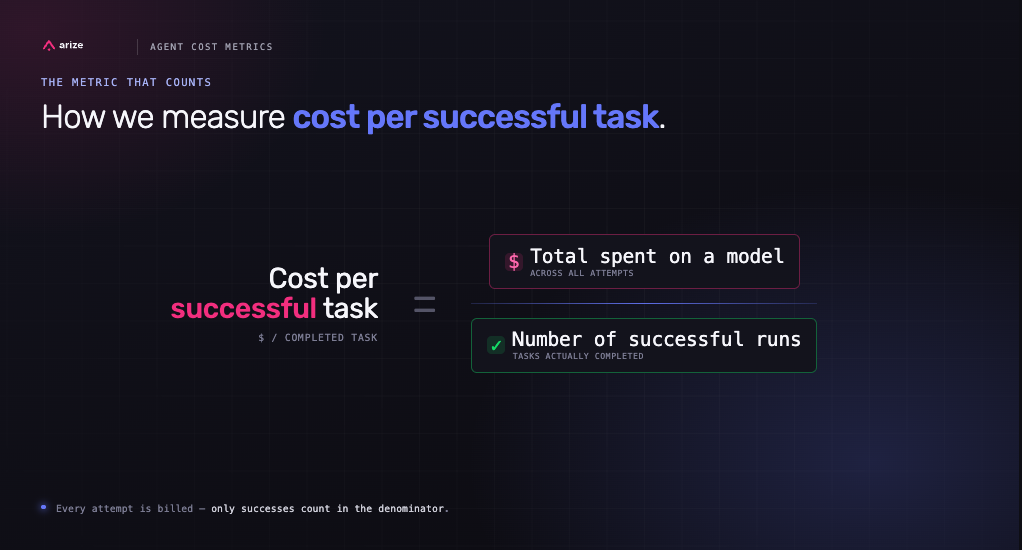 image成功したタスクあたりのコストの計算式:全試行での総支出 ÷ 成功した実行数。
トークン価格だけでは、再試行や失敗したツール呼び出し、不正な出力、判定(judge)呼び出し、あるいはリミットに達して一向に進まない実行は把握できません。しかし「成功したタスクあたりのコスト」なら、それらすべてを可視化できます。以下に、2,400 回の試行(40 のタスク × 10 のモデル × 各 6 回)で得られた結果を示します。
AI モデルのベンチマーク結果:成功したタスクあたりのコスト(10 モデル)
- Model:Provider / Pass rate / Mean $/attempt / $/successful task / Retry tax
- gpt-oss-120b:Fireworks (open) / 33% / $0.018 / $0.054 / 3.0×
- gemini-3.1-flash-lite:Google / 40% / $0.026 / $0.063 / 2.5×
- Kimi K2.6:Fireworks (open) / 42% / $0.163 / $0.384 / 2.4×
- GLM-5.2:Fireworks (open) / 42% / $0.208 / $0.500 / 2.4×
- DeepSeek V4 Pro:Fireworks (open) / 39% / $0.230 / $0.588 / 2.6×
- GPT-5.5:OpenAI (frontier) / 67% / $0.424 / $0.636 / 1.5×
- Kimi K3:Fireworks (open) / 66% / $0.441 / $0.670 / 1.5x
- GPT-5:OpenAI / 41% / $0.317 / $0.769 / 2.4×
- Claude Sonnet 5:Anthropic / 49% / $0.494 / $1.014 / 2.1×
- gemini-3.5-flash:Google / 23% / $0.288 / $1.233 / 4.3×
※本ベンチマークでは GPT-5.6 sol はテストしていません。以下の結果は、上記の 10 モデルのみを対象としたものであり、GPT-5.6 Sol との直接的な比較として解釈しないでください。
成功したタスクあたりのコストで最も効率的なモデルはオープンソースのものであり、今回の調査ではパス率も最低でした。gpt-oss-120b は 33% の確率でタスクを完了しますが、そのコストは 1 つの成功あたり約 0.054 ドルです。これは GPT-5.5 と比較して約 12 分の 1、gemini-3.5-flash と比較すれば 23 倍のコスト効率が良いことになります。
「再試行税(retry tax)」という列は、成功 1 回あたりに必要な試行回数という隠れたコストを数値化したものです。この税を支払ったとしても、コスト効率の観点ではオープンソースモデルが圧倒的に優位です。
フロンティアモデルの高額な価格がどこに消えるのか
集計データには最も重要な洞察が隠されています。タスクの難易度ごとに結果を分割して見てみましょう。
- モデル:easy / medium / hard
- gpt-oss-120b:65% / 32% / 14%
- gemini-3.1-flash-lite:69% / 48% / 8%
- Kimi K2.6:73% / 43% / 21%
- GPT-5.5:69% / 75% / 51%
- Kimi K3:100% / 72% / 32%
タスクの難易度ごとのパス率。
簡単なタスクにおいては、フロンティアモデルへの高額な支払いには何の意味もありません。GPT-5.5 は簡単なタスクを 69% の確率で成功させますが、Kimi K2.6 は 73%、gpt-oss-120b は 65% です。後者のコストは試行あたりの費用がフロンティアモデルの約 24 分の 1 に過ぎません。簡単な作業のために高額な価格を支払うのは、経済合理的ではありません。
一方、難しいタスクにおいては、上位クラス以外のモデルでは太刀打ちできません。最もコスト効率が良いモデルでも難易度の高い問題には遠く及びません。最難関の問題を解決するには、オープンソースかクローズドかを問わず、フロンティアクラスのモデルが必要です。また、再試行でカバーできるわけではありません。タスクをこなせないモデルは 4 回目の試行でそれを覚えるわけではなく、単に請求額が 4 倍になるだけです。こここそがルーティング(振り分け)でコストを節約できない唯一の場所です。機能そのものには対価を支払う必要があります。
「フロンティア級」という言葉は、単一のものを指すわけではありません。GPT-5.5(クローズド)と Kimi K3(近日オープン化予定、現在は Kimi.com 経由)は、ほぼ同点でこの調査を完了しました。1 つの成功タスクあたりのコストはそれぞれ 0.64 ドルと 0.67 ドル、成功率も 67% と 66% です。しかし、両者の得意分野は真逆です。
K3 は調査内のすべての簡単なタスクを完璧に解決しました(全 6 試行すべてで成功)。一方、GPT-5.5 はここで 69% の成功率にとどまりました。逆に最も難しいタスクでは結果が入れ替わります。GPT-5.5 が 51%、K3 は 32% です。
同じ階層、同じ価格帯、同じ総合成功率、しかし得意分野は正反対で、一方はオープンソース、もう一方はクローズドです。どちらがあなたのワークロードに適しているかを知る唯一の方法は、実際に自分のワークロードで測定してみることです。
最もコストパフォーマンスに優れたモデルが、そのまま置き換え可能なわけではない理由
「1 つの成功あたりのコスト」と「カバー範囲」は別の問題です。モデルが確実に解決できるタスクの数(6 試行のうち 4 回以上成功)をカウントすると以下のようになります。
gpt-oss-120b: 40 件中 8 件
GPT-5.5: 40 件中 25 件
Kimi K3: 40 件中 26 件
gpt-oss-120b は、自分が勝てるタスクにのみ集中して勝利するため、成功あたりのコスト効率が比較的高くなります。もしフロンティア級モデルをこのモデルへ丸ごと置き換えた場合、請求額は大幅に減りますが、その分、製品が実行できる作業の範囲も狭まってしまいます。
まず、この指標が最初に崩壊する地点です。成功したタスクあたりのコスト効率で最も優れているのは、オープンソースの gpt-oss-120b とクローズドの gemini-3.1-flash-lite で、わずか $0.054 と $0.063 と僅差です。一方、性能が最も高いのは GPT-5.5(クローズド)と Kimi K3(オープン)で、互角の結果でした。
オープンかクローズドかではなく、両端にそれぞれ存在するモデルを比較すると、真の軸は「再試行を含む小規模かつコスト効率の高いモデル」対「大規模で高価なモデル」という違いにあります。どちらを選ぶかは、直面しているタスクの内容次第です。
つまり、簡単なタスクに対して最先端モデルを使うのは過剰投資ですが、逆に小規模モデルだけだと解決策が得られない場合もあります。この課題に対する適切な対応は「ルーティング」です。簡単なタスクはコスト効率の高いモデルに、難しいタスクは最先端モデルへ振り分けるのです。その具体的な方法については後ほど解説します。
2,400 回の試行で評価した 10 の AI モデル
Terminal-Bench から実務のタスクを採用しました。これは実際のコマンドライン作業(ファイル変換、プログラムのデバッグ、ハッシュの解読、パズルの解決など)を評価するベンチマークです。各タスクには独自の Docker 環境とテストスクリプトが用意されています。
その上で、これらのタスクに挑戦するための小型で計測機能を持つエージェントを構築しました。
設定(エンドツーエンド)
- コストがモデルの性能に直結するよう、軽量なエージェントを採用しました。ツールは 1 つだけ(タスクコンテナ内で bash コマンドを実行)。シンプルなループ処理のみで構成し、複雑な枠組みによる評価の曖昧化を防ぎました。
- 実行にかかったコストはすべてモデルが獲得したものです。
設計段階からモデル非依存を徹底。表に含まれるすべてのモデルは、Fireworks、OpenAI、Anthropic、Google といった OpenAI 互換 API を通じて単一のコードパスを実行します。新しいモデルを追加する際は、ベース URL、モデル ID、価格を記述した設定行を追加するだけです。
誠実で決定論的な評価。エージェントがタスク完了後に実行するのは、コンテナ内で動作するそのタスク固有のテストスイートです。すべてのテストに合格すれば成功、一つでも失敗すればタスク全体が失敗となります。エージェントはテスト内容を見ることができないため、テストを回避する行為も不可能です。
2 つの安全装置。1 つ目はトークン予算(公平性を保つための主要なカットオフ基準)、2 つ目は十分な余裕を持たせた壁時計タイムアウト(セーフティネット)です。いずれかの条件に達した実行は「その理由」付きで失敗として記録され、真の誤答とは明確に区別されます。これにより、成功数の集計が正確に保たれます。
Arize AX への完全なトレーシング。すべての実行は OpenInference 形式のトレースを出力します。これは、ネストされた LLM スパンやツール呼び出しスパンを含むルートエージェントスパン、トークン数、レイテンシ、そして何かが起きた際の明確なエラーステータスから構成されます。これにより、単に「いくら使ったか」だけでなく、「どこにお金がかかったか」を可視化することが可能になりました。
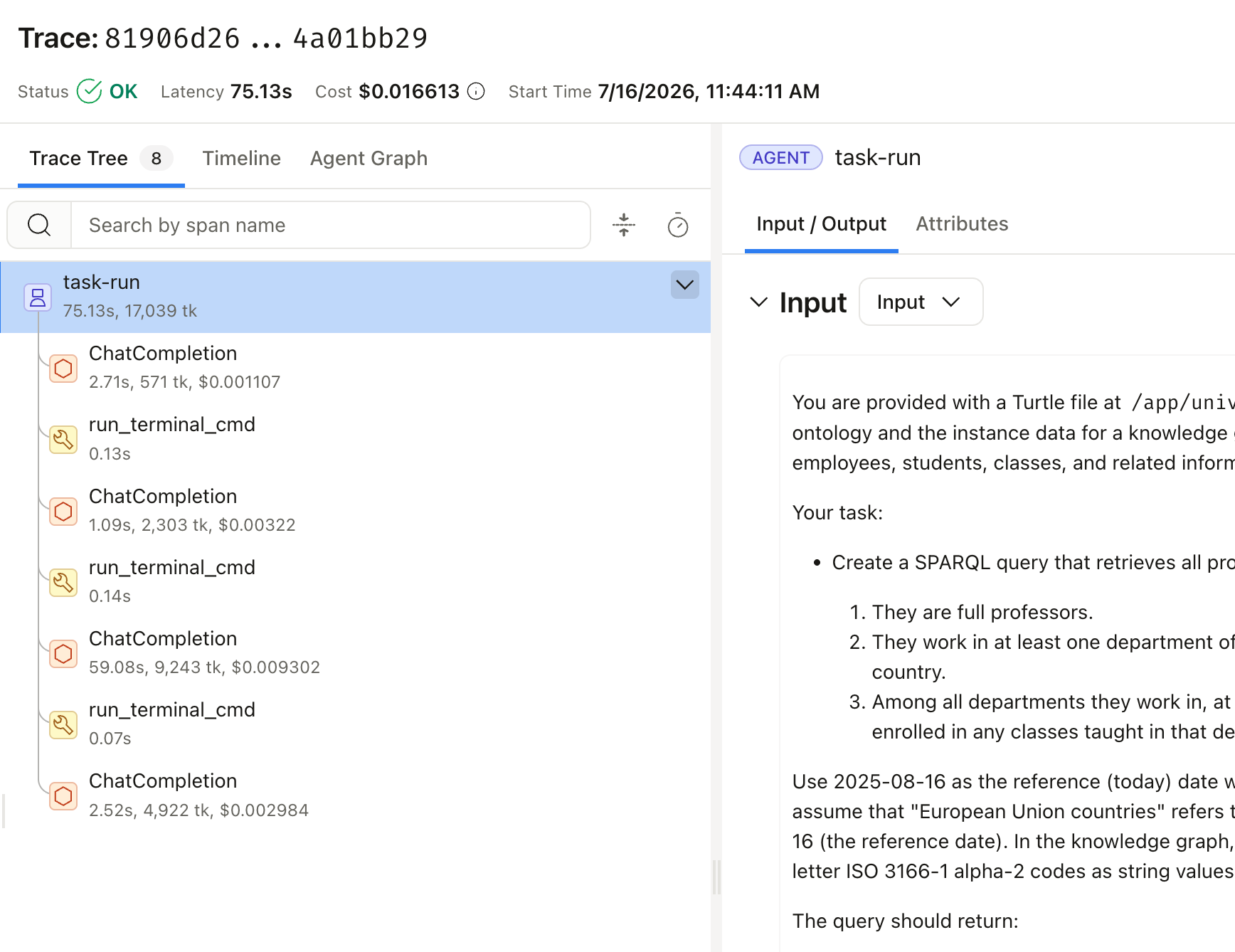 imageベンチマーク設定:Terminal-Bench の 40 タスク、10 モデル、各タスク・モデルペアで 6 回の試行を行い、Arize AX で追跡。40 タスク × 10 モデル × 6 回試行 = 計 2,400 実行、API 利用料は合計 626 ドル。400 のタスク・モデルペアそれぞれに正確に 6 回の試行が行われており、成功率の 95% 信頼区間は約±6 ポイントとなります。これなら「成功あたりのコスト」でモデルを順位付けするには十分ですが、隣り合うモデルのわずかな差まで見極めるには不十分です。例えば Kimi K2.6 と GLM-5.5 は互いに五分五分であり、どちらが優れていると報告することはできません。
AI モデルのルーティングによる「成功あたりのコスト」削減
最先端の高額モデルを簡単なタスクに使い、難しいタスクでこそ必要とするなら、両方の用途に同じモデルを買うのをやめるのが自然な選択です。実際の運用データに基づいてそのシミュレーションを行いました。
- ポリシー:確実に解決できるタスク数 / 成功あたりのコスト
- gpt-oss-120b 単独:8/40 / $0.054
- GPT-5.5 単独(単一モデルで最高):25/40 / $0.636
- Oracle ルーティング(各タスクを確実に解決できる最もコスト効率の良いモデルを選択):34/40 / $0.228
- エスカレーション(gpt-oss → flash-lite → Kimi 2.6 → GPT-5.5、初回パスで停止):32.3/40 / $0.525
- 全 10 モデルへの単純なエスカレーション:34.5/40 / $1.319
この結果から、3 つの重要な知見が得られます。
ルーティングは、単一モデルの性能を両方の軸で同時に上回ります。Oracle ルーティングは、GPT-5.5 単体と比較して成功するタスクが 36% 増え、かつ成功あたりのコストは約 3 分の 1 で済みます。ただし、各タスクに最適なモデルを選定するには事後の知識(ヒンドサイト)が必要となるため、これはルーティングがもたらす可能性の上限を示す指標と捉えるべきで、そのまま実装できるポリシーではありません。
エスカレーションは実装可能なバージョンであり、それでも両方の軸で勝利します。最もコスト効率の良いモデルから試し、失敗したらエスカレートし、最初のパスで成功すれば停止する——このアプローチでは、成功あたりのコストは 0.525 ドルです。これは単一の最前線モデルよりも多くのタスクを解決できます。なぜなら、ほとんどの作業は試行あたり 3 セント未満の安価なモデルで完了し、本当に難しいタスクのみが高価な段階に到達するからです。
不適切なエスカレーション・ラダーは、ルーティングなしよりも悪くなります。10 個のモデルをすべて無差別に通す単純なアプローチでは、成功あたりのコストが 1.319 ドルとなり、本研究で評価されたどの単一モデルよりも劣ります。誰も解決できない約 6 タスクに対してラダー全体のコストを支払うことになり、さらに価値の低い段階も通過する際に無駄が発生します。ラダーを慎重に設計することが不可欠です。
AI エージェントはいつ最前線モデルへエスカレートすべきか?
上記の内容に対する明白な反論があります。「失敗時にエスカレートする」という前提には、実行が失敗したかどうかを判断できる必要があるという点が含まれています。私たちのベンチマークでは、Terminal-Bench の各タスクにテストスイートが付属しているため、この問題は自動的に解決されます。しかし、実際の生産環境のシステムではそうはいきません。ここでは、実環境でどう対応すべきかを示します:
失敗を検出する必要が必ずしもないケースもあります。上記の難易度表自体がルーティングポリシーとして機能し、実行時の検証は不要です。各モデルがどのクラスの仕事に対応するかを一度だけオフラインで測定し、入力されるリクエストのクラスに応じてルーティングすればよいのです。「簡単な依頼には効率的なモデルを、複雑なものには最先端モデルを」という方針には、検証器ではなく分類器が必要です。エスカレーションは成果指向のルーティングであり、タスククラスに基づくルーティングは、オラクルなしで実装可能なバージョンです。
実際、人々が想定する以上に検証可能な作業は多いです。確認すべき質問例として以下が挙げられます。「コードはコンパイルされるか」「テストはパスするか」「JSON は解析可能かスキーマに適合するか」「SQL は実行され API 呼び出しはエラーレスで完了したか」「引用された記述は実際にソース文書に含まれているか」です。回答を検証する方が、生成するよりもコスト効果が高いケースがほとんどです。低コストの決定論的チェックが存在する場所であれば、エスカレーションを今日から導入可能です。多くのエージェント作業はまさにこの形状をしています。
検証者がいない場合、失敗よりも「苦戦の兆候」を重視してエスカレーションすべきです。正解を知る必要はありません。処理が破綻しているかどうかは直感的にわかります。
Gemini-3.5-flash の失敗事例の 91% が予算枯渇によるものでした。これは、モデルが自身の能力を超えて無理をして処理し続ける状態です。この「無理やり処理する様子」は進行中に明確に観測可能です。ツール呼び出しが非ゼロで終了する、同じコマンドを 3 回繰り返す、そのタスクタイプの平均コストの 5 倍もの費用がかかる——これらはすべてリアルタイムのシグナルであり、正解(ground truth)を知る必要もありません。これらの情報はすべて、Arize から取得できるトレースデータの中に存在しています。
しかし、実際にコストを発生させるのは「静かな失敗」です。テストが失敗したと判定された処理が、自信満々に完了し、すべてのスパンが緑色で表示され、コマンドもクリーンに実行されているのに、回答自体は誤っているケースです。内部からは何も問題がないように見えるため、苦戦のシグナルは発生しません。
こうしたケースに対処するには、真の検証が必要です。検証者(verifier)や LLM 判事(LLM judge)を用いる方法があります。ただし、LLM 判事の呼び出し自体が明確なコストであり、同じ会計基準で管理する必要があります。あるいは、下流からのシグナル——「いいね」ボタンでの評価低下、再試行の発生、サポートチケットの作成など——を利用することも有効です。
ここで無料の午餐はありません。これを無視するルーティング戦略を採用すれば、後で代償を払うことになります。
もしシステム全体で成功と失敗を見分けることが本当にできないのであれば、モデル選定が最大の課題ではありません。評価できない製品を出荷している状態だからです。「成功したタスクあたりのコスト」を重視することは、厳密な評価を通じて「成功とは何か」を定義することを強要します。これは本来、あなたがすでに実施すべきことなのです。
最先端の AI モデルは、常に信頼性が高いのでしょうか?
高価なモデルを「とりあえず動けばいい」という選択肢として扱いたくなる気持ちもわかります。しかし、実際のトレースデータはそれを否定しています。
csv から parquet への変換という極めて単純なタスクにおいてさえ、GPT-5.5 は 6 回の試行のうち 3 回しか成功しませんでした。
今回の調査で最も高価な成功事例となったのは、Claude Sonnet 5 が暗号解読タスクを完了させた際の $1.35 です。これは、平均的な成功にかかるコストが gpt-oss-120b の約 25 倍に相当します。
gemini-3.5-flash は、今回の調査全体における教訓となるケースです。このモデルは、成功率(23%)、成功あたりのコスト($1.233)、リトライによる追加コスト(4.3 倍)のすべての指標で最悪の結果を記録しました。さらに、失敗の 91%(184 件中 168 件)がトークン制限によるものでした。モデルは予算を浪費し続け、何も生成しないまま終わってしまうのです。一方、同じく Gemini シリーズの軽量版である flash-lite は、成功あたりのコスト効率において業界で第 2 位を記録しています。これほどまでに近い兄弟モデル間で結果が異なるのは、なぜ評価が必要なのかを如実に物語っています。
AI のトレース解析が明らかにする隠れたコスト
集計データからは、低コストモデルが効率的であることがわかります。しかし、トレースデータを分析することで「なぜそうなるのか」の理由が見え、「見えないはずのコスト」が可視化されます。すべての実行を Arize AX でツール呼び出しやトークン数の詳細まで追跡しているため、各失敗には固有の説明がつきます。
token_cap: エージェントは予算に対して無駄な試行を繰り返すも収束せず、何らかの成果に至りませんでした。ツール呼び出しが延々と続く様子が確認できます。これは、モデルが自身の能力を超えたタスクに直面した際に生じる本当のコストです。トークン価格ベースの評価では決して見えてこないコストであり、gemini-3.5-flash の失敗の 91% がまさにこれに該当します。
テストに失敗したケース:エージェントは完了したと確信していましたが、タスクのテスト結果とは矛盾していました。トレースを見ると、すべてのモデル呼び出しが正常(緑色)で、すべてのコマンドも問題なく実行されていますが、ルートスパンだけが赤く表示されます。「すべては機能したが、結果だけが悪かった」というこの兆候は、静かなる失敗であり、最もコストのかかるタイプです。なぜなら、本番環境では何も警告が出ないからです。これが GPT-5.5 で発生した CSV から Parquet への変換で起きた失敗の典型的な姿です。
ツール呼び出しにおける摩擦:非ゼロで終了するコマンドはトレース上で赤く表示されるため、実行が困難に陥った正確なステップと、回復のために消費された試行回数を一目で確認できます。
トークン単位のベンチマークでは「1 つの数値」しか得られず、改善の余地も示されません。一方、トレースを活用すれば、失敗した実行を診断へと変換できます。「どのモデルが」「どのステップで」「どれほどのコストで」「大げさに失敗したのか、それとも静かに失敗したのか」が明確になるのです。これは単にコストを知っているのと、そのコストに対して具体的な対策を講じられることの決定的な違いです。
(ジャッジコストに関する注記:今回の評価では各タスク固有の決定論的テストを使用したため、LLM-as-a-Judge によるオーバーヘッドは発生していません。評価に LLM-as-a-Judge を採用するシステムでは、そのジャッジ呼び出し自体が新たな実質的な継続コストとなり、同様に「成功したタスクあたりのコスト」を算出する必要があります。)
開発者体験について一言
Fireworks により、モデルの側面での実装が容易になりました。OpenAI 互換 API を採用しているため、同社が開発したオープンソースモデルも、他社のプロバイダーと同様のコードパスで動作します(Fireworks はこの点について分かりやすいドキュメントを提供しています)。違いは、ベース URL とモデル ID のみです。すでに gpt-oss-120b を対象とした調査に GLM-5.2 を追加する際も、設定行の追加だけで済み、統合プロジェクトのような手間はありませんでした。
比較研究においてはこうした利便性は歓迎すべき点ですが、本番環境でのルーティング層を構築する場合は決定的な重要性を持ちます。「このタスクは最も低コストで能力の高いモデルに送り、失敗したらエスカレーションする」という戦略が現実味を持つのは、API レベルで各段階のモデルが相互交換可能である場合に限られます。一つのプラットフォーム上で強力なオープンソースモデルが幅広く利用可能であることが、その「梯子」の低コスト側を有効にする根拠です。上記の数値が示す通り、タスクの多くは低コスト側のモデルで処理すべきなのです。
自分で測定してみよう
本調査で使用したフルハーン(エージェント、Docker タスクリンナー、採点機能、ガードレール、Arize AX のインストルメンテーション、ルーティング分析、および本研究の結果)は、実行と拡張が可能です。このレシピは、あなた自身のタスクにも応用できます。
- 検討中のモデルに対して、代表的な実務タスクのセットを複数回試行してください。低コストモデルでは処理が困難なタスクも含まれるようにします。そこにはカーブの最も興味深い部分が潜んでいます。
- 各実行結果は、自社のプロダクトで実際に成功と定義する基準に基づいて採点してください。
- すべての費用を合計し、成功件数で割ってコストを算出します。同時に失敗したケースのトレースも確認しましょう。必ず「カバレッジ」と「コスト」の両方を報告してください。
モデルや価格の変動に応じてルーティングを見直し、再測定を行う必要があります。
結論
トークン価格はインフラストラクチャの指標であり、キャパシティ計画には有用ですが、プロダクションスタックの設計においてはほとんど役に立ちません。真に重要なのは「成功したタスクあたりのコスト」という生産性の指標です。2,400 回の試行にわたってエンドツーエンドでこれを測定すると、価格ページが描くイメージは逆転します。
成功したタスクあたりのコストはトークン価格から桁違い(1 桁以上)に乖離することがあり、価格ページが示すランキングを完全にひっくり返してしまいます。
「オープンかクローズドか」というラベルは、ここでは何の意味も持ちません。最も効率的なモデル 2 つのうち 1 つはオープンで他方はクローズドでしたし、最も強力なモデル 2 つ(GPT-5.5 とオープンウェイトの Kimi K3)も同様に 1 つがクローズド、もう 1 つがオープンでした。両者は互角の実力です。特定の「陣営」を買うのではなく、機能と価格で選ぶべきです。
最先端モデルへのプレミアムは簡単な作業では無意味ですが、難しい作業では決定的な差を生みます。したがって、すべてのタスクに単一のモデルを割り当てるのではなく、難易度に応じてルーティングを行うべきです。
コストとカバレッジの両面で、単一モデル戦略よりもルーティングが優れています。ただし、これは意図的なエスカレーション階層(ladder)があってこそです。不適切なエスカレーション階層は、何もない状態よりも悪くなります。
「カバレッジ」と「コスト」は別の問いです。コスト効率に優れたモデルは 40 タスクのうち 8 つを確実に解決しましたが、最先端ティアのモデルは 25〜26 タスクを解決しました。この両方を報告する必要があります。
これらのトレースにより、サイレントフォールト(静かな失敗)や、失敗時に予算の 91% を使い果たしてしまうような隠れたコストも、すべて明確に浮き彫りになりました。
成功したタスクあたりのコストを最適化し、各レイヤーに実際に適したモデルを割り当ててください(誰が作ったかやトークンあたりのコストに関係なく)。また、難しいケースに対応できるよう、高性能なモデルを予備として確保し、すべてのプロセスを追跡可能にしておくことが重要です。これは単にコスト効率が良いスタックというだけでなく、論理的に分析可能なスタックでもあります。
今回の研究では、Terminal-Bench の 40 タスク × 10 モデル × 6 回の試行(計 2,400 回の実行、API 利用料 $626)を評価しました。各タスクのテストスイートによって採点され、Arize AX で完全にトレーシングされています。各タスクとモデルの組み合わせには 6 回の試行が行われ、合格率には約±6 ポイントの 95% 信頼区間が含まれます。価格は 2026 年 7 月時点のものです。この結果はランキング表ではなく方向性を示すものであり、Terminal-Bench の約 240 タスクのうち、一部のモデルが合格し他のモデルが不合格となる境界領域に位置する 40 タスクを選定しています。Claude Sonnet 5 は導入価格ではなく標準料金が適用されています。
「成功したタスクあたりのコスト:Kimi K3、GPT-5.5、およびその他 8 つの AI モデルをベンチマーク」という記事は、Arize AI で最初に公開されました。
原文を表示
Arize and Fireworks tested 10 open and closed models (including the soon to be open-weights Kimi K3) on 40 real agent tasks and 2,400 runs, measuring pass rates, retries, coverage, and cost per successful task.
This is an experiment from Fireworks and Arize, built around one question: when you’re choosing a model to get real work done, what should you actually optimize? The reflex is to pick a side by label, open or closed, cost effective or frontier. We ran ten models from four providers against real command-line tasks and measured not the price of tokens but the price of finishing the job, and the labels turned out to be the wrong axis. What separated the models was cost per successful task.
The question matters more every month, because the economics of inference are shifting. The first few years of the LLM era ran on heavily subsidized pricing, set to capture market share rather than to cover cost. That era is ending (a shift I’ve written about before). When you pay the full cost of inference, the gap between a model that looks cost effective on a pricing page and a model that is actually cost effective to get work done becomes the difference between a product that pencils out and one that doesn’t.
Cost per token is an infrastructure metric. Cost per successful task is a productivity metric. The second one is what teams should optimize.
By cost per successful task we mean everything a model spent across every attempt, including the runs that failed, retried, or timed out, divided by the number of times it actually completed the task:
imageCost per successful task formula: total spend across all attempts divided by successful runs.
Token price can’t see retries, failed tool calls, malformed outputs, judge calls, or runs that grind to a limit and never finish. Cost per successful task sees all of it. Here is what it showed across 2,400 runs: 40 tasks, 10 models, 6 trials each.
AI model benchmark results: cost per successful task across 10 models
Model
Provider
Pass rate
Mean $/attempt
$/successful task
Retry tax
gpt-oss-120b
Fireworks (open)
33%
$0.018
$0.054
3.0×
gemini-3.1-flash-lite
40%
$0.026
$0.063
2.5×
Kimi K2.6
Fireworks (open)
42%
$0.163
$0.384
2.4×
GLM-5.2
Fireworks (open)
42%
$0.208
$0.500
2.4×
DeepSeek V4 Pro
Fireworks (open)
39%
$0.230
$0.588
2.6×
GPT-5.5
OpenAI (frontier)
67%
$0.424
$0.636
1.5×
Kimi K3
Fireworks (open)
66%
$0.441
$0.670
1.5x
GPT-5
OpenAI
41%
$0.317
$0.769
2.4×
Claude Sonnet 5
Anthropic
49%
$0.494
$1.014
2.1×
gemini-3.5-flash
23%
$0.288
$1.233
4.3×
Note: We did not test GPT-5.6 sol in this benchmark. The results below reflect only the 10 models listed and should not be interpreted as a direct comparison with GPT-5.6 Sol.
The most cost effective model per successful task is an open one, and it has the worst pass rate in the study. gpt-oss-120b finishes a task for $0.054 while passing only 33% of the time, roughly 12× lower cost per success than GPT-5.5 and 23× more cost effective than gemini-3.5-flash. The “retry tax” column is that hidden cost in one number, the attempts needed per success. Even paying that tax, cost effective model economics win handily.
Where the frontier premium actually goes
Aggregates hide the most actionable result in the study. Split the same runs by task difficulty:
Model
easy
medium
hard
gpt-oss-120b
65%
32%
14%
gemini-3.1-flash-lite
69%
48%
8%
Kimi K2.6
73%
43%
21%
GPT-5.5
69%
75%
51%
Kimi K3
100%
72%
32%
Pass rate by task difficulty.
On easy tasks, the frontier premium buys you nothing at all. GPT-5.5 passes 69% of easy tasks. Kimi K2.6 passes 73% of them, and gpt-oss-120b passes 65% at roughly a twenty-fourth of the cost per attempt. Paying frontier prices for easy work doesn’t make financial sense.
On hard tasks, only the top tier even competes. The most cost-effective models fall far; solving the hardest problems takes a frontier-class model, open or closed. And retrying is no substitute: a model that cannot do a task does not learn it on the fourth attempt, it just bills you four times. This is the one place routing cannot save you money. You have to pay for capability.
But “frontier-class” is not one thing. GPT-5.5 (closed) and Kimi K3 (soon to be open, currently via Kimi.com) finished the study in a near-tie, 67% and 66% success at $0.64 and $0.67 per successful task, and yet they’re good at opposite work. K3 solved every easy task in the study, all six trials of all of them, where GPT-5.5 slipped to 69%. On the hardest tasks they swap: GPT-5.5 51%, K3 32%. Same tier, same price, same overall success, opposite strengths, one open and one closed. The only way to know which fits your workload is to measure it on your workload.
Why the most cost-effective model is not a drop-in replacement
Cost per success and coverage are different questions. Counting tasks a model solves reliably (4 of 6 trials or better):
gpt-oss-120b: 8 of 40
GPT-5.5: 25 of 40
Kimi K3: 26 of 40
gpt-oss-120b is more cost effective per success partly because it only wins the tasks it can win. If you swap your frontier model for it wholesale, your bill collapses and so does the set of things your product can do.
This is where the labels first break down, and it isn’t the last. The two most efficient models per success are gpt-oss-120b (open) and gemini-3.1-flash-lite (closed), a hair apart at $0.054 and $0.063. At the other end, the two strongest models are GPT-5.5 (closed) and Kimi K3 (open), in a dead heat. Open and closed, side by side, at both ends of the range. The real axis is not open versus closed. It is small-and-cost-effective-with-retries versus large-and-expensive, and which one you want depends entirely on the task in front of you.
So using a frontier model overpays for easy tasks, but using a smaller model may leave you with no solution at all. The right response to this is routing: send easy tasks to the cost effective model, and harder tasks to the frontier. We’ll talk about how to do that in a moment.
How we benchmarked 10 AI models across 2,400 runs
We ran real tasks from Terminal-Bench, a benchmark of genuine command-line jobs (e.g. convert this file, debug this program, crack this hash, solve this puzzle), each shipping its own Docker environment and its own test script. Then we built a small, fully instrumented agent to attempt them.
The setup, end to end:
A thin agent, so cost reflects the model. One tool (run a bash command in the task’s container) in a plain loop. No elaborate scaffolding to muddy the attribution. Whatever a run costs, the model earned it.
Model-agnostic by design. Every model in the table runs through one code path via OpenAI-compatible APIs: Fireworks, OpenAI, Anthropic, and Google. Adding a model is a config line: a base URL, a model id, a price.
Honest, deterministic grading. After the agent finishes, we run the task’s own test suite inside the container. All tests pass or the task failed. The agent never sees the tests, so it can’t game them.
Two guardrails. A token budget (the primary, fairness-preserving cutoff) and a generous wall-clock timeout (a safety net). A run that hits either is recorded as a failure with that reason, kept distinct from a genuine wrong answer, so the success count stays honest.
Full tracing to Arize AX. Every run emits an OpenInference trace: a root agent span with nested LLM and tool-call spans, token counts, latency, and a clear error status when something goes wrong. This is what let us see where the money went, not just how much.
imageBenchmark setup: 40 Terminal-Bench tasks, 10 models, and 6 trials per task-model cell, traced to Arize AX.
40 tasks × 10 models × 6 trials = 2,400 runs, $626 of API spend. Every one of the 400 task-model cells has exactly 6 trials, which puts the 95% confidence interval on a pass rate at about ±6 points. That is enough to rank models by cost per success with confidence. It is not enough to split hairs between neighbors: Kimi K2.6 and GLM-5.5 are a coin flip apart, and we would not report one as beating the other.
How AI model routing reduces cost per successful task
If the frontier premium is wasted on easy work and essential on hard work, the obvious move is to stop buying one model for both. We simulated that over the real runs.
Policy
Reliably solves
$/successful task
gpt-oss-120b alone
8/40
$0.054
GPT-5.5 alone (best single model)
25/40
$0.636
Oracle routing (the most cost effective model that reliably solves each task)
34/40
$0.228
Escalation (gpt-oss → flash-lite → Kimi 2.6 → GPT-5.5, stop on first pass)
32.3/40
$0.525
Naive escalation through all 10 models
34.5/40
$1.319
Three things fall out of this:
Routing beats the best single model on both axes at once. Oracle routing solves 36% more tasks than GPT-5.5 alone at roughly a third of the cost per success. It needs hindsight to pick the right model per task, so treat it as the ceiling on what good routing buys rather than a policy you can deploy.
Escalation is the deployable version, and it still wins on both axes. Try the most cost effective model, escalate on failure, stop on the first pass: $0.525 per success while solving more tasks than the frontier model alone, because most work gets done by a model costing under three cents an attempt and only the genuinely hard tasks ever reach the expensive rung.
A bad escalation ladder is worse than no routing at all. Naively escalating through all 10 models costs $1.319 per success, worse than every single model in the study. You pay the entire ladder on the roughly six tasks nobody solves, and you pay poor-value rungs on the way past. Designing your ladder carefully is essential.
When should an AI agent escalate to a frontier model?
There’s an obvious objection to everything above. “Escalate on failure” assumes you can tell that a run failed. Our benchmark gets that for free, because every Terminal-Bench task ships its own test suite. Most production systems don’t. Here’s how to do it in production:
Often you don’t need to detect failure at all. The difficulty table above is already a routing policy, and it needs no runtime verification of anything. Measure once, offline, which class of work each model handles, then route by the class of the incoming request. “Simple requests to the more efficient model, complex ones to the frontier” needs a classifier, not a verifier. Escalation is the outcome-driven version of routing; routing by task class is the version you can ship without an oracle.
More work is verifiable than people assume. A few example questions you should ask: Does the code compile? Do its tests pass? Does the JSON parse and does it validate against the schema? Does the SQL run and did the API call come back non-error? And do the cited quotes actually appear in the source document? Checking an answer is usually more cost effective than producing one. Wherever a low-cost deterministic check exists, escalation is deployable today, and a lot of agentic work is exactly this shape.
When there’s no verifier, escalate on distress rather than on failure. You don’t need to know the right answer to notice a run going badly. Recall that 91% of Gemini-3.5-flash’s failures were budget exhaustion: a model out of its depth churns, and churn is visible while it’s happening. Tool calls exiting non-zero, the same command repeated three times, a run costing five times the median for its task type: all of these are live signals, none of them require ground truth, and all of them are sitting in the traces you get from Arize.
But the failure that actually costs you is the silent one. A test_failed run finishes confidently, every span green, every command clean, and the answer simply wrong. No distress signal fires, because from the inside nothing went wrong. For those you need a real check: a verifier, an LLM judge (whose calls are a genuine cost and belong in the same accounting), or a downstream signal like a thumbs-down, a retry, or a support ticket. There is no free lunch here, and a routing story that pretends otherwise is one you’ll pay for later.
But if you genuinely cannot tell success from failure anywhere in your system, model selection is not your biggest problem: you’re shipping something you can’t evaluate. Cost per successful task forces you to define what success means through rigorous evaluations, which is something you should have been shipping anyway.
Are frontier AI models always more reliable?
It’s tempting to treat the expensive model as the “just works” option. The traces say otherwise.
On csv-to-parquet, a trivially easy “convert this file” task, GPT-5.5 passed only 3 of 6 trials.
The single most expensive success in the entire study was Claude Sonnet 5 solving a cryptanalysis task for $1.35, twenty-five times what gpt-oss-120b charges for an average success.
gemini-3.5-flash is the cautionary tale of the whole study. It has the worst pass rate (23%), the worst cost per success ($1.233), the worst retry tax (4.3×), and 91% of its failures (168 of 184) were the token cap: it spirals, burns its entire budget, and produces nothing. Meanwhile its own smaller sibling, flash-lite, is the second most cost effective model per success in the field. Such different results from close model siblings is why you need evaluations.
How AI tracing exposes hidden model costs
Aggregates tell you that the low cost models are efficient. Traces tell you why, and traces are where the “invisible” costs become visible. Because every run is traced to Arize AX with tool-call and token detail, each failure carries its own explanation:
token_cap: the agent churned against the budget without converging. You see a long tail of tool calls going nowhere. This is the real cost of a model that’s out of its depth, and it is exactly what a token-price benchmark hides. It is also 91% of what gemini-3.5-flash did.
test_failed: the agent finished, confident it was done, but the task’s tests disagreed. In the trace, every model call is green and every command ran cleanly, yet the root span is red. That “everything worked except the outcome” signature is a silent failure, the most expensive kind, because in production nothing would have alerted you. This is what GPT-5.5’s csv-to-parquet failures look like.
Tool-call friction: commands that exit non-zero light up red in the trace, so you can see the exact step where a run started to struggle and how many attempts it burned recovering.
A per-token benchmark gives you one number and no recourse. Traces turn a failed run into a diagnosis: which model failed, at which step, at what cost, and whether it failed loudly or silently. That is the difference between knowing your costs and being able to do something about them.
(A note on judge costs: we graded with each task’s own deterministic tests, so there was no LLM-as-a-Judge overhead here. In systems that use LLM-as-a-Judge for evaluation, those judge calls are another real, recurring cost, and the same cost-per-successful-task accounting is needed.)
A word on the developer experience
Fireworks made the model side effortless. It’s OpenAI-compatible API meant its open models ran through the same code path as every other provider we tested (Fireworks offers easy-to-follow documentation on this), differing only by a base URL and a model id. Adding GLM-5.2 to a study that already had gpt-oss-120b was a config line, not an integration project.
For a comparison study that’s a convenience. For a production routing layer it’s critical: “send this task to the lowest cost and most capable model, escalate if it fails” is only realistic when the rungs of your ladder are interchangeable at the API level. The breadth of strong open models on one platform is what makes the cost effective end of that ladder possible at all, and as the numbers above show, the low-cost end is where most of your tasks should be getting done.
Measure it yourself
The full harness (the agent, the Docker task runner, the grading, the guardrails, the Arize AX instrumentation, the routing analysis, and the results from this study) is available to run and extend. The recipe is portable to your own tasks:
Run a representative set of your real tasks, several trials each, across the models you’re considering. Include tasks that are too hard for the low-cost models; that’s where the interesting part of the curve is.
Grade each run the way your product actually defines success.
Count all the spend, divide by the successes, and read the traces on the failures. Report coverage next to cost, always.
Route accordingly, and re-measure, because models and prices both move.
The takeaway
Token price is an infrastructure metric. It’s useful for capacity planning and almost useless for designing your production stack. Cost per successful task is the productivity metric, and when you measure it end to end across 2,400 runs, the picture the pricing pages paint flips:
Cost per successful task can diverge from token price by more than an order of magnitude, and it inverts the ranking the pricing pages give you.
The open-versus-closed label predicts nothing that matters here. The two most efficient models were one open and one closed; the two strongest were one closed and one open, GPT-5.5 and the open-weights Kimi K3, in a dead heat. Buy capability and price, not a camp.
The frontier premium is worth nothing on easy work and decisive on hard work, so route by difficulty instead of buying one model for every job.
Routing beats every single-model strategy on cost and coverage at once, but only with a deliberate ladder. A bad escalation ladder is worse than none.
Coverage and cost are different questions: the cost-effective model reliably solved 8 of 40 tasks, the frontier tier 25 to 26. Report both.
The traces made every hidden cost, including silent failures and the model that burned its whole budget 91% of the time it failed, impossible to miss.
Optimize for cost per successful task, match each rung of your stack to the model that actually fits it (regardless of who built it or what it costs per token), keep a capable model in reserve for the hard tail, and instrument everything. That’s not just the more cost-effective stack; it’s the one you can reason about.
Study: 40 Terminal-Bench tasks × 10 models × 6 trials (2,400 runs, $626 of API spend), graded by each task’s own test suite, fully traced to Arize AX. Every task-model cell has 6 trials; pass rates carry roughly a ±6 point 95% confidence interval. Prices as of July 2026. Results are directional, not a leaderboard score: 40 of Terminal-Bench’s ~240 tasks, chosen to sit in the band where some models pass and some fail. Claude Sonnet 5 is billed at its standard rate, not its introductory rate.
The post Cost per successful task: Benchmarking Kimi K3, GPT-5.5, and 8 more AI models appeared first on Arize AI.
同じ出来事を2媒体で確認
同じ出来事を扱う別媒体の記事です。見出しと公開時刻を比較できます。
News to Guide
ニュースの次に確認する
発表内容を、現在の料金や仕様と照らし合わせられる関連ガイドです。
今日のまとめ
AIデイリーブリーフで今日の重要ニュースをまとめ読み