大規模言語モデルの理解を深めるための書籍5選
本文の状態
日本語全文を表示中
詳細モードで約9分の本文を読めます。
同じ出来事の情報源
この情報源を基点に整理
KDnuggets
生成 AI エコシステムが急速に進化する中で、API のプロンプト操作を超えて大規模言語モデルの内部仕組みを深く理解し、訓練や展開を行うために必要な書籍 5 冊を紹介している。
AI深層分析を開く2026年7月31日 21:51
AI深層分析
キーポイント
技術的基礎の構築
Sebastian Raschka の著書は、PyTorch を用いて大規模言語モデルをゼロから設計・訓練・微調整するプロセスを詳細に解説している。
概念的理解の深化
現代の言語モデルが実際にどのように機能するかを示す概念的な地図を提供し、高レベルな抽象化ではなく数学的・論理的な裏付けに触れることを重視する。
実践的な学習リソース
20 以上の注釈付き Jupyter ノートブックを含み、トークン化、埋め込み、アテンション層などのコアメカニズムについて深く技術的にカバーしている。
体系的な学習の必要性
断片的なチュートリアルでは不十分であり、シリアスな実務家が基礎モデルを扱うには構造化された包括的なリソースが必要であると指摘している。
限られた時間で効率的に学習できる入門書
Andriy Burkovの著書は、忙しい専門家や学生向けに、技術的な正確さを損なわずにNLP分野への高シグナルな導入を提供する。n-gramsからGPTやBERTに至るまでの進化をたどり、数学的概念を視覚とコードで解説している。
重要な引用
The generative AI ecosystem moves fast, but the mathematics and architectures powering it are well-documented.
Instead of hiding the mechanics behind high-level abstractions, it puts you in direct contact with the underlying mathematics and logic.
Fragmented tutorials won't cut it for serious practitioners.
"It traces the evolution of language models from simple count-based n-grams to modern architectures like GPT and BERT."
編集コメントを表示
編集コメント
このリストは、大規模言語モデルの技術的深掘りを求める実践者にとって貴重なガイドとなる。特にゼロからの実装を重視するアプローチは、ブラックボックス化が進む現代の AI 開発において重要な視点を提供している。
Source Article
元記事を日本語で読む
本文に関係しない購読案内、埋め込み通知、サイト内プロモーションは除いています。
イントロダクション
生成 AI のエコシステムは急速に進化していますが、その背後にある数学やアーキテクチャの仕組みについてはすでに多くの文献が蓄積されています。古典的な自然言語処理(NLP)から生成 AI へ移行したことで、データ専門家が実際に習得すべき知識も大きく変化しました。
数年前であれば、リカレントニューラルネットワーク(RNN)や一般的な分類モデルを理解していれば、多くの役割をこなすことができました。しかし現在では、トランスフォーマーアーキテクチャのスケールと複雑さが、機械学習に対するより厳密でシステム全体を見渡せるアプローチを求めています。
API へのプロンプト入力に留まらず、ファウンデーションモデルのトレーニングやファインチューニング、展開までを自ら理解したいのであれば、体系的で包括的なリソースが必要です。断片的なチュートリアルでは、本格的な実践者には物足りません。
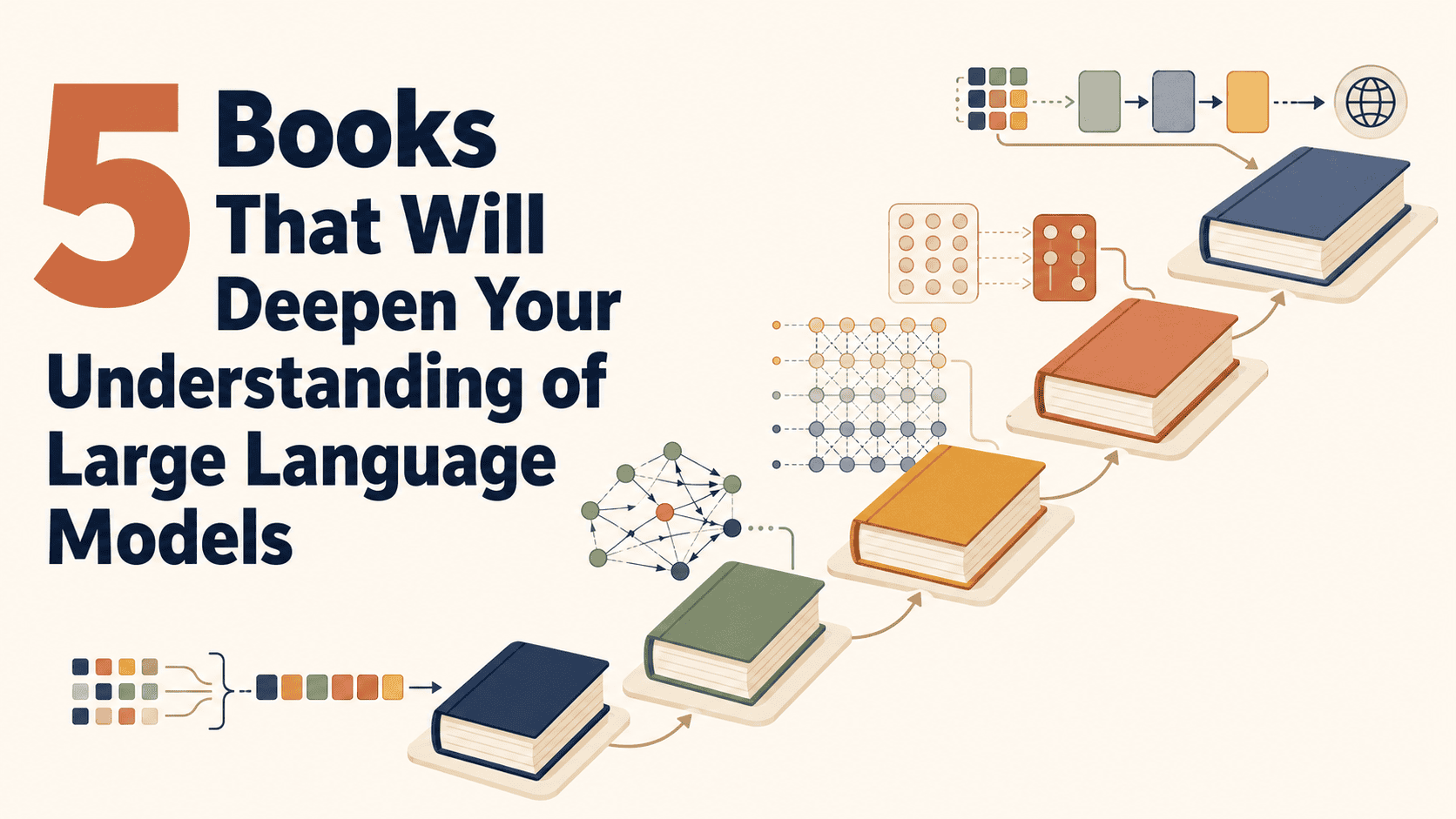
以下に紹介する 5 冊は、大規模言語モデル(LLM)への理解を深めるための書籍です。簡潔な概念的解説から、コードを多用したエンジニアリングのハンドブックまで、幅広いレベルに対応しています。
Sebastian Raschka 著『Build a Large Language Model (From Scratch)』
まずは技術的な基礎から始めましょう。複雑なシステムを理解する最も確実な方法は、実際に自分で構築してみることです。最初の 2 冊はこの原則に忠実に従っています。1 冊目は LLM をゼロから構築する手順を丁寧に案内し、もう 1 冊目は現代の言語モデルがどのように動作しているのかについて、最も鋭い概念的な地図を提供します。
Sebastian Raschka 著の『Build a Large Language Model (From Scratch)』は、LLM の設計・トレーニング・ファインチューニングに至るまでの細部にわたるプロセスを丁寧に解説します。高レベルな抽象化の背後に隠された仕組みではなく、その根底にある数学やロジックと直接向き合うことで理解を深めることができます。
本書で扱われる主な内容は以下の通りです。
- PyTorch を用いてトランスフォーマーベースの LLM をゼロから完全に実装する手順をガイドします。
- トークン化、埋め込み、アテンション層、最適化手法などの中核的な仕組みについて、深い技術的解説を提供します。
- 実践的な理解を促すため、注釈付きの Jupyter ノートブックが 20 本以上収録されています。
- 高レベルな理論と実装コードをつなぎ、データがネットワーク内をどのように流れるかを正確に把握したい研究者や AI エンジニアにとって最適な一冊です。
# 2. Andriy Burkov 著『The Hundred-Page Language Models Book』
ゼロから構築することは直感を養う一つの方法ですが、何かを構築し始める前に、その分野の全体像を示す高品質な地図が必要な場合もあります。そんな時に役立つのが、Burkov のコンパクトなガイド『The Hundred-Page Language Models Book』です。忙しいビジネスパーソンや学生にとって、NLP 分野へのシグナルの高い入門書として最適で、技術的な正確さを損なうことなく、必要な知識を効率的に得ることができます。
この本が際立っている理由:
言語モデルの進化を、単純なカウントベースの n-gram から GPT や BERT といった現代のアーキテクチャに至るまで追跡しています。
コアとなる数学的概念をわかりやすく解説し、クリーンなビジュアルと動作する Python のコードスニペットを組み合わせました。
事前学習やテキスト生成、アテンション機構といった複雑なトピックを、消化しやすい章立てで分解して紹介しています。
時間制約のある読者向けに、1 時間あたりの学習価値が最大になるよう設計されています。
# 3. Hands-On Large Language Models by Jay Alammar and Maarten Grootendorst
ここからは実践的な層へと話を移しましょう。基礎を固めた後、自然な次の疑問は「この知識を使って実際にどう何かを作るのか」という点です。以下の 3 冊は LLM の理解から実装へ焦点をシフトし、視覚的な直感やセマンティック検索、大規模なプロダクション展開に至るまで幅広くカバーしています。
トランスフォーマーに関するビジュアルエッセイで知られる Jay Alammar と Maarten Grootendorst によって書かれた『Hands-On Large Language Models』は、理論と実践の両方を求めるビジュアルラーナーやデータサイエンティストにとって、複雑なアーキテクチャを身近なものにします。
主なポイント:
アテンションヘッドや多層トランスフォーマーといったテーマを解説するカスタム図版が250点以上収録されています。
キーワードマッチングを超えたセマンティック検索システムや、高密度検索エンジン(Dense Retrieval Engine)の構築に関するチュートリアルも用意されています。
プロンプトエンジニアリングから、検索拡張生成(RAG)に至るまでの現代的なAIパイプライン全体を網羅しています。
オープンソースツールとHugging Faceの連携を活用したモデルのファインチューニングやデプロイに関する実践的なガイダンスも提供されます。
4. 『Natural Language Processing with Transformers』
著者:Lewis Tunstall, Leandro von Werra, Thomas Wolf
前作が視覚的な直観を養うものであるなら、本書はそれを裏付けるエンジニアリングの厳密さを備えています。Hugging Faceのエンジニアたちによって共著された Natural Language Processing with Transformers は、現代のオープンソースAIエコシステムを支える具体的なツールやライブラリを扱うマニュアルとして機能します。本格的な生産レベルのAIアプリケーションを開発する方にとっては、まさに標準的な参照書と言えるでしょう。
本書で得られる知識:
- BERT、GPT、T5といったモデルのトレーニングと活用に関するステップバイステップのチュートリアル。
- データセットの準備からモデルのトレーニング、ファインチューニング、性能評価に至るまでの包括的な解説。
- 医療、金融、多言語対応などの実社会におけるNLP応用例を紹介するケーススタディ。
- Hugging Faceのリポジトリを生産環境に統合する機械学習エンジニア向けのターゲットを絞ったガイダンス。
モデルのトレーニングやファインチューニングは物語の半分です。多くのチームにとってより困難な課題は、その後のことです:信頼性があり、スケーラブルで、保守可能な形で、そのモデルを実際のユーザーの前に届けること。この本が埋めようとしている正是そのギャップです。他の書籍が主に初期のモデルトレーニングに焦点を当てる中、The LLM Engineering Handbook は、LLM をユーザー向けプロダクトにデプロイするための運用マニュアルとして機能します。
主な特徴:
- LLM プロダクトのライフサイクル全体を詳細に解説し、研究モデルを信頼性の高い本番環境対応システムへと変換する方法を示しています。
- プロンプト最適化、関数呼び出しによるツール利用、複雑な RAG(検索拡張生成)アーキテクチャに関する具体的な例を提供します。
- スケーラブルな評価パターンを組み込んだデプロイ戦略もカバーしています。
- 単なる API ラッパーを超えて、スケーラブルな LLM アプリケーションを構築したい開発者向けに書かれています。
# ここからどこへ進むべきか
これら5冊の本は、大規模言語モデル(LLM)と真剣に取り組むために必要なすべてを網羅しています:トランスフォーマーをゼロからコーディングすること、アテンションの背後にある数学を可視化すること、オープンソースモデルのファインチューニング、そして本番環境へのリリースです。これらは自然な学習経路を描いています:直感を養い、技術的な基礎を固め、実際に何かを作り上げるためのエンジニアリングスキルを身につけるのです。
これら 5 冊を一度に読む必要はありません。どこから始めるべきかは、現在のあなたの立ち位置によります。
もしこの分野が初めてで、概念的な基礎を築いている最中なら、Burkov 氏や Alammar 氏と Grootendorst 氏の著書が最も明確な入り口となります。一方、理論にはすでに慣れ親しんでいて、実装の深掘りをしたいのであれば、Raschka 氏のゼロから作るアプローチや、Tunstall らによる Hugging Face のハンドブックがスキルをさらに高めてくれるでしょう。
そして、いよいよ本格的にプロダクション(実運用)について考え始める段階になったら、Iusztin 氏と Labonne 氏がその先へと導いてくれます。
この分野で評価されるのは、単なる呼び出し方を覚えている人ではなく、これらのシステムが実際にどう動いているかを真剣に理解しようとする人です。あなたの旅路のどの段階にあっても、少なくとも一冊は手元に置いておくべき本があるはずです。
Vinod Chugani は、AI とデータサイエンスの教育者であり、新興 AI 技術と実務家のための実践的な応用の間にあるギャップを埋める役割を果たしています。彼の専門分野は、エージェント型 AI、機械学習の応用、自動化ワークフローです。
テクニカルメンターや講師としての活動を通じて、Vinod はデータプロフェッショナルたちのスキル開発やキャリア転換を支えてきました。定量的金融からの分析専門知識を、実践的な指導スタイルに活かしています。彼のコンテンツは、即座に実務で活用できる戦略とフレームワークに重点を置いています。
原文を表示
**
# Introduction
The generative AI ecosystem moves fast, but the mathematics and architectures powering it are well-documented. The shift from classical natural language processing (NLP) to generative AI has changed what data professionals actually need to know. A few years ago, understanding recurrent neural networks or standard classification models was enough for most roles. Today, the scale and complexity of transformer architectures demand a more rigorous, systems-level approach to machine learning.
If you want to move beyond prompting an API and actually understand how to train, fine-tune, and deploy foundation models, you need structured, comprehensive resources. Fragmented tutorials won't cut it for serious practitioners. Below are five books that will sharpen your understanding of large language models (LLMs), ranging from concise conceptual overviews to deep, code-heavy engineering handbooks.
# 1. Build a Large Language Model (From Scratch) by Sebastian Raschka
We will begin with the technical foundations. The most durable way to understand any complex system is to build it yourself. The first two books take that principle seriously: one by walking you through constructing an LLM from the ground up, and the other by giving you the sharpest possible conceptual map of how modern language models actually work.
Sebastian Raschka's book Build a Large Language Model (From Scratch)** walks you through the granular process of designing, training, and fine-tuning an LLM. Instead of hiding the mechanics behind high-level abstractions, it puts you in direct contact with the underlying mathematics and logic.
Here's what this book covers:
- It guides you through coding a transformer-based LLM completely from scratch using PyTorch.
- It provides deep technical coverage of core mechanics, including tokenization, embeddings, attention layers, and optimization techniques.
- It includes over 20 annotated Jupyter notebooks for hands-on reinforcement.
- It bridges high-level theory and applied coding, making it a good fit for researchers and AI engineers who need to understand exactly how data flows through the network.
# 2. The Hundred-Page Language Models Book by Andriy Burkov
**
Building from scratch is one way to develop intuition, but sometimes you need a high-quality map of the territory before you start constructing anything. That's where Burkov's compact guide The Hundred-Page Language Models Book** comes in. For busy professionals or students who need a high-signal introduction to NLP, it moves quickly without sacrificing the technical accuracy you need to understand the field.
Why this book stands out:
- It traces the evolution of language models from simple count-based n-grams to modern architectures like GPT and BERT.
- It explains core mathematical concepts accessibly, pairing them with clean visuals and working Python code snippets.
- It breaks down pretraining, text generation, and attention mechanisms into digestible chapters.
- It's designed to deliver maximum learning value per hour for time-constrained readers.
# 3. Hands-On Large Language Models by Jay Alammar and Maarten Grootendorst
**
Let's now turn to the applied practitioner layer. Once you have a solid grasp of the foundations, the natural next question is: how do you actually build something with this knowledge? The following three books shift the focus from understanding LLMs to working with them, covering everything from visual intuition and semantic search to production deployment at scale.
Written by Jay Alammar, known for his visual essays on transformers, and Maarten Grootendorst, Hands-On Large Language Models** makes complex architectures accessible to visual learners and data scientists who want both theory and application.
Key highlights:
- Over 250 custom figures that illustrate topics like attention heads and multi-layer transformers.
- Tutorials on building semantic search systems and dense retrieval engines that go beyond keyword matching.
- Coverage of the modern AI pipeline, from prompt engineering to retrieval-augmented generation (RAG).
- Practical guidance on fine-tuning and deploying models using open-source tools and Hugging Face integrations.
# 4. Natural Language Processing with Transformers by Lewis Tunstall, Leandro von Werra, and Thomas Wolf
**
If the previous book gives you the visual intuition, this one gives you the engineering rigor to match it. Co-written by Hugging Face engineers, Natural Language Processing with Transformers** functions as a manual for the exact tools and libraries driving the modern open-source AI ecosystem, and if you're building production-level AI applications, it's the standard reference.
What you'll learn:
- Step-by-step tutorials on training and using models like BERT, GPT, and T5.
- Thorough coverage of dataset preparation, model training, fine-tuning, and performance evaluation.
- Real-world case studies demonstrating NLP applications in healthcare, finance, and multilingual contexts.
- Targeted guidance for machine learning engineers integrating Hugging Face repositories into production stacks.
# 5. The LLM Engineering Handbook by Paul Iusztin and Maxime Labonne
**
Training and fine-tuning a model is only half the story. The harder challenge for most teams is what comes next: getting that model in front of real users in a way that's reliable, scalable, and maintainable. That's exactly the gap this book addresses. While the other books focus largely on initial model training, The LLM Engineering Handbook** functions as an operations manual for deploying LLMs into user-facing products.
Key features:
- It details the end-to-end lifecycle of LLM products, showing how to turn research models into reliable, production-ready systems.
- It provides concrete examples for prompt optimization, tool use via function calling, and complex RAG architectures.
- It covers deployment strategies, including model evaluation patterns built for scale.
- It's aimed at developers who want to move beyond simple API wrappers and build scalable LLM applications.
# Where to Go From Here
**
These five books cover the full spectrum of what it takes to work seriously with large language models: coding a transformer from scratch, visualizing the mathematics behind attention, fine-tuning open-source models, and shipping them into production. Together, they trace a natural learning path: build your intuition, sharpen your technical foundations, then develop the engineering skills to make something real.
You don't need to read all five at once. The most useful starting point depends on where you are right now. If you're newer to the field or still building your conceptual footing, Burkov or Alammar and Grootendorst will give you the clearest on-ramp. If you're already comfortable with the theory and want to go deeper on implementation, Raschka's from-scratch approach or Tunstall et al.'s Hugging Face handbook will push your skills further. And when you're ready to think seriously about production, Iusztin and Labonne will meet you there.
The field rewards people who engage seriously with how these systems actually work, not just how to call them. Wherever you are in that journey, at least one of these belongs on your shelf.
Vinod Chugani** is an AI and data science educator who bridges the gap between emerging AI technologies and practical application for working professionals. His focus areas include agentic AI, machine learning applications, and automation workflows. Through his work as a technical mentor and instructor, Vinod has supported data professionals through skill development and career transitions. He brings analytical expertise from quantitative finance to his hands-on teaching approach. His content emphasizes actionable strategies and frameworks that professionals can apply immediately.
関連記事
News to Guide
ニュースの次に確認する
発表内容を、現在の料金や仕様と照らし合わせられる関連ガイドです。
今日のまとめ
AIデイリーブリーフで今日の重要ニュースをまとめ読み