AI を通じた人間の知能の拡張
Microsoft Research は、現代の AI システムが人間の知能を模倣するのではなく、人間のコグニションや言語に根ざした構造を拡張・モデル化しているという新たな視点(現象学に基づく)を提示し、AI の能力と限界、そして安全性へのアプローチを再定義している。
キーポイント
AI は人間の知能の「拡張」である
現代 AI システムは人間のような知能そのものではなく、人間のコグニションや言語に内在する構造(安定した物体認識や関係性の概念など)を学習し、拡張しているという本質的な定義が示されている。
現象学による限界の解明
エドムント・フッサールの現象学に基づき、AI のハルシネーションや推論の破綻は、人間が経験を通じて獲得した「沈殿化された構造」をモデル化する過程における必然的な境界として説明される。
安全性へのパラダイム転換
AI 安全性は「暴走する AI」という物語ではなく、システムレベルの課題であり、エンジニアリングとガバナンスを強化することで対処すべきものであると提唱している。
AI の構造的限界:経験に基づく修正の欠如
AI はテキスト内のパターンを拡張する能力は高いが、人間のようにより世界への体験的関与を通じて信念や期待を修正する機能を持たないため、幻覚(hallucination)が発生しやすくなる。
構成性ギャップと多様性の欠如
大規模モデルは既存のパターンには強いが、概念を真に新しい方法で結合する「構成性」において弱く、視覚と言語を組み合わせたシステムでも安定した物体の知覚ではなく相関関係の学習に留まる。
AI セーフティの再定義:意図よりも責任の欠如
現在のリスクは「暴走する超知能」への恐怖や過小評価ではなく、世界に対する反省的な責任を持たずに推論パターンを拡張し続ける性質に起因する。
AI セーフティのシフトとハルネス
モデル単体の安全性から、AI の振る舞いを制約・監視する「システム全体の安全性」へと焦点が移っており、これには業界で「ハルネス」と呼ばれる多層防御機構が不可欠です。
重要な引用
Modern AI systems are powerful not because they replicate human intelligence, but because they presuppose it, by extending structures already present in human cognition and language.
This research argues that AI safety is a system-level challenge, shifting attention from 'rogue AI' narratives toward harnessing engineering and governance.
Understanding AI as an extension of human intelligence—not a replacement for it—offers a more grounded path for building trustworthy AI systems.
AI systems, by contrast, extend patterns within text itself. They can continue a line of reasoning with remarkable fluency, but they lack the lived engagement with the world that anchors meaning and truth.
The most immediate risks arise not because AI possesses human-like intentions, but because it can extend patterns of reasoning without reflective responsibility to the world.
"trustworthy behavior emerges from the work of builders of AI systems responsible for their behavior, a responsibility that cannot be delegated to or shared with models."
影響分析・編集コメントを表示
影響分析
この論文は、現在の生成 AI ブームにおける根本的な誤解(AI が人間のような意識や推論能力を獲得しているという錯覚)を正し、技術的限界の根源を人間の認知構造に求めることで、開発者や研究者に対する重要な指針となる。特に「暴走する AI」への過度な恐怖ではなく、現実的なシステム工学とガバナンスの重要性を強調することで、業界全体のリスク管理や倫理的枠組みの再構築に影響を与える可能性がある。
編集コメント
AI の本質を「模倣」から「拡張」と捉え直すこの視点は、ハルシネーション対策や安全性確保の議論において、従来の技術的アプローチとは異なる哲学的・認知的な基盤を提供する極めて重要な提言です。

一言で言えば
現代の AI システムが強力なのは、人間の知能を複製しているからではなく、人間の認知や言語にすでに存在する構造を拡張し、それを前提としているからです。
この視点は、AI の驚異的な能力と、幻覚(hallucinations)や推論の破綻といった繰り返される限界の両方を説明するのに役立ちます。
本研究は、AI セーフティがシステムレベルの課題であると主張し、「暴走する AI」という物語から、エンジニアリングとガバナンスを活用することへと注意を向けるべきだと説きます。
AI を人間の知能の代替ではなく拡張として理解することは、信頼できる AI システムを構築するためのより着実な道筋を提供します。
現在の AI システムは、エッセイの作成、コードの生成、複雑なアイデアの要約、そして流暢な会話の実行が可能です。しかし、同じシステムでも、人間にとっては直感的なタスクには依然として苦戦しています。例えば、変化を通じてオブジェクトを確実に追跡すること、見知らぬ状況で構成論的に推論すること、あるいは真実と plausible なフィクション(妥当な虚構)を見分けることなどです。これらの矛盾が、AI に関する二極化した議論に火をつけてきました。一部の人は現在のシステムを人間のような知能の初期形態と見ていますが、他の人々はそれを洗練されたオートコンプリート(自動補完)として切り捨てています。
最近の学際的な研究、例えばアダム・フランク、マラセロ・グレイサー、エバン・トンプソンによる『The Blind Spot』や、ディープマインドの研究者アレクサンダー・レルヒナーによる『The Abstraction Fallacy』などにおいて、異なる見方が浮かび上がってきています。AI システムが人間の意味で知性を備えつつあるかどうかを問うのではなく、これらのアプローチはより根本的な問いを立てます:もし AI システムが、人間の認知に根ざした構造に依存しているからこそ機能しているのであればどうなるか?この視座の転換はエドムント・フッサールの現象学に基づいており、現代の AI の能力と限界の両方を理解する手助けとなります。
私たちの最近の研究論文『The Origins of Artificial Intelligence in Natural Intelligence』では、現代の AI システムを人間の心とも、単なる統計的な小技とも捉えるのではなく、むしろ人間の認知その中に起源を持つ構造を拡張するものとして理解するのが最も適切であると主張しています。さらにフッサールの現象学に依拠し、言語にはすでに人間的理解の沈殿した構造が含まれており、AI システムはそれをモデル化して拡張していくのだと提案します。この視点は、現代の AI の能力とその境界の両方を説明する助けとなります。
人間の知覚は、単なる感覚データの受動的な受け取りではありません。私たちは世界を、変化を通じて展開する安定した事物として経験します:コップは周囲を移動しても同じコップであり続け、メロディは個々の音符が過ぎ去っても依然として認識可能です。言語は、これらの安定した構造を概念的な形で表現することによって生じます。「赤い」「丸い」「より大きい」といった言葉は、生きた経験に由来する関係を具体化します。
大規模言語モデルは、この言語世界内の統計的関係性を学習します。彼らは、概念が膨大な量の人間の著作においてどのように関連し合う傾向があるかを捉えます。これが、AI システムが多様なドメインで一貫した応答を生成できる理由です。しかし同時に、なぜそれらが幻覚(ハルシネーション)を起こすのかという理由も説明します。人間は世界に対して責任を負い続けています:経験が絶えず私たちの期待や信念を修正するからです。一方、AI システムはテキスト自体内のパターンを拡張します。彼らは驚くほど流暢に推論の連鎖を続けることができますが、意味と真実を根ざさせる生きた世界との関与には欠けています。
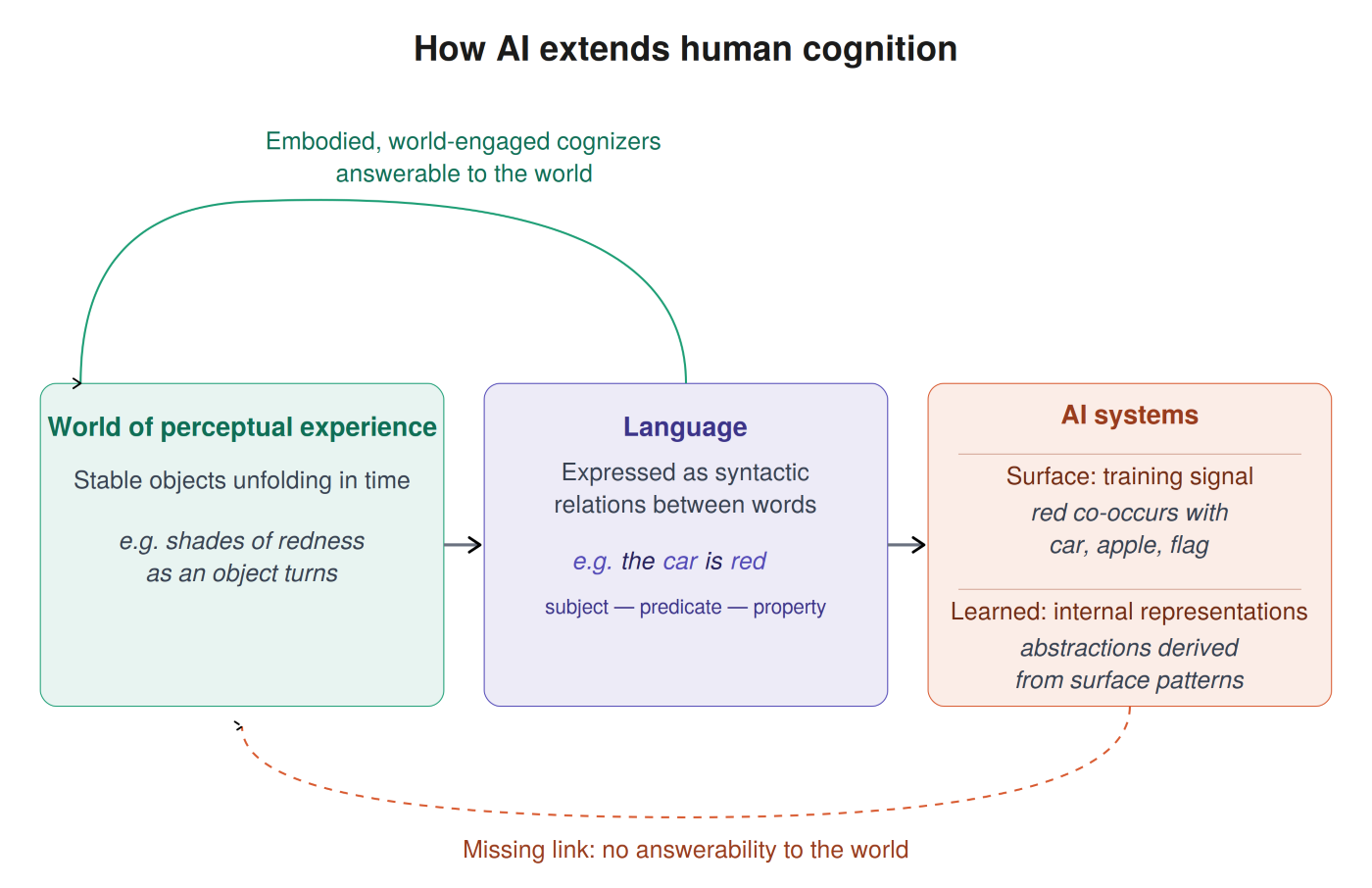 imageAI は人間の認知能力を拡張する
この枠組みは、AI 研究におけるいくつかの繰り返される課題を説明するのに役立ちます。その一つが「構成性のギャップ」です。これは、言語モデルが既知の推論パターンでは良好に機能する一方で、概念を真に新しい方法で組み合わせるよう求められた際に失敗するという傾向を指します。研究はますます、大規模なモデルが流暢さや事実の想起能力を、真の構成性推論能力よりもはるかに速く向上させることを示しています。私たちの見解では、これは単なる工学上の限界ではなく構造的な境界です。AI システムは言語にすでに沈殿したパターンを拡張することはできますが、人間のように真に新しい概念的関係を生成することを可能にする世界指向の理解力を持ち合わせてはいません。
同様のパターンは、言語と視覚を組み合わせたマルチモーダルシステムにも見られます。これらのシステムは画像を正しくラベル付けできることが多い一方で、物体やその部分に関する堅牢な推論には依然として失敗します。彼らは、人間が行うように時間を通じて展開する安定した物体を知覚するのではなく、視覚パターンと言語の間の相関関係を学習します。その結果、システムは既知のパターン外では驚くほど脆いままにしながらも、流暢さにおいて印象的な姿を示すことになります。
この視点は、AI セーフティに関する議論を再構成するものです。公的な議論は往々にして、「暴走した超知能」への恐怖と、AI が実質的なリスクをもたらさないという主張の間で揺れ動きます。私たちの研究によれば、両極端な見方は現在のシステムの性質を誤解しています。最も差し迫ったリスクは、AI が人間のような意図を持っているからではなく、反省的な責任を伴わずに推論のパターンを世界に拡張できる点に起因します。システムは説得力がありながら根拠のない出力を生成したり、欠陥のある決定を大規模に自動化したり、あるいは管理が不十分な環境に組み込まれた場合、有害な行動を実行したりする可能性があります。
これが、AI セーフティがモデルの安全性からシステムの安全性へとシフトしている理由を説明する助けとなります。実際、組織はすでに、業界でますます「ハルネス」と呼ばれる多層的なセーフガードに依存し、AI の振る舞いを制約・検証・監視しています。一時的なパッチではなく、私たちの論文は、これらのメカニズムが AI アーキテクチャそのものに関する根本的な何かを反映していると主張します:信頼できる振る舞いは、その振る舞いに対する責任を負う AI システムの構築者たちの働きから生じるものであり、この責任はモデルに委譲したり共有したりすることはできません。
この解釈は、企業が信頼できる AI の導入にどのように取り組むようになっているかという点と密接に一致しています。組織には、人間の知能を拡張しつつも、管理可能で監査可能であり、人間の監督と整合性を持つシステムが必要です。AI を派生した知能の形態として理解することは、なぜ階層化されたガバナンス、評価、および運用制御がこれほどまでに重要なのかを明確にします。
Spotlight: AI-POWERED EXPERIENCE

Microsoft research copilot experience
AI を活用した体験を通じて、マイクロソフトの研究についてさらに詳しく知る
今すぐ開始
新しいタブで開く
先を見据えると、現象学は AI に対する批判以上のもの、すなわちその可能性を理解するための枠組みを提供すると考えています。AI システムは人間の認知そのものについて深い洞察を明らかにします:意味は形式化され、拡張され、強力な新しい方法でスケール可能であるということです。したがって、AI の中心的な社会的リスクは、人間経験および認知におけるその起源の梯子を蹴落とすこと、つまり AI を人間の尊厳を損ない、結果として AI 自体の真の可能性を損なう競合する知能と誤解釈することにあると言えます。
では、問われるべきは AI が人間の知能を代替するかどうかではなく、その理解が生じる世界に根ざしたまま、どのようにして人間的理解を拡張するシステムを責任を持って構築できるかという点です。AI システムを自律的な心と誤解すれば、それらを過信するリスクがあります。一方、それらを些末なトリックとして切り捨てれば、現代において最も重要な技術的発展の一つを見逃すリスクが生じます。より現実的な解釈は、この二つの真実を同時に認識することです。AI は人間の知能の真なる拡張であり、まさにその理由から、それがどのように理解され、統治され、利用されるかについては、人間が引き続き責任を負わなければなりません。
新しいタブで開きます。本記事「Extending Human Intelligence Through AI」は、Microsoft Research で最初に発表されました。
原文を表示
At a glance
Modern AI systems are powerful not because they replicate human intelligence, but because they presuppose it, by extending structures already present in human cognition and language.
This perspective helps explain both AI’s remarkable capabilities and its recurring boundaries, including hallucinations and breakdowns in reasoning.
This research argues that AI safety is a system-level challenge, shifting attention from “rogue AI” narratives toward harnessing engineering and governance.
Understanding AI as an extension of human intelligence—not a replacement for it—offers a more grounded path for building trustworthy AI systems.
AI systems today can write essays, generate code, summarize complex ideas, and carry on conversations with remarkable fluency. Yet those same systems still struggle with tasks humans find intuitive: reliably tracking objects through change, reasoning compositionally in unfamiliar situations, or distinguishing truth from plausible fiction. These contradictions have fueled polarized debates about AI. Some see current systems as early forms of human-like intelligence; others dismiss them as sophisticated autocomplete.
In recent interdisciplinary work – including Adam Frank, Marcelo Gleiser, and Evan Thompson’s The Blind Spot (opens in new tab) and DeepMind researcher Alexander Lerchner’s The Abstraction Fallacy (opens in new tab) – a different picture is emerging. Rather than asking whether AI systems are becoming intelligent in the human sense, these approaches ask a more basic question: What if AI systems work because they rely on structures that are rooted in human cognition? This shift in perspective, which draws on the phenomenology of Edmund Husserl, helps make sense of both the capabilities and the limits of modern AI.
In our recent paper, The Origins of Artificial Intelligence in Natural Intelligence, we argue that modern AI systems are best understood neither as human minds nor as trivial statistical tricks. Instead, they extend structures that originate in human cognition itself. Further drawing on the phenomenology of Husserl, the paper proposes that language already contains sedimented structures of human understanding —structures that AI systems learn to model and extend. This perspective helps explain both the capabilities and the boundaries of contemporary AI.
Human perception is not simply passive reception of sensory data. We experience the world as stable things unfolding through change: a cup remains the same cup as we move around it; a melody remains recognizable even as individual notes pass away. Language emerges by expressing these stable structures in conceptual form. Words like “red,” “round,” or “larger than” articulate relationships that originate in lived experience.
Large language models learn statistical relationships within this linguistic world. They capture how concepts tend to relate across enormous bodies of human writing. This explains why AI systems can produce coherent responses across many domains. But it also explains why they hallucinate. Humans remain answerable to the world: experience continually corrects our expectations and beliefs. AI systems, by contrast, extend patterns within text itself. They can continue a line of reasoning with remarkable fluency, but they lack the lived engagement with the world that anchors meaning and truth.
imageAI Extends Human Cognition
This framework helps explain several recurring challenges in AI research. One is the “compositionality gap”—the tendency for language models to perform well on familiar reasoning patterns while failing when asked to combine concepts in genuinely novel ways. Research increasingly shows that larger models improve fluency and factual recall much faster than they improve true compositional reasoning. From our perspective, this is not simply an engineering limitation but a structural boundary: AI systems can extend patterns already sedimented in language, but they do not possess the world-directed understanding that allows humans to generate genuinely new conceptual relations.
A similar pattern appears in multimodal systems that combine language and vision. These systems can often label images correctly while still failing at robust reasoning about objects and their parts. They learn correlations between visual patterns and language rather than perceiving stable objects unfolding through time in the way humans do. The result is systems that can appear impressively fluent while remaining surprisingly brittle outside familiar patterns.
This perspective also reframes debates about AI safety. Public discussion often swings between fears of “rogue superintelligence” and claims that AI poses little meaningful risk. Our research suggests that both extremes misunderstand the nature of current systems. The most immediate risks arise not because AI possesses human-like intentions, but because it can extend patterns of reasoning without reflective responsibility to the world. Systems can generate persuasive but ungrounded outputs, automate flawed decisions at scale, or execute harmful actions if embedded in poorly governed environments.
This helps explain why AI safety is increasingly shifting from model safety to system safety. In practice, organizations already rely on layered safeguards—what the industry increasingly calls “harnesses”—to constrain, validate, and monitor AI behavior. Rather than temporary patches, our paper argues that these mechanisms reflect something fundamental about AI architecture itself: trustworthy behavior emerges from the work of builders of AI systems responsible for their behavior, a responsibility that cannot be delegated to or shared with models.
This interpretation aligns closely with how enterprises increasingly approach trustworthy AI deployment. Organizations need systems that can extend human intelligence while remaining governable, auditable, and aligned with human oversight. Understanding AI as a derived form of intelligence clarifies why layered governance, evaluation, and operational controls matter so deeply.
Spotlight: AI-POWERED EXPERIENCE
image
Microsoft research copilot experience
Discover more about research at Microsoft through our AI-powered experience
Start now
Opens in a new tab
Looking ahead, we believe phenomenology offers more than a critique of AI—it offers a framework for understanding its promise. AI systems reveal something profound about human cognition itself: that meaning can be formalized, extended, and scaled in powerful new ways. The central societal risk of AI thus turns out to be kicking away the ladder of its origins in human experience and cognition – misinterpreting AI as a rival intelligence that diminishes our humanity and thus, in turn, diminishes the true promise of AI itself.
The question, then, is not whether AI will replace human intelligence. It is how we can responsibly build systems that extend human understanding while remaining grounded in the world from which that understanding arises. If we mistake AI systems for autonomous minds, we risk over-trusting them. If we dismiss them as trivial tricks, we risk overlooking one of the most important technological developments of our time. A more grounded interpretation recognizes both truths at once: AI is a genuine extension of human intelligence—and precisely because of that, humans remain responsible for how it is understood, governed, and used.
Opens in a new tabThe post Extending Human Intelligence Through AI appeared first on Microsoft Research.
関連記事
今日のまとめ
AI日報で今日の重要ニュースをまとめ読み