Google Cloud、企業向けにClaudeを大規模展開可能に
本文の状態
日本語全文を表示中
詳細モードで約10分の本文を読めます。
Google Cloud は Anthropic の Claude を自社のインフラ上で提供し、エンタープライズ向けに管理型インフラとグローバルな遅延制御を実現する発表を行った。
AI深層分析を開く2026年8月4日 11:56
AI深層分析
キーポイント
管理型インフラによる工数削減
エンジニアが推論基盤の運用から解放され、機能開発に集中できる環境を提供する。
グローバルなエンドポイントと低遅延
世界中の利用者に対して低遅延かつ高稼働率を維持するためのグローバルエンドポイントを整備する。
セキュリティとデータ主権の統合
Google Cloud が持つセキュリティ機能やデータ主権制御をそのまま継承し、コンプライアンス要件を満たす。
スケール時のコスト最適化
大規模運用においてもコストとパフォーマンスのバランスを保つためのサービング層機能を備える。
フルマネージドインフラによる運用負荷の軽減
計算リソースのプロビジョニング、自動スケーリング、ロードバランシング、フェイルオーバーがプラットフォーム側で処理されるため、チームは機能の実装に集中できる。
重要な引用
Calling Claude becomes operationally identical to calling any other Google Cloud service — same Identity and Access Management (IAM), same VPC Service controls, same observability
Claude brings the reasoning, and Google Cloud brings the managed infrastructure, global reach, and compliance posture that enterprises already run on.
Running frontier AI in production is demanding — accelerators to manage, latency to hold steady across continents, regulated data to keep in-region
Compute provisioning, auto-scaling logic, load balancing, and failover at frontier-model scale are handled by the platform — work that would otherwise occupy multiple teams full-time.
編集コメントを表示
編集コメント
Google Cloud と Anthropic の連携により、企業が最先端の推論能力を即座に実装できる環境が整った。これは単なるモデルの提供ではなく、エンタープライズレベルの運用要件を満たす統合ソリューションとしての意義が大きい。
Source Article
元記事を日本語で読む
本文に関係しない購読案内、埋め込み通知、サイト内プロモーションは除いています。
本番環境で最先端 AI を運用するのは、管理すべきアクセラレータの増加、大陸間での低遅延維持、地域内データ規制への対応、そして長文コンテキストリクエストの信頼性ある処理など、多くの課題を伴います。Claude on Google Cloud はまさにこれらの課題解決のために設計されています。
モネの『睡蓮』シリーズのように、最先端モデルとエンタープライズプラットフォームは相性が良いものです。具体的には、Claude が推論能力を提供し、Google Cloud が企業が既に運用している管理インフラ、グローバルな到達範囲、コンプライアンス体制を提供します。Claude の呼び出しは、他の Google Cloud サービスを呼び出すことと操作上同じです。Identity and Access Management (IAM)、VPC Service controls、観測可能性のすべてが共通しているため、チームは推論インフラの運用に時間を割くのではなく、機能開発に集中できます。
本稿では、Claude on Google Cloud が本番環境で提供する価値を 4 つの領域に分けて解説します。
- エンジニアの時間を取り戻す管理されたインフラ
- 世界中のユーザー向けに低遅延と高稼働率を実現するグローバルエンドポイント
- Google Cloud から継承されたセキュリティおよびデータ主権制御機能
- スケール時のコストとパフォーマンスを最適化するサービングレイヤー機能
エンジニアの時間を解放する管理されたインフラ
Google Cloud 上で稼働する Claude は、フルマネージド型インフラストラクチャ上での運用が可能であり、エンタープライズチームはクラスターの構築に時間を割くことなく、機能の実装に集中できます。最先端モデルのスケールに対応した計算リソースのプロビジョニング、自動スケーリングロジック、ロードバランシング、フェイルオーバー処理などはすべてプラットフォームが担当するため、通常であれば複数のチームがフルタイムで取り組むべき作業を不要にします。
Claude は Agent Platform の Model Garden を通じて、モデル・アズ・ア・サービス(MaaS)として提供されています。標準的な REST / JSON over HTTP/1.1 または HTTP/2 エンドポイントを通じてすぐに利用可能です。Claude の呼び出し操作は、他の Google Cloud サービスを呼び出す際と全く同じです。IAM ポリシー、VPC 制御、そして Cloud Logging や Cloud Monitoring を通じた可観測性スタックも共通です。
Claude の提供には、AnthropicVertex クライアントを使用した Python コードを数行記述するだけで十分です。
AnthropicVertex クライアントは、プロンプトのキャッシュ、ツール使用、構造化出力、ストリーミング、適応的思考をすべて処理します。バッチ推論には Vertex AI バッチ予測を使用してください。認証にはアプリケーションデフォルト認証情報(Application Default Credentials)を利用し、リクエストは自動的にプロジェクトの IAM 設定と VPC 構成を引き継ぎます。
一貫したレイテンシと組み込みのフェイルオーバーを備えたグローバル展開
単一のエンドポイントから世界中のユーザーにサービスを提供すると、遅延の極端な値(テールレイテンシ)が発生しやすくなり、単一障害点のリスクも高まります。多くの企業は、パフォーマンスの一貫性を保ちながら推論インフラストラクチャを大陸間にも複製することができません。
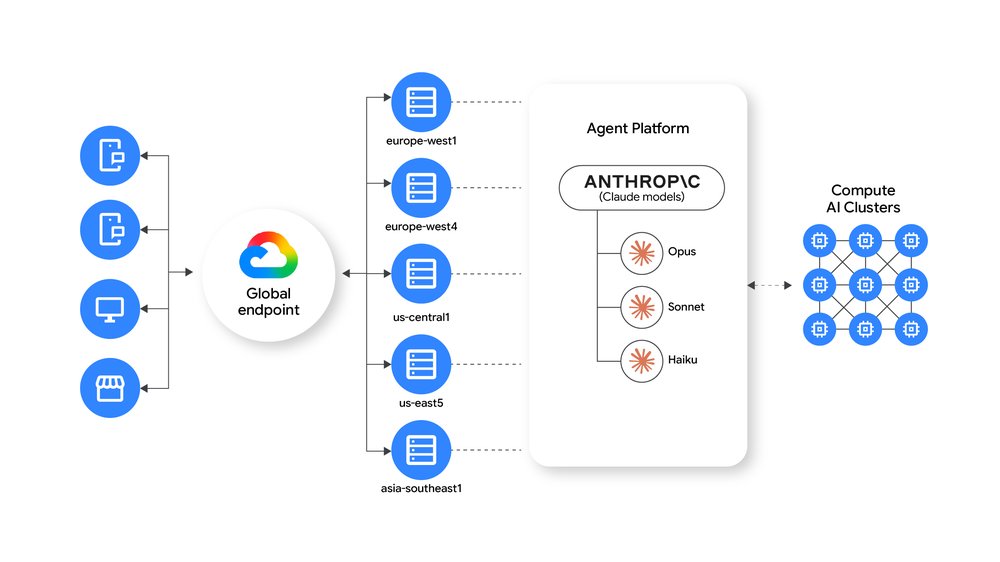
Agent Platform では Claude 向けに 3 つのエンドポイントタイプを用意しており、それぞれが異なる生産要件に対応しています。**グローバルエンドポイント** は、AI コンピューティングリソースが利用可能な地域へリクエストをルーティングします。例えば us-central1 で容量不足が発生した場合、トラフィックは自動的に europe-west1 など、空きがある他の地域に転送されます。これにより、アプリケーション側のルーティングロジックを追加することなく、自動フェイルオーバーと地理的負荷分散を実現できます。グローバルエンドポイントは、最大限の可用性とコスト効率を追求するユースケースに最適です。
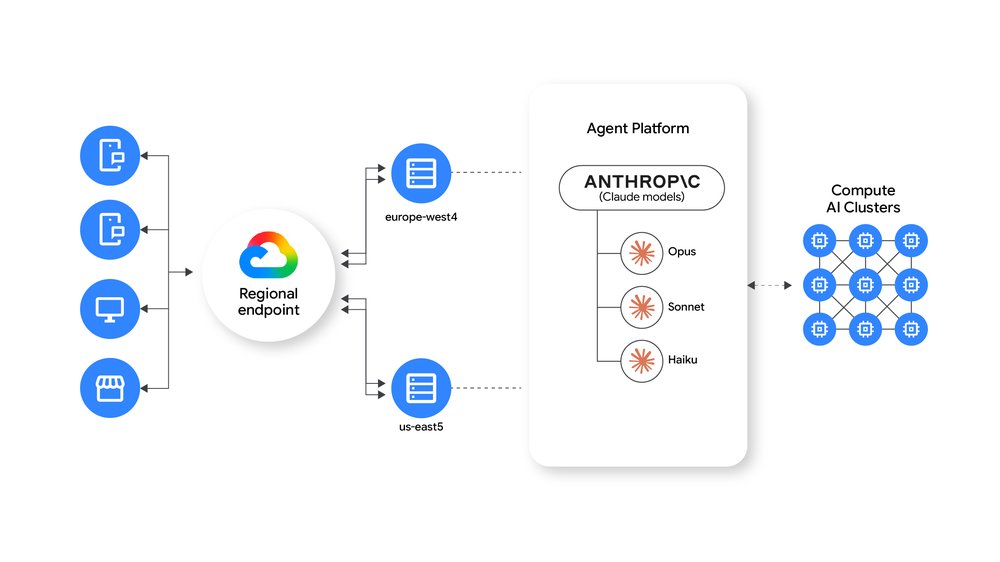
us-east5 や europe-west1 といったリージョンエンドポイントを使用すれば、プロンプト、回答、中間状態を特定の地理的範囲内に保持できるため、低遅延やデータ所在地要件に対応した環境に最適です。
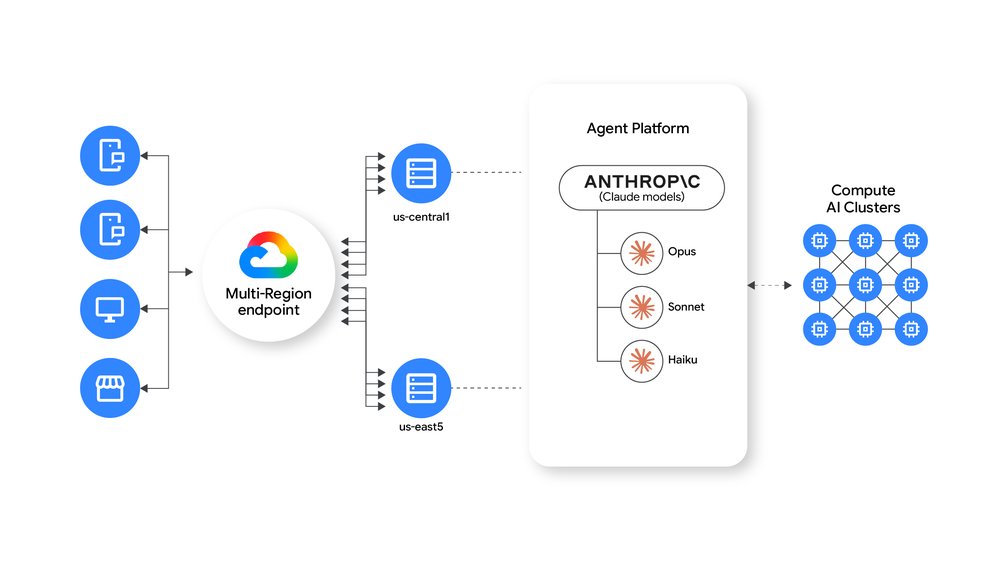
マルチリージョンエンドポイント を利用すれば、米国または欧州のデータ所在地を維持しつつ、単一リージョンへの依存から解放されます。これらは複数のリージョンエンドポイント間で動的にルーティングされ、リージョンごとの障害や容量制約に対する耐性を自動的に備えています。
以下の図は、アプリケーションがこれらのエンドポイントを通じて Claude にアクセスする仕組みと、エージェントプラットフォームのサービングレイヤーがどのようにしてトラフィックを地域間にある Compute AI クラスターへ振り分けるかを示しています:
組み込みのエンタープライズセキュリティとデータ主権
規制対象のワークロード、すなわち金融サービス、ヘルスケア、政府機関向けには、コンプライアンスと利便性のトレードオフを強いることなく、エンタープライズグレードのセキュリティとデータ主権が提供されます。また、制御が最も難しい層である推論(inference)部分の再構築も不要です。推論では、プロンプト、完成文、中間状態がすべてサービングスタックを流れます。
Claude on Agent Platform は、Google Cloud の包括的なセキュリティ体制を引き継いでいます。FedRAMP High および HIPAA への準拠により、政府、ヘルスケア、金融サービス環境でのデプロイが可能になります。VPC Service Controls を利用すれば、組織は Agent Platform リソースの周囲に境界を定義し、データ流出を防ぐことができます。IAM ネイティブなアクセス制御により、Claude エンドポイントは他の Google Cloud リソースと同じロールとポリシーで管理されます。個別の API キーを管理したり回転させたりする必要はありません。Cloud Logging と Cloud Monitoring により、トークン使用量、エラー率、レイテンシ、クォータ消費状況などをほぼリアルタイムで可視化できます。
上記のリージョンおよびマルチリージョンエンドポイントと組み合わせることで、規制対象の顧客は、コンプライアンス体制の再監査を行うことなく、本番環境でフロンティア AI を運用する道筋を得られます。
スケール時のコストとパフォーマンスに最適化
本番環境では、コストとパフォーマンスがすべてのアーキテクチャ決定を左右します。両方を正しく実現するには、Claude のネイティブモデル機能と Google Cloud のサービングインフラストラクチャという 2 つのレイヤーからの能力が必要です。Agent Platform はこれら双方をサポートしており、チームは個別に管理することなく、スタック全体にわたって最適化を行うことができます。
Claude ネイティブ機能、エージェントプラットフォームで完全サポート
これらの機能は Claude に組み込まれており、追加設定なしでエージェントプラットフォーム上で利用可能です。
- プロンプトキャッシング:共有されるプレフィックス(長いシステムプロンプト、法務文書、コードベースなど)を保存して再利用します。これにより、リクエストの遅延が最大 80%、コストは最大 90% 削減されます。
- ストリーミングレスポンス:サーバー送信イベントを通じてトークンが生成されるたびに配信され、チャットインターフェースやコーディングアシスタントなど、知覚される遅延が重要な用途に不可欠です。
- 拡張および適応的思考:Claude が複雑で多段階の問題に対して、いつどのように推論を行うかを動的に決定できます。また、ユーザーはコスト制御のために思考の努力度を直接調整することも可能です。高度なコード生成、数学的推論、複数ドキュメント分析などのユースケースに最適化されています。
- 最大 100 万トークンの拡張コンテキストウィンドウ(Claude Opus 4.6、Sonnet 4.6 およびそれ以降のモデル):長文書の分析、大規模なコードベースの推論、深い多段階対話を実現します。
Google Cloud サービングインフラストラクチャ
エージェントプラットフォームは、Claude のネイティブ機能の上に独自のサービングレイヤー機能を追加しています。
バッチ予測は、文書分類、コンテンツモデレーション、一括要約といった大規模なオフラインワークロードを、非同期で低優先度かつ低コストで処理します。
プロビジョニング済みスループットは、ミッションクリティカルなワークロードのために推論リソースを専有し、一般トラフィックから隔離することで、ピーク時の需要においても予測可能なパフォーマンスを保証します。
長文コンテキストを扱うリクエストにおけるメモリ管理とスケジューリングは、インフラストラクチャ層で処理されます。
これら 2 つのレイヤーにより、チームはモデルレベルの効率化からインフラレベルの容量制御まで、単一の統合プラットフォーム上であらゆる最適化手段を活用できます。
推論からエージェントへ
Claude の推論を支える同じインフラが、Google Cloud 上の Agent Platform のエージェント層も支えています。構築と登録の流れは以下の 3 ステップで構成されます:
Claude を活用して構築する。Claude は、拡張されたコンテキストウィンドウ、ネイティブなツール利用機能、そして適応的な思考能力を備えており、オーケストレーションの基盤として非常に適しています。これにより、多段階タスクの計画やサブエージェントへの委任が効果的に実行可能です。モデルガーデンから Claude Opus、Sonnet、または Haiku を選択し、Agent Development Kit(ADK)を活用して構築しましょう。Python、Go、Java、TypeScript によるコードファーストの開発が可能で、開発したエージェントは Agent Runtime、Cloud Run、または Google Kubernetes Engine にデプロイできます。
エージェントをランタイムへデプロイする。ユースケースに応じて、Agent Runtime、Google Kubernetes Engine、あるいは GKE Agent Sandbox のいずれかを選択して、デプロイされたエージェントを実行してください。
A2A を介した相互運用。
原文を表示
Running frontier AI in production is demanding — accelerators to manage, latency to hold steady across continents, regulated data to keep in-region, and long-context requests to serve reliably. Claude on Google Cloud is built for exactly this.
Like Monet and water lilies), frontier models and the enterprise platforms are often better together. In our case, Claude brings the reasoning, and Google Cloud brings the managed infrastructure, global reach, and compliance posture that enterprises already run on. Calling Claude becomes operationally identical to calling any other Google Cloud service — same Identity and Access Management (IAM), same VPC Service controls, same observability — so teams are able to spend their time building features instead of running inference infrastructure.
This post walks through what Claude on Google Cloud delivers in production across four areas:
- Managed infrastructure that gives engineers their time back
- Global endpoints that hold latency low, and uptime high for a worldwide user base
- Security and data-sovereignty controls inherited straight from Google Cloud
- Serving-layer features that keep cost and performance optimized at scale.
Managed infrastructure that frees engineering time
Claude on Google Cloud runs on fully managed infrastructure, so enterprise teams ship features instead of building clusters. Compute provisioning, auto-scaling logic, load balancing, and failover at frontier-model scale are handled by the platform — work that would otherwise occupy multiple teams full-time.
Claude is available through Agent Platform's Model Garden as a Model-as-a-Service offering, ready to use over standard REST / JSON over HTTP/1.1 or HTTP/2 endpoints. Invoking Claude is operationally identical to invoking any other Google Cloud service: the same IAM policies, the same VPC controls, and the same observability stack via Cloud Logging and Cloud Monitoring.
Serving Claude takes a few lines of Python using the AnthropicVertex client:
code_block
- )])]>
The same AnthropicVertex client handles prompt caching, tool use, structured outputs, streaming, and adaptive thinking; for batch inference, use Vertex AI Batch Prediction. Authentication uses Application Default Credentials; requests automatically inherit your project's IAM and VPC configuration.
Global reach with consistent latency and built-in failover
Serving a worldwide user base from a single endpoint produces high tail latency and a single point of failure. Most enterprises can't replicate inference infrastructure across continents while keeping performance consistent.
Agent Platform exposes three endpoint types for Claude, each solving a different production requirement:
Global endpoints route requests to a region with available AI compute capacity. For example, if us-central1 is capacity-constrained, traffic redirects to europe-west1 or another region with available capacity. That’s automatic failover and geographic load balancing without application-side routing logic. Global endpoints are ideal for maximum availability and lowest cost.
- Regional endpoints like us-east5 or europe-west1 keep prompts, completions, and intermediate state inside a specific geographical boundary, making it ideal for low latency and data-residency requirements.
- Multi-region endpoints give U.S. or EU data residency without single-region dependency. They dynamically route across regional endpoints providing built-in resilience against regional outages and capacity constraints.
The diagram below shows how applications reach Claude through these endpoint types, and how the Agent Platform serving layer routes traffic to the Compute AI clusters across regions:
Enterprise security and data sovereignty built in
Regulated workloads — financial services, healthcare, and government — get enterprise-grade security and data sovereignty without trading compliance for convenience, and without re-engineering the hardest layer to control: inference, where prompts, completions, and intermediate state all flow through the serving stack.
Claude on Agent Platform inherits Google Cloud's full security posture. FedRAMP High and HIPAA compliance enable deployment in government, healthcare, and financial services environments. VPC Service Controls let organizations define a perimeter around Agent Platform resources, preventing data exfiltration. IAM-native access control governs Claude endpoints with the same roles and policies that protect every other Google Cloud resource — no separate API keys to manage or rotate. Cloud Logging and Cloud Monitoring provide near real-time visibility into token usage, error rates, latency, and quota consumption.
Combined with the regional and multi-region endpoints above, this gives regulated customers a path to running frontier AI in production without re-auditing their compliance posture.
Optimized for cost and performance at scale
In production, cost and performance drive every architectural decision. Getting both right requires capabilities from two layers: Claude's native model features, and Google Cloud's serving infrastructure. Agent Platform supports both, so teams can optimize across the stack without managing them separately.
Claude-native capabilities, fully supported on Agent Platform
These features are built into Claude and available on Agent Platform without any additional configuration:
- Prompt caching stores and reuses shared prefixes — long system prompts, legal documents, codebases — reducing request latency by up to 80% and cost by up to 90%.
- Streaming responses over server-sent events deliver tokens as they are generated, critical for chat interfaces and coding assistants where perceived latency matters.
- Extended and adaptive thinking lets Claude dynamically determine when and how much to reason through complex, multi-step problems — and allows users to dial the thinking effort directly, for example to control cost. Optimized for use cases like advanced code generation, mathematical reasoning, and multi-document analysis.
- Extended context windows up to 1M tokens (for Claude Opus 4.6,Sonnet 4.6 and newer models) enable long-document analysis, large codebase reasoning, and multi-turn conversations at depth.
Google Cloud serving infrastructure
Agent Platform adds its own serving-layer capabilities on top of Claude's native features:
- Batch prediction handles large-scale offline workloads — document classification, content moderation, bulk summarization — asynchronously at lower priority and reduced cost.
- Provisioned throughput reserves dedicated inference capacity for mission-critical workloads, isolating them from public traffic and ensuring predictable performance during peak demand.
- Memory management and scheduling for long-context requests is handled at the infrastructure layer,.
Together, these two layers give teams the full range of optimization levers — from model-level efficiency to infrastructure-level capacity control — on a single, unified platform.
From inference to agents
The same infrastructure that serves Claude inference powers the agent layer of Agent Platform on Google Cloud. The build-and-register flow has three steps:
- Build with Claude. Claude is well-suited as an orchestration backbone — its extended context window, native tool use, and adaptive thinking make it effective at planning multi-step tasks and delegating to sub-agents. Pick Claude Opus, Sonnet, or Haiku from the Model Garden, then build with the Agent Development Kit (ADK) — code-first in Python, Go, Java, or TypeScript — deploy to Agent Runtime, Cloud Run or Google Kubernetes Engine.
- Deploy the Agent to a Runtime. Depending on your use case, select Agent Runtime, Google Kubernetes Engine or GKE Agent Sandbox to run your deployed agents.
Interoperate over A2A. The
AI算出
主要ニュースainew評価標準
Google Cloud が Anthropic の Claude をフルマネージド型として提供開始したことは、AI エンタープライズ市場における重要な製品リリースであるため primary_news に分類し、具体的なモデル名とサービス内容から novelty と search_opportunity を高く評価する。ただし、日本企業固有の導入事例や価格・規制に関する詳細情報が本文にないため、japan_relevance は低く設定する。
6つの評価軸を見る
- AI関連度
- 75
- 情報源の信頼性
- 25
- 新規性
- 75
- 調べる価値
- 75
- 重複の少なさ
- 100
- 日本での有用性
- 25
同じ出来事を2媒体で確認
同じ出来事を扱う別媒体の記事です。見出しと公開時刻を比較できます。
今日のまとめ
AIデイリーブリーフで今日の重要ニュースをまとめ読み