金融サービスにおけるアジェンティック AI で運用レジリエンスを構築
本文の状態
日本語全文を表示中
詳細モードで約9分の本文を読めます。
同じ出来事の情報源
この情報源を基点に整理
Google Cloud AI
欧州の DORA 規制強化を受け、金融機関が顧客や規制当局に対して重要業務とデジタルインフラの耐性を証明する必要性が高まっている中、Google Cloud はアジェンティック AI を活用した運用レジリエンス構築の手法を提案している。
AI深層分析を開く2026年8月18日 23:51
AI深層分析
キーポイント
規制対応と業務継続性の強化
EU のデジタル・オペレーショナル・レジリエンス法 (DORA) の施行により、金融機関は証拠に基づく厳格な要件を満たす必要が生じ、Deutsche Bank はこれに対応するため AI を活用したアプローチを採用した。
エージェント型 AI プラットフォームの導入
Deutsche Bank と Google Cloud のパートナーシップにより構築されたプラットフォームは、アーキテクチャやデータフロー、インシデント履歴などの実データを基に、文脈を考慮したシナリオと証拠生成を自動的に行う。
手作業から継続的インテリジェンスへ
従来のマニュアルな準備やテーブルトップ演習が、生産環境の依存関係や実際の運用状況を反映した、継続的なインテリジェンスモデルへと変容し、規制当局への提出用アーティファクトも自動生成される。
リアルタイム信号に基づく継続的インテリジェンスモデルへの移行
DB は手動のテーブルトップ演習から、実際の企業信号に基づいたシナリオを実行する継続的なインテリジェンスモデルへと変革した。これにより、静的な入力に依存する仮説ではなく、真のシステム依存関係や障害パターンを反映できるようになった。
監査対応と規制要件を満たす構造化シナリオの実現
Gemini Enterprise Agent Platform を活用することで、明確なタイムラインと判断ポイントを備えた構造化シナリオへ移行し、監査証跡として利用可能な一貫した証拠を生成している。
重要な引用
Firms must now demonstrate that their critical business services and supporting digital infrastructures can withstand disruption, support coordinated response, and recover with control.
Deutsche Bank developed an AI-powered agentic resilience platform that modernized its regulatory tabletop exercises at scale
DB has been able to transform its tabletop exercises from manual preparation to a continuous intelligence model.
This means that every scenario it runs is based on real enterprise signals.
編集コメントを表示
編集コメント
金融規制の厳格化という外部圧力を、AI の自律性を活用して解決策へと転換した事例は非常に示唆に富む。このアプローチは、単なるツールの導入ではなく、組織全体のリスク管理プロセスそのものを再設計する必要性を浮き彫りにしている。
Source Article
元記事を日本語で読む
本文に関係しない購読案内、埋め込み通知、サイト内プロモーションは除いています。
金融機関にとって、事業継続のレジリエンスは長年、規制当局や監督官庁からの要請として組み込まれてきました。もちろん、消費者の高い期待も無視できません。
欧州連合(EU)の「デジタル・オペレーショナル・レジリエンス法(DORA)」が施行されたことで、これらの期待はさらに厳格なものとなりました。より明確で調和され、証拠に基づく要件が課されるようになったのです。企業は今や、重要なビジネスサービスとそれを支えるデジタルインフラが混乱に耐えうるか、協調的な対応を可能にするか、そして統制された状態で回復できるかを証明する必要があります。
こうした要件を満たすため、ドイツ銀行(Deutsche Bank)はAIを活用した自律型レジリエンスプラットフォームを開発しました。これにより、大規模な規制当局向けのテーブルトップ演習が近代化され、手作業による準備から、実際の運用データに基づいた文脈を把握し、証拠を即座に提示できるシミュレーションへと転換されました。
このプラットフォームは、アーキテクチャ、データフロー、ログ、インシデント履歴、アラート信号、および運用テレメトリから企業全体のコンテキストを構築。これにより、シナリオの生成、模擬的な運用証拠の作成、構造化されたセッション記録、そして規制当局が即座に確認できる成果物の作成を実現しています。
相互依存するアプリケーション、データフロー、サードパーティ製サービスにまたがる大規模銀行の運営において、これは極めて重要かつ存亡に関わる転換点です。金融サービス業界全体で規制当局の期待が変化しており、それに伴い、各銀行が行うテーブルトップ演習(シミュレーション訓練)は、実際の生産環境での依存関係や運用実態をより直接的に反映し、一貫した証拠基準への準拠を示す必要があります。
ドイツ銀行(Deutsche Bank)がこの転換を大規模かつ効率的に成功させる方法を検討する際、長年のパートナーである Google Cloud と、その拡充されるエージェント型 AI ツール群に注目しました。
テーブルトップ演習からレジリエンス知能へ
エージェント型のレジリエンスプラットフォームを用いることで、ドイツ銀行は手作業による準備からなるテーブルトップ演習を、継続的なインテリジェンスモデルへと変革できました。また、実際の運用状況が必要な際の根本原因分析にも、同様のエージェント層を拡張適用しています。
これは、実行されるすべてのシナリオが実際の企業信号に基づいていることを意味します。プラットフォームは、静的な入力(より多くの仮定を導き出す可能性が高い)に依存するのではなく、真のシステム依存関係、障害パターン、およびビジネスへの影響を反映することができます。
Gemini Enterprise Agent Platform を活用することで、DB は運用上の文脈を明確なタイムライン、意思決定のポイント、期待される対応策を持つ構造化されたシナリオへと移行できました。これにより、各エクササイズが実際のシステム動作に基づき、規制当局の要件を満たす一貫性のある監査可能な証拠を生み出すことが保証されています。
制御と柔軟性を両立する二重オーケストレーション
規制レベルの厳格な管理と運用上の柔軟性の両方を提供するため、DB のプラットフォームではワークフローを2 つの補完的な実行モデルに分離した「二重オーケストレーション」アーキテクチャを導入しました。
まず、規制当局との整合性を重視する実行においては、LangGraph を採用しています。これにより、入力コンテキストから出力に至るまでの明確な系譜(ラインージ)を持つ、追跡可能で決定論的なプロセスを通じてすべてのシナリオが生成されます。この仕組みは、監督当局によるレビューに必要な監査性を支えています。
一方、適応型や調査が必要なシナリオでは、Google Agent Development Kit(ADK)を活用し、エージェント主導の調整を可能にしています。このアプローチにより、プラットフォームは事前に定義された実行パスに縛られず、状況に応じて動的に分析を行い、対応策を生成できるようになります。
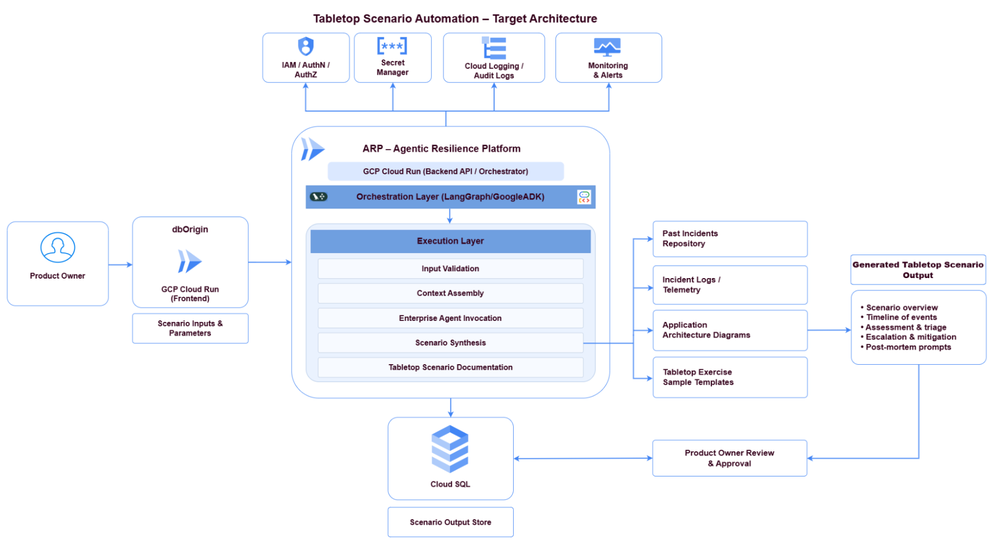
図 1:コンテキストの統合、オーケストレーション、シナリオ生成のためのアーキテクチャ
このようにアーキテクチャを分離することで、プラットフォームは統制された実行と適応的な調査を組み合わせても、共通のインテリジェンス層を維持できます。同じエージェントやツールを用いれば、卓上でのシナリオ生成から関連するインシデント分析ワークフローに至るまで、アーキテクチャ、データフロー図、ログ、コードアーティファクトといった多様な要素に対して推論を行うことが可能です。重要なのは、このアプローチが計画された演習と実際の運用事象の両方で、一貫したレジリエンスモデルを支える点にあります。
ドイツ銀行がこのプラットフォームで目指したのは、規制要件を満たすレジリエンスモデルを構築することでした。特に、非常に複雑で分散化された環境下であっても、重要な金融システムにおいてその実現を図ります。動的に生成されるシナリオを実際のビジネスコンテキストと結びつけ、統制されたオーケストレーションと適応的な分析を組み合わせることで、当行は運用レジリエンスのためのインテリジェントかつ継続的に適応するモデルを実現しました。
– サンジャイ・トリパティ氏(ドイツ銀行 専務執行役員、グローバル監視技術およびコンプライアンスクラウド & AI 変革担当責任者)
Google Cloud で支える生成とガバナンス
Google Cloud が提供するエージェント型ツールのスイートは、ドイツ銀行のプラットフォームを、多くの統制されたエンタープライズグレードのレジリエンスワークフローにスケールさせるための基盤となっています。具体的には以下の通りです。
- Cloud Run は、シナリオ生成および証拠生成サービスの弾力的な実行をサポートします。
「Gemini Enterprise Agent Platform」は、運用上の文脈を構造化されたレジリエンスシナリオへと変換します。
「Google ADK」は、適応型のエージェント調整を可能にします。
「Cloud SQL」は、シナリオやセッション成果物、レビュー記録に対する永続的な保存機能を提供します。
これらのサービスを組み合わせることで、コンプライアンス監査と継続的改善に必要な、追跡可能な生成、制御された実行、そして永続的な証拠記録のデータベースサポートが実現されます。
スケーラブルで証拠に即したレジリエンステスト
ドイツ銀行のプラットフォームによって生成されるすべてのシナリオは、対応・エスカレーション・復旧を担当するチーム向けの構造化されたテーブルトップ演習を駆動します。これらの演習は実際の企業文脈に基づいているため、運用上の現実を反映しつつ、チーム間の整合性を高め、規制要件を満たす監査対応可能な証拠を創出します。DORA や同様のフレームワークの下で運営される機関にとって、これは大規模な制御された調整された規律ある対応を実証しやすくするものです。
このモデルは現在、複数の DB ポートフォリオに適用されており、銀行がより一貫性がありスケーラブルなレジリエンスのパラダイムを確立し、金融セクター全体への複製可能な青写真を提供することを支援しています。
このモデルでは、根本原因分析が実際のインシデントと将来のレジリエンステストをつなぐフィードバックループとして機能します。本番環境での事象から得られる知見は、今後のテーブルトップ演習の設計に活かされ、一方、演習の結果は対応プレイブックやエスカレーションパス、復旧準備を強化するために活用されます。
これにより、プラットフォームの価値は計画的なレジリエンス演習から実際の運用イベントへと拡張されつつも、シナリオベースのレジリエンステストが主要ユースケースとして維持されます。
導入が進むにつれ、このプラットフォームは文脈に応じたレジリエンスを重視する Google Cloud の手法を組み込むことで一貫性をもたらします。これにより、断片的な手作業アプローチに終止符を打ち、銀行全体で AI を活用したクロスファンクショナルな運用モデルが確立されます。
レジリエンスインテリジェンスへ
銀行の次のステップは、このアプローチを広範なレジリエンスインテリジェンス層へと拡張することです。プレイブックの改善や復旧準備度の評価、そして変化するシステム条件に対する統制の継続的な検証を支援するために、同じパターンを展開できるからです。
金融機関にとってこれは戦略的転換点です。システムがより分散化し、規制要件が厳しくなる中で、銀行は定期的なレジリエンステストから、インテリジェンス駆動型の継続的な能力へと移行する必要があります。Deutsche Bank では Google Cloud が、この移行を組織全体で容易に実現しています。
Google Cloud の文脈を考慮したレジリエンス構築の手法については、こちらの 記事 で詳しく解説しています。
原文を表示
For financial institutions, operational resilience has long been embedded in regulatory and supervisory expectations — to say nothing of the high expectations of consumers. With the implementation of the European Union’s Digital Operational Resiliency Act (DORA), those expectations have become even more stringent, with more explicit, harmonized, and evidence-driven requirements. Firms must now demonstrate that their critical business services and supporting digital infrastructures can withstand disruption, support coordinated response, and recover with control.
To meet these conditions, Deutsche Bank developed an AI-powered agentic resilience platform that modernized its regulatory tabletop resilience exercises at scale and turned manual preparation into context-aware and evidence-ready simulations grounded in actual operational data. The platform builds enterprise context from architecture, data flows, logs, incident history, alerting signals, and operational telemetry to generate scenarios, simulated operational evidence, structured session records, and regulator-ready artifacts.
At many large banks with operations that span interdependent applications, data flows, and third-party services, this is a critical and even existential shift. Across financial services, supervisory expectations are evolving and as they do, banks’ tabletop exercises must reflect their production dependencies, real operating conditions, and compliance with consistent evidence standards more directly.
As Deutsche Bank considered how to successfully and efficiently make this shift at scale, it looked to its long-time partner, Google Cloud, and its growing suite of agentic AI tools.
From tabletop exercises to resilience intelligence
With its agentic resilience platform, DB has been able to transform its tabletop exercises from manual preparation to a continuous intelligence model. And it’s been able to extend the same agentic layer to root-cause analysis when real operational context is needed.
This means that every scenario it runs is based on real enterprise signals. The platform can then reflect true system dependencies, failure patterns, and business impact instead of relying on static inputs that are more likely to return assumptions than real-time insights.
By using Gemini Enterprise Agent Platform, DB has been able to migrate this operational context into structured scenarios with clear timelines, decision points, and expected responses. This has ensured that each exercise is grounded in real system behavior that produces consistent, audit-ready evidence that meets regulatory expectations.
Dual orchestration for control and flexibility
In order to deliver both regulator-grade control and operational flexibility, DB’s platform introduced a dual-orchestration architecture that separates workflows into two complementary execution models.
First, for regulator-aligned execution, the bank is using LangGraph to ensure that it generates every scenario through a traceable, deterministic process — with clear lineage from input context to output — that supports the auditability required for supervisory review.
Next, for its adaptive and investigative scenarios, DB is using Google Agent Development Kit (ADK) to enable agent-driven coordination. This approach allows the bank’s platform to dynamically analyze conditions and generate responses without predefined execution paths.
With this architectural separation, the platform can combine governed execution with adaptive investigation while preserving a common intelligence layer. The same agents and tools can reason over architecture, data-flow diagrams, logs, and code artifacts across tabletop scenario generation and related incident-analysis workflows. Importantly, this supports a consistent resilience model across both planned exercises and real operational events.
Deutsche Bank’s objective with this platform was to engineer a resilience model for critical financial systems that meets regulatory expectations — even within highly complex, distributed environments. By linking dynamically generated scenarios to real business context and combining governed orchestration with adaptive analysis, the platform has given us an intelligent, continuously adaptive model for operational resilience.” – Sanjay Tripathi, Managing Director, Global Head of Surveillance Technology & Compliance Cloud & AI Transformation Lead, Deutsche Bank
Powering generation and governance with Google Cloud
Google Cloud’s suite of agentic tools is providing the foundation for scaling Deutsche Bank’s platform across its many governed, enterprise-grade resilience workflows. Here’s how:
- Cloud Run supports elastic execution of scenario and evidence-generation services.
- Gemini Enterprise Agent Platform transforms operational context into structured resilience scenarios.
- Google ADK enables adaptive agent coordination.
- Cloud SQL provides durable persistence for scenarios, session artifacts, and review records.
Collectively, these services give DB support for the traceable generation, controlled execution, and persistent evidence record required for compliance review and continuous improvement.
Scalable, evidence-ready resilience testing
Every scenario generated by Deutsche Bank’s platform drives a structured tabletop session for the teams that run response, escalation, and recovery. Because these exercises are grounded in real enterprise context, they reflect operational reality while also strengthening consistency across teams and creating audit-ready evidence that meets regulatory expectations. For institutions that operate under DORA or similar frameworks, this makes it easier to demonstrate controlled, coordinated, and disciplined response at scale.
This model is now being applied across multiple DB portfolios, which is helping the bank establish more consistent and scalable resilience paradigms and a replicable blueprint for the broader financial sector.
In this model, root-cause analysis acts as the feedback loop between real incidents and future resilience testing. The resulting insights from production events can inform future tabletop scenarios, while exercise outcomes can strengthen response playbooks, escalation paths, and recovery readiness.
All of this extends the platform’s value from planned resilience exercises to real operational events while keeping scenario-based resilience testing as the primary use case.
As adoption expands, this platform brings consistency by embedding Google Cloud’s methodology for context-aware resilience. It eliminates fragmented manual approaches and establishes a cross-functional, AI-informed operating model across the bank.
Toward resilience intelligence
The bank’s next step is to extend this approach into a broader resilience intelligence layer, which is possible because it can deploy the same patterns to support playbook refinement, recovery-readiness assessments, and continuous validation of controls against evolving system conditions.
For financial institutions, this is a strategic shift. As systems become more distributed and regulatory expectations more demanding, banks must move from periodic resilience testing to continuous, intelligence-driven capabilities. At Deutsche Bank, Google Cloud is making that transition simple across the organization.
Learn more about Google Cloud’s methodology for context-aware resilience in this article.
関連記事
今日のまとめ
AIデイリーブリーフで今日の重要ニュースをまとめ読み