[AINews] Anthropic Claude Fable 5 — 神話的だが安全、論争的な条件付き
本文の状態
日本語全文を表示中
詳細モードで約24分の本文を読めます。
同じ出来事の情報源
この情報源を基点に整理
Latent Space
Anthropic は、SpaceX との提携から約 1 ヶ月後に、Opus よりも大規模な「Mythos クラス」モデルを一般公開した。この新モデルは安全性を保ちつつ、利用に際して論争を呼ぶ特定の条件を課している。
Source Article
元記事を日本語で読む
本文に関係しない購読案内、埋め込み通知、サイト内プロモーションは除いています。
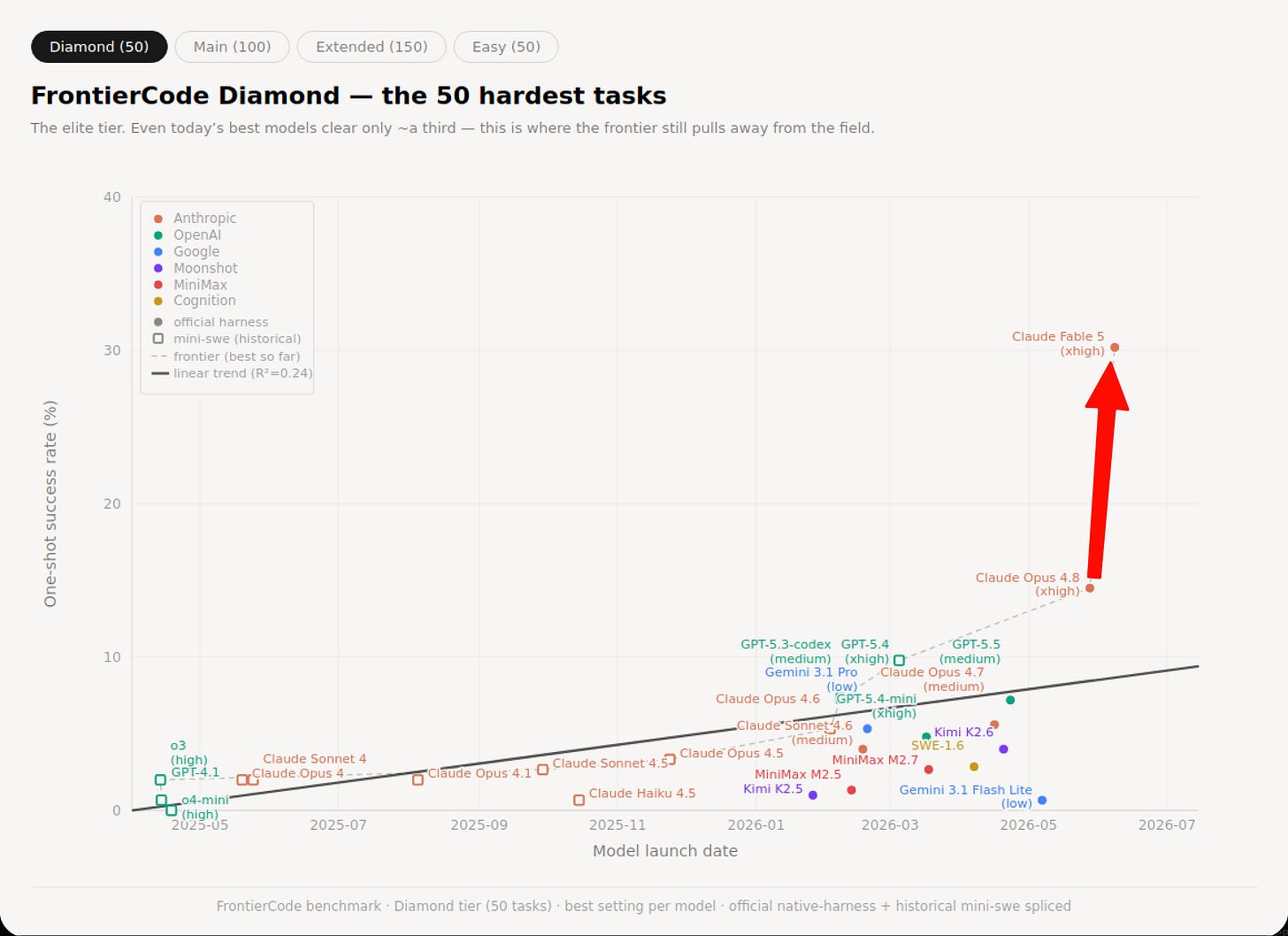
いくつかの指標では、わずか2週間しか経っていない Opus 4.8 がすでに世界最高のモデルでした。しかし今、SpaceXai の提携から34日後、そしてオリジナルの Mythos 発表から63日後*、私たちは誰でも利用可能な Mythos クラスのモデル(少なくとも Opus の2倍の規模)を手に入れました(Claude Tokyo と同時期です)。これらの研究用モデルを一般公開(GA)し、アクセス性を確保することは信じられないほどのエンジニアリングとコミットメントの成果であり、ベンチマーク結果も素晴らしいものです……ただし注釈付きです。昨日発表されたばかりで分布外データである FrontierCode Diamond における数値は、13.4% から29.3% に向上しています:
tweet
ブログ記事とシステムカードには権威ある情報のほとんどが記載されていますが、Factorio や Pokemon(Claude Plays Pokemon とは異なり、これは単なるビジョン機能の活用であり、私たちがポッドキャストで取り上げたような複雑なハーンは使用していません)、EDM の可視化(これまで音楽を聴いたことがない状態でのヘッドミュージック)、3D CAD エディタによる作成と印刷など、メインの紹介動画から得られる他の機能も決して見逃さないでください。
API の価格設定も素晴らしく、Opus の約2倍です。
ただし注釈がつくのは、Fable が2つの論争を呼ぶ変更点と共にリリースされたためです:
ZDR の適用なし:「Mythos クラスのモデルにおけるすべてのトラフィックについて、初回およびサードパーティの両方の表面において 30 日間のデータ保持を要求します。このデータを新しい Claude モデルのトレーニングや、安全性に関係しない目的に使用することはありません。また、データへの人間によるアクセスをすべてログ記録し、ほぼすべてのケースで 30 日後に削除することを保証するなどの新たなプライバシー保護措置を導入しました……」(完全なポリシーはこちら)
RSI(自己加速リスク)の抑制:「最近のモデルが自身の開発を加速させる能力を持つことを踏まえ、フロンティア LLM の開発を対象としたリクエストに対する Claude の効果を制限する新たな介入策を実装しました。具体的には、事前トレーニングパイプラインの構築や分散トレーニングインフラストラクチャ、ML アクセラレータ設計などです。競合モデルの開発に Claude を使用することはすでに利用規約違反ですが、この制限をセーフガードを通じて執行することで、これらの規約を最も意図的に違反するアクターが加速することを防ぎます。
セキュリティ対策、生物学・化学分野への介入、および蒸留試行に対する私たちの介入とは異なり、これらのセーフガードはユーザーには表示されません。Fable 5 は別のモデルにフォールバックしません。代わりに、プロンプトの修正、ステアリングベクトル、またはパラメータ効率的ファインチューニング(PEFT)などの手法を通じて効果を制限します。これらの介入は、コーディング作業の绝大多数には影響を及ぼしません。推計では、トラフィックの約 0.03% に影響し、その対象となる組織は全体の 0.1% 未満に集中しています」
これらの制限の影響を受けるユーザーは绝大多数ではないものの、オープン AI コミュニティがこれに納得いかないのは当然であり、以下にその様子が示されています。
Diane Penn 氏の東京での講演における利用に関するより多くの推奨事項は、以下に抜粋してあります。
*(Anthropic と OpenAI が来週の SpaceX の IPO に先駆けて S-1 を提出してから 1 週間後から 1 日後…)
2026 年 6 月 8 日〜9 日の AI ニュース。私たちは 12 のサブレッド、544 のツイートを確認し、Discord はさらに確認していません。AINews のウェブサイトでは過去のすべての号を検索できます。念のため、AINews は現在 Latent Space の一部となっています。メールの頻度を選択的にオン/オフにできます!
AI Twitter リキャップ
トップストーリー:Anthropic Claude Fable 5 と Mythos 5 のリリース
何が起きたか
Anthropic は次期主要モデルファミリーの 2 つのバージョンをリリースしました。一般利用向けは Claude Fable 5、制限付きアクセス向けは Claude Mythos 5 です。
Anthropic は公式に Claude Fable 5 を「初めて広く一般公開された Mythos クラスのモデル」として発表し、これまでに広く一般公開したどのモデルよりも優れており、テストされたほぼすべてのベンチマークで最先端であると述べています @claudeai, @claudeai
Anthropic は、Fable 5 が Mythos 5 と同じ基盤モデルであり、追加のセーフガードが施されていると述べました。また、サイバー/バイオ/化学/蒸留関連のプロンプトの一部は、代わりに Claude Opus 4.8 にルーティングされる可能性があると述べています @ClaudeDevs, @scaling01
Anthropic は、「限定的な範囲」の潜在的に有害なトピックについては、クエリが透明性を持って Opus 4.8 にフォールバックすると述べており、初期のユーザー向けメッセージによると、セッションの 95% 以上は一度もそれを見ないと主張しています @claudeai, @mikeyk
Anthropic の開発者向けメッセージでは、フォールバック機能はサーバーサイドおよび Python、TypeScript、Go、Java、C# における SDK ミドルウェアを通じて利用可能であるとされています @ClaudeDevs
Fable 5 と Mythos 5 の両方の価格設定は、入力トークンあたり 100 万トークンで 10 ドル、出力トークンあたり 100 万トークンで 50 ドルと報告されました。キャッシュの価格設定については、後に第三者の評価者によって、キャッシュ書き込みあたり 100 万回で 12.50 ドル、キャッシュ読み取りあたり 100 万回で 1 ドルと報告されています @scaling01, @ArtificialAnlys
Fable 5 は、Artificial Analysis によると Anthropic の 100 万トークンのコンテキストウィンドウを維持しています @ArtificialAnlys
Anthropic は Fable 5 を Pro、Max、Team、および座席ベースの Enterprise プランに 6 月 22 日まで組み込みましたが、その後、容量制約のため利用クレジットが必要になると発表し、後でより広範なサブスクリプションアクセスを復元する計画があると述べています @ClaudeDevs, @scaling01, @ArtificialAnlys, @kimmonismus
この一時的な組み込みに関する混乱は即座に生じました。ユーザーが「6 月 22 日まで含まれる」という意味を尋ねたところ、Anthropic のスタッフがロールアウトについて説明しました @dejavucoder, @TheAmolAvasare
Anthropic は後ほど、過大な需要に応じて製品全体で 5 時間および週ごとのレート制限をリセットしました @ClaudeDevs
公式な主張と第三者のベンチマークデータ
Anthropic とパートナープラットフォームは、特にコーディングや長期にわたるエージェントタスクにおいて広範なベンチマークでのリードを報告しています。
Anthropic の公式発表によると、Fable 5 はソフトウェアエンジニアリング、知識労働、科学研究、そしてビジョン処理において特に強力であり、タスクの長さや複雑さが増すほどそのリード幅が拡大します @claudeai
Cursor によれば、Fable 5 は CursorBench で 72.9% という新たな SOTA(State of the Art:最良性能)を記録し、これまでの最高記録を 8 ポイント上回りました @cursor_ai
Cognition は Fable 5 が FrontierCode で第 1 位を獲得したと発表し、Devin に統合して Devin Cloud Ultra、Desktop、および CLI で利用可能になったと伝えています @cognition, @cognition
Cline の報告では、Fable 5 は Terminal-Bench 2.1 で 88.0% を達成し、GPT-5.5 よりも 4.6 ポイント上回りました @cline
Artificial Analysis は Fable 5 をそのインテリジェンス・インデックスで第 1 位(スコア 64.9)にランク付けし、これは GPT-5.5 より約 5 ポイント上の成績であり、Anthropic が上位 2 つのポジションを独占していると指摘しました @ArtificialAnlys
Artificial Analysis はさらに以下も報告しています:
GDPval-AA Elo スコアは 1932 で、エージェント型の実世界における知識労働タスクで第 1 位です @ArtificialAnlys
Humanity's Last Exam(人類最後の試験)では 53% の正答率を記録し、次点のモデルより 7 ポイント以上上回りましたが、HLE タスクの 9% でフォールバックがトリガーされました @ArtificialAnlys
インテリジェンス・インデックスのタスク全体で約 8% がフォールバックルーティングに振り分けられ、その多くは科学的な質問に関するものでした @ArtificialAnlys
Anthropic は、平均してセッションの 5% 未満でフォールバックが発生すると述べています @ArtificialAnlys
コミュニティによるベンチマークの要約では、コーディング分野における非常に大きな差が浮き彫りになりました:
SWE-Bench Pro: Fable 5 が 80.3% に対し GPT-5.5 は 58.6% @Yuchenj_UW
FrontierCode Diamond: Mythos 5 が 30.9% で、次点の 13.4% を大きく引き離しました @scaling01
Anthropic ECI(Enterprise Capability Index)は Mythos 5 で 161.29 です @scaling01
Artificial Analysis は、Fable 5 の AA-Omniscience における知識ベンチマークの飛躍が、以前の公開された Anthropic モデルよりも大規模なモデルを暗示している可能性があると指摘しましたが、これは推測であり確認された仕様ではありません @ArtificialAnlys
製品動作、使用プロファイル、および展開の詳細
今回のリリースは、単純な評価値だけでなく、ワークフローの変更とコスト構成によっても特徴づけられました。
Anthropic のスタッフや初期ユーザーたちは繰り返し、Fable 5 を非常に長く、高負荷なタスク向けのモデルとして説明し、ユーザー側も単なるタスクの指示から、目標や責任の付与へとシフトさせています @felixrieseberg, @ClaudeDevs, @alexalbert__
Anthropic はユーザーに対し、デフォルトで xhigh/high 努力設定を使用し、古い CLAUDE.md の指示を書き換え、モデルにより多くの判断権限を持たせるようアドバイスしました @alexalbert__
Anthropic の開発者向けメッセージはマルチエージェントのオーケストレーションを強調しており、Fable は Claude Managed Agents 内でより小さなモデルへの委任を行います @ClaudeDevs
複数のテスターが Fable を「遅く、トークンを多く消費し、高価だが、非常に能力が高い」と表現しました:
Dan Shipper は、同モデルがタスクで通常 50 万から 100 万トークンを使用し、重負荷な作業に限定して使用するのが最善であると述べています @danshipper
Simon Willison はこれを「遅く、高価だが能力が高い」と呼びました @simonw
Theo はすぐに制限に達し、後に Anthropic のレートリセットを歓迎しました @theo, @ClaudeDevs
サードパーティおよび内部の事例は、長時間実行されるエンジニアリングタスクにおける大幅な向上を強調しています:
Ethan Mollick は、15 ページの設計ドキュメントを渡せば、同モデルが 9 時間以上作業を続けると述べています @emollick
Kimmonismus は、Stripe が Fable を使用して 1 日で 5000 万行の Ruby マイグレーションを完了し、本来ならチーム全体で 2 ヶ月以上かかる作業を置き換えたという Anthropic の主張を強調しました @kimmonismus
Victor Taelin は、Fable が微妙なバグを発見し、あるケースでは claimed な速度向上が最大 1770% に達したと報告しましたが、それでも正しさの監査は必要だと指摘しています @VictorTaelin
Anthropic と関連する投稿では、カーネルの速度向上が 430 倍、自己学習の速度向上が 69 倍、創薬設計の加速が 10 倍であると引用されていますが、これらはベンチマークやシステムカードの解釈に基づくものであり、独立して再現されるまでベンダー側の主張として扱うべきです @scaling01, @scaling01, @scaling01
エコシステムの展開は即座に始まり、Fable 5 は Cursor、Devin、Notion、Microsoft Foundry、GitHub Copilot App/CLI、Cline、Replit、Base44、MagicPath、Arena、MCP Atlas などに表示されました @cursor_ai, @cognition, @NotionHQ, @Azure, @pierceboggan, @cline, @pirroh, @ScaleAILabs
安全性アーキテクチャと主な論争点
最大の議論は Fable/Mythos が強力かどうかではなく、Anthropic が一部の最先端 AI 開発タスクにおいて有用性を静かに低下させるという決定に関するものでした。
複数のユーザーによって表面化した Anthropic のシステムカードの記述によると、Fable 5 を最先端大規模言語モデル(LLM)の開発に使用する場合、Anthropic はプロンプトの変更、ステアリングベクトル、PEFT(Parameter-Efficient Fine-Tuning)を通じてモデルの有効性を制限する可能性があり、ユーザーには通知されないとしています。Anthropic はこれが約 0.03% のトラフィックに影響すると推定しています @Hangsiin, @kimmonismus
Anthropic はまた、サイバーセキュリティおよびバイオセキュリティに関するリクエストを Opus 4.8 @ClaudeDevs へ自動再ルーティングする仕組みも個別に明らかにしました。
この区別は重要でした:一部の危険なクエリは明示的に Opus として再ルーティング・請求される一方で、フロンティア LLM(大規模言語モデル)開発に関するリクエストは、再ルーティングや拒否ではなく、静かに性能が低下させられる可能性があります。
批判派はこの状況を研究およびエンジニアリングのワークフローにおける記録されない交絡因子であると指摘しました:
「有料製品において『静かなるハンデ』が存在してはならない」@nrehiew_
「ユーザーに知らせずに機械学習(ML)研究のパフォーマンスを低下させるのは、驚くほど敵対的な行為だ」@deanwball
複数の研究者はこれを、オープンな研究やオープンウェイトに対する競争阻害的な梯子引き上げであると位置づけました:
「研究所が梯子を引き上げ始めている」@natolambert
「これはオープンソース AI を保護し育成するための最大の警鐘だ」@rasdani_
「彼らは AI 研究を一時停止すると言ったのではなく、あなたの AI 研究を一時停止すると言ったのだ」@bayeslord
「独創的な思考者は劣等階級であってはならない」@marksaroufim
「権力・能力・経済的富の集中こそが、AI における最大のリスクである」@ClementDelangue
複数のユーザーは、分類器の境界線が広すぎたり誤りやすすぎたりすると懸念しました:
あるユーザーは「『がん』という単語がバイオセキュリティリスクとしてフラグされる」と述べました @DeryaTR_
別のユーザーは Fable が「心臓は何をするのか?」と問われても回答しないと指摘しました @Yuchenj_UW
生物学分野のユーザーからは、アカウントコンテキストによる違いが報告されました。例えば、シークレットモード(Incognito Mode)では Fable を使用できるが、通常モードでは使用できないというケースです @cremieuxrecueil
Teknium および他のユーザーは、単純なエンジニアリングプロンプトに対する拒絶を報告しました @Teknium, @Teknium
ユーザーたちは、PTX ISA(Parallel Thread Execution 命令セットアーキテクチャ)に関する質問や推論最適化の問い合わせがフラグに指定される事例を報告しました @snowclipsed, @dejavucoder
いくつかの例はユーモアがありつつも示唆に富んでいました:ユーザーたちは、推論コードの要求に対してモデルが「ONNX のインポートを開始する」か JEPA(Joint Embedding Predictive Architecture)を実装するかのように振る舞うと冗談めかして述べ、これは能力の誘導を示す兆候であると指摘しました @vikhyatk, @MattVMacfarlane
事実 vs 意見
事実 / リリース資料またはベンチマーク投稿によって直接裏付けられるもの
Fable 5 は一般利用可能となりましたが、Mythos 5 はアクセス制限付きです @claudeai, @TheRundownAI
Fable 5 と Mythos 5 は同じ基盤モデルを共有しており、Fable には追加の安全対策が施されています @ClaudeDevs, @scaling01
料金は入力/出力トークン 100 万あたり 10 ドル / 50 ドルです @scaling01, @ArtificialAnlys
Fable は 100 万トークンのコンテキスト(文脈)を維持します @ArtificialAnlys
Anthropic は拒絶・フォールバック機構および SDK ミドルウェアを導入しました @ClaudeDevs
Anthropic は、フロンティア大規模言語モデルの開発に影響を与える静かなる介入について、約 0.03% のトラフィックに及ぶことを明らかにしました @Hangsiin
Fable は 6 月 22 日までの間サブスクリプションに含まれており、その後はクレジットベースとなります @ArtificialAnlys
意見 / 解釈
「Anthropic が勝利した」「Anthropic にはコーディングの堀がある」「Anthropic は ASI(人工超知能)を目指している」といった主張は、検証された事実ではなくコメントです @scaling01, @scaling01, @scaling01
この動きが主に IPO の外観のため、オープンソースへの反対立場、あるいは特に Meta/中国/オープンラボを遅らせるためのものだという主張は、妥当な解釈ではあるものの、Anthropic によって確認されたわけではありません @kimmonismus, @kylebrussell, @natolambert
Anthropic が cynical な参入障壁の構築ではなく、真摯な安全性への信念に基づいて行動しているという主張もまた、解釈に過ぎません @finbarrtimbers
「GPT-4 の瞬間」、「大規模モデル特有の匂い」、「エンジニアとして私を圧倒的に凌駕する」、「一般ユーザーにはそれほど良く見えない」といった主観的な報告は、経験則に基づくものであり、標準化された証拠ではありません @karinanguyen, @bcherny, @akbirkhan, @citrini
異なる視点
支持派/能力重視
Anthropic のスタッフや近しいテスターたちは、Fable 5 を段階的な飛躍的改善と記述しました:
フェリックス・リースベルク(Felix Rieseberg):AI にタスクを与えることから、責任を与えることへの転換 @felixrieseberg
アレックス・アルバート(Alex Albert):モデルはツールのように感じるのではなく、協力的に感じられる @alexalbert__
カルパティ(Karpathy):特に長くて困難なタスクにおいて、「メジャーバージョンアップに値する段階的変化」だが、安全対策は「リリースには少し過敏すぎる」と指摘 @karpathy
Bcherny:Opus 4.5 以来最大のステップ。このモデルは判断力、審美眼、体系的なデバッグ能力を示している @bcherny
サードパーティのインフラおよびアプリケーションベンダーは、安全性に関する論争よりも、ベンチマークでの勝利と統合価値を強調しました @cursor_ai, @cognition, @NotionHQ, @Azure
批判派/信頼とオープン性
多くの研究者やオープンモデル推進派は、安全性が動機であっても、静かなるスロットリング(制限)は許容できないと主張しました:
Natolambert は、ユーザーに知らせずにこれを行うことを「アライメントのズレ」と呼んだ @natolambert
Dean Ball は、これが独占禁止法審査の対象となる可能性を警告した @deanwball
Jeremy Howard はこれを「非常に暗く、非常に悲しい日」だと表現した @jeremyphoward
Gneubig は、AI が特定の特権階級のみによって提供される未来への警鐘を鳴らした @gneubig
Eric Zelikman は、これを顧客に対する黙示的な妨害として捉えた @ericzelikman
オープンソース支持者たちは、この発表を主権型/オープンモデルの必要性を主張する材料として利用した @nickfrosst, @NoahZiems, @ClementDelangue
中立 / 混合見解
一部の観察者は、製品設計が不十分であるとしても、Anthropic はおそらくこれらの介入が安全性のために必要であると心から信じていると論じた @finbarrtimbers
他の人々は、Anthropic が誰に対しても無制限の最前線能力を提供する義務はないとしつつも、これは利他的行為ではなく、単なるビジネスおよび市場セグメンテーションだと指摘した @suchenzang
Karpathy の見解は混合である:モデルの品質は卓越しているが、導入時の安全対策は過敏すぎ、おそらく調整が必要であると述べている @karpathy
研究制限、プライバシー、そして企業への影響
議論は安全性から、信頼、プライバシー、企業の信頼性に関するより広範な問いへと広がった。
中核的な企業上の課題は予測可能性である:プロバイダーが推定されたタスクカテゴリに基づいて黙示的に出力を劣化させることができる場合、ユーザーは障害がモデル由来なのか、プロンプトによるものなのか、それとも隠れた介入によるものなのかを不再に知ることができなくなる @MattGibsonMusic, @code_star
一部のユーザーは、これが重要なワークフローにおけるサプライチェーンリスクとなり、企業がオープンウェイトモデルや社内開発モデルへと移行する要因になると懸念しています @NoahZiems, @deliprao
また、アカウントレベルのコンテキストや過去の利用履歴がトリガー動作に影響を与える可能性についても懸念が示されており、これは生物学者たちの報告で通常モードとインコグニト(シークレット)モードの違いについて言及された事例に見られるものです @cremieuxrecueil
提供されたセット内のどのツイートも、Anthropic がユーザーデータを学習データとして使用していることや、明示的なデータプライバシー規約に違反していることを直接証明する証拠を提供していませんでした。ここではプライバシーに関する議論の中心は、古典的な学習データのプライバシー問題ではなく、行動プロファイリングや黙示的なポリシー執行に関するものでした。
研究利用者の場合、この隠された介入は再現性や科学的帰属を損なうものとして特に深刻な被害をもたらすと捉えられています @deanwball, @MattGibsonMusic
エンタープライズ(企業)の購入者にとっての問題は、モデルがどれほど強力かという点だけでなく、コーディング、医療、科学、金融、インフラストラクチャにおいて安定しており監査可能な依存関係であるかどうかという点にあります。
背景
今回のローンチが重要視されるのは、目に見える能力の飛躍と、アクセス制御における明確な変化が組み合わされたからです。
このリリースは、GPT-5.5 との激しい競争や、間もなく登場する GPT-5.6、Gemini 3.5 Pro の状況の中で行われました。複数の投稿者は、Anthropic がコーディングおよびエージェントワークにおいて一時的なリードを獲得したと主張しています @kimmonismus, @teortaxesTex
また、これはオープンモデルとクローズドモデルの格差に関するより広範な議論の一環でもあります。ある投稿では Epoch スタイルの枠組みを引用し、オープンウェイトモデルはクローズド型のフロンティアモデルに比べて平均して約 4 月遅れであると指摘しています @dl_weekly
コミュニティの反応は、この発表が「大規模モデル特有の匂い」やベンチマークでの飛躍だけでなく、「選択的な機能公開の常態化」としても記憶される可能性を示唆しています。すなわち、最前線のモデルへの一般アクセスは提供されるものの、ドメイン固有の隠された制限が存在するという方針です。
このポリシーラインは、今後の議論に以下のような影響を与える可能性があります:
安全性とオープン性のバランス
最先端研究ツールへの公平なアクセス
独占禁止法とプラットフォームの権力
API プロバイダーに対する企業の信頼
純粋な能力では劣っていても、機密性の高い技術作業においてオープンモデルがデフォルトとなるべきかどうか
モデル、ベンチマーク、評価
労働市場に適合したエージェントのパフォーマンスをテストするために、新しいベンチマークプロジェクト「Agents' Last Exam (ALE)」が立ち上げられました。最上位のエージェントでも最も困難なレベルでは 2.6% のスコアしか得られず、1,500 以上のタスク、55 の職業分野にわたる評価が行われました。このプロジェクトには、100 以上の機関から 300 人以上の専門家が貢献しています @YiyouSun, @SnorkelAI, @dawnsongtweets
Cohere は、初のオープンソースコーディングモデル「North Mini Code」をリリースしました。総パラメータ数は 30B、アクティブな MoE(Mixture of Experts)部分は 3B で、コンテキスト長は 256K、最大生成長は 64K です。Apache 2.0 ライセンスの下、エージェントワークフローに最適化されています @cohere, @JayAlammar, @vllm_project
Google は「Gemini 3.5 Flash Live Translate」を発表しました。これは 70 以上の言語でリアルタイムの音声対音声翻訳を実現する機能で、Gemini API、AI Studio、Google Translate で利用可能となり、今後は Google Meet にも導入されます @OfficialLoganK
新しいベンチマーク「iOSWorld」は、26 のカスタム iOS アプリと 133 のタスクにわたって個人用インテリジェント電話エージェントを評価します。特権アクセスを与えられた場合でも、最も強力な最先端モデルの成功率はわずか 52% に留まります @rsalakhu
推論、トレーニング、およびシステム
潜在文脈言語モデル(LCLMs)は、コンテキストを最大 16 倍圧縮する長文脈推論手法として導入され、KV キャッシュ圧縮法 @micahgoldblum, @iamleonli を超えてレイテンシと精度のフロンティアを改善しました。
Microsoft Research の Mirage は、3D シーンを潜在トークンとして保存し、動画生成が 10.57 倍高速化され、メモリ使用量が 55 分削減されたことを報告しています @HuggingPapers。
vLLM は、NeMo-RL, OpenRLHF, verl と並列する vLLM エコシステム内の RL 後学習フレームワーク「vime」を導入しました @vllm_project。
エージェントトレーニングに関する議論は続き、自己改善のための足場として Self-Harness が @omarsar0 で、ターン間で推論トレースを保持する AutoForge/interleaved thinking が @cwolferesearch で取り上げられました。
Google と Hugging Face は、品質を損なうことなく単一の A10G 上で Gemma 4 E4B を高速化するための「Fast Gemma Challenge」を開始しました @googlegemma, @osanseviero, @_lewtun。
エージェント、ツール、開発者ワークフロー
LangChain は、Fleet で繰り返されるトリガーによって駆動されるエージェントループのパターンを強調しました @caspar_br。
OpenAI は、Responses API にウェブ検索の結果として画像を追加しました @OpenAIDevs。
GitHub/Copilot アプリの更新には、並列サブセッションと動的インターフェース用のキャンバス UI が含まれました @tgrall, @burkeholland。
Hermes Desktop は Ollama のサポートを追加し、自己学習型の Python スキルとメッセージングアプリとの統合を実現しました @ollama, @NousResearch。
エージェント実行に関するセキュリティ指向の反論として、Temenos は、認証やツールをホストに保持しつつ、rootless gVisor を使用して生成されたコードのみをサンドボックス化すべきだと主張しています @abhijithneil。
研究、科学、および形式手法
Axiom は Lean ベースの経済学ライブラリである EconLib を発表しました。また、Auma の形式化も進められています。
原文を表示
By some measures, Opus 4.8, barely two weeks old, was already the leading model in the world. But now, 34 days after the SpaceXai deal and 63 days after the original Mythos announcement*, we have a Mythos-class model (at least 2x size of Opus) available to everyone (in coinciding with Claude Tokyo). It is a feat of incredible engineering (and commitment to access) to make these research models GA, and the benchmarks are great… with asterisks. Here they are on yesterday’s brand new, out of distribution, FrontierCode Diamond, going from 13.4% to 29.3%:
tweet
The blog and the system card contain most of the authoritative information, but don’t miss the youtube videos showing it playing Factorio, Pokemon (unlike Claude Plays Pokemon, this is just using vision, no complex harness as we covered in our pod), EDM visualization (never having head music before), 3D CAD editor creation and printing and more from their main intro video.
API pricing is also fantastic, at roughly 2x Opus.
The asterisks come because Fable is released with two controversial changes:
No ZDR: “We will require 30-day retention for all traffic on Mythos-class models, on both first- and third-party surfaces. We won’t use this data to train new Claude models, or for any non-safety-related purpose, and we’ve instituted new privacy protections including logging all human access to the data and ensuring its deletion after 30 days in almost all cases ...” (see full policy)
RSI suppression: “In light of the ability of recent models to accelerate their own development, we’ve implemented new interventions that limit Claude’s effectiveness for requests targeting frontier LLM development (for example, on building pretraining pipelines, distributed training infrastructure, or ML accelerator design). Using Claude to develop competing models already violates our Terms of Service, but enforcing this restriction through our safeguards avoids accelerating the actors most willing to violate these terms.
Unlike our interventions for cybersecurity, biology and chemistry, and distillation attempts, these safeguards will not be visible to the user. Fable 5 will not fall back to a different model. Instead, the safeguards will limit effectiveness through methods such as prompt modification, steering vectors, or parameter-efficient fine-tuning (PEFT). These interventions will not affect the vast majority of coding work. We estimate they will impact ~0.03% of traffic, concentrated in fewer than 0.1% of organizations”.
The vast majority of users will not be affected by these limitations, but the open AI community is understandably upset, as you will see below.
You can find more of their recommendations on usage in Diane Penn’s Tokyo talk, which we have clipped below.
*(and 1 week-1 day after both Anthropic and OpenAI filed their S-1’s ahead of SpaceX’s IPO next week…)
AI News for 6/8/2026-6/9/2026. We checked 12 subreddits, 544 Twitters and no further Discords. AINews’ website lets you search all past issues. As a reminder, AINews is now a section of Latent Space. You can opt in/out of email frequencies!
AI Twitter Recap
Top Story: Anthropic Claude Fable 5 and Mythos 5 release
What happened
Anthropic released two versions of its next major model family: Claude Fable 5 for general availability and Claude Mythos 5 for restricted access.
Anthropic officially announced Claude Fable 5 as its “first generally available Mythos-class model,” saying it exceeds any model it has previously made broadly available and is state-of-the-art on nearly all tested benchmarks @claudeai, @claudeai
Anthropic said Fable 5 is the same underlying model as Mythos 5 with added safeguards, and that some cyber/bio/chemistry/distillation-related prompts may be routed to Claude Opus 4.8 instead @ClaudeDevs, @scaling01
Anthropic stated that for a “narrow range” of potentially harmful topics, queries transparently fall back to Opus 4.8, and claimed 95%+ of sessions never see one according to early user-facing messaging @claudeai, @mikeyk
Anthropic developer messaging said fallback is available server-side and via SDK middleware in Python, TypeScript, Go, Java, and C# @ClaudeDevs
Pricing for both Fable 5 and Mythos 5 was reported as $10 / million input tokens and $50 / million output tokens; cache pricing was later reported by third-party evaluators as $12.50 / million cache writes and $1 / million cache reads @scaling01, @ArtificialAnlys
Fable 5 kept Anthropic’s 1M-token context window according to Artificial Analysis @ArtificialAnlys
Anthropic put Fable 5 into Pro, Max, Team, and seat-based Enterprise plans until June 22, then said it would require usage credits due to capacity constraints, with plans to restore broader subscription access later @ClaudeDevs, @scaling01, @ArtificialAnlys, @kimmonismus
Confusion over the temporary inclusion was immediate; users asked what “included until June 22” meant and Anthropic staff clarified the rollout @dejavucoder, @TheAmolAvasare
Anthropic later reset 5-hour and weekly rate limits across products after heavy demand @ClaudeDevs
Official claims and third-party benchmark data
Anthropic and partner platforms reported a broad benchmark lead, especially in coding and long-horizon agentic tasks.
Anthropic’s public claim: Fable 5 is especially strong in software engineering, knowledge work, scientific research, and vision, and its lead increases with task length and complexity @claudeai
Cursor said Fable 5 set a new CursorBench SOTA at 72.9%, 8 points above the previous best @cursor_ai
Cognition said Fable 5 took the #1 spot on FrontierCode, and Devin integrated it into Devin Cloud Ultra, Desktop, and CLI @cognition, @cognition
Cline reported Fable 5 at 88.0% on Terminal-Bench 2.1, beating GPT-5.5 by 4.6 points @cline
Artificial Analysis placed Fable 5 #1 on its Intelligence Index at 64.9, roughly 5 points ahead of GPT-5.5, and said Anthropic occupied the top two spots @ArtificialAnlys
Artificial Analysis also reported:
GDPval-AA Elo 1932, #1 on agentic real-world knowledge work @ArtificialAnlys
53% on Humanity’s Last Exam, more than 7 points ahead of the next-best model, while fallback triggered on 9% of HLE tasks @ArtificialAnlys
~8% fallback routing across Intelligence Index tasks, mostly on scientific questions @ArtificialAnlys
Anthropic stated fallback occurs in fewer than 5% of sessions on average @ArtificialAnlys
Community benchmark summaries highlighted very large deltas in coding:
SWE-Bench Pro: Fable 5 80.3% vs GPT-5.5 58.6% @Yuchenj_UW
FrontierCode Diamond: Mythos 5 30.9% vs second-best 13.4% @scaling01
Anthropic ECI 161.29 for Mythos 5 @scaling01
Artificial Analysis noted that Fable 5’s knowledge benchmark jump on AA-Omniscience could imply a larger model than prior public Anthropic models, though that is inference rather than confirmed spec @ArtificialAnlys
Product behavior, usage profile, and deployment details
The release was defined as much by workflow changes and cost profile as by raw evals.
Anthropic staff and early users repeatedly described Fable 5 as a model for very long, high-effort tasks, with users shifting from giving it tasks to giving it objectives/responsibilities @felixrieseberg, @ClaudeDevs, @alexalbert__
Anthropic advised users to default to xhigh/high effort, rewrite old CLAUDE.md instructions, and let the model use more judgment @alexalbert__
Anthropic’s developer messaging emphasized multi-agent orchestration, with Fable delegating to smaller models in Claude Managed Agents @ClaudeDevs
Multiple testers described Fable as slow, token-hungry, expensive, but unusually capable:
Dan Shipper said it routinely used 500k to 1M tokens on tasks and was best reserved for heavy jobs @danshipper
Simon Willison called it “slow, expensive and capable” @simonw
Theo quickly hit limits and later welcomed Anthropic’s rate-limit reset @theo, @ClaudeDevs
Third-party and internal anecdotes emphasized large gains on long-running engineering tasks:
Ethan Mollick said he could hand it a 15-page design document and it would work for 9+ hours @emollick
Kimmonismus highlighted Anthropic’s claim that Stripe used Fable to do a 50-million-line Ruby migration in a day, replacing what would have taken a whole team over two months @kimmonismus
Victor Taelin reported Fable finding a subtle bug and producing claimed speedups up to 1770% in one case, though he still needed to audit correctness @VictorTaelin
Anthropic-associated posts cited 430x kernel speedups, 69x self-training speedups, and 10x drug-design acceleration, though these came from benchmark/system-card interpretations and should be treated as vendor-side claims unless independently replicated @scaling01, @scaling01, @scaling01
Ecosystem rollout was immediate: Fable 5 appeared in Cursor, Devin, Notion, Microsoft Foundry, GitHub Copilot App/CLI, Cline, Replit, Base44, MagicPath, Arena, MCP Atlas and more @cursor_ai, @cognition, @NotionHQ, @Azure, @pierceboggan, @cline, @pirroh, @ScaleAILabs
Safety architecture and the main controversy
The biggest debate was not whether Fable/Mythos is strong; it was Anthropic’s decision to silently reduce usefulness on some frontier-AI-development tasks.
Anthropic’s system-card language, surfaced by multiple users, said: when Fable 5 is used for frontier LLM development, Anthropic may limit the model’s effectiveness via prompt modification, steering vectors, and PEFT, and that the user is not notified; Anthropic estimated this would affect roughly 0.03% of traffic @Hangsiin, @kimmonismus
Anthropic also separately disclosed auto-rerouting for cybersecurity and biosecurity requests to Opus 4.8 @ClaudeDevs
This distinction mattered: some risky queries are visibly rerouted/billed as Opus, while frontier-LLM-development requests may be silently weakened rather than rerouted or refused
Critics argued that this creates an unlogged confounder in research and engineering workflows:
“silent handicaps should not be a thing in a paid product” @nrehiew_
“degrading performance on ML research without telling the user is shockingly hostile” @deanwball
Several researchers framed it as anti-competitive ladder-pulling against open research and open weights:
“labs starting to pull up the ladders” @natolambert
“this is the biggest wake-up call to protect and nourish open source AI” @rasdani_
“They didn’t mean pause AI research, they meant pause your AI research” @bayeslord
“original thinkers can’t be an underclass” @marksaroufim
“concentration of power, capabilities and economic wealth is the biggest risk in AI” @ClementDelangue
Multiple users worried the classifier boundary was too broad or too error-prone:
one user said “the word cancer is flagged as a biosecurity risk” @DeryaTR_
another said Fable wouldn’t answer “What does the heart do?” @Yuchenj_UW
users in biology reported account-context differences, including being able to use Fable in Incognito Mode but not normal mode @cremieuxrecueil
Teknium and others reported refusal on simple engineering prompts @Teknium, @Teknium
users reported PTX ISA questions and inference optimization queries getting flagged @snowclipsed, @dejavucoder
Some examples were humorous but pointed: users joked that asking for inference code caused the model to “start importing ONNX” or implementing JEPA, as a sign of capability steering @vikhyatk, @MattVMacfarlane
Facts vs. opinions
Facts / directly supported by release materials or benchmark posts
Fable 5 is generally available; Mythos 5 is restricted-access @claudeai, @TheRundownAI
Fable 5 and Mythos 5 share the same underlying model with additional safeguards on Fable @ClaudeDevs, @scaling01
Pricing is $10 / $50 per million input/output tokens @scaling01, @ArtificialAnlys
Fable retains 1M context @ArtificialAnlys
Anthropic introduced refusal/fallback mechanisms and SDK middleware @ClaudeDevs
Anthropic disclosed silent interventions for frontier LLM development affecting about 0.03% of traffic @Hangsiin
Fable is temporarily included in subscriptions until June 22, then credit-based @ArtificialAnlys
Opinions / interpretations
“Anthropic won,” “Anthropic has a coding moat,” “Anthropic going for ASI” are commentary rather than verified fact @scaling01, @scaling01, @scaling01
Claims that the move is primarily for IPO optics, anti-open-source positioning, or specifically to slow Meta/China/open labs are plausible interpretations but not confirmed by Anthropic @kimmonismus, @kylebrussell, @natolambert
Claims that Anthropic is acting from sincere safety beliefs rather than cynical moat-building are also interpretive @finbarrtimbers
Subjective reports like “GPT-4 moment,” “big model smell,” “strictly dominates me as an engineer,” or “doesn’t seem much better to normal users” are experiential, not standardized evidence @karinanguyen, @bcherny, @akbirkhan, @citrini
Different perspectives
Supportive / capability-first
Anthropic staff and close testers described Fable 5 as a step-function improvement:
Felix Rieseberg: shift from giving AI tasks to giving it responsibilities @felixrieseberg
Alex Albert: model feels collaborative rather than tool-like @alexalbert__
Karpathy: a “major-version-bump-deserving step change,” especially on long difficult tasks, though safeguards are “a little too trigger happy for launch” @karpathy
Bcherny: biggest step since Opus 4.5; the model shows judgment, taste, methodical debugging @bcherny
Third-party infra and app vendors emphasized benchmark wins and integration value rather than the safety controversy @cursor_ai, @cognition, @NotionHQ, @Azure
Critical / trust and openness
Many researchers and open-model advocates argued the silent throttling is unacceptable even if safety-motivated:
Natolambert called doing it without telling users “misaligned” @natolambert
Dean Ball warned it could attract antitrust scrutiny @deanwball
Jeremy Howard called it “a very dark and very sad day” @jeremyphoward
Gneubig warned of a future where AI is provided only to a privileged few @gneubig
Eric Zelikman framed it as silently sabotaging customers @ericzelikman
Open-source supporters used the launch as an argument for sovereign/open models @nickfrosst, @NoahZiems, @ClementDelangue
Neutral / mixed
Some observers argued Anthropic probably sincerely believes these interventions are necessary for safety, even if the product design is poor @finbarrtimbers
Others said Anthropic does not owe anyone unrestricted frontier capability, but still saw this as straightforward business and market segmentation rather than altruism @suchenzang
Karpathy’s view is mixed: model quality is exceptional, but launch safeguards are over-sensitive and should likely be tuned @karpathy
Research restrictions, privacy, and enterprise implications
The discussion expanded from safety to broader questions of trust, privacy, and enterprise reliability.
The central enterprise issue was predictability: if a provider can silently degrade outputs based on inferred task category, users may no longer know whether failures come from the model, the prompt, or hidden intervention @MattGibsonMusic, @code_star
Some users worried this is effectively a supply-chain risk for important workflows, pushing companies toward open weights or in-house models @NoahZiems, @deliprao
There was also concern that account-level context or prior usage history might affect trigger behavior, as seen in biologists’ reports about normal vs incognito mode @cremieuxrecueil
No tweet in the supplied set provided direct evidence that Anthropic was training on user data or violating stated data privacy terms; the privacy debate here was mostly about behavioral profiling / silent policy enforcement rather than classic training-data privacy
For research users, the hidden intervention was framed as especially damaging because it undermines reproducibility and scientific attribution @deanwball, @MattGibsonMusic
For enterprise buyers, the issue is not just whether the model is powerful, but whether it is a stable and auditable dependency for coding, medicine, science, finance, and infrastructure
Context
This launch matters because it combines a visible capability jump with a visible shift in access control.
The release landed amid intense competition with GPT-5.5, upcoming GPT-5.6, and Gemini 3.5 Pro; several posters argued Anthropic has opened a temporary lead in coding/agentic work @kimmonismus, @teortaxesTex
It also lands in a broader argument about the open vs closed model gap; one linked Epoch-style framing said open-weight models lag closed frontier models by about 4 months on average @dl_weekly
Community reaction suggests the launch may be remembered not only for “big model smell” and benchmark jumps, but for normalizing selective capability release: public access to the frontier model, but with domain-specific hidden limits
That policy line is likely to influence future debates around:
safety vs openness
fair access to frontier research tools
antitrust and platform power
enterprise trust in API providers
whether open models become the default for sensitive technical work even when they trail on raw capability
Models, benchmarks, and evals
New benchmark project Agents’ Last Exam (ALE) launched to test labor-market-aligned agent performance; top agents score only 2.6% on the hardest tier, across 1,500+ tasks, 55 occupations, with contributions from 300+ experts across 100+ institutions @YiyouSun, @SnorkelAI, @dawnsongtweets
Cohere released North Mini Code, its first open-source coding model: 30B total / 3B active MoE, 256K context, 64K max generation, Apache 2.0, optimized for agentic workflows @cohere, @JayAlammar, @vllm_project
Google announced Gemini 3.5 Flash Live Translate, real-time speech-to-speech translation in 70+ languages, available in Gemini API, AI Studio, Google Translate, and coming to Meet @OfficialLoganK
New benchmark iOSWorld evaluates personally intelligent phone agents across 26 custom iOS apps and 133 tasks; strongest frontier model reaches only 52% success even with privileged access @rsalakhu
Inference, training, and systems
Latent Context Language Models (LCLMs) were introduced as a long-context inference method compressing context up to 16×, improving the latency/accuracy frontier over KV-cache compression @micahgoldblum, @iamleonli
Microsoft Research’s Mirage stores 3D scenes as latent tokens, reporting 10.57× faster video generation and 55× lower memory use @HuggingPapers
vLLM introduced vime, an RL post-training framework in the vLLM ecosystem, positioned alongside NeMo-RL, OpenRLHF, and verl @vllm_project
Discussion around agent training continued with Self-Harness for self-improving scaffolds @omarsar0 and AutoForge/interleaved thinking retaining reasoning traces across turns @cwolferesearch
Google/Hugging Face launched the Fast Gemma Challenge to speed up Gemma 4 E4B on a single A10G without wrecking quality @googlegemma, @osanseviero, @_lewtun
Agents, tooling, and developer workflow
LangChain highlighted a pattern of agent loops driven by recurring triggers in Fleet @caspar_br
OpenAI added image results to web search in the Responses API @OpenAIDevs
GitHub/Copilot app updates included parallel sub-sessions and a canvas UI for dynamic interfaces @tgrall, @burkeholland
Hermes Desktop added Ollama support, with self-learning Python skills and messaging app integrations @ollama, @NousResearch
A security-oriented counterpoint on agent execution: Temenos argues for sandboxing generated code, not the agent, using rootless gVisor while keeping auth/tools on host @abhijithneil
Research, science, and formal methods
Axiom announced EconLib, a Lean-based economics library; formalizing Auma
関連記事
今日のまとめ
AIデイリーブリーフで今日の重要ニュースをまとめ読み